
Heavy metals
80 metals in periodic table
They have corrosive & astringent properties
Acts as a protoplasmic poison by inhibiting essential enzyme
Ability to form complexes with important biological radical like
hydroxyl,Carboxyl,Keto,Sulfhydryl,disulphide,Amino, phosphate etc.
 Heavy metal poisoning is not uncommon
 Commonly implicated metals include- Pb, Hg, As,Cd
Drugs used to prevent heavy metal poisoning
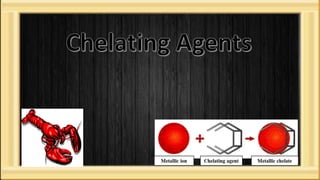
Derived from Greek “Chele = Claws”
Chelation:- The process of an equilibrium reaction between a metal
ion & complexing agent what produce a stable, Non-ionized, Non-
toxic and water soluble complex which can be eliminated easily
Two or more reactive groups (ligands)
which can hold the metal from at least two sides so that a ring is formed
 Have two or more electronegative groups that forms stable
covalent bonds with the cationic metals
Chelating agents compete with body
Ligands for the heavy metals
 Clinical useful Chelating agents Affinity:-
↑↑ Affinity- Toxic metal
↓ ↓ Affinity- Calcium, body ligands
More affinity for metals than endogenous ligands
High solubility in water
Resistance to Biotransformation
Form non-toxic complex's with toxic metal
Cheap & easy to administered
Low affinity for Calcium
Easy excretion of chelating complex
Heavy metals
Cu,Fe,Mn,Pb
,Ca
Stable compound
Non-ionized , Non-metabolized
Non toxic
Water soluble
Chelating agents
Forming ring structure
Eliminated Via Kidney
Dimercaprol (BAL) & derivatives
EDTA derivatives -Disodium edetate, Calcium disodium edetate
 Calcium disodium DTPA (Diethylene triamine penta acetic acid)
Penicillamine
Desferrioxamine
Deferiprone
It is an oily, pungent smelling, viscous liquid
 Developed by Britisher during World War II as an Antidote for arsenic
containing war gases such as Lewisite
 Also called as British Anti-lewisite or BAL
 (-SH) group of BAL responsible for Chelation
 Analogue- 1.DMSA- (2,3 dimarcaptosuccinic acid )/ Succimer
2.DMPS-(2,3-Dimercapto-1-propanesulfonic acid)/ Unithiol
Mechanism:-
Form poorly dissociable complex with metal ions
Protect the SH enzymes
Prevent inhibition of enzyme
Pharmacokinetics:-
Can’t be given orally
Given by deep IM injection
t1/2-Short Peak plasma level in 1/2hrs -1 hr( IM)
Metabolized –liver glucuronide conjugated
 Excretion-As via urine (4-6hr)
Uses:-
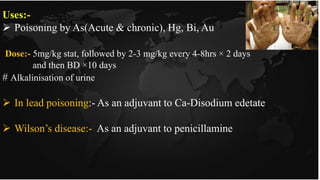
 Poisoning by As(Acute & chronic), Hg, Bi, Au
Dose:- 5mg/kg stat, followed by 2-3 mg/kg every 4-8hrs × 2 days
and then BD ×10 days
# Alkalinisation of urine
 In lead poisoning:- As an adjuvant to Ca-Disodium edetate
 Wilson’s disease:- As an adjuvant to penicillamine
 Tachycardia, Hypertension
 Injection is painful and Chances of sterile abscess
 Allergic reaction
 Nausea, vomiting, headache
 Lacrimation, Conjuctivitis, Blepharospasm
 Sialorrhoea, muscle pain
(Antihistaminic given 30 min before injection )
Contraindication:-
 Iron & Cadmium poisoning
Water soluble analogue of dimercaprol
Advantage:-
- Less toxic
- orally effective
 Use- DOC for As,
 Also Hg, Pb poisoning.
 SE- Nausea, loose motion, Anorexia
2,3-Dimercapto-1-propane-sulfonic acid
Water soluble analogue
Used orally and IV
Used in severe acute poisoning with As and Hg(Mercary)
IV-DMPS better efficacy over orally Succimer & IM-dimercaprol
Side effect-
Skin reaction
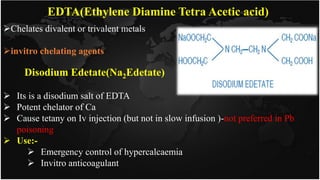
EDTA(Ethylene Diamine Tetra Acetic acid)
Chelates divalent or trivalent metals
invitro chelating agents
 Its is a disodium salt of EDTA
 Potent chelator of Ca
 Cause tetany on Iv injection (but not in slow infusion )-not preferred in Pb
poisoning
 Use:-
 Emergency control of hypercalcaemia
 Invitro anticoagulant
Disodium Edetate(Na2Edetate)
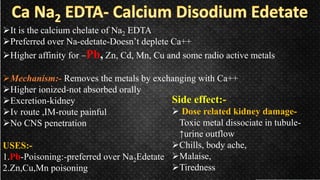
It is the calcium chelate of Na2 EDTA
Preferred over Na-edetate-Doesn’t deplete Ca++
Higher affinity for –Pb, Zn, Cd, Mn, Cu and some radio active metals
Mechanism:- Removes the metals by exchanging with Ca++
Higher ionized-not absorbed orally
Excretion-kidney
Iv route ,IM-route painful
No CNS penetration
USES:-
1.Pb-Poisoning:-preferred over Na2Edetate
2.Zn,Cu,Mn poisoning
Side effect:-
 Dose related kidney damage-
Toxic metal dissociate in tubule-
↑urine outflow
Chills, body ache,
Malaise,
Tiredness
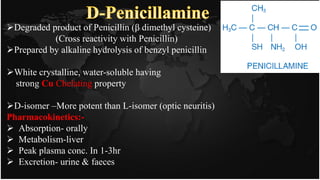
Degraded product of Penicillin (β dimethyl cysteine)
(Cross reactivity with Penicillin)
Prepared by alkaline hydrolysis of benzyl penicillin
White crystalline, water-soluble having
strong Cu Chelating property
D-isomer –More potent than L-isomer (optic neuritis)
Pharmacokinetics:-
 Absorption- orally
 Metabolism-liver
 Peak plasma conc. In 1-3hr
 Excretion- urine & faeces
USES:-
-Wilson’s disease-
 An autosomal recessive disorder
 Deficiency of Ceruloplasmin, major Cu transport protein
 Absence of ceruloplasmin- Positive copper balance
 Cu deposition – liver, Substantia nigra, basal ganglia of brain
Rx-
-Cu-poisoning- DOC
-Hg poisoning- alternative drug to dimercaprol
-Cystinuria & cystine stones: It promotes the excretion of cysteine and prevents
its precipitation
-Scleroderma:- Penicillamine benefits by increasing soluble collagen
General toxicities:-
Headache, rash, fever, lymphadenopathy, dysguesia
Hematological toxicities
Aplastic anemia, agranulocytosis, thrombocytopenia
Autoimmune syndrome
Good pasture's Syndrome, Myasthenia Gravis
Others
Drug fever, polyarthritis, exfoliative dermatitis
Trientene:- Less potent but safer then d-penicillamine
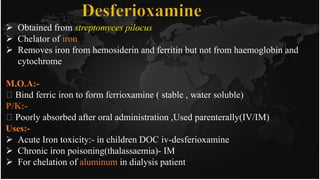
 Obtained from streptomyces pilocus
 Chelator of iron
 Removes iron from hemosiderin and ferritin but not from haemoglobin and
cytochrome
M.O.A:-
Bind ferric iron to form ferrioxamine ( stable , water soluble)
P/K:-
Poorly absorbed after oral administration ,Used parenterally(IV/IM)
Uses:-
 Acute Iron toxicity:- in children DOC iv-desferioxamine
 Chronic iron poisoning(thalassaemia)- IM
 For chelation of aluminum in dialysis patient
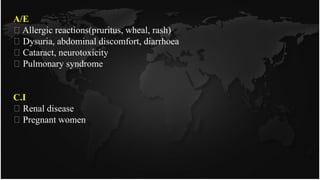
A/E
Allergic reactions(pruritus, wheal, rash)
Dysuria, abdominal discomfort, diarrhoea
Cataract, neurotoxicity
Pulmonary syndrome
C.I
Renal disease
Pregnant women
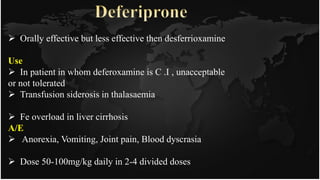
 Orally effective but less effective then desferrioxamine
Use
 In patient in whom deferoxamine is C .I , unacceptable
or not tolerated
 Transfusion siderosis in thalasaemia
 Fe overload in liver cirrhosis
A/E
 Anorexia, Vomiting, Joint pain, Blood dyscrasia
 Dose 50-100mg/kg daily in 2-4 divided doses
Kkk
Drug Route of
Administrat
ion
Affinity for Uses C/I
BAL IM As As,Bi,Pb,Hg poisoning Fe,Cd
Na2Edetate I.v. Ca -Hypercalcemia
-an invitro anticoagulant
-
CaNa2Edetate Iv infusion Pb Pb,Zn, Mn, poisoning Hg poisoning
d-penicillamine Oral Cu -Wilson disease (Cu-
poisoning)
-Sceleroderma
-Cystinuria
desferioxamine IV,IM Fe Acute & chronic Fe poisoning Pregnancy,
Renal
insufficiency
Deferiprone Oral Fe Transfusion siderosis in
thalasaemia
Chelating agents

Chelating agents

  • 2.
    Heavy metals 80 metalsin periodic table They have corrosive & astringent properties Acts as a protoplasmic poison by inhibiting essential enzyme Ability to form complexes with important biological radical like hydroxyl,Carboxyl,Keto,Sulfhydryl,disulphide,Amino, phosphate etc.  Heavy metal poisoning is not uncommon  Commonly implicated metals include- Pb, Hg, As,Cd
  • 3.
    Drugs used toprevent heavy metal poisoning Derived from Greek “Chele = Claws” Chelation:- The process of an equilibrium reaction between a metal ion & complexing agent what produce a stable, Non-ionized, Non- toxic and water soluble complex which can be eliminated easily Two or more reactive groups (ligands) which can hold the metal from at least two sides so that a ring is formed
  • 4.
     Have twoor more electronegative groups that forms stable covalent bonds with the cationic metals Chelating agents compete with body Ligands for the heavy metals  Clinical useful Chelating agents Affinity:- ↑↑ Affinity- Toxic metal ↓ ↓ Affinity- Calcium, body ligands
  • 5.
    More affinity formetals than endogenous ligands High solubility in water Resistance to Biotransformation Form non-toxic complex's with toxic metal Cheap & easy to administered Low affinity for Calcium Easy excretion of chelating complex
  • 6.
    Heavy metals Cu,Fe,Mn,Pb ,Ca Stable compound Non-ionized, Non-metabolized Non toxic Water soluble Chelating agents Forming ring structure Eliminated Via Kidney
  • 7.
    Dimercaprol (BAL) &derivatives EDTA derivatives -Disodium edetate, Calcium disodium edetate  Calcium disodium DTPA (Diethylene triamine penta acetic acid) Penicillamine Desferrioxamine Deferiprone
  • 8.
    It is anoily, pungent smelling, viscous liquid  Developed by Britisher during World War II as an Antidote for arsenic containing war gases such as Lewisite  Also called as British Anti-lewisite or BAL  (-SH) group of BAL responsible for Chelation  Analogue- 1.DMSA- (2,3 dimarcaptosuccinic acid )/ Succimer 2.DMPS-(2,3-Dimercapto-1-propanesulfonic acid)/ Unithiol
  • 9.
    Mechanism:- Form poorly dissociablecomplex with metal ions Protect the SH enzymes Prevent inhibition of enzyme Pharmacokinetics:- Can’t be given orally Given by deep IM injection t1/2-Short Peak plasma level in 1/2hrs -1 hr( IM) Metabolized –liver glucuronide conjugated  Excretion-As via urine (4-6hr)
  • 10.
    Uses:-  Poisoning byAs(Acute & chronic), Hg, Bi, Au Dose:- 5mg/kg stat, followed by 2-3 mg/kg every 4-8hrs × 2 days and then BD ×10 days # Alkalinisation of urine  In lead poisoning:- As an adjuvant to Ca-Disodium edetate  Wilson’s disease:- As an adjuvant to penicillamine
  • 11.
     Tachycardia, Hypertension Injection is painful and Chances of sterile abscess  Allergic reaction  Nausea, vomiting, headache  Lacrimation, Conjuctivitis, Blepharospasm  Sialorrhoea, muscle pain (Antihistaminic given 30 min before injection ) Contraindication:-  Iron & Cadmium poisoning
  • 12.
    Water soluble analogueof dimercaprol Advantage:- - Less toxic - orally effective  Use- DOC for As,  Also Hg, Pb poisoning.  SE- Nausea, loose motion, Anorexia
  • 13.
    2,3-Dimercapto-1-propane-sulfonic acid Water solubleanalogue Used orally and IV Used in severe acute poisoning with As and Hg(Mercary) IV-DMPS better efficacy over orally Succimer & IM-dimercaprol Side effect- Skin reaction
  • 14.
    EDTA(Ethylene Diamine TetraAcetic acid) Chelates divalent or trivalent metals invitro chelating agents  Its is a disodium salt of EDTA  Potent chelator of Ca  Cause tetany on Iv injection (but not in slow infusion )-not preferred in Pb poisoning  Use:-  Emergency control of hypercalcaemia  Invitro anticoagulant Disodium Edetate(Na2Edetate)
  • 15.
    It is thecalcium chelate of Na2 EDTA Preferred over Na-edetate-Doesn’t deplete Ca++ Higher affinity for –Pb, Zn, Cd, Mn, Cu and some radio active metals Mechanism:- Removes the metals by exchanging with Ca++ Higher ionized-not absorbed orally Excretion-kidney Iv route ,IM-route painful No CNS penetration USES:- 1.Pb-Poisoning:-preferred over Na2Edetate 2.Zn,Cu,Mn poisoning Side effect:-  Dose related kidney damage- Toxic metal dissociate in tubule- ↑urine outflow Chills, body ache, Malaise, Tiredness
  • 16.
    Degraded product ofPenicillin (β dimethyl cysteine) (Cross reactivity with Penicillin) Prepared by alkaline hydrolysis of benzyl penicillin White crystalline, water-soluble having strong Cu Chelating property D-isomer –More potent than L-isomer (optic neuritis) Pharmacokinetics:-  Absorption- orally  Metabolism-liver  Peak plasma conc. In 1-3hr  Excretion- urine & faeces
  • 17.
    USES:- -Wilson’s disease-  Anautosomal recessive disorder  Deficiency of Ceruloplasmin, major Cu transport protein  Absence of ceruloplasmin- Positive copper balance  Cu deposition – liver, Substantia nigra, basal ganglia of brain Rx- -Cu-poisoning- DOC -Hg poisoning- alternative drug to dimercaprol -Cystinuria & cystine stones: It promotes the excretion of cysteine and prevents its precipitation -Scleroderma:- Penicillamine benefits by increasing soluble collagen
  • 18.
    General toxicities:- Headache, rash,fever, lymphadenopathy, dysguesia Hematological toxicities Aplastic anemia, agranulocytosis, thrombocytopenia Autoimmune syndrome Good pasture's Syndrome, Myasthenia Gravis Others Drug fever, polyarthritis, exfoliative dermatitis Trientene:- Less potent but safer then d-penicillamine
  • 19.
     Obtained fromstreptomyces pilocus  Chelator of iron  Removes iron from hemosiderin and ferritin but not from haemoglobin and cytochrome M.O.A:- Bind ferric iron to form ferrioxamine ( stable , water soluble) P/K:- Poorly absorbed after oral administration ,Used parenterally(IV/IM) Uses:-  Acute Iron toxicity:- in children DOC iv-desferioxamine  Chronic iron poisoning(thalassaemia)- IM  For chelation of aluminum in dialysis patient
  • 20.
    A/E Allergic reactions(pruritus, wheal,rash) Dysuria, abdominal discomfort, diarrhoea Cataract, neurotoxicity Pulmonary syndrome C.I Renal disease Pregnant women
  • 21.
     Orally effectivebut less effective then desferrioxamine Use  In patient in whom deferoxamine is C .I , unacceptable or not tolerated  Transfusion siderosis in thalasaemia  Fe overload in liver cirrhosis A/E  Anorexia, Vomiting, Joint pain, Blood dyscrasia  Dose 50-100mg/kg daily in 2-4 divided doses
  • 22.
    Kkk Drug Route of Administrat ion Affinityfor Uses C/I BAL IM As As,Bi,Pb,Hg poisoning Fe,Cd Na2Edetate I.v. Ca -Hypercalcemia -an invitro anticoagulant - CaNa2Edetate Iv infusion Pb Pb,Zn, Mn, poisoning Hg poisoning d-penicillamine Oral Cu -Wilson disease (Cu- poisoning) -Sceleroderma -Cystinuria desferioxamine IV,IM Fe Acute & chronic Fe poisoning Pregnancy, Renal insufficiency Deferiprone Oral Fe Transfusion siderosis in thalasaemia

Editor's Notes

  • #15 Bisphosphonate is the preferred drug in It can be used for emergency control of hypercalcaemia -Chelates extracellular metal ions more than intracellular ions-poor penetration to cell membrane hence