CHELATING
AGENTS
DR GEETHA
DEFINITION
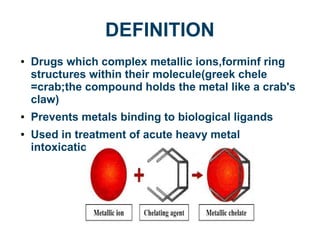
ā— Drugs which complex metallic ions,forminf ring
structures within their molecule(greek chele
=crab;the compound holds the metal like a crab's
claw)
ā— Prevents metals binding to biological ligands
ā— Used in treatment of acute heavy metal
intoxications
PROPERTIES OF IDEAL
CHELATOR
ā— Ability to reach sites of metal storage and form
stable and non toxic complexes with toxic metals
and should be readily excreted
ā— A low affinity for essential metals like calcium and
zinc also is desirable,because they often act
through competition with these metals
ā— High solubility in water and resistance to bio
transformation
ā— They have atleast two reactive groups(ligands)
which hold the metal from atleast two sides so that
a ring is formed.(5-7 membered ring is most
stable)
DISADVANTAGES
ā— Not useful in chronic exposure ,may increase the
neurotoxic effects
Useful CHELATING AGENTS
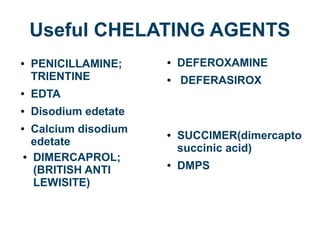
ā— PENICILLAMINE;
TRIENTINE
ā— EDTA
ā— Disodium edetate
ā— Calcium disodium
edetate
ā— DEFEROXAMINE
ā— DEFERASIROX
ā— SUCCIMER(dimercapto
succinic acid)
ā— DMPS
ā— DIMERCAPROL;
(BRITISH ANTI
LEWISITE)
PENICILLAMINE
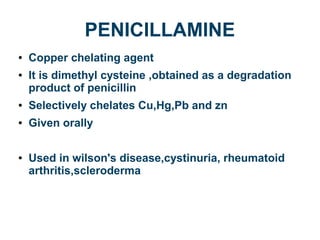
ā— Copper chelating agent
ā— It is dimethyl cysteine ,obtained as a degradation
product of penicillin
ā— Selectively chelates Cu,Hg,Pb and zn
ā— Given orally
ā— Used in wilson's disease,cystinuria, rheumatoid
arthritis,scleroderma
ABSORPTION AND
EXCRETION:-
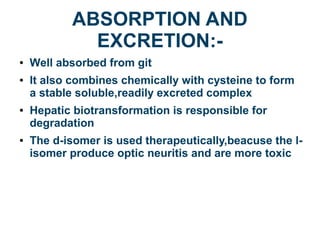
ā— Well absorbed from git
ā— It also combines chemically with cysteine to form
a stable soluble,readily excreted complex
ā— Hepatic biotransformation is responsible for
degradation
ā— The d-isomer is used therapeutically,beacuse the l-
isomer produce optic neuritis and are more toxic
TOXICITY
ā— Long term use induces cutaneous lesions and
myasthenia gravis
ā— Leukopenia,aplastic anemia,agranulocytosis
ā— Renal toxicity is seen
ā— CONTRAINDICATIONS
ā— Pregnancy
ā— Renal insufficiency
ā— H/o of agranulocytosis
TRIENTINE(trietheylenetetrami
ne dihydrochloride)
ā— Acceptable alternative to penicillamine and orally
effective
ā— Its cupriuretic agent in patients with wilson's
disease
SIDE EFFECTS:-
ā— Iron deficiency
DESFEROXAMINE
ā— It has high affinity for ferric ironand very low
affinity for calcium and is given parenterally
ā— 1g is capable of chelating 85mg of elemental iron
ā— For severe iron toxicity ,IV route is preferred
ā— For chronic iron intoxication,transfusion siderosis
(thalassemia) IM is preffered
ā— Also used to chelate aluminuim in dialysis patients
ā— Its metobolised by plasma enzymes and excreted
readily in urine
ā— Used in acute iron poisioning :mostly in children
ADVERSE EFFECTS:
ā— Desferroxamine can
cause histamine
release = fall in
bp,flushing,itching,urti
caria,rash
CONTRAINDICATIONS:
-
ā— RENAL INSUFFIENCY
DEFERIPRONE
ā— Orally active iron chelator which simplified the
treatment of transfusion siderosis in thalasemia
patients
ā— Excessive hemolysis occurs in these patients ,so
they should be given repeated blood transfusions
=iron overload
ā— Oral deferiprone is less effective compared to
injected desferroxamine but has less side effects
ā— Indicate din acute iron poisioning and for iron
overload in liver cirrhosis
ā— SIDE EFFECTS:anorexia,vomiting,altered
taste,reversible neutropenia
EDTA (Ethylene diamine tetra
acetic acid)
ā— Available as edetate calcium disodium used in
acute lead intoxication along with dimercaprol
Mechanism of action :-
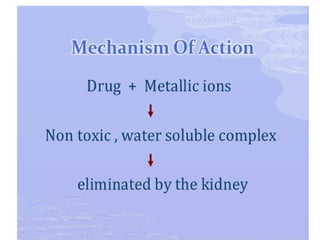
ā— Metal ions with higher affinity than calcium will be
chelated,mobilzed and usually excreted
ā— Charged at physiological pH,so doesn't penetrate
cells,<5% is absorbed from git
ā— Its highly ionized ,therefore distributed only
extracellularly
ā— Administered intravenously,
ā— Excreted in urine through glomerular filtration
EDTA
Toxicity :-
ā— Nephrotoxic causes
proximal tubular
necrosis
ā— Rapid IV administration
causes hypocalcemic
tetany
Side effects:-
ā— Malaise,chills body
aches
ā— Fatigue
ā— Excessive thirst
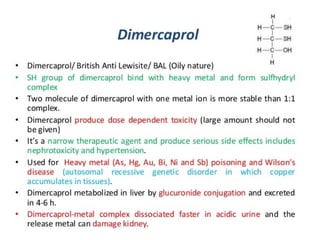
BAL
Mechanism of action :-
ā—
Bal forms complexes between two sulfhydryl
groups and metals and delivered to kidneys and is
toxic to kidneys
ā—
Its dissociates in acidic urine and metal is
released in kidneys,so urine is alkanized during
dimercaprol therapy
BAL
ā— It limits toxicity from
arsenic,gold,mercury
ā— Given as deep IM in
peanut oil
Toxicity:-
ā— Rise in bp
accompanied with
tachycardia &returns to
normal in 2hrs
ā— Not used in chronic
exposures to heavy
metals because it
doesnot prevent
neurotoxic effects
SUCCIMER
(2,3 dimercapto succinic acid-
DMSA)
ā— Orally effective chelator against lead
ā— Its water soluble and doesn't mobilise metals to
brain
ā— Doesn't significantly chelate essential metals ,so
has better toxicity profile
MECHANISM OF ACTION:-
ā— Forms complex with lead,succimer-lead chelate is
eliminated both in urine and bile through entero
hepatic circulation
Side effects:-
ā— Nausea,vomiting,diarhhoea and loss of appetite
ā— In USA ,Succimer is approved for treatment of
children with blood levels >45 mcg/dl
ā— Not used in India
DMPS
ā— Approved only in germany
ā— Chelator of lead,arsenic and especially mercury
ā—
Thank you
Chelating agents -pharmacology

Chelating agents -pharmacology

  • 1.
  • 2.
    DEFINITION ā— Drugs whichcomplex metallic ions,forminf ring structures within their molecule(greek chele =crab;the compound holds the metal like a crab's claw) ā— Prevents metals binding to biological ligands ā— Used in treatment of acute heavy metal intoxications
  • 3.
    PROPERTIES OF IDEAL CHELATOR ā—Ability to reach sites of metal storage and form stable and non toxic complexes with toxic metals and should be readily excreted ā— A low affinity for essential metals like calcium and zinc also is desirable,because they often act through competition with these metals ā— High solubility in water and resistance to bio transformation ā— They have atleast two reactive groups(ligands) which hold the metal from atleast two sides so that a ring is formed.(5-7 membered ring is most stable)
  • 5.
    DISADVANTAGES ā— Not usefulin chronic exposure ,may increase the neurotoxic effects
  • 6.
    Useful CHELATING AGENTS ā—PENICILLAMINE; TRIENTINE ā— EDTA ā— Disodium edetate ā— Calcium disodium edetate ā— DEFEROXAMINE ā— DEFERASIROX ā— SUCCIMER(dimercapto succinic acid) ā— DMPS ā— DIMERCAPROL; (BRITISH ANTI LEWISITE)
  • 7.
    PENICILLAMINE ā— Copper chelatingagent ā— It is dimethyl cysteine ,obtained as a degradation product of penicillin ā— Selectively chelates Cu,Hg,Pb and zn ā— Given orally ā— Used in wilson's disease,cystinuria, rheumatoid arthritis,scleroderma
  • 8.
    ABSORPTION AND EXCRETION:- ā— Wellabsorbed from git ā— It also combines chemically with cysteine to form a stable soluble,readily excreted complex ā— Hepatic biotransformation is responsible for degradation ā— The d-isomer is used therapeutically,beacuse the l- isomer produce optic neuritis and are more toxic
  • 9.
    TOXICITY ā— Long termuse induces cutaneous lesions and myasthenia gravis ā— Leukopenia,aplastic anemia,agranulocytosis ā— Renal toxicity is seen ā— CONTRAINDICATIONS ā— Pregnancy ā— Renal insufficiency ā— H/o of agranulocytosis
  • 10.
    TRIENTINE(trietheylenetetrami ne dihydrochloride) ā— Acceptablealternative to penicillamine and orally effective ā— Its cupriuretic agent in patients with wilson's disease SIDE EFFECTS:- ā— Iron deficiency
  • 11.
    DESFEROXAMINE ā— It hashigh affinity for ferric ironand very low affinity for calcium and is given parenterally ā— 1g is capable of chelating 85mg of elemental iron ā— For severe iron toxicity ,IV route is preferred ā— For chronic iron intoxication,transfusion siderosis (thalassemia) IM is preffered ā— Also used to chelate aluminuim in dialysis patients ā— Its metobolised by plasma enzymes and excreted readily in urine ā— Used in acute iron poisioning :mostly in children
  • 12.
    ADVERSE EFFECTS: ā— Desferroxaminecan cause histamine release = fall in bp,flushing,itching,urti caria,rash CONTRAINDICATIONS: - ā— RENAL INSUFFIENCY
  • 13.
    DEFERIPRONE ā— Orally activeiron chelator which simplified the treatment of transfusion siderosis in thalasemia patients ā— Excessive hemolysis occurs in these patients ,so they should be given repeated blood transfusions =iron overload ā— Oral deferiprone is less effective compared to injected desferroxamine but has less side effects ā— Indicate din acute iron poisioning and for iron overload in liver cirrhosis ā— SIDE EFFECTS:anorexia,vomiting,altered taste,reversible neutropenia
  • 14.
    EDTA (Ethylene diaminetetra acetic acid) ā— Available as edetate calcium disodium used in acute lead intoxication along with dimercaprol Mechanism of action :- ā— Metal ions with higher affinity than calcium will be chelated,mobilzed and usually excreted ā— Charged at physiological pH,so doesn't penetrate cells,<5% is absorbed from git ā— Its highly ionized ,therefore distributed only extracellularly ā— Administered intravenously, ā— Excreted in urine through glomerular filtration
  • 15.
    EDTA Toxicity :- ā— Nephrotoxiccauses proximal tubular necrosis ā— Rapid IV administration causes hypocalcemic tetany Side effects:- ā— Malaise,chills body aches ā— Fatigue ā— Excessive thirst
  • 17.
    BAL Mechanism of action:- ā— Bal forms complexes between two sulfhydryl groups and metals and delivered to kidneys and is toxic to kidneys ā— Its dissociates in acidic urine and metal is released in kidneys,so urine is alkanized during dimercaprol therapy
  • 18.
    BAL ā— It limitstoxicity from arsenic,gold,mercury ā— Given as deep IM in peanut oil Toxicity:- ā— Rise in bp accompanied with tachycardia &returns to normal in 2hrs ā— Not used in chronic exposures to heavy metals because it doesnot prevent neurotoxic effects
  • 19.
    SUCCIMER (2,3 dimercapto succinicacid- DMSA) ā— Orally effective chelator against lead ā— Its water soluble and doesn't mobilise metals to brain ā— Doesn't significantly chelate essential metals ,so has better toxicity profile MECHANISM OF ACTION:- ā— Forms complex with lead,succimer-lead chelate is eliminated both in urine and bile through entero hepatic circulation
  • 20.
    Side effects:- ā— Nausea,vomiting,diarhhoeaand loss of appetite ā— In USA ,Succimer is approved for treatment of children with blood levels >45 mcg/dl ā— Not used in India
  • 21.
    DMPS ā— Approved onlyin germany ā— Chelator of lead,arsenic and especially mercury
  • 22.