CHELATING
AGENTS
By:
Dr Rishitha Krishna
CHELATING AGENTS
 These are the drugs used to prevent heavy metal
poisoning.
 Chelation: The process of an equilibrium reaction between
a metal ion and complexing agent which produces a
stable, non-ionized, non-toxic and water soluble complex
which can be eliminated easily.
 These compounds are usually flexible organic molecules
which can incorporate metal ions into their molecular
structure by means of chemical groups called ligands.
MECHANISM OF ACTION
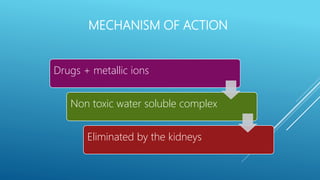
Drugs + metallic ions
Non toxic water soluble complex
Eliminated by the kidneys
IDEAL CHELATING AGENT
 More affinity for metal than endogenous ligands.
 High solubility in water.
 Resistance to bio transformation.
 Form non toxic complexes with toxic metals.
 Accelerate mobilization and/or removal of the metals.
 Cheap and easy to administrate.
 Easy excretion of chelating complex.
COMMON CHELATING AGENTS USED
 Dimercaprol (BAL)
 Dimercaptosuccinic Acid (DMSA)
 Dimercaptopropane Sulfonic Acid (DMPS)
 Disodium edetate (EDTA)
 Calcium disodium edetate
 Penicillamine
 Desferrioxamine & Deferiprone
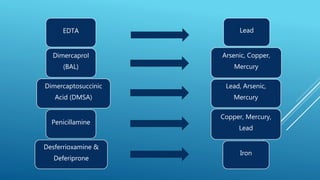
EDTA
Dimercaprol
(BAL)
Dimercaptosuccinic
Acid (DMSA)
Penicillamine
Desferrioxamine &
Deferiprone
Lead
Arsenic, Copper,
Mercury
Lead, Arsenic,
Mercury
Copper, Mercury,
Lead
Iron
DIMERCAPROL (BAL)
 Synthesised during the World War II by Britisher’s as an antidote to
arsenic war gas Lewisite.
 oily, pungent smelling, viscous fluid.
 Route of administration – i.m in oil (arachis oil)
 SH ligands of dimercaprol compete with – SH groups of enzymes
for heavy metal.
 Excess of dimercaprol should be maintained in plasma.
 Dimercaprol-metal complex is stable and excreted in urine.
USES
For the treatment of arsenic and mercury
poisoning.
As an adjuvant to calcium disodium edetate in
lead poisoning.
As an adjuvant to penicillamine in copper
poisoning and in Wilson’s disease.
Contraindicated in iron and cadmium poisoning.
DMPS (UNITHIOL)
Dimercaprol analogue
 water soluble, less toxic.
 Can be administrated orally as well as IV.
 Used for severe acute poisoning by mercury and
arsenic.
 Also effective in the treatment of lead poisoning.
 Adverse effects are low, except for mild self-limiting
urticaria.
DISODIUM EDETATE (EDTA)
It is a disodium salt of EDTA.
Potent chelator of calcium.
Causes tetany on IV injection (but not on slow
infusion)
Can be used for emergency control of
hypercalcemia (rare) 50 mg per kg IV over 2-4
hours.
CALCIUM DISODIUM EDETATE
 Calcium chelator of Disodium edetate.
 Has a high affinity for lead.
 Most important use in lead poisoning.
 Poorly absorbed from GI.
 IM is very painful – IV preferred.
 Not metabolised.
 Excreted by glomerular filtration and tubular secretion.
PENICILLAMINE
Dimethyl cysteine
 water soluble degradation product of penicillin.
 D-isomer is used – relatively non toxic compared to I-
isomer.
 Easily absorbed in GIT.
 Little metabolised, excreted in urine and faeces.
 It has strong copper chelating property and was used in
1956 for Wilson’s disease.
 It selectively chelates copper, mercury, lead and zinc.
USES
Wilson’s Disease (Hepato-lenticular degeneration)
 Copper/Mercury poisoning.
 Adjuvant to calcium disodium edetate in lead poisoning
but DMSA is preferred.
 Cystinuria and cysteine stones.
 Scleroderma – benefits by increasing the soluble collagen.
 Used as a Disease Modifying Drug in Rheumatoid Arthiritis
but now replaced by safer drug.
DESFERRIOXAMINE
 Ferrioxamine obtained from actinomycete, long chain iron
containing complex.
 Chemical removal of iron from it yields desferrioxamine.
 1 gm is capable of chelating 85 mg of elemental iron.
 Low affinity for calcium.
 Parenterally – partially metabolised, rapidly excreted in
urine.
 Acute iron poisoning : mostly in children, important and
life saving.
DEFERIPRONE
Orally active.
Used in transfusion siderosis.
Also indicated in iron poisoning and iron load in
liver cirrhosis.
CONCLUSION
Primary goals of chelating therapy:
To reduce metal retention.
To decrease morbidity and mortality.
To prevent complications.
Administer less toxic chelator when possible.
Chelating agents

Chelating agents

  • 1.
  • 2.
    CHELATING AGENTS  Theseare the drugs used to prevent heavy metal poisoning.  Chelation: The process of an equilibrium reaction between a metal ion and complexing agent which produces a stable, non-ionized, non-toxic and water soluble complex which can be eliminated easily.  These compounds are usually flexible organic molecules which can incorporate metal ions into their molecular structure by means of chemical groups called ligands.
  • 3.
    MECHANISM OF ACTION Drugs+ metallic ions Non toxic water soluble complex Eliminated by the kidneys
  • 4.
    IDEAL CHELATING AGENT More affinity for metal than endogenous ligands.  High solubility in water.  Resistance to bio transformation.  Form non toxic complexes with toxic metals.  Accelerate mobilization and/or removal of the metals.  Cheap and easy to administrate.  Easy excretion of chelating complex.
  • 5.
    COMMON CHELATING AGENTSUSED  Dimercaprol (BAL)  Dimercaptosuccinic Acid (DMSA)  Dimercaptopropane Sulfonic Acid (DMPS)  Disodium edetate (EDTA)  Calcium disodium edetate  Penicillamine  Desferrioxamine & Deferiprone
  • 6.
  • 7.
    DIMERCAPROL (BAL)  Synthesisedduring the World War II by Britisher’s as an antidote to arsenic war gas Lewisite.  oily, pungent smelling, viscous fluid.  Route of administration – i.m in oil (arachis oil)  SH ligands of dimercaprol compete with – SH groups of enzymes for heavy metal.  Excess of dimercaprol should be maintained in plasma.  Dimercaprol-metal complex is stable and excreted in urine.
  • 8.
    USES For the treatmentof arsenic and mercury poisoning. As an adjuvant to calcium disodium edetate in lead poisoning. As an adjuvant to penicillamine in copper poisoning and in Wilson’s disease. Contraindicated in iron and cadmium poisoning.
  • 9.
    DMPS (UNITHIOL) Dimercaprol analogue water soluble, less toxic.  Can be administrated orally as well as IV.  Used for severe acute poisoning by mercury and arsenic.  Also effective in the treatment of lead poisoning.  Adverse effects are low, except for mild self-limiting urticaria.
  • 10.
    DISODIUM EDETATE (EDTA) Itis a disodium salt of EDTA. Potent chelator of calcium. Causes tetany on IV injection (but not on slow infusion) Can be used for emergency control of hypercalcemia (rare) 50 mg per kg IV over 2-4 hours.
  • 11.
    CALCIUM DISODIUM EDETATE Calcium chelator of Disodium edetate.  Has a high affinity for lead.  Most important use in lead poisoning.  Poorly absorbed from GI.  IM is very painful – IV preferred.  Not metabolised.  Excreted by glomerular filtration and tubular secretion.
  • 12.
    PENICILLAMINE Dimethyl cysteine  watersoluble degradation product of penicillin.  D-isomer is used – relatively non toxic compared to I- isomer.  Easily absorbed in GIT.  Little metabolised, excreted in urine and faeces.  It has strong copper chelating property and was used in 1956 for Wilson’s disease.  It selectively chelates copper, mercury, lead and zinc.
  • 13.
    USES Wilson’s Disease (Hepato-lenticulardegeneration)  Copper/Mercury poisoning.  Adjuvant to calcium disodium edetate in lead poisoning but DMSA is preferred.  Cystinuria and cysteine stones.  Scleroderma – benefits by increasing the soluble collagen.  Used as a Disease Modifying Drug in Rheumatoid Arthiritis but now replaced by safer drug.
  • 14.
    DESFERRIOXAMINE  Ferrioxamine obtainedfrom actinomycete, long chain iron containing complex.  Chemical removal of iron from it yields desferrioxamine.  1 gm is capable of chelating 85 mg of elemental iron.  Low affinity for calcium.  Parenterally – partially metabolised, rapidly excreted in urine.  Acute iron poisoning : mostly in children, important and life saving.
  • 15.
    DEFERIPRONE Orally active. Used intransfusion siderosis. Also indicated in iron poisoning and iron load in liver cirrhosis.
  • 16.
    CONCLUSION Primary goals ofchelating therapy: To reduce metal retention. To decrease morbidity and mortality. To prevent complications. Administer less toxic chelator when possible.