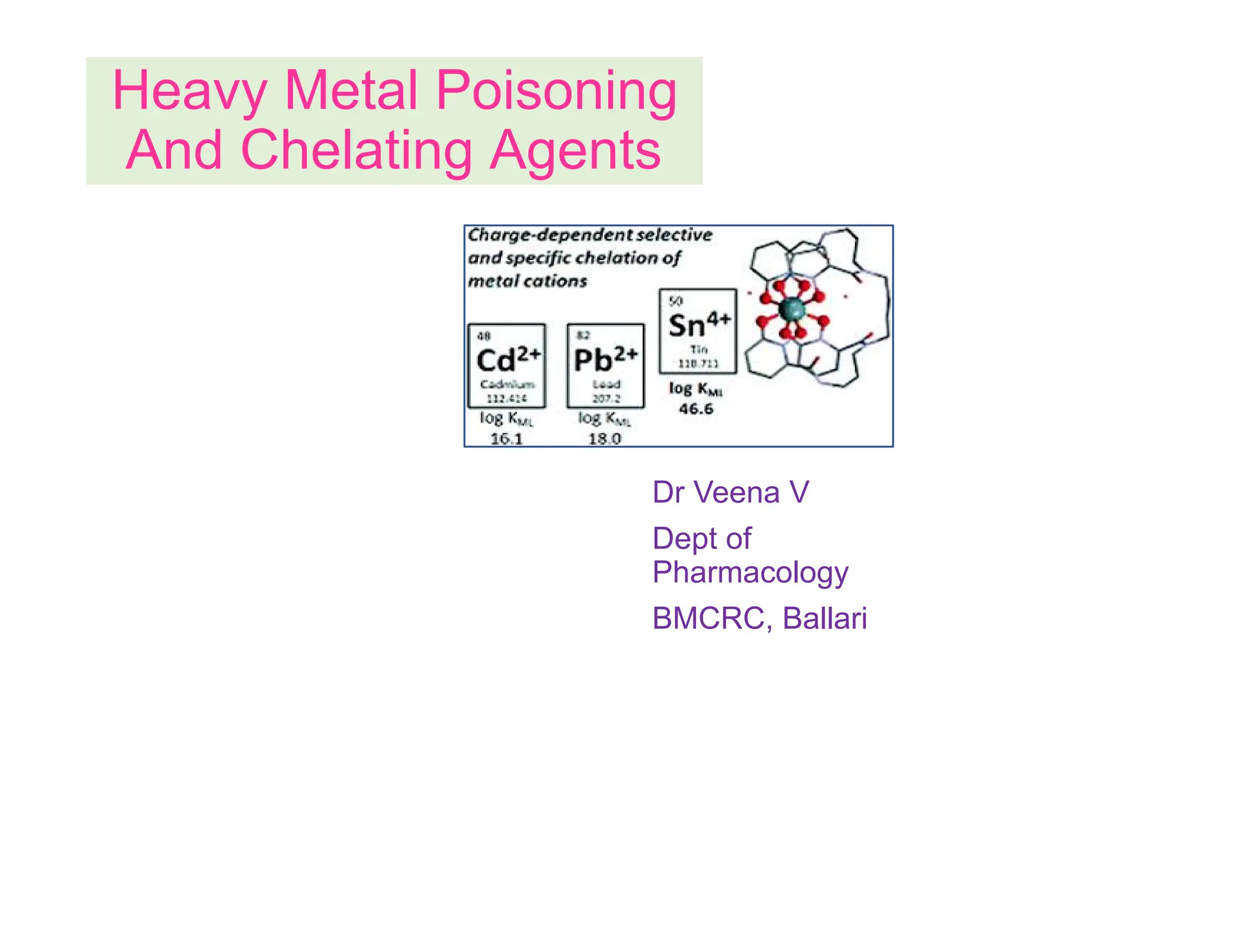
Heavy Metal Poisoning
And Chelating Agents
Dr Veena V
Dept of
Pharmacology
BMCRC, Ballari
INTRODUC
TION
Toxicology deals with toxic effects of drugs & various chemicals in
use
Chemicals : Air pollutants, Environmental pollutants, Agricultural
pollutants, Industrial solvents & Heavy metals
Heavy metals: Pb, Cu, Hg, Fe, As etc
Poisoning can be suicidal, homicidal, accidental or occupational
Specific antidotes are for heavy metals, OP compounds, Methyl
alc & Cyanides
General measures in Treatment of
Poisoning
1) Provide support for Vital functions (ABC)
2) Symptomatic
3) Specific antidote
4) Decontaminate skin, eyes & GIT
• Thorough washing of affected parts with soap/ shampoo & lukewarm
water
• Flush eyes with saline or water along with LA drops
• GIT: a) Emesis –Ipecac syrup (30ml in 250ml of water within 30 min
of ingestion)
Avoid it in corrosives, petroleum products, strychnine
poisoning
& in unconscious and convulsing pts
b) Gastric lavage
c) Cathartics : 10% MgSO4 or 70% Sorbitol
d) Whole bowel irrigation: PEG( Polyethylene Glycol)
e) Activated Charcoal: Adsorbs almost all poisons & drugs
Avoid in (I LAC): Iron, Lithium, Alc, Corrosives or Cyanide
poisoning
Unconscious/Convulsing pts
Intestinal obstruction
Pts who need endoscopic examn
Avoid Emesis/ Cathartics along with this ( Charcoal removes
Emetics/
Cathartics, Causes Dehydration)
0.5-2g/kg in water, given oral/ via gastric tube
Repeat 20-30g every 4hrs
5) Hemoperfusion
6) Hemodialysis
7) Peritoneal dialysis
8) Urinary manipulation:
Alkalanise urine in acidic drug poisoning using Sod bicarb
Acidify urine in basic drug poisoning using Ascorbic acid
Avoid acidification of urine in presence of myoglobinuria/
Rhabdomyolysis
9) Treatment of heavy metals by Chelating agents
Heavy Metal
Poisoning
• Poisoning with lead, mercury, iron, copper, arsenic & nickel occur
in persons working in mines, industries of glass, paint, pesticides &
petroleum.
• Heavy metals combine with the functional groups( ligands) of vital
enzymes, interfere with enzymes functioning & exert their toxic
effects
• Metals are treated by chelating agents
ARSENI
C
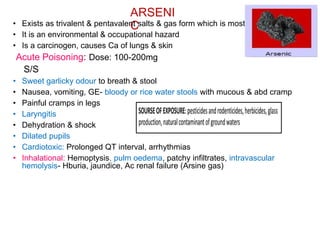
• Exists as trivalent & pentavalent salts & gas form which is most toxic.
• It is an environmental & occupational hazard
• Is a carcinogen, causes Ca of lungs & skin
Acute Poisoning: Dose: 100-200mg
S/S
• Sweet garlicky odour to breath & stool
• Nausea, vomiting, GE- bloody or rice water stools with mucous & abd cramp
• Painful cramps in legs
• Laryngitis
• Dehydration & shock
• Dilated pupils
• Cardiotoxic: Prolonged QT interval, arrhythmias
• Inhalational: Hemoptysis, pulm oedema, patchy infiltrates, intravascular
hemolysis- Hburia, jaundice, Ac renal failure (Arsine gas)
• ARDS
• Hepatitis
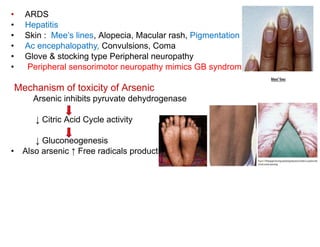
• Skin : Mee’s lines, Alopecia, Macular rash, Pigmentation
• Ac encephalopathy, Convulsions, Coma
• Glove & stocking type Peripheral neuropathy
• Peripheral sensorimotor neuropathy mimics GB syndrome
Mechanism of toxicity of Arsenic
Arsenic inhibits pyruvate dehydrogenase
↓ Citric Acid Cycle activity
↓ Gluconeogenesis
• Also arsenic ↑ Free radicals production
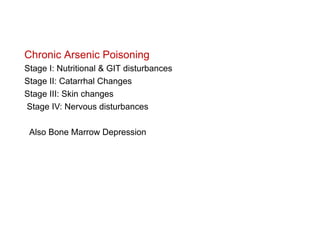
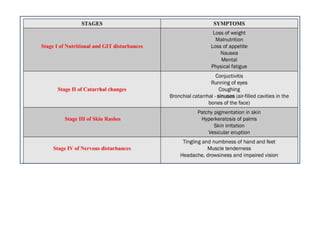
Chronic Arsenic Poisoning
Stage I: Nutritional & GIT disturbances
Stage II: Catarrhal Changes
Stage III: Skin changes
Stage IV: Nervous disturbances
Also Bone Marrow Depression
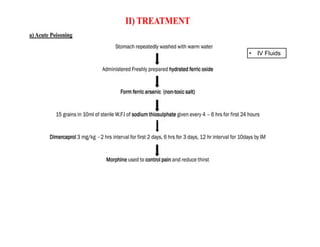
• IV Fluids
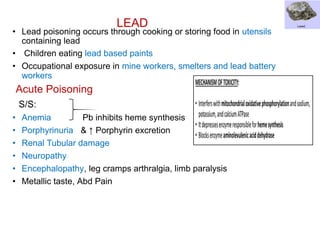
LEAD
• Lead poisoning occurs through cooking or storing food in utensils
containing lead
• Children eating lead based paints
• Occupational exposure in mine workers, smelters and lead battery
workers
Acute Poisoning
S/S:
• Anemia Pb inhibits heme synthesis
• Porphyrinuria & ↑ Porphyrin excretion
• Renal Tubular damage
• Neuropathy
• Encephalopathy, leg cramps arthralgia, limb paralysis
• Metallic taste, Abd Pain
Chronic Pb poisoning (Plumbism)
• Lethargy, weakness
• Tremors, Anorexia, wt loss
• GIT disturbances: Constipation, colicky pain
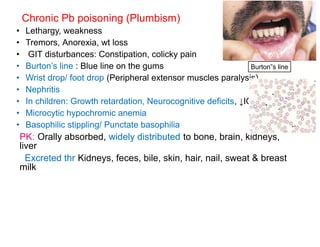
• Burton’s line : Blue line on the gums
• Wrist drop/ foot drop (Peripheral extensor muscles paralysis)
• Nephritis
• In children: Growth retardation, Neurocognitive deficits, ↓IQ
• Microcytic hypochromic anemia
• Basophilic stippling/ Punctate basophilia
PK: Orally absorbed, widely distributed to bone, brain, kidneys,
liver
Excreted thr Kidneys, feces, bile, skin, hair, nail, sweat & breast
milk
Burton”s line
Treatment
Ac poisoning
• Gastric lavage: Sod or MgSO4
• Morphine or Atropine to relieve colic
• Calcium Disodium EDTA ( Chelating agent)
Chr Poisoning
• Gastric lavage
• 5% DNS
• Morphine or Atropine 1g bd upto 5 days
• BAL : 4mg/kg every 4 hrs
MERCUR
Y
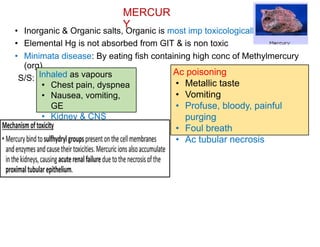
• Inorganic & Organic salts, Organic is most imp toxicologically
• Elemental Hg is not absorbed from GIT & is non toxic
• Minimata disease: By eating fish containing high conc of Methylmercury
(org)
S/S: Inhaled as vapours
• Chest pain, dyspnea
• Nausea, vomiting,
GE
• Kidney & CNS
damage
Ac poisoning
• Metallic taste
• Vomiting
• Profuse, bloody, painful
purging
• Foul breath
• Ac tubular necrosis
Chr Poisoning
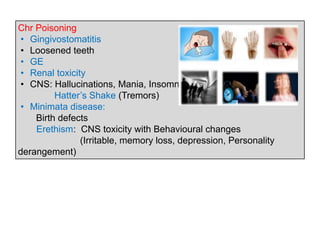
• Gingivostomatitis
• Loosened teeth
• GE
• Renal toxicity
• CNS: Hallucinations, Mania, Insomnia
Hatter’s Shake (Tremors)
• Minimata disease:
Birth defects
Erethism: CNS toxicity with Behavioural changes
(Irritable, memory loss, depression, Personality
derangement)
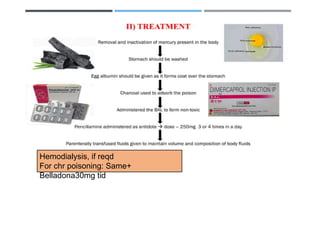
Hemodialysis, if reqd
For chr poisoning: Same+
Belladona30mg tid
CHELATING
AGENTS
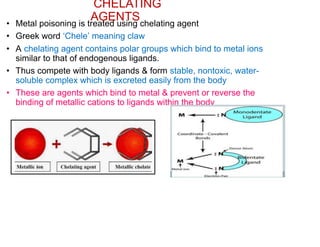
• Metal poisoning is treated using chelating agent
• Greek word ‘Chele’ meaning claw
• A chelating agent contains polar groups which bind to metal ions
similar to that of endogenous ligands.
• Thus compete with body ligands & form stable, nontoxic, water-
soluble complex which is excreted easily from the body
• These are agents which bind to metal & prevent or reverse the
binding of metallic cations to ligands within the body
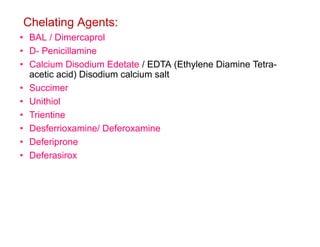
Chelating Agents:
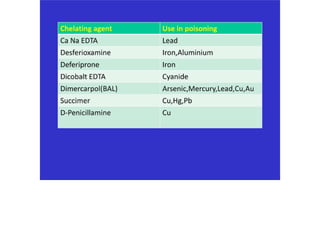
• BAL / Dimercaprol
• D- Penicillamine
• Calcium Disodium Edetate / EDTA (Ethylene Diamine Tetra-
acetic acid) Disodium calcium salt
• Succimer
• Unithiol
• Trientine
• Desferrioxamine/ Deferoxamine
• Deferiprone
• Deferasirox
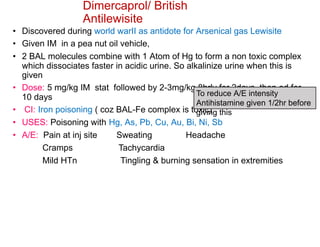
Dimercaprol/ British
Antilewisite
• Discovered during world warII as antidote for Arsenical gas Lewisite
• Given IM in a pea nut oil vehicle,
• 2 BAL molecules combine with 1 Atom of Hg to form a non toxic complex
which dissociates faster in acidic urine. So alkalinize urine when this is
given
• Dose: 5 mg/kg IM stat followed by 2-3mg/kg 8hrly for 2days, then od for
10 days
• CI: Iron poisoning ( coz BAL-Fe complex is toxic)
• USES: Poisoning with Hg, As, Pb, Cu, Au, Bi, Ni, Sb
• A/E: Pain at inj site Sweating Headache
Cramps Tachycardia
Mild HTn Tingling & burning sensation in extremities
To reduce A/E intensity
Antihistamine given 1/2hr before
giving this
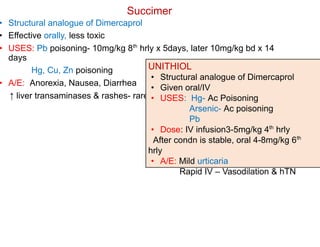
Succimer
• Structural analogue of Dimercaprol
• Effective orally, less toxic
• USES: Pb poisoning- 10mg/kg 8th
hrly x 5days, later 10mg/kg bd x 14
days
Hg, Cu, Zn poisoning
• A/E: Anorexia, Nausea, Diarrhea
↑ liver transaminases & rashes- rare
UNITHIOL
• Structural analogue of Dimercaprol
• Given oral/IV
• USES: Hg- Ac Poisoning
Arsenic- Ac poisoning
Pb
• Dose: IV infusion3-5mg/kg 4th
hrly
After condn is stable, oral 4-8mg/kg 6th
hrly
• A/E: Mild urticaria
Rapid IV – Vasodilation & hTN
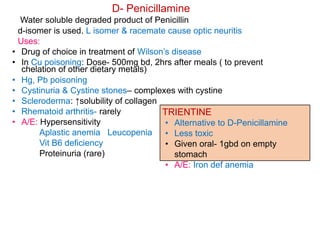
D- Penicillamine
Water soluble degraded product of Penicillin
d-isomer is used. L isomer & racemate cause optic neuritis
Uses:
• Drug of choice in treatment of Wilson’s disease
• In Cu poisoning: Dose- 500mg bd, 2hrs after meals ( to prevent
chelation of other dietary metals)
• Hg, Pb poisoning
• Cystinuria & Cystine stones– complexes with cystine
• Scleroderma: ↑solubility of collagen
• Rhematoid arthritis- rarely
• A/E: Hypersensitivity
Aplastic anemia Leucopenia
Vit B6 deficiency
Proteinuria (rare)
TRIENTINE
• Alternative to D-Penicillamine
• Less toxic
• Given oral- 1gbd on empty
stomach
• A/E: Iron def anemia
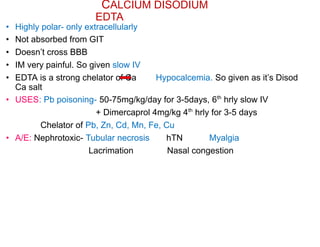
CALCIUM DISODIUM
EDTA
• Highly polar- only extracellularly
• Not absorbed from GIT
• Doesn’t cross BBB
• IM very painful. So given slow IV
• EDTA is a strong chelator of Ca Hypocalcemia. So given as it’s Disod
Ca salt
• USES: Pb poisoning- 50-75mg/kg/day for 3-5days, 6th
hrly slow IV
+ Dimercaprol 4mg/kg 4th
hrly for 3-5 days
Chelator of Pb, Zn, Cd, Mn, Fe, Cu
• A/E: Nephrotoxic- Tubular necrosis hTN Myalgia
Lacrimation Nasal congestion
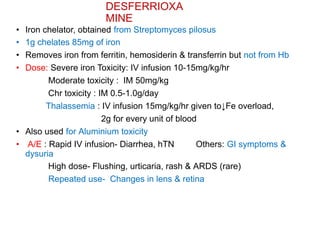
DESFERRIOXA
MINE
• Iron chelator, obtained from Streptomyces pilosus
• 1g chelates 85mg of iron
• Removes iron from ferritin, hemosiderin & transferrin but not from Hb
• Dose: Severe iron Toxicity: IV infusion 10-15mg/kg/hr
Moderate toxicity : IM 50mg/kg
Chr toxicity : IM 0.5-1.0g/day
Thalassemia : IV infusion 15mg/kg/hr given to↓Fe overload,
2g for every unit of blood
• Also used for Aluminium toxicity
• A/E : Rapid IV infusion- Diarrhea, hTN Others: GI symptoms &
dysuria
High dose- Flushing, urticaria, rash & ARDS (rare)
Repeated use- Changes in lens & retina
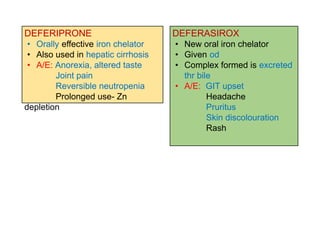
DEFERIPRONE
• Orally effective iron chelator
• Also used in hepatic cirrhosis
• A/E: Anorexia, altered taste
Joint pain
Reversible neutropenia
Prolonged use- Zn
depletion
DEFERASIROX
• New oral iron chelator
• Given od
• Complex formed is excreted
thr bile
• A/E: GIT upset
Headache
Pruritus
Skin discolouration
Rash
Heavy Metals And Chelating Agents ppt.pptx.pdf

Heavy Metals And Chelating Agents ppt.pptx.pdf

  • 1.
    Heavy Metal Poisoning AndChelating Agents Dr Veena V Dept of Pharmacology BMCRC, Ballari
  • 2.
    INTRODUC TION Toxicology deals withtoxic effects of drugs & various chemicals in use Chemicals : Air pollutants, Environmental pollutants, Agricultural pollutants, Industrial solvents & Heavy metals Heavy metals: Pb, Cu, Hg, Fe, As etc Poisoning can be suicidal, homicidal, accidental or occupational Specific antidotes are for heavy metals, OP compounds, Methyl alc & Cyanides
  • 3.
    General measures inTreatment of Poisoning 1) Provide support for Vital functions (ABC) 2) Symptomatic 3) Specific antidote 4) Decontaminate skin, eyes & GIT • Thorough washing of affected parts with soap/ shampoo & lukewarm water • Flush eyes with saline or water along with LA drops • GIT: a) Emesis –Ipecac syrup (30ml in 250ml of water within 30 min of ingestion) Avoid it in corrosives, petroleum products, strychnine poisoning & in unconscious and convulsing pts
  • 4.
    b) Gastric lavage c)Cathartics : 10% MgSO4 or 70% Sorbitol d) Whole bowel irrigation: PEG( Polyethylene Glycol) e) Activated Charcoal: Adsorbs almost all poisons & drugs Avoid in (I LAC): Iron, Lithium, Alc, Corrosives or Cyanide poisoning Unconscious/Convulsing pts Intestinal obstruction Pts who need endoscopic examn Avoid Emesis/ Cathartics along with this ( Charcoal removes Emetics/ Cathartics, Causes Dehydration) 0.5-2g/kg in water, given oral/ via gastric tube Repeat 20-30g every 4hrs
  • 5.
    5) Hemoperfusion 6) Hemodialysis 7)Peritoneal dialysis 8) Urinary manipulation: Alkalanise urine in acidic drug poisoning using Sod bicarb Acidify urine in basic drug poisoning using Ascorbic acid Avoid acidification of urine in presence of myoglobinuria/ Rhabdomyolysis 9) Treatment of heavy metals by Chelating agents
  • 6.
    Heavy Metal Poisoning • Poisoningwith lead, mercury, iron, copper, arsenic & nickel occur in persons working in mines, industries of glass, paint, pesticides & petroleum. • Heavy metals combine with the functional groups( ligands) of vital enzymes, interfere with enzymes functioning & exert their toxic effects • Metals are treated by chelating agents
  • 7.
    ARSENI C • Exists astrivalent & pentavalent salts & gas form which is most toxic. • It is an environmental & occupational hazard • Is a carcinogen, causes Ca of lungs & skin Acute Poisoning: Dose: 100-200mg S/S • Sweet garlicky odour to breath & stool • Nausea, vomiting, GE- bloody or rice water stools with mucous & abd cramp • Painful cramps in legs • Laryngitis • Dehydration & shock • Dilated pupils • Cardiotoxic: Prolonged QT interval, arrhythmias • Inhalational: Hemoptysis, pulm oedema, patchy infiltrates, intravascular hemolysis- Hburia, jaundice, Ac renal failure (Arsine gas)
  • 8.
    • ARDS • Hepatitis •Skin : Mee’s lines, Alopecia, Macular rash, Pigmentation • Ac encephalopathy, Convulsions, Coma • Glove & stocking type Peripheral neuropathy • Peripheral sensorimotor neuropathy mimics GB syndrome Mechanism of toxicity of Arsenic Arsenic inhibits pyruvate dehydrogenase ↓ Citric Acid Cycle activity ↓ Gluconeogenesis • Also arsenic ↑ Free radicals production
  • 9.
    Chronic Arsenic Poisoning StageI: Nutritional & GIT disturbances Stage II: Catarrhal Changes Stage III: Skin changes Stage IV: Nervous disturbances Also Bone Marrow Depression
  • 11.
  • 13.
    LEAD • Lead poisoningoccurs through cooking or storing food in utensils containing lead • Children eating lead based paints • Occupational exposure in mine workers, smelters and lead battery workers Acute Poisoning S/S: • Anemia Pb inhibits heme synthesis • Porphyrinuria & ↑ Porphyrin excretion • Renal Tubular damage • Neuropathy • Encephalopathy, leg cramps arthralgia, limb paralysis • Metallic taste, Abd Pain
  • 14.
    Chronic Pb poisoning(Plumbism) • Lethargy, weakness • Tremors, Anorexia, wt loss • GIT disturbances: Constipation, colicky pain • Burton’s line : Blue line on the gums • Wrist drop/ foot drop (Peripheral extensor muscles paralysis) • Nephritis • In children: Growth retardation, Neurocognitive deficits, ↓IQ • Microcytic hypochromic anemia • Basophilic stippling/ Punctate basophilia PK: Orally absorbed, widely distributed to bone, brain, kidneys, liver Excreted thr Kidneys, feces, bile, skin, hair, nail, sweat & breast milk Burton”s line
  • 15.
    Treatment Ac poisoning • Gastriclavage: Sod or MgSO4 • Morphine or Atropine to relieve colic • Calcium Disodium EDTA ( Chelating agent) Chr Poisoning • Gastric lavage • 5% DNS • Morphine or Atropine 1g bd upto 5 days • BAL : 4mg/kg every 4 hrs
  • 16.
    MERCUR Y • Inorganic &Organic salts, Organic is most imp toxicologically • Elemental Hg is not absorbed from GIT & is non toxic • Minimata disease: By eating fish containing high conc of Methylmercury (org) S/S: Inhaled as vapours • Chest pain, dyspnea • Nausea, vomiting, GE • Kidney & CNS damage Ac poisoning • Metallic taste • Vomiting • Profuse, bloody, painful purging • Foul breath • Ac tubular necrosis
  • 17.
    Chr Poisoning • Gingivostomatitis •Loosened teeth • GE • Renal toxicity • CNS: Hallucinations, Mania, Insomnia Hatter’s Shake (Tremors) • Minimata disease: Birth defects Erethism: CNS toxicity with Behavioural changes (Irritable, memory loss, depression, Personality derangement)
  • 18.
    Hemodialysis, if reqd Forchr poisoning: Same+ Belladona30mg tid
  • 19.
    CHELATING AGENTS • Metal poisoningis treated using chelating agent • Greek word ‘Chele’ meaning claw • A chelating agent contains polar groups which bind to metal ions similar to that of endogenous ligands. • Thus compete with body ligands & form stable, nontoxic, water- soluble complex which is excreted easily from the body • These are agents which bind to metal & prevent or reverse the binding of metallic cations to ligands within the body
  • 21.
    Chelating Agents: • BAL/ Dimercaprol • D- Penicillamine • Calcium Disodium Edetate / EDTA (Ethylene Diamine Tetra- acetic acid) Disodium calcium salt • Succimer • Unithiol • Trientine • Desferrioxamine/ Deferoxamine • Deferiprone • Deferasirox
  • 22.
    Dimercaprol/ British Antilewisite • Discoveredduring world warII as antidote for Arsenical gas Lewisite • Given IM in a pea nut oil vehicle, • 2 BAL molecules combine with 1 Atom of Hg to form a non toxic complex which dissociates faster in acidic urine. So alkalinize urine when this is given • Dose: 5 mg/kg IM stat followed by 2-3mg/kg 8hrly for 2days, then od for 10 days • CI: Iron poisoning ( coz BAL-Fe complex is toxic) • USES: Poisoning with Hg, As, Pb, Cu, Au, Bi, Ni, Sb • A/E: Pain at inj site Sweating Headache Cramps Tachycardia Mild HTn Tingling & burning sensation in extremities To reduce A/E intensity Antihistamine given 1/2hr before giving this
  • 23.
    Succimer • Structural analogueof Dimercaprol • Effective orally, less toxic • USES: Pb poisoning- 10mg/kg 8th hrly x 5days, later 10mg/kg bd x 14 days Hg, Cu, Zn poisoning • A/E: Anorexia, Nausea, Diarrhea ↑ liver transaminases & rashes- rare UNITHIOL • Structural analogue of Dimercaprol • Given oral/IV • USES: Hg- Ac Poisoning Arsenic- Ac poisoning Pb • Dose: IV infusion3-5mg/kg 4th hrly After condn is stable, oral 4-8mg/kg 6th hrly • A/E: Mild urticaria Rapid IV – Vasodilation & hTN
  • 24.
    D- Penicillamine Water solubledegraded product of Penicillin d-isomer is used. L isomer & racemate cause optic neuritis Uses: • Drug of choice in treatment of Wilson’s disease • In Cu poisoning: Dose- 500mg bd, 2hrs after meals ( to prevent chelation of other dietary metals) • Hg, Pb poisoning • Cystinuria & Cystine stones– complexes with cystine • Scleroderma: ↑solubility of collagen • Rhematoid arthritis- rarely • A/E: Hypersensitivity Aplastic anemia Leucopenia Vit B6 deficiency Proteinuria (rare) TRIENTINE • Alternative to D-Penicillamine • Less toxic • Given oral- 1gbd on empty stomach • A/E: Iron def anemia
  • 25.
    CALCIUM DISODIUM EDTA • Highlypolar- only extracellularly • Not absorbed from GIT • Doesn’t cross BBB • IM very painful. So given slow IV • EDTA is a strong chelator of Ca Hypocalcemia. So given as it’s Disod Ca salt • USES: Pb poisoning- 50-75mg/kg/day for 3-5days, 6th hrly slow IV + Dimercaprol 4mg/kg 4th hrly for 3-5 days Chelator of Pb, Zn, Cd, Mn, Fe, Cu • A/E: Nephrotoxic- Tubular necrosis hTN Myalgia Lacrimation Nasal congestion
  • 26.
    DESFERRIOXA MINE • Iron chelator,obtained from Streptomyces pilosus • 1g chelates 85mg of iron • Removes iron from ferritin, hemosiderin & transferrin but not from Hb • Dose: Severe iron Toxicity: IV infusion 10-15mg/kg/hr Moderate toxicity : IM 50mg/kg Chr toxicity : IM 0.5-1.0g/day Thalassemia : IV infusion 15mg/kg/hr given to↓Fe overload, 2g for every unit of blood • Also used for Aluminium toxicity • A/E : Rapid IV infusion- Diarrhea, hTN Others: GI symptoms & dysuria High dose- Flushing, urticaria, rash & ARDS (rare) Repeated use- Changes in lens & retina
  • 27.
    DEFERIPRONE • Orally effectiveiron chelator • Also used in hepatic cirrhosis • A/E: Anorexia, altered taste Joint pain Reversible neutropenia Prolonged use- Zn depletion DEFERASIROX • New oral iron chelator • Given od • Complex formed is excreted thr bile • A/E: GIT upset Headache Pruritus Skin discolouration Rash