CLINICAL EVALUATION
METHODS
BY- TANOJ PATIDAR
INTRODUCTION
• Evaluation is the direct or indirect measurement of any attribute with respect to
some standard, perhaps the most frequently used and least attended term.
• It is the process of judging the value or worth of achievement against some
standards.
• It is not simply administering the test, checking answer sheets and announcing marks
to the students.
• What remains in the heart of evaluation is the value or quality judgement.
• In education we need to evaluate both the process and products
• It is the process that starts with the specification of the criteria or objectives for
evaluation; preparing and administering the test based on the pre specified criteria;
gathering the data and facts, and making a judgement whether the objectives are
achieved or not.
DEFINITION
• ‘’evaluation is the process of determining to what extent the educational objectives
are being realized.’’
By- Ralph Tyler
• ‘’Evaluation is the assessment of merits and or worth.’’
By- Scriven
TYPES OF EVALUATION
1. FORMATIVE EVALUATION:
• It is an ongoing assessment or evaluation of the student’s achievement while the
instructional course/programme is in progress.
• To monitor the students and provide feedback for improvement.
• Carried out quiet frequently ranging from daily to weekly.
• Detailed focus on content.
• Methods include in formative evaluation are questioning, daily assignment,
observation test, internal assessment, presentation, case study etc.
TYPES OF EVALUATION
2. SUMMATIVE EVALUATION:
• It is the final evaluation of the student’s achievement at the end of a
unit/course/programme.
• To finally assign the grades or pass/fail status.
• Carried out monthly, biannually, annually at the end of the course.
• General and broad content scope.
• Methods include in summative evaluation are project, practical examination, viva
voce, OSCE etc.
PURPOSES OF EVALUATION
• To provide short-term goals to the students to work towards the achievement of
educational objectives.
• To clarify the intended learning outcome.
• To determine the level of knowledge and understanding in students.
• To encourage student, learning by measuring their achievement and informing about
success.
• To help students acquire the attitude and skills of self-evaluation.
• To improve curriculum in light of recent advances.
• To assess the non scholastic domains of the student’s personality.
• To provide feedback to the students about their strengths and weaknesses.
• To satisfy the university requirements for a curriculum.
PURPOSES OF EVALUATION
• To determine whether a particular student’s competent enough to be advanced to
the next class.
• To recommend the names of student eligible for a degree to the university.
• Evaluation is carried out for general and educational research.
SCOPE OF EVALUATION
• Selection of students.
• Feedback to students.
• Feedback to teachers.
• Incentive to learning.
• Motivation of learning activities.
• Certification of competence.
• Decision for success or failure.
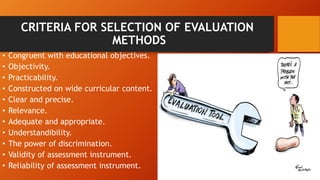
CRITERIA FOR SELECTION OF EVALUATION
METHODS
• Congruent with educational objectives.
• Objectivity.
• Practicability.
• Constructed on wide curricular content.
• Clear and precise.
• Relevance.
• Adequate and appropriate.
• Understandibility.
• The power of discrimination.
• Validity of assessment instrument.
• Reliability of assessment instrument.
METHODS OF CLINICAL EVALUATION
• Knowledge is tested in theory examination and skills are evaluated in clinical or
practical examination.
• Various methods of skill assessment of the students in nursing profession include
traditional or conventional practical examinations, case study, observational
checklists, viva voce, OSCE, rating scales etc.
• Any of this methods independently can not assess the skills of the students with good
validity, objectivity and reliability.
• A wise combination of these methods is mandatory for a holistic skills assessment.
CASE STUDY/PRESENTATION
• The student with the help of the clinical instructor selects one of her patient for
intensive study which she finds interesting.
• The students tries to solve the problems through the study, consultation and
experimentation and decided the nursing measures which will meet the patient
needs.
• Student must be given opportunity to take care of the patient over a long duration of
time, to understand his/her behaviour, to gain confidence and to note the effects of
nursing measure.
• Students learn to recognize the effect of personal and social factors on illness and
recovery to organize the information and identify the problems.
• The students also learn about the problem solving approach to nursing, the report
may act as a reference material for other students.
CASE STUDY/PRESENTATION
• In the end student can present the report in front of the group and it should be
evaluated in terms of content, organization, clarity of thought, presentation skills
and interest.
• The oral presentation helps the student to speak in front of the group.
TRADITIONAL OR CONVENTIONAL PRACTICAL
EXAMINATION
• This system in nursing usually involves writing of detailed procedure or writing
nursing process for one or two patients, followed by observation of performance of
nursing care by the student on the patient.
• Observation of the students performance in the clinical setting is the most frequently
used evaluation technique in health profession.
• It is used to make judgement on not only skills but all three domains, including
knowledge, attitude and interpersonal relationship.
ADVANTAGES:
• Practical examination provides an opportunity to assess the skills and competency
acquired by the students.
TRADITIONAL OR CONVENTIONAL PRACTICAL
EXAMINATION
• Practical examination offers an opportunity to the examiners for assessing the use of
compartmentalized knowledge in an integrated manner by a student while providing
holistic nursing care to patient.
• An examiner also get an opportunity to assess the communication and interpersonal
skills of the students along with their clinical competence in performing the nursing
procedure.
DISADVANTAGES:
• Practical examination is not considered a standardized assessment practice when
students are assessed while working with the patient.
TRADITIONAL OR CONVENTIONAL PRACTICAL
EXAMINATION
• It is not considered an objective method of assessment, there are chances of
subjectivity and biases.
• It is a time consuming process.
• Can not be considered a feasible method for assessing a large group of students.
• Sometimes it is considered as unethical to expose patients for examining students.
• The emergencies and complex ward routines may be considered as disturbance factor
to the smooth conduction of practical examination
OBSERVATIONAL CHECKLISTS
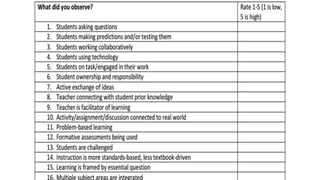
• An observational checklists is the most commonly used instrument for performance
evaluation.
• It is an approach to monitor performance of specific skills, behaviours, or disposition
of individual student.
• It is a method of recording whether a characteristic is present or an action is
performed.
• It is simply a list of the performers behaviour associated with particular nursing
interventions within a space for the assessor to check or tick off whether or not that
particulars behaviours occurred.
• Examples like writing skills, speaking skills action based, procedure based skills etc.
OBSERVATIONAL CHECKLISTS
ADVANTAGES:
• Allows inter-individual comparison.
• Provide a simple method to record observation.
• They are adaptable to subject matter areas.
• Checklists are useful in evaluating learning activities expected to be performed.
• Helpful in evaluating procedural work.
• Properly prepared checklists allow the observer to constrain the direct observation.
• Have objectivity to evaluate characteristics.
• Useful for evaluating the processes subdivided into a series of action
• Decreases the chances of error.
OBSERVATIONAL CHECKLISTS
DISADVANTAGES:
• Do not indicate the quality of performance so the usefulness of checklists is limited.
• Only a limited component of overall clinical performance can be evaluated.
• Only the presence or absence of an attitude, behaviour or performance parameter
may be assessed, However the degree of accuracy of performance can be assessed.
• Limited use in qualitative observation.
• Not easy to prepare.
RATING SCALE
• Rating is the term used to express opinion or judgement regarding some performance
of a person, object, situation and character.
• The rating scale involves qualitative description of a limited number of aspects of a
things or traits of a person.
• When we use rating scale, we judge an object in absolute terms against some
specified criteria.
• It could be 3 point, 5 point or a 7 point rating scale.
• For example, the overall performance of the student in a mouth care procedure;
excellent, very good, good, poor and average.
ADVANTAGES: Easy to administer and score measured attributes.
• Wide range of application in nursing educational evaluation.
RATING SCALE
• Graphic rating scale is more easy to make and less time consuming.
• Rating scle can be easily used for a large group.
• They are also used for quantitative methods.
• They are also be used for assessment for interests, attitude, personal characteristics
• Adaptable and flexible assessment instruments.
DISADVANTAGES: it is difficult or dangerous to fix up rating about many aspects of an
individual.
• Misuse can result in a decrease in objectivity.
• There are chances of subjective evaluation thus the scales may become unscientific
and unreliable.
VIVA VOCE/ ORAL EXAMINATION
• Viva voce is integral part of traditional practical examination.
• Oral examination is meant to evaluate certain qualities of the students such as the
depth of the knowledge, attitude, confidence, ability to perform under stressand
professional competence.
• The focus of oral examination should be to test students problem solving skills,
ability to develop an answer with rational and ability to come to a decision quickly,
less focus should be given on factual recall during viva.
• Viva voce also provides opportunity to clarify the wrong answers.
ADVANTAGES: provide direct contact with the candidate to assess their
communication, presentation skills and overall impression.
VIVA VOCE/ ORAL EXAMINATION
• Provides opportunity to mitigate circumstances into accounts.
• Provides flexibility in moving the candidates from strong to weak points.
• Facilities simultaneous assessment by two or more examiners.
DISADVANTAGES:
• Costly in terms of professional time.
• Suffers from undue influence of irrelevant factors.
• Permits favouritism and can not used for future reference.
• Lacks of standardization and objectivity.
OSCE
• Objective structured clinical examination is a modern type of examination often used
in various professional disciplines including nursing.
• Designed to test clinical skills performance such as communication, clinical
examination, medical or nursing procedures by a student in a clinical area where the
student is asked to perform a particular task on a patient and is evaluated by the
examiner.
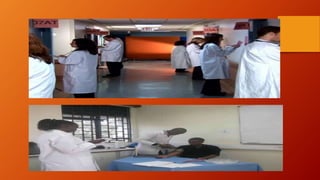
• It is usually consist of 8-12 short stations, in which candidate moves around these
station in a predetermined manner, spend a specific amount of time (5-10 minute)
for completing task and moves to the next station.
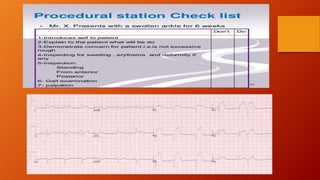
• There are two types of stations; procedure and response stations, at procedure
station student need to perform any task (history collection) and examiner will
observe and give the marks.
OSCE
• At response station , student write down the answer of question on the response
sheet.(AGGs interpretations, ECG).
ADVANTAGES:
• More valid thn traditional approach to clinical examinations
• Examiner can decide in advance what is to be tested.
• Examiners can have better control on the content and complexities.
• Emphasis can be moved away from testing factual knowledge to testing a wide range
of skills including advanced clinical skills
• More reliable
• Objectivity
• More practical
OSCE
DISADVANTAGES:
• students knowledge and skills are tested in compartments and they are not tested on
their ability to look at the patient whole.
• Demanding for both examiners and patients.
• Maintaining uniform difficulty levels is not always possible.
• examiners are required to pay close attention to students repeating the same task
on a number of occasions.
• The time involved in setting up the examination is greater than for the traditional
examination.
Clinical evaluation methods by Tanoj Patidar MSc Nursing (MSN)

Clinical evaluation methods by Tanoj Patidar MSc Nursing (MSN)

  • 1.
  • 2.
    INTRODUCTION • Evaluation isthe direct or indirect measurement of any attribute with respect to some standard, perhaps the most frequently used and least attended term. • It is the process of judging the value or worth of achievement against some standards. • It is not simply administering the test, checking answer sheets and announcing marks to the students. • What remains in the heart of evaluation is the value or quality judgement. • In education we need to evaluate both the process and products • It is the process that starts with the specification of the criteria or objectives for evaluation; preparing and administering the test based on the pre specified criteria; gathering the data and facts, and making a judgement whether the objectives are achieved or not.
  • 3.
    DEFINITION • ‘’evaluation isthe process of determining to what extent the educational objectives are being realized.’’ By- Ralph Tyler • ‘’Evaluation is the assessment of merits and or worth.’’ By- Scriven
  • 4.
    TYPES OF EVALUATION 1.FORMATIVE EVALUATION: • It is an ongoing assessment or evaluation of the student’s achievement while the instructional course/programme is in progress. • To monitor the students and provide feedback for improvement. • Carried out quiet frequently ranging from daily to weekly. • Detailed focus on content. • Methods include in formative evaluation are questioning, daily assignment, observation test, internal assessment, presentation, case study etc.
  • 5.
    TYPES OF EVALUATION 2.SUMMATIVE EVALUATION: • It is the final evaluation of the student’s achievement at the end of a unit/course/programme. • To finally assign the grades or pass/fail status. • Carried out monthly, biannually, annually at the end of the course. • General and broad content scope. • Methods include in summative evaluation are project, practical examination, viva voce, OSCE etc.
  • 6.
    PURPOSES OF EVALUATION •To provide short-term goals to the students to work towards the achievement of educational objectives. • To clarify the intended learning outcome. • To determine the level of knowledge and understanding in students. • To encourage student, learning by measuring their achievement and informing about success. • To help students acquire the attitude and skills of self-evaluation. • To improve curriculum in light of recent advances. • To assess the non scholastic domains of the student’s personality. • To provide feedback to the students about their strengths and weaknesses. • To satisfy the university requirements for a curriculum.
  • 7.
    PURPOSES OF EVALUATION •To determine whether a particular student’s competent enough to be advanced to the next class. • To recommend the names of student eligible for a degree to the university. • Evaluation is carried out for general and educational research.
  • 8.
    SCOPE OF EVALUATION •Selection of students. • Feedback to students. • Feedback to teachers. • Incentive to learning. • Motivation of learning activities. • Certification of competence. • Decision for success or failure.
  • 9.
    CRITERIA FOR SELECTIONOF EVALUATION METHODS • Congruent with educational objectives. • Objectivity. • Practicability. • Constructed on wide curricular content. • Clear and precise. • Relevance. • Adequate and appropriate. • Understandibility. • The power of discrimination. • Validity of assessment instrument. • Reliability of assessment instrument.
  • 10.
    METHODS OF CLINICALEVALUATION • Knowledge is tested in theory examination and skills are evaluated in clinical or practical examination. • Various methods of skill assessment of the students in nursing profession include traditional or conventional practical examinations, case study, observational checklists, viva voce, OSCE, rating scales etc. • Any of this methods independently can not assess the skills of the students with good validity, objectivity and reliability. • A wise combination of these methods is mandatory for a holistic skills assessment.
  • 11.
    CASE STUDY/PRESENTATION • Thestudent with the help of the clinical instructor selects one of her patient for intensive study which she finds interesting. • The students tries to solve the problems through the study, consultation and experimentation and decided the nursing measures which will meet the patient needs. • Student must be given opportunity to take care of the patient over a long duration of time, to understand his/her behaviour, to gain confidence and to note the effects of nursing measure. • Students learn to recognize the effect of personal and social factors on illness and recovery to organize the information and identify the problems. • The students also learn about the problem solving approach to nursing, the report may act as a reference material for other students.
  • 12.
    CASE STUDY/PRESENTATION • Inthe end student can present the report in front of the group and it should be evaluated in terms of content, organization, clarity of thought, presentation skills and interest. • The oral presentation helps the student to speak in front of the group.
  • 13.
    TRADITIONAL OR CONVENTIONALPRACTICAL EXAMINATION • This system in nursing usually involves writing of detailed procedure or writing nursing process for one or two patients, followed by observation of performance of nursing care by the student on the patient. • Observation of the students performance in the clinical setting is the most frequently used evaluation technique in health profession. • It is used to make judgement on not only skills but all three domains, including knowledge, attitude and interpersonal relationship. ADVANTAGES: • Practical examination provides an opportunity to assess the skills and competency acquired by the students.
  • 14.
    TRADITIONAL OR CONVENTIONALPRACTICAL EXAMINATION • Practical examination offers an opportunity to the examiners for assessing the use of compartmentalized knowledge in an integrated manner by a student while providing holistic nursing care to patient. • An examiner also get an opportunity to assess the communication and interpersonal skills of the students along with their clinical competence in performing the nursing procedure. DISADVANTAGES: • Practical examination is not considered a standardized assessment practice when students are assessed while working with the patient.
  • 15.
    TRADITIONAL OR CONVENTIONALPRACTICAL EXAMINATION • It is not considered an objective method of assessment, there are chances of subjectivity and biases. • It is a time consuming process. • Can not be considered a feasible method for assessing a large group of students. • Sometimes it is considered as unethical to expose patients for examining students. • The emergencies and complex ward routines may be considered as disturbance factor to the smooth conduction of practical examination
  • 16.
    OBSERVATIONAL CHECKLISTS • Anobservational checklists is the most commonly used instrument for performance evaluation. • It is an approach to monitor performance of specific skills, behaviours, or disposition of individual student. • It is a method of recording whether a characteristic is present or an action is performed. • It is simply a list of the performers behaviour associated with particular nursing interventions within a space for the assessor to check or tick off whether or not that particulars behaviours occurred. • Examples like writing skills, speaking skills action based, procedure based skills etc.
  • 17.
    OBSERVATIONAL CHECKLISTS ADVANTAGES: • Allowsinter-individual comparison. • Provide a simple method to record observation. • They are adaptable to subject matter areas. • Checklists are useful in evaluating learning activities expected to be performed. • Helpful in evaluating procedural work. • Properly prepared checklists allow the observer to constrain the direct observation. • Have objectivity to evaluate characteristics. • Useful for evaluating the processes subdivided into a series of action • Decreases the chances of error.
  • 18.
    OBSERVATIONAL CHECKLISTS DISADVANTAGES: • Donot indicate the quality of performance so the usefulness of checklists is limited. • Only a limited component of overall clinical performance can be evaluated. • Only the presence or absence of an attitude, behaviour or performance parameter may be assessed, However the degree of accuracy of performance can be assessed. • Limited use in qualitative observation. • Not easy to prepare.
  • 20.
    RATING SCALE • Ratingis the term used to express opinion or judgement regarding some performance of a person, object, situation and character. • The rating scale involves qualitative description of a limited number of aspects of a things or traits of a person. • When we use rating scale, we judge an object in absolute terms against some specified criteria. • It could be 3 point, 5 point or a 7 point rating scale. • For example, the overall performance of the student in a mouth care procedure; excellent, very good, good, poor and average. ADVANTAGES: Easy to administer and score measured attributes. • Wide range of application in nursing educational evaluation.
  • 21.
    RATING SCALE • Graphicrating scale is more easy to make and less time consuming. • Rating scle can be easily used for a large group. • They are also used for quantitative methods. • They are also be used for assessment for interests, attitude, personal characteristics • Adaptable and flexible assessment instruments. DISADVANTAGES: it is difficult or dangerous to fix up rating about many aspects of an individual. • Misuse can result in a decrease in objectivity. • There are chances of subjective evaluation thus the scales may become unscientific and unreliable.
  • 23.
    VIVA VOCE/ ORALEXAMINATION • Viva voce is integral part of traditional practical examination. • Oral examination is meant to evaluate certain qualities of the students such as the depth of the knowledge, attitude, confidence, ability to perform under stressand professional competence. • The focus of oral examination should be to test students problem solving skills, ability to develop an answer with rational and ability to come to a decision quickly, less focus should be given on factual recall during viva. • Viva voce also provides opportunity to clarify the wrong answers. ADVANTAGES: provide direct contact with the candidate to assess their communication, presentation skills and overall impression.
  • 24.
    VIVA VOCE/ ORALEXAMINATION • Provides opportunity to mitigate circumstances into accounts. • Provides flexibility in moving the candidates from strong to weak points. • Facilities simultaneous assessment by two or more examiners. DISADVANTAGES: • Costly in terms of professional time. • Suffers from undue influence of irrelevant factors. • Permits favouritism and can not used for future reference. • Lacks of standardization and objectivity.
  • 26.
    OSCE • Objective structuredclinical examination is a modern type of examination often used in various professional disciplines including nursing. • Designed to test clinical skills performance such as communication, clinical examination, medical or nursing procedures by a student in a clinical area where the student is asked to perform a particular task on a patient and is evaluated by the examiner. • It is usually consist of 8-12 short stations, in which candidate moves around these station in a predetermined manner, spend a specific amount of time (5-10 minute) for completing task and moves to the next station. • There are two types of stations; procedure and response stations, at procedure station student need to perform any task (history collection) and examiner will observe and give the marks.
  • 27.
    OSCE • At responsestation , student write down the answer of question on the response sheet.(AGGs interpretations, ECG). ADVANTAGES: • More valid thn traditional approach to clinical examinations • Examiner can decide in advance what is to be tested. • Examiners can have better control on the content and complexities. • Emphasis can be moved away from testing factual knowledge to testing a wide range of skills including advanced clinical skills • More reliable • Objectivity • More practical
  • 28.
    OSCE DISADVANTAGES: • students knowledgeand skills are tested in compartments and they are not tested on their ability to look at the patient whole. • Demanding for both examiners and patients. • Maintaining uniform difficulty levels is not always possible. • examiners are required to pay close attention to students repeating the same task on a number of occasions. • The time involved in setting up the examination is greater than for the traditional examination.