



CONSANGUINEOUS ATOPY
BY:
Mr. Dinabandhu Barad
MSc Tutor, SNC,SOA,DTU
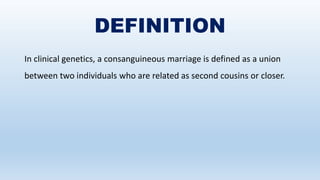
DEFINITION
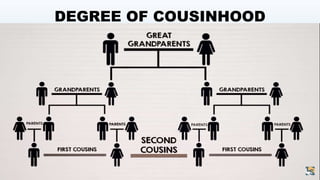
In clinical genetics, a consanguineous marriage is defined as a union
between two individuals who are related as second cousins or closer.
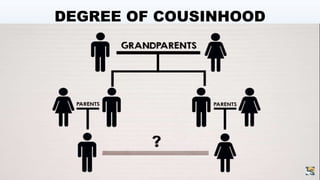
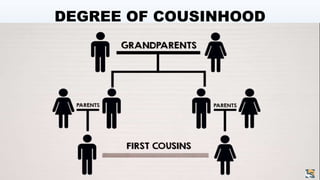
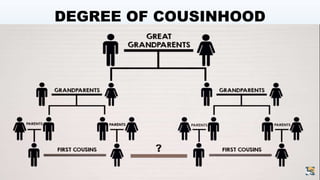
DEGREE OF COUSINHOOD
REASONS FOR CHOOSING TO MARRY
A COUSIN
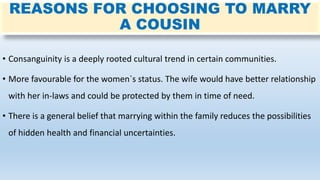
• Consanguinity is a deeply rooted cultural trend in certain communities.
• More favourable for the women`s status. The wife would have better relationship
with her in-laws and could be protected by them in time of need.
• There is a general belief that marrying within the family reduces the possibilities
of hidden health and financial uncertainties.
REASONS FOR CHOOSING TO MARRY
A COUSIN
• Premarital negotiations regarding financial matters of marriage are more easily
conducted, keeping the money and property within the family.
• Strengthens family ties, and enforces family solidarity.
FACTORS AFFECTING CONSANGUINITY
RATES
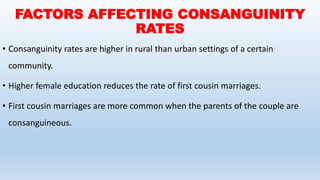
• Consanguinity rates are higher in rural than urban settings of a certain
community.
• Higher female education reduces the rate of first cousin marriages.
• First cousin marriages are more common when the parents of the couple are
consanguineous.
FACTORS AFFECTING
CONSANGUINITY
RATES
• In the same community, consanguinity rates are higher among Muslims than
among Christians, for example in Lebanon, Jordan, South India.
FACTORS MAY DECREASE
CONSANGUINITY RATE
• Higher female education
• Higher age at marriage
• Low fertility
• More mobility from rural to urban
• Better economic status of families
EFFECT OF CONSANGUINITY
• Stillbirth rates are either similar or slightly higher among consanguineous couples
than the non-related couples.
• There is a positive association between parental consanguinity and increased
infant and childhood mortality.
• Many studies have shown a positive association between parental consanguinity
and congenital heart defects.
• The association of consanguinity with cleft lip and palate, and neural tube defects
is not clear.
EFFECT OF CONSANGUINITY
• Among genetic disorders, only autosomal recessive disorders are strongly
associated with consanguinity.
• The association of NCD’s ( such as diabetes, hypertension) with parental
consanguinity is still not clear.
COUNSELLING
• Genetic counselling is the process by which clients or their relatives, at risk of an
inherited disorder, are advised to prevent, avoid or ameliorate the disorder.
• They are advised on
• the consequences and nature of the disorder,
• the probabilities of developing or transmitting it,
• the choices open to them in management and planning of their families.
COUNSELLING
Genetic counsellors provide useful information and support to families who may be
at risk of inherited disorders.
• They are involved
• in identification of families at risk
• investigation of problems presented by the family
• interpretation of information about the disorder
• analysis of inheritance patterns and
• evaluation of risks of recurrence
• reviewing testing options available to the family.
Consanguinous marriage

Consanguinous marriage

  • 1.
    CONSANGUINEOUS ATOPY BY: Mr. DinabandhuBarad MSc Tutor, SNC,SOA,DTU
  • 2.
    DEFINITION In clinical genetics,a consanguineous marriage is defined as a union between two individuals who are related as second cousins or closer.
  • 3.
  • 4.
  • 5.
  • 6.
  • 8.
    REASONS FOR CHOOSINGTO MARRY A COUSIN • Consanguinity is a deeply rooted cultural trend in certain communities. • More favourable for the women`s status. The wife would have better relationship with her in-laws and could be protected by them in time of need. • There is a general belief that marrying within the family reduces the possibilities of hidden health and financial uncertainties.
  • 9.
    REASONS FOR CHOOSINGTO MARRY A COUSIN • Premarital negotiations regarding financial matters of marriage are more easily conducted, keeping the money and property within the family. • Strengthens family ties, and enforces family solidarity.
  • 10.
    FACTORS AFFECTING CONSANGUINITY RATES •Consanguinity rates are higher in rural than urban settings of a certain community. • Higher female education reduces the rate of first cousin marriages. • First cousin marriages are more common when the parents of the couple are consanguineous.
  • 11.
    FACTORS AFFECTING CONSANGUINITY RATES • Inthe same community, consanguinity rates are higher among Muslims than among Christians, for example in Lebanon, Jordan, South India.
  • 12.
    FACTORS MAY DECREASE CONSANGUINITYRATE • Higher female education • Higher age at marriage • Low fertility • More mobility from rural to urban • Better economic status of families
  • 13.
    EFFECT OF CONSANGUINITY •Stillbirth rates are either similar or slightly higher among consanguineous couples than the non-related couples. • There is a positive association between parental consanguinity and increased infant and childhood mortality. • Many studies have shown a positive association between parental consanguinity and congenital heart defects. • The association of consanguinity with cleft lip and palate, and neural tube defects is not clear.
  • 14.
    EFFECT OF CONSANGUINITY •Among genetic disorders, only autosomal recessive disorders are strongly associated with consanguinity. • The association of NCD’s ( such as diabetes, hypertension) with parental consanguinity is still not clear.
  • 15.
    COUNSELLING • Genetic counsellingis the process by which clients or their relatives, at risk of an inherited disorder, are advised to prevent, avoid or ameliorate the disorder. • They are advised on • the consequences and nature of the disorder, • the probabilities of developing or transmitting it, • the choices open to them in management and planning of their families.
  • 16.
    COUNSELLING Genetic counsellors provideuseful information and support to families who may be at risk of inherited disorders. • They are involved • in identification of families at risk • investigation of problems presented by the family • interpretation of information about the disorder • analysis of inheritance patterns and • evaluation of risks of recurrence • reviewing testing options available to the family.