Plant Diversity: A
Comprehensive Guide
Welcome to an exploration of the incredible diversity found in the plant
kingdom. This presentation covers taxonomy, classification systems, and the
major plant groups from algae to angiosperms.
by sandeep swamy
Understanding
Taxonomy
1 Definition
Taxonomy is the branch of
biology dealing with
identification, nomenclature,
and classification of organisms.
2 Origin
The term was proposed by A.P.
de Candolle in his book
"Theories elementaire de la
botanique."
3 Components
Includes identification, nomenclature, and classification based on
observable characters.
Systematics vs. Taxonomy
Systematics
Derived from Latin "Systema," meaning systematic arrangement.
Introduced by Linnaeus. Includes evolutionary relationships
between organisms.
Taxonomy
Focuses specifically on identification, naming, and classification.
Modern taxonomists use external and internal structures, cell
structure, and ecological information.
Types of Taxonomy
Cytotaxonomy
Uses cytological characters like
chromosome number, structure,
and behavior to solve taxonomic
problems.
Chemotaxonomy
Based on chemical constituents
like alkaloids, carotenoids, tannins,
polysaccharides, nucleic acids,
and fatty acids.
Numerical Taxonomy
Uses numbers and codes for characters, processed by computers. Gives
equal importance to all characters.
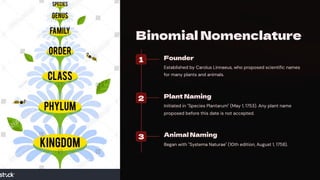
Binomial Nomenclature
1 Founder
Established by Carolus Linnaeus, who proposed scientific names
for many plants and animals.
2 Plant Naming
Initiated in "Species Plantarum" (May 1, 1753). Any plant name
proposed before this date is not accepted.
3 Animal Naming
Began with "Systema Naturae" (10th edition, August 1, 1758).
International Code of Botanical
Nomenclature
1
Two-Part Names
Species names consist of generic name and specific epithet (e.g., Solanum tuberosum).
2
Capitalization Rules
First letter of generic name capitalized; specific epithet in lowercase.
3
Formatting
Names should be underlined when handwritten or typed; italicized when printed.
4
Attribution
Scientist's name abbreviated after specific epithet (e.g., Mangifera indica Linn.).
Types of Biological Classification
1
2
3
4
Practical
Based on economic importance or
human use (e.g., medicinal plants,
spices).
Artificial
Based on one or few superficial
morphological characters.
Natural
Based on complete morphological
characters, representing natural
similarities.
Phylogenetic
Considers both morphology and
evolutionary relationships.
Pioneers of Plant
Classification
Aristotle
(384-322 BC)
Greek philosopher who
first classified plants
into three groups: herbs,
shrubs, and trees.
Theophrastus
(371-287 BC)
"Father of botany" who
classified plants into
herbs, undershrubs,
shrubs, and trees.
Carolus
Linnaeus
(1707-1778)
"Father of modern
taxonomy" who
formalized binomial
nomenclature and two-
kingdom system.
Taxonomic Categories
1
Kingdom
Broadest category
2
Division/Phylum
Major lineages
3
Class
Related orders
4
Order
Related families
5
Family
Related genera
6
Genus
Related species
7
Species
Basic unit
Taxonomical Aids
Herbarium
Collection of dried, pressed plant
specimens on sheets (11.5 × 16.5 inches),
arranged by classification system.
Botanical Gardens
Living plant collections for reference and
identification, with each plant labeled with
scientific name and family.
Museums
Collections of preserved plant and animal
specimens in containers or as dry
specimens for study and reference.
Evolution of
Classification Systems
Two-Kingdom System (Linnaeus, 1758)
Divided organisms into Plantae and Animalia based on cell wall presence.
Five-Kingdom System (Whittaker, 1969)
Expanded to Monera, Protista, Fungi, Plantae, and Animalia based on
cell structure and nutrition.
Three-Domain System (Woese)
Proposed Bacteria, Archaea, and Eukarya, dividing Monera into two
domains.
Kingdom Monera: Prokaryotes
1 Cell Structure
Prokaryotic cells with peptidoglycan
cell walls, no membrane-bound
organelles, and 70S ribosomes.
2 Genetic Material
Circular DNA in nucleoid region,
often with additional plasmids.
3 Examples
Eubacteria, Blue-Green Algae
(Cyanobacteria), Mycoplasma,
Archaebacteria, Rickettsia, and
Chlamydia.
Bacterial Diversity
Bacteria show remarkable diversity in shape: spherical cocci, rod-shaped bacilli, spiral spirilla, and comma-shaped vibrio. Their
movement is facilitated by flagella with complex basal bodies.
Bacterial Cell Structure
Cell Envelope
Three-layered structure with glycocalyx
(capsule/slime), cell wall (peptidoglycan),
and cell membrane.
Gram Staining
Gram-positive bacteria retain purple stain
due to thick peptidoglycan layer. Gram-
negative have thinner walls with
lipopolysaccharide outer layer.
Cytoplasm
Contains nucleoid (DNA), ribosomes,
mesosomes, and storage granules. No
membrane-bound organelles.
Bacterial Nutrition and Reproduction
Nutrition Types
Autotrophs (photosynthetic or
chemosynthetic) and heterotrophs
(saprotrophic or parasitic). Most diverse
metabolic capabilities in nature.
Reproduction
Asexual reproduction by binary fission or
endospore formation. Genetic
recombination through transformation,
transduction, or conjugation.
Cyanobacteria (Blue-
Green Algae)
Structure
Prokaryotic with cell wall,
thylakoids for photosynthesis,
and gas vacuoles. Can be
unicellular, colonial, or
filamentous.
Nitrogen Fixation
Many can fix atmospheric
nitrogen using specialized
heterocyst cells, improving soil
fertility in paddy fields.
Reproduction
Vegetative by binary fission or fragmentation. Asexual by akinete formation
for protection during unfavorable conditions.
Kingdom Protista
1
Characteristics
Unicellular eukaryotes, primarily aquatic. Form a link between
other kingdoms.
2
Examples
Dinoflagellates, diatoms, euglenoids, slime molds, and protozoans.
3
Reproduction
Asexual by binary fission or spore formation. Sexual reproduction
through isogamy, anisogamy, or oogamy.
Protist Diversity
Protists show remarkable diversity: bioluminescent dinoflagellates, silica-walled diatoms, mixotrophic euglenoids, and the fascinating
plasmodium stage of slime molds that can spread over several feet.
Kingdom Fungi
1 Characteristics
Heterotrophic eukaryotes with chitin cell walls. Body composed of
filaments called hyphae that form mycelium.
2 Nutrition
Absorptive nutrition as saprophytes or parasites. Some form symbiotic
relationships as lichens or mycorrhiza.
3 Reproduction
Vegetative by fragmentation or budding. Asexual by spores. Sexual
through plasmogamy, karyogamy, and meiosis.
4 Classification
Divided into Phycomycetes, Ascomycetes, Basidiomycetes, and
Deuteromycetes based on reproductive structures.
Fungal Classes
Phycomycetes
Coenocytic aseptate mycelium. Asexual
reproduction by zoospores or
aplanospores. Sexual by zygospores or
oospores.
Ascomycetes
"Sac fungi" with septate mycelium. Produce
ascospores in sac-like asci. Include yeasts,
Penicillium, and morels.
Basidiomycetes
"Club fungi" with septate mycelium and
dolipore septa. Produce basidiospores on
club-shaped basidia. Include mushrooms
and rusts.
Kingdom Plantae: Algae
Chlorophyceae Phaeophyceae Rhodophyceae Other Algae
Algae are primarily aquatic, photosynthetic thalloid plants. They lack true roots, stems, and leaves. Classification is based on pigments,
cell wall composition, and stored food. The three main classes are green algae (Chlorophyceae), brown algae (Phaeophyceae), and red
algae (Rhodophyceae).
Algal Diversity
Green Algae
Contain chlorophyll a and b. Store starch.
Cell walls of cellulose and pectose. Found
as unicellular, colonial, or filamentous
forms. Most closely related to land plants.
Brown Algae
Contain fucoxanthin pigment. Store
laminarin and mannitol. Cell walls with
algin. Mostly marine and largest in size.
Show holdfast, stipe, and frond structure.
Red Algae
Contain phycoerythrin. Store floridean
starch. No motile stages. Mostly marine.
Important source of agar and
carrageenin.
Bryophytes:
Amphibians of Plant
Kingdom
1 Characteristics
First land plants but dependent
on water for fertilization. Lack
vascular tissue and true roots.
Prefer moist, shady habitats.
2 Life Cycle
Dominant gametophyte
generation. Multicellular
jacketed sex organs.
Sporophyte dependent on
gametophyte.
3 Classes
Divided into liverworts (Hepaticopsida), hornworts (Anthocerotopsida),
and mosses (Bryopsida).
Bryophyte Classes
Liverworts
Thalloid or leafy. Rhizoids unicellular.
Sporophyte with foot, seta, and capsule
(except Riccia). Reproduce by
fragmentation or gemmae.
Hornworts
Thalloid with unicellular rhizoids.
Sporophyte with foot and elongated horn-
like capsule. Partially photosynthetic
sporophyte.
Mosses
Leafy gametophyte with multicellular
rhizoids. Sporophyte with foot, seta, and
capsule. Spores germinate to form
protonema.
Pteridophytes: Vascular Cryptogams
1
Vascular Tissue
First plants with true xylem and phloem, allowing greater height and terrestrial adaptation.
2
True Roots
Possess true roots, stems, and leaves, though still require water for fertilization.
3
Independent Generations
Sporophyte dominant and independent of gametophyte.
Unique alternation of generations.
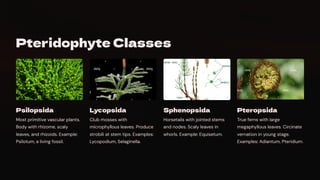
Pteridophyte Classes
Psilopsida
Most primitive vascular plants.
Body with rhizome, scaly
leaves, and rhizoids. Example:
Psilotum, a living fossil.
Lycopsida
Club mosses with
microphyllous leaves. Produce
strobili at stem tips. Examples:
Lycopodium, Selaginella.
Sphenopsida
Horsetails with jointed stems
and nodes. Scaly leaves in
whorls. Example: Equisetum.
Pteropsida
True ferns with large
megaphyllous leaves. Circinate
vernation in young stage.
Examples: Adiantum, Pteridium.
Gymnosperms: Naked
Seed Plants
Characteristics
Seed plants with exposed ovules.
Vascular plants with early
secondary growth. Adapted to
xerophytic conditions.
Reproduction
Heterosporous with endosporic
germination. Male and female
cones. Fertilization by
siphonogamy. No fruit formation.
Classification
Divided into Cycadophyta (lower gymnosperms) and Coniferophyta
(higher gymnosperms).
Gymnosperm Diversity
Gymnosperms show remarkable diversity: Cycas (sago palm) with large ovules and motile sperm, Pinus (pine) with needle leaves and
winged seeds, Ginkgo biloba (maidenhair tree) as a living fossil, and Ephedra, a medicinal shrub containing ephedrine used for asthma
treatment.
Viruses, Viroids, and
Prions
1 Viruses
Submicroscopic obligate intracellular parasites with either DNA or
RNA. Inert outside host cells. First crystallized by Stanley (TMV).
2 Viroids
Discovered by T.O. Diener in 1971. Contain only low molecular
weight RNA without protein coat. Cause plant diseases like potato
spindle tuber.
3 Prions
Smallest proteinaceous infectious agents. Abnormally folded
proteins causing diseases like mad cow disease and Creutzfeldt-
Jakob disease.
Lichens and Mycorrhiza: Symbiotic
Relationships
Lichens
Symbiotic association between algae (phycobiont) and fungi
(mycobiont). Classified as crustose, foliose, or fruticose.
Important as pollution indicators and sources of dyes and
medicines.
Mycorrhiza
Symbiotic association between roots and fungi. Ectomycorrhiza
forms external sheath and Hartig net. Endomycorrhiza (VAM)
forms vesicles and arbuscules inside root cells. Enhances
nutrient absorption.

Plant-Diversity-A-Comprehensive-Guide.pdf

  • 1.
    Plant Diversity: A ComprehensiveGuide Welcome to an exploration of the incredible diversity found in the plant kingdom. This presentation covers taxonomy, classification systems, and the major plant groups from algae to angiosperms. by sandeep swamy
  • 2.
    Understanding Taxonomy 1 Definition Taxonomy isthe branch of biology dealing with identification, nomenclature, and classification of organisms. 2 Origin The term was proposed by A.P. de Candolle in his book "Theories elementaire de la botanique." 3 Components Includes identification, nomenclature, and classification based on observable characters.
  • 3.
    Systematics vs. Taxonomy Systematics Derivedfrom Latin "Systema," meaning systematic arrangement. Introduced by Linnaeus. Includes evolutionary relationships between organisms. Taxonomy Focuses specifically on identification, naming, and classification. Modern taxonomists use external and internal structures, cell structure, and ecological information.
  • 4.
    Types of Taxonomy Cytotaxonomy Usescytological characters like chromosome number, structure, and behavior to solve taxonomic problems. Chemotaxonomy Based on chemical constituents like alkaloids, carotenoids, tannins, polysaccharides, nucleic acids, and fatty acids. Numerical Taxonomy Uses numbers and codes for characters, processed by computers. Gives equal importance to all characters.
  • 5.
    Binomial Nomenclature 1 Founder Establishedby Carolus Linnaeus, who proposed scientific names for many plants and animals. 2 Plant Naming Initiated in "Species Plantarum" (May 1, 1753). Any plant name proposed before this date is not accepted. 3 Animal Naming Began with "Systema Naturae" (10th edition, August 1, 1758).
  • 6.
    International Code ofBotanical Nomenclature 1 Two-Part Names Species names consist of generic name and specific epithet (e.g., Solanum tuberosum). 2 Capitalization Rules First letter of generic name capitalized; specific epithet in lowercase. 3 Formatting Names should be underlined when handwritten or typed; italicized when printed. 4 Attribution Scientist's name abbreviated after specific epithet (e.g., Mangifera indica Linn.).
  • 7.
    Types of BiologicalClassification 1 2 3 4 Practical Based on economic importance or human use (e.g., medicinal plants, spices). Artificial Based on one or few superficial morphological characters. Natural Based on complete morphological characters, representing natural similarities. Phylogenetic Considers both morphology and evolutionary relationships.
  • 8.
    Pioneers of Plant Classification Aristotle (384-322BC) Greek philosopher who first classified plants into three groups: herbs, shrubs, and trees. Theophrastus (371-287 BC) "Father of botany" who classified plants into herbs, undershrubs, shrubs, and trees. Carolus Linnaeus (1707-1778) "Father of modern taxonomy" who formalized binomial nomenclature and two- kingdom system.
  • 9.
    Taxonomic Categories 1 Kingdom Broadest category 2 Division/Phylum Majorlineages 3 Class Related orders 4 Order Related families 5 Family Related genera 6 Genus Related species 7 Species Basic unit
  • 10.
    Taxonomical Aids Herbarium Collection ofdried, pressed plant specimens on sheets (11.5 × 16.5 inches), arranged by classification system. Botanical Gardens Living plant collections for reference and identification, with each plant labeled with scientific name and family. Museums Collections of preserved plant and animal specimens in containers or as dry specimens for study and reference.
  • 11.
    Evolution of Classification Systems Two-KingdomSystem (Linnaeus, 1758) Divided organisms into Plantae and Animalia based on cell wall presence. Five-Kingdom System (Whittaker, 1969) Expanded to Monera, Protista, Fungi, Plantae, and Animalia based on cell structure and nutrition. Three-Domain System (Woese) Proposed Bacteria, Archaea, and Eukarya, dividing Monera into two domains.
  • 12.
    Kingdom Monera: Prokaryotes 1Cell Structure Prokaryotic cells with peptidoglycan cell walls, no membrane-bound organelles, and 70S ribosomes. 2 Genetic Material Circular DNA in nucleoid region, often with additional plasmids. 3 Examples Eubacteria, Blue-Green Algae (Cyanobacteria), Mycoplasma, Archaebacteria, Rickettsia, and Chlamydia.
  • 13.
    Bacterial Diversity Bacteria showremarkable diversity in shape: spherical cocci, rod-shaped bacilli, spiral spirilla, and comma-shaped vibrio. Their movement is facilitated by flagella with complex basal bodies.
  • 14.
    Bacterial Cell Structure CellEnvelope Three-layered structure with glycocalyx (capsule/slime), cell wall (peptidoglycan), and cell membrane. Gram Staining Gram-positive bacteria retain purple stain due to thick peptidoglycan layer. Gram- negative have thinner walls with lipopolysaccharide outer layer. Cytoplasm Contains nucleoid (DNA), ribosomes, mesosomes, and storage granules. No membrane-bound organelles.
  • 15.
    Bacterial Nutrition andReproduction Nutrition Types Autotrophs (photosynthetic or chemosynthetic) and heterotrophs (saprotrophic or parasitic). Most diverse metabolic capabilities in nature. Reproduction Asexual reproduction by binary fission or endospore formation. Genetic recombination through transformation, transduction, or conjugation.
  • 16.
    Cyanobacteria (Blue- Green Algae) Structure Prokaryoticwith cell wall, thylakoids for photosynthesis, and gas vacuoles. Can be unicellular, colonial, or filamentous. Nitrogen Fixation Many can fix atmospheric nitrogen using specialized heterocyst cells, improving soil fertility in paddy fields. Reproduction Vegetative by binary fission or fragmentation. Asexual by akinete formation for protection during unfavorable conditions.
  • 17.
    Kingdom Protista 1 Characteristics Unicellular eukaryotes,primarily aquatic. Form a link between other kingdoms. 2 Examples Dinoflagellates, diatoms, euglenoids, slime molds, and protozoans. 3 Reproduction Asexual by binary fission or spore formation. Sexual reproduction through isogamy, anisogamy, or oogamy.
  • 18.
    Protist Diversity Protists showremarkable diversity: bioluminescent dinoflagellates, silica-walled diatoms, mixotrophic euglenoids, and the fascinating plasmodium stage of slime molds that can spread over several feet.
  • 19.
    Kingdom Fungi 1 Characteristics Heterotrophiceukaryotes with chitin cell walls. Body composed of filaments called hyphae that form mycelium. 2 Nutrition Absorptive nutrition as saprophytes or parasites. Some form symbiotic relationships as lichens or mycorrhiza. 3 Reproduction Vegetative by fragmentation or budding. Asexual by spores. Sexual through plasmogamy, karyogamy, and meiosis. 4 Classification Divided into Phycomycetes, Ascomycetes, Basidiomycetes, and Deuteromycetes based on reproductive structures.
  • 20.
    Fungal Classes Phycomycetes Coenocytic aseptatemycelium. Asexual reproduction by zoospores or aplanospores. Sexual by zygospores or oospores. Ascomycetes "Sac fungi" with septate mycelium. Produce ascospores in sac-like asci. Include yeasts, Penicillium, and morels. Basidiomycetes "Club fungi" with septate mycelium and dolipore septa. Produce basidiospores on club-shaped basidia. Include mushrooms and rusts.
  • 21.
    Kingdom Plantae: Algae ChlorophyceaePhaeophyceae Rhodophyceae Other Algae Algae are primarily aquatic, photosynthetic thalloid plants. They lack true roots, stems, and leaves. Classification is based on pigments, cell wall composition, and stored food. The three main classes are green algae (Chlorophyceae), brown algae (Phaeophyceae), and red algae (Rhodophyceae).
  • 22.
    Algal Diversity Green Algae Containchlorophyll a and b. Store starch. Cell walls of cellulose and pectose. Found as unicellular, colonial, or filamentous forms. Most closely related to land plants. Brown Algae Contain fucoxanthin pigment. Store laminarin and mannitol. Cell walls with algin. Mostly marine and largest in size. Show holdfast, stipe, and frond structure. Red Algae Contain phycoerythrin. Store floridean starch. No motile stages. Mostly marine. Important source of agar and carrageenin.
  • 23.
    Bryophytes: Amphibians of Plant Kingdom 1Characteristics First land plants but dependent on water for fertilization. Lack vascular tissue and true roots. Prefer moist, shady habitats. 2 Life Cycle Dominant gametophyte generation. Multicellular jacketed sex organs. Sporophyte dependent on gametophyte. 3 Classes Divided into liverworts (Hepaticopsida), hornworts (Anthocerotopsida), and mosses (Bryopsida).
  • 24.
    Bryophyte Classes Liverworts Thalloid orleafy. Rhizoids unicellular. Sporophyte with foot, seta, and capsule (except Riccia). Reproduce by fragmentation or gemmae. Hornworts Thalloid with unicellular rhizoids. Sporophyte with foot and elongated horn- like capsule. Partially photosynthetic sporophyte. Mosses Leafy gametophyte with multicellular rhizoids. Sporophyte with foot, seta, and capsule. Spores germinate to form protonema.
  • 25.
    Pteridophytes: Vascular Cryptogams 1 VascularTissue First plants with true xylem and phloem, allowing greater height and terrestrial adaptation. 2 True Roots Possess true roots, stems, and leaves, though still require water for fertilization. 3 Independent Generations Sporophyte dominant and independent of gametophyte. Unique alternation of generations.
  • 26.
    Pteridophyte Classes Psilopsida Most primitivevascular plants. Body with rhizome, scaly leaves, and rhizoids. Example: Psilotum, a living fossil. Lycopsida Club mosses with microphyllous leaves. Produce strobili at stem tips. Examples: Lycopodium, Selaginella. Sphenopsida Horsetails with jointed stems and nodes. Scaly leaves in whorls. Example: Equisetum. Pteropsida True ferns with large megaphyllous leaves. Circinate vernation in young stage. Examples: Adiantum, Pteridium.
  • 27.
    Gymnosperms: Naked Seed Plants Characteristics Seedplants with exposed ovules. Vascular plants with early secondary growth. Adapted to xerophytic conditions. Reproduction Heterosporous with endosporic germination. Male and female cones. Fertilization by siphonogamy. No fruit formation. Classification Divided into Cycadophyta (lower gymnosperms) and Coniferophyta (higher gymnosperms).
  • 28.
    Gymnosperm Diversity Gymnosperms showremarkable diversity: Cycas (sago palm) with large ovules and motile sperm, Pinus (pine) with needle leaves and winged seeds, Ginkgo biloba (maidenhair tree) as a living fossil, and Ephedra, a medicinal shrub containing ephedrine used for asthma treatment.
  • 29.
    Viruses, Viroids, and Prions 1Viruses Submicroscopic obligate intracellular parasites with either DNA or RNA. Inert outside host cells. First crystallized by Stanley (TMV). 2 Viroids Discovered by T.O. Diener in 1971. Contain only low molecular weight RNA without protein coat. Cause plant diseases like potato spindle tuber. 3 Prions Smallest proteinaceous infectious agents. Abnormally folded proteins causing diseases like mad cow disease and Creutzfeldt- Jakob disease.
  • 30.
    Lichens and Mycorrhiza:Symbiotic Relationships Lichens Symbiotic association between algae (phycobiont) and fungi (mycobiont). Classified as crustose, foliose, or fruticose. Important as pollution indicators and sources of dyes and medicines. Mycorrhiza Symbiotic association between roots and fungi. Ectomycorrhiza forms external sheath and Hartig net. Endomycorrhiza (VAM) forms vesicles and arbuscules inside root cells. Enhances nutrient absorption.