Ectocarpus
Occurrence
Ectocarpus is a brown alga. It is abundantly found
throughout the world in cold waters. A few species
occur in fresh waters.
The plant grows attached to rocks and stones along
coasts.
Some species are epiphytes on other algae like
members of Fucales and Laminaria.
Structure of thallus
• Genetically the thalli may be haploid or diploid.
But both the types are morphologically alike.
• The thallus consists of profusely branched
uniseriate filaments. It shows heterotrichous
habit.
• There are two systems of filaments. These are
prostrate and projecting system.
• The filaments of the projecting system arise from
the filaments of prostrate system
• a) Prostate system: The prostrate system
consists of creeping,septate, irregularly
branched filaments.
• These filaments are attached to the
substratum with the help of rhizoids. This
system penetrates the host tissues in
epiphytic conditions.
• Prostrate system is poorly developed in free
floating species.
B. Projecting system: The projecting system arises from
the prostrate system. It consists of well branched
filaments.
Each branch arises beneath the septa. The main axis and
the branches of the projecting system are uniseriate.
In this case, branches are joined end to end in a single
series. The branches terminate into an acute point to
form a hair.
In some species the older portions of main axis are
ensheathed (corticated). This sheath is formed of a
layer of descending rhizoidal branches.
Cell Structure
• The cells are small. They are cylindrical or rectangular
and uninucleate.
• the cell wall is thick ,It is composed of pectic-cellulose.
Algin and fucoidan are also present in the cell wall.
These are characteristic gelatinous substances of the
walls of brown algae.
• The chromatophores may be ribbon-like with irregular
outline or disc- shaped. The dominant pigment of
Ectocarpus is fucoxanthin. It gives this algae golden
brown colour. The other photosynthetic pigments are
chlorophyll-a, -c, beta-carotene and other
xanthophylls.
• pyrenoid-like bodies-are associated with the
chromatophores. All other eukaryotic organells
are present.
• Growth; The growth of filaments in projecting
system is intercalary : intercalary meristem is
present at the base of the hair. It is called
trichothallic meristem. It increases the length of
the terminal hair and vegetative cell of the
branch.
• This growth is called trichothallic growth.
• b) The growth in the prostrate system is
apical
Reproduction
Ectocarpus reproduces by both asexual and sexual
methods.
Asexual reproduction
The asexual reproduction takes place by the formation of
biflagellate zompores.
These zoospores may be haploid produced in one-celled
unilocular sporangia.
Or they may be diploid formed in manycellod plurilocular
sporangia. B
oth kinds of sporangia are present on the same diploid
sporophyte plant.
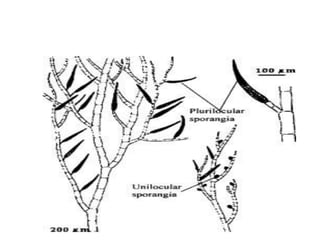
The sporangia are borne terminally and singly on lateral
branches.
(a) Unilocular Sporangia
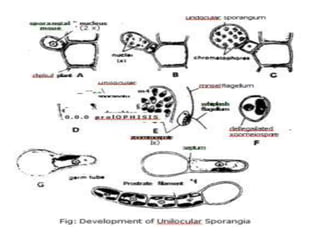
A unilocular sporangium develops from a terminal cell of a
short lateral branch.
The sporangial initial enlarges in size. It becomes globose or
ellipsoidal. The number of chromatophores also increases in it.
The nucleus of the sporangium divides meiotically to produce
four haploid nuclei. These nuclei undergo repeated mitotic
divisions to produce 32-64 daughter nuclei. The cytoplasm of
the sporangium divides.
A small amount of cytoplasm surrounds a nucleus and a
zoospore is formed.
thromatophore to produce daughter protoplasts. Each
daughter protoplast metamorphoses into a
meiozoospore (produced by meiosis).
Meiozoospore is pyriforrn and biflagellate. The
flagella are laterally inserted and are of unequal size.
The larger one directed forward and the smaller one is
directed backward.
An apical pore is formed in the gelatinous mass of
sporangia.
The meiozoospores come out of this pore.
These are separated from each other after few
moments.
They swim freely in all directions. A new sporangium
may be produced within the old sporangial wall after
the liberation of zoospores.
b) Plurilocular Sporangia
The plurilocular sporangia are stalked or
sessile.
These are elongated, cone-like multicellular
structures.
These also develop from a terminal cell of a
short lateral branch.
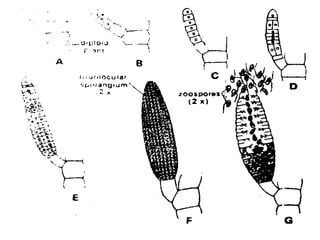
•The sporangial initial enlarges in size.
• It undergoes repeated transverse mitotic divisions. It
produces a vertical row of 6-12 :ells.
•These cells then divide by vertical and transverse divisions
repeatedly.
•They form a cone-like structure. This cone consists of
hundreds of small cubical cells. These cells are arranged in
20-40 transverse tiers.
•Each cell represents a sporangium.
3.The protoplast of each cell metamorphoses into a single
mitozoospore (produced by mitosis).
4.The mitozoospore is pear-shaped, diploid and biflagellate.
The flagella are of unequal size and are laterally inserted.
4.The mitozoospores are liberated through a terminal or a
lateral pore of the sporangium.
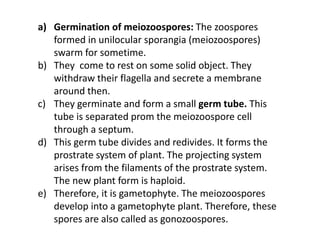
a) Germination of meiozoospores: The zoospores
formed in unilocular sporangia (meiozoospores)
swarm for sometime.
b) They come to rest on some solid object. They
withdraw their flagella and secrete a membrane
around then.
c) They germinate and form a small germ tube. This
tube is separated prom the meiozoospore cell
through a septum.
d) This germ tube divides and redivides. It forms the
prostrate system of plant. The projecting system
arises from the filaments of the prostrate system.
The new plant form is haploid.
e) Therefore, it is gametophyte. The meiozoospores
develop into a gametophyte plant. Therefore, these
spores are also called as gonozoospores.
b) Germination of mitozoospores: The zoospores
produced in plurilocular sporangia are
mitozoospores.
They develop in the same manner as the
meiozoospores. But they are diploid. Therefore, they
develop into a diploid sporophyte.
The mitozoospores are also called as neutral spores.
They are useful for the reduplication of sporophyte
generation.
Sexual Reproduction
Sexual reproduction takes place by isogamy or anisogamy.
Majority of the species are isogamous and homothallic.
Some species are anisogamous.
Ectocarpus secundus is heterothallic and anisogamous.
The gametes are produced in plurilocular gametangia.
These gametangia are many-celled, elongated, and sessile or
shortly stalked conical structures.
These gametangia are produced on the haploid plants
developing from the meiozoospores.
The development of gametangia is similar to that of plurilocular
sporangia.
. These develop from terminal cell of a
lateral branch.
It divides mitotically by repeated
transverse divisions.
It produces a vertical row of flat cells.
•These cells undergo repeated vertical and transverse
divisions.
•They form many hundred small cubical cells. These
cells are arranged in 24-40 transverse rows.
•The protoplast of each cell metatnorphoses into a
single, pyriform, biflagellate, haploid zoogamete.
•The flagella are laterally attached. The zoospores and
the gametes are similar in structure. But the gametes
are relatively smaller in size.
•The gametes are liberated from the gametangium
through the apical pore formed in the cell walI of the
sporangium. .
Isogamy: Isogamous species are E. pusilus and E.
globifer etc.
In these species, the fusion takes place between
alike gametes.
These gametes belong to the same plant or even to
toe same gametangium.
•Physiological anisogamy or Clump Formation: It
occurs in species like E. siliculosis. The fusing gametes
are identical norphologically.
• But they show different sexual behaviour. One is less
active and is called female gamete.
•The other is more active and is called male gamete.
•The female gamete soon comes to rest. It settles on a
substratum.
•It becomes surrounded by active male gametes.
•The male gametes attach themselves to the female
gamete through their anterior flagella.
•The anchoring flagellum contracts. Therefore, the body
of the male gamete comes in contact with that of the
female gamete and the fusion takes place.
•This phenomenon is called clump formation.
•Morphological Anisogamy: It occurs in
species like E. secundus. In this case, the two
fusing gametes are dissimilar in size.
•They are produced in different gametangia:
•The smaller ones are produced in
microgametangia.
• The larger ones are lroduced in
megagametangia
Fertilization
Fere lization occurs and diploid
zygote is formed. There is no
zygotic meiosis. The zygote
germinates into a diploid
sporophyte
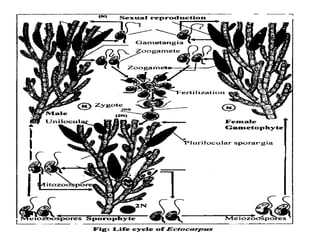
Alternation of Generations
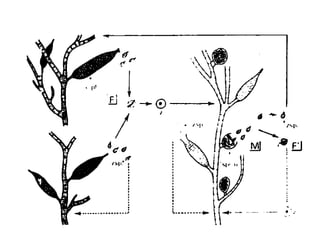
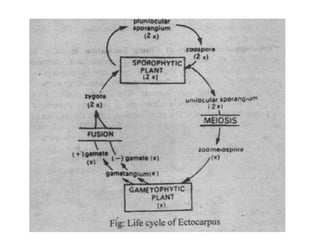
Ectocarpus shows isomorphic alternation of generations.
a) Sporophyte: The sporophyte is diploid. It develops two types of
sporangia. Zoospores are produced in these sporangia. Zoospores are
produced by mitosis (mitozoospores) in plurilocular sporangia. The
zoospores in unilocular sporangia are produced meiotically
(meiozoospores). The mitozoospores germinate into a diploid sporophyte.
These spores cause reduplication of sporophyte generation. The
meiozoospores germinate to give rise a haploid gametophyte plant.
Gametophyte: It develops pl uri !ocular gametangia. These gametophytes
are similar to the sporophyte in morphology. Haploid gametes are produced
in the gametangia. These gametes fuse to form a diploid zygote. Zygote
germinates into a diploid sporophyte plant. In some species the
gametophyte generation is also reduplicated by the parthenogenesis. In
this case, the gametes from plu-ilocular sporangia form new gametophyte
generation.

Ectocarpusppt y.vani

  • 1.
    Ectocarpus Occurrence Ectocarpus is abrown alga. It is abundantly found throughout the world in cold waters. A few species occur in fresh waters. The plant grows attached to rocks and stones along coasts. Some species are epiphytes on other algae like members of Fucales and Laminaria.
  • 2.
    Structure of thallus •Genetically the thalli may be haploid or diploid. But both the types are morphologically alike. • The thallus consists of profusely branched uniseriate filaments. It shows heterotrichous habit. • There are two systems of filaments. These are prostrate and projecting system. • The filaments of the projecting system arise from the filaments of prostrate system
  • 3.
    • a) Prostatesystem: The prostrate system consists of creeping,septate, irregularly branched filaments. • These filaments are attached to the substratum with the help of rhizoids. This system penetrates the host tissues in epiphytic conditions. • Prostrate system is poorly developed in free floating species.
  • 4.
    B. Projecting system:The projecting system arises from the prostrate system. It consists of well branched filaments. Each branch arises beneath the septa. The main axis and the branches of the projecting system are uniseriate. In this case, branches are joined end to end in a single series. The branches terminate into an acute point to form a hair. In some species the older portions of main axis are ensheathed (corticated). This sheath is formed of a layer of descending rhizoidal branches.
  • 6.
    Cell Structure • Thecells are small. They are cylindrical or rectangular and uninucleate. • the cell wall is thick ,It is composed of pectic-cellulose. Algin and fucoidan are also present in the cell wall. These are characteristic gelatinous substances of the walls of brown algae. • The chromatophores may be ribbon-like with irregular outline or disc- shaped. The dominant pigment of Ectocarpus is fucoxanthin. It gives this algae golden brown colour. The other photosynthetic pigments are chlorophyll-a, -c, beta-carotene and other xanthophylls.
  • 7.
    • pyrenoid-like bodies-areassociated with the chromatophores. All other eukaryotic organells are present. • Growth; The growth of filaments in projecting system is intercalary : intercalary meristem is present at the base of the hair. It is called trichothallic meristem. It increases the length of the terminal hair and vegetative cell of the branch. • This growth is called trichothallic growth.
  • 8.
    • b) Thegrowth in the prostrate system is apical
  • 10.
    Reproduction Ectocarpus reproduces byboth asexual and sexual methods. Asexual reproduction The asexual reproduction takes place by the formation of biflagellate zompores. These zoospores may be haploid produced in one-celled unilocular sporangia. Or they may be diploid formed in manycellod plurilocular sporangia. B oth kinds of sporangia are present on the same diploid sporophyte plant. The sporangia are borne terminally and singly on lateral branches.
  • 11.
    (a) Unilocular Sporangia Aunilocular sporangium develops from a terminal cell of a short lateral branch. The sporangial initial enlarges in size. It becomes globose or ellipsoidal. The number of chromatophores also increases in it. The nucleus of the sporangium divides meiotically to produce four haploid nuclei. These nuclei undergo repeated mitotic divisions to produce 32-64 daughter nuclei. The cytoplasm of the sporangium divides. A small amount of cytoplasm surrounds a nucleus and a zoospore is formed.
  • 12.
    thromatophore to producedaughter protoplasts. Each daughter protoplast metamorphoses into a meiozoospore (produced by meiosis). Meiozoospore is pyriforrn and biflagellate. The flagella are laterally inserted and are of unequal size. The larger one directed forward and the smaller one is directed backward. An apical pore is formed in the gelatinous mass of sporangia. The meiozoospores come out of this pore. These are separated from each other after few moments. They swim freely in all directions. A new sporangium may be produced within the old sporangial wall after the liberation of zoospores.
  • 13.
    b) Plurilocular Sporangia Theplurilocular sporangia are stalked or sessile. These are elongated, cone-like multicellular structures. These also develop from a terminal cell of a short lateral branch.
  • 14.
    •The sporangial initialenlarges in size. • It undergoes repeated transverse mitotic divisions. It produces a vertical row of 6-12 :ells. •These cells then divide by vertical and transverse divisions repeatedly. •They form a cone-like structure. This cone consists of hundreds of small cubical cells. These cells are arranged in 20-40 transverse tiers. •Each cell represents a sporangium. 3.The protoplast of each cell metamorphoses into a single mitozoospore (produced by mitosis). 4.The mitozoospore is pear-shaped, diploid and biflagellate. The flagella are of unequal size and are laterally inserted. 4.The mitozoospores are liberated through a terminal or a lateral pore of the sporangium.
  • 16.
    a) Germination ofmeiozoospores: The zoospores formed in unilocular sporangia (meiozoospores) swarm for sometime. b) They come to rest on some solid object. They withdraw their flagella and secrete a membrane around then. c) They germinate and form a small germ tube. This tube is separated prom the meiozoospore cell through a septum. d) This germ tube divides and redivides. It forms the prostrate system of plant. The projecting system arises from the filaments of the prostrate system. The new plant form is haploid. e) Therefore, it is gametophyte. The meiozoospores develop into a gametophyte plant. Therefore, these spores are also called as gonozoospores.
  • 18.
    b) Germination ofmitozoospores: The zoospores produced in plurilocular sporangia are mitozoospores. They develop in the same manner as the meiozoospores. But they are diploid. Therefore, they develop into a diploid sporophyte. The mitozoospores are also called as neutral spores. They are useful for the reduplication of sporophyte generation.
  • 19.
    Sexual Reproduction Sexual reproductiontakes place by isogamy or anisogamy. Majority of the species are isogamous and homothallic. Some species are anisogamous. Ectocarpus secundus is heterothallic and anisogamous. The gametes are produced in plurilocular gametangia. These gametangia are many-celled, elongated, and sessile or shortly stalked conical structures. These gametangia are produced on the haploid plants developing from the meiozoospores. The development of gametangia is similar to that of plurilocular sporangia.
  • 21.
    . These developfrom terminal cell of a lateral branch. It divides mitotically by repeated transverse divisions. It produces a vertical row of flat cells.
  • 22.
    •These cells undergorepeated vertical and transverse divisions. •They form many hundred small cubical cells. These cells are arranged in 24-40 transverse rows. •The protoplast of each cell metatnorphoses into a single, pyriform, biflagellate, haploid zoogamete. •The flagella are laterally attached. The zoospores and the gametes are similar in structure. But the gametes are relatively smaller in size. •The gametes are liberated from the gametangium through the apical pore formed in the cell walI of the sporangium. .
  • 23.
    Isogamy: Isogamous speciesare E. pusilus and E. globifer etc. In these species, the fusion takes place between alike gametes. These gametes belong to the same plant or even to toe same gametangium.
  • 24.
    •Physiological anisogamy orClump Formation: It occurs in species like E. siliculosis. The fusing gametes are identical norphologically. • But they show different sexual behaviour. One is less active and is called female gamete. •The other is more active and is called male gamete. •The female gamete soon comes to rest. It settles on a substratum. •It becomes surrounded by active male gametes. •The male gametes attach themselves to the female gamete through their anterior flagella. •The anchoring flagellum contracts. Therefore, the body of the male gamete comes in contact with that of the female gamete and the fusion takes place. •This phenomenon is called clump formation.
  • 25.
    •Morphological Anisogamy: Itoccurs in species like E. secundus. In this case, the two fusing gametes are dissimilar in size. •They are produced in different gametangia: •The smaller ones are produced in microgametangia. • The larger ones are lroduced in megagametangia
  • 26.
    Fertilization Fere lization occursand diploid zygote is formed. There is no zygotic meiosis. The zygote germinates into a diploid sporophyte
  • 28.
    Alternation of Generations Ectocarpusshows isomorphic alternation of generations. a) Sporophyte: The sporophyte is diploid. It develops two types of sporangia. Zoospores are produced in these sporangia. Zoospores are produced by mitosis (mitozoospores) in plurilocular sporangia. The zoospores in unilocular sporangia are produced meiotically (meiozoospores). The mitozoospores germinate into a diploid sporophyte. These spores cause reduplication of sporophyte generation. The meiozoospores germinate to give rise a haploid gametophyte plant. Gametophyte: It develops pl uri !ocular gametangia. These gametophytes are similar to the sporophyte in morphology. Haploid gametes are produced in the gametangia. These gametes fuse to form a diploid zygote. Zygote germinates into a diploid sporophyte plant. In some species the gametophyte generation is also reduplicated by the parthenogenesis. In this case, the gametes from plu-ilocular sporangia form new gametophyte generation.