Course - Academic Writing
Application Number –
4d4aedc0e92111e992bfcb5fa4bbed35
Name - Dr. Nisha Verma (AW Learner)
College - Government Degree College, Bilaspur (Rampur) Uttar Pradesh.
Affiliated with MJP Rohilkhand University, Bareilly, Uttar Pradesh
Acknowledgment
I would like to thanks Dr. Ajay Semalty
Sir, MOOC Course Coordinator
(Academic Writing) and Dr. Mona
Semalty Madam for organizing this
course on Swayam Portal. This course
help me to improve my academic writing
skills.
What are Bryophytes……?
Bryon-Moss
Phyton-Plant
Sphagnum
General Characters
• Simplest and primitive non-vascular plants of group
Embryophyta.
• Occupy the position between Thallophyta and
Pteridophyta.
• Main plant body is gametophyte.
• Plant body is composed of parenchymatous cell only.
• “Liliputians of Plant Kingdom”
• “Amphibians of Plant Kingdom”.
Habitat
• Moist soil
• Damp rocks
• In ravines
• Tree trunk
• Logs of wood
• Wet walls
On Tree Trunk On Rock
On Wall On Tree
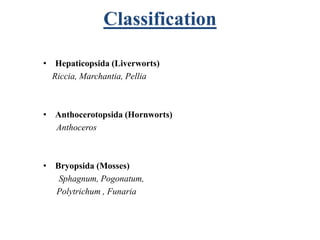
Classification
• Hepaticopsida (Liverworts)
Riccia, Marchantia, Pellia
• Anthocerotopsida (Hornworts)
Anthoceros
• Bryopsida (Mosses)
Sphagnum, Pogonatum,
Polytrichum , Funaria
Plant body of Bryophyte are of two type
Liverworts or Thalloid Moss
Riccia Funaria
Liverworts Moss
Dorsal Surface Ventral Surface
Riccia
Rhizoids
Roots are absent. On the
ventral surface, rhizoids
are present in place of
roots.
Rhizoids are of two
types:
1. Smooth walled
2. Tuberculate Rhizoids
Scales
Position –Present along
the margins (Riccia)
sometimes also present
on ventral surface of the
thallus (Marchantia).
Function- Protection of
growing regions of the
thallus.
Internal Structure
The thallus is internally differentiated into upper,
assimilatory (photosynthetic) zone and lower, storage
zone. The assimilatory zone consists of air chambers,
pores and assimilatory filaments.
V.T.S. of Riccia
V.T.S. of Marchantia
Marchantia Sphagnum
Anthoceros Plagiochasma
Vegetative Reproduction
• Fragmentation
• Adventitious branches
• By death and decay of
the older parts of the
thallus
• Tuber formation
• Gemma cup
Tuber formation
Gemma cup
Sexual Reproduction
Antheridium
Archegonium
Jacket layer
Androcyte
cells
stalk
Cover cells
Neck
canal
cells
Venter
canal cell
Egg cell
stalk
Antheridium Archegonium
Antherozoid Egg cell
Fertilization
Zygote
Embryo
Sporophyte
The mature antheridium dehisces
and releases antherozoids. They
swim in the film of water and reach
to the neck of the arehegonium. At
the time of fertilization the neck and
venter canal cells disintegrate. The
antherozoid swims upto the
archegonial venter passing through
the neck and fertilizes the egg.
The fertilized egg starts dividing
immediately after the fertilization
without undergoing any resting
period and remains inside the
archegonial wall. It develops into a
multicellular embryo, which
differentiates into the sporophyte.
Sporophyte The sporophyte consists of foot,
seta and capsule. The foot is
parenchymatous structure which
remains embedded in the
gametophytic tissue and derives
nourishment for the developing
sporophyte. Seta is the stalk, which
holds the capsule.The capsule is
the main fertile portion of the
sporophytic generation. It has
capsule wall enclosing
archesporium. The archesporial
cells get differentiated into spore
mother cells . The spore mother
cells, after meiotic division, form
spore tetrads having haploid
spores.
Alternation of Generation
Protonema Plant Body
(Gametophyte)x
Spores(x) Reproductive
Structures
MEIOSIS Antheridium (x) Archegonium(x)
Spore mother cell(2x) Anterozoids(x) Egg cell(x)
Capsule(2x) Fertilization
Sporophyte(2x) Zygote(2x)
Two well-marked and heteromorphic generations i.e.
Gametophyte and Sporophyte, which follow one after the
other in alternate manner.
Economic Importance
• Ecological importance
• Soil binders
• Packing and transporting material
• As a source of fuel
• Pollution indicators
References
• https://en.wikipedia.org
• https://byjus.com
• www.google.com
• Singh, Pandey and Jain. “A Text Book Of
Botany”. Rastogi Publication, Meerut.
• Vashishtha, B.R. “Botany For Degree students
Bryophyta”. S. Chand & Company Ltd. Ram
Nagar, New Delhi.
Feedback
Academic Writing, A great course, I received lots of
information and knowledge. This knowledge will help
me to implement and improve my writing skills; I
thoroughly enjoyed all the lectures of the course. This
course provides me some great idea for writing. I
congratulate to Dr. Ajay Semalty Sir, Course
Coordinator and Dr. Mona Semalty Madam for their
tremendous efforts. Thankyou very much for the
informative course.
Thanks

Aw assignment 2

  • 1.
    Course - AcademicWriting Application Number – 4d4aedc0e92111e992bfcb5fa4bbed35 Name - Dr. Nisha Verma (AW Learner) College - Government Degree College, Bilaspur (Rampur) Uttar Pradesh. Affiliated with MJP Rohilkhand University, Bareilly, Uttar Pradesh
  • 2.
    Acknowledgment I would liketo thanks Dr. Ajay Semalty Sir, MOOC Course Coordinator (Academic Writing) and Dr. Mona Semalty Madam for organizing this course on Swayam Portal. This course help me to improve my academic writing skills.
  • 3.
  • 4.
    General Characters • Simplestand primitive non-vascular plants of group Embryophyta. • Occupy the position between Thallophyta and Pteridophyta. • Main plant body is gametophyte. • Plant body is composed of parenchymatous cell only. • “Liliputians of Plant Kingdom” • “Amphibians of Plant Kingdom”.
  • 5.
    Habitat • Moist soil •Damp rocks • In ravines • Tree trunk • Logs of wood • Wet walls
  • 6.
    On Tree TrunkOn Rock On Wall On Tree
  • 7.
    Classification • Hepaticopsida (Liverworts) Riccia,Marchantia, Pellia • Anthocerotopsida (Hornworts) Anthoceros • Bryopsida (Mosses) Sphagnum, Pogonatum, Polytrichum , Funaria
  • 8.
    Plant body ofBryophyte are of two type Liverworts or Thalloid Moss Riccia Funaria
  • 9.
    Liverworts Moss Dorsal SurfaceVentral Surface Riccia
  • 10.
    Rhizoids Roots are absent.On the ventral surface, rhizoids are present in place of roots. Rhizoids are of two types: 1. Smooth walled 2. Tuberculate Rhizoids Scales Position –Present along the margins (Riccia) sometimes also present on ventral surface of the thallus (Marchantia). Function- Protection of growing regions of the thallus.
  • 11.
    Internal Structure The thallusis internally differentiated into upper, assimilatory (photosynthetic) zone and lower, storage zone. The assimilatory zone consists of air chambers, pores and assimilatory filaments. V.T.S. of Riccia V.T.S. of Marchantia
  • 12.
  • 13.
    Vegetative Reproduction • Fragmentation •Adventitious branches • By death and decay of the older parts of the thallus • Tuber formation • Gemma cup Tuber formation Gemma cup
  • 14.
    Sexual Reproduction Antheridium Archegonium Jacket layer Androcyte cells stalk Covercells Neck canal cells Venter canal cell Egg cell stalk
  • 15.
    Antheridium Archegonium Antherozoid Eggcell Fertilization Zygote Embryo Sporophyte The mature antheridium dehisces and releases antherozoids. They swim in the film of water and reach to the neck of the arehegonium. At the time of fertilization the neck and venter canal cells disintegrate. The antherozoid swims upto the archegonial venter passing through the neck and fertilizes the egg. The fertilized egg starts dividing immediately after the fertilization without undergoing any resting period and remains inside the archegonial wall. It develops into a multicellular embryo, which differentiates into the sporophyte.
  • 16.
    Sporophyte The sporophyteconsists of foot, seta and capsule. The foot is parenchymatous structure which remains embedded in the gametophytic tissue and derives nourishment for the developing sporophyte. Seta is the stalk, which holds the capsule.The capsule is the main fertile portion of the sporophytic generation. It has capsule wall enclosing archesporium. The archesporial cells get differentiated into spore mother cells . The spore mother cells, after meiotic division, form spore tetrads having haploid spores.
  • 17.
    Alternation of Generation ProtonemaPlant Body (Gametophyte)x Spores(x) Reproductive Structures MEIOSIS Antheridium (x) Archegonium(x) Spore mother cell(2x) Anterozoids(x) Egg cell(x) Capsule(2x) Fertilization Sporophyte(2x) Zygote(2x) Two well-marked and heteromorphic generations i.e. Gametophyte and Sporophyte, which follow one after the other in alternate manner.
  • 18.
    Economic Importance • Ecologicalimportance • Soil binders • Packing and transporting material • As a source of fuel • Pollution indicators
  • 19.
    References • https://en.wikipedia.org • https://byjus.com •www.google.com • Singh, Pandey and Jain. “A Text Book Of Botany”. Rastogi Publication, Meerut. • Vashishtha, B.R. “Botany For Degree students Bryophyta”. S. Chand & Company Ltd. Ram Nagar, New Delhi.
  • 20.
    Feedback Academic Writing, Agreat course, I received lots of information and knowledge. This knowledge will help me to implement and improve my writing skills; I thoroughly enjoyed all the lectures of the course. This course provides me some great idea for writing. I congratulate to Dr. Ajay Semalty Sir, Course Coordinator and Dr. Mona Semalty Madam for their tremendous efforts. Thankyou very much for the informative course.
  • 21.