This document provides spelling tips for 100 commonly misspelled words. It offers a mnemonic or memory device for each word to help the reader remember its correct spelling. The tips note patterns in spelling like prefixes, suffixes, doubled consonants, vowel sounds and exceptions to rules. Mastering the spellings provided could reduce time spent searching dictionaries by 50%.
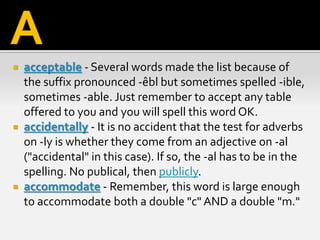
![ acquire -Try to acquire the knowledge that
this word and the next began with the prefix
ad- but the [d] converts to [c] before [q].
acquit - See the previous discussion.
a lot -Two words! Hopefully, you won't have to
allot a lot of time to this problem.
amateur - Amateurs need not be mature: this
word ends on the French suffix -eur (the
equivalent of English -er).
A](https://image.slidesharecdn.com/misspelledwords-161019035146/85/Misspelled-words-4-320.jpg)
![ apparent - A parent need not be apparent but
"apparent" must pay the rent, so remember this
word always has the rent.
argument - Let's not argue about the loss of
this verb's silent [e] before the suffix -ment.
atheist - Lord help you remember that this
word comprises the prefix a- "not" + the "god"
(also in the-ology) + -ist "one who believes."
A](https://image.slidesharecdn.com/misspelledwords-161019035146/85/Misspelled-words-5-320.jpg)
![ believe -You must believe that [i] usually comes
before [e] except after [c] or when it is pronounced
like "a" as "neighbor" and "weigh" or "e" as in "their"
and "heir." Also take a look at "foreign" below. (The
"i-before-e" rule has more exceptions than words it
applies to.)
bellwether - Often misspelled "bellweather." A
wether is a gelded ram, chosen to lead the herd
(thus his bell) due to the greater likelihood that he
will remain at all times ahead of the ewes.
B](https://image.slidesharecdn.com/misspelledwords-161019035146/85/Misspelled-words-6-320.jpg)
![ calendar -This word has an [e] between
two [a]s.The last vowel is [a].
category -This word is not in a category
with "catastrophe" even if it sounds like it:
the middle letter is [e].
cemetery - Don't let this one bury you: it
ends on -ery nary an -ary in it.You already
know it starts on [c], of course.
C](https://image.slidesharecdn.com/misspelledwords-161019035146/85/Misspelled-words-7-320.jpg)
![ changeable -The verb "change" keeps its [e]
here to indicate that the [g] is soft, not hard.
(That is also why "judgement" is the correct
spelling of this word, no matter what anyone
says.)
collectible - Another -ible word.You just have to
remember.
column - Silent final [e] is commonplace in
English but a silent final [n] is not uncommon,
especially after [m].
C](https://image.slidesharecdn.com/misspelledwords-161019035146/85/Misspelled-words-8-320.jpg)
![ committed - If you are committed to correct
spelling, you will remember that this word doubles
its final [t] from "commit" to "committed."
conscience - Don't let misspelling this word weigh on
your conscience: [ch] spelled "sc" is unusual but
legitimate.
conscientious -Work on your spelling
conscientiously and remember this word with [ch]
spelled two different ways: "sc" and "ti." English
spelling!
C](https://image.slidesharecdn.com/misspelledwords-161019035146/85/Misspelled-words-9-320.jpg)
![ conscious -Try to be conscious of the
"sc" [ch] sound and all the vowels in
this word's ending and i-o-u a note of
congratulations.
consensus -The census does not
require a consensus, since they are
not related.
C](https://image.slidesharecdn.com/misspelledwords-161019035146/85/Misspelled-words-10-320.jpg)
![ daiquiri - Don't make yourself another daiquiri
until you learn how to spell this funny word-the
name of a Cuban village.
definite (ly) -This word definitely sounds as
though it ends only on -it, but it carries a silent
"e" everywhere it goes.
discipline - A little discipline, spelled with the
[s] and the [c] will get you to the correct
spelling of this one.
D](https://image.slidesharecdn.com/misspelledwords-161019035146/85/Misspelled-words-11-320.jpg)
![ drunkenness -You would be surprised
how many sober people omit one of the
[n]s in this one.
dumbbell - Even smart people forget
one of the [b]s in this one. (So be careful
who you call one when you write.)
D](https://image.slidesharecdn.com/misspelledwords-161019035146/85/Misspelled-words-12-320.jpg)
![ embarrass (ment) -This one won't embarrass
you if you remember it is large enough for a
double [r] AND a double [s].
equipment -This word is misspelled
"equiptment" 22,932 times on the web right now.
exhilarate - Remembering that [h] when you
spell this word will lift your spirits and if you
remember both [a]s, it will be exhilarating!
E](https://image.slidesharecdn.com/misspelledwords-161019035146/85/Misspelled-words-13-320.jpg)
![ exceed - Remember that this one is -ceed, not -
cede. (To exceed all expectations, master the
spellings of this word, "precede" and "supersede"
below.)
existence - No word like this one spelled with an
[a] is in existence.This word is a menage a quatre
of one [i] with three [e]s.
experience - Don't experience the same problem
many have with "existence" above in this word: -
ence!
E](https://image.slidesharecdn.com/misspelledwords-161019035146/85/Misspelled-words-14-320.jpg)
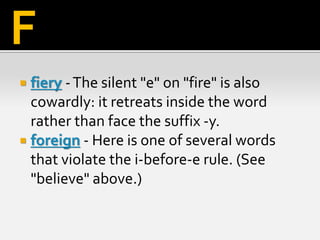
![ gauge -You must learn to gauge the
positioning of the [a] and [u] in this word.
Remember, they are in alphabetical order
(though not the [e]).
grateful -You should be grateful to know that
keeping "great" out of "grateful" is great.
guarantee -This word is not spelled like
"warranty" even though they are synonyms.
G](https://image.slidesharecdn.com/misspelledwords-161019035146/85/Misspelled-words-16-320.jpg)
![ harass -This word is too small for two double letters
but don't let it harass you, just keep the [r]s down to
one.
height - English reaches the height (not heighth!) of
absurdity when it spells "height" and "width" so
differently.
hierarchy -The i-before-e rule works here, so what is
the problem?
humorous - Humor us and spell this word "humorous":
the [r] is so weak, it needs an [o] on both sides to hold it
up.
H](https://image.slidesharecdn.com/misspelledwords-161019035146/85/Misspelled-words-17-320.jpg)
![ ignorance - Don't show your ignorance by
spelling this word -ence!
immediate -The immediate thing to remember
is that this word has a prefix, in- "not" which
becomes [m] before [m] (or [b] or [p]). "Not
mediate" means direct which is why
"immediately" means "directly."
independent - Please be independent but not in
your spelling of this word. It ends on -ent.
I](https://image.slidesharecdn.com/misspelledwords-161019035146/85/Misspelled-words-18-320.jpg)
![ indispensable - Knowing that this word ends on
-able is indispensable to good writing.
inoculate -This one sounds like a shot in the
eye. One [n] the eye is enough.
intelligence - Using two [l]s in this word and
ending it on -ence rather than -ance are marks
of . . . you guessed it.
its/it's -The apostrophe marks a contraction of
"it is." Something that belongs to it is "its."
I](https://image.slidesharecdn.com/misspelledwords-161019035146/85/Misspelled-words-19-320.jpg)
![ jewelry - Sure, sure, it is made by a jeweler but the last [e] in this
case flees the scene like a jewel thief. However, if you prefer
British spelling, remember to double the [l]: "jeweller,"
"jewellery."
judgment -Traditionally, the word has been spelled judgment in
all forms of the English language. However, the spelling
judgement (with e added) largely replaced judgment in the
United Kingdom in a non-legal context. In the context of the law,
however, judgment is preferred.This spelling change contrasts
with other similar spelling changes made in American English,
which were rejected in the UK. In the US at least, judgment is
still preferred and judgement is considered incorrect by many
American style guides.
J](https://image.slidesharecdn.com/misspelledwords-161019035146/85/Misspelled-words-20-320.jpg)
![ kernel (colonel) -There is more than a
kernel of truth in the claim that all the
vowels in this word are [e]s. So why is the
military rank (colonel) pronounced
identically?
K](https://image.slidesharecdn.com/misspelledwords-161019035146/85/Misspelled-words-21-320.jpg)
![ leisure -Yet another violator of the i-before-e rule.You
can be sure of the spelling of the last syllable but not
of the pronunciation.
liaison - Another French word throwing us an
orthographical curve: a spare [i], just in case.That's an
[s], too, that sounds like a [z].
library - It may be as enjoyable as a berry patch but
that isn't the way it is spelled.That first [r] should be
pronounced, too.
license -Where does English get the license to use
both its letters for the sound [s] in one word?
L](https://image.slidesharecdn.com/misspelledwords-161019035146/85/Misspelled-words-22-320.jpg)
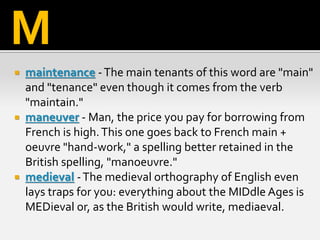
![ memento -Why would something to remind of
you of a moment be spelled "memento?"Well, it
is.
millennium - Here is another big word, large
enough to hold two double consonants, double
[l] and double [n].
miniature - Since that [a] is seldom pronounced,
it is seldom included in the spelling.This one is a
"mini ature;" remember that.
M](https://image.slidesharecdn.com/misspelledwords-161019035146/85/Misspelled-words-24-320.jpg)
![ minuscule - Since something minuscule is smaller
than a miniature, shouldn't they be spelled
similarly? Less than cool, or "minus cule."
mischievous -This mischievous word holds two
traps: [i] before [e] and [o] before [u]. Four of the
five vowels in English reside here.
misspell -What is more embarrassing than to
misspell the name of the problem? Just remember
that it is mis + spell and that will spell you the worry
about spelling "misspell."
M](https://image.slidesharecdn.com/misspelledwords-161019035146/85/Misspelled-words-25-320.jpg)
![ neighbor -The word "neighbor" invokes the
silent "gh" as well as "ei" sounded as "a" rule.
This is fraught with error potential. If you use
British spelling, it will cost you another [u]:
"neighbour."
noticeable -The [e] is noticeably retained in this
word to indicate the [c] is "soft," pronounced
like [s]. Without the [e], it would be pronounced
"hard," like [k], as in "applicable."
N](https://image.slidesharecdn.com/misspelledwords-161019035146/85/Misspelled-words-26-320.jpg)
![ occasionally -Writers occasionally tire of
doubling so many consonants and omit one,
usually one of the [l]s. Don't you ever do it.
occurrence - Remember not only the occurrence
of double double consonants in this word, but
that the suffix is -ence, not -ance. No reason,
just the English language keeping us on our toes.
O](https://image.slidesharecdn.com/misspelledwords-161019035146/85/Misspelled-words-27-320.jpg)
![ pastime - Since a pastime is something you
do to pass the time, you would expect a
double [s] here.Well, there is only one.The
second [s] was slipped through the cracks in
English orthography long ago.
perseverance - All it takes is perseverance and
you, too, can be a (near-) perfect speller.The
suffix is -ance for no reason at all.
P](https://image.slidesharecdn.com/misspelledwords-161019035146/85/Misspelled-words-28-320.jpg)
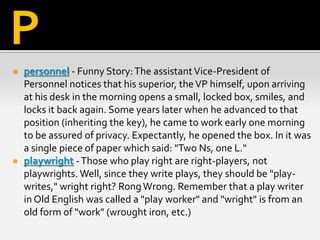
![ questionnaire -The French doing it
to us again. Double up on the [n]s in
this word and don't forget the silent
[e]. Maybe someday we will spell it
the English way.
Q](https://image.slidesharecdn.com/misspelledwords-161019035146/85/Misspelled-words-30-320.jpg)
![ receive/receipt - I hope you have received the message by now:
[i] before [e] except after . . . .
recommend - I would recommend you think of this word as the
equivalent of commending all over again: re+commend.That
would be recommendable.
referred - Final consonants are often doubled before suffixes
(remit: remitted, remitting). However, this rule applies only to
accented syllables ending on [l] and [r], e.g. "rebelled,"
"referred" but "traveled," "buffered" and not containing a
diphthong, e.g. "prevailed," "coiled."
reference - Refer to the last mentioned word and also
remember to add -ence to the end for the noun.
R](https://image.slidesharecdn.com/misspelledwords-161019035146/85/Misspelled-words-31-320.jpg)
![ relevant -The relevant factor here is that the word is not
"revelant," "revelent," or even "relevent." [l] before [v] and the
suffix -ant.
restaurant - 'Ey, you! Remember, these two words when you
spell "restaurant."They are in the middle of it.
rhyme - Actually, "rime" was the correct spelling until 1650. After
that, egg-heads began spelling it like "rhythm." Why? No rhyme
nor reason other than to make it look like "rhythm."
rhythm -This one was borrowed fromGreek (and conveniently
never returned) so it is spelled the way we spell words borrowed
from Greek and conveniently never returned.
R](https://image.slidesharecdn.com/misspelledwords-161019035146/85/Misspelled-words-32-320.jpg)
![ schedule - If perfecting your spelling is on your schedule,
remember the [sk] is spelled as in "school." (If you use British or
Canadian pronunciation, why do you pronounce this word
[shedyul] but "school," [skul]?That has always puzzled me.)
separate - How do you separate the [e]s from the [a]s in this
word? Simple: the [e]s surround the [a]s.
sergeant -The [a] needed in both syllables of this word has been
pushed to the back of the line. Remember that, and the fact that
[e] is used in both syllables, and you can write your sergeant
without fear of misspelling his rank.
supersede -This word supersedes all others in perversity.This is
the only English word based on this stem spelled -sede.
Supersede combines the Latin words "super" and "sedere" which
means to sit above.
S](https://image.slidesharecdn.com/misspelledwords-161019035146/85/Misspelled-words-33-320.jpg)
![ their/they're/there -They're all pronounced the same but spelled
differently. Possessive is "their" and the contraction of "they are"
is "they're." Everywhere else, it is "there."
threshold -This one can push you over the threshold. It looks like
a compound "thresh + hold" but it isn't.Two [h]s are enough.
twelfth - Even if you omit the [f] in your pronunciation of this
word (which you shouldn't do), it is retained in the spelling.
tyranny - If you are still resisting the tyranny of English
orthography at this point, you must face the problem of [y] inside
this word, where it shouldn't be.The guy is a "tyrant" and his
problem is "tyranny." (Don't forget to double up on the [n]s, too.)
T](https://image.slidesharecdn.com/misspelledwords-161019035146/85/Misspelled-words-34-320.jpg)
![ until - I will never stop harping on
this until this word is spelled with
an extra [l] for the last time!
U](https://image.slidesharecdn.com/misspelledwords-161019035146/85/Misspelled-words-35-320.jpg)
![ vacuum - If your head is not a vacuum,
remember that the silent [e] on this one
married the [u] and joined him inside the
word where they are living happily ever
since.Well, the evidence is suggestive but
not conclusive. Anyway, spell this word
with two [u]s and not like "volume."
V](https://image.slidesharecdn.com/misspelledwords-161019035146/85/Misspelled-words-36-320.jpg)
![ weather -Whether you like the
weather or not, you have to write the
[a] after the [e] when you spell it.
weird -This word is an exception to the
rule about [i] before [e] except after...?
So, rules can be broken!
W,X,Y,Z](https://image.slidesharecdn.com/misspelledwords-161019035146/85/Misspelled-words-37-320.jpg)