Chapter 8 RX and Elimination Rxns
The E2 Mechanism
The E2 Mechanism
Energy Diagram for the E2 Mechanism
Effect of the Substrate on E2 Reactivity
Effect of the LG on E2 Reactivity
The E2 and SN2 mechanisms share
many of the same characteristics
Here are four characteristics that the
E2 / SN2 mechanisms have in common.
The E1Mechanism
Let ‘s look at an E1 reaction mechanism
using the rxn shown below.
The E1 Mechanism
The first step of the E1 and SN1
mechanisms are identical.
The E1 Mechanism
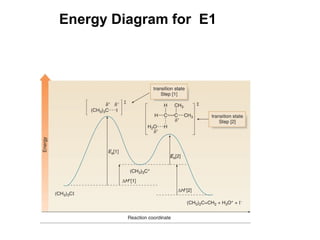
Energy Diagram for E1
The E1 and SN1 mechanisms share
many of the same characteristics
Here are four characteristics that the E1 / SN1
mechanisms have in common.
What about dehydrohalogenations
involving RX with hydrogen atoms on
different β carbon atoms
The Zaitsev Rule
The Zaitsev Rule- A Regioselective Rxn
The Zaitsev Rule (Z-rule)
According to the Z-rule, the major product
in a dehydrohalgenation is the …..
most stable product.
Let’s ask a different question about the
products.
More R groups increase the stability of
the T.S.
Let look at another example from the
Smith text.
The Zaitsev (Saytzeff) Rule – A Stereoselective RXN
E2 Stereochemistry
The LG and the H atom can be syn or
anti to each other
Bases Used in Elimination Rxns
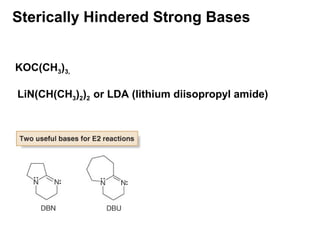
Sterically Hindered Strong Bases
KOC(CH3)3,
LiN(CH(CH3)2)2 or LDA (lithium diisopropyl amide)
Exam II Review Problems
Predict the organic product(s) and name
the mechanism
Methylenecyclohexane is not the major
product in this rxn. Give the chemical
structure of the major product and explain
why it would be the major product.
Alkyl Halides and Elimination Reactions
• Elimination reactions involve the loss of elements from
the starting material to form a new π bond in the
product.
General Features of Elimination
Alkyl Halides and Elimination Reactions
• Equations [1] and [2] illustrate examples of elimination
reactions. In both reactions a base removes the
elements of an acid, HX, from the organic starting
material.
General Features of Elimination
Alkyl Halides and Elimination Reactions
• Removal of the elements HX is called
dehydrohalogenation.
• Dehydrohalogenation is an example of β elimination.
• The curved arrow formalism shown below illustrates
how four bonds are broken or formed in the process.
General Features of Elimination
Alkyl Halides and Elimination Reactions
• The most common bases used in elimination reactions
are negatively charged oxygen compounds, such as HO¯
and its alkyl derivatives, RO¯, called alkoxides.
General Features of Elimination
Alkyl Halides and Elimination Reactions
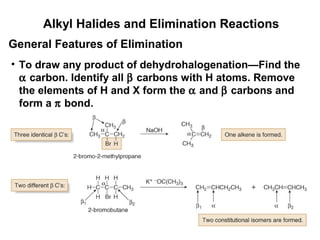
• To draw any product of dehydrohalogenation—Find the
α carbon. Identify all β carbons with H atoms. Remove
the elements of H and X form the α and β carbons and
form a π bond.
General Features of Elimination
Alkyl Halides and Elimination Reactions
• Recall that the double bond of an alkene consists of a σ
bond and a π bond.
Alkenes—The Products of Elimination
Alkyl Halides and Elimination Reactions
• Alkenes are classified according to the number of
carbon atoms bonded to the carbons of the double bond.
Alkenes—The Products of Elimination
Alkyl Halides and Elimination Reactions
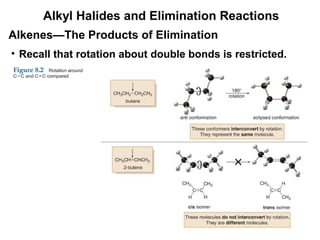
• Recall that rotation about double bonds is restricted.
Alkenes—The Products of Elimination
Alkyl Halides and Elimination Reactions
• Because of restricted rotation, two stereoisomers of 2-
butene are possible. cis-2-Butene and trans-2-butene are
diastereomers, because they are stereoisomers that are
not mirror images of each other.
Alkenes—The Products of Elimination
Alkyl Halides and Elimination Reactions
• Whenever the two groups on each end of a carbon-
carbon double bond are different from each other, two
diastereomers are possible.
Alkenes—The Products of Elimination
Alkyl Halides and Elimination Reactions
• In general, trans alkenes are more stable than cis
alkenes because the groups bonded to the double bond
carbons are further apart, reducing steric interactions.
Alkenes—The Products of Elimination
Alkyl Halides and Elimination Reactions
• The stability of an alkene increases as the number of R
groups bonded to the double bond carbons increases.
Alkenes—The Products of Elimination
• The higher the percent s-character, the more readily an atom
accepts electron density. Thus, sp2
carbons are more able to
accept electron density and sp3
carbons are more able to
donate electron density.
• Consequently, increasing the number of electron donating
groups on a carbon atom able to accept electron density
makes the alkene more stable.
Alkyl Halides and Elimination Reactions
• trans-2-Butene (a disubstituted alkene) is more stable
than cis-2-butene (another disubstituted alkene), but
both are more stable than 1-butene (a monosubstituted
alkene).
Alkenes—The Products of Elimination
Alkyl Halides and Elimination Reactions
• There are two mechanisms of elimination—E2 and E1,
just as there are two mechanisms of substitution, SN2
and SN1.
• E2 mechanism—bimolecular elimination
• E1 mechanism—unimolecular elimination
• The E2 and E1 mechanisms differ in the timing of bond
cleavage and bond formation, analogous to the SN2 and
SN1 mechanisms.
• E2 and SN2 reactions have some features in common, as
do E1 and SN1 reactions.
Mechanisms of Elimination
Alkyl Halides and Elimination Reactions
• The most common mechanism for dehydrohalogenation
is the E2 mechanism.
• It exhibits second-order kinetics, and both the alkyl
halide and the base appear in the rate equation i.e.
Mechanisms of Elimination—E2
rate = k[(CH3)3CBr][¯OH]
• The reaction is concerted—all bonds are broken and
formed in a single step.
The Zaitsev (Saytzeff) Rule
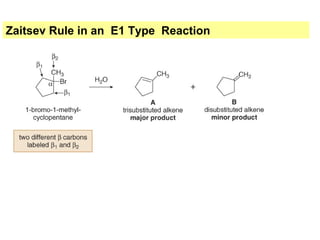
Zaitsev Rule in an E1 Type Reaction
Alkyl Halides and Elimination Reactions
• There are close parallels between E2 and SN2 mechanisms in
how the identity of the base, the leaving group and the
solvent affect the rate.
• The base appears in the rate equation, so the rate of the E2
reaction increases as the strength of the base increases.
• E2 reactions are generally run with strong, negatively charged
bases like¯OH and ¯OR. Two strong sterically hindered
nitrogen bases called DBN and DBU are also sometimes used.
Mechanisms of Elimination—E2
Alkyl Halides and Elimination Reactions
Mechanisms of Elimination—E2
Alkyl Halides and Elimination Reactions
• The increase in E2 reaction rate with increasing alkyl
substitution can be rationalized in terms of transition state
stability.
• In the transition state, the double bond is partially formed.
Thus, increasing the stability of the double bond with alkyl
substituents stabilizes the transition state (i.e. lowers Ea,
which increases the rate of the reaction according to the
Hammond postulate).
Mechanisms of Elimination—E2
Alkyl Halides and Elimination Reactions
• Increasing the number of R groups on the carbon with the
leaving group forms more highly substituted, more stable
alkenes in E2 reactions.
• In the reactions below, since the disubstituted alkene is more
stable, the 30
alkyl halide reacts faster than the 10
alkyl halide.
Mechanisms of Elimination—E2
Alkyl Halides and Elimination Reactions
Mechanisms of Elimination—E2
Alkyl Halides and Elimination Reactions
• Recall that when alkyl halides have two or more different β
carbons, more than one alkene product is formed.
• When this happens, one of the products usually
predominates.
• The major product is the more stable product—the one with
the more substituted double bond.
• This phenomenon is called the Zaitsev rule.
The Zaitsev (Saytzeff) Rule
Alkyl Halides and Elimination Reactions
• When a mixture of stereoisomers is possible from a
dehydrohalogenation, the major product is the more stable
stereoisomer.
• A reaction is stereoselective when it forms predominantly or
exclusively one stereoisomer when two or more are possible.
• The E2 reaction is stereoselective because one stereoisomer
is formed preferentially.
The Zaitsev (Saytzeff) Rule
Alkyl Halides and Elimination Reactions
• The dehydrohalogenation of (CH3)3CI with H2O to form
(CH3)C=CH2 can be used to illustrate the second general
mechanism of elimination, the E1 mechanism.
• An E1 reaction exhibits first-order kinetics:
Mechanisms of Elimination—E1
rate = k[(CH3)3CI]
• The E1 reaction proceed via a two-step mechanism: the bond
to the leaving group breaks first before the π bond is formed.
The slow step is unimolecular, involving only the alkyl halide.
• The E1 and E2 mechanisms both involve the same number of
bonds broken and formed. The only difference is timing. In an
E1, the leaving group comes off before the β proton is
removed, and the reaction occurs in two steps. In an E2
reaction, the leaving group comes off as the β proton is
removed, and the reaction occurs in one step.
Alkyl Halides and Elimination Reactions
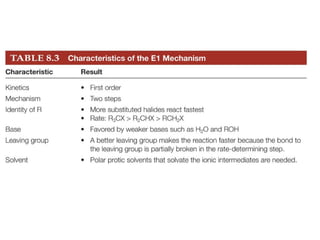
• The rate of an E1 reaction increases as the number of R groups
on the carbon with the leaving group increases.
Mechanisms of Elimination—E1
• The strength of the base usually determines whether a reaction
follows the E1 or E2 mechanism. Strong bases like ¯OH and ¯OR
favor E2 reactions, whereas weaker bases like H2O and ROH
favor E1 reactions.
Alkyl Halides and Elimination Reactions
Table 8.3 summarizes the characteristics of the E1 mechanism.
Mechanisms of Elimination—E1
Alkyl Halides and Elimination Reactions
• SN1 and E1 reactions have exactly the same first step—formation
of a carbocation. They differ in what happens to the carbocation.
SN1 and E1 Reactions
• Because E1 reactions often occur with a competing SN1 reaction,
E1 reactions of alkyl halides are much less useful than E2
reactions.
Alkyl Halides and Elimination Reactions
• The transition state of an E2 reaction consists of four atoms from
an alkyl halide—one hydrogen atom, two carbon atoms, and the
leaving group (X)—all aligned in a plane. There are two ways for
the C—H and C—X bonds to be coplanar.
Stereochemistry of the E2 Reaction
• E2 elimination occurs most often in the anti periplanar geometry.
This arrangement allows the molecule to react in the lower
energy staggered conformation, and allows the incoming base
and leaving group to be further away from each other.
Stereochemistry of the E2 Reaction
Alkyl Halides and Elimination Reactions
• The stereochemical requirement of an anti periplanar geometry
in an E2 reaction has important consequences for compounds
containing six-membered rings.
• Consider chlorocyclohexane which exists as two chair
conformers. Conformer A is preferred since the bulkier Cl group
is in the equatorial position.
Stereochemistry of the E2 Reaction
• For E2 elimination, the C-Cl bond must be anti periplanar to the
C—H bond on a β carbon, and this occurs only when the H and
Cl atoms are both in the axial position. The requirement for trans
diaxial geometry means that elimination must occur from the
less stable conformer, B.
Alkyl Halides and Elimination Reactions
Stereochemistry of the E2 Reaction
Alkyl Halides and Elimination Reactions
• Now consider the E2 dehydrohalogenation of cis- and trans-1-
chloro-2-methylcyclohexane.
Stereochemistry of the E2 Reaction
• This cis isomer exists as two conformers, A and B, each of
which as one group axial and one group equatorial. E2 reaction
must occur from conformer B, which contains an axial Cl atom.
Alkyl Halides and Elimination Reactions
• Because conformer B has two different axial β
hydrogens, labeled Ha and Hb, E2 reaction occurs in two
different directions to afford two alkenes.
• The major product contains the more stable
trisubstituted double bond, as predicted by the Zaitsev
rule.
Stereochemistry of the E2 Reaction
Alkyl Halides and Elimination Reactions
• The trans isomer of 1-chloro-2-methylcyclohexane exists
as two conformers: C, having two equatorial substituents,
and D, having two axial substituents.
Stereochemistry of the E2 Reaction
• E2 reaction must occur from D, since it contains an axial Cl
atom.
Alkyl Halides and Elimination Reactions
• Because conformer D has only one axial β H, E2 reaction
occurs only in one direction to afford a single product. This
is not predicted by the Zaitzev rule.
Stereochemistry of the E2 Reaction
Alkyl Halides and Elimination Reactions
• The strength of the base is the most important factor in
determining the mechanism for elimination. Strong
bases favor the E2 mechanism. Weak bases favor the E1
mechanism.
When is the Mechanism E1 or E2
Alkyl Halides and Elimination Reactions
• A single elimination reaction produces a π bond of an
alkene. Two consecutive elimination reactions produce
two π bonds of an alkyne.
E2 Reactions and Alkyne Synthesis
Alkyl Halides and Elimination Reactions
• Two elimination reactions are needed to remove two
moles of HX from a dihalide substrate.
• Two different starting materials can be used—a vicinal
dihalide or a geminal dihalide.
E2 Reactions and Alkyne Synthesis
Alkyl Halides and Elimination Reactions
• Stronger bases are needed to synthesize alkynes by
dehydrohalogenation than are needed to synthesize
alkenes.
• The typical base used is ¯NH2 (amide), used as the
sodium salt of NaNH2. KOC(CH3)3 can also be used with
DMSO as solvent.
E2 Reactions and Alkyne Synthesis
Alkyl Halides and Elimination Reactions
• The reason that stronger bases are needed for this
dehydrohalogenation is that the transition state for the
second elimination reaction includes partial cleavage of
the C—H bond. In this case however, the carbon atom is
sp2
hybridized and sp2
hybridized C—H bonds are
stronger than sp3
hybridized C—H bonds. As a result, a
stronger base is needed to cleave this bond.
E2 Reactions and Alkyne Synthesis
Alkyl Halides and Elimination Reactions
E2 Reactions and Alkyne Synthesis
Alkyl Halides and Elimination Reactions
• Good nucleophiles that are weak bases favor
substitution over elimination—Certain anions always
give products of substitution because they are good
nucleophiles but weak bases. These include I¯, Br¯, HS¯,
and CH3COO¯.
Predicting the Mechanism from the Reactants—SN1,
SN2, E1 or E2.
Alkyl Halides and Elimination Reactions
• Bulky nonnucleophilic bases favor elimination over
substitution—KOC(CH3)3, DBU, and DBN are too
sterically hindered to attack tetravalent carbon, but are
able to remove a small proton, favoring elimination over
substitution.
Predicting the Mechanism from the Reactants—SN1,
SN2, E1 or E2.
Predicting the Mechanism from the Reactants—SN1,
SN2, E1 or E2.
Alkyl Halides and Elimination Reactions
Predicting the Mechanism from the Reactants—SN1,
SN2, E1 or E2.
Alkyl Halides and Elimination Reactions
Stereochemistry of the E2 Reaction
Is it SN1, SN2, E1 or E2?
• acstaff.gpc.edu/~jpoteat/chapter8smith.ppt
• 31 Maret 2010

Chapter8smith reaksi eliminasi

  • 1.
    Chapter 8 RXand Elimination Rxns
  • 2.
  • 3.
  • 4.
    Energy Diagram forthe E2 Mechanism
  • 6.
    Effect of theSubstrate on E2 Reactivity
  • 7.
    Effect of theLG on E2 Reactivity
  • 8.
    The E2 andSN2 mechanisms share many of the same characteristics
  • 9.
    Here are fourcharacteristics that the E2 / SN2 mechanisms have in common.
  • 10.
  • 11.
    Let ‘s lookat an E1 reaction mechanism using the rxn shown below.
  • 12.
  • 13.
    The first stepof the E1 and SN1 mechanisms are identical.
  • 14.
  • 15.
  • 17.
    The E1 andSN1 mechanisms share many of the same characteristics
  • 18.
    Here are fourcharacteristics that the E1 / SN1 mechanisms have in common.
  • 19.
    What about dehydrohalogenations involvingRX with hydrogen atoms on different β carbon atoms The Zaitsev Rule
  • 20.
    The Zaitsev Rule-A Regioselective Rxn
  • 21.
    The Zaitsev Rule(Z-rule) According to the Z-rule, the major product in a dehydrohalgenation is the ….. most stable product.
  • 22.
    Let’s ask adifferent question about the products.
  • 24.
    More R groupsincrease the stability of the T.S.
  • 25.
    Let look atanother example from the Smith text.
  • 26.
    The Zaitsev (Saytzeff)Rule – A Stereoselective RXN
  • 27.
  • 28.
    The LG andthe H atom can be syn or anti to each other
  • 29.
    Bases Used inElimination Rxns
  • 31.
    Sterically Hindered StrongBases KOC(CH3)3, LiN(CH(CH3)2)2 or LDA (lithium diisopropyl amide)
  • 32.
  • 33.
    Predict the organicproduct(s) and name the mechanism
  • 34.
    Methylenecyclohexane is notthe major product in this rxn. Give the chemical structure of the major product and explain why it would be the major product.
  • 35.
    Alkyl Halides andElimination Reactions • Elimination reactions involve the loss of elements from the starting material to form a new π bond in the product. General Features of Elimination
  • 36.
    Alkyl Halides andElimination Reactions • Equations [1] and [2] illustrate examples of elimination reactions. In both reactions a base removes the elements of an acid, HX, from the organic starting material. General Features of Elimination
  • 37.
    Alkyl Halides andElimination Reactions • Removal of the elements HX is called dehydrohalogenation. • Dehydrohalogenation is an example of β elimination. • The curved arrow formalism shown below illustrates how four bonds are broken or formed in the process. General Features of Elimination
  • 38.
    Alkyl Halides andElimination Reactions • The most common bases used in elimination reactions are negatively charged oxygen compounds, such as HO¯ and its alkyl derivatives, RO¯, called alkoxides. General Features of Elimination
  • 39.
    Alkyl Halides andElimination Reactions • To draw any product of dehydrohalogenation—Find the α carbon. Identify all β carbons with H atoms. Remove the elements of H and X form the α and β carbons and form a π bond. General Features of Elimination
  • 40.
    Alkyl Halides andElimination Reactions • Recall that the double bond of an alkene consists of a σ bond and a π bond. Alkenes—The Products of Elimination
  • 41.
    Alkyl Halides andElimination Reactions • Alkenes are classified according to the number of carbon atoms bonded to the carbons of the double bond. Alkenes—The Products of Elimination
  • 42.
    Alkyl Halides andElimination Reactions • Recall that rotation about double bonds is restricted. Alkenes—The Products of Elimination
  • 43.
    Alkyl Halides andElimination Reactions • Because of restricted rotation, two stereoisomers of 2- butene are possible. cis-2-Butene and trans-2-butene are diastereomers, because they are stereoisomers that are not mirror images of each other. Alkenes—The Products of Elimination
  • 44.
    Alkyl Halides andElimination Reactions • Whenever the two groups on each end of a carbon- carbon double bond are different from each other, two diastereomers are possible. Alkenes—The Products of Elimination
  • 45.
    Alkyl Halides andElimination Reactions • In general, trans alkenes are more stable than cis alkenes because the groups bonded to the double bond carbons are further apart, reducing steric interactions. Alkenes—The Products of Elimination
  • 46.
    Alkyl Halides andElimination Reactions • The stability of an alkene increases as the number of R groups bonded to the double bond carbons increases. Alkenes—The Products of Elimination • The higher the percent s-character, the more readily an atom accepts electron density. Thus, sp2 carbons are more able to accept electron density and sp3 carbons are more able to donate electron density. • Consequently, increasing the number of electron donating groups on a carbon atom able to accept electron density makes the alkene more stable.
  • 47.
    Alkyl Halides andElimination Reactions • trans-2-Butene (a disubstituted alkene) is more stable than cis-2-butene (another disubstituted alkene), but both are more stable than 1-butene (a monosubstituted alkene). Alkenes—The Products of Elimination
  • 48.
    Alkyl Halides andElimination Reactions • There are two mechanisms of elimination—E2 and E1, just as there are two mechanisms of substitution, SN2 and SN1. • E2 mechanism—bimolecular elimination • E1 mechanism—unimolecular elimination • The E2 and E1 mechanisms differ in the timing of bond cleavage and bond formation, analogous to the SN2 and SN1 mechanisms. • E2 and SN2 reactions have some features in common, as do E1 and SN1 reactions. Mechanisms of Elimination
  • 49.
    Alkyl Halides andElimination Reactions • The most common mechanism for dehydrohalogenation is the E2 mechanism. • It exhibits second-order kinetics, and both the alkyl halide and the base appear in the rate equation i.e. Mechanisms of Elimination—E2 rate = k[(CH3)3CBr][¯OH] • The reaction is concerted—all bonds are broken and formed in a single step.
  • 50.
  • 51.
    Zaitsev Rule inan E1 Type Reaction
  • 52.
    Alkyl Halides andElimination Reactions • There are close parallels between E2 and SN2 mechanisms in how the identity of the base, the leaving group and the solvent affect the rate. • The base appears in the rate equation, so the rate of the E2 reaction increases as the strength of the base increases. • E2 reactions are generally run with strong, negatively charged bases like¯OH and ¯OR. Two strong sterically hindered nitrogen bases called DBN and DBU are also sometimes used. Mechanisms of Elimination—E2
  • 53.
    Alkyl Halides andElimination Reactions Mechanisms of Elimination—E2
  • 54.
    Alkyl Halides andElimination Reactions • The increase in E2 reaction rate with increasing alkyl substitution can be rationalized in terms of transition state stability. • In the transition state, the double bond is partially formed. Thus, increasing the stability of the double bond with alkyl substituents stabilizes the transition state (i.e. lowers Ea, which increases the rate of the reaction according to the Hammond postulate). Mechanisms of Elimination—E2
  • 55.
    Alkyl Halides andElimination Reactions • Increasing the number of R groups on the carbon with the leaving group forms more highly substituted, more stable alkenes in E2 reactions. • In the reactions below, since the disubstituted alkene is more stable, the 30 alkyl halide reacts faster than the 10 alkyl halide. Mechanisms of Elimination—E2
  • 56.
    Alkyl Halides andElimination Reactions Mechanisms of Elimination—E2
  • 57.
    Alkyl Halides andElimination Reactions • Recall that when alkyl halides have two or more different β carbons, more than one alkene product is formed. • When this happens, one of the products usually predominates. • The major product is the more stable product—the one with the more substituted double bond. • This phenomenon is called the Zaitsev rule. The Zaitsev (Saytzeff) Rule
  • 58.
    Alkyl Halides andElimination Reactions • When a mixture of stereoisomers is possible from a dehydrohalogenation, the major product is the more stable stereoisomer. • A reaction is stereoselective when it forms predominantly or exclusively one stereoisomer when two or more are possible. • The E2 reaction is stereoselective because one stereoisomer is formed preferentially. The Zaitsev (Saytzeff) Rule
  • 59.
    Alkyl Halides andElimination Reactions • The dehydrohalogenation of (CH3)3CI with H2O to form (CH3)C=CH2 can be used to illustrate the second general mechanism of elimination, the E1 mechanism. • An E1 reaction exhibits first-order kinetics: Mechanisms of Elimination—E1 rate = k[(CH3)3CI] • The E1 reaction proceed via a two-step mechanism: the bond to the leaving group breaks first before the π bond is formed. The slow step is unimolecular, involving only the alkyl halide. • The E1 and E2 mechanisms both involve the same number of bonds broken and formed. The only difference is timing. In an E1, the leaving group comes off before the β proton is removed, and the reaction occurs in two steps. In an E2 reaction, the leaving group comes off as the β proton is removed, and the reaction occurs in one step.
  • 60.
    Alkyl Halides andElimination Reactions • The rate of an E1 reaction increases as the number of R groups on the carbon with the leaving group increases. Mechanisms of Elimination—E1 • The strength of the base usually determines whether a reaction follows the E1 or E2 mechanism. Strong bases like ¯OH and ¯OR favor E2 reactions, whereas weaker bases like H2O and ROH favor E1 reactions.
  • 61.
    Alkyl Halides andElimination Reactions Table 8.3 summarizes the characteristics of the E1 mechanism. Mechanisms of Elimination—E1
  • 62.
    Alkyl Halides andElimination Reactions • SN1 and E1 reactions have exactly the same first step—formation of a carbocation. They differ in what happens to the carbocation. SN1 and E1 Reactions • Because E1 reactions often occur with a competing SN1 reaction, E1 reactions of alkyl halides are much less useful than E2 reactions.
  • 63.
    Alkyl Halides andElimination Reactions • The transition state of an E2 reaction consists of four atoms from an alkyl halide—one hydrogen atom, two carbon atoms, and the leaving group (X)—all aligned in a plane. There are two ways for the C—H and C—X bonds to be coplanar. Stereochemistry of the E2 Reaction • E2 elimination occurs most often in the anti periplanar geometry. This arrangement allows the molecule to react in the lower energy staggered conformation, and allows the incoming base and leaving group to be further away from each other.
  • 64.
  • 65.
    Alkyl Halides andElimination Reactions • The stereochemical requirement of an anti periplanar geometry in an E2 reaction has important consequences for compounds containing six-membered rings. • Consider chlorocyclohexane which exists as two chair conformers. Conformer A is preferred since the bulkier Cl group is in the equatorial position. Stereochemistry of the E2 Reaction • For E2 elimination, the C-Cl bond must be anti periplanar to the C—H bond on a β carbon, and this occurs only when the H and Cl atoms are both in the axial position. The requirement for trans diaxial geometry means that elimination must occur from the less stable conformer, B.
  • 66.
    Alkyl Halides andElimination Reactions Stereochemistry of the E2 Reaction
  • 67.
    Alkyl Halides andElimination Reactions • Now consider the E2 dehydrohalogenation of cis- and trans-1- chloro-2-methylcyclohexane. Stereochemistry of the E2 Reaction • This cis isomer exists as two conformers, A and B, each of which as one group axial and one group equatorial. E2 reaction must occur from conformer B, which contains an axial Cl atom.
  • 68.
    Alkyl Halides andElimination Reactions • Because conformer B has two different axial β hydrogens, labeled Ha and Hb, E2 reaction occurs in two different directions to afford two alkenes. • The major product contains the more stable trisubstituted double bond, as predicted by the Zaitsev rule. Stereochemistry of the E2 Reaction
  • 69.
    Alkyl Halides andElimination Reactions • The trans isomer of 1-chloro-2-methylcyclohexane exists as two conformers: C, having two equatorial substituents, and D, having two axial substituents. Stereochemistry of the E2 Reaction • E2 reaction must occur from D, since it contains an axial Cl atom.
  • 70.
    Alkyl Halides andElimination Reactions • Because conformer D has only one axial β H, E2 reaction occurs only in one direction to afford a single product. This is not predicted by the Zaitzev rule. Stereochemistry of the E2 Reaction
  • 71.
    Alkyl Halides andElimination Reactions • The strength of the base is the most important factor in determining the mechanism for elimination. Strong bases favor the E2 mechanism. Weak bases favor the E1 mechanism. When is the Mechanism E1 or E2
  • 72.
    Alkyl Halides andElimination Reactions • A single elimination reaction produces a π bond of an alkene. Two consecutive elimination reactions produce two π bonds of an alkyne. E2 Reactions and Alkyne Synthesis
  • 73.
    Alkyl Halides andElimination Reactions • Two elimination reactions are needed to remove two moles of HX from a dihalide substrate. • Two different starting materials can be used—a vicinal dihalide or a geminal dihalide. E2 Reactions and Alkyne Synthesis
  • 74.
    Alkyl Halides andElimination Reactions • Stronger bases are needed to synthesize alkynes by dehydrohalogenation than are needed to synthesize alkenes. • The typical base used is ¯NH2 (amide), used as the sodium salt of NaNH2. KOC(CH3)3 can also be used with DMSO as solvent. E2 Reactions and Alkyne Synthesis
  • 75.
    Alkyl Halides andElimination Reactions • The reason that stronger bases are needed for this dehydrohalogenation is that the transition state for the second elimination reaction includes partial cleavage of the C—H bond. In this case however, the carbon atom is sp2 hybridized and sp2 hybridized C—H bonds are stronger than sp3 hybridized C—H bonds. As a result, a stronger base is needed to cleave this bond. E2 Reactions and Alkyne Synthesis
  • 76.
    Alkyl Halides andElimination Reactions E2 Reactions and Alkyne Synthesis
  • 77.
    Alkyl Halides andElimination Reactions • Good nucleophiles that are weak bases favor substitution over elimination—Certain anions always give products of substitution because they are good nucleophiles but weak bases. These include I¯, Br¯, HS¯, and CH3COO¯. Predicting the Mechanism from the Reactants—SN1, SN2, E1 or E2.
  • 78.
    Alkyl Halides andElimination Reactions • Bulky nonnucleophilic bases favor elimination over substitution—KOC(CH3)3, DBU, and DBN are too sterically hindered to attack tetravalent carbon, but are able to remove a small proton, favoring elimination over substitution. Predicting the Mechanism from the Reactants—SN1, SN2, E1 or E2.
  • 79.
    Predicting the Mechanismfrom the Reactants—SN1, SN2, E1 or E2. Alkyl Halides and Elimination Reactions
  • 80.
    Predicting the Mechanismfrom the Reactants—SN1, SN2, E1 or E2. Alkyl Halides and Elimination Reactions
  • 81.
  • 82.
    Is it SN1,SN2, E1 or E2?
  • 83.