ELIMINATION REACTIONS
Dr. Priyanka
5/18/2023 Dr.Priyanka 1
CONTENTS
Elimination Reactions
• Rearrangements
Carbocations may undergo rearrangements to yield
their more stable counterparts, and this phenomenon is
typically labeled as carbocationic rearrangement. In this
section, we will discuss the carbocation rearrangement
for classical and non-classical carbocations.
5/18/2023 Dr.Priyanka 2
Rearrangement Reactions in Classical Carbocation:
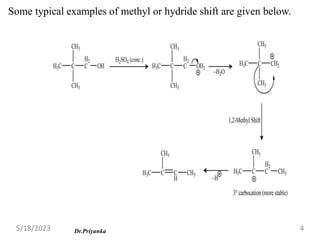
The 1-2 methyl shit or 1-2 hydride shifts are very common in
carbocation chemistry to attain a more stable counterpart. For
instance, a primary carbocation will prefer to rearrange itself into a
more stable tertiary carbocation.
Dr.Priyanka
5/18/2023 3
Dr.Priyanka
Some typical examples of methyl or hydride shift are given below.
5/18/2023 4
Dr.Priyanka
Saytzeff’s Rule
.
5/18/2023 5
Elimination reactions of some alkyl
halides and alcohol will result in different
alkenes, and Saytzeff’s rule is used to
predict the major product. The major and
minor products are predicted based on
the number of alkyl groups attached to
the alkene.
Dr.Priyanka
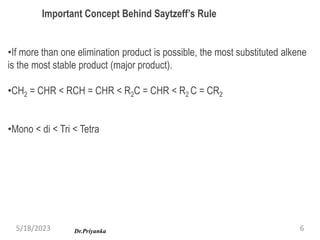
Important Concept Behind Saytzeff’s Rule
•If more than one elimination product is possible, the most substituted alkene
is the most stable product (major product).
•CH2 = CHR < RCH = CHR < R2C = CHR < R2 C = CR2
•Mono < di < Tri < Tetra
5/18/2023 6
General Mechanism for E1 Elimination
• E1 describes an elimination reaction (E) in which the rate-
determining step is unimolecular (1) and does not involve the base.
The leaving group leaves in this step, and the proton is removed in
a separate second step.
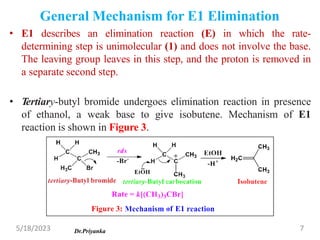
• Tertiary-butyl bromide undergoes elimination reaction in presence
of ethanol, a weak base to give isobutene. Mechanism of E1
reaction is shown in Figure 3.
5/18/2023 Dr.Priyanka 7
E1 verses E2 reactions
Dr.Priyanka
5/18/2023 8
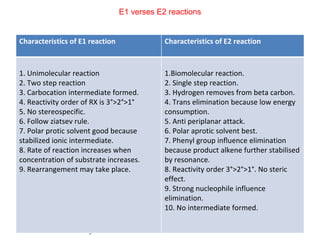
Characteristics of E1 reaction Characteristics of E2 reaction
1. Unimolecular reaction
2. Two step reaction
3. Carbocation intermediate formed.
4. Reactivity order of RX is 3°>2°>1°
5. No stereospecific.
6. Follow ziatsev rule.
7. Polar protic solvent good because
stabilized ionic intermediate.
8. Rate of reaction increases when
concentration of substrate increases.
9. Rearrangement may take place.
1.Biomolecular reaction.
2. Single step reaction.
3. Hydrogen removes from beta carbon.
4. Trans elimination because low energy
consumption.
5. Anti periplanar attack.
6. Polar aprotic solvent best.
7. Phenyl group influence elimination
because product alkene further stabilised
by resonance.
8. Reactivity order 3°>2°>1°. No steric
effect.
9. Strong nucleophile influence
elimination.
10. No intermediate formed.
Factors affecting E1 and E2 reactions
Dr.Priyanka
5/18/2023 9
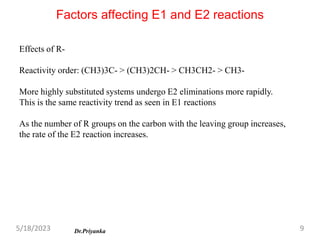
Effects of R-
Reactivity order: (CH3)3C- > (CH3)2CH- > CH3CH2- > CH3-
More highly substituted systems undergo E2 eliminations more rapidly.
This is the same reactivity trend as seen in E1 reactions
As the number of R groups on the carbon with the leaving group increases,
the rate of the E2 reaction increases.
Dr.Priyanka
5/18/2023 10
(ii) Leaving Group (LG) Rate of reaction follows the order Rate of reaction follows the
order, R−I > R−Br > R−Cl > R−F
(iii) Base (B) The strength of the base usually determines whether a reaction follows
the E1 or E2 mechanism. Strong bases like OH− and OR− g favor E2
reactions, whereas weaker bases like H2O and ROH favor E1 reactions.
RCH2 X R2CH X R3C X
Increasing rate of E1 reaction
Kinetics – First order
Mechanism – Two steps
Identity of R group – More substituted halides react faster
Rate: R 3CX > R 2CHX > RCH 2 X
Strength of the base – Favored by weaker bases such as
H2O and ROH
Leaving group – Better leaving group leads to faster
reaction rates. Just as in S N 1 reactions reactions, the rate
determining determining step involves the C—X bond
cleavage
Type of solvent – Favored by polar protic solvents, which
can stabilize the ionic intermediates
Dr.Priyanka
5/18/2023 11
Elimination v/s substitution
Elimination and substitution reactions are closely related
and competitive but form different products.
However, substitution becomes favorable as it involves
less bond reorganization and energetically being more
favorable.
1)Basicity and nucleophilicity:For elimination reaction
basicity of nucleophile or base is important while for
substitution it is nucleophilicity that matters more.
Therefore, strongly basic conditions favor elimination
reaction and use of strong bases is advisable. If some
compounds which are not strong bases but are good
nucleophiles are used, then substitution predominates.
Use of strong and slightly polarizable base such as amide
or alkoxide favours elimination over substitution.
Dr.Priyanka
5/18/2023 12
2)Substrate structure : Crowded reactant favors
elimination reaction over substitution due to
hindrance to approach of nucleophile. In primary
alkyl halides, easy approach of nucleophile is
possible hence substitution is favored over
elimination. In secondary alkyl halides, substitution
is difficult due to steric hindrance and elimination is
favored. Whereas ,in case of tertiary halides SN2
reaction is not possible, elimination is favored
particularly at elevated temperature. If substitution
occurs, then it is by SN1 pathway.
Dr.Priyanka
5/18/2023 13
Dr.Priyanka
5/18/2023 14
More examples: nature of the base Structure of
base has similar effect on the ratio of
substitution or elimination reaction. A more
crowded base of similar strength favors
elimination over a less crowded base.
Therefore, tert-butoxide gives more of
elimination product than substitution whereas
ethoxide shows opposite effect altogether.
3)Solvent : In E2reaction, five atoms are
involved, thus, charge is more dispersed due to
which less polar solvents favor E2 elimination
over SN2 reaction. (Similar is the case with
E1reaction).
Dr.Priyanka
5/18/2023 15
More examples: role of temperature
4)Temperature : Elimination reactions are
favored at higher temperature than
substitution reaction because elimination
reaction has high free energies of activation
than substitution due to higher degree of
bond reorganization (or change in the
bonding pattern)i.e., more bonds are broken
and formed.

elimination reaction part 2.pptx

  • 1.
  • 2.
    CONTENTS Elimination Reactions • Rearrangements Carbocationsmay undergo rearrangements to yield their more stable counterparts, and this phenomenon is typically labeled as carbocationic rearrangement. In this section, we will discuss the carbocation rearrangement for classical and non-classical carbocations. 5/18/2023 Dr.Priyanka 2
  • 3.
    Rearrangement Reactions inClassical Carbocation: The 1-2 methyl shit or 1-2 hydride shifts are very common in carbocation chemistry to attain a more stable counterpart. For instance, a primary carbocation will prefer to rearrange itself into a more stable tertiary carbocation. Dr.Priyanka 5/18/2023 3
  • 4.
    Dr.Priyanka Some typical examplesof methyl or hydride shift are given below. 5/18/2023 4
  • 5.
    Dr.Priyanka Saytzeff’s Rule . 5/18/2023 5 Eliminationreactions of some alkyl halides and alcohol will result in different alkenes, and Saytzeff’s rule is used to predict the major product. The major and minor products are predicted based on the number of alkyl groups attached to the alkene.
  • 6.
    Dr.Priyanka Important Concept BehindSaytzeff’s Rule •If more than one elimination product is possible, the most substituted alkene is the most stable product (major product). •CH2 = CHR < RCH = CHR < R2C = CHR < R2 C = CR2 •Mono < di < Tri < Tetra 5/18/2023 6
  • 7.
    General Mechanism forE1 Elimination • E1 describes an elimination reaction (E) in which the rate- determining step is unimolecular (1) and does not involve the base. The leaving group leaves in this step, and the proton is removed in a separate second step. • Tertiary-butyl bromide undergoes elimination reaction in presence of ethanol, a weak base to give isobutene. Mechanism of E1 reaction is shown in Figure 3. 5/18/2023 Dr.Priyanka 7
  • 8.
    E1 verses E2reactions Dr.Priyanka 5/18/2023 8 Characteristics of E1 reaction Characteristics of E2 reaction 1. Unimolecular reaction 2. Two step reaction 3. Carbocation intermediate formed. 4. Reactivity order of RX is 3°>2°>1° 5. No stereospecific. 6. Follow ziatsev rule. 7. Polar protic solvent good because stabilized ionic intermediate. 8. Rate of reaction increases when concentration of substrate increases. 9. Rearrangement may take place. 1.Biomolecular reaction. 2. Single step reaction. 3. Hydrogen removes from beta carbon. 4. Trans elimination because low energy consumption. 5. Anti periplanar attack. 6. Polar aprotic solvent best. 7. Phenyl group influence elimination because product alkene further stabilised by resonance. 8. Reactivity order 3°>2°>1°. No steric effect. 9. Strong nucleophile influence elimination. 10. No intermediate formed.
  • 9.
    Factors affecting E1and E2 reactions Dr.Priyanka 5/18/2023 9 Effects of R- Reactivity order: (CH3)3C- > (CH3)2CH- > CH3CH2- > CH3- More highly substituted systems undergo E2 eliminations more rapidly. This is the same reactivity trend as seen in E1 reactions As the number of R groups on the carbon with the leaving group increases, the rate of the E2 reaction increases.
  • 10.
    Dr.Priyanka 5/18/2023 10 (ii) LeavingGroup (LG) Rate of reaction follows the order Rate of reaction follows the order, R−I > R−Br > R−Cl > R−F (iii) Base (B) The strength of the base usually determines whether a reaction follows the E1 or E2 mechanism. Strong bases like OH− and OR− g favor E2 reactions, whereas weaker bases like H2O and ROH favor E1 reactions. RCH2 X R2CH X R3C X Increasing rate of E1 reaction
  • 11.
    Kinetics – Firstorder Mechanism – Two steps Identity of R group – More substituted halides react faster Rate: R 3CX > R 2CHX > RCH 2 X Strength of the base – Favored by weaker bases such as H2O and ROH Leaving group – Better leaving group leads to faster reaction rates. Just as in S N 1 reactions reactions, the rate determining determining step involves the C—X bond cleavage Type of solvent – Favored by polar protic solvents, which can stabilize the ionic intermediates Dr.Priyanka 5/18/2023 11
  • 12.
    Elimination v/s substitution Eliminationand substitution reactions are closely related and competitive but form different products. However, substitution becomes favorable as it involves less bond reorganization and energetically being more favorable. 1)Basicity and nucleophilicity:For elimination reaction basicity of nucleophile or base is important while for substitution it is nucleophilicity that matters more. Therefore, strongly basic conditions favor elimination reaction and use of strong bases is advisable. If some compounds which are not strong bases but are good nucleophiles are used, then substitution predominates. Use of strong and slightly polarizable base such as amide or alkoxide favours elimination over substitution. Dr.Priyanka 5/18/2023 12
  • 13.
    2)Substrate structure :Crowded reactant favors elimination reaction over substitution due to hindrance to approach of nucleophile. In primary alkyl halides, easy approach of nucleophile is possible hence substitution is favored over elimination. In secondary alkyl halides, substitution is difficult due to steric hindrance and elimination is favored. Whereas ,in case of tertiary halides SN2 reaction is not possible, elimination is favored particularly at elevated temperature. If substitution occurs, then it is by SN1 pathway. Dr.Priyanka 5/18/2023 13
  • 14.
    Dr.Priyanka 5/18/2023 14 More examples:nature of the base Structure of base has similar effect on the ratio of substitution or elimination reaction. A more crowded base of similar strength favors elimination over a less crowded base. Therefore, tert-butoxide gives more of elimination product than substitution whereas ethoxide shows opposite effect altogether. 3)Solvent : In E2reaction, five atoms are involved, thus, charge is more dispersed due to which less polar solvents favor E2 elimination over SN2 reaction. (Similar is the case with E1reaction).
  • 15.
    Dr.Priyanka 5/18/2023 15 More examples:role of temperature 4)Temperature : Elimination reactions are favored at higher temperature than substitution reaction because elimination reaction has high free energies of activation than substitution due to higher degree of bond reorganization (or change in the bonding pattern)i.e., more bonds are broken and formed.