Chapter 8: Recombinant DNA Technology Linnea Fletcher Ph.D. BIOL 2316
Principal Points Cloning is the making of many copies of a segment of DNA Cloning vectors range from plasmids to artificial chromosomes to viruses Genomic libraries are collections of clones that contain at least one copy of every DNA sequence in an organism’s genome cDNA made from mRNA represent eukaryotic genes without introns Identification of clones can be done using cDNA probes, antibodies, complementation of mutations, and sequencing The PCR is a procedure for amplifying a specific segment of DNA
DNA fragments separated by gel electrophoresis and visualized under UV light. (EtBr intercalates between the bases; allowing for visualization of the DNA)
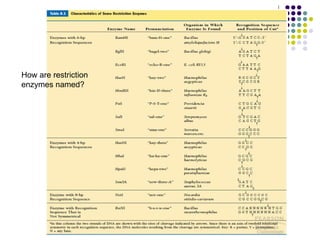
What are the 3  general  steps used to clone DNA? Isolate DNA from an organism Cut the organismal DNA and the vector with restriction enzymes making recombinant DNA Introduce the recombinant DNA into a host  Restriction Enzymes Recognize a specific site (generally a pallidromic sequence) Produce overhangs or straight cuts Naturally found in bacteria, they protect against viruses and foreign DNA More than 400 enzymes have been isolated Named for the organism they from which they are isolated The first letter is that of the genus and the 2 nd  and 3 rd  are from the species
Figure 8.1 Restriction site in DNA, showing symmetry of the sequence around the center point. The sequence is a palindrome, reading the same from left to right (5’-to-3’) on the top strand (GAATTC, here) as it does from right to left (5’-to-3’) on the bottom strand. Shown is the restriction site for  Eco RI.
How are restriction enzymes named?
Figure 8.2 Examples of how restriction enzymes cleave DNA.  (a)  Sma I results in blunt ends.  (b)  Bam HI results in 5’ overhanging (“sticky”) ends.  (c)  Pst I results in 3’ overhanging (“sticky”) ends.
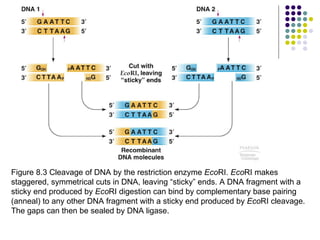
Figure 8.3 Cleavage of DNA by the restriction enzyme  Eco RI.  Eco RI makes staggered, symmetrical cuts in DNA, leaving “sticky” ends. A DNA fragment with a sticky end produced by  Eco RI digestion can bind by complementary base pairing (anneal) to any other DNA fragment with a sticky end produced by  Eco RI cleavage. The gaps can then be sealed by DNA ligase.
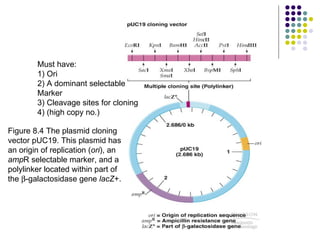
What types of nucleic acids are used as cloning vectors? What are some elements that are necessary for a plasmid cloning vector and in what ways is the pUC19 vector especially useful for cloning DNA? Why must a cloning plasmid be recircularized before transforming a host bacterium? Describe how insertional mutagenesis is used to distinguish nonrecombinant plasmid from recombinant plasmid when screening transformed hosts. What are some elements that are necessary for a shuttle plasmid cloning vector? What are some elements that are necessary for an expression cloning vector, a YAC, and a BAC? Compare the size of DNA insert that can be carried by a plasmid, a YAC, and a BAC.
Must have: 1) Ori 2) A dominant selectable Marker 3) Cleavage sites for cloning 4) (high copy no.) Figure 8.4 The plasmid cloning vector pUC19. This plasmid has an origin of replication ( ori ), an  amp R selectable marker, and a polylinker located within part of the   -galactosidase gene  lacZ +.
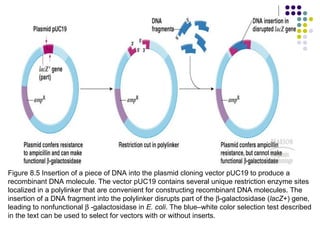
Figure 8.5 Insertion of a piece of DNA into the plasmid cloning vector pUC19 to produce a recombinant DNA molecule. The vector pUC19 contains several unique restriction enzyme sites localized in a polylinker that are convenient for constructing recombinant DNA molecules. The insertion of a DNA fragment into the polylinker disrupts part of the   -galactosidase ( lacZ +) gene, leading to nonfunctional    -galactosidase in  E. coli . The blue–white color selection test described in the text can be used to select for vectors with or without inserts.
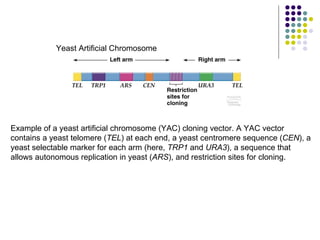
Yeast Artificial Chromosome Example of a yeast artificial chromosome (YAC) cloning vector. A YAC vector contains a yeast telomere ( TEL ) at each end, a yeast centromere sequence ( CEN ), a yeast selectable marker for each arm (here,  TRP1  and  URA3 ), a sequence that allows autonomous replication in yeast ( ARS ), and restriction sites for cloning.
What types of DNA inserts are found in genomic libraries, chromosomal libraries, and a cDNA library? Describe the steps in constructing a genomic library. What strategies can be used to ensure that the DNA inserts for a genomic library are especially large? How can you avoid “gaps” in a genomic library? How can a chromosome be segregated for constructing a chromosomal library?
What are some advantages of constructing a cDNA library? How is mRNA isolated for constructing a cDNA library and what special enzymes are required  to prepare cDNA?  What is adapter and linker DNA, and what advantages do they offer?
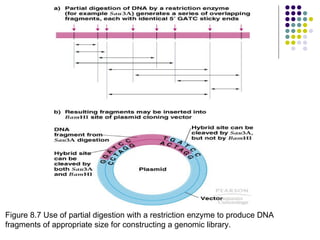
Figure 8.7 Use of partial digestion with a restriction enzyme to produce DNA fragments of appropriate size for constructing a genomic library.
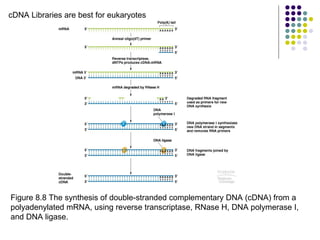
cDNA Libraries are best for eukaryotes Figure 8.8 The synthesis of double-stranded complementary DNA (cDNA) from a polyadenylated mRNA, using reverse transcriptase, RNase H, DNA polymerase I, and DNA ligase.
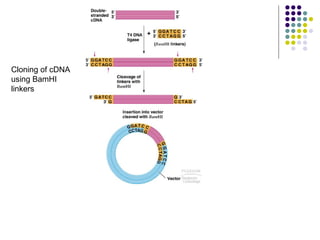
Cloning of cDNA using BamHI linkers
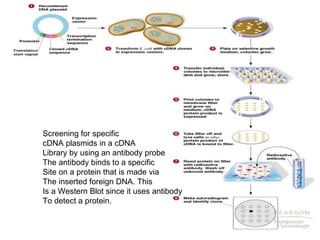
Screening What screening method can be used to identify a recombinant clone with a target gene in a cDNA library cloned into an expression vector? (Western Blot) What role does a plastic membrane play in this screening strategy? (protein product will stick to the membane) How can antibody binding be detected? (radioactivity is an inexpensive method!) Review the next slide—know how to do this!
Screening for specific cDNA plasmids in a cDNA Library by using an antibody probe The antibody binds to a specific Site on a protein that is made via The inserted foreign DNA. This Is a Western Blot since it uses antibody To detect a protein.
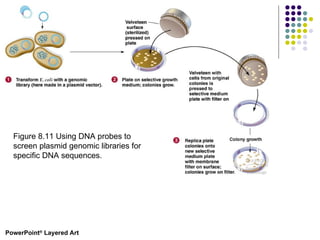
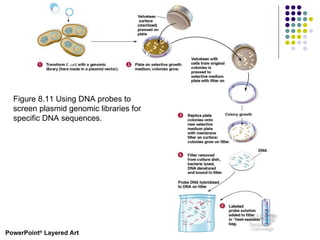
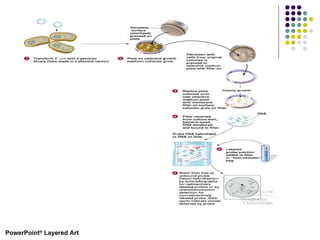
Southern Blot: Detection of A Specific DNA Sequence Using a Probe Once some sequence information is available on a target gene, how can it be quickly screened for in a genomic library? What is replica plating, and how does it make library screens more efficient? What are some requirements for probing DNA with a complementary DNA fragment and how are these requirements met in screening a library with a probe? Describe how DNA probes can be labeled for detection of annealing to a complementary sequence.  Which method(s) have the greatest sensitivity of detection? About how long must a synthetic probe be in order to discriminate a target sequence in a genomic library? What is a heterologous probe, and what limitations are there to the use of these probes in screening genomic libraries? Describe how GenBank is used to design a heterologous probe that matches a consensus sequence. What can be done to design a probe specific to a target gene when there is no clear consensus sequence in the target gene?
Designing Probes If the sequence of a gene is partially known in an organism, a homologous probe can be made. If it is known in another organism, a heterologous probe can be made Probes are usually 20 to 30 bases long and can be labeled with radioactive tags or fluorescent tags. They can be synthesized by a company (e.g. Sigma Genosys makes custom oligos)
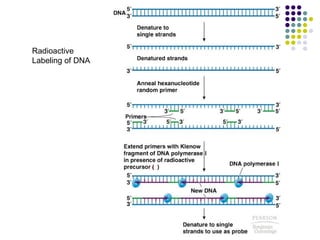
Radioactive Labeling of DNA
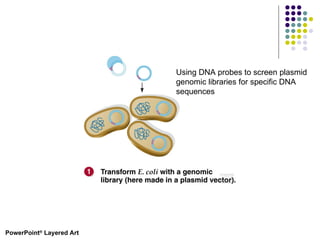
PowerPoint ®  Layered Art Using DNA probes to screen plasmid genomic libraries for specific DNA sequences
PowerPoint ®  Layered Art Figure 8.11 Using DNA probes to screen plasmid genomic libraries for specific DNA sequences.
PowerPoint ®  Layered Art
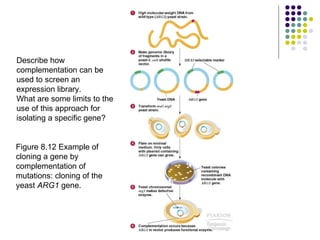
Describe how complementation can be used to screen an expression library.  What are some limits to the use of this approach for isolating a specific gene?  Figure 8.12 Example of cloning a gene by complementation of mutations: cloning of the yeast  ARG1  gene.
Electrophoresis Describe the two apposing forces that allows DNA fragments to be separated by size in gel electrophoresis. How are DNA fragments detected in an agarose gel? How are the sizes of DNA fragments determined in an agarose gel?
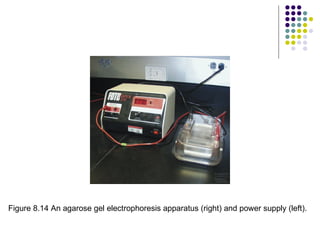
Figure 8.14 An agarose gel electrophoresis apparatus (right) and power supply (left).
Restriction Mapping How is a restriction map of a recombinant plasmid determined, and what is a practical application of such a map? In many situations, a restriction site must be studied in its genomic background.  Explain how this is done. Why is it necessary to use a hybridization probe for such an analysis? Why is it necessary to blot the agarose gel onto a plastic membrane before probing? What is this approach called?
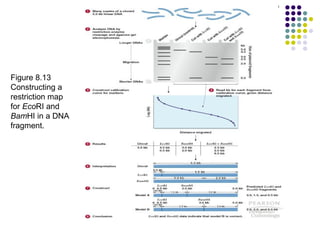
Figure 8.13 Constructing a restriction map for  Eco RI and  Bam HI in a DNA fragment.
Applications of a Map How is a restriction map of a recombinant plasmid determined, and what is a practical application of such a map? In many situations, a restriction site must be studied in its genomic background.  Explain how this is done. Why is it necessary to use a hybridization probe for such an analysis? Why is it necessary to blot the agarose gel onto a plastic membrane before probing? What is this approach called?
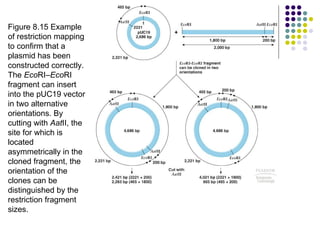
Figure 8.15 Example of restriction mapping to confirm that a plasmid has been constructed correctly. The  Eco RI– Eco RI fragment can insert into the pUC19 vector in two alternative orientations. By cutting with  Aat II, the site for which is located asymmetrically in the cloned fragment, the orientation of the clones can be distinguished by the restriction fragment sizes.
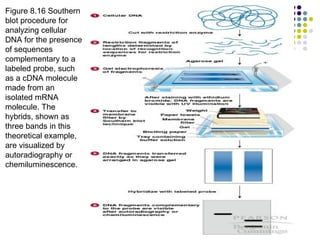
Figure 8.16 Southern blot procedure for analyzing cellular DNA for the presence of sequences complementary to a labeled probe, such as a cDNA molecule made from an isolated mRNA molecule. The hybrids, shown as three bands in this theoretical example, are visualized by autoradiography or chemiluminescence.
Blots continued What does a northern blot analyze, and how is this different from a Southern blot? What are some common applications of northern blot analysis?
DNA Sequencing Describe the rationale behind the Sanger dideoxy sequencing technique. What are the necessary components of sequencing reactions? How is the radiogram interpreted in sequencing reactions? In what ways are the sequencing reactions different in an automated DNA procedure? What types of information does DNA sequencing reveal?
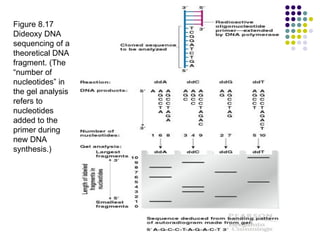
Figure 8.17 Dideoxy DNA sequencing of a theoretical DNA fragment. (The “number of nucleotides” in the gel analysis refers to nucleotides added to the primer during new DNA synthesis.)
 
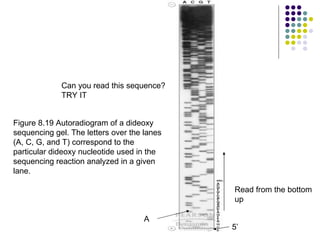
Can you read this sequence? TRY IT A 5’ Read from the bottom up Figure 8.19 Autoradiogram of a dideoxy sequencing gel. The letters over the lanes (A, C, G, and T) correspond to the particular dideoxy nucleotide used in the sequencing reaction analyzed in a given lane.
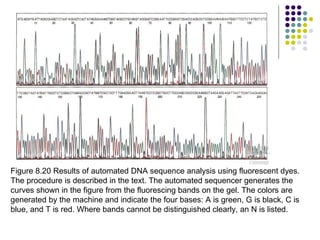
Figure 8.20 Results of automated DNA sequence analysis using fluorescent dyes. The procedure is described in the text. The automated sequencer generates the curves shown in the figure from the fluorescing bands on the gel. The colors are generated by the machine and indicate the four bases: A is green, G is black, C is blue, and T is red. Where bands cannot be distinguished clearly, an N is listed.
PCR Describe the rationale behind the polymerase chain reaction (PCR) technique. What are the necessary components of PCR reactions? Why must the DNA polymerase be highly thermally stable? What are the temperatures of the thermal cycle, and what occurs at each of these temperature? What are some advantages and limitations of PCR? What are some applications of PCR?
What is RT-PCR, and in what ways is it different from PCR reactions? Why is PCR poorly quantitative? How has RT-PCR been made to be quantitative?
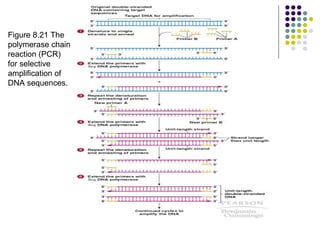
Figure 8.21 The polymerase chain reaction (PCR) for selective amplification of DNA sequences.
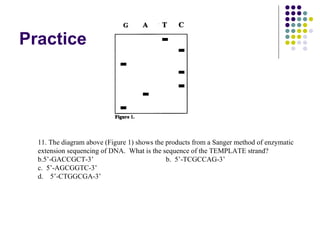
Practice 11. The diagram above (Figure 1) shows the products from a Sanger method of enzymatic extension sequencing of DNA.  What is the sequence of the TEMPLATE strand? 5’-GACCGCT-3’ b.  5’-TCGCCAG-3’ c.  5’-AGCGGTC-3’ d.  5’-CTGGCGA-3’

Chapter8 igenetics

  • 1.
    Chapter 8: RecombinantDNA Technology Linnea Fletcher Ph.D. BIOL 2316
  • 2.
    Principal Points Cloningis the making of many copies of a segment of DNA Cloning vectors range from plasmids to artificial chromosomes to viruses Genomic libraries are collections of clones that contain at least one copy of every DNA sequence in an organism’s genome cDNA made from mRNA represent eukaryotic genes without introns Identification of clones can be done using cDNA probes, antibodies, complementation of mutations, and sequencing The PCR is a procedure for amplifying a specific segment of DNA
  • 3.
    DNA fragments separatedby gel electrophoresis and visualized under UV light. (EtBr intercalates between the bases; allowing for visualization of the DNA)
  • 4.
    What are the3 general steps used to clone DNA? Isolate DNA from an organism Cut the organismal DNA and the vector with restriction enzymes making recombinant DNA Introduce the recombinant DNA into a host Restriction Enzymes Recognize a specific site (generally a pallidromic sequence) Produce overhangs or straight cuts Naturally found in bacteria, they protect against viruses and foreign DNA More than 400 enzymes have been isolated Named for the organism they from which they are isolated The first letter is that of the genus and the 2 nd and 3 rd are from the species
  • 5.
    Figure 8.1 Restrictionsite in DNA, showing symmetry of the sequence around the center point. The sequence is a palindrome, reading the same from left to right (5’-to-3’) on the top strand (GAATTC, here) as it does from right to left (5’-to-3’) on the bottom strand. Shown is the restriction site for Eco RI.
  • 6.
    How are restrictionenzymes named?
  • 7.
    Figure 8.2 Examplesof how restriction enzymes cleave DNA. (a) Sma I results in blunt ends. (b) Bam HI results in 5’ overhanging (“sticky”) ends. (c) Pst I results in 3’ overhanging (“sticky”) ends.
  • 8.
    Figure 8.3 Cleavageof DNA by the restriction enzyme Eco RI. Eco RI makes staggered, symmetrical cuts in DNA, leaving “sticky” ends. A DNA fragment with a sticky end produced by Eco RI digestion can bind by complementary base pairing (anneal) to any other DNA fragment with a sticky end produced by Eco RI cleavage. The gaps can then be sealed by DNA ligase.
  • 9.
    What types ofnucleic acids are used as cloning vectors? What are some elements that are necessary for a plasmid cloning vector and in what ways is the pUC19 vector especially useful for cloning DNA? Why must a cloning plasmid be recircularized before transforming a host bacterium? Describe how insertional mutagenesis is used to distinguish nonrecombinant plasmid from recombinant plasmid when screening transformed hosts. What are some elements that are necessary for a shuttle plasmid cloning vector? What are some elements that are necessary for an expression cloning vector, a YAC, and a BAC? Compare the size of DNA insert that can be carried by a plasmid, a YAC, and a BAC.
  • 10.
    Must have: 1)Ori 2) A dominant selectable Marker 3) Cleavage sites for cloning 4) (high copy no.) Figure 8.4 The plasmid cloning vector pUC19. This plasmid has an origin of replication ( ori ), an amp R selectable marker, and a polylinker located within part of the  -galactosidase gene lacZ +.
  • 11.
    Figure 8.5 Insertionof a piece of DNA into the plasmid cloning vector pUC19 to produce a recombinant DNA molecule. The vector pUC19 contains several unique restriction enzyme sites localized in a polylinker that are convenient for constructing recombinant DNA molecules. The insertion of a DNA fragment into the polylinker disrupts part of the  -galactosidase ( lacZ +) gene, leading to nonfunctional  -galactosidase in E. coli . The blue–white color selection test described in the text can be used to select for vectors with or without inserts.
  • 12.
    Yeast Artificial ChromosomeExample of a yeast artificial chromosome (YAC) cloning vector. A YAC vector contains a yeast telomere ( TEL ) at each end, a yeast centromere sequence ( CEN ), a yeast selectable marker for each arm (here, TRP1 and URA3 ), a sequence that allows autonomous replication in yeast ( ARS ), and restriction sites for cloning.
  • 13.
    What types ofDNA inserts are found in genomic libraries, chromosomal libraries, and a cDNA library? Describe the steps in constructing a genomic library. What strategies can be used to ensure that the DNA inserts for a genomic library are especially large? How can you avoid “gaps” in a genomic library? How can a chromosome be segregated for constructing a chromosomal library?
  • 14.
    What are someadvantages of constructing a cDNA library? How is mRNA isolated for constructing a cDNA library and what special enzymes are required to prepare cDNA? What is adapter and linker DNA, and what advantages do they offer?
  • 15.
    Figure 8.7 Useof partial digestion with a restriction enzyme to produce DNA fragments of appropriate size for constructing a genomic library.
  • 16.
    cDNA Libraries arebest for eukaryotes Figure 8.8 The synthesis of double-stranded complementary DNA (cDNA) from a polyadenylated mRNA, using reverse transcriptase, RNase H, DNA polymerase I, and DNA ligase.
  • 17.
    Cloning of cDNAusing BamHI linkers
  • 18.
    Screening What screeningmethod can be used to identify a recombinant clone with a target gene in a cDNA library cloned into an expression vector? (Western Blot) What role does a plastic membrane play in this screening strategy? (protein product will stick to the membane) How can antibody binding be detected? (radioactivity is an inexpensive method!) Review the next slide—know how to do this!
  • 19.
    Screening for specificcDNA plasmids in a cDNA Library by using an antibody probe The antibody binds to a specific Site on a protein that is made via The inserted foreign DNA. This Is a Western Blot since it uses antibody To detect a protein.
  • 20.
    Southern Blot: Detectionof A Specific DNA Sequence Using a Probe Once some sequence information is available on a target gene, how can it be quickly screened for in a genomic library? What is replica plating, and how does it make library screens more efficient? What are some requirements for probing DNA with a complementary DNA fragment and how are these requirements met in screening a library with a probe? Describe how DNA probes can be labeled for detection of annealing to a complementary sequence. Which method(s) have the greatest sensitivity of detection? About how long must a synthetic probe be in order to discriminate a target sequence in a genomic library? What is a heterologous probe, and what limitations are there to the use of these probes in screening genomic libraries? Describe how GenBank is used to design a heterologous probe that matches a consensus sequence. What can be done to design a probe specific to a target gene when there is no clear consensus sequence in the target gene?
  • 21.
    Designing Probes Ifthe sequence of a gene is partially known in an organism, a homologous probe can be made. If it is known in another organism, a heterologous probe can be made Probes are usually 20 to 30 bases long and can be labeled with radioactive tags or fluorescent tags. They can be synthesized by a company (e.g. Sigma Genosys makes custom oligos)
  • 22.
  • 23.
    PowerPoint ® Layered Art Using DNA probes to screen plasmid genomic libraries for specific DNA sequences
  • 24.
    PowerPoint ® Layered Art Figure 8.11 Using DNA probes to screen plasmid genomic libraries for specific DNA sequences.
  • 25.
    PowerPoint ® Layered Art Figure 8.11 Using DNA probes to screen plasmid genomic libraries for specific DNA sequences.
  • 26.
    PowerPoint ® Layered Art
  • 27.
    Describe how complementationcan be used to screen an expression library. What are some limits to the use of this approach for isolating a specific gene? Figure 8.12 Example of cloning a gene by complementation of mutations: cloning of the yeast ARG1 gene.
  • 28.
    Electrophoresis Describe thetwo apposing forces that allows DNA fragments to be separated by size in gel electrophoresis. How are DNA fragments detected in an agarose gel? How are the sizes of DNA fragments determined in an agarose gel?
  • 29.
    Figure 8.14 Anagarose gel electrophoresis apparatus (right) and power supply (left).
  • 30.
    Restriction Mapping Howis a restriction map of a recombinant plasmid determined, and what is a practical application of such a map? In many situations, a restriction site must be studied in its genomic background. Explain how this is done. Why is it necessary to use a hybridization probe for such an analysis? Why is it necessary to blot the agarose gel onto a plastic membrane before probing? What is this approach called?
  • 31.
    Figure 8.13 Constructinga restriction map for Eco RI and Bam HI in a DNA fragment.
  • 32.
    Applications of aMap How is a restriction map of a recombinant plasmid determined, and what is a practical application of such a map? In many situations, a restriction site must be studied in its genomic background. Explain how this is done. Why is it necessary to use a hybridization probe for such an analysis? Why is it necessary to blot the agarose gel onto a plastic membrane before probing? What is this approach called?
  • 33.
    Figure 8.15 Exampleof restriction mapping to confirm that a plasmid has been constructed correctly. The Eco RI– Eco RI fragment can insert into the pUC19 vector in two alternative orientations. By cutting with Aat II, the site for which is located asymmetrically in the cloned fragment, the orientation of the clones can be distinguished by the restriction fragment sizes.
  • 34.
    Figure 8.16 Southernblot procedure for analyzing cellular DNA for the presence of sequences complementary to a labeled probe, such as a cDNA molecule made from an isolated mRNA molecule. The hybrids, shown as three bands in this theoretical example, are visualized by autoradiography or chemiluminescence.
  • 35.
    Blots continued Whatdoes a northern blot analyze, and how is this different from a Southern blot? What are some common applications of northern blot analysis?
  • 36.
    DNA Sequencing Describethe rationale behind the Sanger dideoxy sequencing technique. What are the necessary components of sequencing reactions? How is the radiogram interpreted in sequencing reactions? In what ways are the sequencing reactions different in an automated DNA procedure? What types of information does DNA sequencing reveal?
  • 37.
    Figure 8.17 DideoxyDNA sequencing of a theoretical DNA fragment. (The “number of nucleotides” in the gel analysis refers to nucleotides added to the primer during new DNA synthesis.)
  • 38.
  • 39.
    Can you readthis sequence? TRY IT A 5’ Read from the bottom up Figure 8.19 Autoradiogram of a dideoxy sequencing gel. The letters over the lanes (A, C, G, and T) correspond to the particular dideoxy nucleotide used in the sequencing reaction analyzed in a given lane.
  • 40.
    Figure 8.20 Resultsof automated DNA sequence analysis using fluorescent dyes. The procedure is described in the text. The automated sequencer generates the curves shown in the figure from the fluorescing bands on the gel. The colors are generated by the machine and indicate the four bases: A is green, G is black, C is blue, and T is red. Where bands cannot be distinguished clearly, an N is listed.
  • 41.
    PCR Describe therationale behind the polymerase chain reaction (PCR) technique. What are the necessary components of PCR reactions? Why must the DNA polymerase be highly thermally stable? What are the temperatures of the thermal cycle, and what occurs at each of these temperature? What are some advantages and limitations of PCR? What are some applications of PCR?
  • 42.
    What is RT-PCR,and in what ways is it different from PCR reactions? Why is PCR poorly quantitative? How has RT-PCR been made to be quantitative?
  • 43.
    Figure 8.21 Thepolymerase chain reaction (PCR) for selective amplification of DNA sequences.
  • 44.
    Practice 11. Thediagram above (Figure 1) shows the products from a Sanger method of enzymatic extension sequencing of DNA. What is the sequence of the TEMPLATE strand? 5’-GACCGCT-3’ b. 5’-TCGCCAG-3’ c. 5’-AGCGGTC-3’ d. 5’-CTGGCGA-3’

Editor's Notes

  • #4 DNA fragments separated by gel electrophoresis and visualized under UV light.
  • #6 Figure 8.1 Restriction site in DNA, showing symmetry of the sequence around the center point. The sequence is a palindrome, reading the same from left to right (5’-to-3’) on the top strand (GAATTC, here) as it does from right to left (5’-to-3’) on the bottom strand. Shown is the restriction site for Eco RI.
  • #8 Figure 8.2 Examples of how restriction enzymes cleave DNA. (a) Sma I results in blunt ends. (b) Bam HI results in 5’ overhanging (“sticky”) ends. (c) Pst I results in 3’ overhanging (“sticky”) ends.
  • #9 Figure 8.3 Cleavage of DNA by the restriction enzyme Eco RI. Eco RI makes staggered, symmetrical cuts in DNA, leaving “sticky” ends. A DNA fragment with a sticky end produced by Eco RI digestion can bind by complementary base pairing (anneal) to any other DNA fragment with a sticky end produced by Eco RI cleavage. The gaps can then be sealed by DNA ligase.
  • #11 Figure 8.4 The plasmid cloning vector pUC19. This plasmid has an origin of replication ( ori ), an amp R selectable marker, and a polylinker located within part of the  -galactosidase gene lacZ +.
  • #12 Figure 8.5 Insertion of a piece of DNA into the plasmid cloning vector pUC19 to produce a recombinant DNA molecule. The vector pUC19 contains several unique restriction enzyme sites localized in a polylinker that are convenient for constructing recombinant DNA molecules. The insertion of a DNA fragment into the polylinker disrupts part of the  -galactosidase ( lacZ +) gene, leading to nonfunctional  -galactosidase in E. coli . The blue–white color selection test described in the text can be used to select for vectors with or without inserts.
  • #13 Figure 8.6 Example of a yeast artificial chromosome (YAC) cloning vector. A YAC vector contains a yeast telomere ( TEL ) at each end, a yeast centromere sequence ( CEN ), a yeast selectable marker for each arm (here, TRP1 and URA3 ), a sequence that allows autonomous replication in yeast ( ARS ), and restriction sites for cloning.
  • #16 Figure 8.7 Use of partial digestion with a restriction enzyme to produce DNA fragments of appropriate size for constructing a genomic library.
  • #17 Figure 8.8 The synthesis of double-stranded complementary DNA (cDNA) from a polyadenylated mRNA, using reverse transcriptase, RNase H, DNA polymerase I, and DNA ligase.
  • #18 Figure 8.9 The cloning of cDNA, using Bam HI linkers.
  • #20 Figure 8.10 Screening for specific cDNA plasmids in a cDNA library by using an antibody probe.
  • #23 Box Figure 8.1 Random primer method of radioactively labeling DNA.
  • #24 Figure 8.11 Using DNA probes to screen plasmid genomic libraries for specific DNA sequences.
  • #25 Figure 8.11 Using DNA probes to screen plasmid genomic libraries for specific DNA sequences.
  • #26 Figure 8.11 Using DNA probes to screen plasmid genomic libraries for specific DNA sequences.
  • #27 Figure 8.11 Using DNA probes to screen plasmid genomic libraries for specific DNA sequences.
  • #28 Figure 8.12 Example of cloning a gene by complementation of mutations: cloning of the yeast ARG1 gene.
  • #30 Figure 8.14 An agarose gel electrophoresis apparatus (right) and power supply (left).
  • #32 Figure 8.13 Constructing a restriction map for Eco RI and Bam HI in a DNA fragment.
  • #34 Figure 8.15 Example of restriction mapping to confirm that a plasmid has been constructed correctly. The Eco RI– Eco RI fragment can insert into the pUC19 vector in two alternative orientations. By cutting with Aat II, the site for which is located asymmetrically in the cloned fragment, the orientation of the clones can be distinguished by the restriction fragment sizes.
  • #35 Figure 8.16 Southern blot procedure for analyzing cellular DNA for the presence of sequences complementary to a labeled probe, such as a cDNA molecule made from an isolated mRNA molecule. The hybrids, shown as three bands in this theoretical example, are visualized by autoradiography or chemiluminescence.
  • #38 Figure 8.17 Dideoxy DNA sequencing of a theoretical DNA fragment. (The “number of nucleotides” in the gel analysis refers to nucleotides added to the primer during new DNA synthesis.)
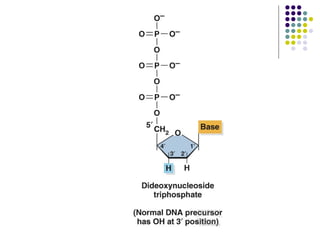
  • #39 Figure 8.18 A dideoxynucleotide (ddNTP) DNA precursor.
  • #40 Figure 8.19 Autoradiogram of a dideoxy sequencing gel. The letters over the lanes (A, C, G, and T) correspond to the particular dideoxy nucleotide used in the sequencing reaction analyzed in a given lane.
  • #41 Figure 8.20 Results of automated DNA sequence analysis using fluorescent dyes. The procedure is described in the text. The automated sequencer generates the curves shown in the figure from the fluorescing bands on the gel. The colors are generated by the machine and indicate the four bases: A is green, G is black, C is blue, and T is red. Where bands cannot be distinguished clearly, an N is listed.
  • #44 Figure 8.21 The polymerase chain reaction (PCR) for selective amplification of DNA sequences.