Principle of ethology with
special reference to pattern of
behavior
behavior
Submitted by
Jagriti baruah
Roll no – 149
Bsc 6th sem, Dept. Of Zoology
DKD college
Index
1. Introduction
a. What is Ethology?
b. Origin & History of Ethology.
2. Principles of Ethology.
3. Some Special Reference of Ethology.
4. Patterns and Behaviour.
5. Conclusion.
6. Reference.
Introduction
What is Ethology?
The brance of biology that deals with the
systematic study of animal behavior is
known as ethology. **The word ethology is
made up of two Greek words "ethos"
meaning 'habit' and "logos" meaning
'study'.** Subjects of study include learning,
communication, sexual behavior, and
others.
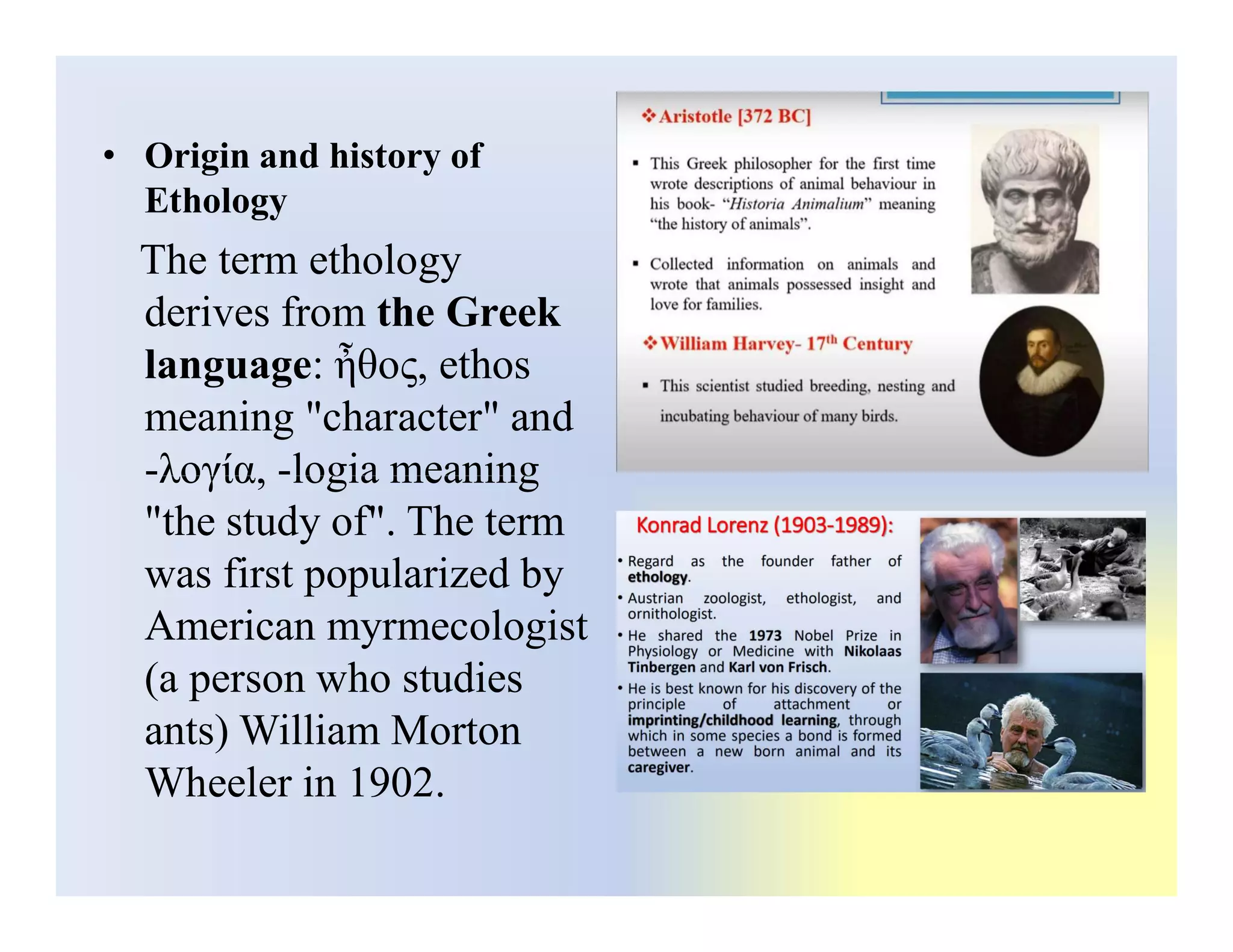
• Origin and history of
Ethology
The term ethology
derives from the Greek
language: ἦθος, ethos
meaning "character" and
-λογία, -logia meaning
"the study of". The term
was first popularized by
American myrmecologist
(a person who studies
ants) William Morton
Wheeler in 1902.
Principles of Ethology
1) To understand why animal behave the way they
do.
2) Understand the cause of behavior.
3) The physiological mechanism that generates the
action.
4) To understand how behavior develops.
5) To study the evolutionary history of behavior.
6) The farmer must be aware of habits of his
animals to get maximum benefit.
Some special reference of
ethology
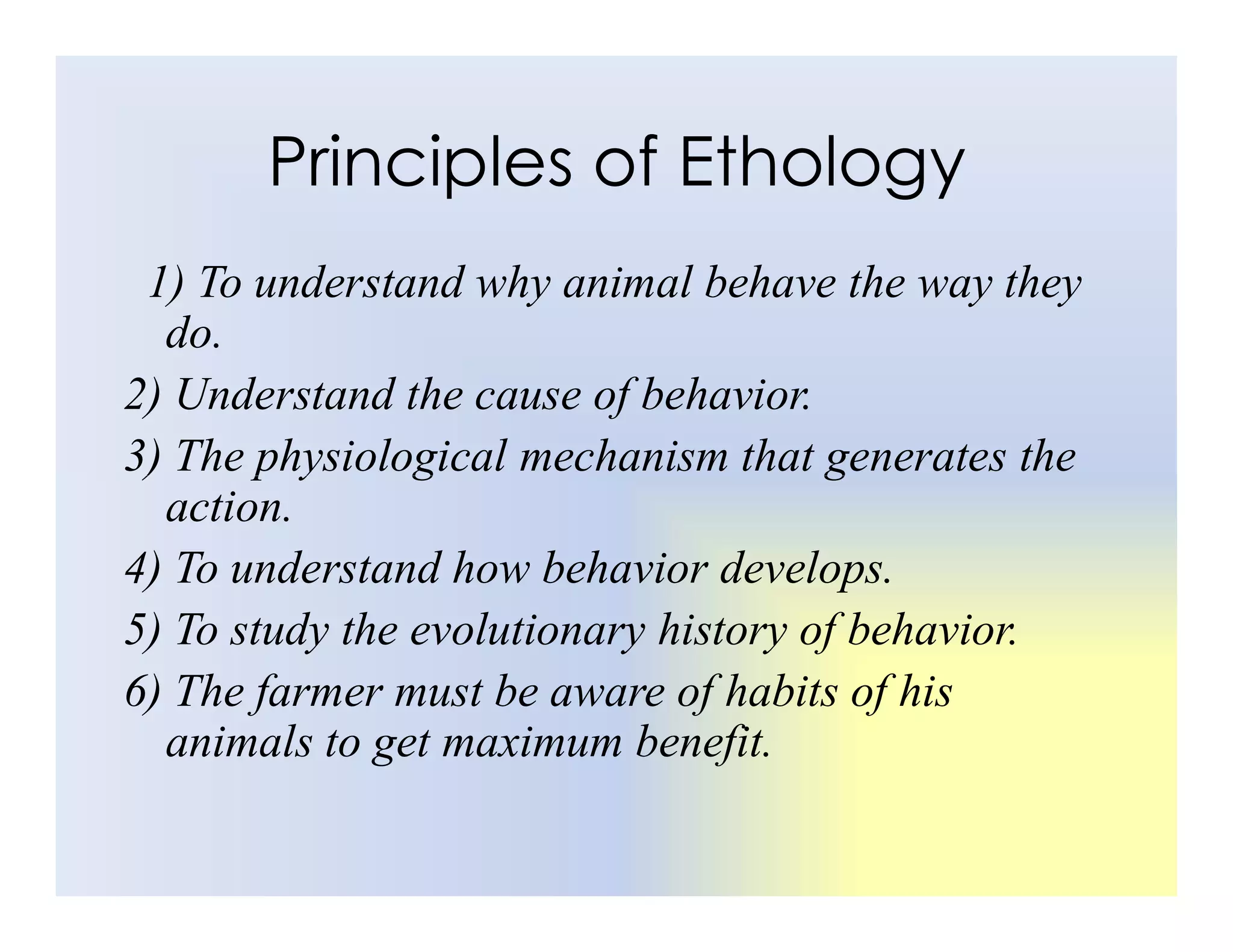
• The common peacock
performs spectacular
dance to attract the lena
hen for mating.
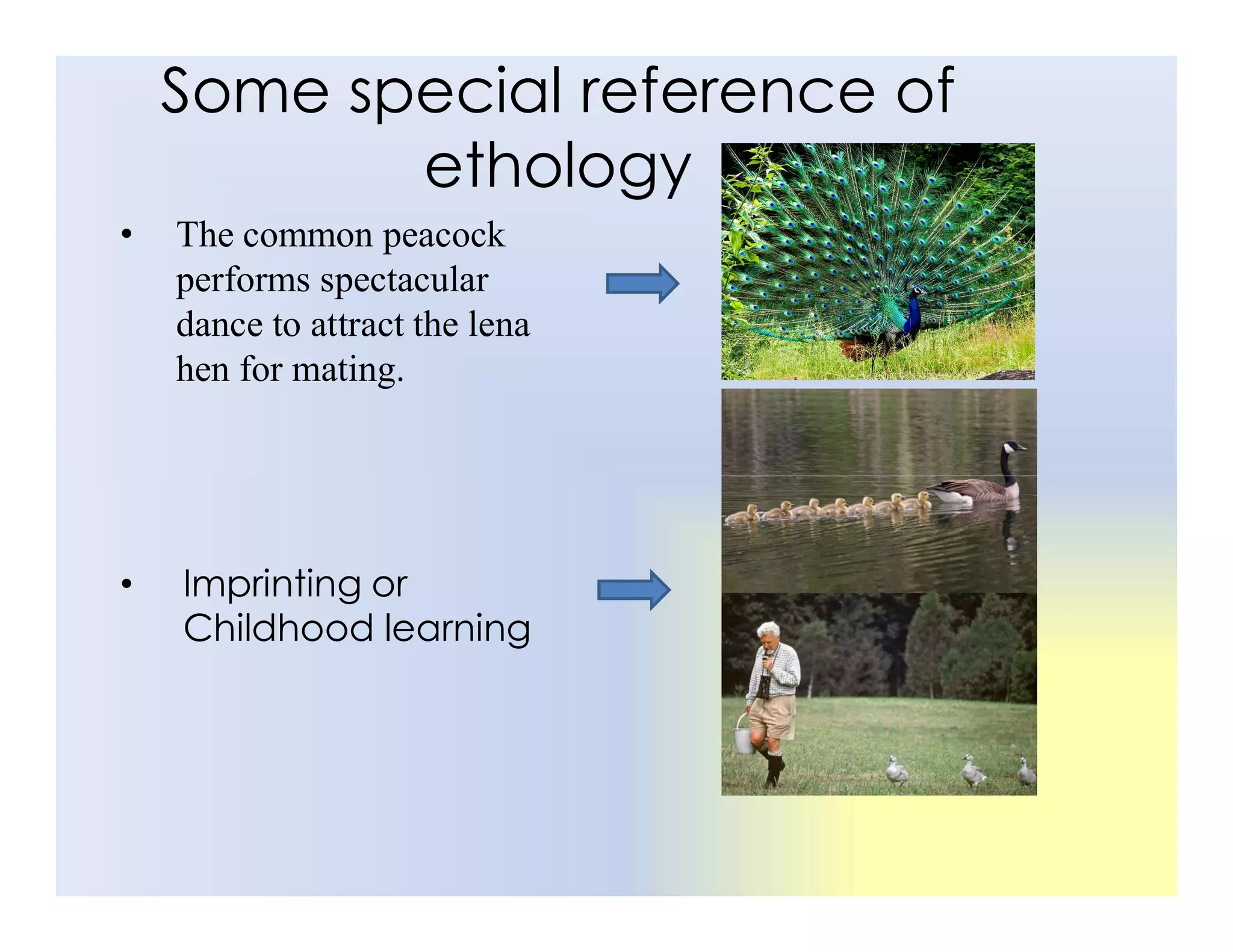
• Imprinting or
Childhood learning
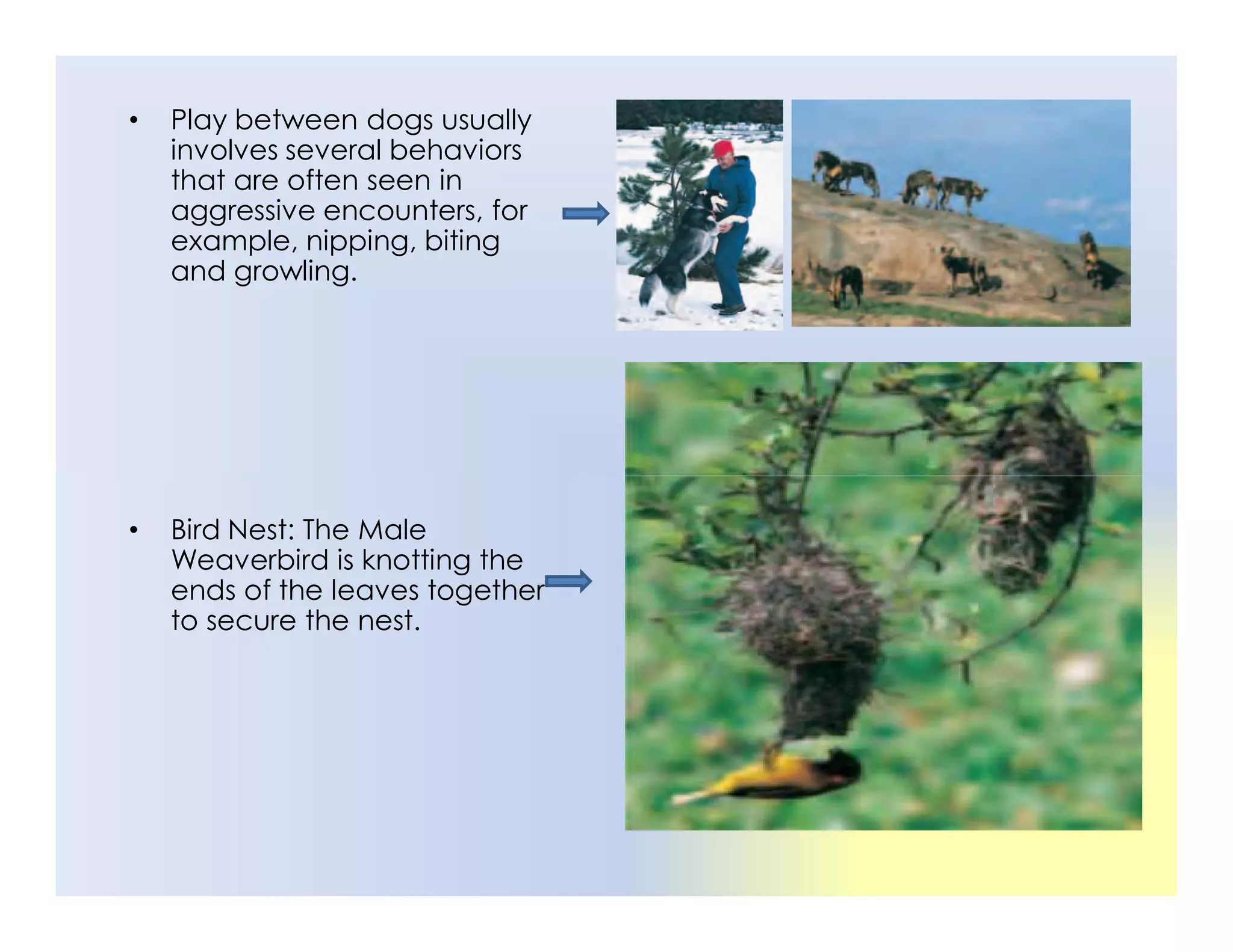
• Play between dogs usually
involves several behaviors
that are often seen in
aggressive encounters, for
example, nipping, biting
and growling.
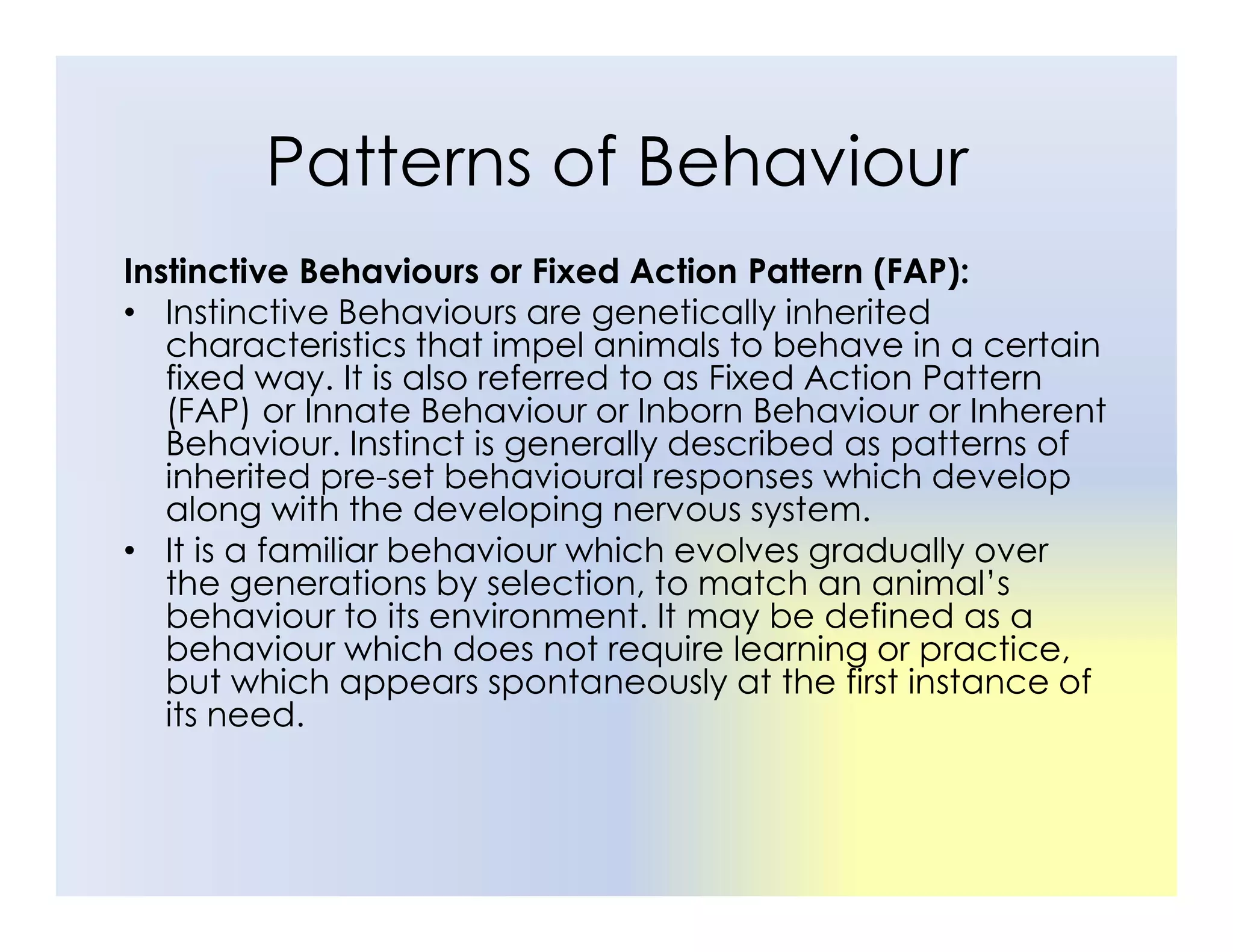
• Bird Nest: The Male
Weaverbird is knotting the
ends of the leaves together
to secure the nest.
Patterns of Behaviour
Instinctive Behaviours or Fixed Action Pattern (FAP):
• Instinctive Behaviours are genetically inherited
characteristics that impel animals to behave in a certain
fixed way. It is also referred to as Fixed Action Pattern
(FAP) or Innate Behaviour or Inborn Behaviour or Inherent
Behaviour. Instinct is generally described as patterns of
inherited pre-set behavioural responses which develop
along with the developing nervous system.
• It is a familiar behaviour which evolves gradually over
the generations by selection, to match an animal’s
behaviour to its environment. It may be defined as a
behaviour which does not require learning or practice,
but which appears spontaneously at the first instance of
its need.
• A few common examples are:
• 1. During the breeding season a pea-cock starts
dancing as soon as it sees a pea-hen. The
dancing act is not learnt by watch-ing.
• 2. A weaver bird never learns to con-struct a nest
. It simply knows it.
• 3. A tailor bird brings two leaves together and
stiches them with a long flexible grass and then
cushions the bottom with soft grasses, where it
lays her eggs. This vital information were passed
cushions the bottom with soft grasses, where it
lays her eggs. This vital information were passed
on to them through the genes of their parents.
• 4. Bees do not learn to build their hive, this
property is acquired genetically.
• Learning Behaviour
• 1. During the breeding season a pea-cock starts
dancing as soon as it sees a pea-hen. The
dancing act is not learnt by watch-ing.
• 2. A weaver bird never learns to con-struct a nest
. It simply knows it.
• 3. A tailor bird brings two leaves together and
stiches them with a long flexible grass and then
cushions the bottom with soft grasses, where it
lays her eggs. This vital information were passed
on to them through the genes of their parents.
• 4. Bees do not learn to build their hive, this
property is acquired genetically.
A common examples are
• i) Scarecrows erected to drive away birds in
crop-fields are effective for a short time. Soon
the birds get habitua-ted to this harmless
scarecrow.
• (ii) Cloud- shadow passing overhead causes
escape responses in young birds which
gradually diminishes.
(iii) Fishes present in a water body next to a
• (iii) Fishes present in a water body next to a
railway track show gradual decrease in
behavioural response due to the commotion
created by passing trains.
Conclusion
Ethology is not only important as an academic
science, but also has important implications in animal
welfare. For example, understanding animal behaviour is
essential in animal parks, animal husbandry, and when
using animals in scientific research. Understanding
animal behaviour is also essential in all other activities
where we interact with living animals, as in the use of
domestic animals, when hunting and fishing, in medical
science using animals, when training animals, and also
for veterinarians and in animal conservation. Studies on
human behaviour are of course also included in
ethology, and the application of such knowledge
provides a natural scientific perspective and
understanding of human behaviour.
Reference
• “ethology | Origin and meaning of
ethology by Online Etymology
Dictionary”.
• “What is ethology? | eNotes”.
• “PSYSC613 – Ethology
• “Fixed Action Patterns Fap in Animals
| Actforlibraries.org”.
• Animal behaviour-s.chand

Principle of Ethology with special reference to pattern of behavior

  • 1.
    Principle of ethologywith special reference to pattern of behavior behavior Submitted by Jagriti baruah Roll no – 149 Bsc 6th sem, Dept. Of Zoology DKD college
  • 2.
    Index 1. Introduction a. Whatis Ethology? b. Origin & History of Ethology. 2. Principles of Ethology. 2. Principles of Ethology. 3. Some Special Reference of Ethology. 4. Patterns and Behaviour. 5. Conclusion. 6. Reference.
  • 3.
    Introduction What is Ethology? Thebrance of biology that deals with the systematic study of animal behavior is known as ethology. **The word ethology is known as ethology. **The word ethology is made up of two Greek words "ethos" meaning 'habit' and "logos" meaning 'study'.** Subjects of study include learning, communication, sexual behavior, and others.
  • 4.
    • Origin andhistory of Ethology The term ethology derives from the Greek language: ἦθος, ethos meaning "character" and -λογία, -logia meaning -λογία, -logia meaning "the study of". The term was first popularized by American myrmecologist (a person who studies ants) William Morton Wheeler in 1902.
  • 5.
    Principles of Ethology 1)To understand why animal behave the way they do. 2) Understand the cause of behavior. 3) The physiological mechanism that generates the 3) The physiological mechanism that generates the action. 4) To understand how behavior develops. 5) To study the evolutionary history of behavior. 6) The farmer must be aware of habits of his animals to get maximum benefit.
  • 6.
    Some special referenceof ethology • The common peacock performs spectacular dance to attract the lena hen for mating. • Imprinting or Childhood learning
  • 7.
    • Play betweendogs usually involves several behaviors that are often seen in aggressive encounters, for example, nipping, biting and growling. • Bird Nest: The Male Weaverbird is knotting the ends of the leaves together to secure the nest.
  • 8.
    Patterns of Behaviour InstinctiveBehaviours or Fixed Action Pattern (FAP): • Instinctive Behaviours are genetically inherited characteristics that impel animals to behave in a certain fixed way. It is also referred to as Fixed Action Pattern (FAP) or Innate Behaviour or Inborn Behaviour or Inherent Behaviour. Instinct is generally described as patterns of inherited pre-set behavioural responses which develop inherited pre-set behavioural responses which develop along with the developing nervous system. • It is a familiar behaviour which evolves gradually over the generations by selection, to match an animal’s behaviour to its environment. It may be defined as a behaviour which does not require learning or practice, but which appears spontaneously at the first instance of its need.
  • 9.
    • A fewcommon examples are: • 1. During the breeding season a pea-cock starts dancing as soon as it sees a pea-hen. The dancing act is not learnt by watch-ing. • 2. A weaver bird never learns to con-struct a nest . It simply knows it. • 3. A tailor bird brings two leaves together and stiches them with a long flexible grass and then cushions the bottom with soft grasses, where it lays her eggs. This vital information were passed cushions the bottom with soft grasses, where it lays her eggs. This vital information were passed on to them through the genes of their parents. • 4. Bees do not learn to build their hive, this property is acquired genetically.
  • 10.
    • Learning Behaviour •1. During the breeding season a pea-cock starts dancing as soon as it sees a pea-hen. The dancing act is not learnt by watch-ing. • 2. A weaver bird never learns to con-struct a nest . It simply knows it. • 3. A tailor bird brings two leaves together and stiches them with a long flexible grass and then cushions the bottom with soft grasses, where it cushions the bottom with soft grasses, where it lays her eggs. This vital information were passed on to them through the genes of their parents. • 4. Bees do not learn to build their hive, this property is acquired genetically.
  • 11.
    A common examplesare • i) Scarecrows erected to drive away birds in crop-fields are effective for a short time. Soon the birds get habitua-ted to this harmless scarecrow. • (ii) Cloud- shadow passing overhead causes escape responses in young birds which gradually diminishes. (iii) Fishes present in a water body next to a • (iii) Fishes present in a water body next to a railway track show gradual decrease in behavioural response due to the commotion created by passing trains.
  • 12.
    Conclusion Ethology is notonly important as an academic science, but also has important implications in animal welfare. For example, understanding animal behaviour is essential in animal parks, animal husbandry, and when using animals in scientific research. Understanding animal behaviour is also essential in all other activities where we interact with living animals, as in the use of where we interact with living animals, as in the use of domestic animals, when hunting and fishing, in medical science using animals, when training animals, and also for veterinarians and in animal conservation. Studies on human behaviour are of course also included in ethology, and the application of such knowledge provides a natural scientific perspective and understanding of human behaviour.
  • 13.
    Reference • “ethology |Origin and meaning of ethology by Online Etymology Dictionary”. • “What is ethology? | eNotes”. • “PSYSC613 – Ethology • “PSYSC613 – Ethology • “Fixed Action Patterns Fap in Animals | Actforlibraries.org”. • Animal behaviour-s.chand