THEORY OF
EVOLUTION
EVOLUTION
Change of heritable
characteristics of
organisms over future
generations
PIONEERS
OF
EVOLUTION
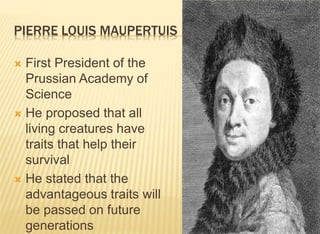
PIERRE LOUIS MAUPERTUIS
 First President of the
Prussian Academy of
Science
 He proposed that all
living creatures have
traits that help their
survival
 He stated that the
advantageous traits will
be passed on future
generations
KARL ERNST VON BAER
 First President of the
Russian Entomological
Society
 Stated that the changes in
the development of the
organisms were
responsible in the
changes of the phenotype
 Created an early version
of phylogenetic tree
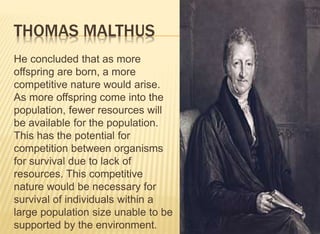
THOMAS MALTHUS
He concluded that as more
offspring are born, a more
competitive nature would arise.
As more offspring come into the
population, fewer resources will
be available for the population.
This has the potential for
competition between organisms
for survival due to lack of
resources. This competitive
nature would be necessary for
survival of individuals within a
large population size unable to be
supported by the environment.
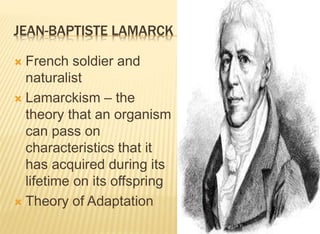
JEAN-BAPTISTE LAMARCK
 French soldier and
naturalist
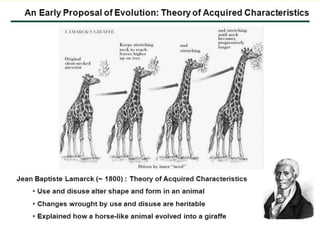
 Lamarckism – the
theory that an organism
can pass on
characteristics that it
has acquired during its
lifetime on its offspring
 Theory of Adaptation
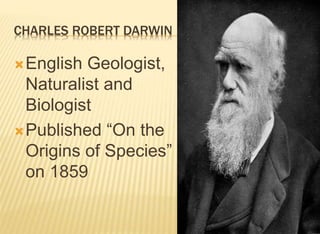
CHARLES ROBERT DARWIN
English Geologist,
Naturalist and
Biologist
Published “On the
Origins of Species”
on 1859
CHARLES ROBERT DARWIN CONTRIBUTIONS:
He stated that
all species of organisms arise
and develop through the natural
selection of small, inherited
variations that increase the
individual's ability to compete,
survive, and reproduce.
CHARLES ROBERT DARWIN CONTRIBUTIONS:
He added that all life on Earth is
connected and related to each
other, and this diversity of life is a
product of modifications of
populations by natural selection,
where some traits were favored
in and environment over others
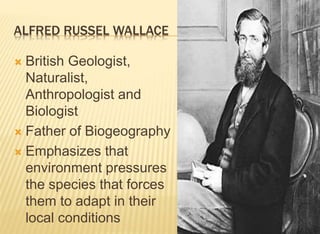
ALFRED RUSSEL WALLACE
 British Geologist,
Naturalist,
Anthropologist and
Biologist
 Father of Biogeography
 Emphasizes that
environment pressures
the species that forces
them to adapt in their
local conditions
NATURAL SELECTION
It is one of the key mechanisms of
evolution. It states that the
organisms best adapted to their
environment will have a better
chance to survive and reproduce.
GENETIC HITCHHIKING
It happens when an allele changes
frequency not because it itself is
under natural selection, but
because it is near another gene
that is undergoing a selective
sweep and that is on the
same DNA chain.
TYPES OF
REPRODUCTIVE
ISOLATION
ADAPTATION
Change in an organisms physical
structure or behaviour that improves
its ability to survive in their habitat
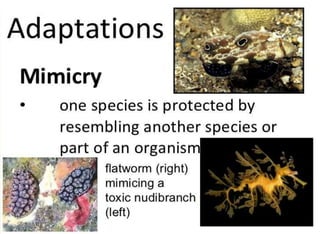
Anything that helps an organism
survives in its environment is an
adaptation
STRUCTURAL ADAPTATION
It involves physical features of an
organism that helps it to survive in its
environment
Examples:
Camouflage, shape of the teeth of an
organism based on its diet, fur of a
bear, beak of a bird
CHEMICAL ADAPTATION
It involves chemical that
helps the organism to adapt
and to survive
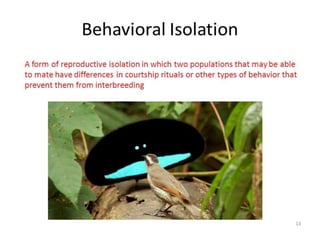
BEHAVIORAL ADAPTATION
It involves the behavioural
patterns of an organism that
helps them to adapt and to
survive in their environment
LAST UNIVERSAL COMMON ANCESTOR
It is the most recent common
ancestor of all current life on
Earth. It is a small, single-
celled, ring-shaped organism
that had lived 4-3.5 billion years
ago.
Evolution and Natural Selection

Evolution and Natural Selection

  • 4.
  • 5.
    EVOLUTION Change of heritable characteristicsof organisms over future generations
  • 7.
  • 8.
    PIERRE LOUIS MAUPERTUIS First President of the Prussian Academy of Science  He proposed that all living creatures have traits that help their survival  He stated that the advantageous traits will be passed on future generations
  • 9.
    KARL ERNST VONBAER  First President of the Russian Entomological Society  Stated that the changes in the development of the organisms were responsible in the changes of the phenotype  Created an early version of phylogenetic tree
  • 10.
    THOMAS MALTHUS He concludedthat as more offspring are born, a more competitive nature would arise. As more offspring come into the population, fewer resources will be available for the population. This has the potential for competition between organisms for survival due to lack of resources. This competitive nature would be necessary for survival of individuals within a large population size unable to be supported by the environment.
  • 11.
    JEAN-BAPTISTE LAMARCK  Frenchsoldier and naturalist  Lamarckism – the theory that an organism can pass on characteristics that it has acquired during its lifetime on its offspring  Theory of Adaptation
  • 13.
    CHARLES ROBERT DARWIN EnglishGeologist, Naturalist and Biologist Published “On the Origins of Species” on 1859
  • 14.
    CHARLES ROBERT DARWINCONTRIBUTIONS: He stated that all species of organisms arise and develop through the natural selection of small, inherited variations that increase the individual's ability to compete, survive, and reproduce.
  • 15.
    CHARLES ROBERT DARWINCONTRIBUTIONS: He added that all life on Earth is connected and related to each other, and this diversity of life is a product of modifications of populations by natural selection, where some traits were favored in and environment over others
  • 16.
    ALFRED RUSSEL WALLACE British Geologist, Naturalist, Anthropologist and Biologist  Father of Biogeography  Emphasizes that environment pressures the species that forces them to adapt in their local conditions
  • 18.
    NATURAL SELECTION It isone of the key mechanisms of evolution. It states that the organisms best adapted to their environment will have a better chance to survive and reproduce.
  • 20.
    GENETIC HITCHHIKING It happenswhen an allele changes frequency not because it itself is under natural selection, but because it is near another gene that is undergoing a selective sweep and that is on the same DNA chain.
  • 22.
  • 30.
    ADAPTATION Change in anorganisms physical structure or behaviour that improves its ability to survive in their habitat Anything that helps an organism survives in its environment is an adaptation
  • 31.
    STRUCTURAL ADAPTATION It involvesphysical features of an organism that helps it to survive in its environment Examples: Camouflage, shape of the teeth of an organism based on its diet, fur of a bear, beak of a bird
  • 33.
    CHEMICAL ADAPTATION It involveschemical that helps the organism to adapt and to survive
  • 34.
    BEHAVIORAL ADAPTATION It involvesthe behavioural patterns of an organism that helps them to adapt and to survive in their environment
  • 37.
    LAST UNIVERSAL COMMONANCESTOR It is the most recent common ancestor of all current life on Earth. It is a small, single- celled, ring-shaped organism that had lived 4-3.5 billion years ago.