Advanced Computer Networks
Chapter 2 Protocols and the TCP/IP Suite
1
Course Objective
 Introducing high speed networks including
gigabit networks.
 Design issues related to IP and TCP/IP and ATM
networks
 Provide up-to-date survey of developments in the
area.
 Performance analysis, congestion control and
provision of QoS to different applications are
also discussed.
Chapter 2 Protocols and the TCP/IP Suite
2
Course Outline
 Protocols and the TCP/IP Suite
 TCP and IP
 Frame Relay
 Asynchronous Transfer Mode
 High-Speed LANs
 Queuing Analysis
 Congestion and Traffic Management
 Internet Routing
 Assignment on Different Protocols in
Networking
Chapter 1 Protocols and the TCP/IP Suite
3
Chapter 2 Protocols and the TCP/IP Suite
4
Chapter 1
Protocols and the TCP/IP Suite
Chapter 2 Protocols and the TCP/IP Suite
5
Introduction
 Layered protocol architecture
 TCP/IP protocol suite
 OSI reference model
 Internetworking
Chapter 2 Protocols and the TCP/IP Suite
6
The Need for a Protocol
Architecture
 When computers, terminals and/or other data
processing devices exchange data:
– The Procedures involved to exchange data
between devices can be complex
– High degree of cooperation required between
communicating systems
 See the example in the next slide.
Chapter 2 Protocols and the TCP/IP Suite
7
Example: File transfer
 Requires a data path to exist (either a direct link
or via a comm. network)
 Tasks:
– Activate data communication path
– Source determines that destination is ready
– File transfer app at source must ascertain that destination file
management app is ready to store file for user
– File format conversion
 Instead of implementing the logic as a single module, the
task is broken up into subtasks, each of which is
implemented separately.
Chapter 2 Protocols and the TCP/IP Suite
8
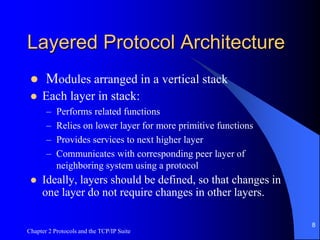
Layered Protocol Architecture
 Modules arranged in a vertical stack
 Each layer in stack:
– Performs related functions
– Relies on lower layer for more primitive functions
– Provides services to next higher layer
– Communicates with corresponding peer layer of
neighboring system using a protocol
 Ideally, layers should be defined, so that changes in
one layer do not require changes in other layers.
Chapter 2 Protocols and the TCP/IP Suite
9
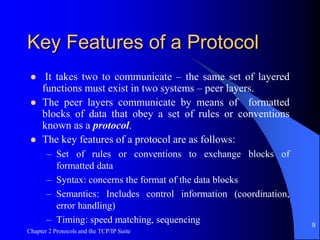
Key Features of a Protocol
 It takes two to communicate – the same set of layered
functions must exist in two systems – peer layers.
 The peer layers communicate by means of formatted
blocks of data that obey a set of rules or conventions
known as a protocol.
 The key features of a protocol are as follows:
– Set of rules or conventions to exchange blocks of
formatted data
– Syntax: concerns the format of the data blocks
– Semantics: Includes control information (coordination,
error handling)
– Timing: speed matching, sequencing
Chapter 2 Protocols and the TCP/IP Suite
10
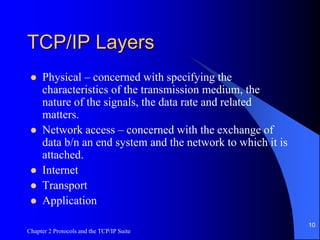
TCP/IP Layers
 Physical – concerned with specifying the
characteristics of the transmission medium, the
nature of the signals, the data rate and related
matters.
 Network access – concerned with the exchange of
data b/n an end system and the network to which it is
attached.
 Internet
 Transport
 Application
Chapter 2 Protocols and the TCP/IP Suite
11
TCP and UDP
 TCP:
– connection-oriented
– Reliable packet delivery in sequence
 UDP:
– connectionless (datagram)
– Unreliable packet delivery
– Packets may arrive out of sequence or
duplicated
Chapter 2 Protocols and the TCP/IP Suite
12
Figure 2.1
Chapter 2 Protocols and the TCP/IP Suite
13
Figure 2.2
Chapter 2 Protocols and the TCP/IP Suite
14
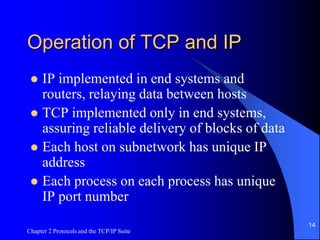
Operation of TCP and IP
 IP implemented in end systems and
routers, relaying data between hosts
 TCP implemented only in end systems,
assuring reliable delivery of blocks of data
 Each host on subnetwork has unique IP
address
 Each process on each process has unique
IP port number
Chapter 2 Protocols and the TCP/IP Suite
15
Figure 2-3
Chapter 2 Protocols and the TCP/IP Suite
16
Figure 2-4
Chapter 2 Protocols and the TCP/IP Suite
17
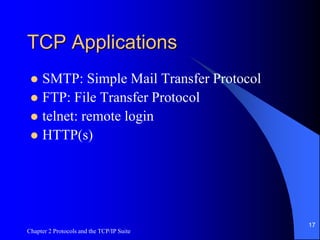
TCP Applications
 SMTP: Simple Mail Transfer Protocol
 FTP: File Transfer Protocol
 telnet: remote login
 HTTP(s)
Chapter 2 Protocols and the TCP/IP Suite
18
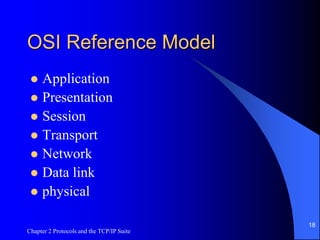
OSI Reference Model
 Application
 Presentation
 Session
 Transport
 Network
 Data link
 physical
Chapter 2 Protocols and the TCP/IP Suite
19
Figure 2.5
Chapter 2 Protocols and the TCP/IP Suite
20
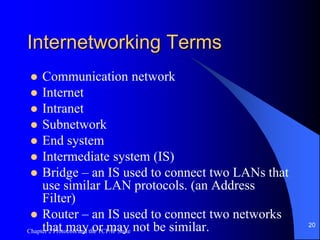
Internetworking Terms
 Communication network
 Internet
 Intranet
 Subnetwork
 End system
 Intermediate system (IS)
 Bridge – an IS used to connect two LANs that
use similar LAN protocols. (an Address
Filter)
 Router – an IS used to connect two networks
that may or may not be similar.
Chapter 2 Protocols and the TCP/IP Suite
21
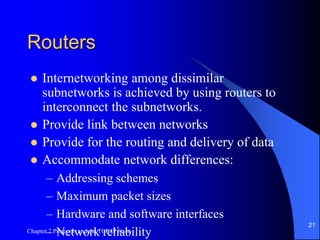
Routers
 Internetworking among dissimilar
subnetworks is achieved by using routers to
interconnect the subnetworks.
 Provide link between networks
 Provide for the routing and delivery of data
 Accommodate network differences:
– Addressing schemes
– Maximum packet sizes
– Hardware and software interfaces
– Network reliability
Chapter 2 Protocols and the TCP/IP Suite
22
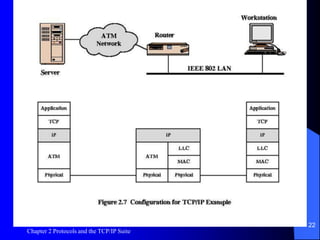
Figure 2-7
Chapter 2 Protocols and the TCP/IP Suite
23
Figure 2-8
Chapter 2 Protocols and the TCP/IP Suite
24
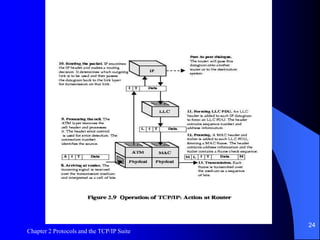
Figure 2-9
Chapter 2 Protocols and the TCP/IP Suite
25
Figure 2-10

Chapter01&02.ppt Advanced computer network

  • 1.
    Advanced Computer Networks Chapter2 Protocols and the TCP/IP Suite 1
  • 2.
    Course Objective  Introducinghigh speed networks including gigabit networks.  Design issues related to IP and TCP/IP and ATM networks  Provide up-to-date survey of developments in the area.  Performance analysis, congestion control and provision of QoS to different applications are also discussed. Chapter 2 Protocols and the TCP/IP Suite 2
  • 3.
    Course Outline  Protocolsand the TCP/IP Suite  TCP and IP  Frame Relay  Asynchronous Transfer Mode  High-Speed LANs  Queuing Analysis  Congestion and Traffic Management  Internet Routing  Assignment on Different Protocols in Networking Chapter 1 Protocols and the TCP/IP Suite 3
  • 4.
    Chapter 2 Protocolsand the TCP/IP Suite 4 Chapter 1 Protocols and the TCP/IP Suite
  • 5.
    Chapter 2 Protocolsand the TCP/IP Suite 5 Introduction  Layered protocol architecture  TCP/IP protocol suite  OSI reference model  Internetworking
  • 6.
    Chapter 2 Protocolsand the TCP/IP Suite 6 The Need for a Protocol Architecture  When computers, terminals and/or other data processing devices exchange data: – The Procedures involved to exchange data between devices can be complex – High degree of cooperation required between communicating systems  See the example in the next slide.
  • 7.
    Chapter 2 Protocolsand the TCP/IP Suite 7 Example: File transfer  Requires a data path to exist (either a direct link or via a comm. network)  Tasks: – Activate data communication path – Source determines that destination is ready – File transfer app at source must ascertain that destination file management app is ready to store file for user – File format conversion  Instead of implementing the logic as a single module, the task is broken up into subtasks, each of which is implemented separately.
  • 8.
    Chapter 2 Protocolsand the TCP/IP Suite 8 Layered Protocol Architecture  Modules arranged in a vertical stack  Each layer in stack: – Performs related functions – Relies on lower layer for more primitive functions – Provides services to next higher layer – Communicates with corresponding peer layer of neighboring system using a protocol  Ideally, layers should be defined, so that changes in one layer do not require changes in other layers.
  • 9.
    Chapter 2 Protocolsand the TCP/IP Suite 9 Key Features of a Protocol  It takes two to communicate – the same set of layered functions must exist in two systems – peer layers.  The peer layers communicate by means of formatted blocks of data that obey a set of rules or conventions known as a protocol.  The key features of a protocol are as follows: – Set of rules or conventions to exchange blocks of formatted data – Syntax: concerns the format of the data blocks – Semantics: Includes control information (coordination, error handling) – Timing: speed matching, sequencing
  • 10.
    Chapter 2 Protocolsand the TCP/IP Suite 10 TCP/IP Layers  Physical – concerned with specifying the characteristics of the transmission medium, the nature of the signals, the data rate and related matters.  Network access – concerned with the exchange of data b/n an end system and the network to which it is attached.  Internet  Transport  Application
  • 11.
    Chapter 2 Protocolsand the TCP/IP Suite 11 TCP and UDP  TCP: – connection-oriented – Reliable packet delivery in sequence  UDP: – connectionless (datagram) – Unreliable packet delivery – Packets may arrive out of sequence or duplicated
  • 12.
    Chapter 2 Protocolsand the TCP/IP Suite 12 Figure 2.1
  • 13.
    Chapter 2 Protocolsand the TCP/IP Suite 13 Figure 2.2
  • 14.
    Chapter 2 Protocolsand the TCP/IP Suite 14 Operation of TCP and IP  IP implemented in end systems and routers, relaying data between hosts  TCP implemented only in end systems, assuring reliable delivery of blocks of data  Each host on subnetwork has unique IP address  Each process on each process has unique IP port number
  • 15.
    Chapter 2 Protocolsand the TCP/IP Suite 15 Figure 2-3
  • 16.
    Chapter 2 Protocolsand the TCP/IP Suite 16 Figure 2-4
  • 17.
    Chapter 2 Protocolsand the TCP/IP Suite 17 TCP Applications  SMTP: Simple Mail Transfer Protocol  FTP: File Transfer Protocol  telnet: remote login  HTTP(s)
  • 18.
    Chapter 2 Protocolsand the TCP/IP Suite 18 OSI Reference Model  Application  Presentation  Session  Transport  Network  Data link  physical
  • 19.
    Chapter 2 Protocolsand the TCP/IP Suite 19 Figure 2.5
  • 20.
    Chapter 2 Protocolsand the TCP/IP Suite 20 Internetworking Terms  Communication network  Internet  Intranet  Subnetwork  End system  Intermediate system (IS)  Bridge – an IS used to connect two LANs that use similar LAN protocols. (an Address Filter)  Router – an IS used to connect two networks that may or may not be similar.
  • 21.
    Chapter 2 Protocolsand the TCP/IP Suite 21 Routers  Internetworking among dissimilar subnetworks is achieved by using routers to interconnect the subnetworks.  Provide link between networks  Provide for the routing and delivery of data  Accommodate network differences: – Addressing schemes – Maximum packet sizes – Hardware and software interfaces – Network reliability
  • 22.
    Chapter 2 Protocolsand the TCP/IP Suite 22 Figure 2-7
  • 23.
    Chapter 2 Protocolsand the TCP/IP Suite 23 Figure 2-8
  • 24.
    Chapter 2 Protocolsand the TCP/IP Suite 24 Figure 2-9
  • 25.
    Chapter 2 Protocolsand the TCP/IP Suite 25 Figure 2-10

Editor's Notes