By Dr. Hamza Mohamed KAOUACH
2015/2016 - 1436/1437
UMM Al-QURA UNIVERSITY
College of Engineering at Al-Lith
Electronics and Communications Engineering Department
5801437-3
Chapter 3
Fundamental Parameters
of Antennas
Antennas and Propagation Course (5801437-3) Chapter 03 By Dr. Hamza KAOUACH 2
Introduction
To describe the performance of an antenna, definitions of various
parameters are necessary. Some of the parameters are interrelated and not
all of them need be specified for complete description of the antenna
performance.
Parameter definitions will be given in this chapter. Many of those in
quotation marks are from the IEEE Standard Definitions of Terms for Antennas
(IEEE Std 145-1983)∗.
Antennas and Propagation Course (5801437-3) Chapter 03 By Dr. Hamza KAOUACH 3
Chapter Contents
1. Radiation Pattern
2. Radiation Power Density
3. Radiation Intensity
4. Beamwidth
5. Directivity
6. Numerical Techniques
7. Antenna Efficiency
8. Gain
9. Beam Efficiency
10. Bandwidth
11. Polarization
12. Polarization Loss Factor
13. Input Impedance
14. Antenna Radiation Efficiency
15. Antenna Vector Effective Length and Equivalent Areas
16. Maximum Directivity and Maximum Effective Area
17. FRIIS Transmission Equation and Radar Range Equation
18. Antenna Temperature
Antennas and Propagation Course (5801437-3) Chapter 03 By Dr. Hamza KAOUACH 4
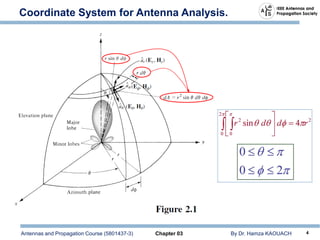
Coordinate System for Antenna Analysis.
Antennas and Propagation Course (5801437-3) Chapter 03 By Dr. Hamza KAOUACH 5
Radiation Pattern
(Far-Field)
Antennas and Propagation Course (5801437-3) Chapter 03 By Dr. Hamza KAOUACH 6
Radiation Pattern
An antenna radiation pattern or antenna pattern is defined as “a
mathematical function or a graphical representation” of the radiation
properties of the antenna as a function of space coordinates.
In most cases, the radiation pattern is determined in the far-field region
and is represented as a function of the directional coordinates.
Radiation properties include power flux density, radiation intensity, field
strength, directivity, phase or polarization.
The radiation property of most concern is the two- or three dimensional
spatial distribution of radiated energy as a function of the observer’s position
along a path or surface of constant radius.
A trace of the received electric (magnetic) field at a constant radius is
called the amplitude field pattern. On the other hand, a graph of the spatial
variation of the power density along a constant radius is called an amplitude
power pattern.
Antennas and Propagation Course (5801437-3) Chapter 03 By Dr. Hamza KAOUACH 7
Radiation Pattern
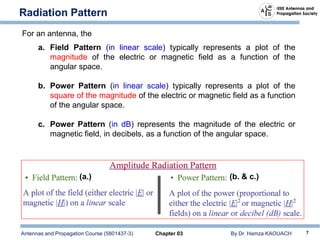
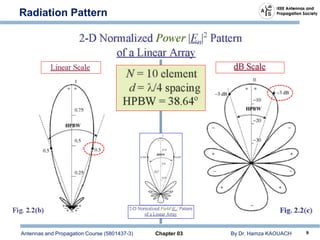
For an antenna, the
a. Field Pattern (in linear scale) typically represents a plot of the
magnitude of the electric or magnetic field as a function of the
angular space.
b. Power Pattern (in linear scale) typically represents a plot of the
square of the magnitude of the electric or magnetic field as a function
of the angular space.
c. Power Pattern (in dB) represents the magnitude of the electric or
magnetic field, in decibels, as a function of the angular space.
(a.) (b. & c.)
Antennas and Propagation Course (5801437-3) Chapter 03 By Dr. Hamza KAOUACH 8
Radiation Pattern
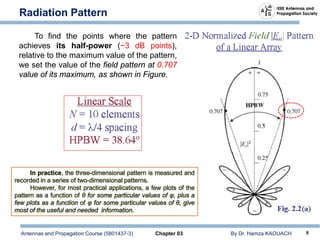
To find the points where the pattern
achieves its half-power (−3 dB points),
relative to the maximum value of the pattern,
we set the value of the field pattern at 0.707
value of its maximum, as shown in Figure.
In practice, the three-dimensional pattern is measured and
recorded in a series of two-dimensional patterns.
However, for most practical applications, a few plots of the
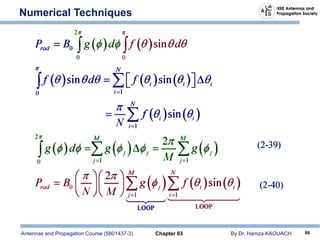
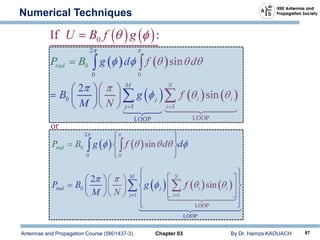
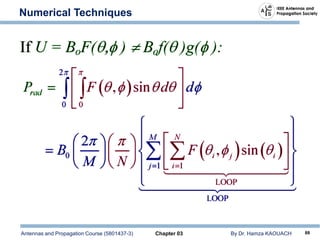
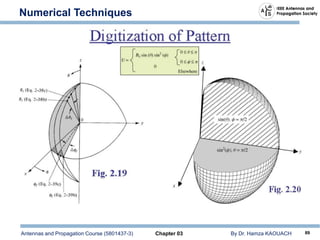
pattern as a function of θ for some particular values of φ, plus a
few plots as a function of φ for some particular values of θ, give
most of the useful and needed information.
Antennas and Propagation Course (5801437-3) Chapter 03 By Dr. Hamza KAOUACH 9
Radiation Pattern
Antennas and Propagation Course (5801437-3) Chapter 03 By Dr. Hamza KAOUACH 10
Radiation Pattern
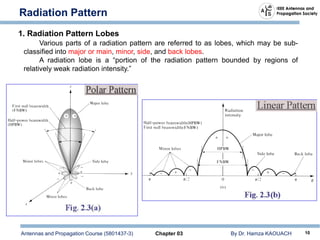
1. Radiation Pattern Lobes
Various parts of a radiation pattern are referred to as lobes, which may be sub-
classified into major or main, minor, side, and back lobes.
A radiation lobe is a “portion of the radiation pattern bounded by regions of
relatively weak radiation intensity.”
Antennas and Propagation Course (5801437-3) Chapter 03 By Dr. Hamza KAOUACH 11
Radiation Pattern
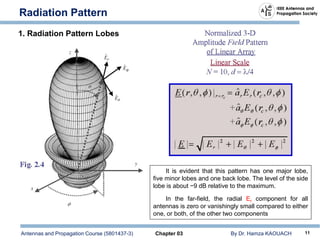
1. Radiation Pattern Lobes
It is evident that this pattern has one major lobe,
five minor lobes and one back lobe. The level of the side
lobe is about −9 dB relative to the maximum.
In the far-field, the radial Er component for all
antennas is zero or vanishingly small compared to either
one, or both, of the other two components
Antennas and Propagation Course (5801437-3) Chapter 03 By Dr. Hamza KAOUACH 12
Radiation Pattern
Antennas and Propagation Course (5801437-3) Chapter 03 By Dr. Hamza KAOUACH 13
Radiation Pattern
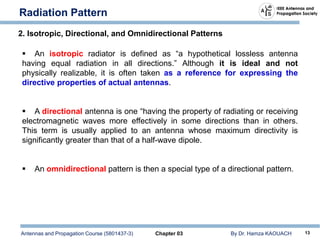
2. Isotropic, Directional, and Omnidirectional Patterns
 An isotropic radiator is defined as “a hypothetical lossless antenna
having equal radiation in all directions.” Although it is ideal and not
physically realizable, it is often taken as a reference for expressing the
directive properties of actual antennas.
 A directional antenna is one “having the property of radiating or receiving
electromagnetic waves more effectively in some directions than in others.
This term is usually applied to an antenna whose maximum directivity is
significantly greater than that of a half-wave dipole.
 An omnidirectional pattern is then a special type of a directional pattern.
Antennas and Propagation Course (5801437-3) Chapter 03 By Dr. Hamza KAOUACH 14
Radiation Pattern
3. Principal Patterns
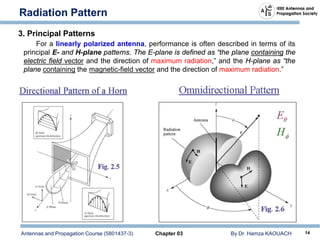
For a linearly polarized antenna, performance is often described in terms of its
principal E- and H-plane patterns. The E-plane is defined as “the plane containing the
electric field vector and the direction of maximum radiation,” and the H-plane as “the
plane containing the magnetic-field vector and the direction of maximum radiation.”
Antennas and Propagation Course (5801437-3) Chapter 03 By Dr. Hamza KAOUACH 15
Radiation Pattern
3. Principal Patterns
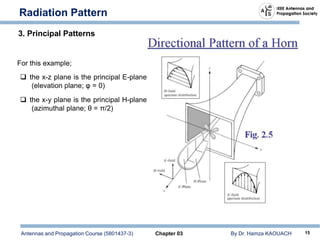
For this example;
 the x-z plane is the principal E-plane
(elevation plane; φ = 0)
 the x-y plane is the principal H-plane
(azimuthal plane; θ = π/2)
3. Principal Patterns
Radiation Pattern
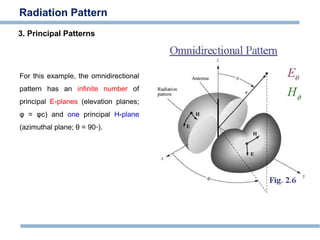
For this example, the omnidirectional
pattern has an infinite number of
principal E-planes (elevation planes;
φ = φc) and one principal H-plane
(azimuthal plane; θ = 90◦).
Antennas and Propagation Course (5801437-3) Chapter 03 By Dr. Hamza KAOUACH 17
Radiation Pattern
3. Field Regions
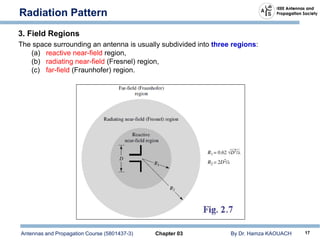
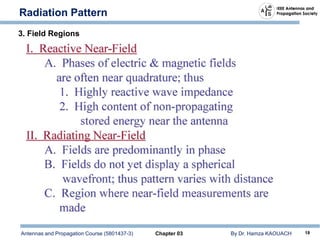
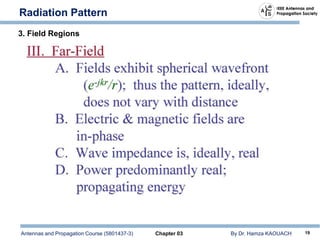
The space surrounding an antenna is usually subdivided into three regions:
(a) reactive near-field region,
(b) radiating near-field (Fresnel) region,
(c) far-field (Fraunhofer) region.
Antennas and Propagation Course (5801437-3) Chapter 03 By Dr. Hamza KAOUACH 18
Radiation Pattern
3. Field Regions
Antennas and Propagation Course (5801437-3) Chapter 03 By Dr. Hamza KAOUACH 19
Radiation Pattern
3. Field Regions
Antennas and Propagation Course (5801437-3) Chapter 03 By Dr. Hamza KAOUACH 20
Radiation Pattern
3. Field Regions
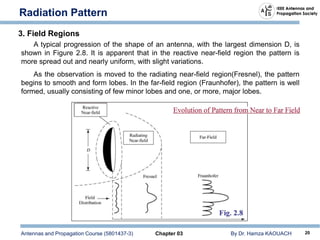
A typical progression of the shape of an antenna, with the largest dimension D, is
shown in Figure 2.8. It is apparent that in the reactive near-field region the pattern is
more spread out and nearly uniform, with slight variations.
As the observation is moved to the radiating near-field region(Fresnel), the pattern
begins to smooth and form lobes. In the far-field region (Fraunhofer), the pattern is well
formed, usually consisting of few minor lobes and one, or more, major lobes.
Antennas and Propagation Course (5801437-3) Chapter 03 By Dr. Hamza KAOUACH 21
Radiation Pattern
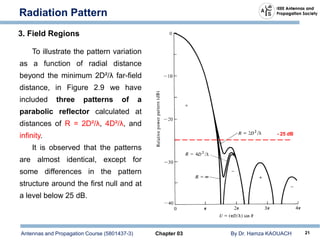
To illustrate the pattern variation
as a function of radial distance
beyond the minimum 2D²/λ far-field
distance, in Figure 2.9 we have
included three patterns of a
parabolic reflector calculated at
distances of R = 2D²/λ, 4D²/λ, and
infinity.
It is observed that the patterns
are almost identical, except for
some differences in the pattern
structure around the first null and at
a level below 25 dB.
3. Field Regions
- 25 dB
Antennas and Propagation Course (5801437-3) Chapter 03 By Dr. Hamza KAOUACH 22
Radiation Pattern
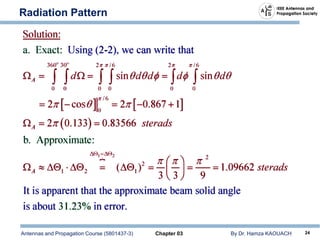
3. Radian and Steradian
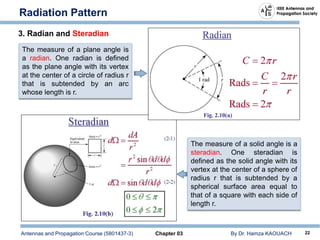
The measure of a plane angle is
a radian. One radian is defined
as the plane angle with its vertex
at the center of a circle of radius r
that is subtended by an arc
whose length is r.
The measure of a solid angle is a
steradian. One steradian is
defined as the solid angle with its
vertex at the center of a sphere of
radius r that is subtended by a
spherical surface area equal to
that of a square with each side of
length r.
Antennas and Propagation Course (5801437-3) Chapter 03 By Dr. Hamza KAOUACH 23
Radiation Pattern
Antennas and Propagation Course (5801437-3) Chapter 03 By Dr. Hamza KAOUACH 24
Radiation Pattern
Antennas and Propagation Course (5801437-3) Chapter 03 By Dr. Hamza KAOUACH 25
Radiation Power Density
Wrad (W/m²)
Antennas and Propagation Course (5801437-3) Chapter 03 By Dr. Hamza KAOUACH 26
Radiation Power Density
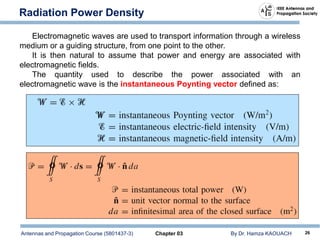
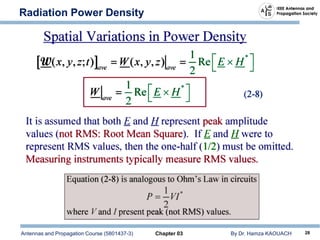
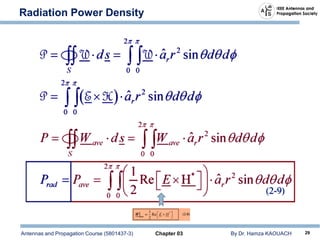
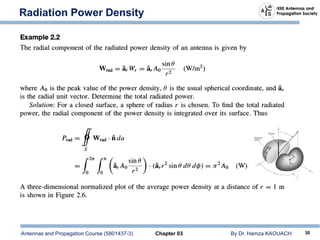
Electromagnetic waves are used to transport information through a wireless
medium or a guiding structure, from one point to the other.
It is then natural to assume that power and energy are associated with
electromagnetic fields.
The quantity used to describe the power associated with an
electromagnetic wave is the instantaneous Poynting vector defined as:
Antennas and Propagation Course (5801437-3) Chapter 03 By Dr. Hamza KAOUACH 27
Radiation Power Density
Antennas and Propagation Course (5801437-3) Chapter 03 By Dr. Hamza KAOUACH 28
Radiation Power Density
Antennas and Propagation Course (5801437-3) Chapter 03 By Dr. Hamza KAOUACH 29
Radiation Power Density
Antennas and Propagation Course (5801437-3) Chapter 03 By Dr. Hamza KAOUACH 30
Radiation Power Density
Antennas and Propagation Course (5801437-3) Chapter 03 By Dr. Hamza KAOUACH 31
Radiation Power Density
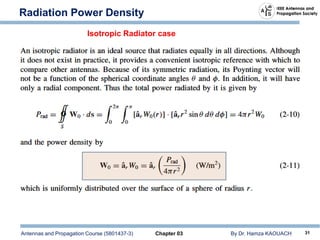
Isotropic Radiator case
Antennas and Propagation Course (5801437-3) Chapter 03 By Dr. Hamza KAOUACH 32
Radiation Intensity
U (W/St)
Antennas and Propagation Course (5801437-3) Chapter 03 By Dr. Hamza KAOUACH 33
Radiation Intensity U (Far-Field)
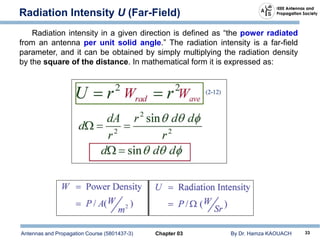
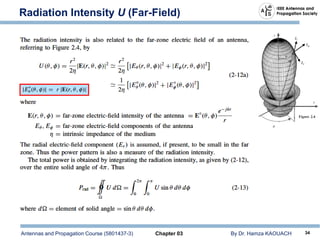
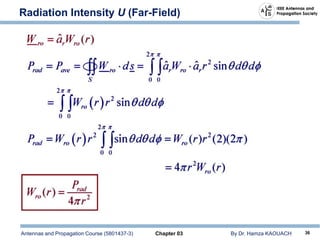
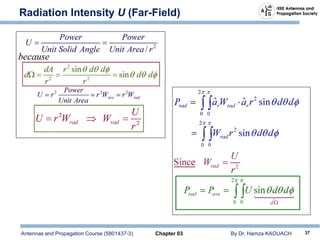
Radiation intensity in a given direction is defined as “the power radiated
from an antenna per unit solid angle.” The radiation intensity is a far-field
parameter, and it can be obtained by simply multiplying the radiation density
by the square of the distance. In mathematical form it is expressed as:
Antennas and Propagation Course (5801437-3) Chapter 03 By Dr. Hamza KAOUACH 34
Radiation Intensity U (Far-Field)
Antennas and Propagation Course (5801437-3) Chapter 03 By Dr. Hamza KAOUACH 35
Radiation Intensity U (Far-Field)
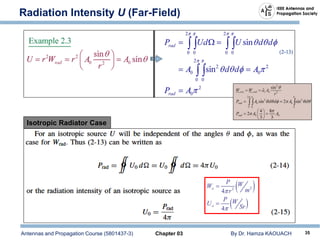
Isotropic Radiator Case
Antennas and Propagation Course (5801437-3) Chapter 03 By Dr. Hamza KAOUACH 36
Radiation Intensity U (Far-Field)
Antennas and Propagation Course (5801437-3) Chapter 03 By Dr. Hamza KAOUACH 37
Radiation Intensity U (Far-Field)
Antennas and Propagation Course (5801437-3) Chapter 03 By Dr. Hamza KAOUACH 38
Beamwidths
BW
Antennas and Propagation Course (5801437-3) Chapter 03 By Dr. Hamza KAOUACH 39
Beamwidths
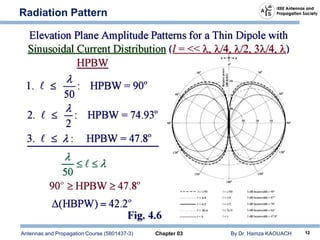
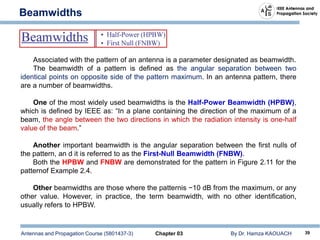
Associated with the pattern of an antenna is a parameter designated as beamwidth.
The beamwidth of a pattern is defined as the angular separation between two
identical points on opposite side of the pattern maximum. In an antenna pattern, there
are a number of beamwidths.
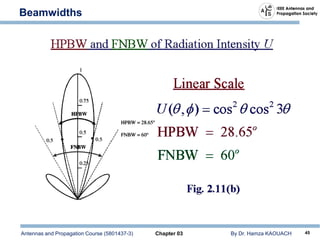
One of the most widely used beamwidths is the Half-Power Beamwidth (HPBW),
which is defined by IEEE as: “In a plane containing the direction of the maximum of a
beam, the angle between the two directions in which the radiation intensity is one-half
value of the beam.”
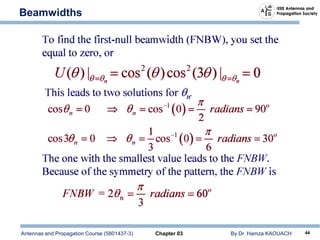
Another important beamwidth is the angular separation between the first nulls of
the pattern, an d it is referred to as the First-Null Beamwidth (FNBW).
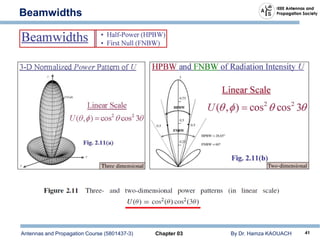
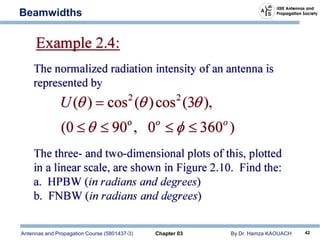
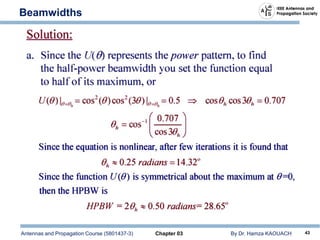
Both the HPBW and FNBW are demonstrated for the pattern in Figure 2.11 for the
patternof Example 2.4.
Other beamwidths are those where the patternis −10 dB from the maximum, or any
other value. However, in practice, the term beamwidth, with no other identification,
usually refers to HPBW.
Antennas and Propagation Course (5801437-3) Chapter 03 By Dr. Hamza KAOUACH 40
Beamwidths
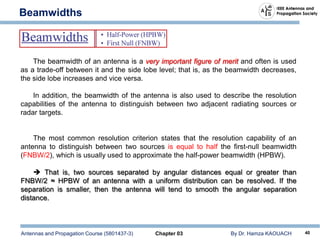
The beamwidth of an antenna is a very important figure of merit and often is used
as a trade-off between it and the side lobe level; that is, as the beamwidth decreases,
the side lobe increases and vice versa.
In addition, the beamwidth of the antenna is also used to describe the resolution
capabilities of the antenna to distinguish between two adjacent radiating sources or
radar targets.
The most common resolution criterion states that the resolution capability of an
antenna to distinguish between two sources is equal to half the first-null beamwidth
(FNBW/2), which is usually used to approximate the half-power beamwidth (HPBW).
 That is, two sources separated by angular distances equal or greater than
FNBW/2 ≈ HPBW of an antenna with a uniform distribution can be resolved. If the
separation is smaller, then the antenna will tend to smooth the angular separation
distance.
Antennas and Propagation Course (5801437-3) Chapter 03 By Dr. Hamza KAOUACH 41
Beamwidths
Antennas and Propagation Course (5801437-3) Chapter 03 By Dr. Hamza KAOUACH 42
Beamwidths
Antennas and Propagation Course (5801437-3) Chapter 03 By Dr. Hamza KAOUACH 43
Beamwidths
Antennas and Propagation Course (5801437-3) Chapter 03 By Dr. Hamza KAOUACH 44
Beamwidths
Antennas and Propagation Course (5801437-3) Chapter 03 By Dr. Hamza KAOUACH 45
Beamwidths
Antennas and Propagation Course (5801437-3) Chapter 03 By Dr. Hamza KAOUACH 46
Directivity
D
Antennas and Propagation Course (5801437-3) Chapter 03 By Dr. Hamza KAOUACH 47
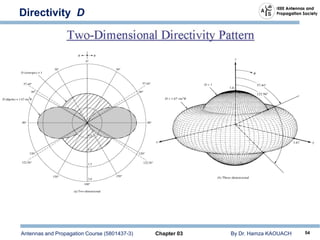
Directivity D
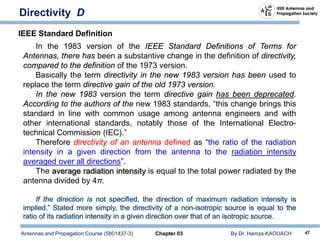
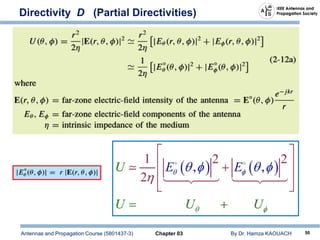
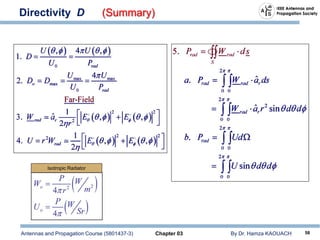
In the 1983 version of the IEEE Standard Definitions of Terms for
Antennas, there has been a substantive change in the definition of directivity,
compared to the definition of the 1973 version.
Basically the term directivity in the new 1983 version has been used to
replace the term directive gain of the old 1973 version.
In the new 1983 version the term directive gain has been deprecated.
According to the authors of the new 1983 standards, “this change brings this
standard in line with common usage among antenna engineers and with
other international standards, notably those of the International Electro-
technical Commission (IEC).”
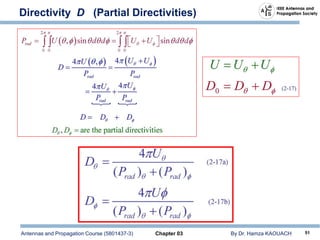
Therefore directivity of an antenna defined as “the ratio of the radiation
intensity in a given direction from the antenna to the radiation intensity
averaged over all directions”.
The average radiation intensity is equal to the total power radiated by the
antenna divided by 4π.
IEEE Standard Definition
Antennas and Propagation Course (5801437-3) Chapter 03 By Dr. Hamza KAOUACH 48
Directivity D
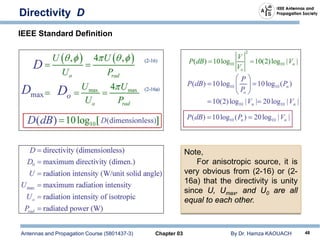
Note,
For anisotropic source, it is
very obvious from (2-16) or (2-
16a) that the directivity is unity
since U, Umax, and U0 are all
equal to each other.
IEEE Standard Definition
Antennas and Propagation Course (5801437-3) Chapter 03 By Dr. Hamza KAOUACH 49
Directivity D (Partial Directivities)
Antennas and Propagation Course (5801437-3) Chapter 03 By Dr. Hamza KAOUACH 50
Directivity D (Partial Directivities)
Antennas and Propagation Course (5801437-3) Chapter 03 By Dr. Hamza KAOUACH 51
Directivity D (Partial Directivities)
Antennas and Propagation Course (5801437-3) Chapter 03 By Dr. Hamza KAOUACH 52
Directivity D
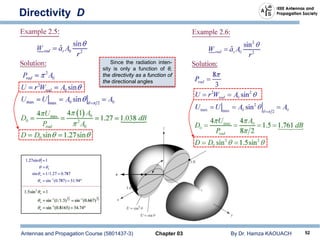
Since the radiation inten-
sity is only a function of θ,
the directivity as a function of
the directional angles
Antennas and Propagation Course (5801437-3) Chapter 03 By Dr. Hamza KAOUACH 53
Directivity D (Summary)
Antennas and Propagation Course (5801437-3) Chapter 03 By Dr. Hamza KAOUACH 54
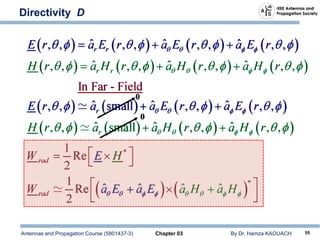
Directivity D
Antennas and Propagation Course (5801437-3) Chapter 03 By Dr. Hamza KAOUACH 55
Directivity D
Antennas and Propagation Course (5801437-3) Chapter 03 By Dr. Hamza KAOUACH 56
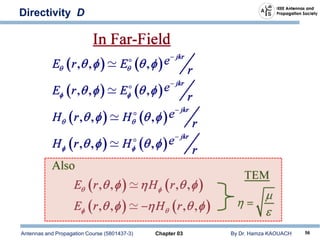
Directivity D
Antennas and Propagation Course (5801437-3) Chapter 03 By Dr. Hamza KAOUACH 57
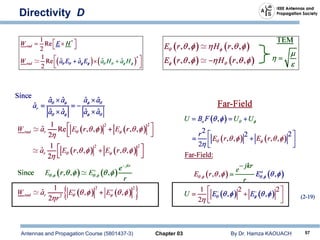
Directivity D
Antennas and Propagation Course (5801437-3) Chapter 03 By Dr. Hamza KAOUACH 58
Isotropic Radiator
Directivity D (Summary)
Antennas and Propagation Course (5801437-3) Chapter 03 By Dr. Hamza KAOUACH 59
Directivity D
(General Formulation)
Antennas and Propagation Course (5801437-3) Chapter 03 By Dr. Hamza KAOUACH 60
Directivity D (General Formulation)
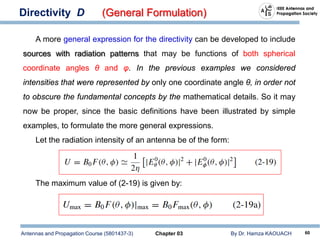
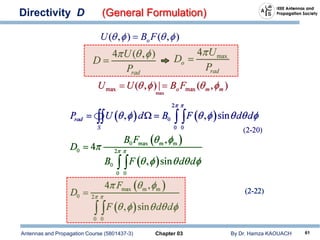
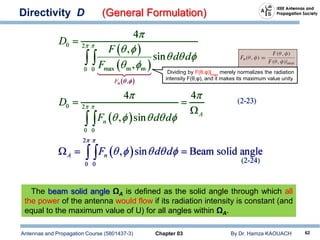
A more general expression for the directivity can be developed to include
sources with radiation patterns that may be functions of both spherical
coordinate angles θ and φ. In the previous examples we considered
intensities that were represented by only one coordinate angle θ, in order not
to obscure the fundamental concepts by the mathematical details. So it may
now be proper, since the basic definitions have been illustrated by simple
examples, to formulate the more general expressions.
Let the radiation intensity of an antenna be of the form:
The maximum value of (2-19) is given by:
Antennas and Propagation Course (5801437-3) Chapter 03 By Dr. Hamza KAOUACH 61
Directivity D (General Formulation)
Antennas and Propagation Course (5801437-3) Chapter 03 By Dr. Hamza KAOUACH 62
Directivity D (General Formulation)
Dividing by F(θ,φ)|max
merely normalizes the radiation
intensity F(θ,φ), and it makes its maximum value unity
The beam solid angle ΩA is defined as the solid angle through which all
the power of the antenna would flow if its radiation intensity is constant (and
equal to the maximum value of U) for all angles within ΩA.
Antennas and Propagation Course (5801437-3) Chapter 03 By Dr. Hamza KAOUACH 63
Directivity D
- Approximations -
Antennas and Propagation Course (5801437-3) Chapter 03 By Dr. Hamza KAOUACH 64
Directivity D - Approximations -
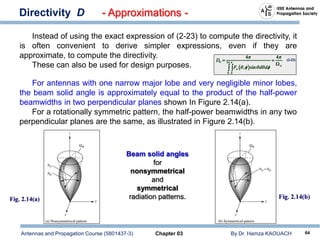
Instead of using the exact expression of (2-23) to compute the directivity, it
is often convenient to derive simpler expressions, even if they are
approximate, to compute the directivity.
These can also be used for design purposes.
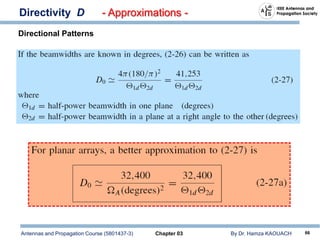
For antennas with one narrow major lobe and very negligible minor lobes,
the beam solid angle is approximately equal to the product of the half-power
beamwidths in two perpendicular planes shown In Figure 2.14(a).
For a rotationally symmetric pattern, the half-power beamwidths in any two
perpendicular planes are the same, as illustrated in Figure 2.14(b).
Beam solid angles
for
nonsymmetrical
and
symmetrical
radiation patterns.
Antennas and Propagation Course (5801437-3) Chapter 03 By Dr. Hamza KAOUACH 65
Directivity D - Approximations -
Directional Patterns
Antennas and Propagation Course (5801437-3) Chapter 03 By Dr. Hamza KAOUACH 66
Directivity D - Approximations -
Directional Patterns
Antennas and Propagation Course (5801437-3) Chapter 03 By Dr. Hamza KAOUACH 67
Directivity D - Approximations -
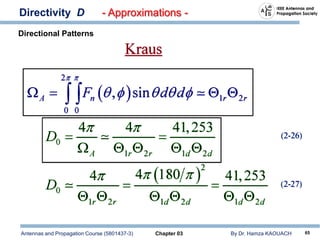
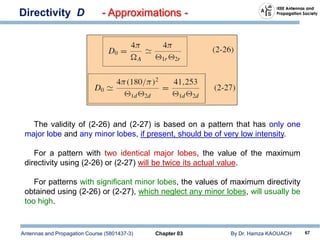
The validity of (2-26) and (2-27) is based on a pattern that has only one
major lobe and any minor lobes, if present, should be of very low intensity.
For a pattern with two identical major lobes, the value of the maximum
directivity using (2-26) or (2-27) will be twice its actual value.
For patterns with significant minor lobes, the values of maximum directivity
obtained using (2-26) or (2-27), which neglect any minor lobes, will usually be
too high.
Antennas and Propagation Course (5801437-3) Chapter 03 By Dr. Hamza KAOUACH 68
Directivity D - Approximations -
Antennas and Propagation Course (5801437-3) Chapter 03 By Dr. Hamza KAOUACH 69
Directivity D
- Directional Patterns -
Antennas and Propagation Course (5801437-3) Chapter 03 By Dr. Hamza KAOUACH 70
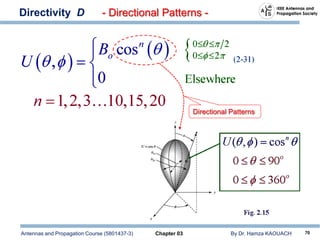
Directivity D - Directional Patterns -
Directional Patterns
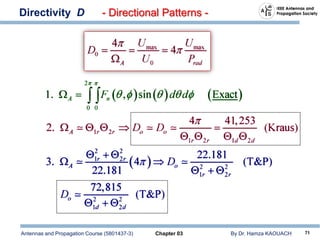
Antennas and Propagation Course (5801437-3) Chapter 03 By Dr. Hamza KAOUACH 71
Directivity D - Directional Patterns -
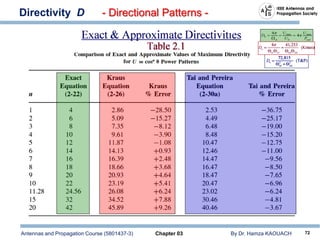
Antennas and Propagation Course (5801437-3) Chapter 03 By Dr. Hamza KAOUACH 72
Directivity D - Directional Patterns -
Antennas and Propagation Course (5801437-3) Chapter 03 By Dr. Hamza KAOUACH 73
Directivity D - Directional Patterns -
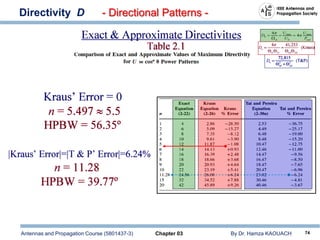
Antennas and Propagation Course (5801437-3) Chapter 03 By Dr. Hamza KAOUACH 74
Directivity D - Directional Patterns -
Antennas and Propagation Course (5801437-3) Chapter 03 By Dr. Hamza KAOUACH 75
Directivity D - Omnidirectional Patterns -
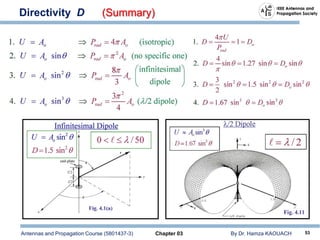
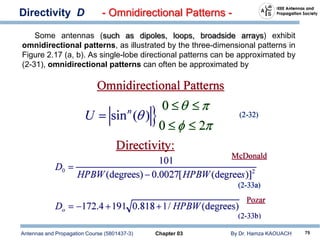
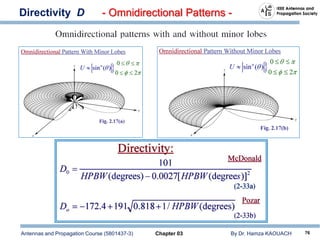
Some antennas (such as dipoles, loops, broadside arrays) exhibit
omnidirectional patterns, as illustrated by the three-dimensional patterns in
Figure 2.17 (a, b). As single-lobe directional patterns can be approximated by
(2-31), omnidirectional patterns can often be approximated by
Antennas and Propagation Course (5801437-3) Chapter 03 By Dr. Hamza KAOUACH 76
Directivity D - Omnidirectional Patterns -
Antennas and Propagation Course (5801437-3) Chapter 03 By Dr. Hamza KAOUACH 77
Directivity D - Omnidirectional Patterns -
Antennas and Propagation Course (5801437-3) Chapter 03 By Dr. Hamza KAOUACH 78
Directivity D - Omnidirectional Patterns -
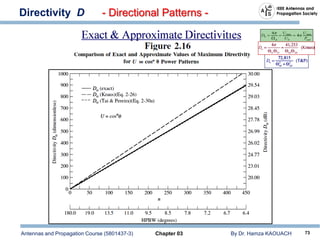
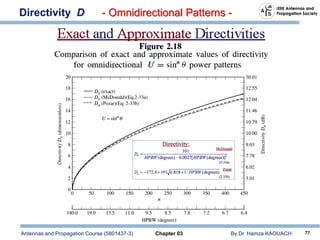
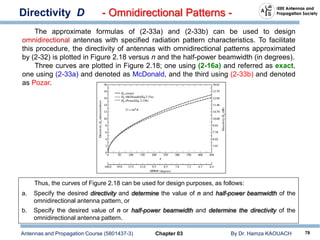
The approximate formulas of (2-33a) and (2-33b) can be used to design
omnidirectional antennas with specified radiation pattern characteristics. To facilitate
this procedure, the directivity of antennas with omnidirectional patterns approximated
by (2-32) is plotted in Figure 2.18 versus n and the half-power beamwidth (in degrees).
Three curves are plotted in Figure 2.18; one using (2-16a) and referred as exact,
one using (2-33a) and denoted as McDonald, and the third using (2-33b) and denoted
as Pozar.
Thus, the curves of Figure 2.18 can be used for design purposes, as follows:
a. Specify the desired directivity and determine the value of n and half-power beamwidth of the
omnidirectional antenna pattern, or
b. Specify the desired value of n or half-power beamwidth and determine the directivity of the
omnidirectional antenna pattern.
Antennas and Propagation Course (5801437-3) Chapter 03 By Dr. Hamza KAOUACH 79
Directivity D - Omnidirectional Patterns -
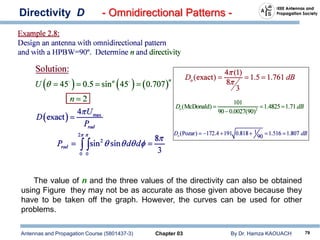
The value of n and the three values of the directivity can also be obtained
using Figure they may not be as accurate as those given above because they
have to be taken off the graph. However, the curves can be used for other
problems.
Antennas and Propagation Course (5801437-3) Chapter 03 By Dr. Hamza KAOUACH 80
Numerical Techniques
Antennas and Propagation Course (5801437-3) Chapter 03 By Dr. Hamza KAOUACH 81
Numerical Techniques
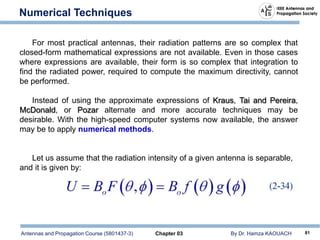
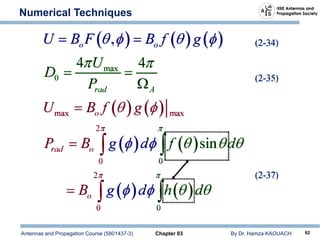
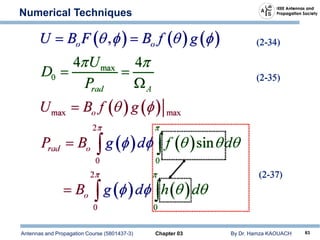
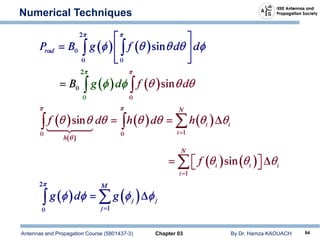
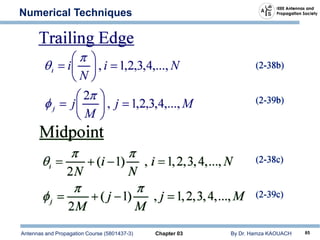
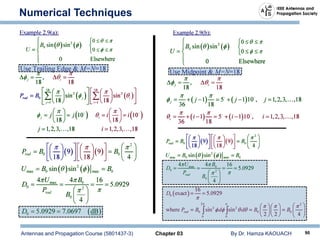
For most practical antennas, their radiation patterns are so complex that
closed-form mathematical expressions are not available. Even in those cases
where expressions are available, their form is so complex that integration to
find the radiated power, required to compute the maximum directivity, cannot
be performed.
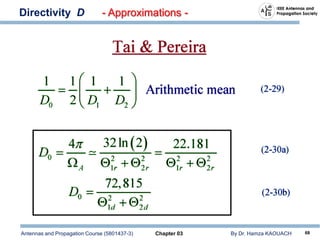
Instead of using the approximate expressions of Kraus, Tai and Pereira,
McDonald, or Pozar alternate and more accurate techniques may be
desirable. With the high-speed computer systems now available, the answer
may be to apply numerical methods.
Let us assume that the radiation intensity of a given antenna is separable,
and it is given by:
Antennas and Propagation Course (5801437-3) Chapter 03 By Dr. Hamza KAOUACH 82
Numerical Techniques
Antennas and Propagation Course (5801437-3) Chapter 03 By Dr. Hamza KAOUACH 83
Numerical Techniques
Antennas and Propagation Course (5801437-3) Chapter 03 By Dr. Hamza KAOUACH 84
Numerical Techniques
Antennas and Propagation Course (5801437-3) Chapter 03 By Dr. Hamza KAOUACH 85
Numerical Techniques
Antennas and Propagation Course (5801437-3) Chapter 03 By Dr. Hamza KAOUACH 86
Numerical Techniques
Antennas and Propagation Course (5801437-3) Chapter 03 By Dr. Hamza KAOUACH 87
Numerical Techniques
Antennas and Propagation Course (5801437-3) Chapter 03 By Dr. Hamza KAOUACH 88
Numerical Techniques
Antennas and Propagation Course (5801437-3) Chapter 03 By Dr. Hamza KAOUACH 89
Numerical Techniques
Antennas and Propagation Course (5801437-3) Chapter 03 By Dr. Hamza KAOUACH 90
Numerical Techniques
Antennas and Propagation Course (5801437-3) Chapter 03 By Dr. Hamza KAOUACH 91
Antenna Efficiency
- e0 -
Antennas and Propagation Course (5801437-3) Chapter 03 By Dr. Hamza KAOUACH 92
Antenna Efficiency
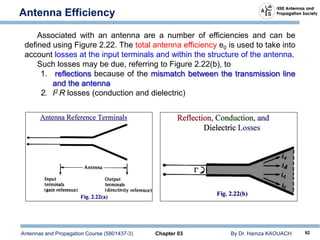
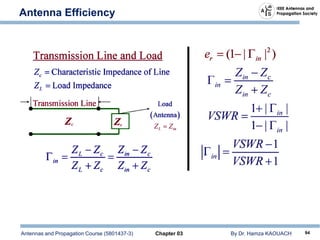
Associated with an antenna are a number of efficiencies and can be
defined using Figure 2.22. The total antenna efficiency e0 is used to take into
account losses at the input terminals and within the structure of the antenna.
Such losses may be due, referring to Figure 2.22(b), to
1. reflections because of the mismatch between the transmission line
and the antenna
2. I2 R losses (conduction and dielectric)
Antennas and Propagation Course (5801437-3) Chapter 03 By Dr. Hamza KAOUACH 93
Antenna Efficiency
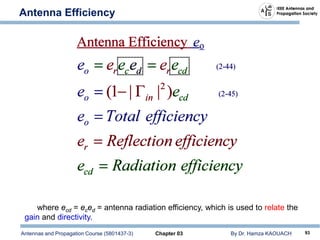
where ecd = eced = antenna radiation efficiency, which is used to relate the
gain and directivity.
Antennas and Propagation Course (5801437-3) Chapter 03 By Dr. Hamza KAOUACH 94
Antenna Efficiency
Antennas and Propagation Course (5801437-3) Chapter 03 By Dr. Hamza KAOUACH 95
Gain
G
Antennas and Propagation Course (5801437-3) Chapter 03 By Dr. Hamza KAOUACH 96
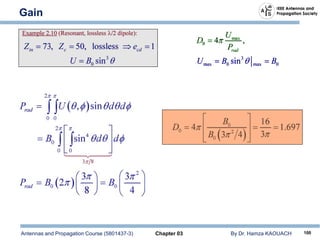
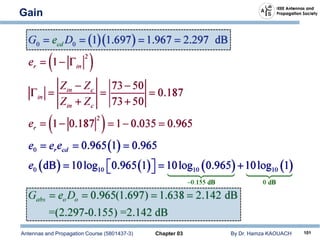
Gain
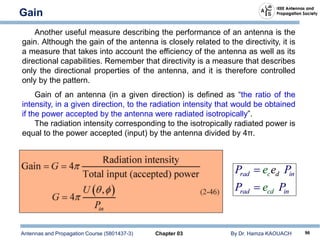
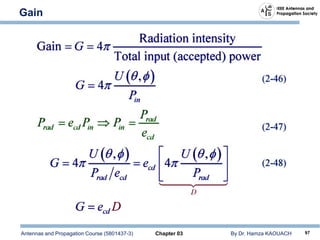
Another useful measure describing the performance of an antenna is the
gain. Although the gain of the antenna is closely related to the directivity, it is
a measure that takes into account the efficiency of the antenna as well as its
directional capabilities. Remember that directivity is a measure that describes
only the directional properties of the antenna, and it is therefore controlled
only by the pattern.
Gain of an antenna (in a given direction) is defined as “the ratio of the
intensity, in a given direction, to the radiation intensity that would be obtained
if the power accepted by the antenna were radiated isotropically”.
The radiation intensity corresponding to the isotropically radiated power is
equal to the power accepted (input) by the antenna divided by 4π.
Antennas and Propagation Course (5801437-3) Chapter 03 By Dr. Hamza KAOUACH 97
Gain
Antennas and Propagation Course (5801437-3) Chapter 03 By Dr. Hamza KAOUACH 98
Gain
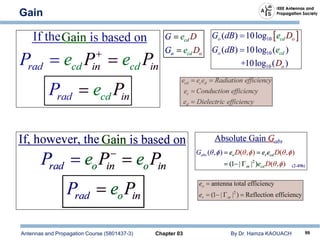
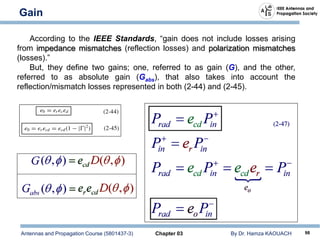
According to the IEEE Standards, “gain does not include losses arising
from impedance mismatches (reflection losses) and polarization mismatches
(losses).”
But, they define two gains; one, referred to as gain (G), and the other,
referred to as absolute gain (Gabs), that also takes into account the
reflection/mismatch losses represented in both (2-44) and (2-45).
Antennas and Propagation Course (5801437-3) Chapter 03 By Dr. Hamza KAOUACH 99
Gain
Antennas and Propagation Course (5801437-3) Chapter 03 By Dr. Hamza KAOUACH 100
Gain
Antennas and Propagation Course (5801437-3) Chapter 03 By Dr. Hamza KAOUACH 101
Gain
Antennas and Propagation Course (5801437-3) Chapter 03 By Dr. Hamza KAOUACH 102
Beam Efficiency
BE
Antennas and Propagation Course (5801437-3) Chapter 03 By Dr. Hamza KAOUACH 103
Beam Efficiency
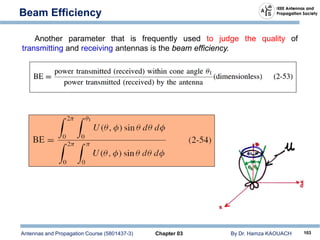
Another parameter that is frequently used to judge the quality of
transmitting and receiving antennas is the beam efficiency.
Antennas and Propagation Course (5801437-3) Chapter 03 By Dr. Hamza KAOUACH 104
Bandwidth
BW
Antennas and Propagation Course (5801437-3) Chapter 03 By Dr. Hamza KAOUACH 105
Bandwidth
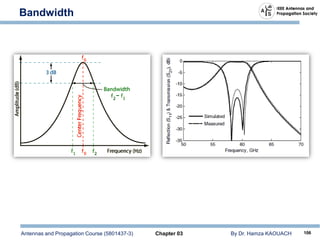
The bandwidth of an antenna is defined as “the range of frequencies within
which the performance of the antenna, with respect to some characteristic,
conforms to a specified standard”.
The bandwidth can be considered to be the range of frequencies, on either
side of a center frequency (usually the resonance frequency for a dipole),
where the antenna characteristics (such as input impedance, pattern,
beamwidth, polarization, side lobe level, gain, beam direction, radiation
efficiency) are within an acceptable value of those at the center frequency.
For broadband antennas, the bandwidth is usually expressed as the ratio
of the upper-to-lower frequencies of acceptable operation. For example, a 10:1
bandwidth indicates that the upper frequency is 10 times greater than the
lower.
For narrowband antennas, the bandwidth is expressed as a percentage of
the frequency difference (upper minus lower) over the center frequency of the
bandwidth. For example, a 5% bandwidth indicates that the frequency
difference of acceptable operation is 5% of the center frequency of the
bandwidth.
Antennas and Propagation Course (5801437-3) Chapter 03 By Dr. Hamza KAOUACH 106
Bandwidth
Antennas and Propagation Course (5801437-3) Chapter 03 By Dr. Hamza KAOUACH 107
Polarization
Polar
Antennas and Propagation Course (5801437-3) Chapter 03 By Dr. Hamza KAOUACH 108
Polarization
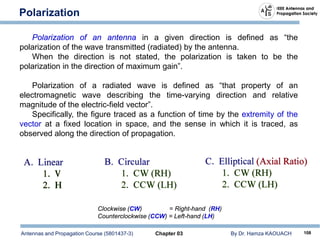
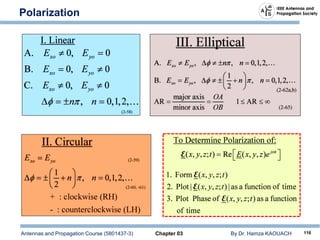
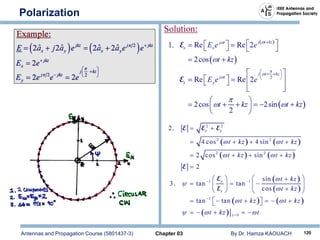
Polarization of an antenna in a given direction is defined as “the
polarization of the wave transmitted (radiated) by the antenna.
When the direction is not stated, the polarization is taken to be the
polarization in the direction of maximum gain”.
Polarization of a radiated wave is defined as “that property of an
electromagnetic wave describing the time-varying direction and relative
magnitude of the electric-field vector”.
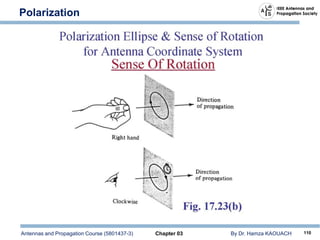
Specifically, the figure traced as a function of time by the extremity of the
vector at a fixed location in space, and the sense in which it is traced, as
observed along the direction of propagation.
Clockwise (CW) = Right-hand (RH)
Counterclockwise (CCW) = Left-hand (LH)
Antennas and Propagation Course (5801437-3) Chapter 03 By Dr. Hamza KAOUACH 109
Polarization
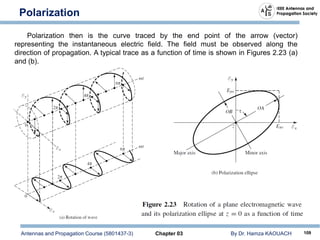
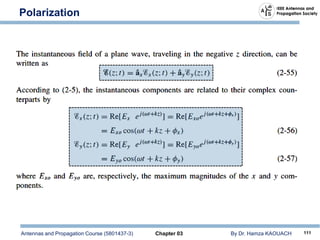
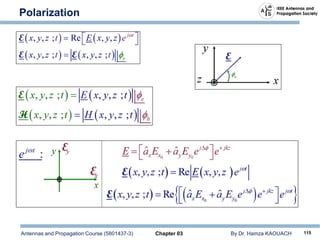
Polarization then is the curve traced by the end point of the arrow (vector)
representing the instantaneous electric field. The field must be observed along the
direction of propagation. A typical trace as a function of time is shown in Figures 2.23 (a)
and (b).
Antennas and Propagation Course (5801437-3) Chapter 03 By Dr. Hamza KAOUACH 110
Polarization
Antennas and Propagation Course (5801437-3) Chapter 03 By Dr. Hamza KAOUACH 111
Polarization
Antennas and Propagation Course (5801437-3) Chapter 03 By Dr. Hamza KAOUACH 112
Polarization
Antennas and Propagation Course (5801437-3) Chapter 03 By Dr. Hamza KAOUACH 113
Polarization
Antennas and Propagation Course (5801437-3) Chapter 03 By Dr. Hamza KAOUACH 114
Polarization
Antennas and Propagation Course (5801437-3) Chapter 03 By Dr. Hamza KAOUACH 115
Polarization
Antennas and Propagation Course (5801437-3) Chapter 03 By Dr. Hamza KAOUACH 116
Polarization
Antennas and Propagation Course (5801437-3) Chapter 03 By Dr. Hamza KAOUACH 117
Polarization (Summary)
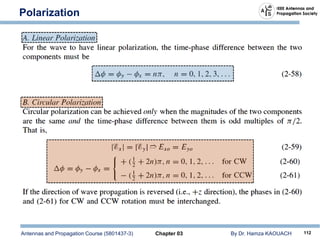
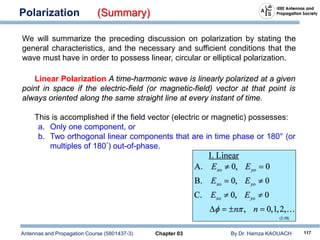
We will summarize the preceding discussion on polarization by stating the
general characteristics, and the necessary and sufficient conditions that the
wave must have in order to possess linear, circular or elliptical polarization.
Linear Polarization A time-harmonic wave is linearly polarized at a given
point in space if the electric-field (or magnetic-field) vector at that point is
always oriented along the same straight line at every instant of time.
This is accomplished if the field vector (electric or magnetic) possesses:
a. Only one component, or
b. Two orthogonal linear components that are in time phase or 180° (or
multiples of 180°) out-of-phase.
Antennas and Propagation Course (5801437-3) Chapter 03 By Dr. Hamza KAOUACH 118
Polarization (Summary)
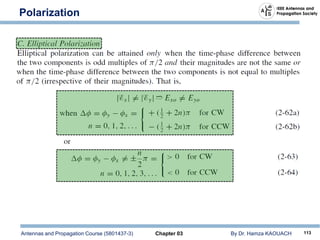
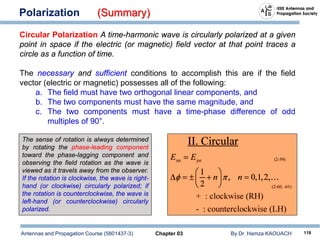
Circular Polarization A time-harmonic wave is circularly polarized at a given
point in space if the electric (or magnetic) field vector at that point traces a
circle as a function of time.
The necessary and sufficient conditions to accomplish this are if the field
vector (electric or magnetic) possesses all of the following:
a. The field must have two orthogonal linear components, and
b. The two components must have the same magnitude, and
c. The two components must have a time-phase difference of odd
multiples of 90°.
The sense of rotation is always determined
by rotating the phase-leading component
toward the phase-lagging component and
observing the field rotation as the wave is
viewed as it travels away from the observer.
If the rotation is clockwise, the wave is right-
hand (or clockwise) circularly polarized; if
the rotation is counterclockwise, the wave is
left-hand (or counterclockwise) circularly
polarized.
Antennas and Propagation Course (5801437-3) Chapter 03 By Dr. Hamza KAOUACH 119
Polarization (Summary)
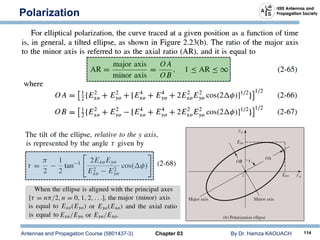
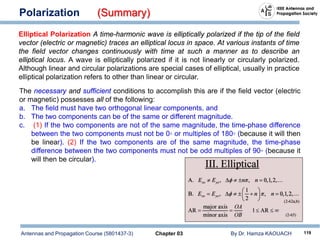
Elliptical Polarization A time-harmonic wave is elliptically polarized if the tip of the field
vector (electric or magnetic) traces an elliptical locus in space. At various instants of time
the field vector changes continuously with time at such a manner as to describe an
elliptical locus. A wave is elliptically polarized if it is not linearly or circularly polarized.
Although linear and circular polarizations are special cases of elliptical, usually in practice
elliptical polarization refers to other than linear or circular.
The necessary and sufficient conditions to accomplish this are if the field vector (electric
or magnetic) possesses all of the following:
a. The field must have two orthogonal linear components, and
b. The two components can be of the same or different magnitude.
c. (1) If the two components are not of the same magnitude, the time-phase difference
between the two components must not be 0◦ or multiples of 180◦ (because it will then
be linear). (2) If the two components are of the same magnitude, the time-phase
difference between the two components must not be odd multiples of 90◦ (because it
will then be circular).
Antennas and Propagation Course (5801437-3) Chapter 03 By Dr. Hamza KAOUACH 120
Polarization
Antennas and Propagation Course (5801437-3) Chapter 03 By Dr. Hamza KAOUACH 121
Polarization Loss Factor
PLF
Antennas and Propagation Course (5801437-3) Chapter 03 By Dr. Hamza KAOUACH 122
Polarization Loss Factor
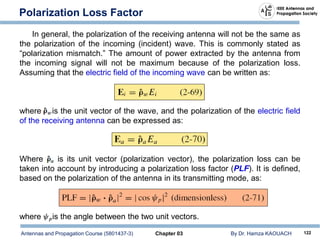
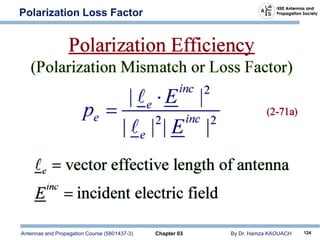
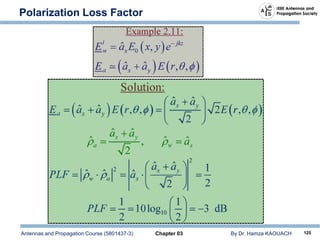
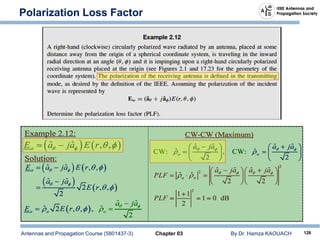
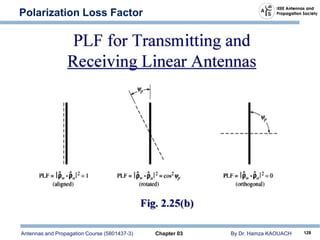
In general, the polarization of the receiving antenna will not be the same as
the polarization of the incoming (incident) wave. This is commonly stated as
“polarization mismatch.” The amount of power extracted by the antenna from
the incoming signal will not be maximum because of the polarization loss.
Assuming that the electric field of the incoming wave can be written as:
where is the unit vector of the wave, and the polarization of the electric field
of the receiving antenna can be expressed as:
Where is its unit vector (polarization vector), the polarization loss can be
taken into account by introducing a polarization loss factor (PLF). It is defined,
based on the polarization of the antenna in its transmitting mode, as:
where is the angle between the two unit vectors.
Antennas and Propagation Course (5801437-3) Chapter 03 By Dr. Hamza KAOUACH 123
Polarization Loss Factor
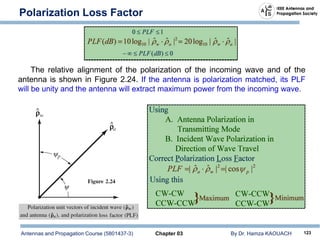
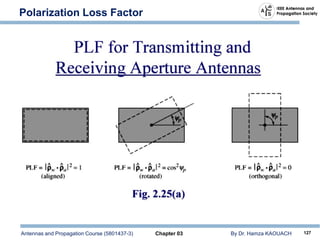
The relative alignment of the polarization of the incoming wave and of the
antenna is shown in Figure 2.24. If the antenna is polarization matched, its PLF
will be unity and the antenna will extract maximum power from the incoming wave.
Antennas and Propagation Course (5801437-3) Chapter 03 By Dr. Hamza KAOUACH 124
Polarization Loss Factor
Antennas and Propagation Course (5801437-3) Chapter 03 By Dr. Hamza KAOUACH 125
Polarization Loss Factor
Antennas and Propagation Course (5801437-3) Chapter 03 By Dr. Hamza KAOUACH 126
Polarization Loss Factor
Antennas and Propagation Course (5801437-3) Chapter 03 By Dr. Hamza KAOUACH 127
Polarization Loss Factor
Antennas and Propagation Course (5801437-3) Chapter 03 By Dr. Hamza KAOUACH 128
Polarization Loss Factor
Antennas and Propagation Course (5801437-3) Chapter 03 By Dr. Hamza KAOUACH 129
Polarization Loss Factor
Antennas and Propagation Course (5801437-3) Chapter 03 By Dr. Hamza KAOUACH 130
Input Impedance
Zin
Antennas and Propagation Course (5801437-3) Chapter 03 By Dr. Hamza KAOUACH 131
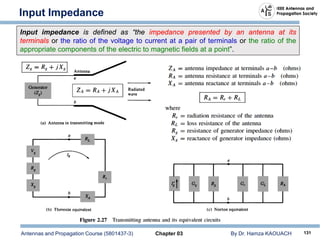
Input Impedance
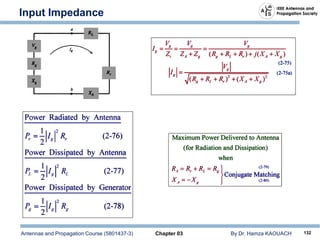
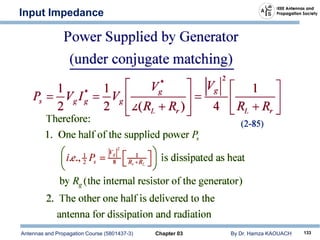
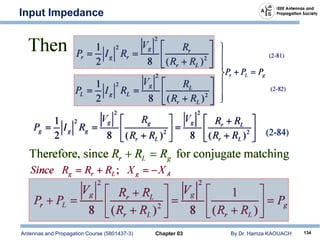
Input impedance is defined as “the impedance presented by an antenna at its
terminals or the ratio of the voltage to current at a pair of terminals or the ratio of the
appropriate components of the electric to magnetic fields at a point”.
Antennas and Propagation Course (5801437-3) Chapter 03 By Dr. Hamza KAOUACH 132
Input Impedance
Antennas and Propagation Course (5801437-3) Chapter 03 By Dr. Hamza KAOUACH 133
Input Impedance
Antennas and Propagation Course (5801437-3) Chapter 03 By Dr. Hamza KAOUACH 134
Input Impedance
Antennas and Propagation Course (5801437-3) Chapter 03 By Dr. Hamza KAOUACH 135
Input Impedance
Antennas and Propagation Course (5801437-3) Chapter 03 By Dr. Hamza KAOUACH 136
Antenna Radiation Efficiency
ecd (η)
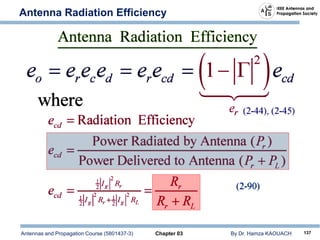
Antennas and Propagation Course (5801437-3) Chapter 03 By Dr. Hamza KAOUACH 137
Antenna Radiation Efficiency
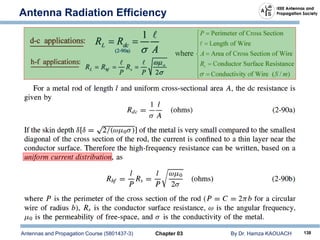
Antennas and Propagation Course (5801437-3) Chapter 03 By Dr. Hamza KAOUACH 138
Antenna Radiation Efficiency
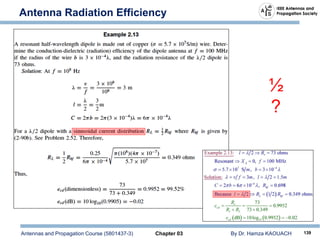
Antennas and Propagation Course (5801437-3) Chapter 03 By Dr. Hamza KAOUACH 139
Antenna Radiation Efficiency
½
?
Antennas and Propagation Course (5801437-3) Chapter 03 By Dr. Hamza KAOUACH 140
Antenna Vector
Efficiency Length
&
Equivelent Areas
Antennas and Propagation Course (5801437-3) Chapter 03 By Dr. Hamza KAOUACH 141
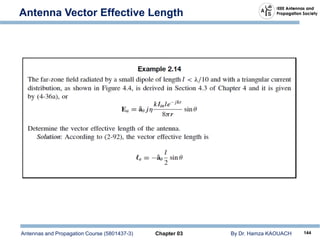
Antenna Vector Effective Length
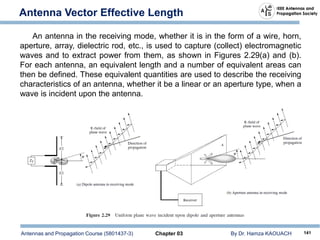
An antenna in the receiving mode, whether it is in the form of a wire, horn,
aperture, array, dielectric rod, etc., is used to capture (collect) electromagnetic
waves and to extract power from them, as shown in Figures 2.29(a) and (b).
For each antenna, an equivalent length and a number of equivalent areas can
then be defined. These equivalent quantities are used to describe the receiving
characteristics of an antenna, whether it be a linear or an aperture type, when a
wave is incident upon the antenna.
Antennas and Propagation Course (5801437-3) Chapter 03 By Dr. Hamza KAOUACH 142
Antenna Vector Effective Length
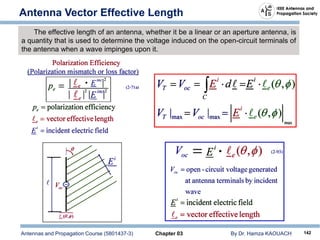
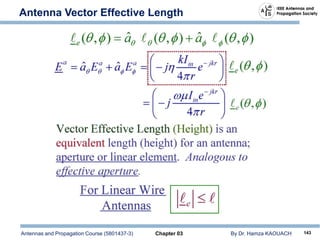
The effective length of an antenna, whether it be a linear or an aperture antenna, is
a quantity that is used to determine the voltage induced on the open-circuit terminals of
the antenna when a wave impinges upon it.
Antennas and Propagation Course (5801437-3) Chapter 03 By Dr. Hamza KAOUACH 143
Antenna Vector Effective Length
Antennas and Propagation Course (5801437-3) Chapter 03 By Dr. Hamza KAOUACH 144
Antenna Vector Effective Length
Antennas and Propagation Course (5801437-3) Chapter 03 By Dr. Hamza KAOUACH 145
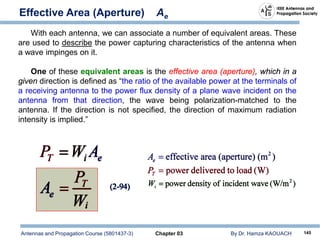
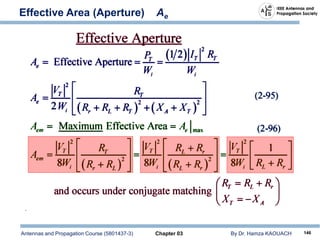
Effective Area (Aperture) Ae
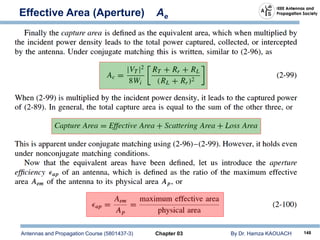
With each antenna, we can associate a number of equivalent areas. These
are used to describe the power capturing characteristics of the antenna when
a wave impinges on it.
One of these equivalent areas is the effective area (aperture), which in a
given direction is defined as “the ratio of the available power at the terminals of
a receiving antenna to the power flux density of a plane wave incident on the
antenna from that direction, the wave being polarization-matched to the
antenna. If the direction is not specified, the direction of maximum radiation
intensity is implied.”
Antennas and Propagation Course (5801437-3) Chapter 03 By Dr. Hamza KAOUACH 146
Effective Area (Aperture) Ae
Antennas and Propagation Course (5801437-3) Chapter 03 By Dr. Hamza KAOUACH 147
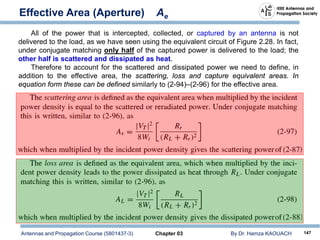
Effective Area (Aperture) Ae
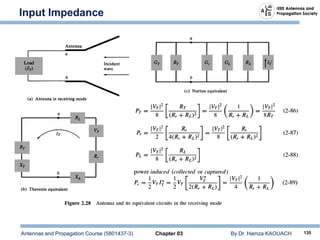
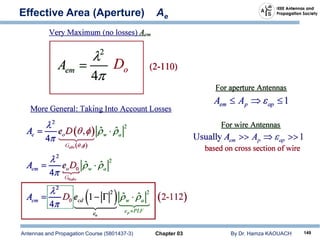
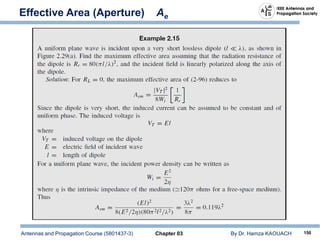
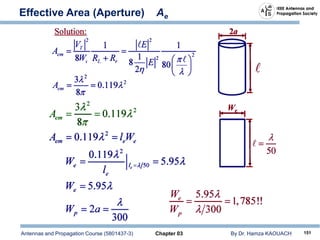
All of the power that is intercepted, collected, or captured by an antenna is not
delivered to the load, as we have seen using the equivalent circuit of Figure 2.28. In fact,
under conjugate matching only half of the captured power is delivered to the load; the
other half is scattered and dissipated as heat.
Therefore to account for the scattered and dissipated power we need to define, in
addition to the effective area, the scattering, loss and capture equivalent areas. In
equation form these can be defined similarly to (2-94)–(2-96) for the effective area.
Antennas and Propagation Course (5801437-3) Chapter 03 By Dr. Hamza KAOUACH 148
Effective Area (Aperture) Ae
Antennas and Propagation Course (5801437-3) Chapter 03 By Dr. Hamza KAOUACH 149
Effective Area (Aperture) Ae
Antennas and Propagation Course (5801437-3) Chapter 03 By Dr. Hamza KAOUACH 150
Effective Area (Aperture) Ae
Antennas and Propagation Course (5801437-3) Chapter 03 By Dr. Hamza KAOUACH 151
Effective Area (Aperture) Ae
Antennas and Propagation Course (5801437-3) Chapter 03 By Dr. Hamza KAOUACH 152
Maximum Directivity
and
Maximum Effective Area
Antennas and Propagation Course (5801437-3) Chapter 03 By Dr. Hamza KAOUACH 153
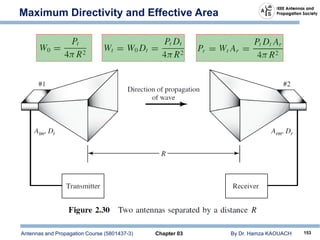
Maximum Directivity and Effective Area
Antennas and Propagation Course (5801437-3) Chapter 03 By Dr. Hamza KAOUACH 154
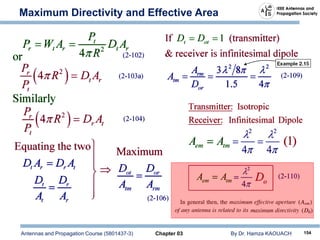
Maximum Directivity and Effective Area
Antennas and Propagation Course (5801437-3) Chapter 03 By Dr. Hamza KAOUACH 155
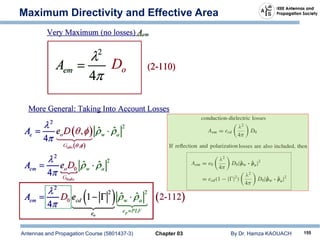
Maximum Directivity and Effective Area
Antennas and Propagation Course (5801437-3) Chapter 03 By Dr. Hamza KAOUACH 156
Friis Transmission Equation
And
Radar Range Equation
Antennas and Propagation Course (5801437-3) Chapter 03 By Dr. Hamza KAOUACH 157
Friis Transmission & Radar Range Equations
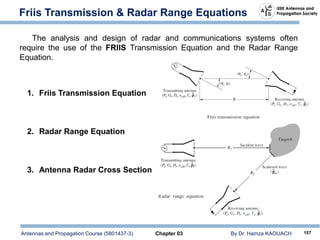
The analysis and design of radar and communications systems often
require the use of the FRIIS Transmission Equation and the Radar Range
Equation.
1. Friis Transmission Equation
2. Radar Range Equation
3. Antenna Radar Cross Section
Antennas and Propagation Course (5801437-3) Chapter 03 By Dr. Hamza KAOUACH 158
Friis Transmission & Radar Range Equations
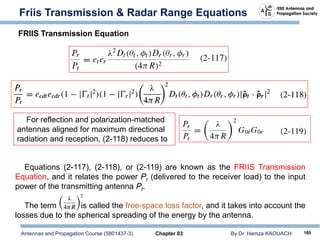
FRIIS Transmission Equation
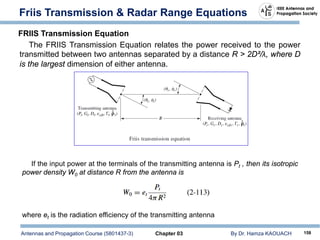
The FRIIS Transmission Equation relates the power received to the power
transmitted between two antennas separated by a distance R > 2D²/λ, where D
is the largest dimension of either antenna.
If the input power at the terminals of the transmitting antenna is Pt , then its isotropic
power density W0 at distance R from the antenna is
where et is the radiation efficiency of the transmitting antenna
Antennas and Propagation Course (5801437-3) Chapter 03 By Dr. Hamza KAOUACH 159
Friis Transmission & Radar Range Equations
FRIIS Transmission Equation
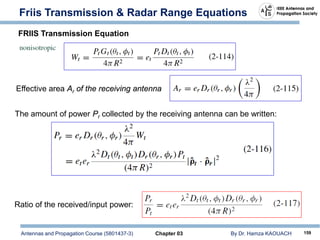
Effective area Ar of the receiving antenna
The amount of power Pr collected by the receiving antenna can be written:
Ratio of the received/input power:
Antennas and Propagation Course (5801437-3) Chapter 03 By Dr. Hamza KAOUACH 160
Friis Transmission & Radar Range Equations
For reflection and polarization-matched
antennas aligned for maximum directional
radiation and reception, (2-118) reduces to
Equations (2-117), (2-118), or (2-119) are known as the FRIIS Transmission
Equation, and it relates the power Pr (delivered to the receiver load) to the input
power of the transmitting antenna Pt.
The term is called the free-space loss factor, and it takes into account the
losses due to the spherical spreading of the energy by the antenna.
FRIIS Transmission Equation
Antennas and Propagation Course (5801437-3) Chapter 03 By Dr. Hamza KAOUACH 161
Friis Transmission & Radar Range Equations
Radar Range Equation
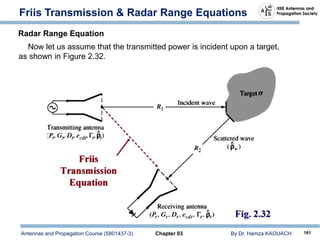
Now let us assume that the transmitted power is incident upon a target,
as shown in Figure 2.32.
Antennas and Propagation Course (5801437-3) Chapter 03 By Dr. Hamza KAOUACH 162
Friis Transmission & Radar Range Equations
Radar Range Equation
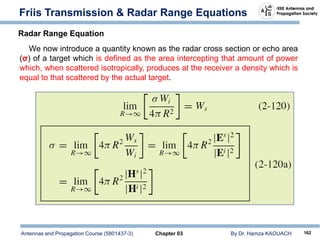
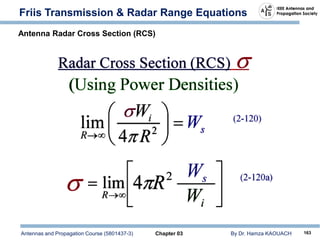
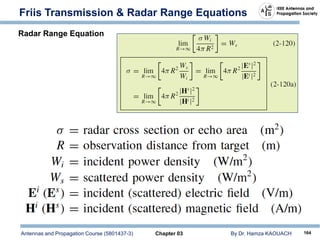
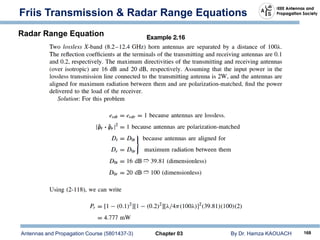
We now introduce a quantity known as the radar cross section or echo area
(σ) of a target which is defined as the area intercepting that amount of power
which, when scattered isotropically, produces at the receiver a density which is
equal to that scattered by the actual target.
Antennas and Propagation Course (5801437-3) Chapter 03 By Dr. Hamza KAOUACH 163
Friis Transmission & Radar Range Equations
Antenna Radar Cross Section (RCS)
Antennas and Propagation Course (5801437-3) Chapter 03 By Dr. Hamza KAOUACH 164
Friis Transmission & Radar Range Equations
Radar Range Equation
Antennas and Propagation Course (5801437-3) Chapter 03 By Dr. Hamza KAOUACH 165
Friis Transmission & Radar Range Equations
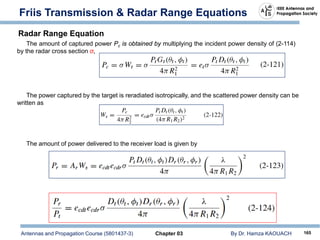
The amount of captured power Pc is obtained by multiplying the incident power density of (2-114)
by the radar cross section σ,
Radar Range Equation
The power captured by the target is reradiated isotropically, and the scattered power density can be
written as
The amount of power delivered to the receiver load is given by
Antennas and Propagation Course (5801437-3) Chapter 03 By Dr. Hamza KAOUACH 166
Friis Transmission & Radar Range Equations
Radar Range Equation
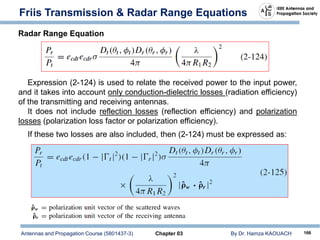
Expression (2-124) is used to relate the received power to the input power,
and it takes into account only conduction-dielectric losses (radiation efficiency)
of the transmitting and receiving antennas.
It does not include reflection losses (reflection efficiency) and polarization
losses (polarization loss factor or polarization efficiency).
If these two losses are also included, then (2-124) must be expressed as:
Antennas and Propagation Course (5801437-3) Chapter 03 By Dr. Hamza KAOUACH 167
Friis Transmission & Radar Range Equations
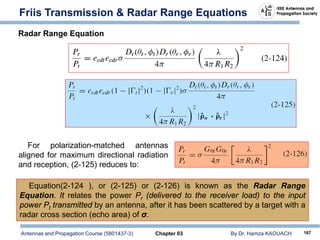
For polarization-matched antennas
aligned for maximum directional radiation
and reception, (2-125) reduces to:
Radar Range Equation
Equation(2-124 ), or (2-125) or (2-126) is known as the Radar Range
Equation. It relates the power Pr (delivered to the receiver load) to the input
power Pt transmitted by an antenna, after it has been scattered by a target with a
radar cross section (echo area) of σ.
Antennas and Propagation Course (5801437-3) Chapter 03 By Dr. Hamza KAOUACH 168
Friis Transmission & Radar Range Equations
Radar Range Equation
Antennas and Propagation Course (5801437-3) Chapter 03 By Dr. Hamza KAOUACH 169
Friis Transmission & Radar Range Equations
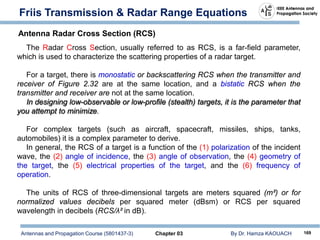
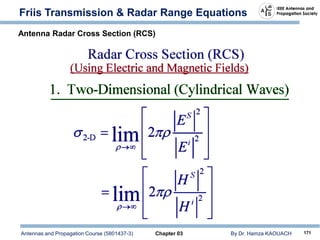
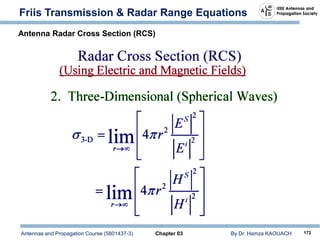
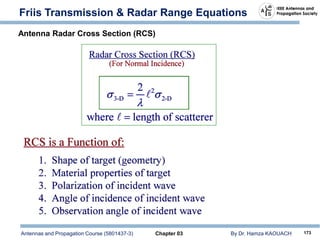
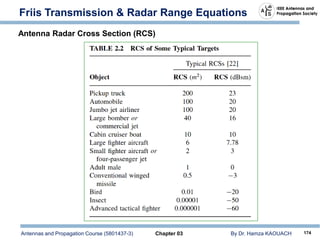
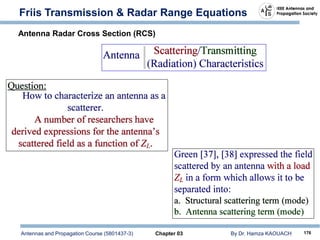
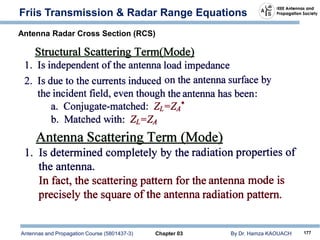
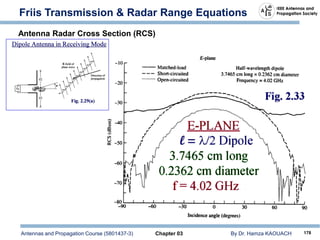
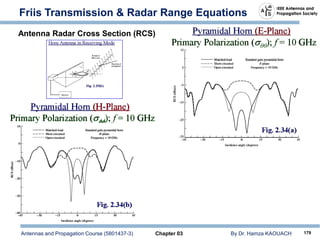
The Radar Cross Section, usually referred to as RCS, is a far-field parameter,
which is used to characterize the scattering properties of a radar target.
For a target, there is monostatic or backscattering RCS when the transmitter and
receiver of Figure 2.32 are at the same location, and a bistatic RCS when the
transmitter and receiver are not at the same location.
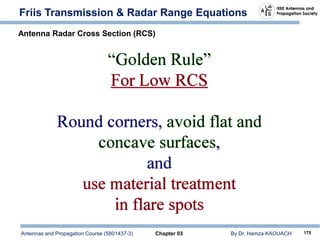
In designing low-observable or low-profile (stealth) targets, it is the parameter that
you attempt to minimize.
For complex targets (such as aircraft, spacecraft, missiles, ships, tanks,
automobiles) it is a complex parameter to derive.
In general, the RCS of a target is a function of the (1) polarization of the incident
wave, the (2) angle of incidence, the (3) angle of observation, the (4) geometry of
the target, the (5) electrical properties of the target, and the (6) frequency of
operation.
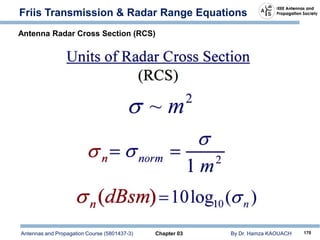
The units of RCS of three-dimensional targets are meters squared (m²) or for
normalized values decibels per squared meter (dBsm) or RCS per squared
wavelength in decibels (RCS/λ² in dB).
Antenna Radar Cross Section (RCS)
Antennas and Propagation Course (5801437-3) Chapter 03 By Dr. Hamza KAOUACH 170
Friis Transmission & Radar Range Equations
Antenna Radar Cross Section (RCS)
Antennas and Propagation Course (5801437-3) Chapter 03 By Dr. Hamza KAOUACH 171
Friis Transmission & Radar Range Equations
Antenna Radar Cross Section (RCS)
Antennas and Propagation Course (5801437-3) Chapter 03 By Dr. Hamza KAOUACH 172
Friis Transmission & Radar Range Equations
Antenna Radar Cross Section (RCS)
Antennas and Propagation Course (5801437-3) Chapter 03 By Dr. Hamza KAOUACH 173
Friis Transmission & Radar Range Equations
Antenna Radar Cross Section (RCS)
Antennas and Propagation Course (5801437-3) Chapter 03 By Dr. Hamza KAOUACH 174
Friis Transmission & Radar Range Equations
Antenna Radar Cross Section (RCS)
Antennas and Propagation Course (5801437-3) Chapter 03 By Dr. Hamza KAOUACH 175
Friis Transmission & Radar Range Equations
Antenna Radar Cross Section (RCS)
Antennas and Propagation Course (5801437-3) Chapter 03 By Dr. Hamza KAOUACH 176
Friis Transmission & Radar Range Equations
Antenna Radar Cross Section (RCS)
Antennas and Propagation Course (5801437-3) Chapter 03 By Dr. Hamza KAOUACH 177
Friis Transmission & Radar Range Equations
Antenna Radar Cross Section (RCS)
Antennas and Propagation Course (5801437-3) Chapter 03 By Dr. Hamza KAOUACH 178
Friis Transmission & Radar Range Equations
Antenna Radar Cross Section (RCS)
Antennas and Propagation Course (5801437-3) Chapter 03 By Dr. Hamza KAOUACH 179
Friis Transmission & Radar Range Equations
Antenna Radar Cross Section (RCS)
Antennas and Propagation Course (5801437-3) Chapter 03 By Dr. Hamza KAOUACH 180
Antenna Temperature
Antennas and Propagation Course (5801437-3) Chapter 03 By Dr. Hamza KAOUACH 181
Antenna Temperature
Antennas and Propagation Course (5801437-3) Chapter 03 By Dr. Hamza KAOUACH 182
Antenna Temperature
Antennas and Propagation Course (5801437-3) Chapter 03 By Dr. Hamza KAOUACH 183
Antenna Temperature
Antennas and Propagation Course (5801437-3) Chapter 03 By Dr. Hamza KAOUACH 184
Antenna Temperature
Antennas and Propagation Course (5801437-3) Chapter 03 By Dr. Hamza KAOUACH 185
Antenna Temperature
Antennas and Propagation Course (5801437-3) Chapter 03 By Dr. Hamza KAOUACH 186
Antenna Temperature
Antennas and Propagation Course (5801437-3) Chapter 03 By Dr. Hamza KAOUACH 187
Antenna Temperature

Chapter three.03_FundamentalParameters.pdf

  • 1.
    By Dr. HamzaMohamed KAOUACH 2015/2016 - 1436/1437 UMM Al-QURA UNIVERSITY College of Engineering at Al-Lith Electronics and Communications Engineering Department 5801437-3 Chapter 3 Fundamental Parameters of Antennas
  • 2.
    Antennas and PropagationCourse (5801437-3) Chapter 03 By Dr. Hamza KAOUACH 2 Introduction To describe the performance of an antenna, definitions of various parameters are necessary. Some of the parameters are interrelated and not all of them need be specified for complete description of the antenna performance. Parameter definitions will be given in this chapter. Many of those in quotation marks are from the IEEE Standard Definitions of Terms for Antennas (IEEE Std 145-1983)∗.
  • 3.
    Antennas and PropagationCourse (5801437-3) Chapter 03 By Dr. Hamza KAOUACH 3 Chapter Contents 1. Radiation Pattern 2. Radiation Power Density 3. Radiation Intensity 4. Beamwidth 5. Directivity 6. Numerical Techniques 7. Antenna Efficiency 8. Gain 9. Beam Efficiency 10. Bandwidth 11. Polarization 12. Polarization Loss Factor 13. Input Impedance 14. Antenna Radiation Efficiency 15. Antenna Vector Effective Length and Equivalent Areas 16. Maximum Directivity and Maximum Effective Area 17. FRIIS Transmission Equation and Radar Range Equation 18. Antenna Temperature
  • 4.
    Antennas and PropagationCourse (5801437-3) Chapter 03 By Dr. Hamza KAOUACH 4 Coordinate System for Antenna Analysis.
  • 5.
    Antennas and PropagationCourse (5801437-3) Chapter 03 By Dr. Hamza KAOUACH 5 Radiation Pattern (Far-Field)
  • 6.
    Antennas and PropagationCourse (5801437-3) Chapter 03 By Dr. Hamza KAOUACH 6 Radiation Pattern An antenna radiation pattern or antenna pattern is defined as “a mathematical function or a graphical representation” of the radiation properties of the antenna as a function of space coordinates. In most cases, the radiation pattern is determined in the far-field region and is represented as a function of the directional coordinates. Radiation properties include power flux density, radiation intensity, field strength, directivity, phase or polarization. The radiation property of most concern is the two- or three dimensional spatial distribution of radiated energy as a function of the observer’s position along a path or surface of constant radius. A trace of the received electric (magnetic) field at a constant radius is called the amplitude field pattern. On the other hand, a graph of the spatial variation of the power density along a constant radius is called an amplitude power pattern.
  • 7.
    Antennas and PropagationCourse (5801437-3) Chapter 03 By Dr. Hamza KAOUACH 7 Radiation Pattern For an antenna, the a. Field Pattern (in linear scale) typically represents a plot of the magnitude of the electric or magnetic field as a function of the angular space. b. Power Pattern (in linear scale) typically represents a plot of the square of the magnitude of the electric or magnetic field as a function of the angular space. c. Power Pattern (in dB) represents the magnitude of the electric or magnetic field, in decibels, as a function of the angular space. (a.) (b. & c.)
  • 8.
    Antennas and PropagationCourse (5801437-3) Chapter 03 By Dr. Hamza KAOUACH 8 Radiation Pattern To find the points where the pattern achieves its half-power (−3 dB points), relative to the maximum value of the pattern, we set the value of the field pattern at 0.707 value of its maximum, as shown in Figure. In practice, the three-dimensional pattern is measured and recorded in a series of two-dimensional patterns. However, for most practical applications, a few plots of the pattern as a function of θ for some particular values of φ, plus a few plots as a function of φ for some particular values of θ, give most of the useful and needed information.
  • 9.
    Antennas and PropagationCourse (5801437-3) Chapter 03 By Dr. Hamza KAOUACH 9 Radiation Pattern
  • 10.
    Antennas and PropagationCourse (5801437-3) Chapter 03 By Dr. Hamza KAOUACH 10 Radiation Pattern 1. Radiation Pattern Lobes Various parts of a radiation pattern are referred to as lobes, which may be sub- classified into major or main, minor, side, and back lobes. A radiation lobe is a “portion of the radiation pattern bounded by regions of relatively weak radiation intensity.”
  • 11.
    Antennas and PropagationCourse (5801437-3) Chapter 03 By Dr. Hamza KAOUACH 11 Radiation Pattern 1. Radiation Pattern Lobes It is evident that this pattern has one major lobe, five minor lobes and one back lobe. The level of the side lobe is about −9 dB relative to the maximum. In the far-field, the radial Er component for all antennas is zero or vanishingly small compared to either one, or both, of the other two components
  • 12.
    Antennas and PropagationCourse (5801437-3) Chapter 03 By Dr. Hamza KAOUACH 12 Radiation Pattern
  • 13.
    Antennas and PropagationCourse (5801437-3) Chapter 03 By Dr. Hamza KAOUACH 13 Radiation Pattern 2. Isotropic, Directional, and Omnidirectional Patterns  An isotropic radiator is defined as “a hypothetical lossless antenna having equal radiation in all directions.” Although it is ideal and not physically realizable, it is often taken as a reference for expressing the directive properties of actual antennas.  A directional antenna is one “having the property of radiating or receiving electromagnetic waves more effectively in some directions than in others. This term is usually applied to an antenna whose maximum directivity is significantly greater than that of a half-wave dipole.  An omnidirectional pattern is then a special type of a directional pattern.
  • 14.
    Antennas and PropagationCourse (5801437-3) Chapter 03 By Dr. Hamza KAOUACH 14 Radiation Pattern 3. Principal Patterns For a linearly polarized antenna, performance is often described in terms of its principal E- and H-plane patterns. The E-plane is defined as “the plane containing the electric field vector and the direction of maximum radiation,” and the H-plane as “the plane containing the magnetic-field vector and the direction of maximum radiation.”
  • 15.
    Antennas and PropagationCourse (5801437-3) Chapter 03 By Dr. Hamza KAOUACH 15 Radiation Pattern 3. Principal Patterns For this example;  the x-z plane is the principal E-plane (elevation plane; φ = 0)  the x-y plane is the principal H-plane (azimuthal plane; θ = π/2)
  • 16.
    3. Principal Patterns RadiationPattern For this example, the omnidirectional pattern has an infinite number of principal E-planes (elevation planes; φ = φc) and one principal H-plane (azimuthal plane; θ = 90◦).
  • 17.
    Antennas and PropagationCourse (5801437-3) Chapter 03 By Dr. Hamza KAOUACH 17 Radiation Pattern 3. Field Regions The space surrounding an antenna is usually subdivided into three regions: (a) reactive near-field region, (b) radiating near-field (Fresnel) region, (c) far-field (Fraunhofer) region.
  • 18.
    Antennas and PropagationCourse (5801437-3) Chapter 03 By Dr. Hamza KAOUACH 18 Radiation Pattern 3. Field Regions
  • 19.
    Antennas and PropagationCourse (5801437-3) Chapter 03 By Dr. Hamza KAOUACH 19 Radiation Pattern 3. Field Regions
  • 20.
    Antennas and PropagationCourse (5801437-3) Chapter 03 By Dr. Hamza KAOUACH 20 Radiation Pattern 3. Field Regions A typical progression of the shape of an antenna, with the largest dimension D, is shown in Figure 2.8. It is apparent that in the reactive near-field region the pattern is more spread out and nearly uniform, with slight variations. As the observation is moved to the radiating near-field region(Fresnel), the pattern begins to smooth and form lobes. In the far-field region (Fraunhofer), the pattern is well formed, usually consisting of few minor lobes and one, or more, major lobes.
  • 21.
    Antennas and PropagationCourse (5801437-3) Chapter 03 By Dr. Hamza KAOUACH 21 Radiation Pattern To illustrate the pattern variation as a function of radial distance beyond the minimum 2D²/λ far-field distance, in Figure 2.9 we have included three patterns of a parabolic reflector calculated at distances of R = 2D²/λ, 4D²/λ, and infinity. It is observed that the patterns are almost identical, except for some differences in the pattern structure around the first null and at a level below 25 dB. 3. Field Regions - 25 dB
  • 22.
    Antennas and PropagationCourse (5801437-3) Chapter 03 By Dr. Hamza KAOUACH 22 Radiation Pattern 3. Radian and Steradian The measure of a plane angle is a radian. One radian is defined as the plane angle with its vertex at the center of a circle of radius r that is subtended by an arc whose length is r. The measure of a solid angle is a steradian. One steradian is defined as the solid angle with its vertex at the center of a sphere of radius r that is subtended by a spherical surface area equal to that of a square with each side of length r.
  • 23.
    Antennas and PropagationCourse (5801437-3) Chapter 03 By Dr. Hamza KAOUACH 23 Radiation Pattern
  • 24.
    Antennas and PropagationCourse (5801437-3) Chapter 03 By Dr. Hamza KAOUACH 24 Radiation Pattern
  • 25.
    Antennas and PropagationCourse (5801437-3) Chapter 03 By Dr. Hamza KAOUACH 25 Radiation Power Density Wrad (W/m²)
  • 26.
    Antennas and PropagationCourse (5801437-3) Chapter 03 By Dr. Hamza KAOUACH 26 Radiation Power Density Electromagnetic waves are used to transport information through a wireless medium or a guiding structure, from one point to the other. It is then natural to assume that power and energy are associated with electromagnetic fields. The quantity used to describe the power associated with an electromagnetic wave is the instantaneous Poynting vector defined as:
  • 27.
    Antennas and PropagationCourse (5801437-3) Chapter 03 By Dr. Hamza KAOUACH 27 Radiation Power Density
  • 28.
    Antennas and PropagationCourse (5801437-3) Chapter 03 By Dr. Hamza KAOUACH 28 Radiation Power Density
  • 29.
    Antennas and PropagationCourse (5801437-3) Chapter 03 By Dr. Hamza KAOUACH 29 Radiation Power Density
  • 30.
    Antennas and PropagationCourse (5801437-3) Chapter 03 By Dr. Hamza KAOUACH 30 Radiation Power Density
  • 31.
    Antennas and PropagationCourse (5801437-3) Chapter 03 By Dr. Hamza KAOUACH 31 Radiation Power Density Isotropic Radiator case
  • 32.
    Antennas and PropagationCourse (5801437-3) Chapter 03 By Dr. Hamza KAOUACH 32 Radiation Intensity U (W/St)
  • 33.
    Antennas and PropagationCourse (5801437-3) Chapter 03 By Dr. Hamza KAOUACH 33 Radiation Intensity U (Far-Field) Radiation intensity in a given direction is defined as “the power radiated from an antenna per unit solid angle.” The radiation intensity is a far-field parameter, and it can be obtained by simply multiplying the radiation density by the square of the distance. In mathematical form it is expressed as:
  • 34.
    Antennas and PropagationCourse (5801437-3) Chapter 03 By Dr. Hamza KAOUACH 34 Radiation Intensity U (Far-Field)
  • 35.
    Antennas and PropagationCourse (5801437-3) Chapter 03 By Dr. Hamza KAOUACH 35 Radiation Intensity U (Far-Field) Isotropic Radiator Case
  • 36.
    Antennas and PropagationCourse (5801437-3) Chapter 03 By Dr. Hamza KAOUACH 36 Radiation Intensity U (Far-Field)
  • 37.
    Antennas and PropagationCourse (5801437-3) Chapter 03 By Dr. Hamza KAOUACH 37 Radiation Intensity U (Far-Field)
  • 38.
    Antennas and PropagationCourse (5801437-3) Chapter 03 By Dr. Hamza KAOUACH 38 Beamwidths BW
  • 39.
    Antennas and PropagationCourse (5801437-3) Chapter 03 By Dr. Hamza KAOUACH 39 Beamwidths Associated with the pattern of an antenna is a parameter designated as beamwidth. The beamwidth of a pattern is defined as the angular separation between two identical points on opposite side of the pattern maximum. In an antenna pattern, there are a number of beamwidths. One of the most widely used beamwidths is the Half-Power Beamwidth (HPBW), which is defined by IEEE as: “In a plane containing the direction of the maximum of a beam, the angle between the two directions in which the radiation intensity is one-half value of the beam.” Another important beamwidth is the angular separation between the first nulls of the pattern, an d it is referred to as the First-Null Beamwidth (FNBW). Both the HPBW and FNBW are demonstrated for the pattern in Figure 2.11 for the patternof Example 2.4. Other beamwidths are those where the patternis −10 dB from the maximum, or any other value. However, in practice, the term beamwidth, with no other identification, usually refers to HPBW.
  • 40.
    Antennas and PropagationCourse (5801437-3) Chapter 03 By Dr. Hamza KAOUACH 40 Beamwidths The beamwidth of an antenna is a very important figure of merit and often is used as a trade-off between it and the side lobe level; that is, as the beamwidth decreases, the side lobe increases and vice versa. In addition, the beamwidth of the antenna is also used to describe the resolution capabilities of the antenna to distinguish between two adjacent radiating sources or radar targets. The most common resolution criterion states that the resolution capability of an antenna to distinguish between two sources is equal to half the first-null beamwidth (FNBW/2), which is usually used to approximate the half-power beamwidth (HPBW).  That is, two sources separated by angular distances equal or greater than FNBW/2 ≈ HPBW of an antenna with a uniform distribution can be resolved. If the separation is smaller, then the antenna will tend to smooth the angular separation distance.
  • 41.
    Antennas and PropagationCourse (5801437-3) Chapter 03 By Dr. Hamza KAOUACH 41 Beamwidths
  • 42.
    Antennas and PropagationCourse (5801437-3) Chapter 03 By Dr. Hamza KAOUACH 42 Beamwidths
  • 43.
    Antennas and PropagationCourse (5801437-3) Chapter 03 By Dr. Hamza KAOUACH 43 Beamwidths
  • 44.
    Antennas and PropagationCourse (5801437-3) Chapter 03 By Dr. Hamza KAOUACH 44 Beamwidths
  • 45.
    Antennas and PropagationCourse (5801437-3) Chapter 03 By Dr. Hamza KAOUACH 45 Beamwidths
  • 46.
    Antennas and PropagationCourse (5801437-3) Chapter 03 By Dr. Hamza KAOUACH 46 Directivity D
  • 47.
    Antennas and PropagationCourse (5801437-3) Chapter 03 By Dr. Hamza KAOUACH 47 Directivity D In the 1983 version of the IEEE Standard Definitions of Terms for Antennas, there has been a substantive change in the definition of directivity, compared to the definition of the 1973 version. Basically the term directivity in the new 1983 version has been used to replace the term directive gain of the old 1973 version. In the new 1983 version the term directive gain has been deprecated. According to the authors of the new 1983 standards, “this change brings this standard in line with common usage among antenna engineers and with other international standards, notably those of the International Electro- technical Commission (IEC).” Therefore directivity of an antenna defined as “the ratio of the radiation intensity in a given direction from the antenna to the radiation intensity averaged over all directions”. The average radiation intensity is equal to the total power radiated by the antenna divided by 4π. IEEE Standard Definition
  • 48.
    Antennas and PropagationCourse (5801437-3) Chapter 03 By Dr. Hamza KAOUACH 48 Directivity D Note, For anisotropic source, it is very obvious from (2-16) or (2- 16a) that the directivity is unity since U, Umax, and U0 are all equal to each other. IEEE Standard Definition
  • 49.
    Antennas and PropagationCourse (5801437-3) Chapter 03 By Dr. Hamza KAOUACH 49 Directivity D (Partial Directivities)
  • 50.
    Antennas and PropagationCourse (5801437-3) Chapter 03 By Dr. Hamza KAOUACH 50 Directivity D (Partial Directivities)
  • 51.
    Antennas and PropagationCourse (5801437-3) Chapter 03 By Dr. Hamza KAOUACH 51 Directivity D (Partial Directivities)
  • 52.
    Antennas and PropagationCourse (5801437-3) Chapter 03 By Dr. Hamza KAOUACH 52 Directivity D Since the radiation inten- sity is only a function of θ, the directivity as a function of the directional angles
  • 53.
    Antennas and PropagationCourse (5801437-3) Chapter 03 By Dr. Hamza KAOUACH 53 Directivity D (Summary)
  • 54.
    Antennas and PropagationCourse (5801437-3) Chapter 03 By Dr. Hamza KAOUACH 54 Directivity D
  • 55.
    Antennas and PropagationCourse (5801437-3) Chapter 03 By Dr. Hamza KAOUACH 55 Directivity D
  • 56.
    Antennas and PropagationCourse (5801437-3) Chapter 03 By Dr. Hamza KAOUACH 56 Directivity D
  • 57.
    Antennas and PropagationCourse (5801437-3) Chapter 03 By Dr. Hamza KAOUACH 57 Directivity D
  • 58.
    Antennas and PropagationCourse (5801437-3) Chapter 03 By Dr. Hamza KAOUACH 58 Isotropic Radiator Directivity D (Summary)
  • 59.
    Antennas and PropagationCourse (5801437-3) Chapter 03 By Dr. Hamza KAOUACH 59 Directivity D (General Formulation)
  • 60.
    Antennas and PropagationCourse (5801437-3) Chapter 03 By Dr. Hamza KAOUACH 60 Directivity D (General Formulation) A more general expression for the directivity can be developed to include sources with radiation patterns that may be functions of both spherical coordinate angles θ and φ. In the previous examples we considered intensities that were represented by only one coordinate angle θ, in order not to obscure the fundamental concepts by the mathematical details. So it may now be proper, since the basic definitions have been illustrated by simple examples, to formulate the more general expressions. Let the radiation intensity of an antenna be of the form: The maximum value of (2-19) is given by:
  • 61.
    Antennas and PropagationCourse (5801437-3) Chapter 03 By Dr. Hamza KAOUACH 61 Directivity D (General Formulation)
  • 62.
    Antennas and PropagationCourse (5801437-3) Chapter 03 By Dr. Hamza KAOUACH 62 Directivity D (General Formulation) Dividing by F(θ,φ)|max merely normalizes the radiation intensity F(θ,φ), and it makes its maximum value unity The beam solid angle ΩA is defined as the solid angle through which all the power of the antenna would flow if its radiation intensity is constant (and equal to the maximum value of U) for all angles within ΩA.
  • 63.
    Antennas and PropagationCourse (5801437-3) Chapter 03 By Dr. Hamza KAOUACH 63 Directivity D - Approximations -
  • 64.
    Antennas and PropagationCourse (5801437-3) Chapter 03 By Dr. Hamza KAOUACH 64 Directivity D - Approximations - Instead of using the exact expression of (2-23) to compute the directivity, it is often convenient to derive simpler expressions, even if they are approximate, to compute the directivity. These can also be used for design purposes. For antennas with one narrow major lobe and very negligible minor lobes, the beam solid angle is approximately equal to the product of the half-power beamwidths in two perpendicular planes shown In Figure 2.14(a). For a rotationally symmetric pattern, the half-power beamwidths in any two perpendicular planes are the same, as illustrated in Figure 2.14(b). Beam solid angles for nonsymmetrical and symmetrical radiation patterns.
  • 65.
    Antennas and PropagationCourse (5801437-3) Chapter 03 By Dr. Hamza KAOUACH 65 Directivity D - Approximations - Directional Patterns
  • 66.
    Antennas and PropagationCourse (5801437-3) Chapter 03 By Dr. Hamza KAOUACH 66 Directivity D - Approximations - Directional Patterns
  • 67.
    Antennas and PropagationCourse (5801437-3) Chapter 03 By Dr. Hamza KAOUACH 67 Directivity D - Approximations - The validity of (2-26) and (2-27) is based on a pattern that has only one major lobe and any minor lobes, if present, should be of very low intensity. For a pattern with two identical major lobes, the value of the maximum directivity using (2-26) or (2-27) will be twice its actual value. For patterns with significant minor lobes, the values of maximum directivity obtained using (2-26) or (2-27), which neglect any minor lobes, will usually be too high.
  • 68.
    Antennas and PropagationCourse (5801437-3) Chapter 03 By Dr. Hamza KAOUACH 68 Directivity D - Approximations -
  • 69.
    Antennas and PropagationCourse (5801437-3) Chapter 03 By Dr. Hamza KAOUACH 69 Directivity D - Directional Patterns -
  • 70.
    Antennas and PropagationCourse (5801437-3) Chapter 03 By Dr. Hamza KAOUACH 70 Directivity D - Directional Patterns - Directional Patterns
  • 71.
    Antennas and PropagationCourse (5801437-3) Chapter 03 By Dr. Hamza KAOUACH 71 Directivity D - Directional Patterns -
  • 72.
    Antennas and PropagationCourse (5801437-3) Chapter 03 By Dr. Hamza KAOUACH 72 Directivity D - Directional Patterns -
  • 73.
    Antennas and PropagationCourse (5801437-3) Chapter 03 By Dr. Hamza KAOUACH 73 Directivity D - Directional Patterns -
  • 74.
    Antennas and PropagationCourse (5801437-3) Chapter 03 By Dr. Hamza KAOUACH 74 Directivity D - Directional Patterns -
  • 75.
    Antennas and PropagationCourse (5801437-3) Chapter 03 By Dr. Hamza KAOUACH 75 Directivity D - Omnidirectional Patterns - Some antennas (such as dipoles, loops, broadside arrays) exhibit omnidirectional patterns, as illustrated by the three-dimensional patterns in Figure 2.17 (a, b). As single-lobe directional patterns can be approximated by (2-31), omnidirectional patterns can often be approximated by
  • 76.
    Antennas and PropagationCourse (5801437-3) Chapter 03 By Dr. Hamza KAOUACH 76 Directivity D - Omnidirectional Patterns -
  • 77.
    Antennas and PropagationCourse (5801437-3) Chapter 03 By Dr. Hamza KAOUACH 77 Directivity D - Omnidirectional Patterns -
  • 78.
    Antennas and PropagationCourse (5801437-3) Chapter 03 By Dr. Hamza KAOUACH 78 Directivity D - Omnidirectional Patterns - The approximate formulas of (2-33a) and (2-33b) can be used to design omnidirectional antennas with specified radiation pattern characteristics. To facilitate this procedure, the directivity of antennas with omnidirectional patterns approximated by (2-32) is plotted in Figure 2.18 versus n and the half-power beamwidth (in degrees). Three curves are plotted in Figure 2.18; one using (2-16a) and referred as exact, one using (2-33a) and denoted as McDonald, and the third using (2-33b) and denoted as Pozar. Thus, the curves of Figure 2.18 can be used for design purposes, as follows: a. Specify the desired directivity and determine the value of n and half-power beamwidth of the omnidirectional antenna pattern, or b. Specify the desired value of n or half-power beamwidth and determine the directivity of the omnidirectional antenna pattern.
  • 79.
    Antennas and PropagationCourse (5801437-3) Chapter 03 By Dr. Hamza KAOUACH 79 Directivity D - Omnidirectional Patterns - The value of n and the three values of the directivity can also be obtained using Figure they may not be as accurate as those given above because they have to be taken off the graph. However, the curves can be used for other problems.
  • 80.
    Antennas and PropagationCourse (5801437-3) Chapter 03 By Dr. Hamza KAOUACH 80 Numerical Techniques
  • 81.
    Antennas and PropagationCourse (5801437-3) Chapter 03 By Dr. Hamza KAOUACH 81 Numerical Techniques For most practical antennas, their radiation patterns are so complex that closed-form mathematical expressions are not available. Even in those cases where expressions are available, their form is so complex that integration to find the radiated power, required to compute the maximum directivity, cannot be performed. Instead of using the approximate expressions of Kraus, Tai and Pereira, McDonald, or Pozar alternate and more accurate techniques may be desirable. With the high-speed computer systems now available, the answer may be to apply numerical methods. Let us assume that the radiation intensity of a given antenna is separable, and it is given by:
  • 82.
    Antennas and PropagationCourse (5801437-3) Chapter 03 By Dr. Hamza KAOUACH 82 Numerical Techniques
  • 83.
    Antennas and PropagationCourse (5801437-3) Chapter 03 By Dr. Hamza KAOUACH 83 Numerical Techniques
  • 84.
    Antennas and PropagationCourse (5801437-3) Chapter 03 By Dr. Hamza KAOUACH 84 Numerical Techniques
  • 85.
    Antennas and PropagationCourse (5801437-3) Chapter 03 By Dr. Hamza KAOUACH 85 Numerical Techniques
  • 86.
    Antennas and PropagationCourse (5801437-3) Chapter 03 By Dr. Hamza KAOUACH 86 Numerical Techniques
  • 87.
    Antennas and PropagationCourse (5801437-3) Chapter 03 By Dr. Hamza KAOUACH 87 Numerical Techniques
  • 88.
    Antennas and PropagationCourse (5801437-3) Chapter 03 By Dr. Hamza KAOUACH 88 Numerical Techniques
  • 89.
    Antennas and PropagationCourse (5801437-3) Chapter 03 By Dr. Hamza KAOUACH 89 Numerical Techniques
  • 90.
    Antennas and PropagationCourse (5801437-3) Chapter 03 By Dr. Hamza KAOUACH 90 Numerical Techniques
  • 91.
    Antennas and PropagationCourse (5801437-3) Chapter 03 By Dr. Hamza KAOUACH 91 Antenna Efficiency - e0 -
  • 92.
    Antennas and PropagationCourse (5801437-3) Chapter 03 By Dr. Hamza KAOUACH 92 Antenna Efficiency Associated with an antenna are a number of efficiencies and can be defined using Figure 2.22. The total antenna efficiency e0 is used to take into account losses at the input terminals and within the structure of the antenna. Such losses may be due, referring to Figure 2.22(b), to 1. reflections because of the mismatch between the transmission line and the antenna 2. I2 R losses (conduction and dielectric)
  • 93.
    Antennas and PropagationCourse (5801437-3) Chapter 03 By Dr. Hamza KAOUACH 93 Antenna Efficiency where ecd = eced = antenna radiation efficiency, which is used to relate the gain and directivity.
  • 94.
    Antennas and PropagationCourse (5801437-3) Chapter 03 By Dr. Hamza KAOUACH 94 Antenna Efficiency
  • 95.
    Antennas and PropagationCourse (5801437-3) Chapter 03 By Dr. Hamza KAOUACH 95 Gain G
  • 96.
    Antennas and PropagationCourse (5801437-3) Chapter 03 By Dr. Hamza KAOUACH 96 Gain Another useful measure describing the performance of an antenna is the gain. Although the gain of the antenna is closely related to the directivity, it is a measure that takes into account the efficiency of the antenna as well as its directional capabilities. Remember that directivity is a measure that describes only the directional properties of the antenna, and it is therefore controlled only by the pattern. Gain of an antenna (in a given direction) is defined as “the ratio of the intensity, in a given direction, to the radiation intensity that would be obtained if the power accepted by the antenna were radiated isotropically”. The radiation intensity corresponding to the isotropically radiated power is equal to the power accepted (input) by the antenna divided by 4π.
  • 97.
    Antennas and PropagationCourse (5801437-3) Chapter 03 By Dr. Hamza KAOUACH 97 Gain
  • 98.
    Antennas and PropagationCourse (5801437-3) Chapter 03 By Dr. Hamza KAOUACH 98 Gain According to the IEEE Standards, “gain does not include losses arising from impedance mismatches (reflection losses) and polarization mismatches (losses).” But, they define two gains; one, referred to as gain (G), and the other, referred to as absolute gain (Gabs), that also takes into account the reflection/mismatch losses represented in both (2-44) and (2-45).
  • 99.
    Antennas and PropagationCourse (5801437-3) Chapter 03 By Dr. Hamza KAOUACH 99 Gain
  • 100.
    Antennas and PropagationCourse (5801437-3) Chapter 03 By Dr. Hamza KAOUACH 100 Gain
  • 101.
    Antennas and PropagationCourse (5801437-3) Chapter 03 By Dr. Hamza KAOUACH 101 Gain
  • 102.
    Antennas and PropagationCourse (5801437-3) Chapter 03 By Dr. Hamza KAOUACH 102 Beam Efficiency BE
  • 103.
    Antennas and PropagationCourse (5801437-3) Chapter 03 By Dr. Hamza KAOUACH 103 Beam Efficiency Another parameter that is frequently used to judge the quality of transmitting and receiving antennas is the beam efficiency.
  • 104.
    Antennas and PropagationCourse (5801437-3) Chapter 03 By Dr. Hamza KAOUACH 104 Bandwidth BW
  • 105.
    Antennas and PropagationCourse (5801437-3) Chapter 03 By Dr. Hamza KAOUACH 105 Bandwidth The bandwidth of an antenna is defined as “the range of frequencies within which the performance of the antenna, with respect to some characteristic, conforms to a specified standard”. The bandwidth can be considered to be the range of frequencies, on either side of a center frequency (usually the resonance frequency for a dipole), where the antenna characteristics (such as input impedance, pattern, beamwidth, polarization, side lobe level, gain, beam direction, radiation efficiency) are within an acceptable value of those at the center frequency. For broadband antennas, the bandwidth is usually expressed as the ratio of the upper-to-lower frequencies of acceptable operation. For example, a 10:1 bandwidth indicates that the upper frequency is 10 times greater than the lower. For narrowband antennas, the bandwidth is expressed as a percentage of the frequency difference (upper minus lower) over the center frequency of the bandwidth. For example, a 5% bandwidth indicates that the frequency difference of acceptable operation is 5% of the center frequency of the bandwidth.
  • 106.
    Antennas and PropagationCourse (5801437-3) Chapter 03 By Dr. Hamza KAOUACH 106 Bandwidth
  • 107.
    Antennas and PropagationCourse (5801437-3) Chapter 03 By Dr. Hamza KAOUACH 107 Polarization Polar
  • 108.
    Antennas and PropagationCourse (5801437-3) Chapter 03 By Dr. Hamza KAOUACH 108 Polarization Polarization of an antenna in a given direction is defined as “the polarization of the wave transmitted (radiated) by the antenna. When the direction is not stated, the polarization is taken to be the polarization in the direction of maximum gain”. Polarization of a radiated wave is defined as “that property of an electromagnetic wave describing the time-varying direction and relative magnitude of the electric-field vector”. Specifically, the figure traced as a function of time by the extremity of the vector at a fixed location in space, and the sense in which it is traced, as observed along the direction of propagation. Clockwise (CW) = Right-hand (RH) Counterclockwise (CCW) = Left-hand (LH)
  • 109.
    Antennas and PropagationCourse (5801437-3) Chapter 03 By Dr. Hamza KAOUACH 109 Polarization Polarization then is the curve traced by the end point of the arrow (vector) representing the instantaneous electric field. The field must be observed along the direction of propagation. A typical trace as a function of time is shown in Figures 2.23 (a) and (b).
  • 110.
    Antennas and PropagationCourse (5801437-3) Chapter 03 By Dr. Hamza KAOUACH 110 Polarization
  • 111.
    Antennas and PropagationCourse (5801437-3) Chapter 03 By Dr. Hamza KAOUACH 111 Polarization
  • 112.
    Antennas and PropagationCourse (5801437-3) Chapter 03 By Dr. Hamza KAOUACH 112 Polarization
  • 113.
    Antennas and PropagationCourse (5801437-3) Chapter 03 By Dr. Hamza KAOUACH 113 Polarization
  • 114.
    Antennas and PropagationCourse (5801437-3) Chapter 03 By Dr. Hamza KAOUACH 114 Polarization
  • 115.
    Antennas and PropagationCourse (5801437-3) Chapter 03 By Dr. Hamza KAOUACH 115 Polarization
  • 116.
    Antennas and PropagationCourse (5801437-3) Chapter 03 By Dr. Hamza KAOUACH 116 Polarization
  • 117.
    Antennas and PropagationCourse (5801437-3) Chapter 03 By Dr. Hamza KAOUACH 117 Polarization (Summary) We will summarize the preceding discussion on polarization by stating the general characteristics, and the necessary and sufficient conditions that the wave must have in order to possess linear, circular or elliptical polarization. Linear Polarization A time-harmonic wave is linearly polarized at a given point in space if the electric-field (or magnetic-field) vector at that point is always oriented along the same straight line at every instant of time. This is accomplished if the field vector (electric or magnetic) possesses: a. Only one component, or b. Two orthogonal linear components that are in time phase or 180° (or multiples of 180°) out-of-phase.
  • 118.
    Antennas and PropagationCourse (5801437-3) Chapter 03 By Dr. Hamza KAOUACH 118 Polarization (Summary) Circular Polarization A time-harmonic wave is circularly polarized at a given point in space if the electric (or magnetic) field vector at that point traces a circle as a function of time. The necessary and sufficient conditions to accomplish this are if the field vector (electric or magnetic) possesses all of the following: a. The field must have two orthogonal linear components, and b. The two components must have the same magnitude, and c. The two components must have a time-phase difference of odd multiples of 90°. The sense of rotation is always determined by rotating the phase-leading component toward the phase-lagging component and observing the field rotation as the wave is viewed as it travels away from the observer. If the rotation is clockwise, the wave is right- hand (or clockwise) circularly polarized; if the rotation is counterclockwise, the wave is left-hand (or counterclockwise) circularly polarized.
  • 119.
    Antennas and PropagationCourse (5801437-3) Chapter 03 By Dr. Hamza KAOUACH 119 Polarization (Summary) Elliptical Polarization A time-harmonic wave is elliptically polarized if the tip of the field vector (electric or magnetic) traces an elliptical locus in space. At various instants of time the field vector changes continuously with time at such a manner as to describe an elliptical locus. A wave is elliptically polarized if it is not linearly or circularly polarized. Although linear and circular polarizations are special cases of elliptical, usually in practice elliptical polarization refers to other than linear or circular. The necessary and sufficient conditions to accomplish this are if the field vector (electric or magnetic) possesses all of the following: a. The field must have two orthogonal linear components, and b. The two components can be of the same or different magnitude. c. (1) If the two components are not of the same magnitude, the time-phase difference between the two components must not be 0◦ or multiples of 180◦ (because it will then be linear). (2) If the two components are of the same magnitude, the time-phase difference between the two components must not be odd multiples of 90◦ (because it will then be circular).
  • 120.
    Antennas and PropagationCourse (5801437-3) Chapter 03 By Dr. Hamza KAOUACH 120 Polarization
  • 121.
    Antennas and PropagationCourse (5801437-3) Chapter 03 By Dr. Hamza KAOUACH 121 Polarization Loss Factor PLF
  • 122.
    Antennas and PropagationCourse (5801437-3) Chapter 03 By Dr. Hamza KAOUACH 122 Polarization Loss Factor In general, the polarization of the receiving antenna will not be the same as the polarization of the incoming (incident) wave. This is commonly stated as “polarization mismatch.” The amount of power extracted by the antenna from the incoming signal will not be maximum because of the polarization loss. Assuming that the electric field of the incoming wave can be written as: where is the unit vector of the wave, and the polarization of the electric field of the receiving antenna can be expressed as: Where is its unit vector (polarization vector), the polarization loss can be taken into account by introducing a polarization loss factor (PLF). It is defined, based on the polarization of the antenna in its transmitting mode, as: where is the angle between the two unit vectors.
  • 123.
    Antennas and PropagationCourse (5801437-3) Chapter 03 By Dr. Hamza KAOUACH 123 Polarization Loss Factor The relative alignment of the polarization of the incoming wave and of the antenna is shown in Figure 2.24. If the antenna is polarization matched, its PLF will be unity and the antenna will extract maximum power from the incoming wave.
  • 124.
    Antennas and PropagationCourse (5801437-3) Chapter 03 By Dr. Hamza KAOUACH 124 Polarization Loss Factor
  • 125.
    Antennas and PropagationCourse (5801437-3) Chapter 03 By Dr. Hamza KAOUACH 125 Polarization Loss Factor
  • 126.
    Antennas and PropagationCourse (5801437-3) Chapter 03 By Dr. Hamza KAOUACH 126 Polarization Loss Factor
  • 127.
    Antennas and PropagationCourse (5801437-3) Chapter 03 By Dr. Hamza KAOUACH 127 Polarization Loss Factor
  • 128.
    Antennas and PropagationCourse (5801437-3) Chapter 03 By Dr. Hamza KAOUACH 128 Polarization Loss Factor
  • 129.
    Antennas and PropagationCourse (5801437-3) Chapter 03 By Dr. Hamza KAOUACH 129 Polarization Loss Factor
  • 130.
    Antennas and PropagationCourse (5801437-3) Chapter 03 By Dr. Hamza KAOUACH 130 Input Impedance Zin
  • 131.
    Antennas and PropagationCourse (5801437-3) Chapter 03 By Dr. Hamza KAOUACH 131 Input Impedance Input impedance is defined as “the impedance presented by an antenna at its terminals or the ratio of the voltage to current at a pair of terminals or the ratio of the appropriate components of the electric to magnetic fields at a point”.
  • 132.
    Antennas and PropagationCourse (5801437-3) Chapter 03 By Dr. Hamza KAOUACH 132 Input Impedance
  • 133.
    Antennas and PropagationCourse (5801437-3) Chapter 03 By Dr. Hamza KAOUACH 133 Input Impedance
  • 134.
    Antennas and PropagationCourse (5801437-3) Chapter 03 By Dr. Hamza KAOUACH 134 Input Impedance
  • 135.
    Antennas and PropagationCourse (5801437-3) Chapter 03 By Dr. Hamza KAOUACH 135 Input Impedance
  • 136.
    Antennas and PropagationCourse (5801437-3) Chapter 03 By Dr. Hamza KAOUACH 136 Antenna Radiation Efficiency ecd (η)
  • 137.
    Antennas and PropagationCourse (5801437-3) Chapter 03 By Dr. Hamza KAOUACH 137 Antenna Radiation Efficiency
  • 138.
    Antennas and PropagationCourse (5801437-3) Chapter 03 By Dr. Hamza KAOUACH 138 Antenna Radiation Efficiency
  • 139.
    Antennas and PropagationCourse (5801437-3) Chapter 03 By Dr. Hamza KAOUACH 139 Antenna Radiation Efficiency ½ ?
  • 140.
    Antennas and PropagationCourse (5801437-3) Chapter 03 By Dr. Hamza KAOUACH 140 Antenna Vector Efficiency Length & Equivelent Areas
  • 141.
    Antennas and PropagationCourse (5801437-3) Chapter 03 By Dr. Hamza KAOUACH 141 Antenna Vector Effective Length An antenna in the receiving mode, whether it is in the form of a wire, horn, aperture, array, dielectric rod, etc., is used to capture (collect) electromagnetic waves and to extract power from them, as shown in Figures 2.29(a) and (b). For each antenna, an equivalent length and a number of equivalent areas can then be defined. These equivalent quantities are used to describe the receiving characteristics of an antenna, whether it be a linear or an aperture type, when a wave is incident upon the antenna.
  • 142.
    Antennas and PropagationCourse (5801437-3) Chapter 03 By Dr. Hamza KAOUACH 142 Antenna Vector Effective Length The effective length of an antenna, whether it be a linear or an aperture antenna, is a quantity that is used to determine the voltage induced on the open-circuit terminals of the antenna when a wave impinges upon it.
  • 143.
    Antennas and PropagationCourse (5801437-3) Chapter 03 By Dr. Hamza KAOUACH 143 Antenna Vector Effective Length
  • 144.
    Antennas and PropagationCourse (5801437-3) Chapter 03 By Dr. Hamza KAOUACH 144 Antenna Vector Effective Length
  • 145.
    Antennas and PropagationCourse (5801437-3) Chapter 03 By Dr. Hamza KAOUACH 145 Effective Area (Aperture) Ae With each antenna, we can associate a number of equivalent areas. These are used to describe the power capturing characteristics of the antenna when a wave impinges on it. One of these equivalent areas is the effective area (aperture), which in a given direction is defined as “the ratio of the available power at the terminals of a receiving antenna to the power flux density of a plane wave incident on the antenna from that direction, the wave being polarization-matched to the antenna. If the direction is not specified, the direction of maximum radiation intensity is implied.”
  • 146.
    Antennas and PropagationCourse (5801437-3) Chapter 03 By Dr. Hamza KAOUACH 146 Effective Area (Aperture) Ae
  • 147.
    Antennas and PropagationCourse (5801437-3) Chapter 03 By Dr. Hamza KAOUACH 147 Effective Area (Aperture) Ae All of the power that is intercepted, collected, or captured by an antenna is not delivered to the load, as we have seen using the equivalent circuit of Figure 2.28. In fact, under conjugate matching only half of the captured power is delivered to the load; the other half is scattered and dissipated as heat. Therefore to account for the scattered and dissipated power we need to define, in addition to the effective area, the scattering, loss and capture equivalent areas. In equation form these can be defined similarly to (2-94)–(2-96) for the effective area.
  • 148.
    Antennas and PropagationCourse (5801437-3) Chapter 03 By Dr. Hamza KAOUACH 148 Effective Area (Aperture) Ae
  • 149.
    Antennas and PropagationCourse (5801437-3) Chapter 03 By Dr. Hamza KAOUACH 149 Effective Area (Aperture) Ae
  • 150.
    Antennas and PropagationCourse (5801437-3) Chapter 03 By Dr. Hamza KAOUACH 150 Effective Area (Aperture) Ae
  • 151.
    Antennas and PropagationCourse (5801437-3) Chapter 03 By Dr. Hamza KAOUACH 151 Effective Area (Aperture) Ae
  • 152.
    Antennas and PropagationCourse (5801437-3) Chapter 03 By Dr. Hamza KAOUACH 152 Maximum Directivity and Maximum Effective Area
  • 153.
    Antennas and PropagationCourse (5801437-3) Chapter 03 By Dr. Hamza KAOUACH 153 Maximum Directivity and Effective Area
  • 154.
    Antennas and PropagationCourse (5801437-3) Chapter 03 By Dr. Hamza KAOUACH 154 Maximum Directivity and Effective Area
  • 155.
    Antennas and PropagationCourse (5801437-3) Chapter 03 By Dr. Hamza KAOUACH 155 Maximum Directivity and Effective Area
  • 156.
    Antennas and PropagationCourse (5801437-3) Chapter 03 By Dr. Hamza KAOUACH 156 Friis Transmission Equation And Radar Range Equation
  • 157.
    Antennas and PropagationCourse (5801437-3) Chapter 03 By Dr. Hamza KAOUACH 157 Friis Transmission & Radar Range Equations The analysis and design of radar and communications systems often require the use of the FRIIS Transmission Equation and the Radar Range Equation. 1. Friis Transmission Equation 2. Radar Range Equation 3. Antenna Radar Cross Section
  • 158.
    Antennas and PropagationCourse (5801437-3) Chapter 03 By Dr. Hamza KAOUACH 158 Friis Transmission & Radar Range Equations FRIIS Transmission Equation The FRIIS Transmission Equation relates the power received to the power transmitted between two antennas separated by a distance R > 2D²/λ, where D is the largest dimension of either antenna. If the input power at the terminals of the transmitting antenna is Pt , then its isotropic power density W0 at distance R from the antenna is where et is the radiation efficiency of the transmitting antenna
  • 159.
    Antennas and PropagationCourse (5801437-3) Chapter 03 By Dr. Hamza KAOUACH 159 Friis Transmission & Radar Range Equations FRIIS Transmission Equation Effective area Ar of the receiving antenna The amount of power Pr collected by the receiving antenna can be written: Ratio of the received/input power:
  • 160.
    Antennas and PropagationCourse (5801437-3) Chapter 03 By Dr. Hamza KAOUACH 160 Friis Transmission & Radar Range Equations For reflection and polarization-matched antennas aligned for maximum directional radiation and reception, (2-118) reduces to Equations (2-117), (2-118), or (2-119) are known as the FRIIS Transmission Equation, and it relates the power Pr (delivered to the receiver load) to the input power of the transmitting antenna Pt. The term is called the free-space loss factor, and it takes into account the losses due to the spherical spreading of the energy by the antenna. FRIIS Transmission Equation
  • 161.
    Antennas and PropagationCourse (5801437-3) Chapter 03 By Dr. Hamza KAOUACH 161 Friis Transmission & Radar Range Equations Radar Range Equation Now let us assume that the transmitted power is incident upon a target, as shown in Figure 2.32.
  • 162.
    Antennas and PropagationCourse (5801437-3) Chapter 03 By Dr. Hamza KAOUACH 162 Friis Transmission & Radar Range Equations Radar Range Equation We now introduce a quantity known as the radar cross section or echo area (σ) of a target which is defined as the area intercepting that amount of power which, when scattered isotropically, produces at the receiver a density which is equal to that scattered by the actual target.
  • 163.
    Antennas and PropagationCourse (5801437-3) Chapter 03 By Dr. Hamza KAOUACH 163 Friis Transmission & Radar Range Equations Antenna Radar Cross Section (RCS)
  • 164.
    Antennas and PropagationCourse (5801437-3) Chapter 03 By Dr. Hamza KAOUACH 164 Friis Transmission & Radar Range Equations Radar Range Equation
  • 165.
    Antennas and PropagationCourse (5801437-3) Chapter 03 By Dr. Hamza KAOUACH 165 Friis Transmission & Radar Range Equations The amount of captured power Pc is obtained by multiplying the incident power density of (2-114) by the radar cross section σ, Radar Range Equation The power captured by the target is reradiated isotropically, and the scattered power density can be written as The amount of power delivered to the receiver load is given by
  • 166.
    Antennas and PropagationCourse (5801437-3) Chapter 03 By Dr. Hamza KAOUACH 166 Friis Transmission & Radar Range Equations Radar Range Equation Expression (2-124) is used to relate the received power to the input power, and it takes into account only conduction-dielectric losses (radiation efficiency) of the transmitting and receiving antennas. It does not include reflection losses (reflection efficiency) and polarization losses (polarization loss factor or polarization efficiency). If these two losses are also included, then (2-124) must be expressed as:
  • 167.
    Antennas and PropagationCourse (5801437-3) Chapter 03 By Dr. Hamza KAOUACH 167 Friis Transmission & Radar Range Equations For polarization-matched antennas aligned for maximum directional radiation and reception, (2-125) reduces to: Radar Range Equation Equation(2-124 ), or (2-125) or (2-126) is known as the Radar Range Equation. It relates the power Pr (delivered to the receiver load) to the input power Pt transmitted by an antenna, after it has been scattered by a target with a radar cross section (echo area) of σ.
  • 168.
    Antennas and PropagationCourse (5801437-3) Chapter 03 By Dr. Hamza KAOUACH 168 Friis Transmission & Radar Range Equations Radar Range Equation
  • 169.
    Antennas and PropagationCourse (5801437-3) Chapter 03 By Dr. Hamza KAOUACH 169 Friis Transmission & Radar Range Equations The Radar Cross Section, usually referred to as RCS, is a far-field parameter, which is used to characterize the scattering properties of a radar target. For a target, there is monostatic or backscattering RCS when the transmitter and receiver of Figure 2.32 are at the same location, and a bistatic RCS when the transmitter and receiver are not at the same location. In designing low-observable or low-profile (stealth) targets, it is the parameter that you attempt to minimize. For complex targets (such as aircraft, spacecraft, missiles, ships, tanks, automobiles) it is a complex parameter to derive. In general, the RCS of a target is a function of the (1) polarization of the incident wave, the (2) angle of incidence, the (3) angle of observation, the (4) geometry of the target, the (5) electrical properties of the target, and the (6) frequency of operation. The units of RCS of three-dimensional targets are meters squared (m²) or for normalized values decibels per squared meter (dBsm) or RCS per squared wavelength in decibels (RCS/λ² in dB). Antenna Radar Cross Section (RCS)
  • 170.
    Antennas and PropagationCourse (5801437-3) Chapter 03 By Dr. Hamza KAOUACH 170 Friis Transmission & Radar Range Equations Antenna Radar Cross Section (RCS)
  • 171.
    Antennas and PropagationCourse (5801437-3) Chapter 03 By Dr. Hamza KAOUACH 171 Friis Transmission & Radar Range Equations Antenna Radar Cross Section (RCS)
  • 172.
    Antennas and PropagationCourse (5801437-3) Chapter 03 By Dr. Hamza KAOUACH 172 Friis Transmission & Radar Range Equations Antenna Radar Cross Section (RCS)
  • 173.
    Antennas and PropagationCourse (5801437-3) Chapter 03 By Dr. Hamza KAOUACH 173 Friis Transmission & Radar Range Equations Antenna Radar Cross Section (RCS)
  • 174.
    Antennas and PropagationCourse (5801437-3) Chapter 03 By Dr. Hamza KAOUACH 174 Friis Transmission & Radar Range Equations Antenna Radar Cross Section (RCS)
  • 175.
    Antennas and PropagationCourse (5801437-3) Chapter 03 By Dr. Hamza KAOUACH 175 Friis Transmission & Radar Range Equations Antenna Radar Cross Section (RCS)
  • 176.
    Antennas and PropagationCourse (5801437-3) Chapter 03 By Dr. Hamza KAOUACH 176 Friis Transmission & Radar Range Equations Antenna Radar Cross Section (RCS)
  • 177.
    Antennas and PropagationCourse (5801437-3) Chapter 03 By Dr. Hamza KAOUACH 177 Friis Transmission & Radar Range Equations Antenna Radar Cross Section (RCS)
  • 178.
    Antennas and PropagationCourse (5801437-3) Chapter 03 By Dr. Hamza KAOUACH 178 Friis Transmission & Radar Range Equations Antenna Radar Cross Section (RCS)
  • 179.
    Antennas and PropagationCourse (5801437-3) Chapter 03 By Dr. Hamza KAOUACH 179 Friis Transmission & Radar Range Equations Antenna Radar Cross Section (RCS)
  • 180.
    Antennas and PropagationCourse (5801437-3) Chapter 03 By Dr. Hamza KAOUACH 180 Antenna Temperature
  • 181.
    Antennas and PropagationCourse (5801437-3) Chapter 03 By Dr. Hamza KAOUACH 181 Antenna Temperature
  • 182.
    Antennas and PropagationCourse (5801437-3) Chapter 03 By Dr. Hamza KAOUACH 182 Antenna Temperature
  • 183.
    Antennas and PropagationCourse (5801437-3) Chapter 03 By Dr. Hamza KAOUACH 183 Antenna Temperature
  • 184.
    Antennas and PropagationCourse (5801437-3) Chapter 03 By Dr. Hamza KAOUACH 184 Antenna Temperature
  • 185.
    Antennas and PropagationCourse (5801437-3) Chapter 03 By Dr. Hamza KAOUACH 185 Antenna Temperature
  • 186.
    Antennas and PropagationCourse (5801437-3) Chapter 03 By Dr. Hamza KAOUACH 186 Antenna Temperature
  • 187.
    Antennas and PropagationCourse (5801437-3) Chapter 03 By Dr. Hamza KAOUACH 187 Antenna Temperature