Chapter 2
Protocols and the TCP/IP Suite
Chapter 2 Protocols and the TCP/IP Suite 1
Introduction
• Layered protocol architecture
• TCP/IP protocol suite
• OSI reference model
• Internetworking
Chapter 2 Protocols and the TCP/IP Suite 2
The Need for a Protocol Architecture
• Procedures to exchange data between devices
can be complex
• High degree of cooperation required between
communicating systems
Chapter 2 Protocols and the TCP/IP Suite 3
Example: File transfer
• Requires a data path to exist
• Tasks:
– Activate data communication path
– Source determines that destination is ready
– File transfer app destination file management app
is ready store file for user
– File format conversion
Chapter 2 Protocols and the TCP/IP Suite 4
Layered Protocol Architecture
• modules arranged in a vertical stack
• Each layer in stack:
– Performs related functions
– Relies on lower layer for more primitive functions
– Provides services to next higher layer
– Communicates with corresponding peer layer of
neighboring system using a protocol
Chapter 2 Protocols and the TCP/IP Suite 5
Key Features of a Protocol
• Set of rules or conventions to exchange blocks
of formatted data
• Syntax: data format
• Semantics: control information (coordination,
error handling)
• Timing: speed matching, sequencing
Chapter 2 Protocols and the TCP/IP Suite 6
TCP/IP Layers
• Physical
• Network access
• Internet
• Transport Application
Chapter 2 Protocols and the TCP/IP Suite 7
TCP and UDP
• TCP:
– connection-oriented
– Reliable packet delivery in sequence
• UDP:
– connectionless (datagram)
– Unreliable packet delivery
– Packets may arrive out of sequence or duplicated
Chapter 2 Protocols and the TCP/IP Suite 8
Figure 2.1
Chapter 2 Protocols and the TCP/IP Suite 9
Figure 2.2
Chapter 2 Protocols and the TCP/IP Suite 10
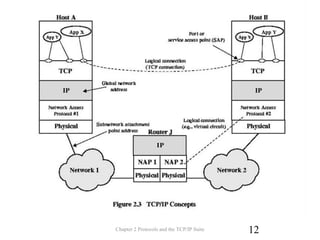
Operation of TCP and IP
• IP implemented in end systems and routers,
relaying data between hosts
• TCP implemented only in end systems,
assuring reliable delivery of blocks of data
• Each host on subnetwork has unique IP
address
• Each process on each process has unique IP
port number
Chapter 2 Protocols and the TCP/IP Suite 11
Figure 2-3
Chapter 2 Protocols and the TCP/IP Suite 12
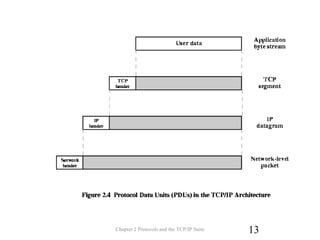
Figure 2-4
Chapter 2 Protocols and the TCP/IP Suite 13
TCP Applications
• SMTP: Simple Mail Transfer Protocol
• FTP: File Transfer Protocol
• telnet: remote login
Chapter 2 Protocols and the TCP/IP Suite 14
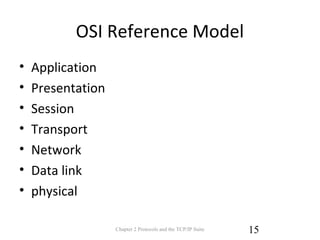
OSI Reference Model
• Application
• Presentation
• Session
• Transport
• Network
• Data link
• physical
Chapter 2 Protocols and the TCP/IP Suite 15
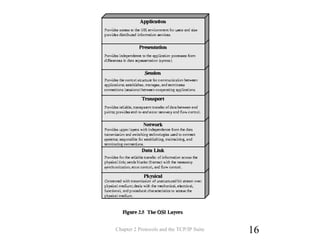
Figure 2.5
Chapter 2 Protocols and the TCP/IP Suite 16
Internetworking Terms
• Communication network
• Internet
• Intranet
• Subnetwork
• End system
• Intermediate system
• Bridge
• Router
Chapter 2 Protocols and the TCP/IP Suite 17
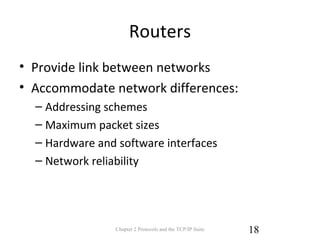
Routers
• Provide link between networks
• Accommodate network differences:
– Addressing schemes
– Maximum packet sizes
– Hardware and software interfaces
– Network reliability
Chapter 2 Protocols and the TCP/IP Suite 18
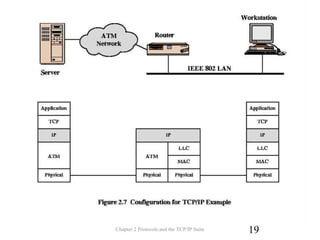
Figure 2-7
Chapter 2 Protocols and the TCP/IP Suite 19
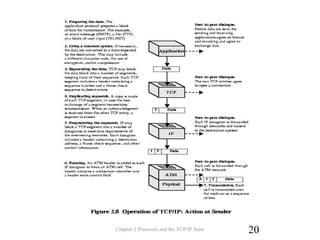
Figure 2-8
Chapter 2 Protocols and the TCP/IP Suite 20
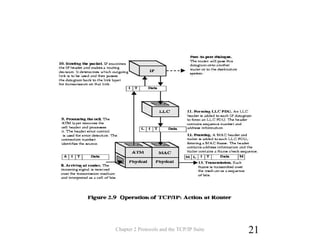
Figure 2-9
Chapter 2 Protocols and the TCP/IP Suite 21
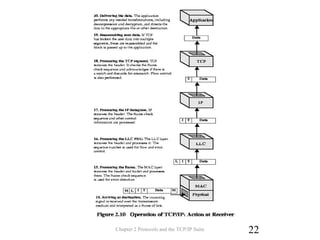
Figure 2-10
Chapter 2 Protocols and the TCP/IP Suite 22

protocol and the TCP/IP suite Chapter 02

  • 1.
    Chapter 2 Protocols andthe TCP/IP Suite Chapter 2 Protocols and the TCP/IP Suite 1
  • 2.
    Introduction • Layered protocolarchitecture • TCP/IP protocol suite • OSI reference model • Internetworking Chapter 2 Protocols and the TCP/IP Suite 2
  • 3.
    The Need fora Protocol Architecture • Procedures to exchange data between devices can be complex • High degree of cooperation required between communicating systems Chapter 2 Protocols and the TCP/IP Suite 3
  • 4.
    Example: File transfer •Requires a data path to exist • Tasks: – Activate data communication path – Source determines that destination is ready – File transfer app destination file management app is ready store file for user – File format conversion Chapter 2 Protocols and the TCP/IP Suite 4
  • 5.
    Layered Protocol Architecture •modules arranged in a vertical stack • Each layer in stack: – Performs related functions – Relies on lower layer for more primitive functions – Provides services to next higher layer – Communicates with corresponding peer layer of neighboring system using a protocol Chapter 2 Protocols and the TCP/IP Suite 5
  • 6.
    Key Features ofa Protocol • Set of rules or conventions to exchange blocks of formatted data • Syntax: data format • Semantics: control information (coordination, error handling) • Timing: speed matching, sequencing Chapter 2 Protocols and the TCP/IP Suite 6
  • 7.
    TCP/IP Layers • Physical •Network access • Internet • Transport Application Chapter 2 Protocols and the TCP/IP Suite 7
  • 8.
    TCP and UDP •TCP: – connection-oriented – Reliable packet delivery in sequence • UDP: – connectionless (datagram) – Unreliable packet delivery – Packets may arrive out of sequence or duplicated Chapter 2 Protocols and the TCP/IP Suite 8
  • 9.
    Figure 2.1 Chapter 2Protocols and the TCP/IP Suite 9
  • 10.
    Figure 2.2 Chapter 2Protocols and the TCP/IP Suite 10
  • 11.
    Operation of TCPand IP • IP implemented in end systems and routers, relaying data between hosts • TCP implemented only in end systems, assuring reliable delivery of blocks of data • Each host on subnetwork has unique IP address • Each process on each process has unique IP port number Chapter 2 Protocols and the TCP/IP Suite 11
  • 12.
    Figure 2-3 Chapter 2Protocols and the TCP/IP Suite 12
  • 13.
    Figure 2-4 Chapter 2Protocols and the TCP/IP Suite 13
  • 14.
    TCP Applications • SMTP:Simple Mail Transfer Protocol • FTP: File Transfer Protocol • telnet: remote login Chapter 2 Protocols and the TCP/IP Suite 14
  • 15.
    OSI Reference Model •Application • Presentation • Session • Transport • Network • Data link • physical Chapter 2 Protocols and the TCP/IP Suite 15
  • 16.
    Figure 2.5 Chapter 2Protocols and the TCP/IP Suite 16
  • 17.
    Internetworking Terms • Communicationnetwork • Internet • Intranet • Subnetwork • End system • Intermediate system • Bridge • Router Chapter 2 Protocols and the TCP/IP Suite 17
  • 18.
    Routers • Provide linkbetween networks • Accommodate network differences: – Addressing schemes – Maximum packet sizes – Hardware and software interfaces – Network reliability Chapter 2 Protocols and the TCP/IP Suite 18
  • 19.
    Figure 2-7 Chapter 2Protocols and the TCP/IP Suite 19
  • 20.
    Figure 2-8 Chapter 2Protocols and the TCP/IP Suite 20
  • 21.
    Figure 2-9 Chapter 2Protocols and the TCP/IP Suite 21
  • 22.
    Figure 2-10 Chapter 2Protocols and the TCP/IP Suite 22

Editor's Notes

  • #12 Insert Figures 2.3, 2.4
  • #19 Insert figures 2-7 – 2-10