DATA COMMUNICATION
AND NETWORK
Topic
TCP/IP PROTOCOLS
GROUP MEMBERS
Ayesha pervaiz (17581556-115)
Saba noor (17581556-040)
TCP/IP INTRODUCTION
 The internet protocol suite (commonly known As TCP/IP) is the set of
communications
Protocols used for the internet and other similar Networks.
It is named from two of the most important protocols In it:
 The transmission control protocol (TCP) and
 The internet protocol (IP), which were the first two networking
 Protocols defined in this standard..
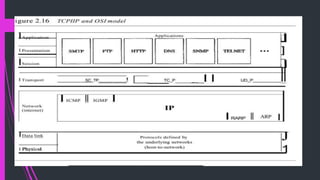
COMPARISON BETWEEN OSI MODEL AND
TCP IP
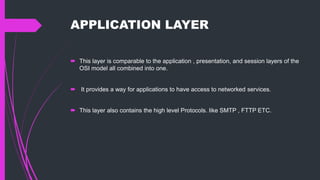
APPLICATION LAYER
 This layer is comparable to the application , presentation, and session layers of the
OSI model all combined into one.
 It provides a way for applications to have access to networked services.
 This layer also contains the high level Protocols. like SMTP , FTTP ETC.
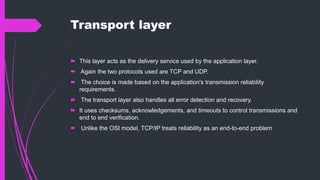
Transport layer
 This layer acts as the delivery service used by the application layer.
 Again the two protocols used are TCP and UDP.
 The choice is made based on the application's transmission reliability
requirements.
 The transport layer also handles all error detection and recovery.
 It uses checksums, acknowledgements, and timeouts to control transmissions and
end to end verification.
 Unlike the OSI model, TCP/IP treats reliability as an end-to-end problem
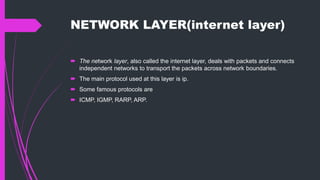
NETWORK LAYER(internet layer)
 The network layer, also called the internet layer, deals with packets and connects
independent networks to transport the packets across network boundaries.
 The main protocol used at this layer is ip.
 Some famous protocols are
 ICMP, IGMP, RARP, ARP.
Physical and Data Link Layers
 At the physical and data link layers, TCPIIP does not define any specific protocol. It
 supports all the standard and proprietary protocols. A network in a TCPIIP
internetwork
 can be a local-area network or a wide-area network.
Advantages of TCP/IP
 TCP/IP is nonproprietary and, as a result, is not controlled by any single company.
 Therefore, the internet protocol suite can be modified easily.
 It is compatible with all operating systems, so it can communicate with any other
system.
 The internet protocol suite is also compatible with all types of computer hardware
and networks.
The disadvantages of TCP/IP
 The disadvantages of TCP/IP, or transmission control protocol/internet protocol,
are its size and its speed.
 Because tcp/ip is built for wide-area networks, its size can be an issue in small
networks with limited resources,.
 Because Tcp/Ip runs several layers concurrently, it can slow down network speeds.
Presentation on TCP\IP protocols

Presentation on TCP\IP protocols

  • 1.
  • 2.
    GROUP MEMBERS Ayesha pervaiz(17581556-115) Saba noor (17581556-040)
  • 3.
    TCP/IP INTRODUCTION  Theinternet protocol suite (commonly known As TCP/IP) is the set of communications Protocols used for the internet and other similar Networks. It is named from two of the most important protocols In it:  The transmission control protocol (TCP) and  The internet protocol (IP), which were the first two networking  Protocols defined in this standard..
  • 4.
    COMPARISON BETWEEN OSIMODEL AND TCP IP
  • 5.
    APPLICATION LAYER  Thislayer is comparable to the application , presentation, and session layers of the OSI model all combined into one.  It provides a way for applications to have access to networked services.  This layer also contains the high level Protocols. like SMTP , FTTP ETC.
  • 6.
    Transport layer  Thislayer acts as the delivery service used by the application layer.  Again the two protocols used are TCP and UDP.  The choice is made based on the application's transmission reliability requirements.  The transport layer also handles all error detection and recovery.  It uses checksums, acknowledgements, and timeouts to control transmissions and end to end verification.  Unlike the OSI model, TCP/IP treats reliability as an end-to-end problem
  • 7.
    NETWORK LAYER(internet layer) The network layer, also called the internet layer, deals with packets and connects independent networks to transport the packets across network boundaries.  The main protocol used at this layer is ip.  Some famous protocols are  ICMP, IGMP, RARP, ARP.
  • 8.
    Physical and DataLink Layers  At the physical and data link layers, TCPIIP does not define any specific protocol. It  supports all the standard and proprietary protocols. A network in a TCPIIP internetwork  can be a local-area network or a wide-area network.
  • 9.
    Advantages of TCP/IP TCP/IP is nonproprietary and, as a result, is not controlled by any single company.  Therefore, the internet protocol suite can be modified easily.  It is compatible with all operating systems, so it can communicate with any other system.  The internet protocol suite is also compatible with all types of computer hardware and networks.
  • 10.
    The disadvantages ofTCP/IP  The disadvantages of TCP/IP, or transmission control protocol/internet protocol, are its size and its speed.  Because tcp/ip is built for wide-area networks, its size can be an issue in small networks with limited resources,.  Because Tcp/Ip runs several layers concurrently, it can slow down network speeds.