MATERIALS SCIENCE

MENJANA MINDA KREATIF DAN INOVATIF
Introduction
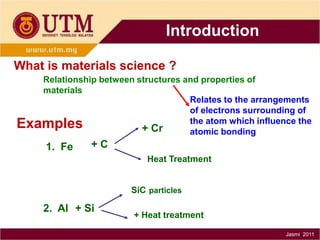
What is materials science ?
Relationship between structures and properties of
materials
Relates to the arrangements
of electrons surrounding of
the atom which influence the
+ Cr
atomic bonding

Examples
1. Fe

+C
Heat Treatment

SiC particles

2. Al + Si

+ Heat treatment
Jasmi 2011
Introduction
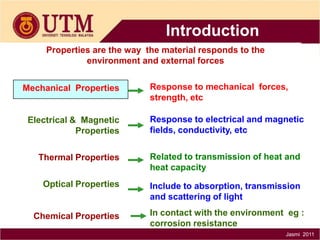
Properties are the way the material responds to the
environment and external forces
Mechanical Properties

Electrical & Magnetic
Properties

Response to mechanical forces,
strength, etc
Response to electrical and magnetic
fields, conductivity, etc

Thermal Properties

Related to transmission of heat and
heat capacity

Optical Properties

Include to absorption, transmission
and scattering of light

Chemical Properties

In contact with the environment eg :
corrosion resistance
Jasmi 2011
Introduction
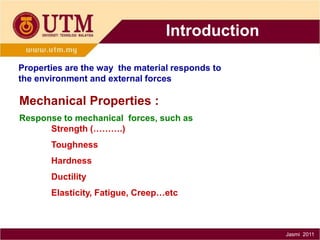
Properties are the way the material responds to
the environment and external forces

Mechanical Properties :
Response to mechanical forces, such as
Strength (……….)
Toughness
Hardness
Ductility
Elasticity, Fatigue, Creep…etc

Jasmi 2011
Introduction
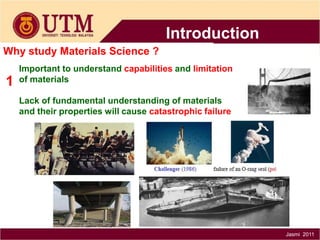
Why study Materials Science ?

1

Important to understand capabilities and limitation
of materials
Lack of fundamental understanding of materials
and their properties will cause catastrophic failure

Jasmi 2011
Introduction
2 An understanding of Materials Science helps us to design
better components, parts , devices, etc.
How do you make something stronger or lighter?
How do elements come together to form alloys ?

Why ……..

3 It is interesting and helps to make you more informed person

Jasmi 2011
Introduction
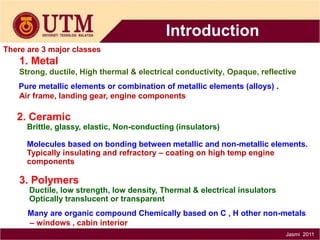
There are 3 major classes

1. Metal
Strong, ductile, High thermal & electrical conductivity, Opaque, reflective
Pure metallic elements or combination of metallic elements (alloys) .
Air frame, landing gear, engine components

2. Ceramic
Brittle, glassy, elastic, Non-conducting (insulators)

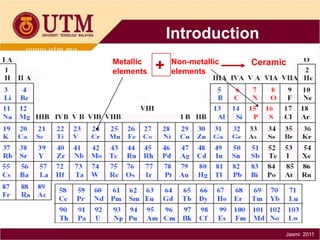
Molecules based on bonding between metallic and non-metallic elements.
Typically insulating and refractory – coating on high temp engine
components

3. Polymers
Ductile, low strength, low density, Thermal & electrical insulators
Optically translucent or transparent
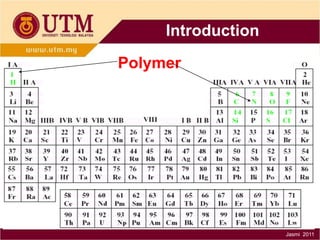
Many are organic compound Chemically based on C , H other non-metals
– windows , cabin interior
Jasmi 2011
Introduction
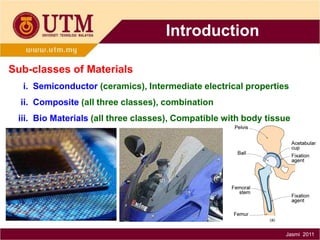
Sub-classes of Materials
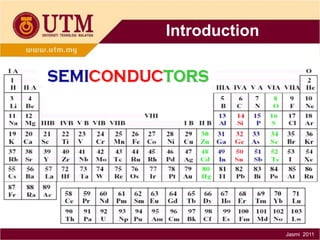
i. Semiconductor (ceramics), Intermediate electrical properties
ii. Composite (all three classes), combination
iii. Bio Materials (all three classes), Compatible with body tissue

Jasmi 2011
Introduction
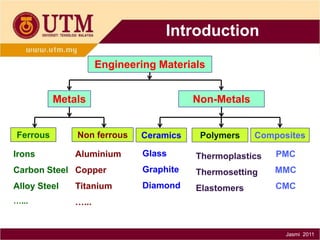
Engineering Materials
Metals
Ferrous

Non-Metals

Non ferrous

Ceramics

Aluminium

Glass

Thermoplastics

PMC

Carbon Steel Copper

Graphite

Thermosetting

MMC

Alloy Steel

Titanium

Diamond

Elastomers

CMC

…...

…...

Irons

Polymers

Composites

Jasmi 2011
Introduction

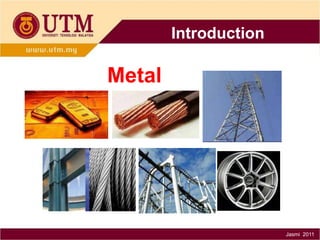
Metal

Jasmi 2011
Introduction

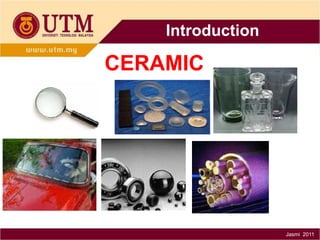
CERAMIC

Jasmi 2011
Introduction

POLYMER

Jasmi 2011
Introduction

COMPOSITE

Jasmi 2011
Introduction

SEMICONDUCTOR

Jasmi 2011
Li

Be

Na

Ca

Rb

Sr

Cs

Ba

Fr

inert gases

accept 1e-

He

Mg

K

give up 3e-

H

accept 2e-

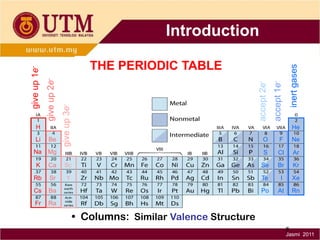
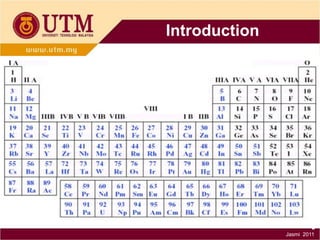
THE PERIODIC TABLE
give up 2e-

give up 1e-

Introduction

O

F

Ne

S

Cl

Ar

Sc

Se

Br

Kr

Y

Te

I

Xe

Po

At

Rn

Ra

• Columns: Similar Valence Structure
6
Jasmi 2011
Introduction

Jasmi 2011
Introduction
Metallic
elements

+
+

Non-metallic
elements

Ceramic

Jasmi 2011
Introduction
Polymer

Jasmi 2011
Introduction

Jasmi 2011
. Introduction
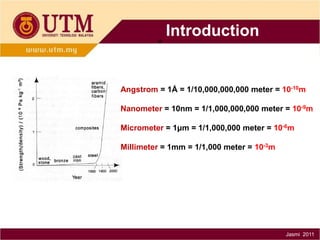
Angstrom = 1Å = 1/10,000,000,000 meter = 10-10m
Nanometer = 10nm = 1/1,000,000,000 meter = 10-9m

Micrometer = 1μm = 1/1,000,000 meter = 10-6m
Millimeter = 1mm = 1/1,000 meter = 10-3m

Jasmi 2011
Atomic Structure
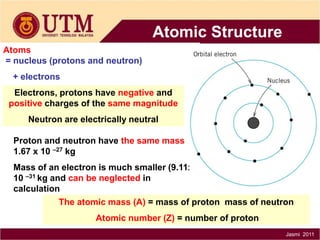
Atoms
= nucleus (protons and neutron)
+ electrons
Electrons, protons have negative and
positive charges of the same magnitude
Neutron are electrically neutral
Proton and neutron have the same mass
1.67 x 10 –27 kg
Mass of an electron is much smaller (9.11x
10 –31 kg and can be neglected in
calculation
The atomic mass (A) = mass of proton mass of neutron
Atomic number (Z) = number of proton
Jasmi 2011
Atomic Structure
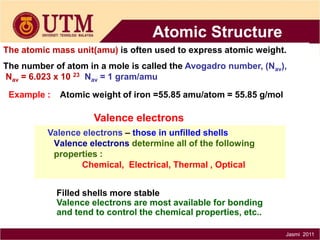
The atomic mass unit(amu) is often used to express atomic weight.
The number of atom in a mole is called the Avogadro number, (Nav),
Nav = 6.023 x 10 23 Nav = 1 gram/amu
Example :

Atomic weight of iron =55.85 amu/atom = 55.85 g/mol

Valence electrons
Valence electrons – those in unfilled shells
Valence electrons determine all of the following
properties :
Chemical, Electrical, Thermal , Optical
Filled shells more stable
Valence electrons are most available for bonding
and tend to control the chemical properties, etc..
Jasmi 2011
Atomic Bonding
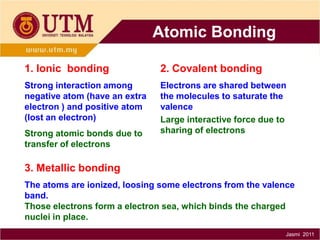
1. Ionic bonding

2. Covalent bonding

Strong interaction among
negative atom (have an extra
electron ) and positive atom
(lost an electron)

Electrons are shared between
the molecules to saturate the
valence
Large interactive force due to
sharing of electrons

Strong atomic bonds due to
transfer of electrons

3. Metallic bonding
The atoms are ionized, loosing some electrons from the valence
band.
Those electrons form a electron sea, which binds the charged
nuclei in place.
Jasmi 2011
Atomic Bonding

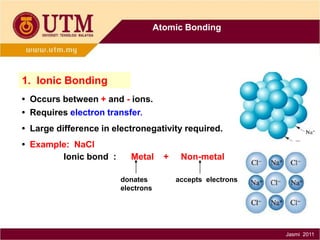
1. Ionic Bonding
• Occurs between + and - ions.
• Requires electron transfer.
• Large difference in electronegativity required.
• Example: NaCl
Ionic bond :

Metal
donates
electrons

+

Non-metal
accepts electrons

Jasmi 2011
Atomic Bonding
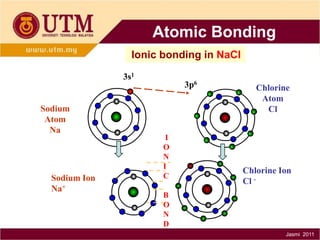
Ionic bonding in NaCl
3s1

Sodium
Atom
Na

Sodium Ion
Na+

3p6

I
O
N
I
C

Chlorine
Atom
Cl

Chlorine Ion
Cl -

B
O
N
D
Jasmi 2011
Atomic Bonding
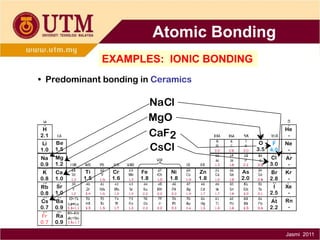
EXAMPLES: IONIC BONDING
• Predominant bonding in Ceramics

NaCl
MgO
CaF2
CsCl

H
2.1

Li
1.0

Be
1.5

Na
0.9

Mg
1.2

K
0.8

Ca
1.0

Rb
0.8
Cs
0.7
Fr
0.7

He
-

O
F
3.5 4.0
Cl
3.0

Ne
-

Br
2.8

Kr
-

Sr
1.0

I
2.5

Ba
0.9

At
2.2

Xe
Rn
-

Ra
0.9

Ti
1.5

Cr
1.6

Fe
1.8

Ni
1.8

Zn
1.8

As
2.0

Ar
-

Jasmi 2011
Atomic Bonding
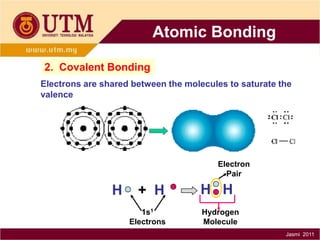
2. Covalent Bonding
Electrons are shared between the molecules to saturate the
valence

Electron
Pair

H

+ H
1s1
Electrons

H H

H

Hydrogen
Molecule
Jasmi 2011
Atomic Bonding
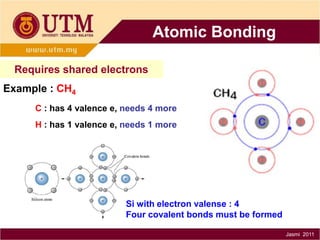
Requires shared electrons
Example : CH4
C : has 4 valence e, needs 4 more
H : has 1 valence e, needs 1 more

Si with electron valense : 4
Four covalent bonds must be formed
Jasmi 2011
Atomic Bonding
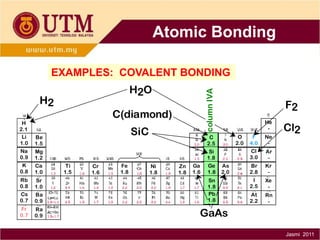
EXAMPLES: COVALENT BONDING
H2
H
2.1
Li
1.0
Na
0.9

Ca
1.0

Rb
0.8

Sr
1.0

Cs
0.7

Ba
0.9

Fr
0.7

Ra
0.9

C(diamond)

Be
1.5
Mg
1.2

K
0.8

column IVA

H2O

SiC
Ti
1.5

Cr
1.6

Fe
1.8

F2
He
O
2.0

C
2.5
Si
1.8
Ni
1.8

Zn
1.8

Ga
1.6

Ge
1.8

As
2.0

Sn
1.8
Pb
1.8

F
4.0
Cl
3.0

Ne
-

Br
2.8

Kr
-

I
2.5

Xe
-

At
2.2

Cl2

Rn
-

Ar
-

GaAs
Jasmi 2011
Atomic Bonding
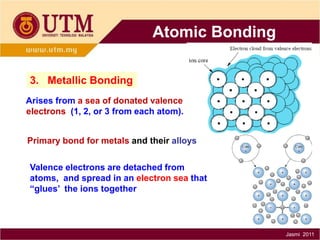
3. Metallic Bonding
Arises from a sea of donated valence
electrons (1, 2, or 3 from each atom).
Primary bond for metals and their alloys
Valence electrons are detached from
atoms, and spread in an electron sea that
“glues’ the ions together

Jasmi 2011
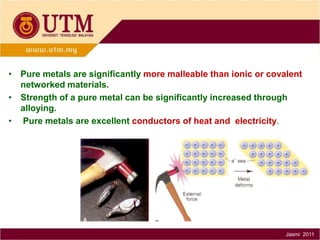
• Pure metals are significantly more malleable than ionic or covalent
networked materials.
• Strength of a pure metal can be significantly increased through
alloying.
• Pure metals are excellent conductors of heat and electricity.

Jasmi 2011
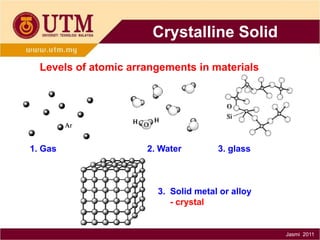
Crystalline Solid
Levels of atomic arrangements in materials

1. Gas

2. Water

3. glass

3. Solid metal or alloy
- crystal

Jasmi 2011
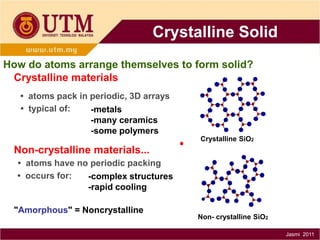
Crystalline Solid
How do atoms arrange themselves to form solid?
Crystalline materials
• atoms pack in periodic, 3D arrays
• typical of:
-metals
-many ceramics
-some polymers
Crystalline SiO2

Non-crystalline materials...
• atoms have no periodic packing
• occurs for:
-complex structures
-rapid cooling
"Amorphous" = Noncrystalline

Non- crystalline SiO2
Jasmi 2011
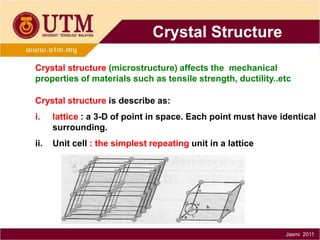
Crystal Structure
Crystal structure (microstructure) affects the mechanical
properties of materials such as tensile strength, ductility..etc
Crystal structure is describe as:
i.

lattice : a 3-D of point in space. Each point must have identical
surrounding.

ii.

Unit cell : the simplest repeating unit in a lattice

Jasmi 2011
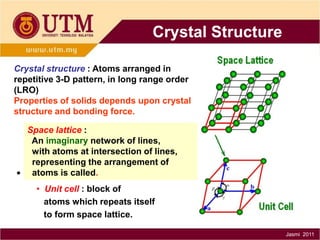
Crystal Structure
Crystal structure : Atoms arranged in
repetitive 3-D pattern, in long range order
(LRO)
Properties of solids depends upon crystal
structure and bonding force.

Space lattice :
An imaginary network of lines,
with atoms at intersection of lines,
representing the arrangement of
• atoms is called.
• Unit cell : block of
atoms which repeats itself
to form space lattice.
Jasmi 2011
Crystal Structure
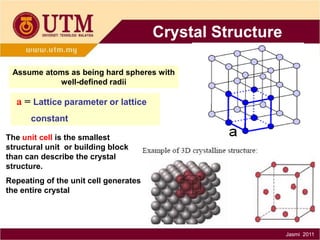
Assume atoms as being hard spheres with
well-defined radii

a = Lattice parameter or lattice
constant
The unit cell is the smallest
structural unit or building block
than can describe the crystal
structure.

Repeating of the unit cell generates
the entire crystal

Jasmi 2011
Crystal Structure
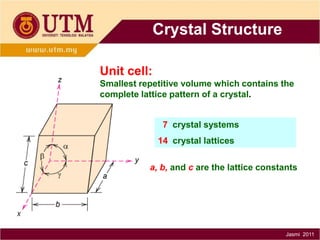
Unit cell:
Smallest repetitive volume which contains the
complete lattice pattern of a crystal.
7 crystal systems
14 crystal lattices
a, b, and c are the lattice constants

Jasmi 2011
Crystal Structure
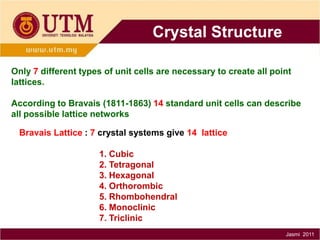
Only 7 different types of unit cells are necessary to create all point
lattices.
According to Bravais (1811-1863) 14 standard unit cells can describe
all possible lattice networks
Bravais Lattice : 7 crystal systems give 14 lattice
1. Cubic
2. Tetragonal
3. Hexagonal
4. Orthorombic
5. Rhombohendral
6. Monoclinic
7. Triclinic
Jasmi 2011
Crystal Structure
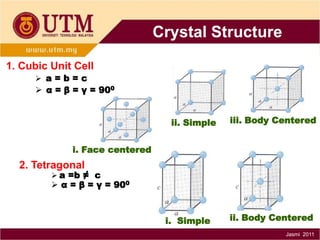
1. Cubic Unit Cell
 a=b=c

 α = β = γ = 900
ii. Simple

iii. Body Centered

i. Face centered

2. Tetragonal

 a =b ≠ c

 α = β = γ = 900

i. Simple

ii. Body Centered
Jasmi 2011
Crystal Structure
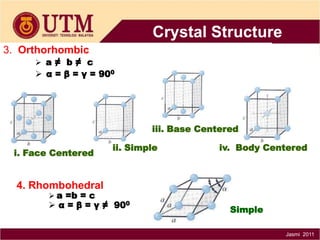
3. Orthorhombic

 a≠ b≠ c

 α = β = γ = 900

iii. Base Centered

i. Face Centered

ii. Simple

iv. Body Centered

4. Rhombohedral
 a =b = c

 α = β = γ ≠ 900

Simple
Jasmi 2011
Crystal Structure
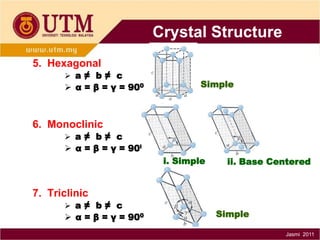
5. Hexagonal

 a≠ b≠ c

 α = β = γ = 900

Simple

6. Monoclinic

 a≠ b≠ c

 α = β = γ = 900
i. Simple

ii. Base Centered

7. Triclinic

 a≠ b≠ c

 α = β = γ = 900

Simple
Jasmi 2011
Crystal Structure
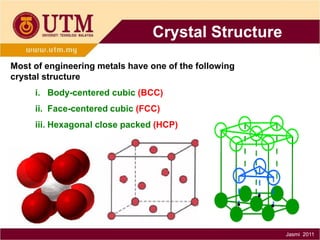
Most of engineering metals have one of the following
crystal structure
i. Body-centered cubic (BCC)
ii. Face-centered cubic (FCC)
iii. Hexagonal close packed (HCP)

Jasmi 2011
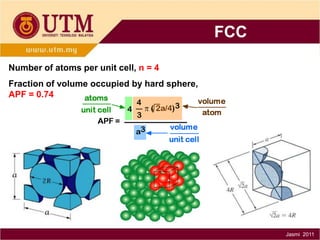
FCC
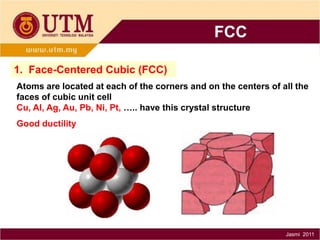
1. Face-Centered Cubic (FCC)
Atoms are located at each of the corners and on the centers of all the
faces of cubic unit cell
Cu, Al, Ag, Au, Pb, Ni, Pt, ….. have this crystal structure
Good ductility

Jasmi 2011
FCC
Number of atoms per unit cell, n = 4
Fraction of volume occupied by hard sphere,
APF = 0.74

Jasmi 2011
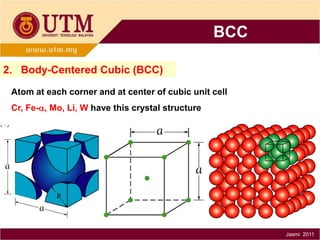
BCC
2. Body-Centered Cubic (BCC)
Atom at each corner and at center of cubic unit cell
Cr, Fe-, Mo, Li, W have this crystal structure

Jasmi 2011
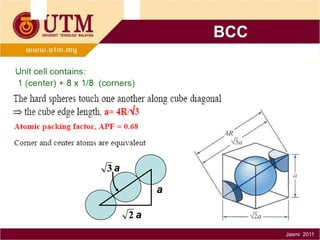
BCC

Jasmi 2011

3a

a
2a
Jasmi 2011
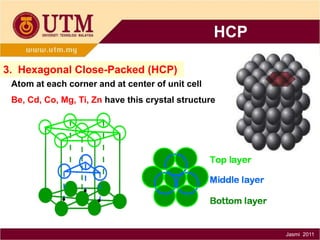
HCP
3. Hexagonal Close-Packed (HCP)
Atom at each corner and at center of unit cell
Be, Cd, Co, Mg, Ti, Zn have this crystal structure

Jasmi 2011
Crystal Structure

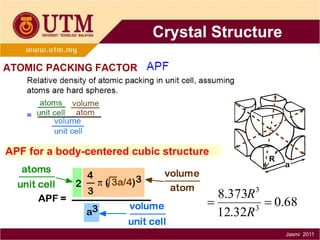
APF for a body-centered cubic structure

R

a

3

8.373R

 0.68
3
12.32R
Jasmi 2011
Crystal Structure
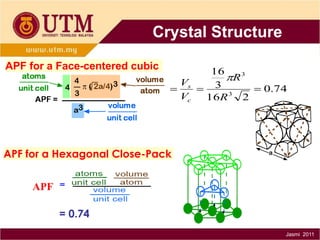
APF for a Face-centered cubic

16
R 3
V
 s  3 3
 0.74
Vc
16R 2

APF for a Hexagonal Close-Pack

a

APF
= 0.74
Jasmi 2011
Crystal Structure
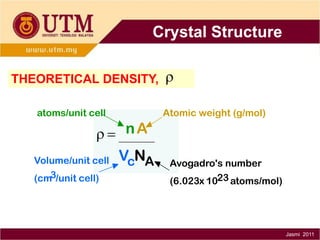
THEORETICAL DENSITY,
atoms/unit cell

r  nA
Volume/unit cell VcNA
(cm3/unit cell)

r
Atomic weight (g/mol)

Avogadro's number
(6.023x 10²³ atoms/mol)

Jasmi 2011
Crystal Structure
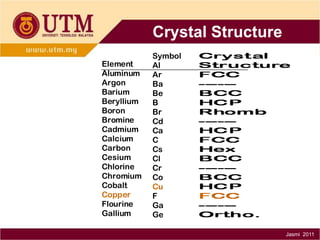
Symbol
Element
Al
Aluminum
Ar
Argon
Ba
Barium
Be
Beryllium
B
Boron
Br
Bromine
Cd
Cadmium
Ca
Calcium
C
Carbon
Cs
Cesium
Cl
Chlorine
Cr
Chromium Co
Cobalt
Cu
Copper
F
Flourine
Ga
Gallium
Ge
Germanium Au
Gold
He

Jasmi 2011

Chapter Atomic Structure and Interatomic Bonds (Jif 104 Chpter 1

  • 1.
    MATERIALS SCIENCE MENJANA MINDAKREATIF DAN INOVATIF
  • 2.
    Introduction What is materialsscience ? Relationship between structures and properties of materials Relates to the arrangements of electrons surrounding of the atom which influence the + Cr atomic bonding Examples 1. Fe +C Heat Treatment SiC particles 2. Al + Si + Heat treatment Jasmi 2011
  • 3.
    Introduction Properties are theway the material responds to the environment and external forces Mechanical Properties Electrical & Magnetic Properties Response to mechanical forces, strength, etc Response to electrical and magnetic fields, conductivity, etc Thermal Properties Related to transmission of heat and heat capacity Optical Properties Include to absorption, transmission and scattering of light Chemical Properties In contact with the environment eg : corrosion resistance Jasmi 2011
  • 4.
    Introduction Properties are theway the material responds to the environment and external forces Mechanical Properties : Response to mechanical forces, such as Strength (……….) Toughness Hardness Ductility Elasticity, Fatigue, Creep…etc Jasmi 2011
  • 5.
    Introduction Why study MaterialsScience ? 1 Important to understand capabilities and limitation of materials Lack of fundamental understanding of materials and their properties will cause catastrophic failure Jasmi 2011
  • 6.
    Introduction 2 An understandingof Materials Science helps us to design better components, parts , devices, etc. How do you make something stronger or lighter? How do elements come together to form alloys ? Why …….. 3 It is interesting and helps to make you more informed person Jasmi 2011
  • 7.
    Introduction There are 3major classes 1. Metal Strong, ductile, High thermal & electrical conductivity, Opaque, reflective Pure metallic elements or combination of metallic elements (alloys) . Air frame, landing gear, engine components 2. Ceramic Brittle, glassy, elastic, Non-conducting (insulators) Molecules based on bonding between metallic and non-metallic elements. Typically insulating and refractory – coating on high temp engine components 3. Polymers Ductile, low strength, low density, Thermal & electrical insulators Optically translucent or transparent Many are organic compound Chemically based on C , H other non-metals – windows , cabin interior Jasmi 2011
  • 8.
    Introduction Sub-classes of Materials i.Semiconductor (ceramics), Intermediate electrical properties ii. Composite (all three classes), combination iii. Bio Materials (all three classes), Compatible with body tissue Jasmi 2011
  • 9.
    Introduction Engineering Materials Metals Ferrous Non-Metals Non ferrous Ceramics Aluminium Glass Thermoplastics PMC CarbonSteel Copper Graphite Thermosetting MMC Alloy Steel Titanium Diamond Elastomers CMC …... …... Irons Polymers Composites Jasmi 2011
  • 10.
  • 11.
  • 12.
  • 13.
  • 14.
  • 15.
    Li Be Na Ca Rb Sr Cs Ba Fr inert gases accept 1e- He Mg K giveup 3e- H accept 2e- THE PERIODIC TABLE give up 2e- give up 1e- Introduction O F Ne S Cl Ar Sc Se Br Kr Y Te I Xe Po At Rn Ra • Columns: Similar Valence Structure 6 Jasmi 2011
  • 16.
  • 17.
  • 18.
  • 19.
  • 20.
    . Introduction Angstrom =1Å = 1/10,000,000,000 meter = 10-10m Nanometer = 10nm = 1/1,000,000,000 meter = 10-9m Micrometer = 1μm = 1/1,000,000 meter = 10-6m Millimeter = 1mm = 1/1,000 meter = 10-3m Jasmi 2011
  • 21.
    Atomic Structure Atoms = nucleus(protons and neutron) + electrons Electrons, protons have negative and positive charges of the same magnitude Neutron are electrically neutral Proton and neutron have the same mass 1.67 x 10 –27 kg Mass of an electron is much smaller (9.11x 10 –31 kg and can be neglected in calculation The atomic mass (A) = mass of proton mass of neutron Atomic number (Z) = number of proton Jasmi 2011
  • 22.
    Atomic Structure The atomicmass unit(amu) is often used to express atomic weight. The number of atom in a mole is called the Avogadro number, (Nav), Nav = 6.023 x 10 23 Nav = 1 gram/amu Example : Atomic weight of iron =55.85 amu/atom = 55.85 g/mol Valence electrons Valence electrons – those in unfilled shells Valence electrons determine all of the following properties : Chemical, Electrical, Thermal , Optical Filled shells more stable Valence electrons are most available for bonding and tend to control the chemical properties, etc.. Jasmi 2011
  • 23.
    Atomic Bonding 1. Ionicbonding 2. Covalent bonding Strong interaction among negative atom (have an extra electron ) and positive atom (lost an electron) Electrons are shared between the molecules to saturate the valence Large interactive force due to sharing of electrons Strong atomic bonds due to transfer of electrons 3. Metallic bonding The atoms are ionized, loosing some electrons from the valence band. Those electrons form a electron sea, which binds the charged nuclei in place. Jasmi 2011
  • 24.
    Atomic Bonding 1. IonicBonding • Occurs between + and - ions. • Requires electron transfer. • Large difference in electronegativity required. • Example: NaCl Ionic bond : Metal donates electrons + Non-metal accepts electrons Jasmi 2011
  • 25.
    Atomic Bonding Ionic bondingin NaCl 3s1 Sodium Atom Na Sodium Ion Na+ 3p6 I O N I C Chlorine Atom Cl Chlorine Ion Cl - B O N D Jasmi 2011
  • 26.
    Atomic Bonding EXAMPLES: IONICBONDING • Predominant bonding in Ceramics NaCl MgO CaF2 CsCl H 2.1 Li 1.0 Be 1.5 Na 0.9 Mg 1.2 K 0.8 Ca 1.0 Rb 0.8 Cs 0.7 Fr 0.7 He - O F 3.5 4.0 Cl 3.0 Ne - Br 2.8 Kr - Sr 1.0 I 2.5 Ba 0.9 At 2.2 Xe Rn - Ra 0.9 Ti 1.5 Cr 1.6 Fe 1.8 Ni 1.8 Zn 1.8 As 2.0 Ar - Jasmi 2011
  • 27.
    Atomic Bonding 2. CovalentBonding Electrons are shared between the molecules to saturate the valence Electron Pair H + H 1s1 Electrons H H H Hydrogen Molecule Jasmi 2011
  • 28.
    Atomic Bonding Requires sharedelectrons Example : CH4 C : has 4 valence e, needs 4 more H : has 1 valence e, needs 1 more Si with electron valense : 4 Four covalent bonds must be formed Jasmi 2011
  • 29.
    Atomic Bonding EXAMPLES: COVALENTBONDING H2 H 2.1 Li 1.0 Na 0.9 Ca 1.0 Rb 0.8 Sr 1.0 Cs 0.7 Ba 0.9 Fr 0.7 Ra 0.9 C(diamond) Be 1.5 Mg 1.2 K 0.8 column IVA H2O SiC Ti 1.5 Cr 1.6 Fe 1.8 F2 He O 2.0 C 2.5 Si 1.8 Ni 1.8 Zn 1.8 Ga 1.6 Ge 1.8 As 2.0 Sn 1.8 Pb 1.8 F 4.0 Cl 3.0 Ne - Br 2.8 Kr - I 2.5 Xe - At 2.2 Cl2 Rn - Ar - GaAs Jasmi 2011
  • 30.
    Atomic Bonding 3. MetallicBonding Arises from a sea of donated valence electrons (1, 2, or 3 from each atom). Primary bond for metals and their alloys Valence electrons are detached from atoms, and spread in an electron sea that “glues’ the ions together Jasmi 2011
  • 31.
    • Pure metalsare significantly more malleable than ionic or covalent networked materials. • Strength of a pure metal can be significantly increased through alloying. • Pure metals are excellent conductors of heat and electricity. Jasmi 2011
  • 32.
    Crystalline Solid Levels ofatomic arrangements in materials 1. Gas 2. Water 3. glass 3. Solid metal or alloy - crystal Jasmi 2011
  • 33.
    Crystalline Solid How doatoms arrange themselves to form solid? Crystalline materials • atoms pack in periodic, 3D arrays • typical of: -metals -many ceramics -some polymers Crystalline SiO2 Non-crystalline materials... • atoms have no periodic packing • occurs for: -complex structures -rapid cooling "Amorphous" = Noncrystalline Non- crystalline SiO2 Jasmi 2011
  • 34.
    Crystal Structure Crystal structure(microstructure) affects the mechanical properties of materials such as tensile strength, ductility..etc Crystal structure is describe as: i. lattice : a 3-D of point in space. Each point must have identical surrounding. ii. Unit cell : the simplest repeating unit in a lattice Jasmi 2011
  • 35.
    Crystal Structure Crystal structure: Atoms arranged in repetitive 3-D pattern, in long range order (LRO) Properties of solids depends upon crystal structure and bonding force. Space lattice : An imaginary network of lines, with atoms at intersection of lines, representing the arrangement of • atoms is called. • Unit cell : block of atoms which repeats itself to form space lattice. Jasmi 2011
  • 36.
    Crystal Structure Assume atomsas being hard spheres with well-defined radii a = Lattice parameter or lattice constant The unit cell is the smallest structural unit or building block than can describe the crystal structure. Repeating of the unit cell generates the entire crystal Jasmi 2011
  • 37.
    Crystal Structure Unit cell: Smallestrepetitive volume which contains the complete lattice pattern of a crystal. 7 crystal systems 14 crystal lattices a, b, and c are the lattice constants Jasmi 2011
  • 38.
    Crystal Structure Only 7different types of unit cells are necessary to create all point lattices. According to Bravais (1811-1863) 14 standard unit cells can describe all possible lattice networks Bravais Lattice : 7 crystal systems give 14 lattice 1. Cubic 2. Tetragonal 3. Hexagonal 4. Orthorombic 5. Rhombohendral 6. Monoclinic 7. Triclinic Jasmi 2011
  • 39.
    Crystal Structure 1. CubicUnit Cell  a=b=c  α = β = γ = 900 ii. Simple iii. Body Centered i. Face centered 2. Tetragonal  a =b ≠ c  α = β = γ = 900 i. Simple ii. Body Centered Jasmi 2011
  • 40.
    Crystal Structure 3. Orthorhombic a≠ b≠ c  α = β = γ = 900 iii. Base Centered i. Face Centered ii. Simple iv. Body Centered 4. Rhombohedral  a =b = c  α = β = γ ≠ 900 Simple Jasmi 2011
  • 41.
    Crystal Structure 5. Hexagonal a≠ b≠ c  α = β = γ = 900 Simple 6. Monoclinic  a≠ b≠ c  α = β = γ = 900 i. Simple ii. Base Centered 7. Triclinic  a≠ b≠ c  α = β = γ = 900 Simple Jasmi 2011
  • 42.
    Crystal Structure Most ofengineering metals have one of the following crystal structure i. Body-centered cubic (BCC) ii. Face-centered cubic (FCC) iii. Hexagonal close packed (HCP) Jasmi 2011
  • 43.
    FCC 1. Face-Centered Cubic(FCC) Atoms are located at each of the corners and on the centers of all the faces of cubic unit cell Cu, Al, Ag, Au, Pb, Ni, Pt, ….. have this crystal structure Good ductility Jasmi 2011
  • 44.
    FCC Number of atomsper unit cell, n = 4 Fraction of volume occupied by hard sphere, APF = 0.74 Jasmi 2011
  • 45.
    BCC 2. Body-Centered Cubic(BCC) Atom at each corner and at center of cubic unit cell Cr, Fe-, Mo, Li, W have this crystal structure Jasmi 2011
  • 46.
  • 47.
    HCP 3. Hexagonal Close-Packed(HCP) Atom at each corner and at center of unit cell Be, Cd, Co, Mg, Ti, Zn have this crystal structure Jasmi 2011
  • 48.
    Crystal Structure APF fora body-centered cubic structure R a 3 8.373R   0.68 3 12.32R Jasmi 2011
  • 49.
    Crystal Structure APF fora Face-centered cubic 16 R 3 V  s  3 3  0.74 Vc 16R 2 APF for a Hexagonal Close-Pack a APF = 0.74 Jasmi 2011
  • 50.
    Crystal Structure THEORETICAL DENSITY, atoms/unitcell r  nA Volume/unit cell VcNA (cm3/unit cell) r Atomic weight (g/mol) Avogadro's number (6.023x 10²³ atoms/mol) Jasmi 2011
  • 51.