JF302 – MATERIAL
TECHNOLOGY 1
LECTURER : PN.NORHAZLINA BTE AMON
(Coordinator)
Contact no. : 019-6462754
Course outline
SYNOPSIS
MATERIAL TECHNOLOGY 1 provides students an understanding on
pure metal, alloy and other non-metal materials that are
commonly used in the engineering field, including a study on metal
and alloy microstructure. Students also learn the processes of
metal work and specific materials used to produce engineering
components.
WEEKLY SCHEDULE
Week 1 : Students Registration
Week 2-3 :1.0 - MATERIAL STRUCTURE AND BINARY ALLOY SYSTEM
Week 4-5 :2.0 – FERROUS MATERIAL STRUCTURE AND BINARY ALLOY SYSTEM
Week 6-8 :3.0 – METAL WORK, CASTING PROCESS AND HEAT TREATMENT ON
STEEL
Week 9 : Mid-Semester Break
Week 10-12 :4.0 MATERIAL TESTING
Week 13-15 :5.0 CORROSION AND NON-FERROUS METAL
Week 16-17 :6.0 PLASTIC
Week 18-19 :Revision Week and Final Examination
GRADING (CONTINUOUS
ASSESSMENT)
No. Assessment Number
(minimum)
% total Week
1 Quiz 2 20 W2, W5, W10
2 Theory Test 2 40 W8, W15
3 Other Assessment Task
i. End of Chapter
ii. Presentation
2
1
20
20
W2, W5, W12
W16
Overall Total 8 100
REFERENCES :
Arens. W. F (2004). Contemporary Advertising. McGraw Hill. United States.
Brown B. C. (2007). The Complete Guide To Google Advertising Including Tips and Tricks and
Strategies to Create a Winning Advertising Plan. Atlantic Publishing Group Inc. Florida.
Ogivly. D. (1985). Ogivly on Advertising. Random House Inc. United States.
Sissors. J.Z. (2002). Advertising Media Planning. McGraw Hill. United States.
Well . W.D. (2005) Advertising : Principles and Pratice. United States.
Atomic Structure
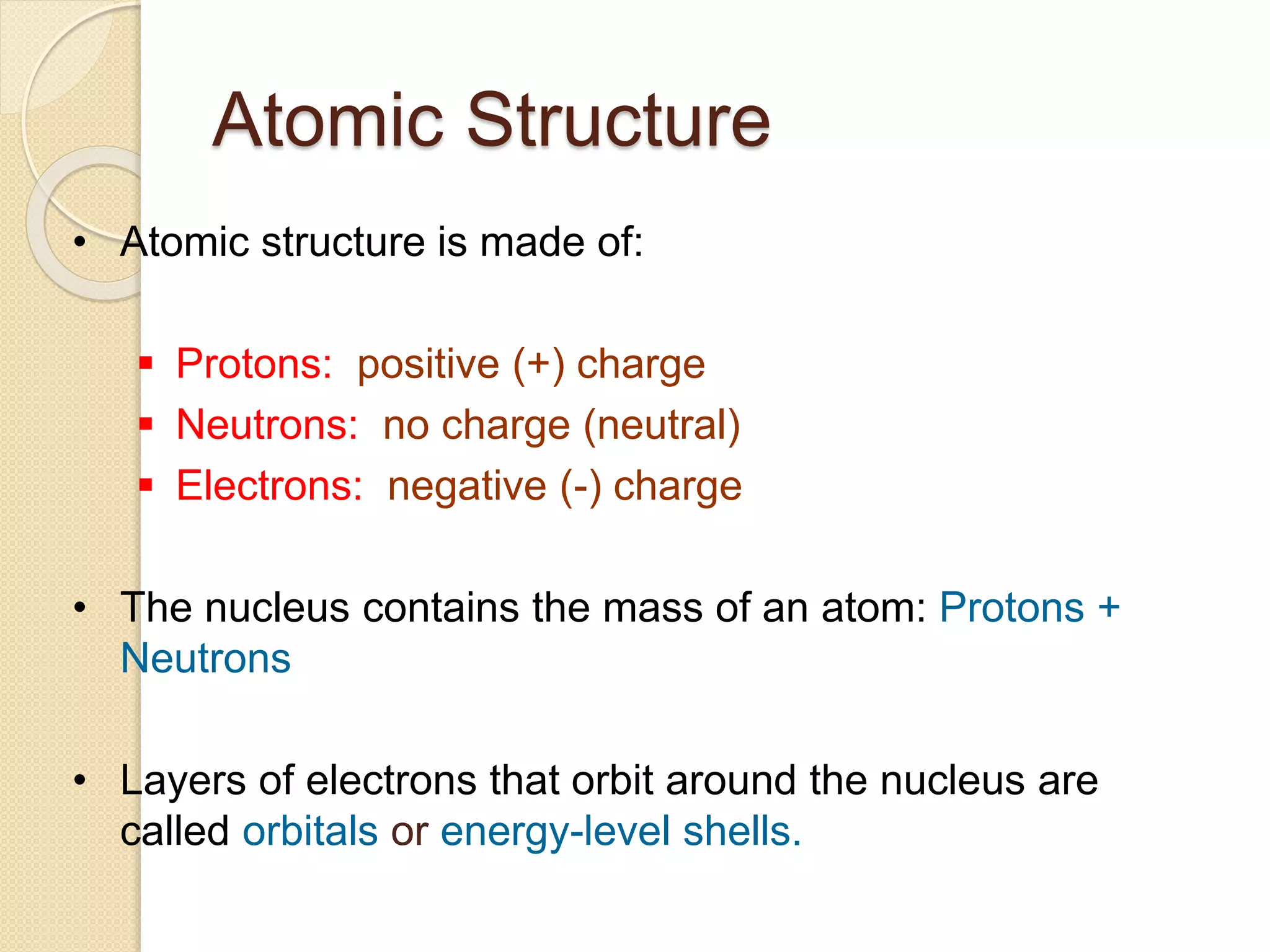
• Atomic structure is made of:
 Protons: positive (+) charge
 Neutrons: no charge (neutral)
 Electrons: negative (-) charge
• The nucleus contains the mass of an atom: Protons +
Neutrons
• Layers of electrons that orbit around the nucleus are
called orbitals or energy-level shells.
Atomic Structure
Element
 In chemistry, an element is a pure
substances that cannot be broken
down into any simpler substances by
chemical method.
 Each element has its own atomic
mass, and a no. of protons and
electrons for an elements always
remains the same.
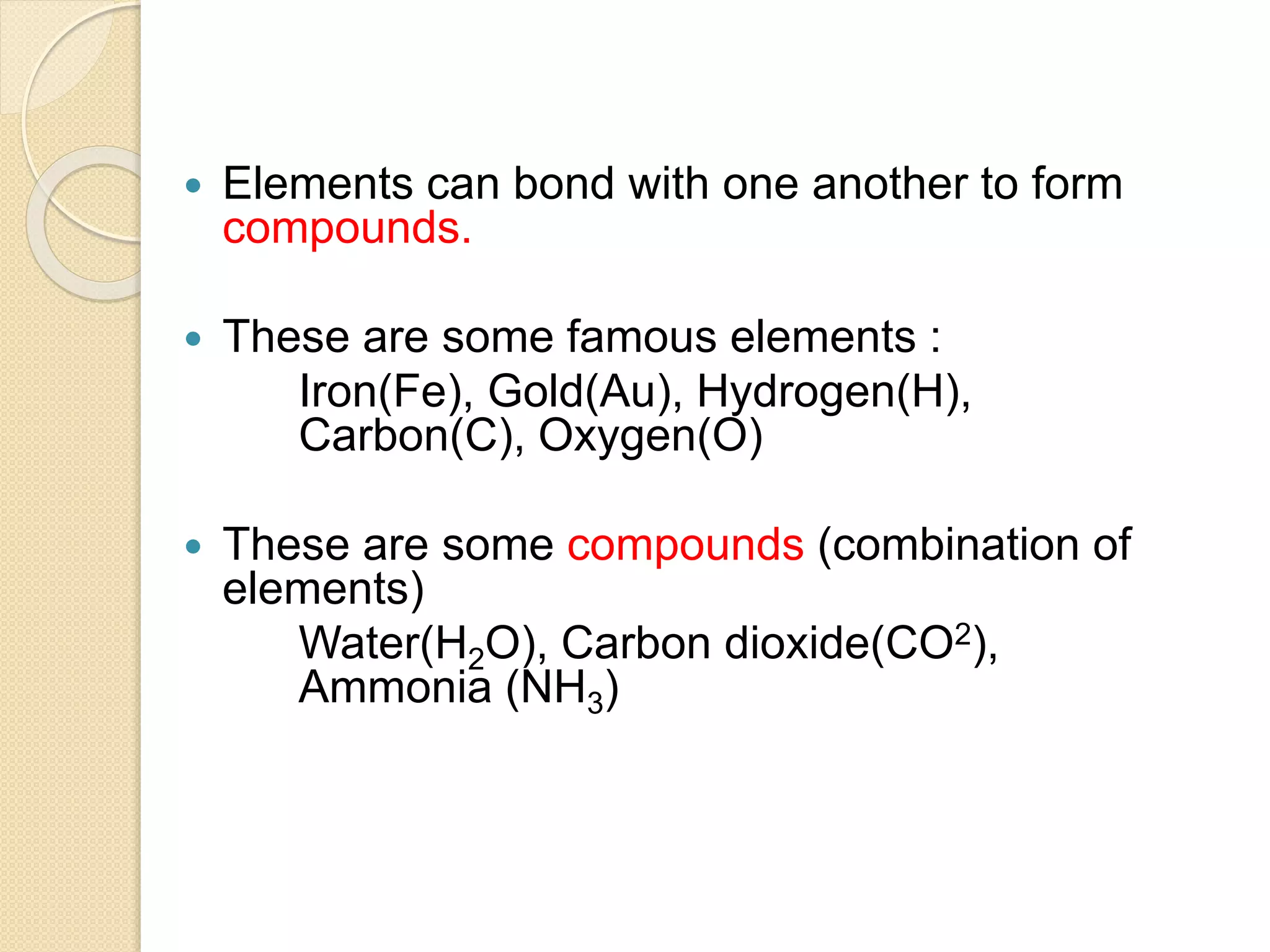
 Elements can bond with one another to form
compounds.
 These are some famous elements :
Iron(Fe), Gold(Au), Hydrogen(H),
Carbon(C), Oxygen(O)
 These are some compounds (combination of
elements)
Water(H2O), Carbon dioxide(CO2),
Ammonia (NH3)
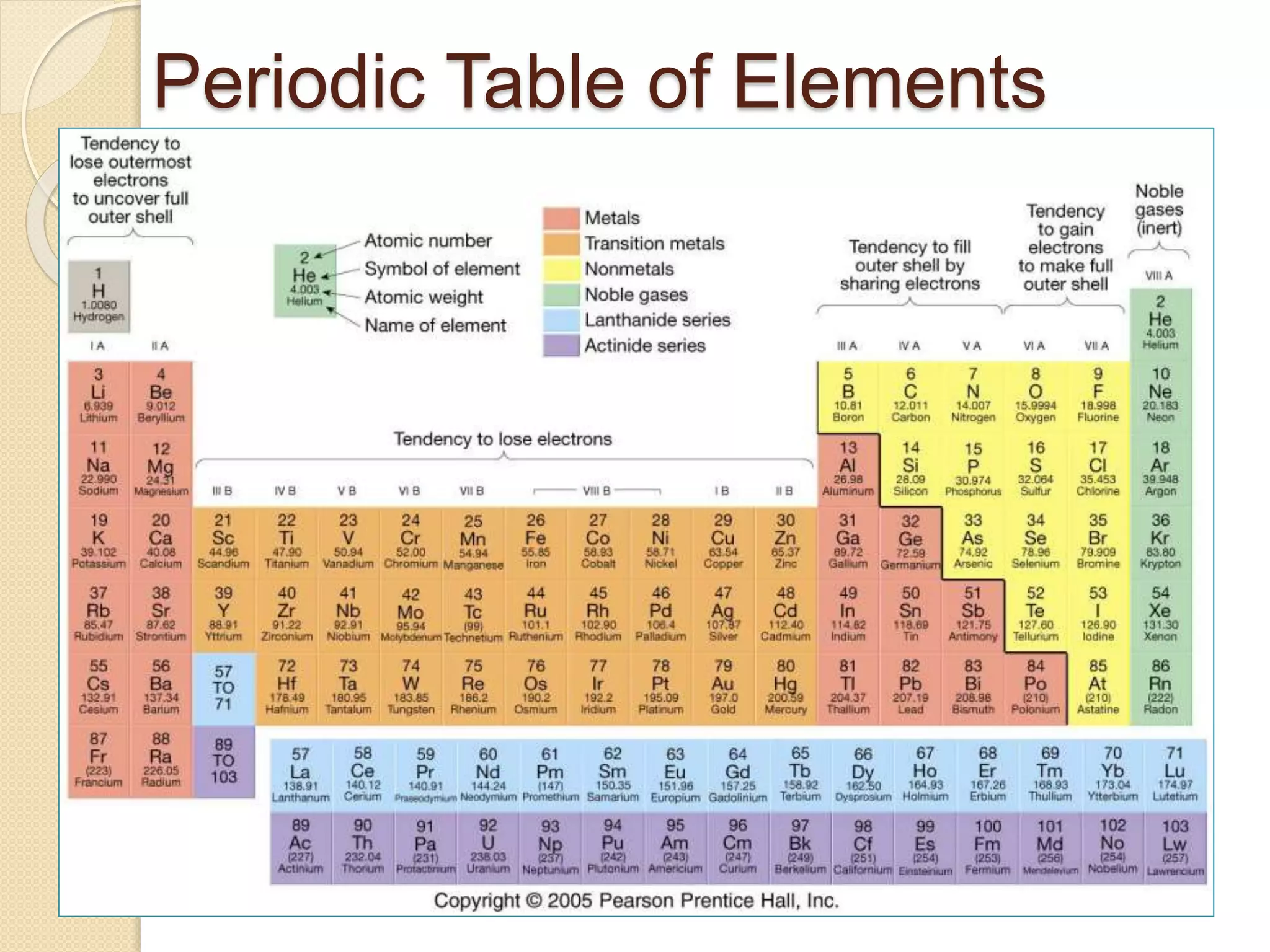
Periodic Table of Elements
Crystalline & Amorphous
 Materials are either:
1. Crystalline
2. Non-crystalline – Amorphous
What is crystalline material?
 Crystalline solid must have an ordered arrangement
of atoms (occupy specific or predictable positions in
a 3D array).
 Crystalline materials include metals, many ceramics
and some polymers
Crystalline & Amorphous
 In an amorphous solid atoms do not possess well-
defined arrangement (atoms have no periodic
packing)
 Amorphous structures form in complex structures,
polymers, and rapidly cooled materials.
Why do we need to know the crystal structure?
• Crystal structure of a material affects its mechanical
properties (strength, toughness, ductility)
• Understanding crystal structures is essential in
understanding the crystalline materials.
Crystalline Structure
􀂄 Structure in which the atoms are located at regular and
recurring positions in three dimensions
􀂄 Unit cell - basic geometric grouping of atoms that is
repeated
􀂄 The pattern may be replicated millions of times within a
given crystal
􀂄 Characteristic structure of virtually all metals, as well as
many ceramics and some polymers
Principals Metallic Crystal
Structures
 Most important engineering metals have one of the
following crystal structures:
◦ BCC - body centered cubic
◦ FCC - face centered cubic
◦ HCP – hexagonal close packed
Principals Metallic Crystal
Structures
BCC ( Body-Centered
Crystal)
Body-centered cubic (BCC) crystal structure:
(a)unit cell, with atoms indicated as point locations in a three-
dimensional axis system
(b) unit cell model showing closely packed atoms (sometimes
called the hard-ball model)
(c) repeated pattern of the BCC structure
Number of atoms in a BCC unit cell
 Each corner atom contributes
as 1/8
 There are 8 corner atoms/
BCC unit cell
• There is 1 atom in the centre
(non shared)
cellunitatomsatomsofnumber /2118
8
1

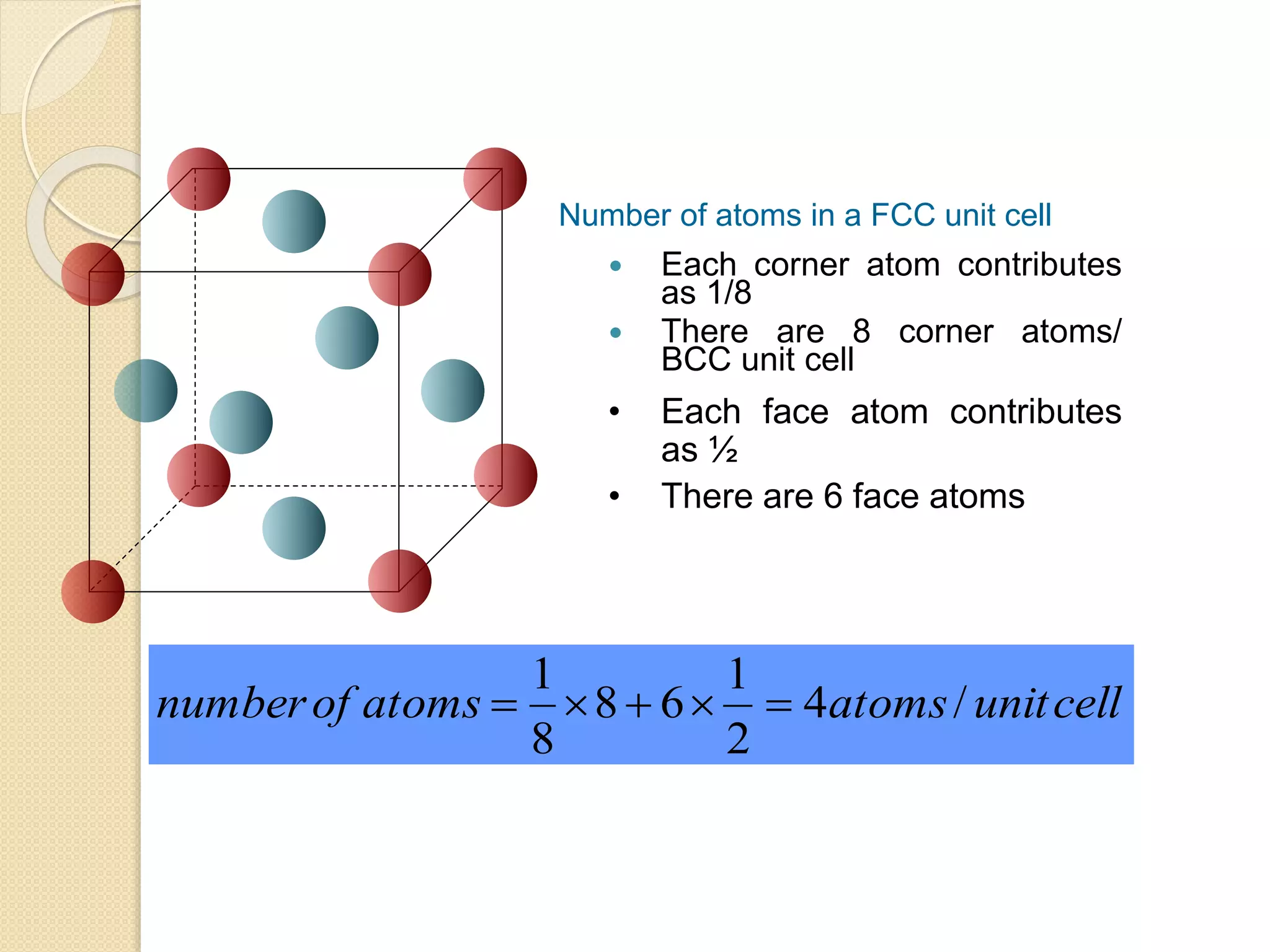
Number of atoms in a FCC unit cell
 Each corner atom contributes
as 1/8
 There are 8 corner atoms/
BCC unit cell
• Each face atom contributes
as ½
• There are 6 face atoms
cellunitatomsatomsofnumber /4
2
1
68
8
1

Crystal Structures for
Common Metals
(at Room Temperature)
 Body-centered cubic (BCC)
Chromium, Iron, Molybdenum, Tungsten
 Face-centered cubic (FCC)
Aluminum, Copper, Gold, Lead, Silver, Nickel
 Hexagonal close-packed (HCP)
Magnesium, Titanium, Zinc
TERMS USE IN
RECRYSTALLIZATION
PROCESS
Space Lattice & Unit Cell
 Lattice - A collection of points that divide space into
smaller equally sized segments.
 Unit cell - A subdivision of the lattice that still retains the
overall characteristics of the entire lattice.
Space Lattice & Unit Cell
Grain And Grain Boundary
 Grain – Most Crystalline solids are
composed of a collection of many crystals.
 Grain Boundary – There exist some atomic
mismatch within the region where two
grains meet.
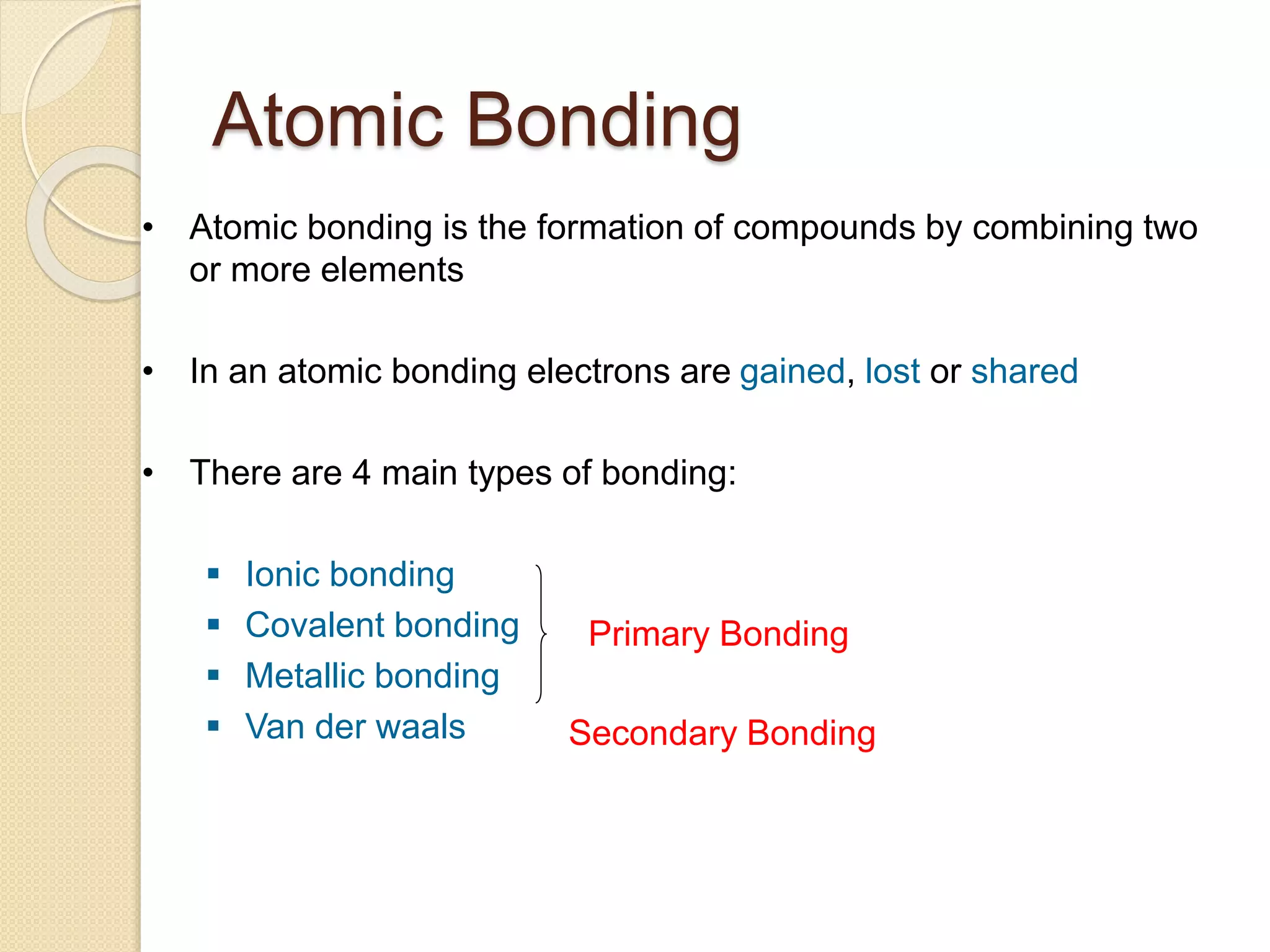
Atomic Bonding
• Atomic bonding is the formation of compounds by combining two
or more elements
• In an atomic bonding electrons are gained, lost or shared
• There are 4 main types of bonding:
 Ionic bonding
 Covalent bonding
 Metallic bonding
 Van der waals
Primary Bonding
Secondary Bonding
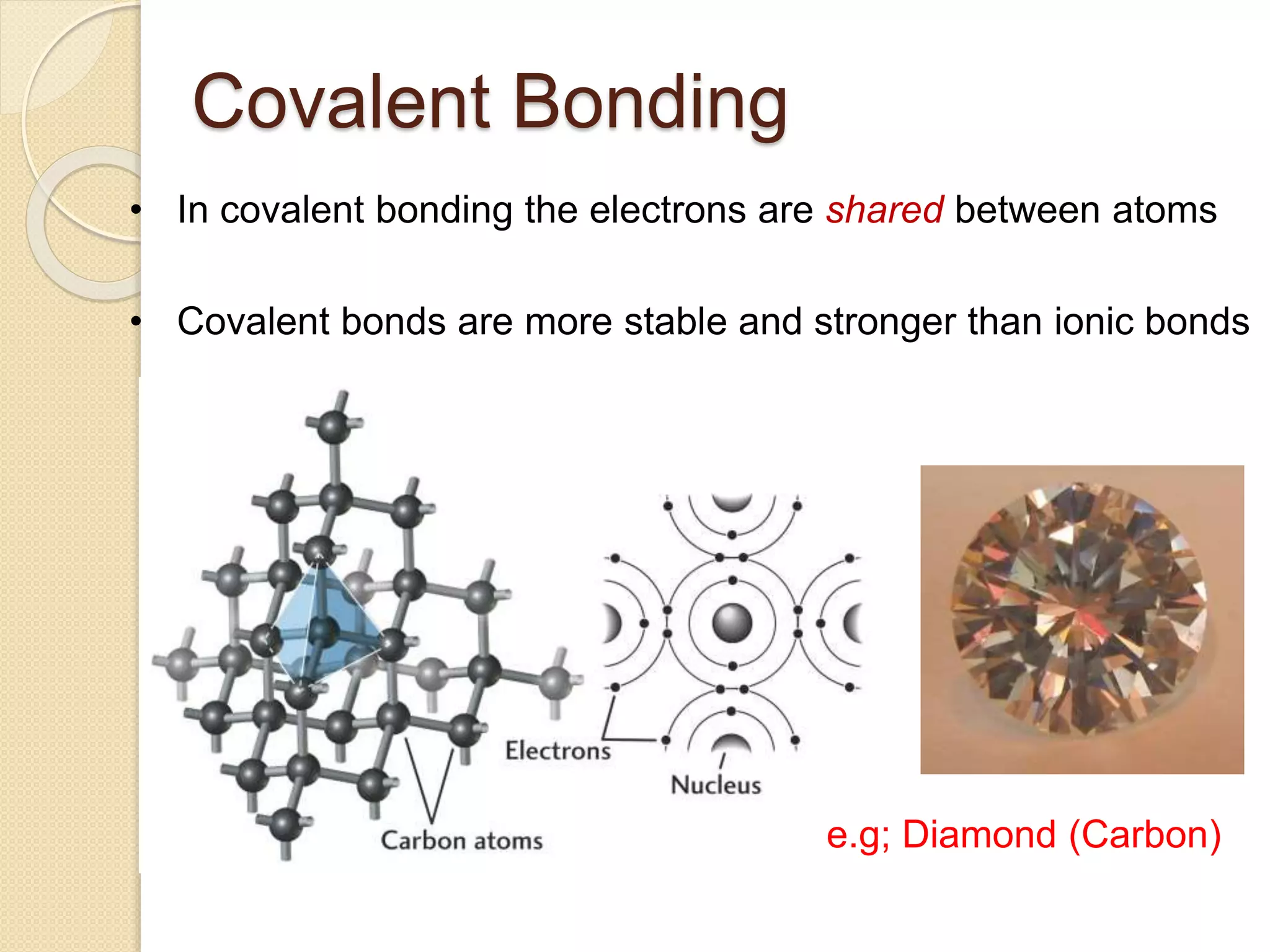
Covalent Bonding
• In covalent bonding the electrons are shared between atoms
• Covalent bonds are more stable and stronger than ionic bonds
e.g; Diamond (Carbon)
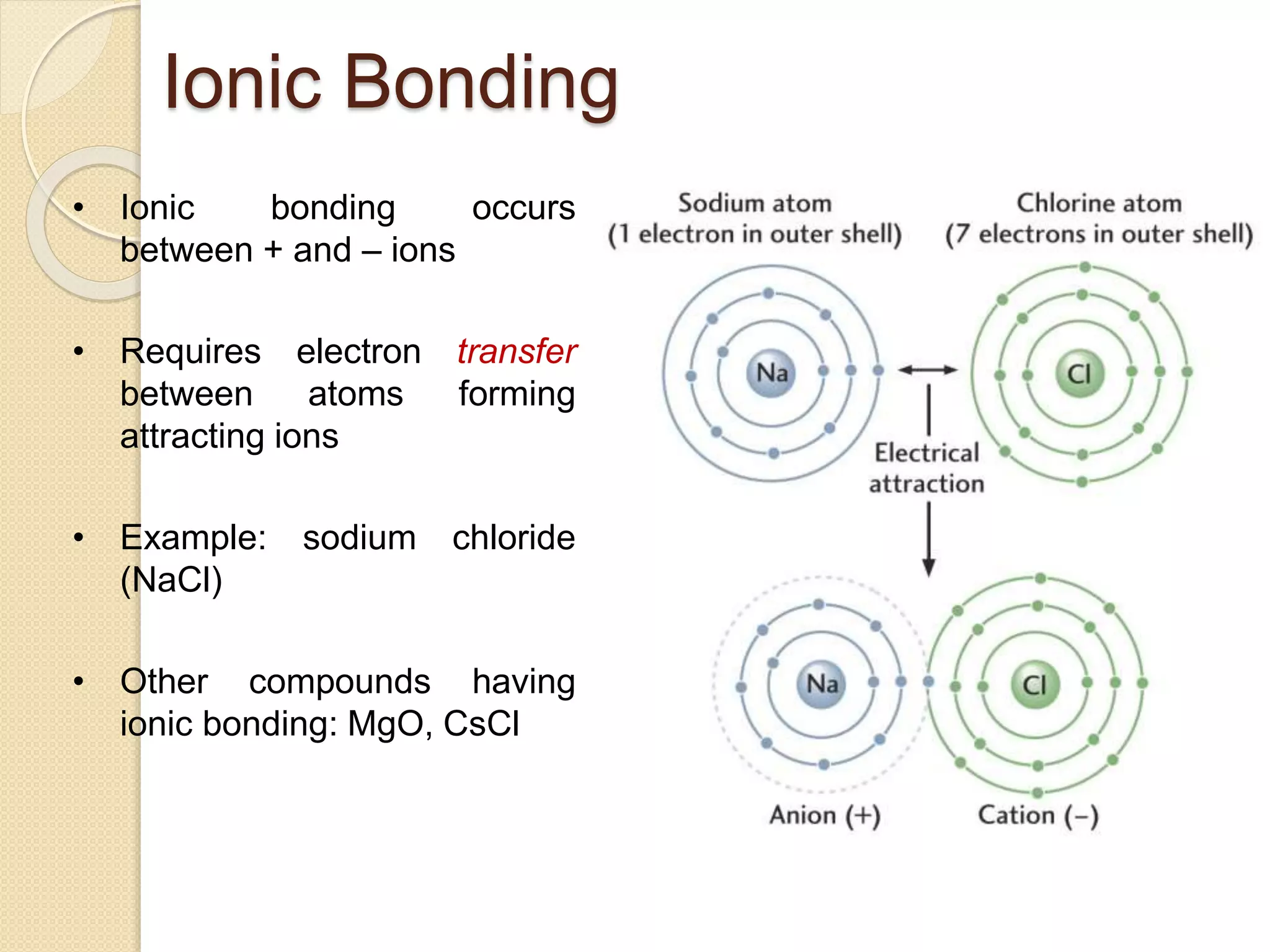
Ionic Bonding
• Ionic bonding occurs
between + and – ions
• Requires electron transfer
between atoms forming
attracting ions
• Example: sodium chloride
(NaCl)
• Other compounds having
ionic bonding: MgO, CsCl
Characteristics of Ionic Bonding
• Ionic compounds are usually hard, rigid and
brittle: the results of ions being held in specific
positions
Metallic Bonding
◦ Valence electrons are detached from atoms, and
spread in an electron sea that glues the ions together
+ + + +
+ + + +
+ + + +
Secondary Bonding
-ex: Polymer (PVC)

Chapter1 material structure and binary alloy system

  • 1.
    JF302 – MATERIAL TECHNOLOGY1 LECTURER : PN.NORHAZLINA BTE AMON (Coordinator) Contact no. : 019-6462754
  • 2.
    Course outline SYNOPSIS MATERIAL TECHNOLOGY1 provides students an understanding on pure metal, alloy and other non-metal materials that are commonly used in the engineering field, including a study on metal and alloy microstructure. Students also learn the processes of metal work and specific materials used to produce engineering components.
  • 3.
    WEEKLY SCHEDULE Week 1: Students Registration Week 2-3 :1.0 - MATERIAL STRUCTURE AND BINARY ALLOY SYSTEM Week 4-5 :2.0 – FERROUS MATERIAL STRUCTURE AND BINARY ALLOY SYSTEM Week 6-8 :3.0 – METAL WORK, CASTING PROCESS AND HEAT TREATMENT ON STEEL Week 9 : Mid-Semester Break Week 10-12 :4.0 MATERIAL TESTING Week 13-15 :5.0 CORROSION AND NON-FERROUS METAL Week 16-17 :6.0 PLASTIC Week 18-19 :Revision Week and Final Examination
  • 4.
    GRADING (CONTINUOUS ASSESSMENT) No. AssessmentNumber (minimum) % total Week 1 Quiz 2 20 W2, W5, W10 2 Theory Test 2 40 W8, W15 3 Other Assessment Task i. End of Chapter ii. Presentation 2 1 20 20 W2, W5, W12 W16 Overall Total 8 100 REFERENCES : Arens. W. F (2004). Contemporary Advertising. McGraw Hill. United States. Brown B. C. (2007). The Complete Guide To Google Advertising Including Tips and Tricks and Strategies to Create a Winning Advertising Plan. Atlantic Publishing Group Inc. Florida. Ogivly. D. (1985). Ogivly on Advertising. Random House Inc. United States. Sissors. J.Z. (2002). Advertising Media Planning. McGraw Hill. United States. Well . W.D. (2005) Advertising : Principles and Pratice. United States.
  • 5.
    Atomic Structure • Atomicstructure is made of:  Protons: positive (+) charge  Neutrons: no charge (neutral)  Electrons: negative (-) charge • The nucleus contains the mass of an atom: Protons + Neutrons • Layers of electrons that orbit around the nucleus are called orbitals or energy-level shells.
  • 6.
  • 7.
    Element  In chemistry,an element is a pure substances that cannot be broken down into any simpler substances by chemical method.  Each element has its own atomic mass, and a no. of protons and electrons for an elements always remains the same.
  • 8.
     Elements canbond with one another to form compounds.  These are some famous elements : Iron(Fe), Gold(Au), Hydrogen(H), Carbon(C), Oxygen(O)  These are some compounds (combination of elements) Water(H2O), Carbon dioxide(CO2), Ammonia (NH3)
  • 9.
  • 10.
    Crystalline & Amorphous Materials are either: 1. Crystalline 2. Non-crystalline – Amorphous What is crystalline material?  Crystalline solid must have an ordered arrangement of atoms (occupy specific or predictable positions in a 3D array).  Crystalline materials include metals, many ceramics and some polymers
  • 11.
    Crystalline & Amorphous In an amorphous solid atoms do not possess well- defined arrangement (atoms have no periodic packing)  Amorphous structures form in complex structures, polymers, and rapidly cooled materials.
  • 12.
    Why do weneed to know the crystal structure? • Crystal structure of a material affects its mechanical properties (strength, toughness, ductility) • Understanding crystal structures is essential in understanding the crystalline materials.
  • 13.
    Crystalline Structure 􀂄 Structurein which the atoms are located at regular and recurring positions in three dimensions 􀂄 Unit cell - basic geometric grouping of atoms that is repeated 􀂄 The pattern may be replicated millions of times within a given crystal 􀂄 Characteristic structure of virtually all metals, as well as many ceramics and some polymers
  • 14.
    Principals Metallic Crystal Structures Most important engineering metals have one of the following crystal structures: ◦ BCC - body centered cubic ◦ FCC - face centered cubic ◦ HCP – hexagonal close packed
  • 15.
  • 16.
    BCC ( Body-Centered Crystal) Body-centeredcubic (BCC) crystal structure: (a)unit cell, with atoms indicated as point locations in a three- dimensional axis system (b) unit cell model showing closely packed atoms (sometimes called the hard-ball model) (c) repeated pattern of the BCC structure Number of atoms in a BCC unit cell  Each corner atom contributes as 1/8  There are 8 corner atoms/ BCC unit cell • There is 1 atom in the centre (non shared) cellunitatomsatomsofnumber /2118 8 1 
  • 17.
    Number of atomsin a FCC unit cell  Each corner atom contributes as 1/8  There are 8 corner atoms/ BCC unit cell • Each face atom contributes as ½ • There are 6 face atoms cellunitatomsatomsofnumber /4 2 1 68 8 1 
  • 18.
    Crystal Structures for CommonMetals (at Room Temperature)  Body-centered cubic (BCC) Chromium, Iron, Molybdenum, Tungsten  Face-centered cubic (FCC) Aluminum, Copper, Gold, Lead, Silver, Nickel  Hexagonal close-packed (HCP) Magnesium, Titanium, Zinc
  • 19.
    TERMS USE IN RECRYSTALLIZATION PROCESS SpaceLattice & Unit Cell  Lattice - A collection of points that divide space into smaller equally sized segments.  Unit cell - A subdivision of the lattice that still retains the overall characteristics of the entire lattice.
  • 20.
    Space Lattice &Unit Cell
  • 21.
    Grain And GrainBoundary  Grain – Most Crystalline solids are composed of a collection of many crystals.  Grain Boundary – There exist some atomic mismatch within the region where two grains meet.
  • 22.
    Atomic Bonding • Atomicbonding is the formation of compounds by combining two or more elements • In an atomic bonding electrons are gained, lost or shared • There are 4 main types of bonding:  Ionic bonding  Covalent bonding  Metallic bonding  Van der waals Primary Bonding Secondary Bonding
  • 23.
    Covalent Bonding • Incovalent bonding the electrons are shared between atoms • Covalent bonds are more stable and stronger than ionic bonds e.g; Diamond (Carbon)
  • 24.
    Ionic Bonding • Ionicbonding occurs between + and – ions • Requires electron transfer between atoms forming attracting ions • Example: sodium chloride (NaCl) • Other compounds having ionic bonding: MgO, CsCl
  • 25.
    Characteristics of IonicBonding • Ionic compounds are usually hard, rigid and brittle: the results of ions being held in specific positions
  • 26.
    Metallic Bonding ◦ Valenceelectrons are detached from atoms, and spread in an electron sea that glues the ions together + + + + + + + + + + + +
  • 27.

Editor's Notes

  • #10 Elektron dalam petala luar atom – atom valensi Bil. elektron yang sama pada petala terluar – merujuk kepada kumpulan yang sama Setiap kalaan mempunyai bil. petala yang sama