Chapter 1 - 1
MSE XXX: Introduction to
Materials Science & Engineering
Course Objective...
Introduce fundamental concepts in Materials
Science
You will learn about:
• material structure
• how structure dictates properties
• how processing can change structure
This course will help you to:
• use materials properly
• realize new design opportunities
with materials
Chapter 1 - 2
LECTURES
Lecturer:
Time:
Location:
Activities:
• Present new material
• Announce reading and homework
• Take quizzes and midterms*
*Make-ups given only for emergencies.
*Discuss potential conflicts beforehand.
Chapter 1 - 3
RECITATIONS
Purpose:
• Discuss homework, quizzes, exams
• Hand back graded quizzes, exams
• Discuss concepts from lecture
Instructor:
Times and Places:
___.
___.
___.
___.
___.
X:XXam
X:XXpm
X:XXpm
X:XXam
X:XXpm
_____ XXX
_____ XXX
_____ XXX
_____ XXX
_____ XXX
Recitations start next week.
Try to attend your registered recitation.
If necessary, attend an alternate recitation.
Chapter 1 - 4
Purpose: To learn more about materials by relating
lecture material with observations. Also to learn to properly
formulate and write engineering reports and proposals.
Instructor:
Location:
LABORATORY SECTIONS
Chapter 1 - 5
TEACHING ASSISTANTS
Teaching Assistants will
• participate in recitation sessions,
• have office hours to help you with course material
and problem sets.
Name
_____
_____
_____
_____
_____
Office
_____ XXX
_____ XXX
_____ XXX
_____ XXX
_____ XXX
Tel.
X-XXXX
X-XXXX
X-XXXX
X-XXXX
X-XXXX
E-mail
_____
_____
_____
_____
_____
Chapter 1 - 6
OFFICE HOURS
Activities:
• Discuss homework, quizzes, exams
• Discuss lectures, book
• Pick up missed handouts
X:XX-X:XX each weekday**
____.
____.
____.
____.
____.
_____ XXX
_____ XXX
_____ XXX
_____ XXX
_____ XXX
_____
_____
_____
_____
_____
**Contact professors for special arrangements
Chapter 1 - 7
Required text:
• Materials Science and Engineering: An Introduction,
W.D. Callister, Jr. and D.G. Rethwisch, 8th edition,
John Wiley and Sons, Inc. (2010).
COURSE MATERIALS (with text)
• _____
________.
Optional Material:
• _____
________.
• _____
________.
Chapter 1 - 8
Required text:
• WileyPLUS for Materials Science and Engineering: An Introduction,
W.D. Callister, Jr. and D.G. Rethwisch, 8th edition, John Wiley
and Sons, Inc. (2010).
COURSE MATERIALS
(with WileyPLUS)
Website: http://www.wileyplus.com/xxxxxxxxxxx
• Can be bought online at wileyplus.com for 40% of textbook price
• Includes complete online version of textbook
• Or comes bundled with textbook at bookstore
• $5 more than textbook alone
• Homework assignments with instant feedback and hints
• Computer graded self-help problems
• Hotlinks in homework to supporting text section
• Quizzes
Chapter 1 - 9
Text Website: http://www.wiley.com/college/callister
• VMSE for 3D visualization and manipulation of atomic structures
• Mechanical Engineering and Biomaterials online support modules
• Case studies of materials usage
• Extended learning objectives
• Self-assessment exercises
Course Website: http://www.xxx.edu/xxxxx
• Syllabus
• Lecture notes
• Answer keys
• Grades
WEBSITES
Chapter 1 - 10
Website: http://www.wileyplus.com/college/callister
Student Companion Site
• Users can manipulate molecules and crystals to
better visualize atomic structures
• Unit cells such as BCC, FCC, HCP
• Crystallographic planes, directions, and defects
• Polymer repeat units and molecules
• Diffusion computations
Virtual Materials Science &
Engineering (VMSE)
Chapter 1 - 11
GRADING
Weekly in-lecture quizzes XX%
Held on _____ at the beginning of class
Based on core homework problems
Your lowest quiz grade will be dropped
Midterm #1 XX%
Tentatively scheduled for:
Material covered:
Midterm #2 XX%
Tentatively scheduled for:
Material covered:
Final XX%
Tentatively scheduled for:
Material covered:
Chapter 1 - 12
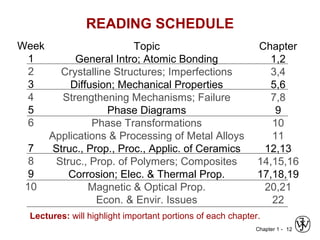
READING SCHEDULE
Week
1
2
3
4
5
6
7
8
9
10
Topic
General Intro; Atomic Bonding
Crystalline Structures; Imperfections
Diffusion; Mechanical Properties
Strengthening Mechanisms; Failure
Phase Diagrams
Phase Transformations
Applications & Processing of Metal Alloys
Struc., Prop., Proc., Applic. of Ceramics
Struc., Prop. of Polymers; Composites
Corrosion; Elec. & Thermal Prop.
Magnetic & Optical Prop.
Econ. & Envir. Issues
Chapter
1,2
3,4
5,6
7,8
9
10
11
12,13
14,15,16
17,18,19
20,21
22
Lectures: will highlight important portions of each chapter.
Chapter 1 - 13
Chapter 1 - Introduction
• What is materials science?
• Why should we know about it?
• Materials drive our society
– Stone Age
– Bronze Age
– Iron Age
– Now?
• Silicon Age?
• Polymer Age?
Chapter 1 - 14
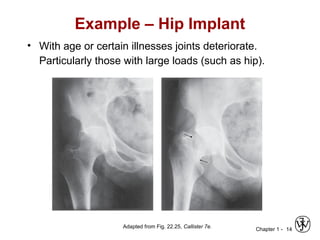
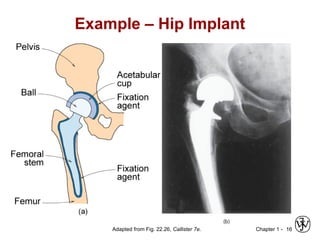
Example – Hip Implant
• With age or certain illnesses joints deteriorate.
Particularly those with large loads (such as hip).
Adapted from Fig. 22.25, Callister 7e.
Chapter 1 - 15
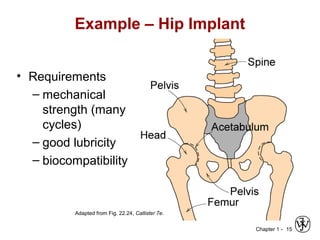
Example – Hip Implant
• Requirements
– mechanical
strength (many
cycles)
– good lubricity
– biocompatibility
Adapted from Fig. 22.24, Callister 7e.
Chapter 1 - 16
Example – Hip Implant
Adapted from Fig. 22.26, Callister 7e.
Chapter 1 - 17
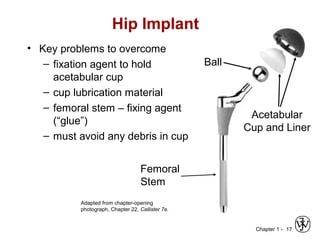
Hip Implant
• Key problems to overcome
– fixation agent to hold
acetabular cup
– cup lubrication material
– femoral stem – fixing agent
(“glue”)
– must avoid any debris in cup
Femoral
Stem
Ball
Acetabular
Cup and Liner
Adapted from chapter-opening
photograph, Chapter 22, Callister 7e.
Chapter 1 - 18
Example – Develop New Types of
Polymers
• Commodity plastics – large volume ca. $0.50 / lb
Ex. Polyethylene
Polypropylene
Polystyrene
etc.
• Engineering Resins – small volume > $1.00 / lb
Ex. Polycarbonate
Nylon
Polysulfone
etc.
Can polypropylene be “upgraded” to properties (and price) near
those of engineering resins?
Chapter 1 - 19
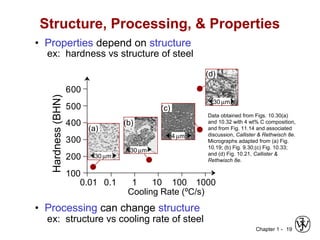
ex: hardness vs structure of steel
• Properties depend on structure
Data obtained from Figs. 10.30(a)
and 10.32 with 4 wt% C composition,
and from Fig. 11.14 and associated
discussion, Callister & Rethwisch 8e.
Micrographs adapted from (a) Fig.
10.19; (b) Fig. 9.30;(c) Fig. 10.33;
and (d) Fig. 10.21, Callister &
Rethwisch 8e.
ex: structure vs cooling rate of steel
• Processing can change structure
Structure, Processing, & Properties
Hardness(BHN)
Cooling Rate (ºC/s)
100
200
300
400
500
600
0.01 0.1 1 10 100 1000
(d)
30 µm
(c)
4 µm
(b)
30 µm
(a)
30 µm
Chapter 1 - 20
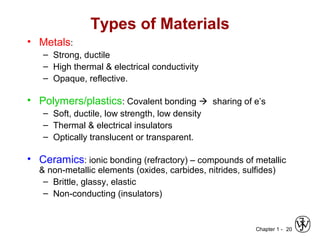
Types of Materials
• Metals:
– Strong, ductile
– High thermal & electrical conductivity
– Opaque, reflective.
• Polymers/plastics: Covalent bonding  sharing of e’s
– Soft, ductile, low strength, low density
– Thermal & electrical insulators
– Optically translucent or transparent.
• Ceramics: ionic bonding (refractory) – compounds of metallic
& non-metallic elements (oxides, carbides, nitrides, sulfides)
– Brittle, glassy, elastic
– Non-conducting (insulators)
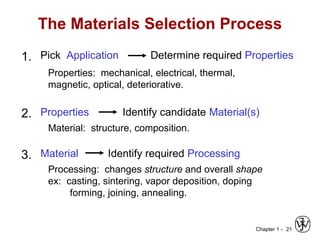
Chapter 1 - 21
1. Pick Application Determine required Properties
Processing: changes structure and overall shape
ex: casting, sintering, vapor deposition, doping
forming, joining, annealing.
Properties: mechanical, electrical, thermal,
magnetic, optical, deteriorative.
Material: structure, composition.
2. Properties Identify candidate Material(s)
3. Material Identify required Processing
The Materials Selection Process
Chapter 1 - 22
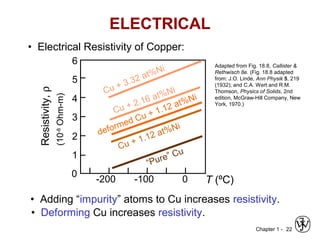
ELECTRICAL
• Electrical Resistivity of Copper:
• Adding “impurity” atoms to Cu increases resistivity.
• Deforming Cu increases resistivity.
Adapted from Fig. 18.8, Callister &
Rethwisch 8e. (Fig. 18.8 adapted
from: J.O. Linde, Ann Physik 5, 219
(1932); and C.A. Wert and R.M.
Thomson, Physics of Solids, 2nd
edition, McGraw-Hill Company, New
York, 1970.)
T (ºC)-200 -100 0
Cu + 3.32 at%Ni
Cu + 2.16 at%Ni
deformed Cu + 1.12 at%Ni
1
2
3
4
5
6
Resistivity,ρ
(10-8
Ohm-m)
0
Cu + 1.12 at%Ni
“Pure” Cu
Chapter 1 - 23
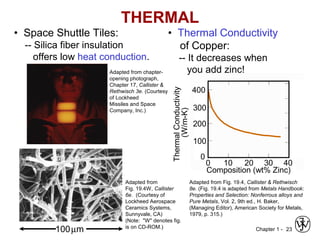
THERMAL
• Space Shuttle Tiles:
-- Silica fiber insulation
offers low heat conduction.
• Thermal Conductivity
of Copper:
-- It decreases when
you add zinc!
Adapted from
Fig. 19.4W, Callister
6e. (Courtesy of
Lockheed Aerospace
Ceramics Systems,
Sunnyvale, CA)
(Note: "W" denotes fig.
is on CD-ROM.)
Adapted from Fig. 19.4, Callister & Rethwisch
8e. (Fig. 19.4 is adapted from Metals Handbook:
Properties and Selection: Nonferrous alloys and
Pure Metals, Vol. 2, 9th ed., H. Baker,
(Managing Editor), American Society for Metals,
1979, p. 315.)
Composition (wt% Zinc)
ThermalConductivity
(W/m-K)
400
300
200
100
0
0 10 20 30 40
100µm
Adapted from chapter-
opening photograph,
Chapter 17, Callister &
Rethwisch 3e. (Courtesy
of Lockheed
Missiles and Space
Company, Inc.)
Chapter 1 - 24
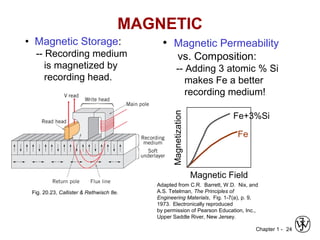
MAGNETIC
• Magnetic Permeability
vs. Composition:
-- Adding 3 atomic % Si
makes Fe a better
recording medium!
Adapted from C.R. Barrett, W.D. Nix, and
A.S. Tetelman, The Principles of
Engineering Materials, Fig. 1-7(a), p. 9,
1973. Electronically reproduced
by permission of Pearson Education, Inc.,
Upper Saddle River, New Jersey.
Fig. 20.23, Callister & Rethwisch 8e.
• Magnetic Storage:
-- Recording medium
is magnetized by
recording head.
Magnetic FieldMagnetization
Fe+3%Si
Fe
Chapter 1 - 25
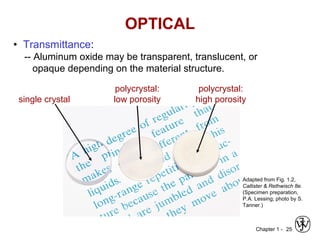
• Transmittance:
-- Aluminum oxide may be transparent, translucent, or
opaque depending on the material structure.
Adapted from Fig. 1.2,
Callister & Rethwisch 8e.
(Specimen preparation,
P.A. Lessing; photo by S.
Tanner.)
single crystal
polycrystal:
low porosity
polycrystal:
high porosity
OPTICAL
Chapter 1 - 26
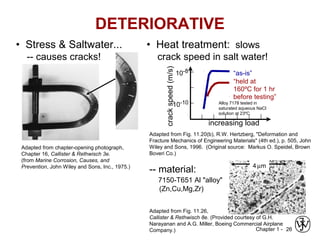
DETERIORATIVE
• Stress & Saltwater...
-- causes cracks!
Adapted from chapter-opening photograph,
Chapter 16, Callister & Rethwisch 3e.
(from Marine Corrosion, Causes, and
Prevention, John Wiley and Sons, Inc., 1975.) 4 µm
-- material:
7150-T651 Al "alloy"
(Zn,Cu,Mg,Zr)
Adapted from Fig. 11.26,
Callister & Rethwisch 8e. (Provided courtesy of G.H.
Narayanan and A.G. Miller, Boeing Commercial Airplane
Company.)
• Heat treatment: slows
crack speed in salt water!
Adapted from Fig. 11.20(b), R.W. Hertzberg, "Deformation and
Fracture Mechanics of Engineering Materials" (4th ed.), p. 505, John
Wiley and Sons, 1996. (Original source: Markus O. Speidel, Brown
Boveri Co.)
“held at
160ºC for 1 hr
before testing”
increasing load
crackspeed(m/s)
“as-is”
10-10
10-8
Alloy 7178 tested in
saturated aqueous NaCl
solution at 23ºC
Chapter 1 - 27
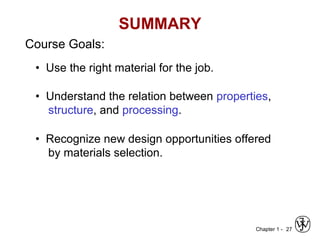
• Use the right material for the job.
• Understand the relation between properties,
structure, and processing.
• Recognize new design opportunities offered
by materials selection.
Course Goals:
SUMMARY

Introduction to Materials Science & Engineering

  • 1.
    Chapter 1 -1 MSE XXX: Introduction to Materials Science & Engineering Course Objective... Introduce fundamental concepts in Materials Science You will learn about: • material structure • how structure dictates properties • how processing can change structure This course will help you to: • use materials properly • realize new design opportunities with materials
  • 2.
    Chapter 1 -2 LECTURES Lecturer: Time: Location: Activities: • Present new material • Announce reading and homework • Take quizzes and midterms* *Make-ups given only for emergencies. *Discuss potential conflicts beforehand.
  • 3.
    Chapter 1 -3 RECITATIONS Purpose: • Discuss homework, quizzes, exams • Hand back graded quizzes, exams • Discuss concepts from lecture Instructor: Times and Places: ___. ___. ___. ___. ___. X:XXam X:XXpm X:XXpm X:XXam X:XXpm _____ XXX _____ XXX _____ XXX _____ XXX _____ XXX Recitations start next week. Try to attend your registered recitation. If necessary, attend an alternate recitation.
  • 4.
    Chapter 1 -4 Purpose: To learn more about materials by relating lecture material with observations. Also to learn to properly formulate and write engineering reports and proposals. Instructor: Location: LABORATORY SECTIONS
  • 5.
    Chapter 1 -5 TEACHING ASSISTANTS Teaching Assistants will • participate in recitation sessions, • have office hours to help you with course material and problem sets. Name _____ _____ _____ _____ _____ Office _____ XXX _____ XXX _____ XXX _____ XXX _____ XXX Tel. X-XXXX X-XXXX X-XXXX X-XXXX X-XXXX E-mail _____ _____ _____ _____ _____
  • 6.
    Chapter 1 -6 OFFICE HOURS Activities: • Discuss homework, quizzes, exams • Discuss lectures, book • Pick up missed handouts X:XX-X:XX each weekday** ____. ____. ____. ____. ____. _____ XXX _____ XXX _____ XXX _____ XXX _____ XXX _____ _____ _____ _____ _____ **Contact professors for special arrangements
  • 7.
    Chapter 1 -7 Required text: • Materials Science and Engineering: An Introduction, W.D. Callister, Jr. and D.G. Rethwisch, 8th edition, John Wiley and Sons, Inc. (2010). COURSE MATERIALS (with text) • _____ ________. Optional Material: • _____ ________. • _____ ________.
  • 8.
    Chapter 1 -8 Required text: • WileyPLUS for Materials Science and Engineering: An Introduction, W.D. Callister, Jr. and D.G. Rethwisch, 8th edition, John Wiley and Sons, Inc. (2010). COURSE MATERIALS (with WileyPLUS) Website: http://www.wileyplus.com/xxxxxxxxxxx • Can be bought online at wileyplus.com for 40% of textbook price • Includes complete online version of textbook • Or comes bundled with textbook at bookstore • $5 more than textbook alone • Homework assignments with instant feedback and hints • Computer graded self-help problems • Hotlinks in homework to supporting text section • Quizzes
  • 9.
    Chapter 1 -9 Text Website: http://www.wiley.com/college/callister • VMSE for 3D visualization and manipulation of atomic structures • Mechanical Engineering and Biomaterials online support modules • Case studies of materials usage • Extended learning objectives • Self-assessment exercises Course Website: http://www.xxx.edu/xxxxx • Syllabus • Lecture notes • Answer keys • Grades WEBSITES
  • 10.
    Chapter 1 -10 Website: http://www.wileyplus.com/college/callister Student Companion Site • Users can manipulate molecules and crystals to better visualize atomic structures • Unit cells such as BCC, FCC, HCP • Crystallographic planes, directions, and defects • Polymer repeat units and molecules • Diffusion computations Virtual Materials Science & Engineering (VMSE)
  • 11.
    Chapter 1 -11 GRADING Weekly in-lecture quizzes XX% Held on _____ at the beginning of class Based on core homework problems Your lowest quiz grade will be dropped Midterm #1 XX% Tentatively scheduled for: Material covered: Midterm #2 XX% Tentatively scheduled for: Material covered: Final XX% Tentatively scheduled for: Material covered:
  • 12.
    Chapter 1 -12 READING SCHEDULE Week 1 2 3 4 5 6 7 8 9 10 Topic General Intro; Atomic Bonding Crystalline Structures; Imperfections Diffusion; Mechanical Properties Strengthening Mechanisms; Failure Phase Diagrams Phase Transformations Applications & Processing of Metal Alloys Struc., Prop., Proc., Applic. of Ceramics Struc., Prop. of Polymers; Composites Corrosion; Elec. & Thermal Prop. Magnetic & Optical Prop. Econ. & Envir. Issues Chapter 1,2 3,4 5,6 7,8 9 10 11 12,13 14,15,16 17,18,19 20,21 22 Lectures: will highlight important portions of each chapter.
  • 13.
    Chapter 1 -13 Chapter 1 - Introduction • What is materials science? • Why should we know about it? • Materials drive our society – Stone Age – Bronze Age – Iron Age – Now? • Silicon Age? • Polymer Age?
  • 14.
    Chapter 1 -14 Example – Hip Implant • With age or certain illnesses joints deteriorate. Particularly those with large loads (such as hip). Adapted from Fig. 22.25, Callister 7e.
  • 15.
    Chapter 1 -15 Example – Hip Implant • Requirements – mechanical strength (many cycles) – good lubricity – biocompatibility Adapted from Fig. 22.24, Callister 7e.
  • 16.
    Chapter 1 -16 Example – Hip Implant Adapted from Fig. 22.26, Callister 7e.
  • 17.
    Chapter 1 -17 Hip Implant • Key problems to overcome – fixation agent to hold acetabular cup – cup lubrication material – femoral stem – fixing agent (“glue”) – must avoid any debris in cup Femoral Stem Ball Acetabular Cup and Liner Adapted from chapter-opening photograph, Chapter 22, Callister 7e.
  • 18.
    Chapter 1 -18 Example – Develop New Types of Polymers • Commodity plastics – large volume ca. $0.50 / lb Ex. Polyethylene Polypropylene Polystyrene etc. • Engineering Resins – small volume > $1.00 / lb Ex. Polycarbonate Nylon Polysulfone etc. Can polypropylene be “upgraded” to properties (and price) near those of engineering resins?
  • 19.
    Chapter 1 -19 ex: hardness vs structure of steel • Properties depend on structure Data obtained from Figs. 10.30(a) and 10.32 with 4 wt% C composition, and from Fig. 11.14 and associated discussion, Callister & Rethwisch 8e. Micrographs adapted from (a) Fig. 10.19; (b) Fig. 9.30;(c) Fig. 10.33; and (d) Fig. 10.21, Callister & Rethwisch 8e. ex: structure vs cooling rate of steel • Processing can change structure Structure, Processing, & Properties Hardness(BHN) Cooling Rate (ºC/s) 100 200 300 400 500 600 0.01 0.1 1 10 100 1000 (d) 30 µm (c) 4 µm (b) 30 µm (a) 30 µm
  • 20.
    Chapter 1 -20 Types of Materials • Metals: – Strong, ductile – High thermal & electrical conductivity – Opaque, reflective. • Polymers/plastics: Covalent bonding  sharing of e’s – Soft, ductile, low strength, low density – Thermal & electrical insulators – Optically translucent or transparent. • Ceramics: ionic bonding (refractory) – compounds of metallic & non-metallic elements (oxides, carbides, nitrides, sulfides) – Brittle, glassy, elastic – Non-conducting (insulators)
  • 21.
    Chapter 1 -21 1. Pick Application Determine required Properties Processing: changes structure and overall shape ex: casting, sintering, vapor deposition, doping forming, joining, annealing. Properties: mechanical, electrical, thermal, magnetic, optical, deteriorative. Material: structure, composition. 2. Properties Identify candidate Material(s) 3. Material Identify required Processing The Materials Selection Process
  • 22.
    Chapter 1 -22 ELECTRICAL • Electrical Resistivity of Copper: • Adding “impurity” atoms to Cu increases resistivity. • Deforming Cu increases resistivity. Adapted from Fig. 18.8, Callister & Rethwisch 8e. (Fig. 18.8 adapted from: J.O. Linde, Ann Physik 5, 219 (1932); and C.A. Wert and R.M. Thomson, Physics of Solids, 2nd edition, McGraw-Hill Company, New York, 1970.) T (ºC)-200 -100 0 Cu + 3.32 at%Ni Cu + 2.16 at%Ni deformed Cu + 1.12 at%Ni 1 2 3 4 5 6 Resistivity,ρ (10-8 Ohm-m) 0 Cu + 1.12 at%Ni “Pure” Cu
  • 23.
    Chapter 1 -23 THERMAL • Space Shuttle Tiles: -- Silica fiber insulation offers low heat conduction. • Thermal Conductivity of Copper: -- It decreases when you add zinc! Adapted from Fig. 19.4W, Callister 6e. (Courtesy of Lockheed Aerospace Ceramics Systems, Sunnyvale, CA) (Note: "W" denotes fig. is on CD-ROM.) Adapted from Fig. 19.4, Callister & Rethwisch 8e. (Fig. 19.4 is adapted from Metals Handbook: Properties and Selection: Nonferrous alloys and Pure Metals, Vol. 2, 9th ed., H. Baker, (Managing Editor), American Society for Metals, 1979, p. 315.) Composition (wt% Zinc) ThermalConductivity (W/m-K) 400 300 200 100 0 0 10 20 30 40 100µm Adapted from chapter- opening photograph, Chapter 17, Callister & Rethwisch 3e. (Courtesy of Lockheed Missiles and Space Company, Inc.)
  • 24.
    Chapter 1 -24 MAGNETIC • Magnetic Permeability vs. Composition: -- Adding 3 atomic % Si makes Fe a better recording medium! Adapted from C.R. Barrett, W.D. Nix, and A.S. Tetelman, The Principles of Engineering Materials, Fig. 1-7(a), p. 9, 1973. Electronically reproduced by permission of Pearson Education, Inc., Upper Saddle River, New Jersey. Fig. 20.23, Callister & Rethwisch 8e. • Magnetic Storage: -- Recording medium is magnetized by recording head. Magnetic FieldMagnetization Fe+3%Si Fe
  • 25.
    Chapter 1 -25 • Transmittance: -- Aluminum oxide may be transparent, translucent, or opaque depending on the material structure. Adapted from Fig. 1.2, Callister & Rethwisch 8e. (Specimen preparation, P.A. Lessing; photo by S. Tanner.) single crystal polycrystal: low porosity polycrystal: high porosity OPTICAL
  • 26.
    Chapter 1 -26 DETERIORATIVE • Stress & Saltwater... -- causes cracks! Adapted from chapter-opening photograph, Chapter 16, Callister & Rethwisch 3e. (from Marine Corrosion, Causes, and Prevention, John Wiley and Sons, Inc., 1975.) 4 µm -- material: 7150-T651 Al "alloy" (Zn,Cu,Mg,Zr) Adapted from Fig. 11.26, Callister & Rethwisch 8e. (Provided courtesy of G.H. Narayanan and A.G. Miller, Boeing Commercial Airplane Company.) • Heat treatment: slows crack speed in salt water! Adapted from Fig. 11.20(b), R.W. Hertzberg, "Deformation and Fracture Mechanics of Engineering Materials" (4th ed.), p. 505, John Wiley and Sons, 1996. (Original source: Markus O. Speidel, Brown Boveri Co.) “held at 160ºC for 1 hr before testing” increasing load crackspeed(m/s) “as-is” 10-10 10-8 Alloy 7178 tested in saturated aqueous NaCl solution at 23ºC
  • 27.
    Chapter 1 -27 • Use the right material for the job. • Understand the relation between properties, structure, and processing. • Recognize new design opportunities offered by materials selection. Course Goals: SUMMARY

Editor's Notes

  • #21 Metals have high thermal & electrical conductivity because valence electrons are free to roam