The document discusses arrays in C programming. It begins by defining an array as a structure that contains a group of related data items of the same type. It notes that arrays allow accessing elements via an index, with the first element having an index of 0. The document then provides examples of declaring, initializing, accessing, and printing single-dimensional and multi-dimensional arrays. It also demonstrates how to store user input into arrays and perform operations like addition and multiplication on 2D arrays representing matrices.
![Revision of Arrays
• Array
– Structures of related data items
– Group of consecutive memory locations
– Same name and type
– e.g int c[12];
• To refer to an element, specify
– Array name
– Position number
• Format:
arrayname[ position number ]
– First element at position 0
– n element array named c:
• c[ 0 ], c[ 1 ]...c[ n – 1 ]
Name of array (Note
that all elements of this
array have the same
name, c)
Position number of
the element within
array c
c[6]
c[0]
c[1]
c[2]
c[3]
c[11]
c[10]
c[9]
c[8]
c[7]
c[5]
c[4]
Dr. Yousaf, PIEAS](https://image.slidesharecdn.com/10-190312230006/85/C-Language-Lecture-10-2-320.jpg)
![Revisions of Arrays
Dr. Yousaf, PIEAS
How to declare array?
typename variablename[size]
int marks[6]={36,78,29,36,7,99};
To print an array, we need loop.
for (i = 0; i <6;i++)
printf("Marks are %dn",marks[i]);
To take the elements of arrays from a user (scanf), we
need loop.
for (i = 0; i <6;i++)
{
printf(“Please enter the marks of studentsn”);
scanf(“ %d",&marks[i]);
}](https://image.slidesharecdn.com/10-190312230006/85/C-Language-Lecture-10-3-320.jpg)
![Revisions of Arrays
Dr. Yousaf, PIEAS
Int a[4] = {2, 4, 3, 10};
We can use a[0]=10;
x=a[2];
a[3]=a[2]; etc.
printf( "%d", a[ 0 ] );
We can declare more than one array
in single line as:
int b[ 100 ], x[ 27 ];
If not enough initializers, rightmost elements become
0
int n[ 5 ] = { 1 } // All other elements would be 0
C arrays have no bounds checking](https://image.slidesharecdn.com/10-190312230006/85/C-Language-Lecture-10-4-320.jpg)
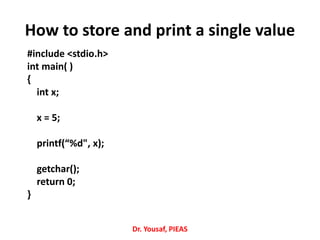
![#include<stdio.h>
int main()
{
int marks[6]={36,78,29,89,7,99};
int i;
for (i = 0; i <6;i++)
printf("Marks are %dn",marks[i]);
getchar();
return 0;
}
Dr. Yousaf, PIEAS
How to Store and Print an Array?](https://image.slidesharecdn.com/10-190312230006/85/C-Language-Lecture-10-6-320.jpg)
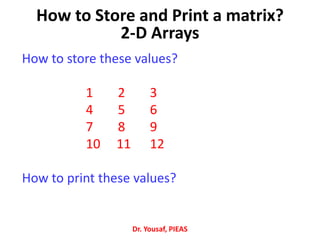
![2-D Arrays
• Arrays in C can have virtually as many dimensions as
you want.
• Definition is accomplished by adding additional
subscripts when it is defined.
• For example:
– int a [4] [3] ; // 4 Rows, 3 Columns
– defines a two dimensional array
a[0][0] a[0][1] a[0][2]
a[1][0] a[1][1] a[1][2]
a[2][0] a[2][1] a[2][2]
a[3][0] a[3][1] a[3][2]
Dr. Yousaf, PIEAS](https://image.slidesharecdn.com/10-190312230006/85/C-Language-Lecture-10-9-320.jpg)
![#include<stdio.h>
int main()
{
int a[4] [3] = { {1, 2, 3} , { 4, 5, 6} , {7, 8, 9} , {10, 11, 12} };
int row, col;
for (row = 0; row <=3; row++)
{ for (col = 0; col <=2; col++)
{
printf(“%d", a[row][col]);
}
}
getchar(); return 0; }
Dr. Yousaf, PIEAS
How to Print 2-D Arrays?](https://image.slidesharecdn.com/10-190312230006/85/C-Language-Lecture-10-11-320.jpg)
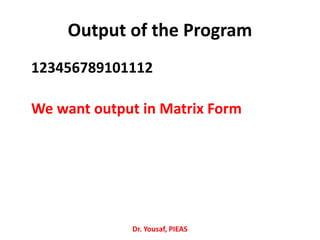
![for (row = 0; row <=3; row++)
{ for (col = 0; col <=2; col++)
{
printf(“%dt",a[row][col]);
}
}
Output:
1 2 3 4 5 6 7 8 9
10 11 12
Dr. Yousaf, PIEAS
Output with Tabs](https://image.slidesharecdn.com/10-190312230006/85/C-Language-Lecture-10-13-320.jpg)
![for (row = 0; row <=3; row++)
{ for (col = 0; col <=2; col++)
{
printf(“%dt", a[row][col]);
}
printf(“n”);
}
Dr. Yousaf, PIEAS
Output in Matrix Form](https://image.slidesharecdn.com/10-190312230006/85/C-Language-Lecture-10-14-320.jpg)
![for (row = 0; row <=3; row++)
{ for (col = 0; col <=2; col++)
{
printf(“%dt", a[row][col]);
}
printf(“n”);
}
Dr. Yousaf, PIEAS
Output in Matrix Form
Output:
1 2 3
4 5 6
7 8 9
10 11 12](https://image.slidesharecdn.com/10-190312230006/85/C-Language-Lecture-10-15-320.jpg)
![#include<stdio.h>
int main()
{
int a[4] [3];
int row, col;
for (row = 0; row <=3; row++)
{
printf("Enter 3 elements of row %dn", row + 1);
for (col = 0; col <=2; col++)
{
scanf("%d",&a[row][col]);
}
}
//Rest of the code goes here
Dr. Yousaf, PIEAS
How to scan 2-D Arrays?](https://image.slidesharecdn.com/10-190312230006/85/C-Language-Lecture-10-16-320.jpg)
![Initializing Multidimensional Arrays
• The following initializes a[4][3]:
int a[4] [3] = { {1, 2, 3} , { 4, 5, 6} , {7, 8, 9} , {10, 11, 12} };
• Also can be done by:
int a[4] [3] = { 1, 2, 3, 4, 5, 6, 7, 8, 9, 10, 11, 12 };
– is equivalent to
a[0][0] = 1;
a[0][1] = 2;
a[0][2] = 3;
a[1][0] = 4;
...
a[3][2] = 12;
Dr. Yousaf, PIEAS](https://image.slidesharecdn.com/10-190312230006/85/C-Language-Lecture-10-17-320.jpg)
![Multiple-Subscripted Arrays
• Multiple subscripted arrays
– Tables with rows and columns (m by n array)
– Like matrices: specify row, then column
Row 0
Row 1
Row 2
Column 0 Column 1 Column 2 Column 3
a[ 0 ][ 0 ]
a[ 1 ][ 0 ]
a[ 2 ][ 0 ]
a[ 0 ][ 1 ]
a[ 1 ][ 1 ]
a[ 2 ][ 1 ]
a[ 0 ][ 2 ]
a[ 1 ][ 2 ]
a[ 2 ][ 2 ]
a[ 0 ][ 3 ]
a[ 1 ][ 3 ]
a[ 2 ][ 3 ]
Row subscript
Array name
Column subscript
Dr. Yousaf, PIEAS](https://image.slidesharecdn.com/10-190312230006/85/C-Language-Lecture-10-18-320.jpg)
![Multiple-Subscripted Arrays
• Initialization
– int b[ 2 ][ 2 ] = { { 1, 2 }, { 3, 4 } };
– Initializers grouped by row in braces
– If not enough, unspecified elements set to zero
int b[ 2 ][ 2 ] = { { 1 }, { 3, 4 } };
• Referencing elements
– Specify row, then column
printf( "%d", b[ 0 ][ 1 ] );
1 2
3 4
1 0
3 4
Dr. Yousaf, PIEAS](https://image.slidesharecdn.com/10-190312230006/85/C-Language-Lecture-10-19-320.jpg)
![Multidimensional Arrays
• Array declarations read right-to-left
• int a[10][3][2];
• “a is array of ten arrays of three arrays of two (type
ints)”. In memory
2 2 2
3
2 2 2
3
2 2 2
3
...
10
Dr. Yousaf, PIEAS](https://image.slidesharecdn.com/10-190312230006/85/C-Language-Lecture-10-20-320.jpg)
![Addition of Two Matrices
#include <stdio.h>
int main()
{
int X[2][2] = { {1,2},{3,4} }, Y[2][2] =
{ {5,6},{7,8} };
int add[2][2];
Dr. Yousaf, PIEAS](https://image.slidesharecdn.com/10-190312230006/85/C-Language-Lecture-10-22-320.jpg)
![Addition of Two Matrices
#include <stdio.h>
int main()
{
int X[2][2] = { {1,2},{3,4} }, Y[2][2] =
{ {5,6},{7,8} };
int add[2][2];
int i, j;
printf("ntAddition of two matrices
is");
for (i = 0; i<2; i++)
{
for (j = 0; j<2; j++)
{
add[i][j] = X[i][j] + Y[i][j];
printf("%dt", add[i][j]);
}
printf("n");
}
getchar();
return 0;
}
Dr. Yousaf, PIEAS](https://image.slidesharecdn.com/10-190312230006/85/C-Language-Lecture-10-23-320.jpg)
![Multiplication of Two Matrices
#include <stdio.h>
int main()
{
int X[2][2] = { {1,2},{3,4} },
Y[2][2] = { {5,6},{7,8} };
int mul[2][2];
int i, j, k, sum = 0;
Dr. Yousaf, PIEAS](https://image.slidesharecdn.com/10-190312230006/85/C-Language-Lecture-10-24-320.jpg)
![Multiplication of Two Matrices
#include <stdio.h>
int main()
{
int X[2][2] = { {1,2},{3,4} },
Y[2][2] = { {5,6},{7,8} };
int mul[2][2];
int i, j, k, sum = 0;
printf("nntMultiplications
of two matrices is");
for (i = 0; i<2; i++)
{
for (j = 0; j<2; j++)
{
for (k=0; k<2; k++)
{
sum = sum + (X[i][k]*Y[k][j]);
}
mul[i][j] = sum;
printf("%dt", mul[i][j]);
sum = 0;
}
printf("n");
} getchar(); return 0; }
Dr. Yousaf, PIEAS](https://image.slidesharecdn.com/10-190312230006/85/C-Language-Lecture-10-25-320.jpg)