DEVELOPING ENGLISH VOCABULARY
MATERIALS FOR THE FIRST GRADE
STUDENTS OF JUNIOR HIGH SCHOOL
By
Komang Satya Permadi
Developing English Vocabulary Materials for the
First Grade Students of Junior High School
Mind Map
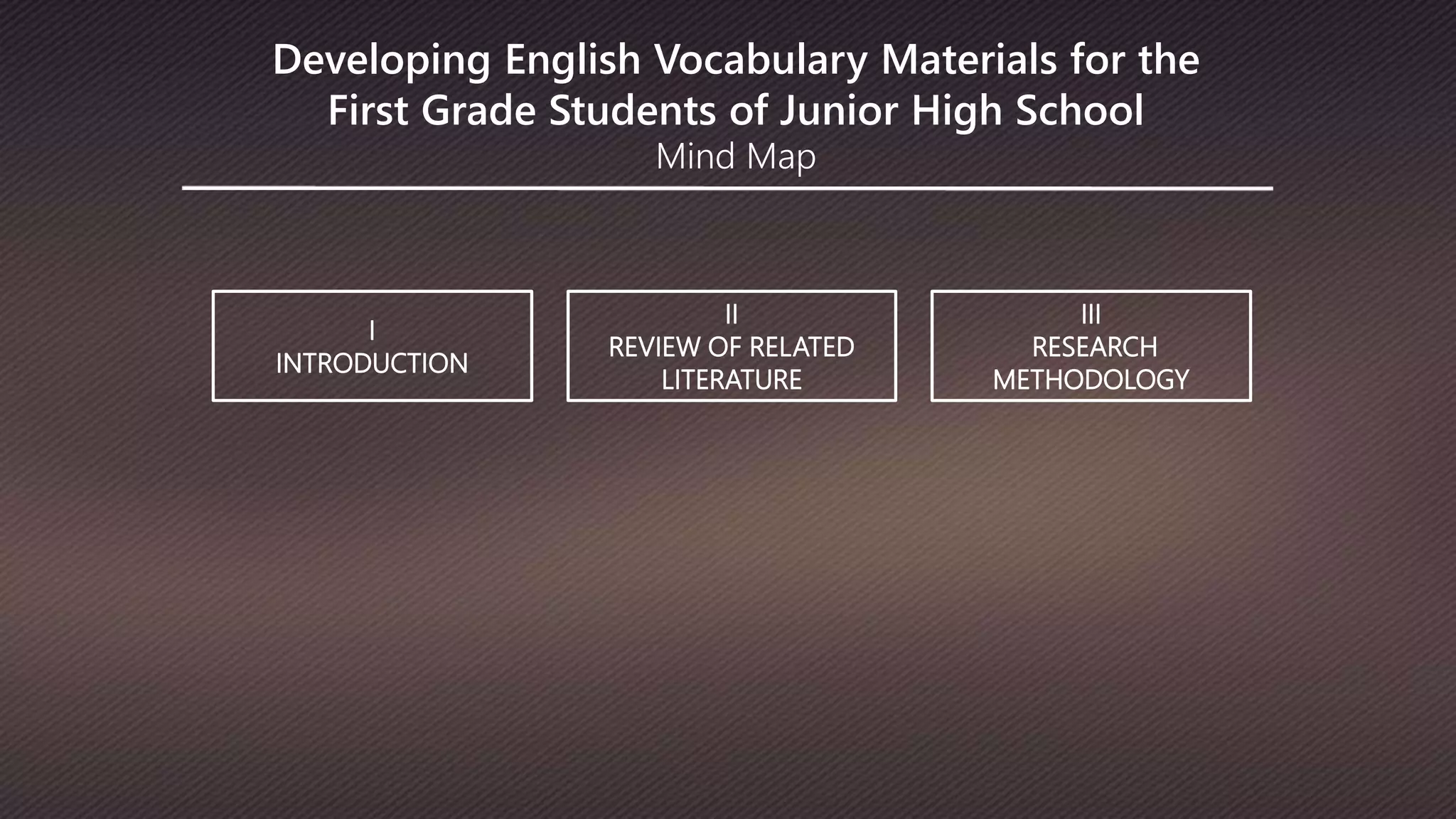
I
INTRODUCTION
II
REVIEW OF RELATED
LITERATURE
III
RESEARCH
METHODOLOGY
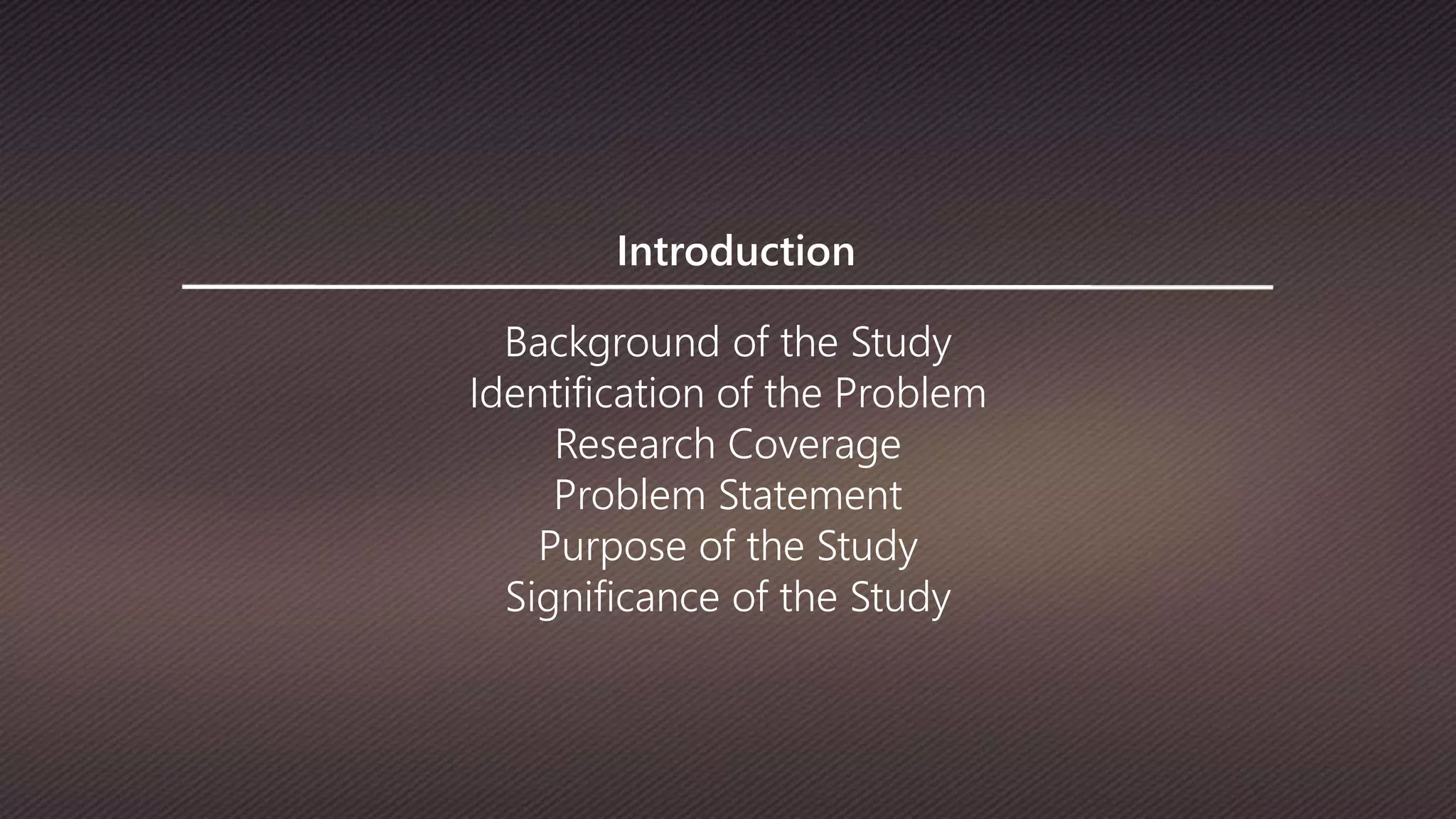
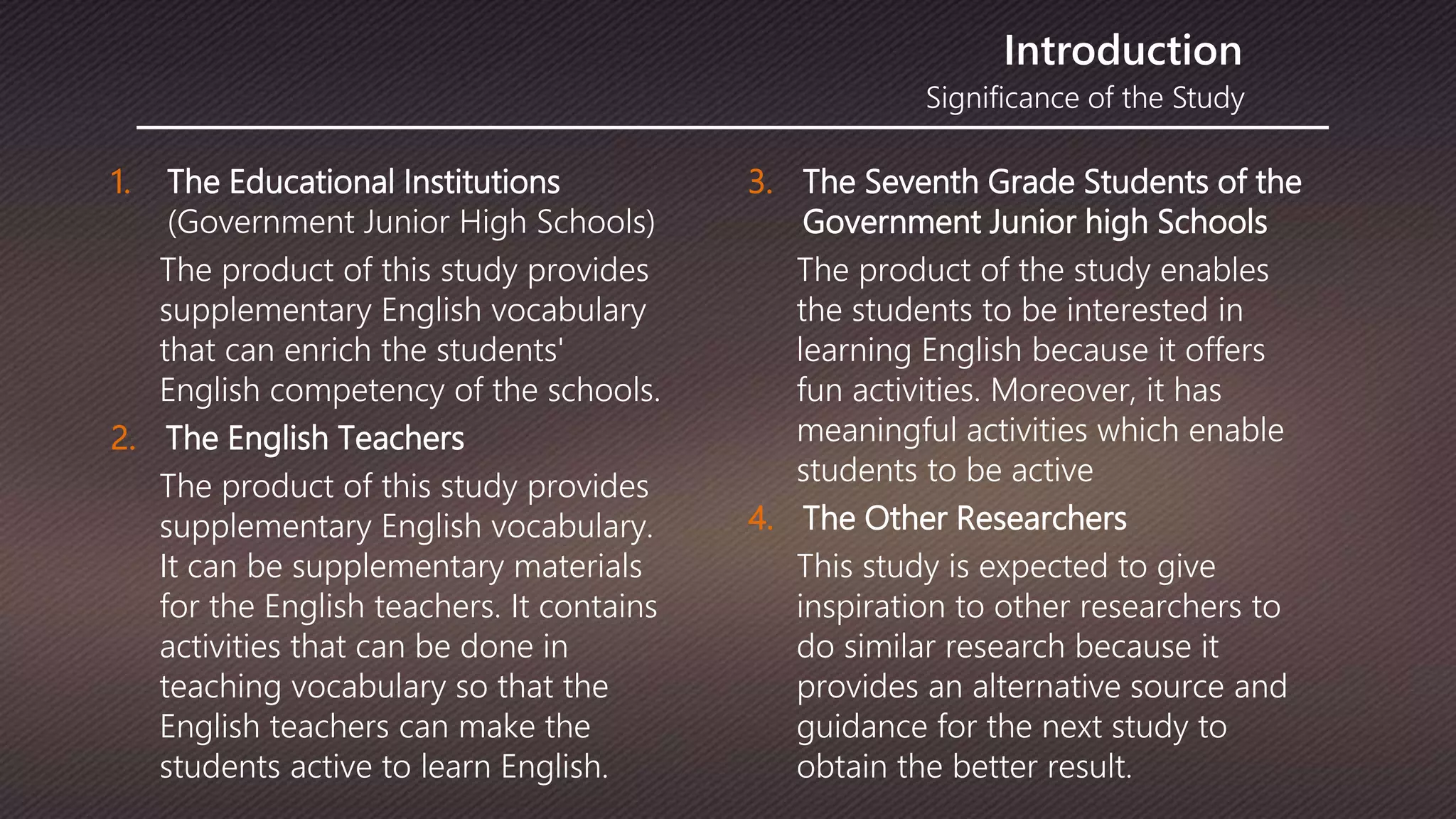
Introduction
Background of the Study
Identification of the Problem
Research Coverage
Problem Statement
Purpose of the Study
Significance of the Study
Background of the Study
Introduction
English Vocabulary TL
2013
Curriculum
Book Research
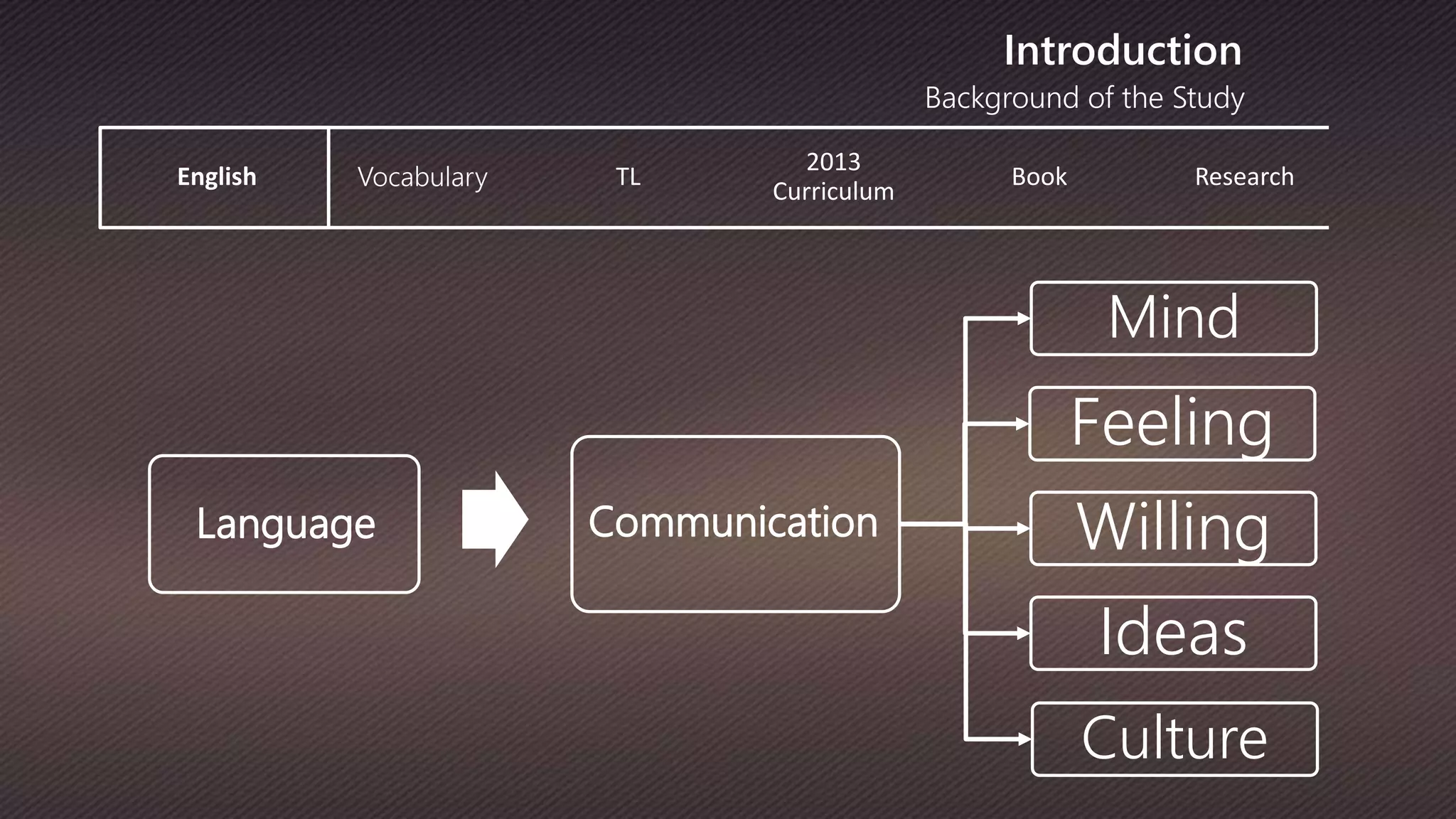
Language
Mind
Communication
Feeling
Willing
Ideas
Culture
Background of the Study
Introduction
English Vocabulary TL
2013
Curriculum
Book Research
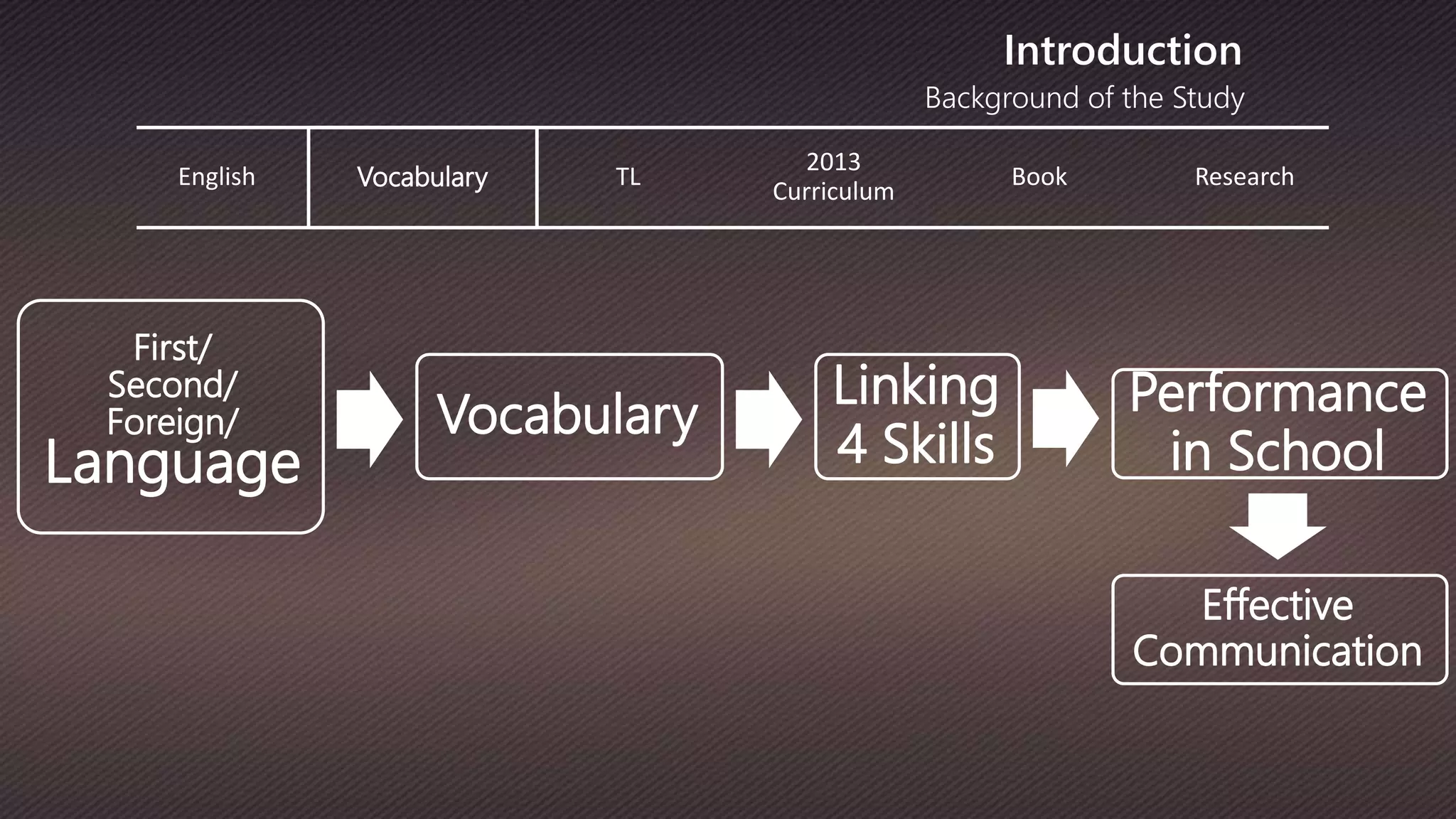
First/
Second/
Foreign/
Language
Vocabulary
Linking
4 Skills
Performance
in School
Effective
Communication
Background of the Study
Introduction
English Vocabulary TL
2013
Curriculum
Book Research
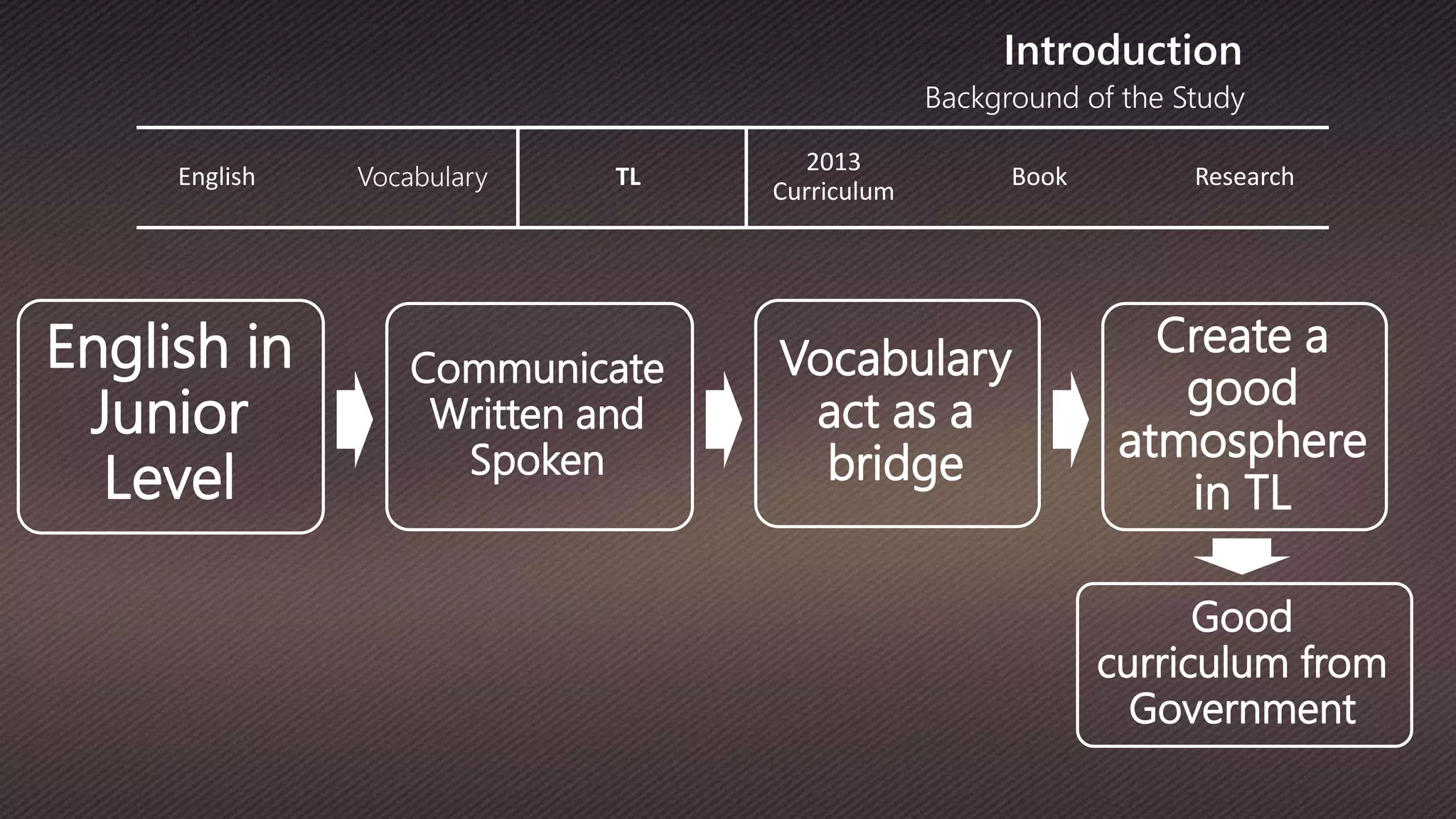
English in
Junior
Level
Communicate
Written and
Spoken
Vocabulary
act as a
bridge
Good
curriculum from
Government
Create a
good
atmosphere
in TL
Background of the Study
Introduction
English Vocabulary TL
2013
Curriculum
Book Research
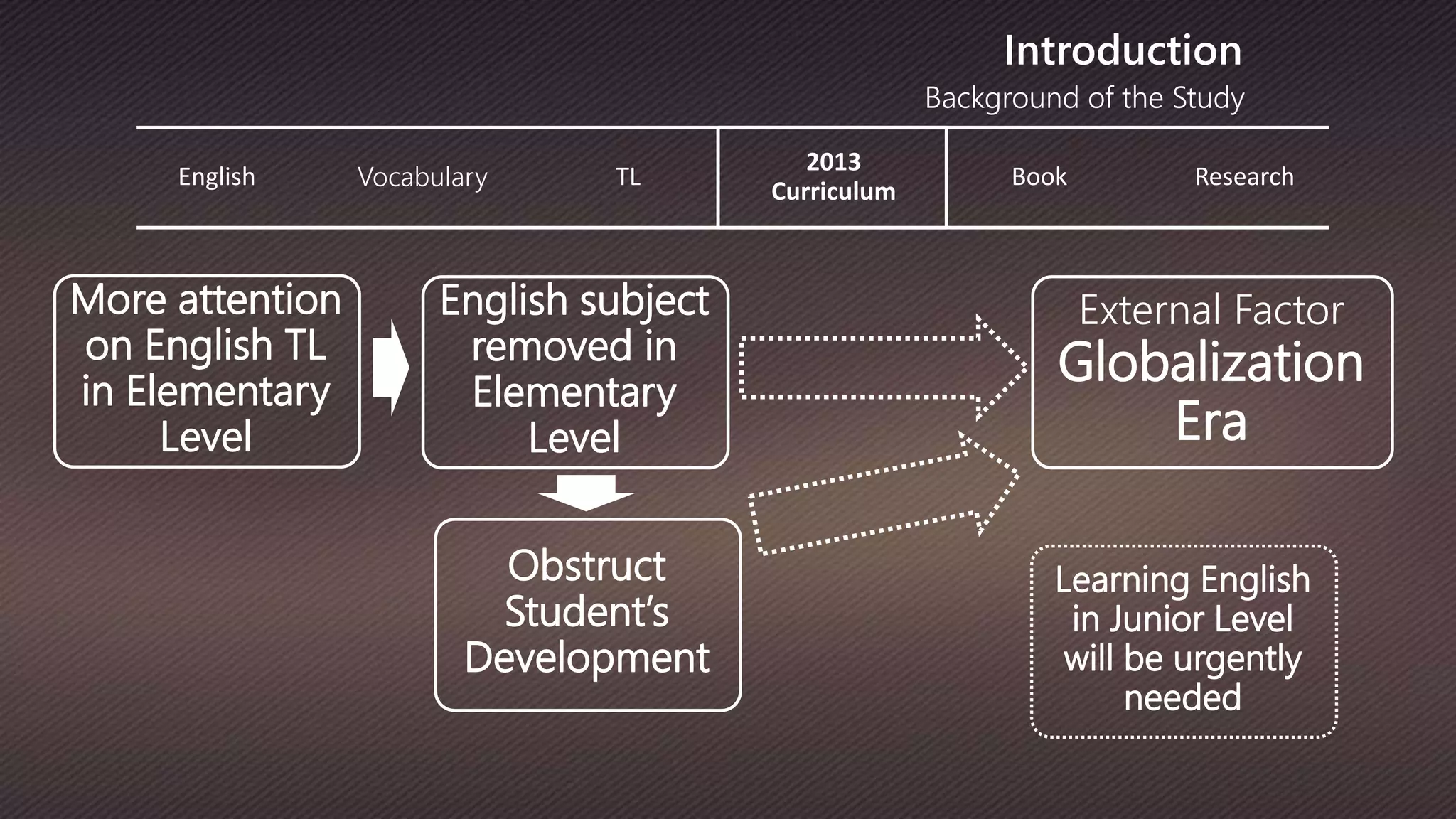
More attention
on English TL
in Elementary
Level
English subject
removed in
Elementary
Level
External Factor
Globalization
Era
Obstruct
Student’s
Development
Learning English
in Junior Level
will be urgently
needed
Background of the Study
Introduction
English Vocabulary TL
2013
Curriculum
Book Research
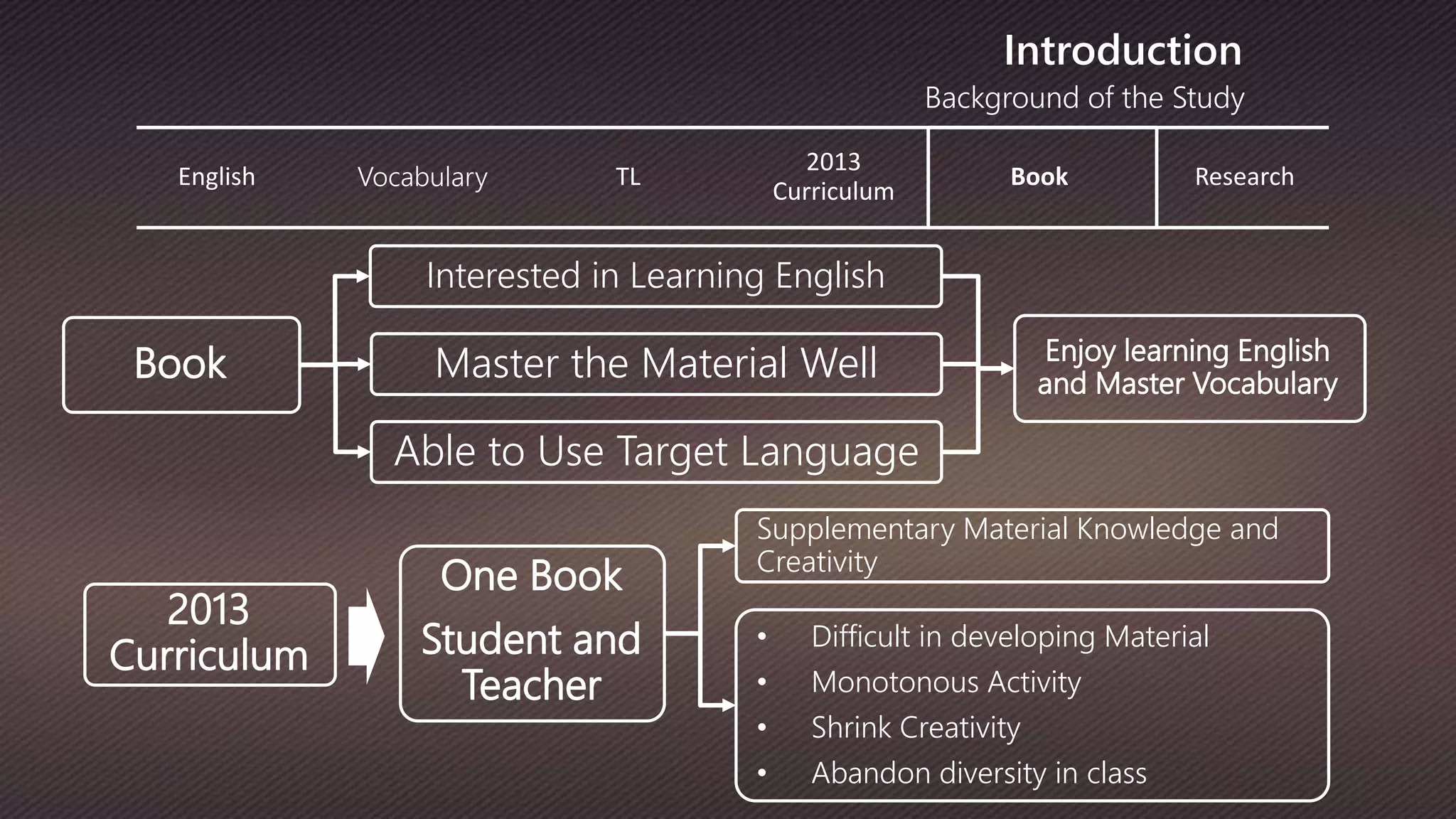
Book
Interested in Learning English
Master the Material Well
Able to Use Target Language
Enjoy learning English
and Master Vocabulary
2013
Curriculum
One Book
Student and
Teacher
Supplementary Material Knowledge and
Creativity
• Difficult in developing Material
• Monotonous Activity
• Shrink Creativity
• Abandon diversity in class
Background of the Study
Introduction
English Vocabulary TL
2013
Curriculum
Book Research
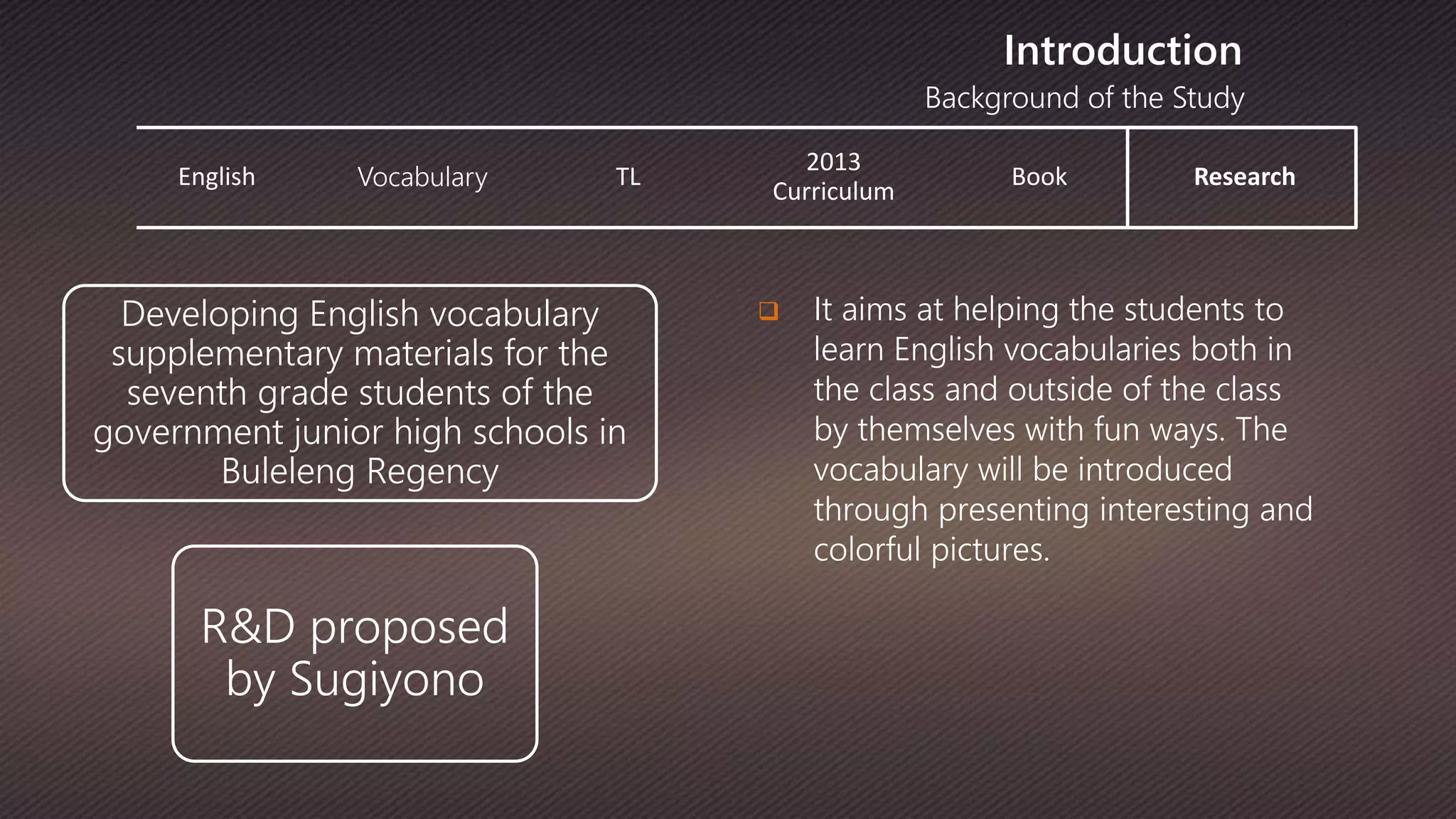
 It aims at helping the students to
learn English vocabularies both in
the class and outside of the class
by themselves with fun ways. The
vocabulary will be introduced
through presenting interesting and
colorful pictures.
Developing English vocabulary
supplementary materials for the
seventh grade students of the
government junior high schools in
Buleleng Regency
R&D proposed
by Sugiyono
Identification of the Problem
Introduction
1. The existing book do not provide
enough activities to enrich the
students• vocabulary that actually
the basis for learning all the
language skills.
2. The book has uncolourful pictures
and monotonous activities.
Research Coverage
Introduction
1. The research coverage of the study
will focus on developing
supplementary English vocabulary
for the seventh grade students of
the government junior high
schools in Buleleng Regency. The
developed English vocabulary will
focus on the range of words
(nouns and verbs).
Problem Statement
Introduction
1. What kinds of vocabulary which
have been provided for the
seventh grade students of the
government junior high schools in
Buleleng Regency based on the
syllabus?
2. What kinds of supplementary
English vocabulary which should
be developed for the seventh
grade students of the government
junior high schools in Buleleng
Regency?
Purpose of the Study
Introduction
1. To identify kinds of vocabulary
which have been provided for the
seventh grade students of the
government junior high schools in
Buleleng Regency based on the
syllabus.
2. To investigate kinds of
supplementary English vocabulary
which should be developed for the
seventh grade students of the
government junior high schools in
Buleleng Regency.
Significance of the Study
Introduction
1. The Educational Institutions
(Government Junior High Schools)
The product of this study provides
supplementary English vocabulary
that can enrich the students'
English competency of the schools.
2. The English Teachers
The product of this study provides
supplementary English vocabulary.
It can be supplementary materials
for the English teachers. It contains
activities that can be done in
teaching vocabulary so that the
English teachers can make the
students active to learn English.
3. The Seventh Grade Students of the
Government Junior high Schools
The product of the study enables
the students to be interested in
learning English because it offers
fun activities. Moreover, it has
meaningful activities which enable
students to be active
4. The Other Researchers
This study is expected to give
inspiration to other researchers to
do similar research because it
provides an alternative source and
guidance for the next study to
obtain the better result.
Review of Related Literature
Curriculum
The Nature of Vocabulary
Material Development
Research and Development
Empirical Research Findings
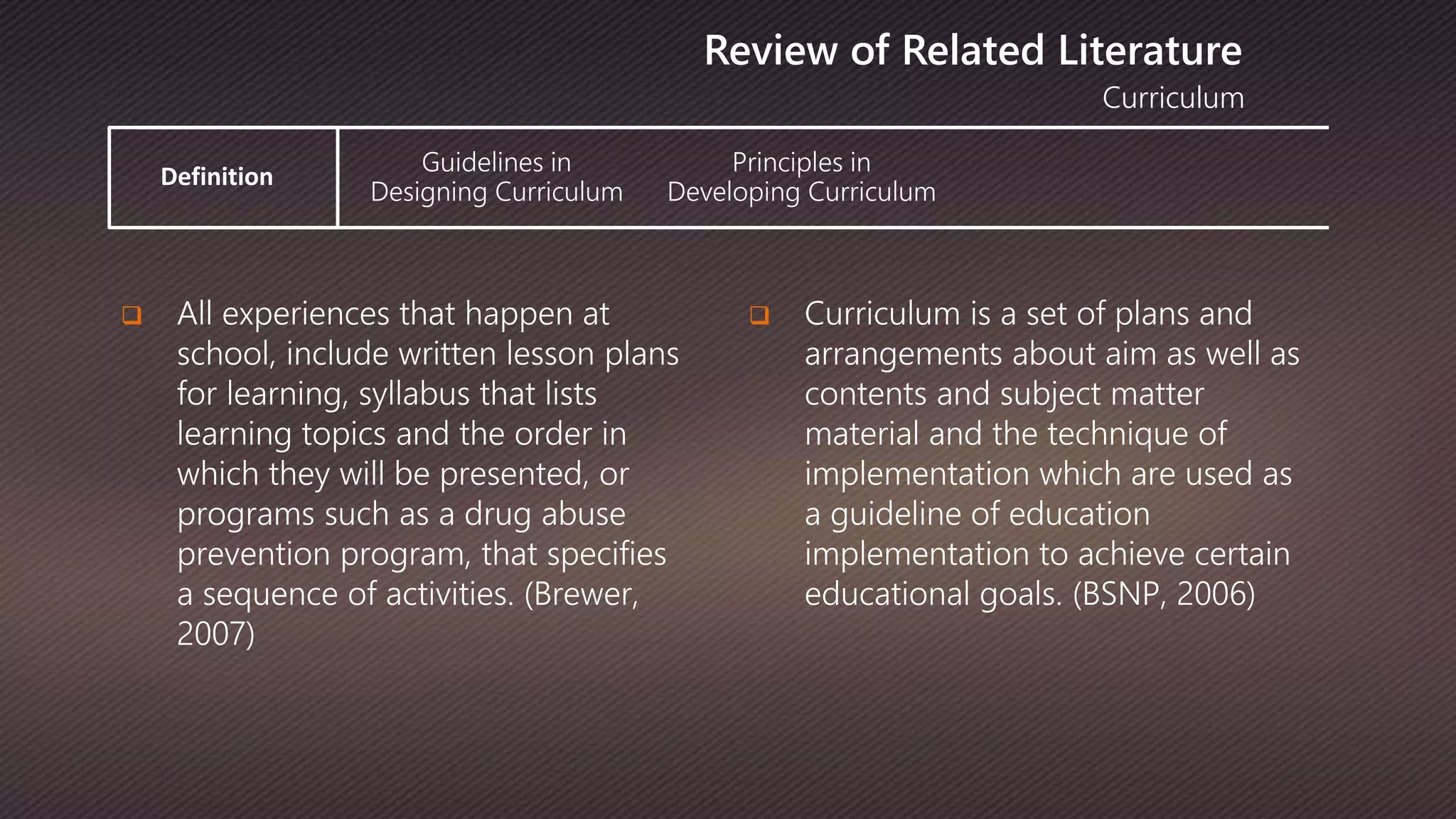
Definition
Guidelines in
Designing Curriculum
Principles in
Developing Curriculum
Curriculum
Review of Related Literature
 All experiences that happen at
school, include written lesson plans
for learning, syllabus that lists
learning topics and the order in
which they will be presented, or
programs such as a drug abuse
prevention program, that specifies
a sequence of activities. (Brewer,
2007)
 Curriculum is a set of plans and
arrangements about aim as well as
contents and subject matter
material and the technique of
implementation which are used as
a guideline of education
implementation to achieve certain
educational goals. (BSNP, 2006)
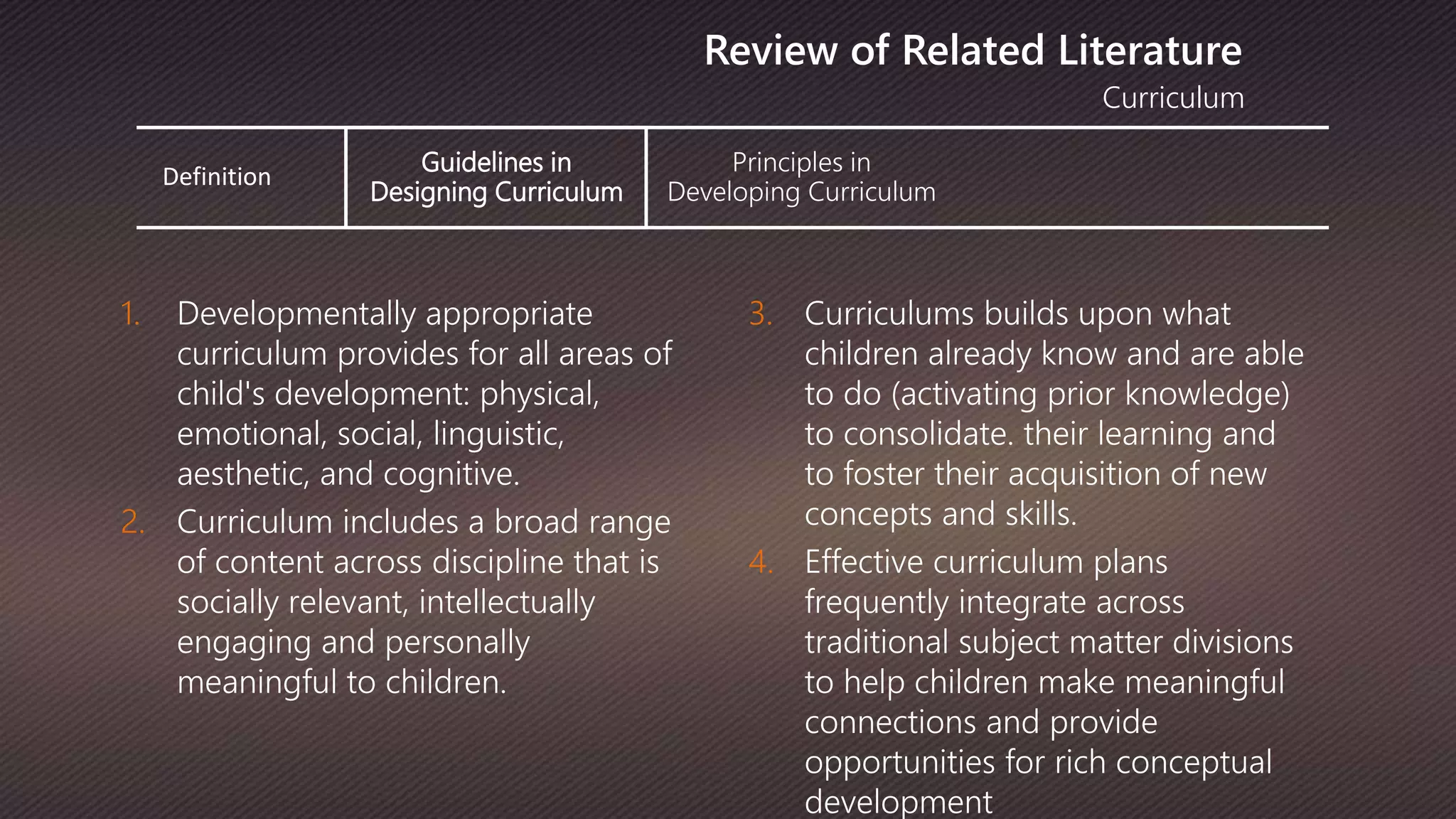
Definition
Guidelines in
Designing Curriculum
Principles in
Developing Curriculum
Curriculum
Review of Related Literature
1. Developmentally appropriate
curriculum provides for all areas of
child's development: physical,
emotional, social, linguistic,
aesthetic, and cognitive.
2. Curriculum includes a broad range
of content across discipline that is
socially relevant, intellectually
engaging and personally
meaningful to children.
3. Curriculums builds upon what
children already know and are able
to do (activating prior knowledge)
to consolidate. their learning and
to foster their acquisition of new
concepts and skills.
4. Effective curriculum plans
frequently integrate across
traditional subject matter divisions
to help children make meaningful
connections and provide
opportunities for rich conceptual
development
Definition
Guidelines in
Designing Curriculum
Principles in
Developing Curriculum
Curriculum
Review of Related Literature
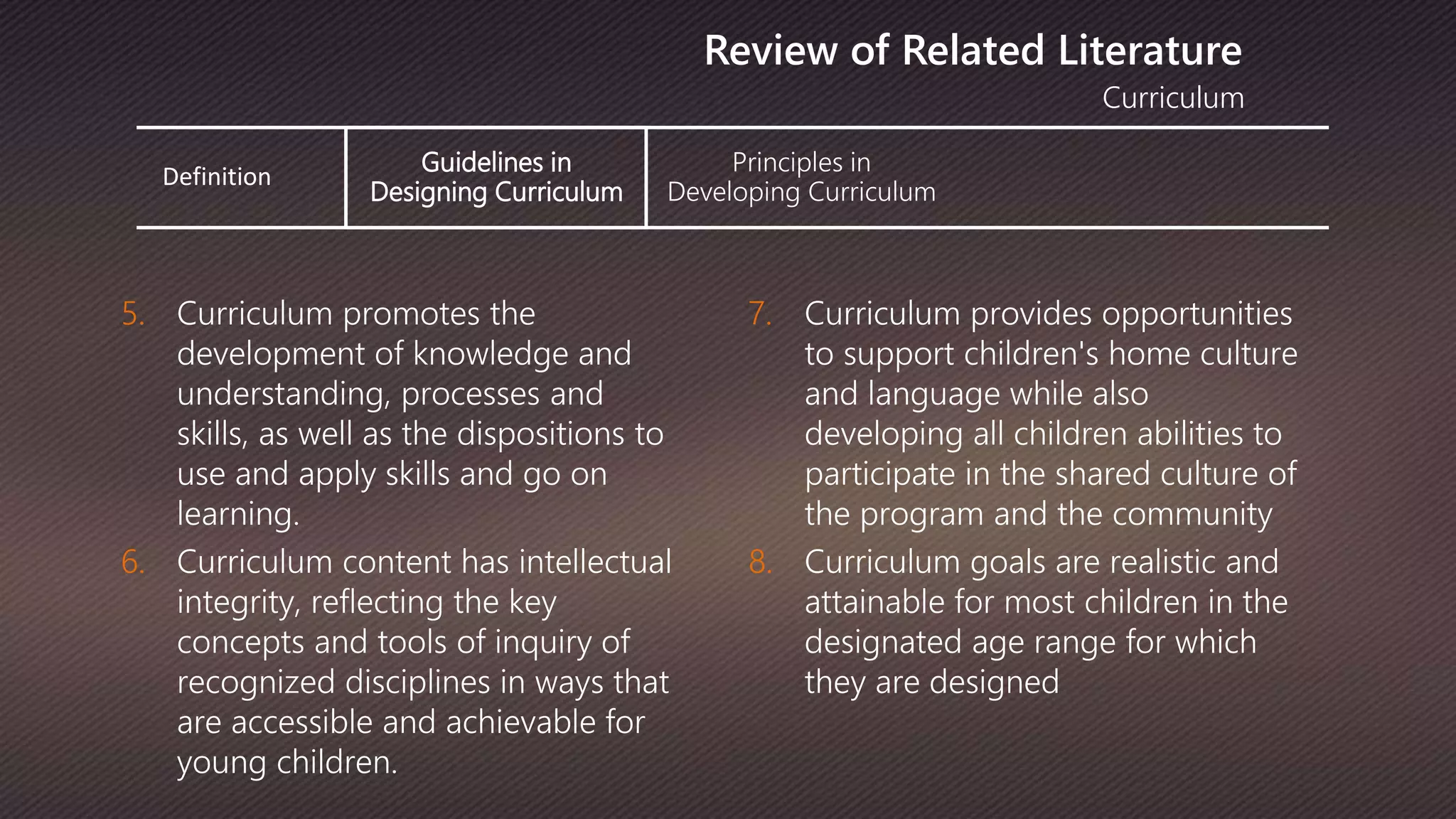
5. Curriculum promotes the
development of knowledge and
understanding, processes and
skills, as well as the dispositions to
use and apply skills and go on
learning.
6. Curriculum content has intellectual
integrity, reflecting the key
concepts and tools of inquiry of
recognized disciplines in ways that
are accessible and achievable for
young children.
7. Curriculum provides opportunities
to support children's home culture
and language while also
developing all children abilities to
participate in the shared culture of
the program and the community
8. Curriculum goals are realistic and
attainable for most children in the
designated age range for which
they are designed
Definition
Guidelines in
Designing Curriculum
Principles in
Developing Curriculum
Curriculum
Review of Related Literature
9. When used, technology is
physically and philosophically
integrated in the classroom
curriculum and teaching.
Definition
Guidelines in
Designing Curriculum
Principles in
Developing Curriculum
Curriculum
Review of Related Literature
 The goal of this curriculum are to
develop innovative, creative,
productive and affective students
through integrated attitude,
knowledge and skill.
 2013 curriculum is an effort to
simplify SBC and use integrated
thematic as the learning model.
Definition
Guidelines in
Designing Curriculum
Principles in
Developing Curriculum
Curriculum
Review of Related Literature
1. Curriculum is not a list of subjects,
because the subject is only used to
reach the competency
2. In the curriculum model, the
competency in which include
affective, cognitive and
psychomotor are attached into
various subjects.
3. Centered on the potential,
development, needs, and interest
of the students and their
surroundings
4. The curriculum is developed based
on the awareness that sciences,
technology, and arts develop
dynamically.
5. The curriculum is developed by
involving the stakeholders to
guarantee the relevance of the
education with real life needs
6. The curriculum is aimed at the
process of development,
acculturation, and empowerment
of the students to enable them to
learn all their life.
The Nature of Vocabulary
Review of Related Literature
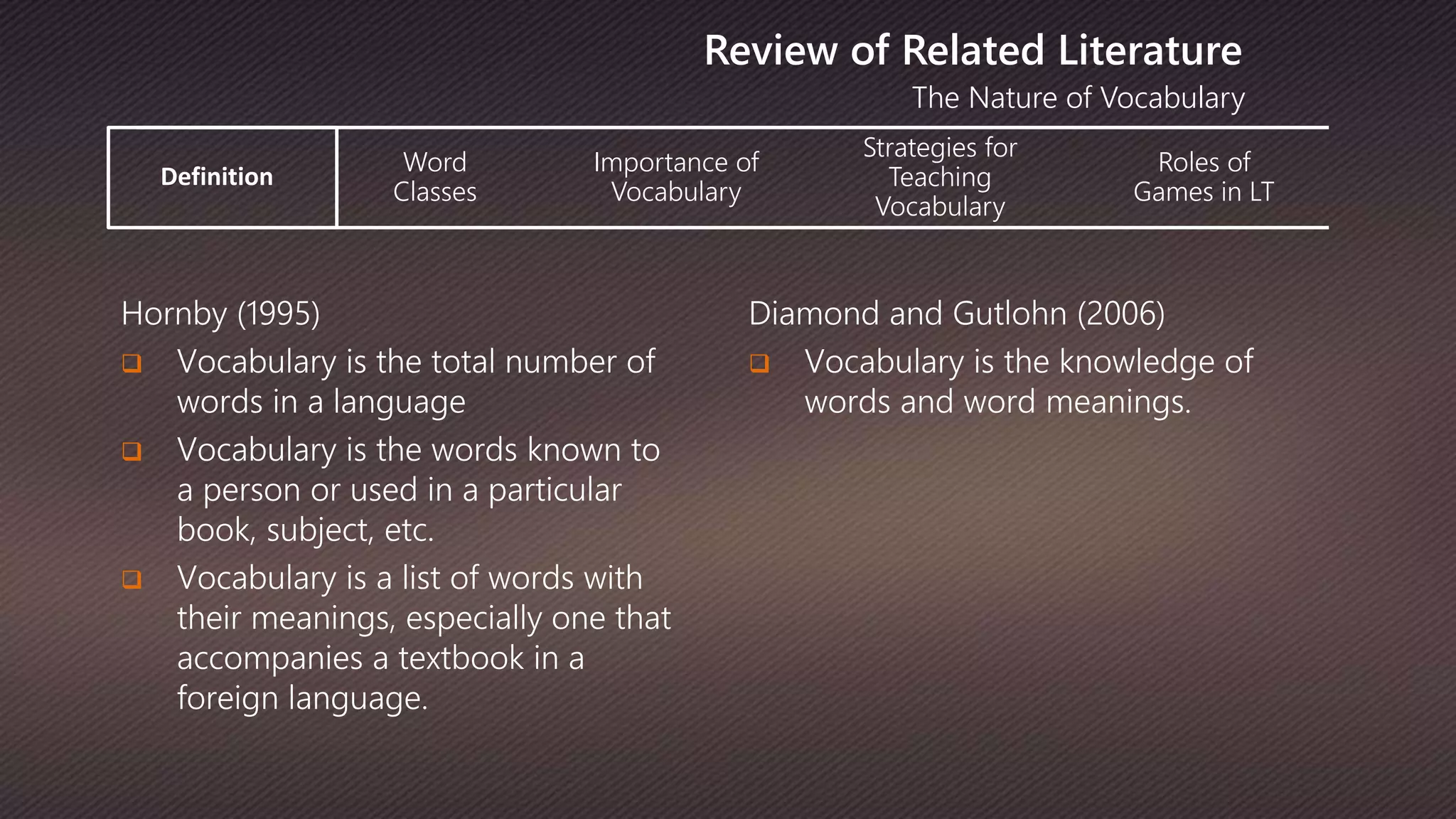
Hornby (1995)
 Vocabulary is the total number of
words in a language
 Vocabulary is the words known to
a person or used in a particular
book, subject, etc.
 Vocabulary is a list of words with
their meanings, especially one that
accompanies a textbook in a
foreign language.
Diamond and Gutlohn (2006)
 Vocabulary is the knowledge of
words and word meanings.
Definition
Word
Classes
Importance of
Vocabulary
Strategies for
Teaching
Vocabulary
Roles of
Games in LT
The Nature of Vocabulary
Review of Related Literature
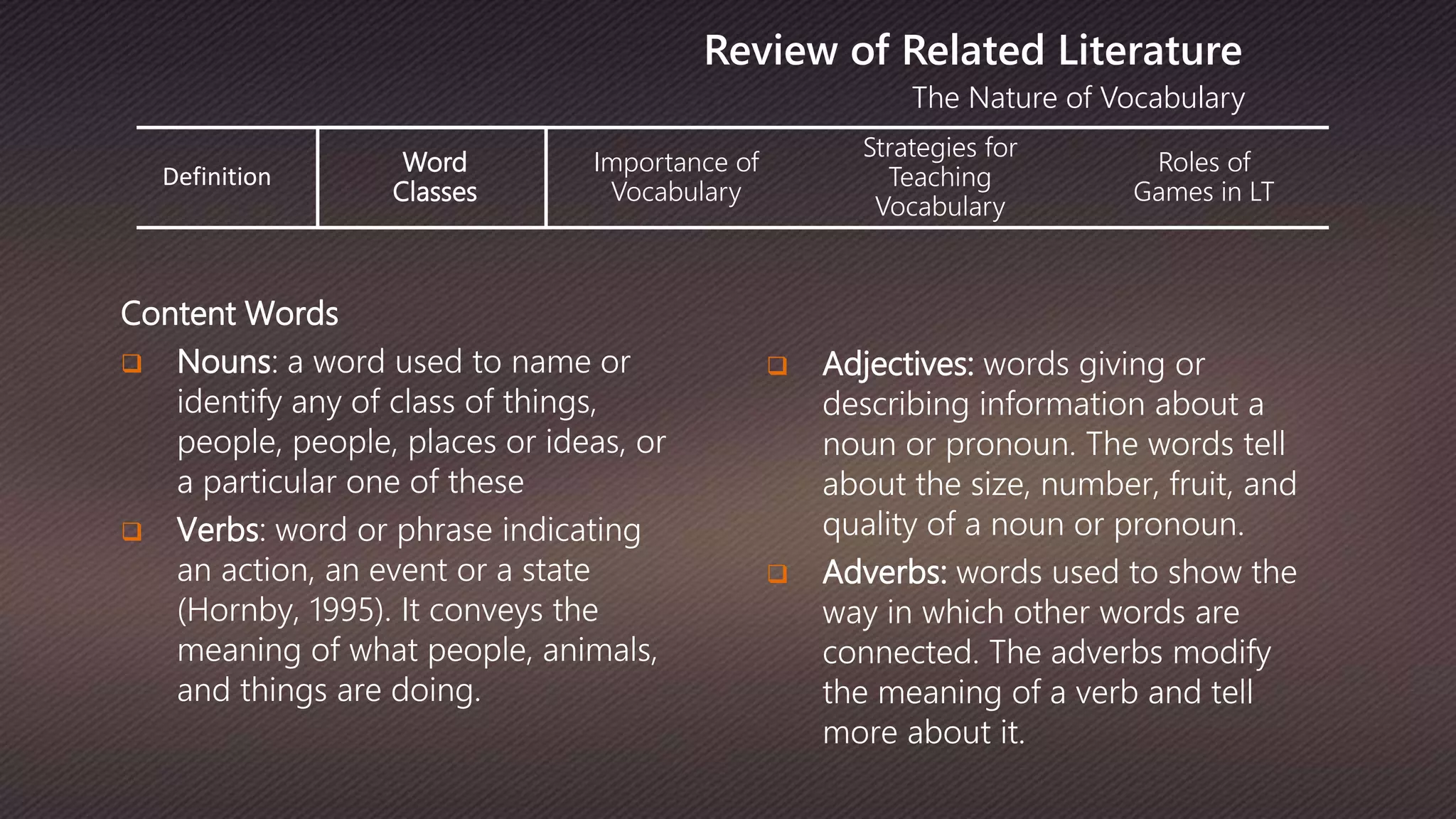
Content Words
 Nouns: a word used to name or
identify any of class of things,
people, people, places or ideas, or
a particular one of these
 Verbs: word or phrase indicating
an action, an event or a state
(Hornby, 1995). It conveys the
meaning of what people, animals,
and things are doing.
 Adjectives: words giving or
describing information about a
noun or pronoun. The words tell
about the size, number, fruit, and
quality of a noun or pronoun.
 Adverbs: words used to show the
way in which other words are
connected. The adverbs modify
the meaning of a verb and tell
more about it.
Definition
Word
Classes
Importance of
Vocabulary
Strategies for
Teaching
Vocabulary
Roles of
Games in LT
The Nature of Vocabulary
Review of Related Literature
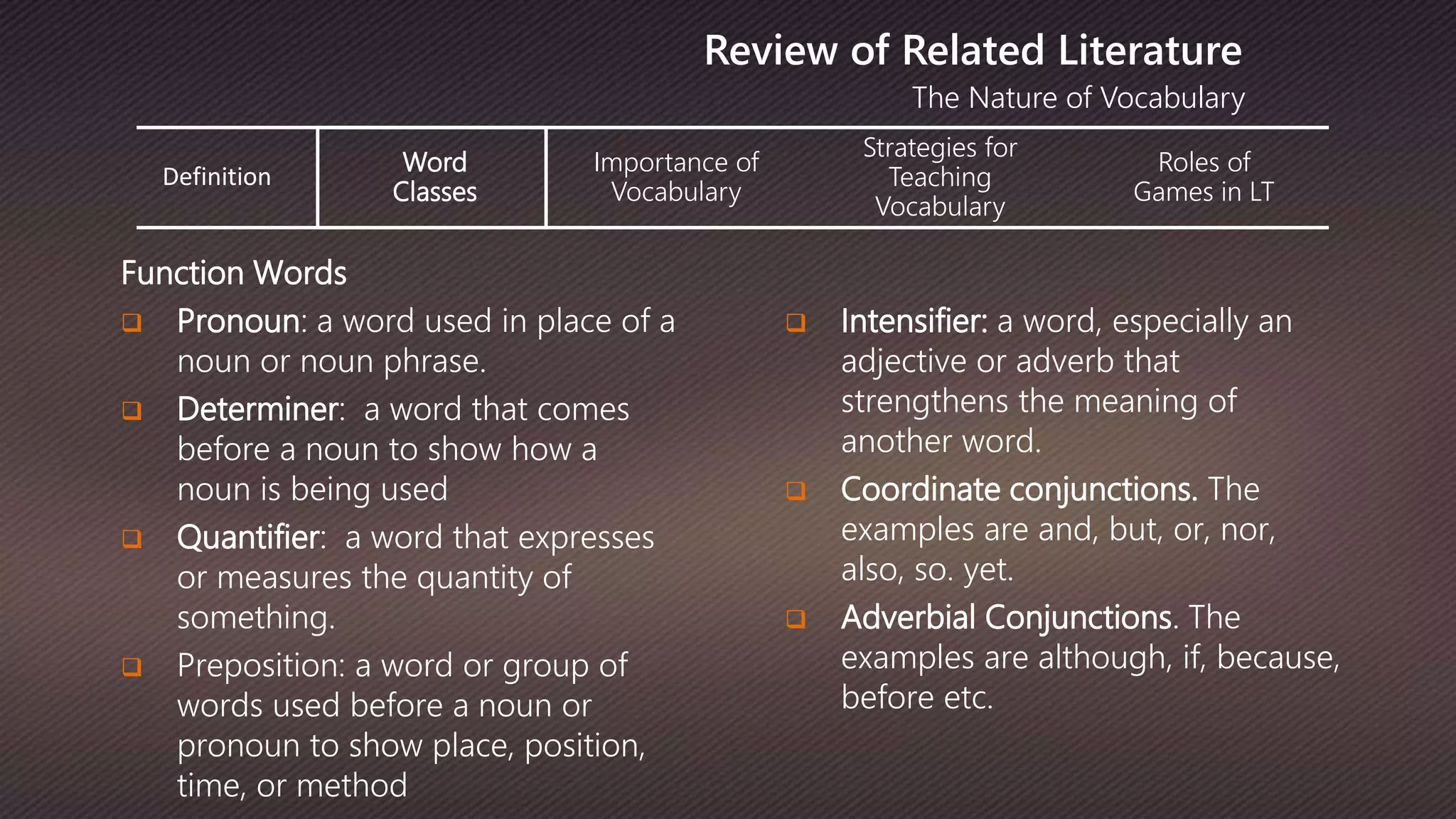
Function Words
 Pronoun: a word used in place of a
noun or noun phrase.
 Determiner: a word that comes
before a noun to show how a
noun is being used
 Quantifier: a word that expresses
or measures the quantity of
something.
 Preposition: a word or group of
words used before a noun or
pronoun to show place, position,
time, or method
Definition
Word
Classes
Importance of
Vocabulary
Strategies for
Teaching
Vocabulary
Roles of
Games in LT
 Intensifier: a word, especially an
adjective or adverb that
strengthens the meaning of
another word.
 Coordinate conjunctions. The
examples are and, but, or, nor,
also, so. yet.
 Adverbial Conjunctions. The
examples are although, if, because,
before etc.
The Nature of Vocabulary
Review of Related Literature
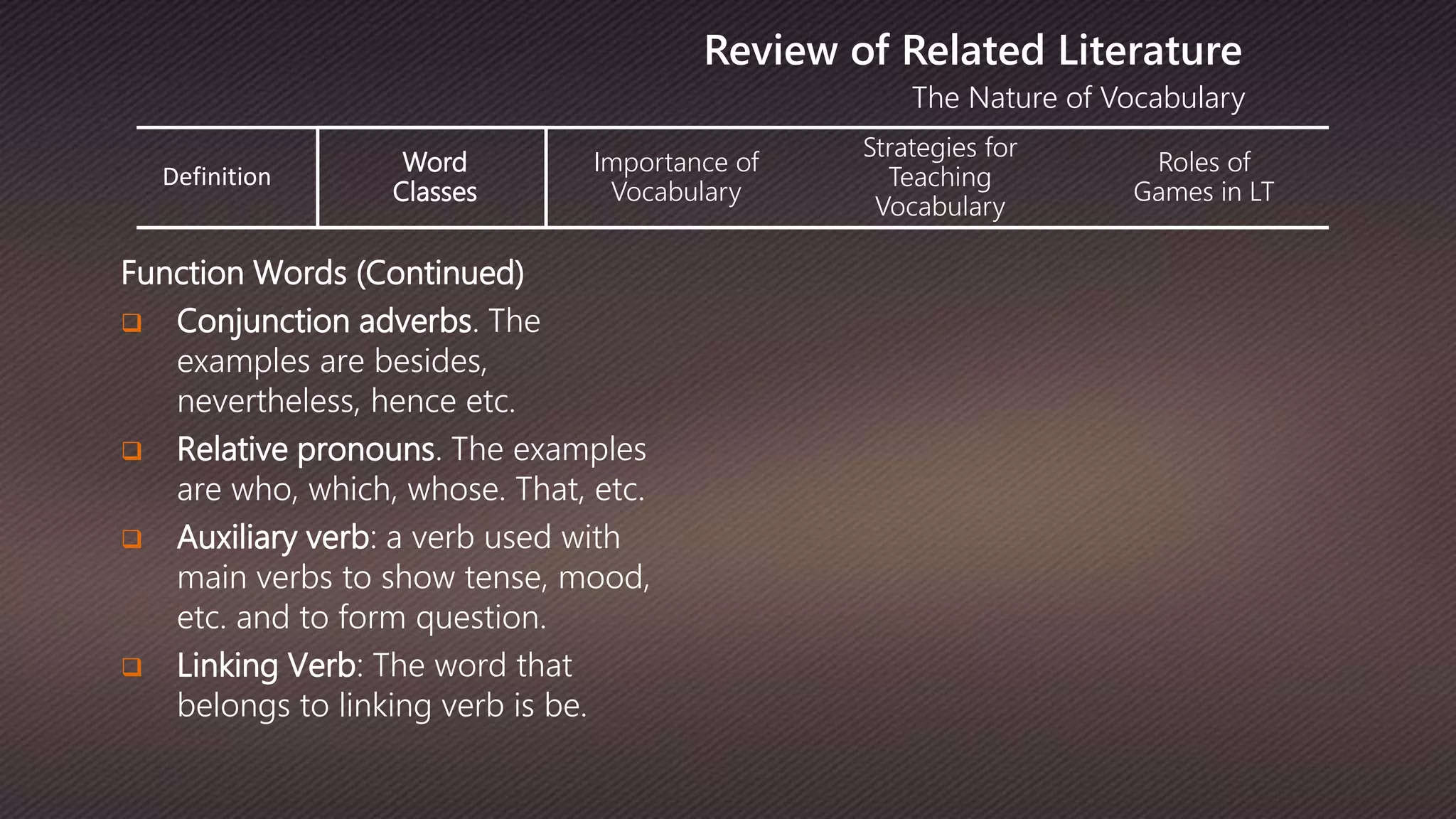
Function Words (Continued)
 Conjunction adverbs. The
examples are besides,
nevertheless, hence etc.
 Relative pronouns. The examples
are who, which, whose. That, etc.
 Auxiliary verb: a verb used with
main verbs to show tense, mood,
etc. and to form question.
 Linking Verb: The word that
belongs to linking verb is be.
Definition
Word
Classes
Importance of
Vocabulary
Strategies for
Teaching
Vocabulary
Roles of
Games in LT
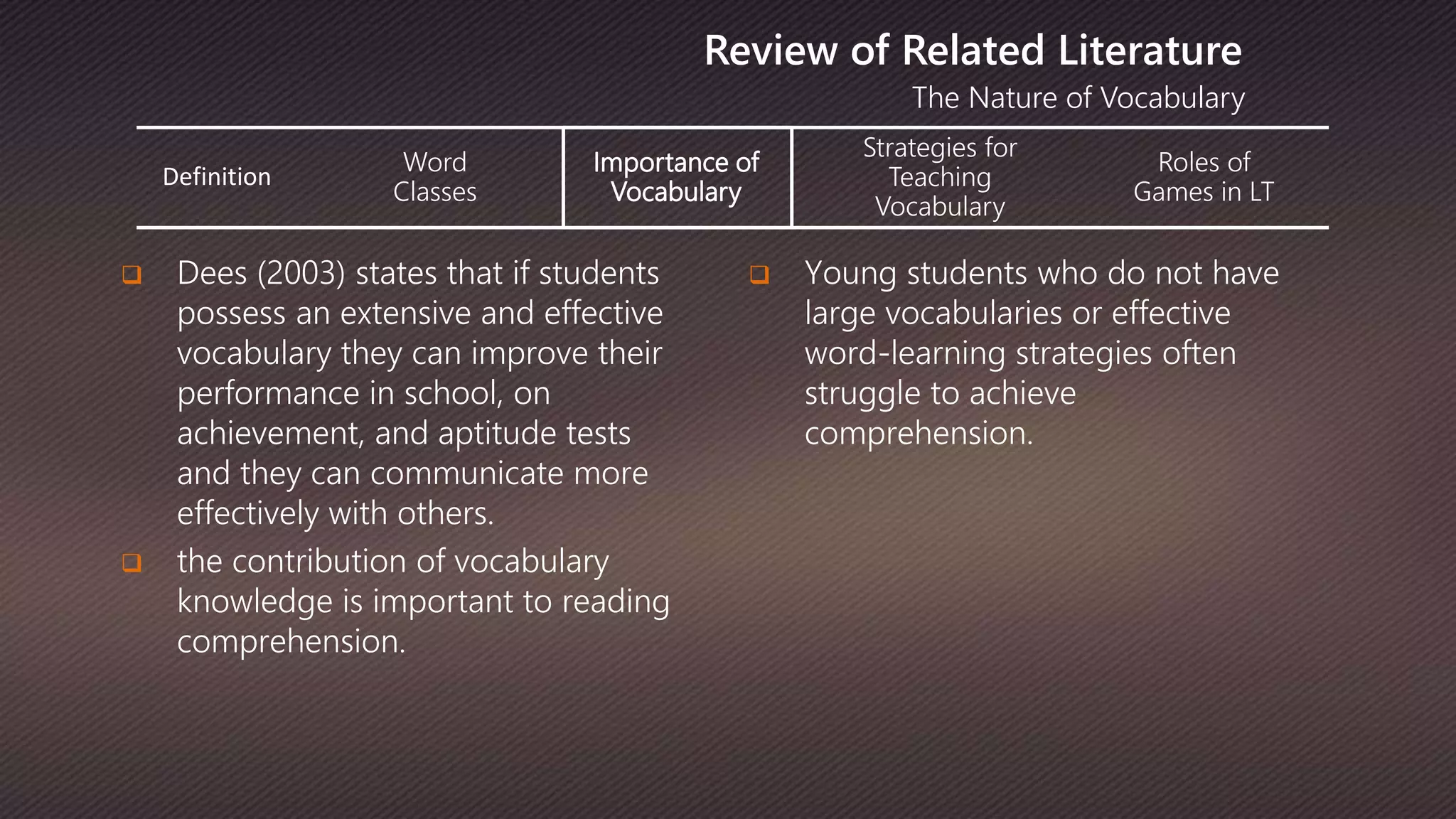
The Nature of Vocabulary
Review of Related Literature
 Dees (2003) states that if students
possess an extensive and effective
vocabulary they can improve their
performance in school, on
achievement, and aptitude tests
and they can communicate more
effectively with others.
 the contribution of vocabulary
knowledge is important to reading
comprehension.
Definition
Word
Classes
Importance of
Vocabulary
Strategies for
Teaching
Vocabulary
Roles of
Games in LT
 Young students who do not have
large vocabularies or effective
word-learning strategies often
struggle to achieve
comprehension.
Definition
Word
Classes
Importance of
Vocabulary
Strategies for
Teaching
Vocabulary
Roles of
Games in LT
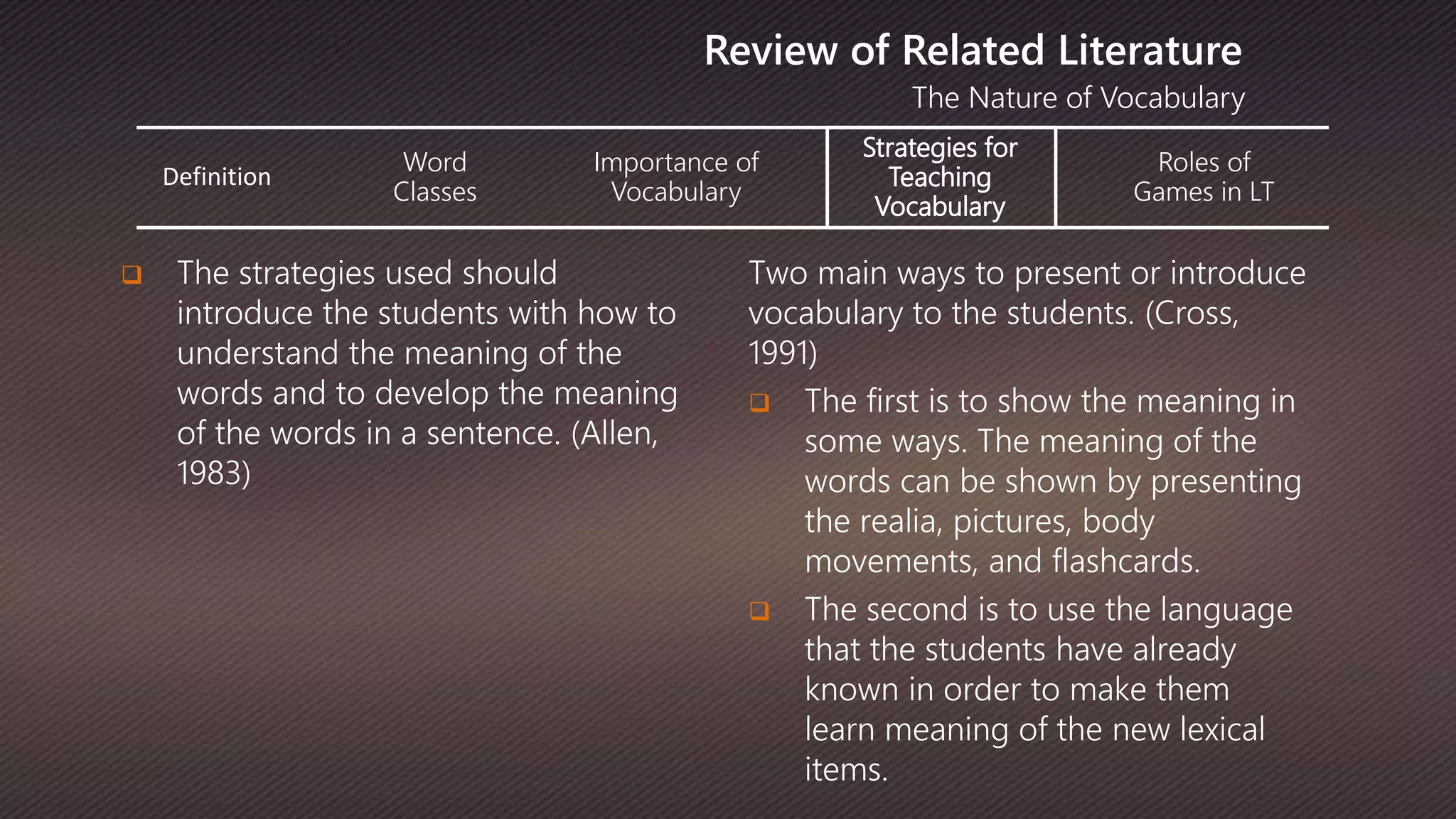
The Nature of Vocabulary
Review of Related Literature
 The strategies used should
introduce the students with how to
understand the meaning of the
words and to develop the meaning
of the words in a sentence. (Allen,
1983)
Two main ways to present or introduce
vocabulary to the students. (Cross,
1991)
 The first is to show the meaning in
some ways. The meaning of the
words can be shown by presenting
the realia, pictures, body
movements, and flashcards.
 The second is to use the language
that the students have already
known in order to make them
learn meaning of the new lexical
items.
Definition
Word
Classes
Importance of
Vocabulary
Strategies for
Teaching
Vocabulary
Roles of
Games in LT
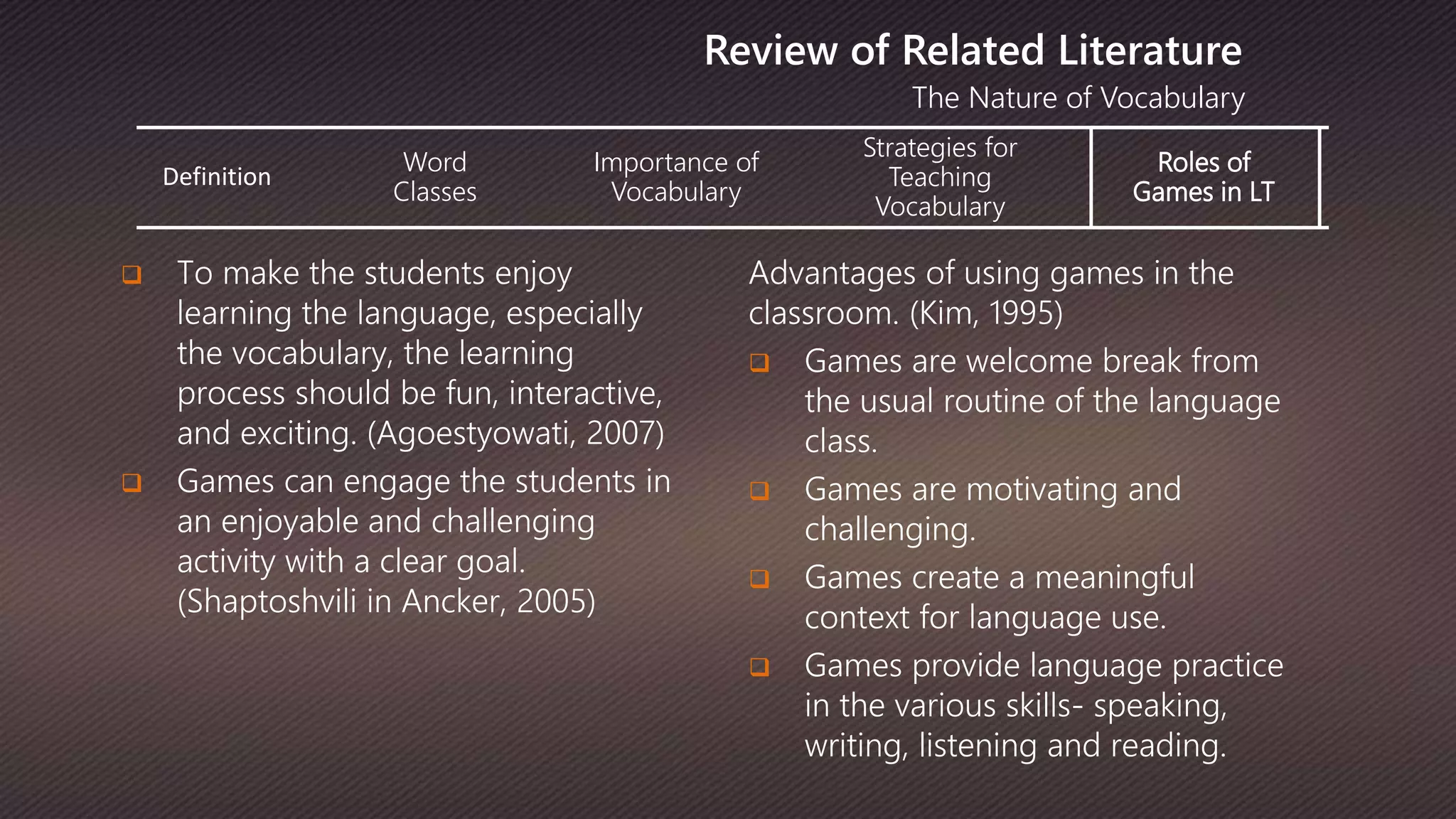
The Nature of Vocabulary
Review of Related Literature
 To make the students enjoy
learning the language, especially
the vocabulary, the learning
process should be fun, interactive,
and exciting. (Agoestyowati, 2007)
 Games can engage the students in
an enjoyable and challenging
activity with a clear goal.
(Shaptoshvili in Ancker, 2005)
Advantages of using games in the
classroom. (Kim, 1995)
 Games are welcome break from
the usual routine of the language
class.
 Games are motivating and
challenging.
 Games create a meaningful
context for language use.
 Games provide language practice
in the various skills- speaking,
writing, listening and reading.
Material Development
Review of Related Literature
 Materials development is the
efforts done by the writers,
teachers, or students to provide
source of language input and to
exploit those sources in ways to
maximize likelihood of intake
(Tomlinson, 1998)
 There are sixteen basic principles
of second language acquisition
relevant to the development of
materials for the teaching of
languages.
Material Development
Review of Related Literature
1. Materials should achieve impact
2. Materials should help learners to
feel at ease
3. Material should help learners to
develop confidence
4. What is being taught should be
perceived by learners as relevant
and useful
5. Materials should require and
facilitate learner self-investment
6. Students must be ready to acquire
the points being taught
7. Materials should expose the
students to language in authentic
use
8. The learners ' attention should be
drawn to linguistic features of the
input
9. Materials should provide the
students with opportunities to use
the target language to achieve
communicative purposes
10. Materials should take into account
that the positive effects of
instruction are usually delayed
11. Materials should take into account
that students differ in learning styles
12. Materials should take into account
that students differ in affective
attitudes
Material Development
Review of Related Literature
13. Materials should permit a silent
period at the beginning of
instruction
14. Materials should maximize learning
potential by encouraging
intellectual, aesthetic, and emotional
involvement which stimulates both
right and left brain activities
15. Materials should not rely too much
on controlled practice
16. Materials should provide
opportunities for outcome feedback
Research and Development
Review of Related Literature
 Research and development is a research method which is used to design
and to examine the effectiveness of the product. (Sugiyono, 2010)
The steps of the study involved:
1. Identifying problems: problem from an irrelevance between what is expected and what has happened
2. Data collection: gather information which can be used as data to design the expected product to solve the problems.
3. Product design: After knowing the problems and collecting the data, a researcher designs a product.
4. Design validation: Measure whether the product design will be more effective from the previous product
5. Product revision: After the experts measure the design, it will be found the weaknesses of the product
6. Product testing I: whether the product is effective or not, it will be tested in a smaller scope through experiment
7. Product revision: To get the good product the researcher will revise the product
8. Product testing II: After Revision the product, it will be tried out again in a wider scope
9. Product revision: Product revision will be done if there are some weaknesses found in the wider scope
10. Final product: If the product of a study is stated effective it can be used
Research Methodology
Research Design
Population and Sample
Research Variable and Definition
Method of Data Collection
Research Instrument
Method of Data Analysis
Research Design
Research Methodology
Considerations of choosing this design
were:
1. It will be relevant to the focus of the
development of the product
2. Comparing with other models its
steps were more straight forward
indicated with identifying problems
and data collection and then
straight forwardly with product
design
3. It provided more flexible steps of
design validation
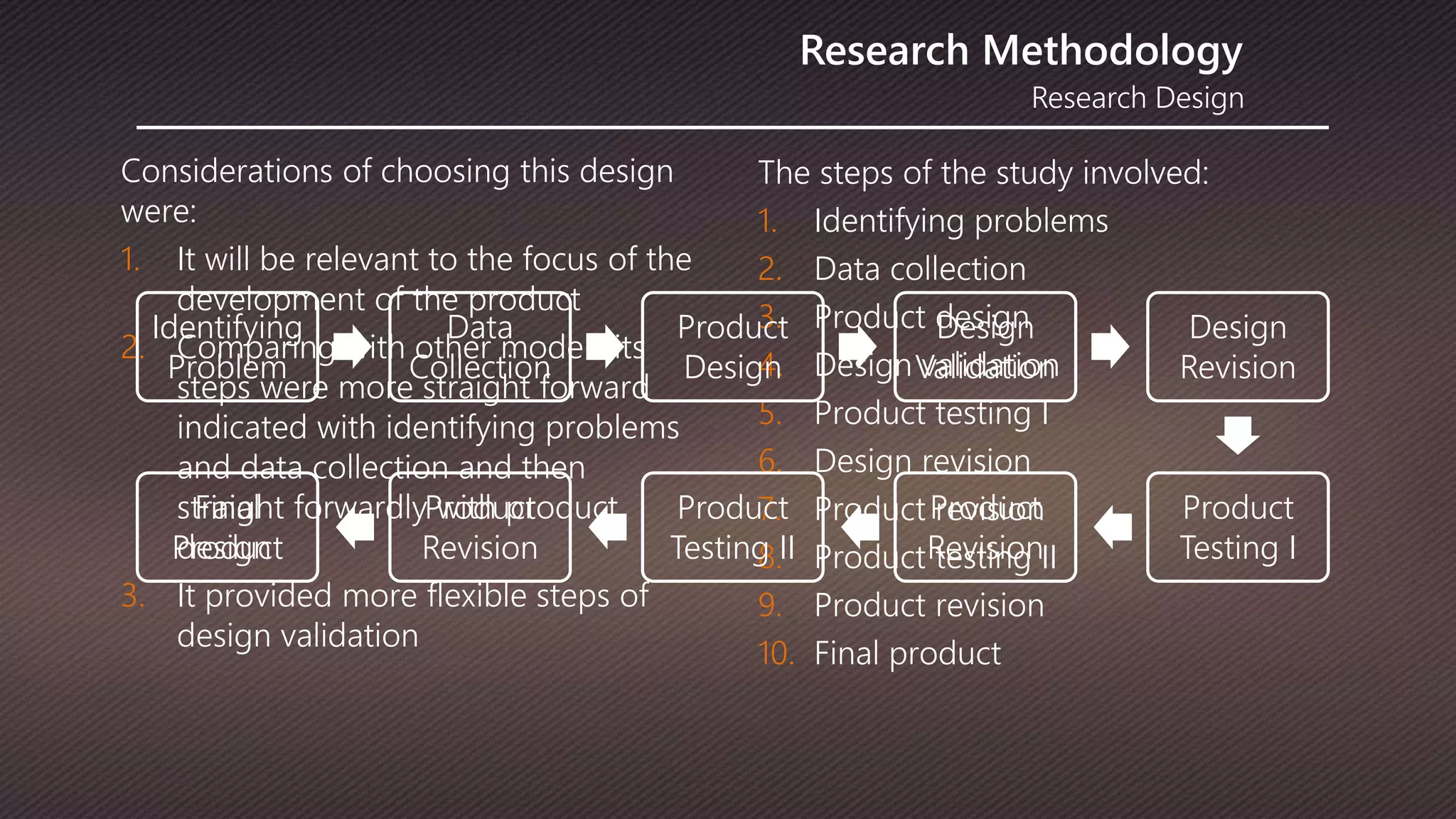
The steps of the study involved:
1. Identifying problems
2. Data collection
3. Product design
4. Design validation
5. Product testing I
6. Design revision
7. Product revision
8. Product testing II
9. Product revision
10. Final product
Identifying
Problem
Data
Collection
Product
Design
Design
Validation
Design
Revision
Product
Testing I
Product
Revision
Product
Testing II
Product
Revision
Final
Product
Population and Sample
Research Methodology
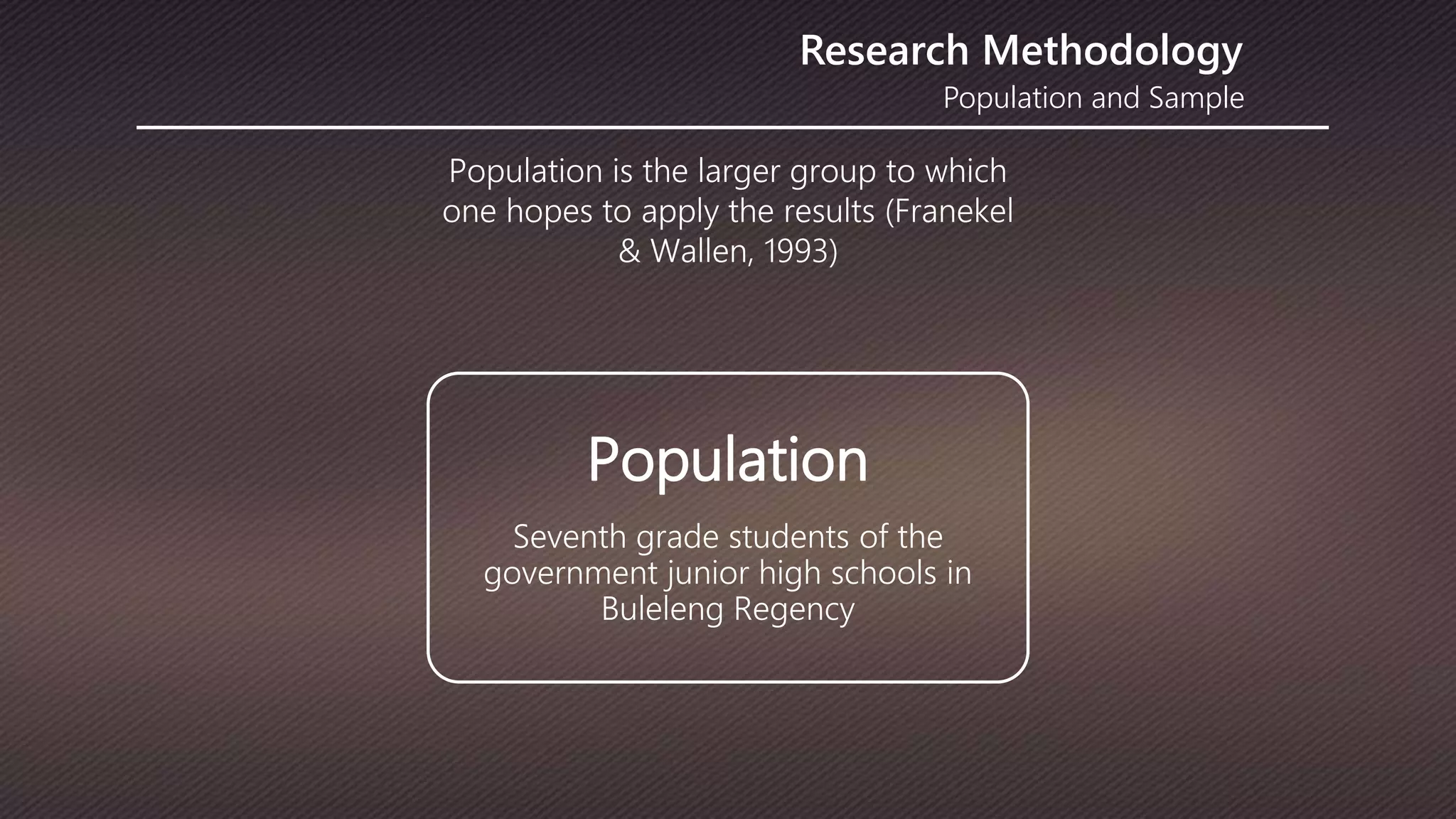
Population is the larger group to which
one hopes to apply the results (Franekel
& Wallen, 1993)
Population
Seventh grade students of the
government junior high schools in
Buleleng Regency
Research Variable and Definition
Research Methodology
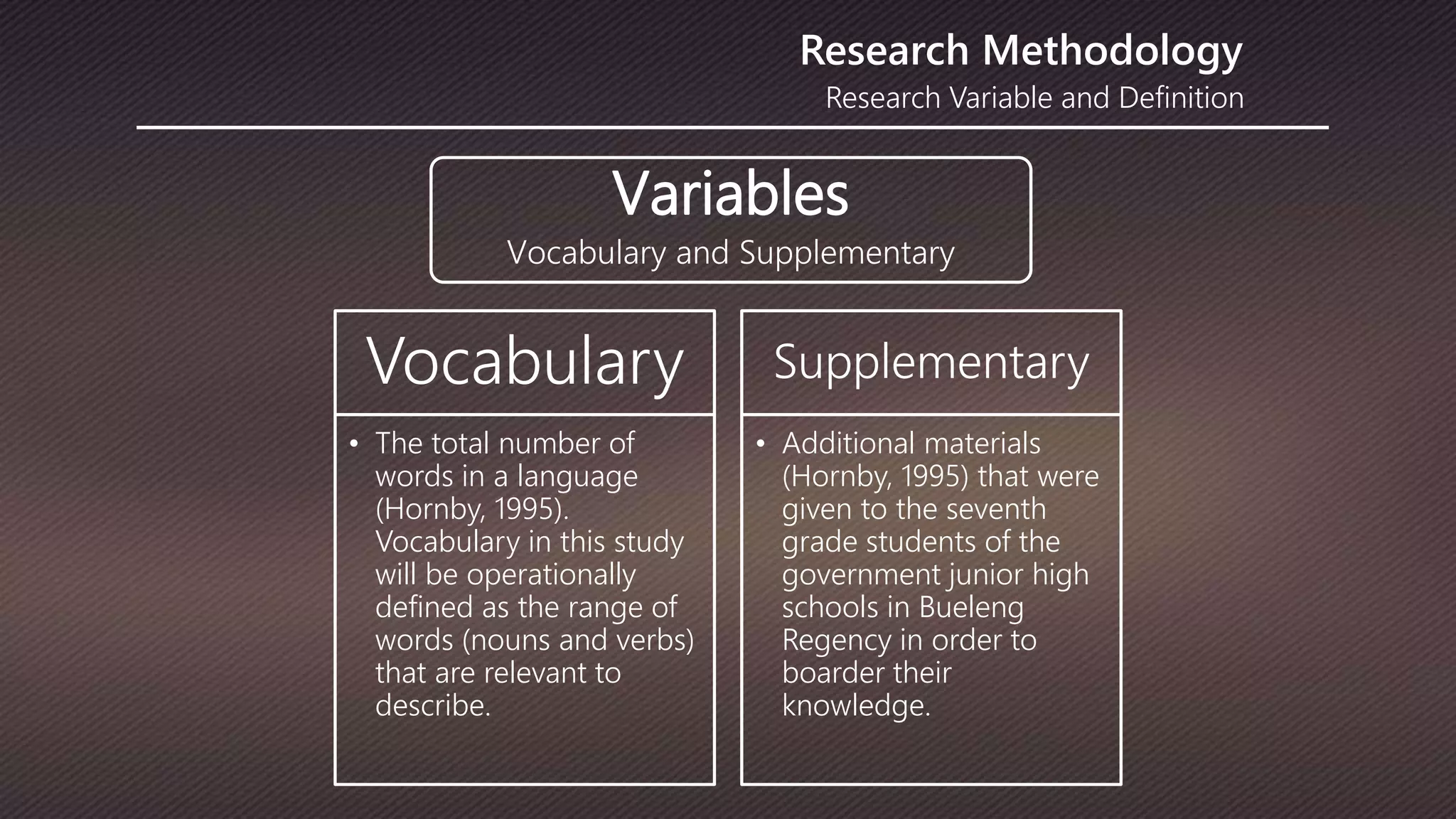
Variables
Vocabulary and Supplementary
Vocabulary
• The total number of
words in a language
(Hornby, 1995).
Vocabulary in this study
will be operationally
defined as the range of
words (nouns and verbs)
that are relevant to
describe.
Supplementary
• Additional materials
(Hornby, 1995) that were
given to the seventh
grade students of the
government junior high
schools in Bueleng
Regency in order to
boarder their
knowledge.
Method of Data Collection
Research Methodology
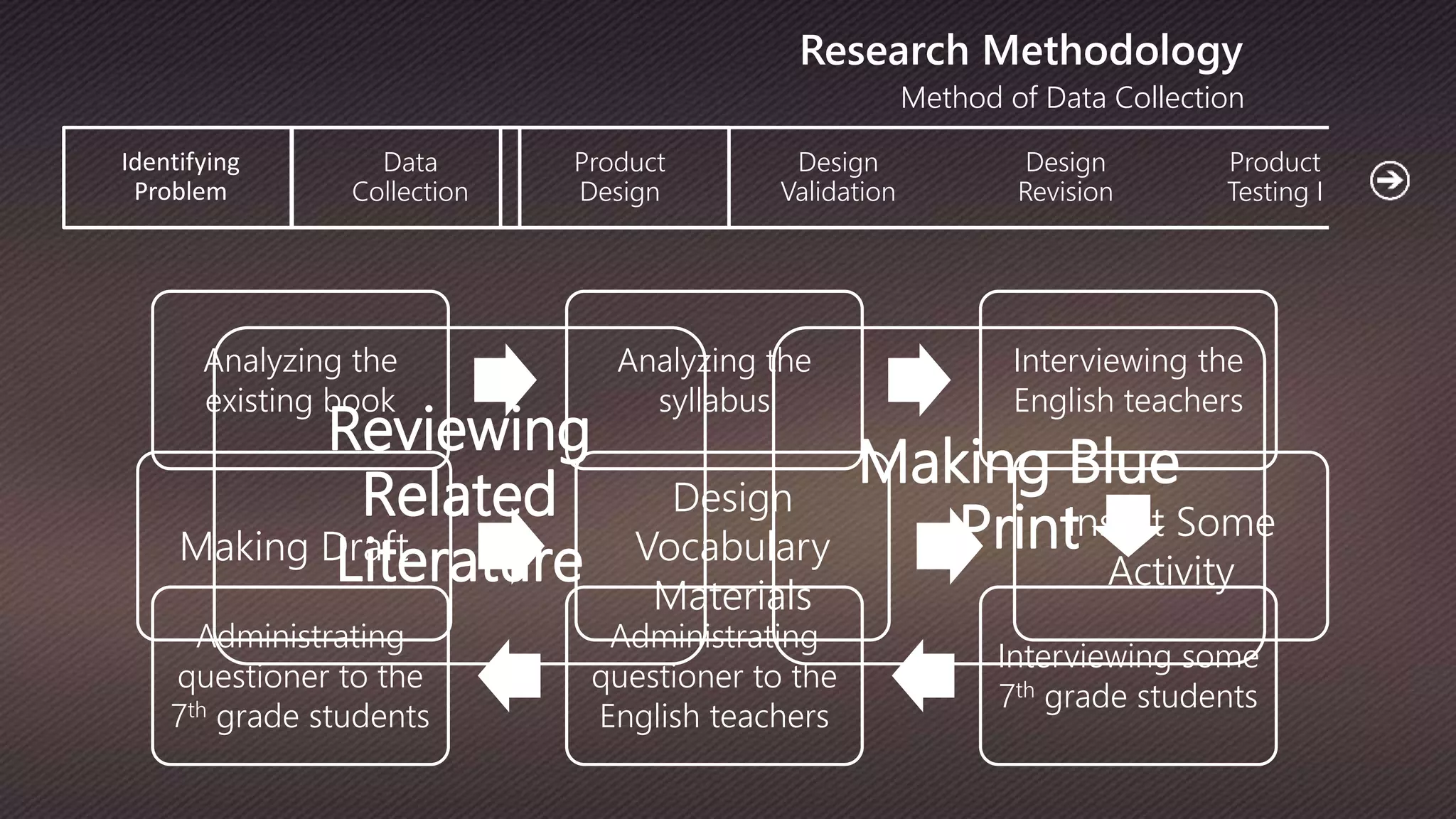
Analyzing the
existing book
Analyzing the
syllabus
Interviewing the
English teachers
Interviewing some
7th grade students
Administrating
questioner to the
English teachers
Administrating
questioner to the
7th grade students
Reviewing
Related
Literature
Making Blue
Print
Identifying
Problem
Data
Collection
Product
Design
Design
Validation
Design
Revision
Product
Testing I
Making Draft
Design
Vocabulary
Materials
Insert Some
Activity
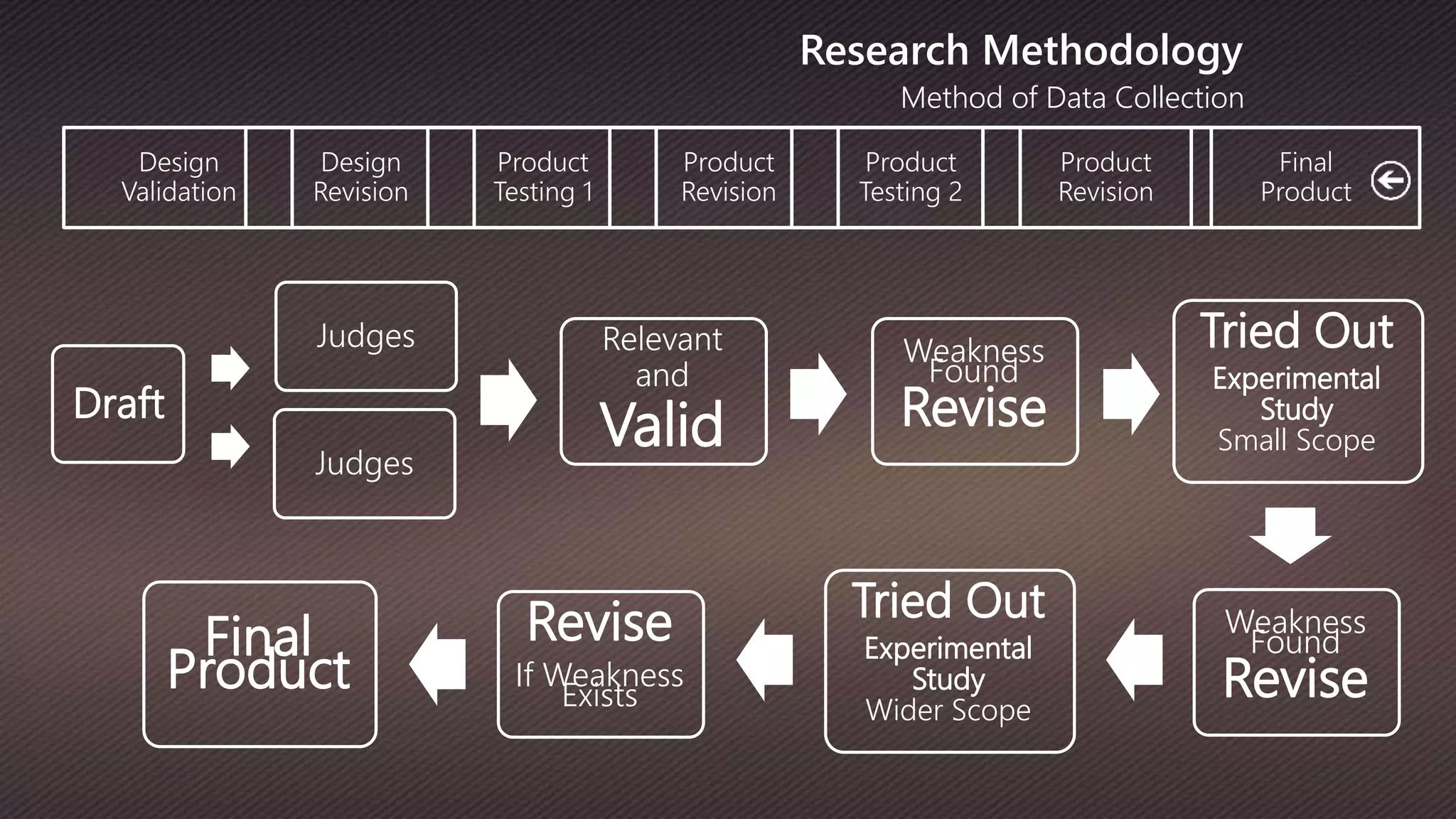
Design
Validation
Design
Revision
Product
Testing 1
Product
Revision
Product
Testing 2
Product
Revision
Final
Product
Method of Data Collection
Research Methodology
Draft
Judges Relevant
and
ValidJudges
Weakness
Found
Revise
Tried Out
Experimental
Study
Small Scope
Weakness
Found
Revise
Tried Out
Experimental
Study
Wider Scope
Revise
If Weakness
Exists
Final
Product
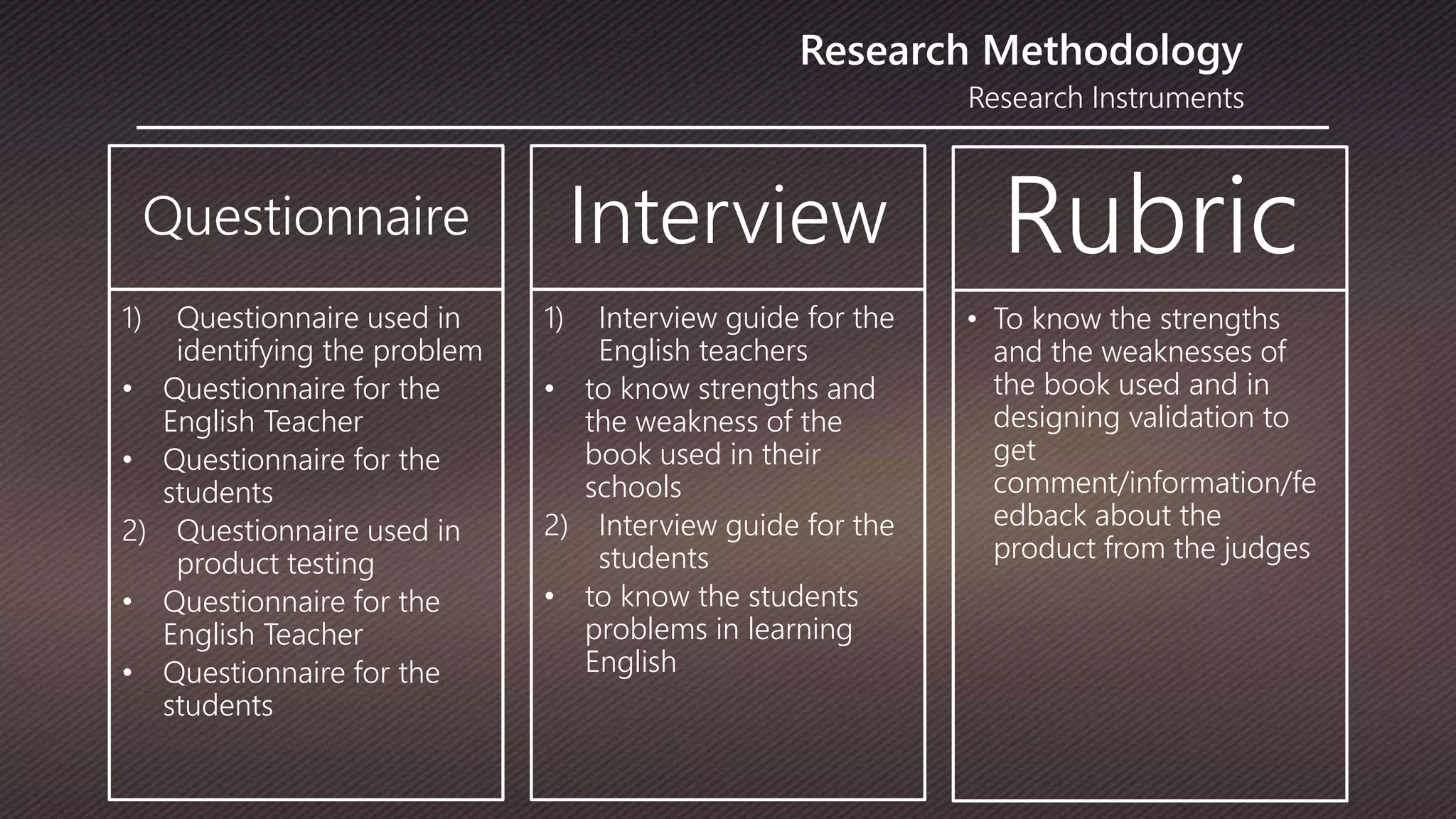
Research Instruments
Research Methodology
Questionnaire
1) Questionnaire used in
identifying the problem
• Questionnaire for the
English Teacher
• Questionnaire for the
students
2) Questionnaire used in
product testing
• Questionnaire for the
English Teacher
• Questionnaire for the
students
Interview
1) Interview guide for the
English teachers
• to know strengths and
the weakness of the
book used in their
schools
2) Interview guide for the
students
• to know the students
problems in learning
English
Rubric
• To know the strengths
and the weaknesses of
the book used and in
designing validation to
get
comment/information/fe
edback about the
product from the judges
Method of Data Analysis
Research Methodology
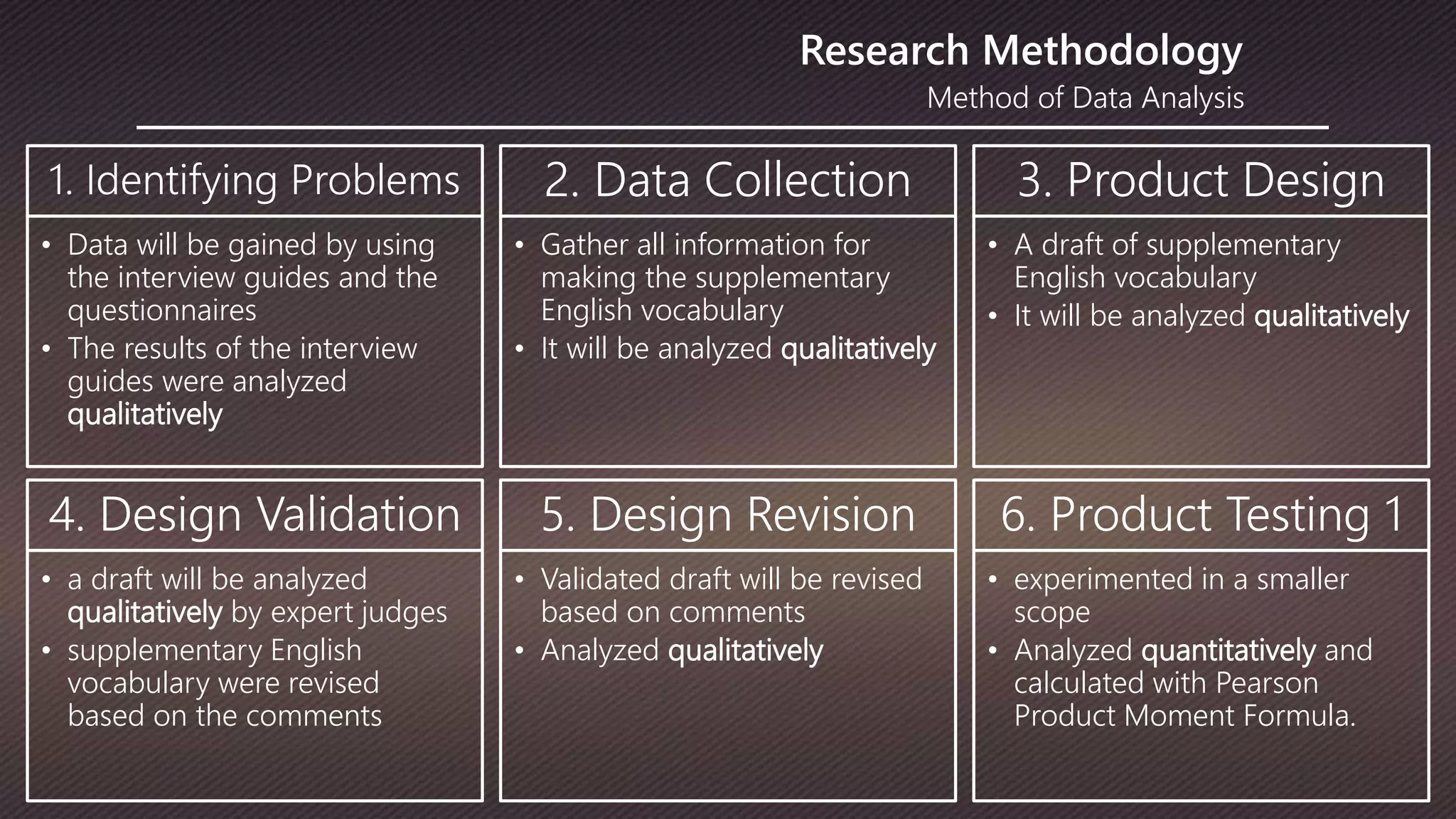
1. Identifying Problems
• Data will be gained by using
the interview guides and the
questionnaires
• The results of the interview
guides were analyzed
qualitatively
4. Design Validation
• a draft will be analyzed
qualitatively by expert judges
• supplementary English
vocabulary were revised
based on the comments
2. Data Collection
• Gather all information for
making the supplementary
English vocabulary
• It will be analyzed qualitatively
5. Design Revision
• Validated draft will be revised
based on comments
• Analyzed qualitatively
3. Product Design
• A draft of supplementary
English vocabulary
• It will be analyzed qualitatively
6. Product Testing 1
• experimented in a smaller
scope
• Analyzed quantitatively and
calculated with Pearson
Product Moment Formula.
Method of Data Analysis
Research Methodology
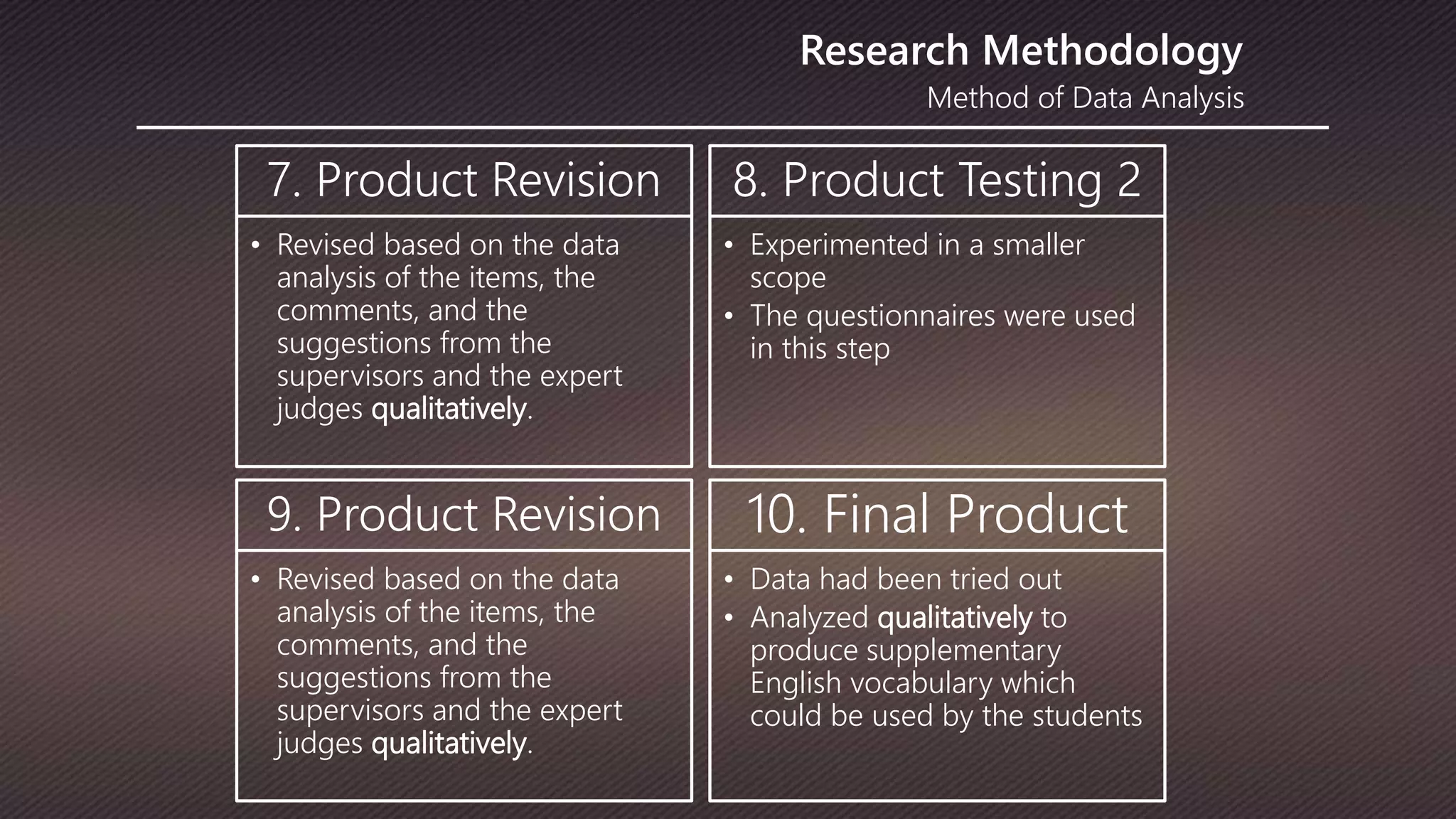
7. Product Revision
• Revised based on the data
analysis of the items, the
comments, and the
suggestions from the
supervisors and the expert
judges qualitatively.
9. Product Revision
• Revised based on the data
analysis of the items, the
comments, and the
suggestions from the
supervisors and the expert
judges qualitatively.
8. Product Testing 2
• Experimented in a smaller
scope
• The questionnaires were used
in this step
10. Final Product
• Data had been tried out
• Analyzed qualitatively to
produce supplementary
English vocabulary which
could be used by the students
THANK YOU!

Seminar Proposal (Developing English Vocabulary Materials for the First Grade Students of Junior High School)

  • 1.
    DEVELOPING ENGLISH VOCABULARY MATERIALSFOR THE FIRST GRADE STUDENTS OF JUNIOR HIGH SCHOOL By Komang Satya Permadi
  • 2.
    Developing English VocabularyMaterials for the First Grade Students of Junior High School Mind Map I INTRODUCTION II REVIEW OF RELATED LITERATURE III RESEARCH METHODOLOGY
  • 3.
    Introduction Background of theStudy Identification of the Problem Research Coverage Problem Statement Purpose of the Study Significance of the Study
  • 4.
    Background of theStudy Introduction English Vocabulary TL 2013 Curriculum Book Research Language Mind Communication Feeling Willing Ideas Culture
  • 5.
    Background of theStudy Introduction English Vocabulary TL 2013 Curriculum Book Research First/ Second/ Foreign/ Language Vocabulary Linking 4 Skills Performance in School Effective Communication
  • 6.
    Background of theStudy Introduction English Vocabulary TL 2013 Curriculum Book Research English in Junior Level Communicate Written and Spoken Vocabulary act as a bridge Good curriculum from Government Create a good atmosphere in TL
  • 7.
    Background of theStudy Introduction English Vocabulary TL 2013 Curriculum Book Research More attention on English TL in Elementary Level English subject removed in Elementary Level External Factor Globalization Era Obstruct Student’s Development Learning English in Junior Level will be urgently needed
  • 8.
    Background of theStudy Introduction English Vocabulary TL 2013 Curriculum Book Research Book Interested in Learning English Master the Material Well Able to Use Target Language Enjoy learning English and Master Vocabulary 2013 Curriculum One Book Student and Teacher Supplementary Material Knowledge and Creativity • Difficult in developing Material • Monotonous Activity • Shrink Creativity • Abandon diversity in class
  • 9.
    Background of theStudy Introduction English Vocabulary TL 2013 Curriculum Book Research  It aims at helping the students to learn English vocabularies both in the class and outside of the class by themselves with fun ways. The vocabulary will be introduced through presenting interesting and colorful pictures. Developing English vocabulary supplementary materials for the seventh grade students of the government junior high schools in Buleleng Regency R&D proposed by Sugiyono
  • 10.
    Identification of theProblem Introduction 1. The existing book do not provide enough activities to enrich the students• vocabulary that actually the basis for learning all the language skills. 2. The book has uncolourful pictures and monotonous activities.
  • 11.
    Research Coverage Introduction 1. Theresearch coverage of the study will focus on developing supplementary English vocabulary for the seventh grade students of the government junior high schools in Buleleng Regency. The developed English vocabulary will focus on the range of words (nouns and verbs).
  • 12.
    Problem Statement Introduction 1. Whatkinds of vocabulary which have been provided for the seventh grade students of the government junior high schools in Buleleng Regency based on the syllabus? 2. What kinds of supplementary English vocabulary which should be developed for the seventh grade students of the government junior high schools in Buleleng Regency?
  • 13.
    Purpose of theStudy Introduction 1. To identify kinds of vocabulary which have been provided for the seventh grade students of the government junior high schools in Buleleng Regency based on the syllabus. 2. To investigate kinds of supplementary English vocabulary which should be developed for the seventh grade students of the government junior high schools in Buleleng Regency.
  • 14.
    Significance of theStudy Introduction 1. The Educational Institutions (Government Junior High Schools) The product of this study provides supplementary English vocabulary that can enrich the students' English competency of the schools. 2. The English Teachers The product of this study provides supplementary English vocabulary. It can be supplementary materials for the English teachers. It contains activities that can be done in teaching vocabulary so that the English teachers can make the students active to learn English. 3. The Seventh Grade Students of the Government Junior high Schools The product of the study enables the students to be interested in learning English because it offers fun activities. Moreover, it has meaningful activities which enable students to be active 4. The Other Researchers This study is expected to give inspiration to other researchers to do similar research because it provides an alternative source and guidance for the next study to obtain the better result.
  • 15.
    Review of RelatedLiterature Curriculum The Nature of Vocabulary Material Development Research and Development Empirical Research Findings
  • 16.
    Definition Guidelines in Designing Curriculum Principlesin Developing Curriculum Curriculum Review of Related Literature  All experiences that happen at school, include written lesson plans for learning, syllabus that lists learning topics and the order in which they will be presented, or programs such as a drug abuse prevention program, that specifies a sequence of activities. (Brewer, 2007)  Curriculum is a set of plans and arrangements about aim as well as contents and subject matter material and the technique of implementation which are used as a guideline of education implementation to achieve certain educational goals. (BSNP, 2006)
  • 17.
    Definition Guidelines in Designing Curriculum Principlesin Developing Curriculum Curriculum Review of Related Literature 1. Developmentally appropriate curriculum provides for all areas of child's development: physical, emotional, social, linguistic, aesthetic, and cognitive. 2. Curriculum includes a broad range of content across discipline that is socially relevant, intellectually engaging and personally meaningful to children. 3. Curriculums builds upon what children already know and are able to do (activating prior knowledge) to consolidate. their learning and to foster their acquisition of new concepts and skills. 4. Effective curriculum plans frequently integrate across traditional subject matter divisions to help children make meaningful connections and provide opportunities for rich conceptual development
  • 18.
    Definition Guidelines in Designing Curriculum Principlesin Developing Curriculum Curriculum Review of Related Literature 5. Curriculum promotes the development of knowledge and understanding, processes and skills, as well as the dispositions to use and apply skills and go on learning. 6. Curriculum content has intellectual integrity, reflecting the key concepts and tools of inquiry of recognized disciplines in ways that are accessible and achievable for young children. 7. Curriculum provides opportunities to support children's home culture and language while also developing all children abilities to participate in the shared culture of the program and the community 8. Curriculum goals are realistic and attainable for most children in the designated age range for which they are designed
  • 19.
    Definition Guidelines in Designing Curriculum Principlesin Developing Curriculum Curriculum Review of Related Literature 9. When used, technology is physically and philosophically integrated in the classroom curriculum and teaching.
  • 20.
    Definition Guidelines in Designing Curriculum Principlesin Developing Curriculum Curriculum Review of Related Literature  The goal of this curriculum are to develop innovative, creative, productive and affective students through integrated attitude, knowledge and skill.  2013 curriculum is an effort to simplify SBC and use integrated thematic as the learning model.
  • 21.
    Definition Guidelines in Designing Curriculum Principlesin Developing Curriculum Curriculum Review of Related Literature 1. Curriculum is not a list of subjects, because the subject is only used to reach the competency 2. In the curriculum model, the competency in which include affective, cognitive and psychomotor are attached into various subjects. 3. Centered on the potential, development, needs, and interest of the students and their surroundings 4. The curriculum is developed based on the awareness that sciences, technology, and arts develop dynamically. 5. The curriculum is developed by involving the stakeholders to guarantee the relevance of the education with real life needs 6. The curriculum is aimed at the process of development, acculturation, and empowerment of the students to enable them to learn all their life.
  • 22.
    The Nature ofVocabulary Review of Related Literature Hornby (1995)  Vocabulary is the total number of words in a language  Vocabulary is the words known to a person or used in a particular book, subject, etc.  Vocabulary is a list of words with their meanings, especially one that accompanies a textbook in a foreign language. Diamond and Gutlohn (2006)  Vocabulary is the knowledge of words and word meanings. Definition Word Classes Importance of Vocabulary Strategies for Teaching Vocabulary Roles of Games in LT
  • 23.
    The Nature ofVocabulary Review of Related Literature Content Words  Nouns: a word used to name or identify any of class of things, people, people, places or ideas, or a particular one of these  Verbs: word or phrase indicating an action, an event or a state (Hornby, 1995). It conveys the meaning of what people, animals, and things are doing.  Adjectives: words giving or describing information about a noun or pronoun. The words tell about the size, number, fruit, and quality of a noun or pronoun.  Adverbs: words used to show the way in which other words are connected. The adverbs modify the meaning of a verb and tell more about it. Definition Word Classes Importance of Vocabulary Strategies for Teaching Vocabulary Roles of Games in LT
  • 24.
    The Nature ofVocabulary Review of Related Literature Function Words  Pronoun: a word used in place of a noun or noun phrase.  Determiner: a word that comes before a noun to show how a noun is being used  Quantifier: a word that expresses or measures the quantity of something.  Preposition: a word or group of words used before a noun or pronoun to show place, position, time, or method Definition Word Classes Importance of Vocabulary Strategies for Teaching Vocabulary Roles of Games in LT  Intensifier: a word, especially an adjective or adverb that strengthens the meaning of another word.  Coordinate conjunctions. The examples are and, but, or, nor, also, so. yet.  Adverbial Conjunctions. The examples are although, if, because, before etc.
  • 25.
    The Nature ofVocabulary Review of Related Literature Function Words (Continued)  Conjunction adverbs. The examples are besides, nevertheless, hence etc.  Relative pronouns. The examples are who, which, whose. That, etc.  Auxiliary verb: a verb used with main verbs to show tense, mood, etc. and to form question.  Linking Verb: The word that belongs to linking verb is be. Definition Word Classes Importance of Vocabulary Strategies for Teaching Vocabulary Roles of Games in LT
  • 26.
    The Nature ofVocabulary Review of Related Literature  Dees (2003) states that if students possess an extensive and effective vocabulary they can improve their performance in school, on achievement, and aptitude tests and they can communicate more effectively with others.  the contribution of vocabulary knowledge is important to reading comprehension. Definition Word Classes Importance of Vocabulary Strategies for Teaching Vocabulary Roles of Games in LT  Young students who do not have large vocabularies or effective word-learning strategies often struggle to achieve comprehension.
  • 27.
    Definition Word Classes Importance of Vocabulary Strategies for Teaching Vocabulary Rolesof Games in LT The Nature of Vocabulary Review of Related Literature  The strategies used should introduce the students with how to understand the meaning of the words and to develop the meaning of the words in a sentence. (Allen, 1983) Two main ways to present or introduce vocabulary to the students. (Cross, 1991)  The first is to show the meaning in some ways. The meaning of the words can be shown by presenting the realia, pictures, body movements, and flashcards.  The second is to use the language that the students have already known in order to make them learn meaning of the new lexical items.
  • 28.
    Definition Word Classes Importance of Vocabulary Strategies for Teaching Vocabulary Rolesof Games in LT The Nature of Vocabulary Review of Related Literature  To make the students enjoy learning the language, especially the vocabulary, the learning process should be fun, interactive, and exciting. (Agoestyowati, 2007)  Games can engage the students in an enjoyable and challenging activity with a clear goal. (Shaptoshvili in Ancker, 2005) Advantages of using games in the classroom. (Kim, 1995)  Games are welcome break from the usual routine of the language class.  Games are motivating and challenging.  Games create a meaningful context for language use.  Games provide language practice in the various skills- speaking, writing, listening and reading.
  • 29.
    Material Development Review ofRelated Literature  Materials development is the efforts done by the writers, teachers, or students to provide source of language input and to exploit those sources in ways to maximize likelihood of intake (Tomlinson, 1998)  There are sixteen basic principles of second language acquisition relevant to the development of materials for the teaching of languages.
  • 30.
    Material Development Review ofRelated Literature 1. Materials should achieve impact 2. Materials should help learners to feel at ease 3. Material should help learners to develop confidence 4. What is being taught should be perceived by learners as relevant and useful 5. Materials should require and facilitate learner self-investment 6. Students must be ready to acquire the points being taught 7. Materials should expose the students to language in authentic use 8. The learners ' attention should be drawn to linguistic features of the input 9. Materials should provide the students with opportunities to use the target language to achieve communicative purposes 10. Materials should take into account that the positive effects of instruction are usually delayed 11. Materials should take into account that students differ in learning styles 12. Materials should take into account that students differ in affective attitudes
  • 31.
    Material Development Review ofRelated Literature 13. Materials should permit a silent period at the beginning of instruction 14. Materials should maximize learning potential by encouraging intellectual, aesthetic, and emotional involvement which stimulates both right and left brain activities 15. Materials should not rely too much on controlled practice 16. Materials should provide opportunities for outcome feedback
  • 32.
    Research and Development Reviewof Related Literature  Research and development is a research method which is used to design and to examine the effectiveness of the product. (Sugiyono, 2010) The steps of the study involved: 1. Identifying problems: problem from an irrelevance between what is expected and what has happened 2. Data collection: gather information which can be used as data to design the expected product to solve the problems. 3. Product design: After knowing the problems and collecting the data, a researcher designs a product. 4. Design validation: Measure whether the product design will be more effective from the previous product 5. Product revision: After the experts measure the design, it will be found the weaknesses of the product 6. Product testing I: whether the product is effective or not, it will be tested in a smaller scope through experiment 7. Product revision: To get the good product the researcher will revise the product 8. Product testing II: After Revision the product, it will be tried out again in a wider scope 9. Product revision: Product revision will be done if there are some weaknesses found in the wider scope 10. Final product: If the product of a study is stated effective it can be used
  • 33.
    Research Methodology Research Design Populationand Sample Research Variable and Definition Method of Data Collection Research Instrument Method of Data Analysis
  • 34.
    Research Design Research Methodology Considerationsof choosing this design were: 1. It will be relevant to the focus of the development of the product 2. Comparing with other models its steps were more straight forward indicated with identifying problems and data collection and then straight forwardly with product design 3. It provided more flexible steps of design validation The steps of the study involved: 1. Identifying problems 2. Data collection 3. Product design 4. Design validation 5. Product testing I 6. Design revision 7. Product revision 8. Product testing II 9. Product revision 10. Final product Identifying Problem Data Collection Product Design Design Validation Design Revision Product Testing I Product Revision Product Testing II Product Revision Final Product
  • 35.
    Population and Sample ResearchMethodology Population is the larger group to which one hopes to apply the results (Franekel & Wallen, 1993) Population Seventh grade students of the government junior high schools in Buleleng Regency
  • 36.
    Research Variable andDefinition Research Methodology Variables Vocabulary and Supplementary Vocabulary • The total number of words in a language (Hornby, 1995). Vocabulary in this study will be operationally defined as the range of words (nouns and verbs) that are relevant to describe. Supplementary • Additional materials (Hornby, 1995) that were given to the seventh grade students of the government junior high schools in Bueleng Regency in order to boarder their knowledge.
  • 37.
    Method of DataCollection Research Methodology Analyzing the existing book Analyzing the syllabus Interviewing the English teachers Interviewing some 7th grade students Administrating questioner to the English teachers Administrating questioner to the 7th grade students Reviewing Related Literature Making Blue Print Identifying Problem Data Collection Product Design Design Validation Design Revision Product Testing I Making Draft Design Vocabulary Materials Insert Some Activity
  • 38.
    Design Validation Design Revision Product Testing 1 Product Revision Product Testing 2 Product Revision Final Product Methodof Data Collection Research Methodology Draft Judges Relevant and ValidJudges Weakness Found Revise Tried Out Experimental Study Small Scope Weakness Found Revise Tried Out Experimental Study Wider Scope Revise If Weakness Exists Final Product
  • 39.
    Research Instruments Research Methodology Questionnaire 1)Questionnaire used in identifying the problem • Questionnaire for the English Teacher • Questionnaire for the students 2) Questionnaire used in product testing • Questionnaire for the English Teacher • Questionnaire for the students Interview 1) Interview guide for the English teachers • to know strengths and the weakness of the book used in their schools 2) Interview guide for the students • to know the students problems in learning English Rubric • To know the strengths and the weaknesses of the book used and in designing validation to get comment/information/fe edback about the product from the judges
  • 40.
    Method of DataAnalysis Research Methodology 1. Identifying Problems • Data will be gained by using the interview guides and the questionnaires • The results of the interview guides were analyzed qualitatively 4. Design Validation • a draft will be analyzed qualitatively by expert judges • supplementary English vocabulary were revised based on the comments 2. Data Collection • Gather all information for making the supplementary English vocabulary • It will be analyzed qualitatively 5. Design Revision • Validated draft will be revised based on comments • Analyzed qualitatively 3. Product Design • A draft of supplementary English vocabulary • It will be analyzed qualitatively 6. Product Testing 1 • experimented in a smaller scope • Analyzed quantitatively and calculated with Pearson Product Moment Formula.
  • 41.
    Method of DataAnalysis Research Methodology 7. Product Revision • Revised based on the data analysis of the items, the comments, and the suggestions from the supervisors and the expert judges qualitatively. 9. Product Revision • Revised based on the data analysis of the items, the comments, and the suggestions from the supervisors and the expert judges qualitatively. 8. Product Testing 2 • Experimented in a smaller scope • The questionnaires were used in this step 10. Final Product • Data had been tried out • Analyzed qualitatively to produce supplementary English vocabulary which could be used by the students
  • 42.