


SuggestopediaGdMrning
by: Bela Negara, Septiarani Pramasari, Satya Permadi, Ika Pradnyana, Gede Laskar, and Sony Wirawan
English Education Department
©2011
Background
Suggestopedia
A learning method that
developed by Bulgarian
psychiatrist-educator
Georgi Lozanov.
Suggestopedia
Specific set of
learning
recommendations
derived from
Suggestology
Describes is a science concerned with the
systematic study of the no rational and/or no
conscious influences that human beings are
constantly responding to (Stevick 1976:42).
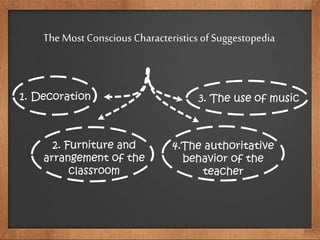
The Most Conscious Characteristics of Suggestopedia
1. Decoration
2. Furniture and
arrangement of the
classroom
3. The use of music
4.The authoritative
behavior of the
teacher
Suggestopedia
The Method has a somewhat mystical
air about it partially because it has few
direct links with established learning or
educational theory in the west, and
partially because of its arcane
terminology and neologisms, which one
critic has unkindly called a “package of
pseudo-scientific gobbledygook”
(Scovel 1979:258)
Suggestopedia can perhaps be best understood as one of
range of theories that purport to describe how
attentiveness is manipulated to optimize learning and recall.
A most conspicuous feature of Suggestopedia is the
centrality of music and musical rhythm to learning.
Suggestopedia thus has kinship with other functional uses
music, particularly therapy. One of the earliest attested
uses music therapy is recorded in the Old Testament
of the Bible.
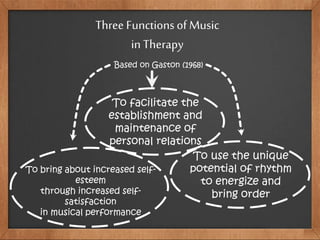
Three Functionsof Music
in Therapy
Based on Gaston (1968)
To facilitate the
establishment and
maintenance of
personal relations
To bring about increased self-
esteem
through increased self-
satisfaction
in musical performance
To use the unique
potential of rhythm
to energize and
bring order
The last function seems to be the
one that Lozanov calls upon in his
use of music to relax learners as well
as to structure, pace, and
punctuate the presentation of
linguistics material.
Approach
Theory of
Language
Theory of
Learning
Approach – Theory of Language
LOZANOV emphasize on
“whole meaningful text”
as acts of communication
“lighthearted text”
to be motivational
LOZANOV emphasize on
“narrow clinical concept of hypnosis as a
kind of static, sleep like, altered state
of consciousness“
that His method is different
from hypnosis and other forms of mind
control
Approach – Theory of Learning
6 PRINCIPALS:
AUTHORITY
The most of people remember best
and are most influenced by information
coming from an authoritative source
Approach – Theory of learning
Infantilization
Authority also used to suggest a
teacher-student relation like parent
and children
Approach – Theory of Language
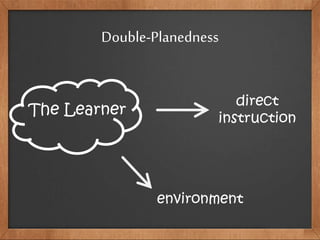
Double-Planedness
The Learner
direct
instruction
environment
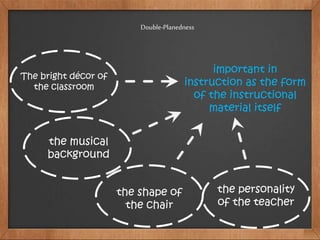
Double-Planedness
The bright décor of
the classroom
the musical
background
the shape of
the chair
the personality
of the teacher
important in
instruction as the form
of the instructional
material itself
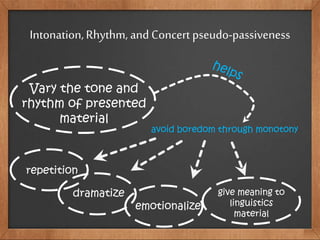
Intonation,Rhythm, and Concert pseudo-passiveness
Vary the tone and
rhythm of presented
material
avoid boredom through monotony
repetition
dramatize
emotionalize
give meaning to
linguistics
material
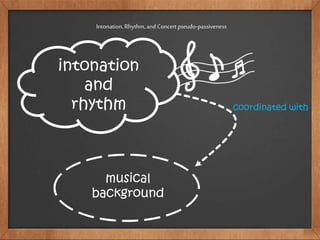
Intonation,Rhythm,and Concertpseudo-passiveness
intonation
and
rhythm coordinated with
musical
background
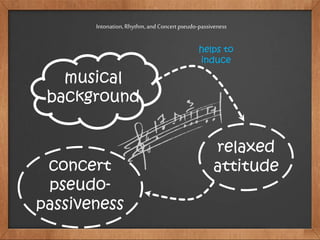
Intonation,Rhythm,and Concertpseudo-passiveness
musical
background
helps to
induce
relaxed
attitudeconcert
pseudo-
passiveness
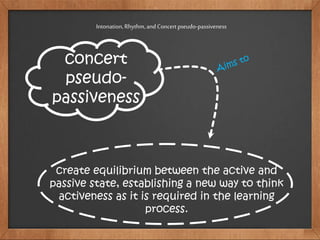
concert
pseudo-
passiveness
Intonation,Rhythm,and Concertpseudo-passiveness
create equilibrium between the active and
passive state, establishing a new way to think
activeness as it is required in the learning
process.
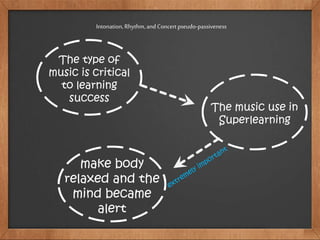
Intonation,Rhythm,and Concertpseudo-passiveness
The type of
music is critical
to learning
success
The music use in
Superlearning
make body
relaxed and the
mind became
alert
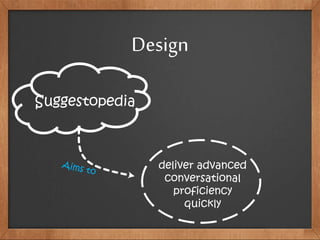
Design
Suggestopedia
deliver advanced
conversational
proficiency
quickly
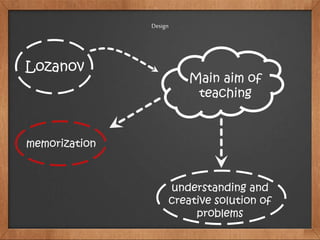
Design
Lozanov
Main aim of
teaching
memorization
understanding and
creative solution of
problems
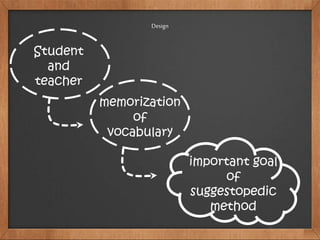
Design
Student
and
teacher
memorization
of
vocabulary
important goal
of
suggestopedic
method
The Syllabus
Lozanov
Only gives the
example of the
syllabus
The Syllabus
It’s still
classic
innovative
It’s not concern about
vocabulary or
grammar.
The Syllabus isn’t
structural
It emphasizes on
the communication
elements
The Syllabus
There should be the dialogue and the
translation
And there is a list of the vocabulary,
and the list of the dialogue
The Syllabus
The whole text will
cover all the
language aspects
Types of Learning and Teaching Activities
Activities more original to Suggestopedia
are the listening activities, which concern
the text and text vocabulary of each unit
typically part of the "pre-session phase,"
which takes place on the first day of a new unit.
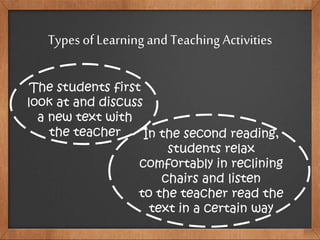
Types of Learning and Teaching Activities
The students first
look at and discuss
a new text with
the teacher In the second reading,
students relax
comfortably in reclining
chairs and listen
to the teacher read the
text in a certain way
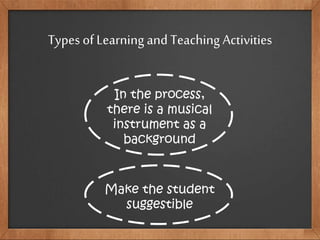
Types of Learning and Teaching Activities
In the process,
there is a musical
instrument as a
background
Make the student
suggestible
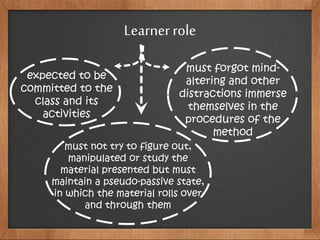
Learnerrole
expected to be
committed to the
class and its
activities
must forgot mind-
altering and other
distractions immerse
themselves in the
procedures of the
method
must not try to figure out,
manipulated or study the
material presented but must
maintain a pseudo-passive state,
in which the material rolls over
and through them
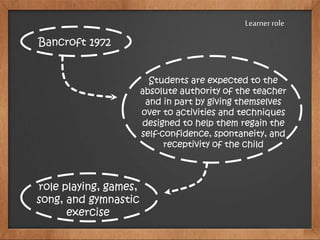
Learnerrole
Bancroft 1972
Students are expected to the
absolute authority of the teacher
and in part by giving themselves
over to activities and techniques
designed to help them regain the
self-confidence, spontaneity, and
receptivity of the child
role playing, games,
song, and gymnastic
exercise
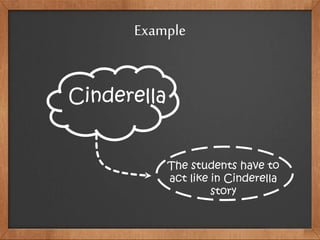
Example
Cinderella
The students have to
act like in Cinderella
story
Teacherroles
to create situation in which
the learners is most suggestible to
encourage positive reception
retention by the learner
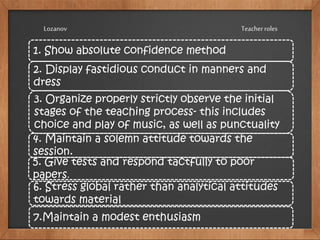
1. Show absolute confidence method
2. Display fastidious conduct in manners and
dress
3. Organize properly strictly observe the initial
stages of the teaching process- this includes
choice and play of music, as well as punctuality
4. Maintain a solemn attitude towards the
session.
5. Give tests and respond tactfully to poor
papers.
6. Stress global rather than analytical attitudes
towards material
7.Maintain a modest enthusiasm
TeacherrolesLozanov
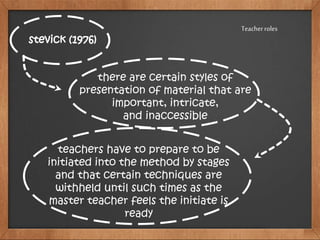
Teacherroles
stevick (1976)
there are certain styles of
presentation of material that are
important, intricate,
and inaccessible
teachers have to prepare to be
initiated into the method by stages
and that certain techniques are
withheld until such times as the
master teacher feels the initiate is
ready
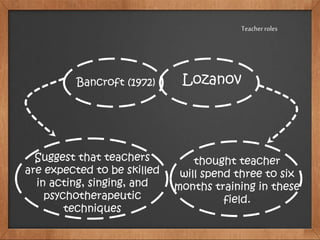
Teacherroles
Bancroft (1972) Lozanov
Suggest that teachers
are expected to be skilled
in acting, singing, and
psychotherapeutic
techniques
thought teacher
will spend three to six
months training in these
field.
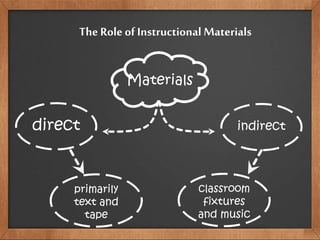
Materials
direct indirect
primarily
text and
tape
classroom
fixtures
and music
The Role of Instructional Materials
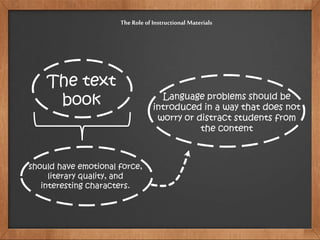
The text
book
should have emotional force,
literary quality, and
interesting characters.
The Role of Instructional Materials
Language problems should be
introduced in a way that does not
worry or distract students from
the content
The Role of Instructional Materials
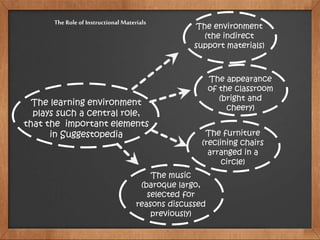
The learning environment
plays such a central role,
that the important elements
in Suggestopedia
The environment
(the indirect
support materials)
The appearance
of the classroom
(bright and
cheery)
The furniture
(reclining chairs
arranged in a
circle)
The music
(baroque largo,
selected for
reasons discussed
previously)
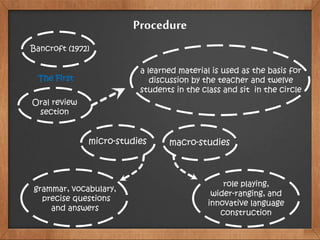
Procedure
Bancroft (1972)
The First
Oral review
section
a learned material is used as the basis for
discussion by the teacher and twelve
students in the class and sit in the circle
micro-studies macro-studies
role playing,
wider-ranging, and
innovative language
construction
grammar, vocabulary,
precise questions
and answers
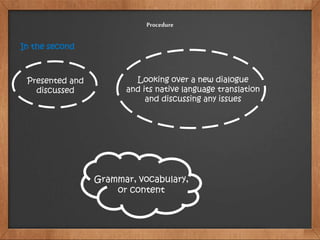
Procedure
In the second
Presented and
discussed
Looking over a new dialogue
and its native language translation
and discussing any issues
Grammar, vocabulary,
or content
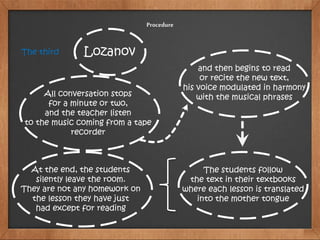
Lozanov
All conversation stops
for a minute or two,
and the teacher listen
to the music coming from a tape
recorder
At the end, the students
silently leave the room.
They are not any homework on
the lesson they have just
had except for reading
The students follow
the text in their textbooks
where each lesson is translated
into the mother tongue
The third
Procedure
and then begins to read
or recite the new text,
his voice modulated in harmony
with the musical phrases
Suggestopedia has probably both the most
enthusiastic and the most critical response of any of the
so-called new methods. Having acknowledged that three
are techniques and procedures in Suggestopedia that may
prove useful in a foreign language classroom. And yet
from Lozanov’s points of view, this air of science is what
gives Suggestopedia its authority in the eyes of students
and prepares them to expect success. Perhaps, then, it is
not productively to futher belabor the science/non-
science, data/double-talk issues and instead, as Bancroft
and Stevick have done, try to identify and validate those
techniques from Suggestopedia that appear effective
and that harmonize with other successful techniques in
the language teaching inventory.
Conclusion
Thank Yu !
Suggestopedia

Suggestopedia

  • 2.
    SuggestopediaGdMrning by: Bela Negara,Septiarani Pramasari, Satya Permadi, Ika Pradnyana, Gede Laskar, and Sony Wirawan English Education Department ©2011
  • 3.
    Background Suggestopedia A learning methodthat developed by Bulgarian psychiatrist-educator Georgi Lozanov.
  • 4.
    Suggestopedia Specific set of learning recommendations derivedfrom Suggestology Describes is a science concerned with the systematic study of the no rational and/or no conscious influences that human beings are constantly responding to (Stevick 1976:42).
  • 5.
    The Most ConsciousCharacteristics of Suggestopedia 1. Decoration 2. Furniture and arrangement of the classroom 3. The use of music 4.The authoritative behavior of the teacher
  • 6.
    Suggestopedia The Method hasa somewhat mystical air about it partially because it has few direct links with established learning or educational theory in the west, and partially because of its arcane terminology and neologisms, which one critic has unkindly called a “package of pseudo-scientific gobbledygook” (Scovel 1979:258)
  • 7.
    Suggestopedia can perhapsbe best understood as one of range of theories that purport to describe how attentiveness is manipulated to optimize learning and recall. A most conspicuous feature of Suggestopedia is the centrality of music and musical rhythm to learning. Suggestopedia thus has kinship with other functional uses music, particularly therapy. One of the earliest attested uses music therapy is recorded in the Old Testament of the Bible.
  • 8.
    Three Functionsof Music inTherapy Based on Gaston (1968) To facilitate the establishment and maintenance of personal relations To bring about increased self- esteem through increased self- satisfaction in musical performance To use the unique potential of rhythm to energize and bring order
  • 9.
    The last functionseems to be the one that Lozanov calls upon in his use of music to relax learners as well as to structure, pace, and punctuate the presentation of linguistics material.
  • 10.
  • 11.
    Approach – Theoryof Language LOZANOV emphasize on “whole meaningful text” as acts of communication “lighthearted text” to be motivational
  • 12.
    LOZANOV emphasize on “narrowclinical concept of hypnosis as a kind of static, sleep like, altered state of consciousness“ that His method is different from hypnosis and other forms of mind control Approach – Theory of Learning
  • 13.
    6 PRINCIPALS: AUTHORITY The mostof people remember best and are most influenced by information coming from an authoritative source Approach – Theory of learning
  • 14.
    Infantilization Authority also usedto suggest a teacher-student relation like parent and children Approach – Theory of Language
  • 15.
  • 16.
    Double-Planedness The bright décorof the classroom the musical background the shape of the chair the personality of the teacher important in instruction as the form of the instructional material itself
  • 17.
    Intonation,Rhythm, and Concertpseudo-passiveness Vary the tone and rhythm of presented material avoid boredom through monotony repetition dramatize emotionalize give meaning to linguistics material
  • 18.
  • 19.
  • 20.
    concert pseudo- passiveness Intonation,Rhythm,and Concertpseudo-passiveness create equilibriumbetween the active and passive state, establishing a new way to think activeness as it is required in the learning process.
  • 21.
    Intonation,Rhythm,and Concertpseudo-passiveness The typeof music is critical to learning success The music use in Superlearning make body relaxed and the mind became alert
  • 22.
  • 23.
  • 24.
  • 25.
    The Syllabus Lozanov Only givesthe example of the syllabus
  • 26.
    The Syllabus It’s still classic innovative It’snot concern about vocabulary or grammar.
  • 27.
    The Syllabus isn’t structural Itemphasizes on the communication elements The Syllabus
  • 28.
    There should bethe dialogue and the translation And there is a list of the vocabulary, and the list of the dialogue The Syllabus The whole text will cover all the language aspects
  • 29.
    Types of Learningand Teaching Activities Activities more original to Suggestopedia are the listening activities, which concern the text and text vocabulary of each unit typically part of the "pre-session phase," which takes place on the first day of a new unit.
  • 30.
    Types of Learningand Teaching Activities The students first look at and discuss a new text with the teacher In the second reading, students relax comfortably in reclining chairs and listen to the teacher read the text in a certain way
  • 31.
    Types of Learningand Teaching Activities In the process, there is a musical instrument as a background Make the student suggestible
  • 32.
    Learnerrole expected to be committedto the class and its activities must forgot mind- altering and other distractions immerse themselves in the procedures of the method must not try to figure out, manipulated or study the material presented but must maintain a pseudo-passive state, in which the material rolls over and through them
  • 33.
    Learnerrole Bancroft 1972 Students areexpected to the absolute authority of the teacher and in part by giving themselves over to activities and techniques designed to help them regain the self-confidence, spontaneity, and receptivity of the child role playing, games, song, and gymnastic exercise
  • 34.
    Example Cinderella The students haveto act like in Cinderella story
  • 35.
    Teacherroles to create situationin which the learners is most suggestible to encourage positive reception retention by the learner
  • 36.
    1. Show absoluteconfidence method 2. Display fastidious conduct in manners and dress 3. Organize properly strictly observe the initial stages of the teaching process- this includes choice and play of music, as well as punctuality 4. Maintain a solemn attitude towards the session. 5. Give tests and respond tactfully to poor papers. 6. Stress global rather than analytical attitudes towards material 7.Maintain a modest enthusiasm TeacherrolesLozanov
  • 37.
    Teacherroles stevick (1976) there arecertain styles of presentation of material that are important, intricate, and inaccessible teachers have to prepare to be initiated into the method by stages and that certain techniques are withheld until such times as the master teacher feels the initiate is ready
  • 38.
    Teacherroles Bancroft (1972) Lozanov Suggestthat teachers are expected to be skilled in acting, singing, and psychotherapeutic techniques thought teacher will spend three to six months training in these field.
  • 39.
  • 40.
    The text book should haveemotional force, literary quality, and interesting characters. The Role of Instructional Materials Language problems should be introduced in a way that does not worry or distract students from the content
  • 41.
    The Role ofInstructional Materials The learning environment plays such a central role, that the important elements in Suggestopedia The environment (the indirect support materials) The appearance of the classroom (bright and cheery) The furniture (reclining chairs arranged in a circle) The music (baroque largo, selected for reasons discussed previously)
  • 42.
    Procedure Bancroft (1972) The First Oralreview section a learned material is used as the basis for discussion by the teacher and twelve students in the class and sit in the circle micro-studies macro-studies role playing, wider-ranging, and innovative language construction grammar, vocabulary, precise questions and answers
  • 43.
    Procedure In the second Presentedand discussed Looking over a new dialogue and its native language translation and discussing any issues Grammar, vocabulary, or content
  • 44.
    Lozanov All conversation stops fora minute or two, and the teacher listen to the music coming from a tape recorder At the end, the students silently leave the room. They are not any homework on the lesson they have just had except for reading The students follow the text in their textbooks where each lesson is translated into the mother tongue The third Procedure and then begins to read or recite the new text, his voice modulated in harmony with the musical phrases
  • 45.
    Suggestopedia has probablyboth the most enthusiastic and the most critical response of any of the so-called new methods. Having acknowledged that three are techniques and procedures in Suggestopedia that may prove useful in a foreign language classroom. And yet from Lozanov’s points of view, this air of science is what gives Suggestopedia its authority in the eyes of students and prepares them to expect success. Perhaps, then, it is not productively to futher belabor the science/non- science, data/double-talk issues and instead, as Bancroft and Stevick have done, try to identify and validate those techniques from Suggestopedia that appear effective and that harmonize with other successful techniques in the language teaching inventory. Conclusion
  • 46.