Page 1
CHAPTER 4
(Property Management Systems)
Page 2
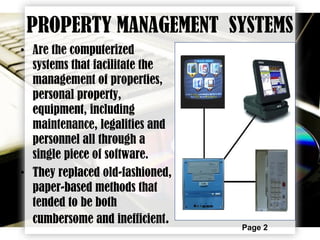
PROPERTY MANAGEMENT SYSTEMS
• Are the computerized
systems that facilitate the
management of properties,
personal property,
equipment, including
maintenance, legalities and
personnel all through a
single piece of software.
• They replaced old-fashioned,
paper-based methods that
tended to be both
cumbersome and inefficient.
Page 3
PMS IN THE HOSPITALITY INDUSTRY
• Hotels used a variety of computer systems to manage the
operations of their front office. Called a property
management system (PMS), these computer systems
manage a variety of tasks.
• A hotel PMS manages a guest’s check-in and checkout,
cash transactions at the front desk, reservations,
housekeeping, night audit and other tasks. The PMS
impacts the rooms division before, during and after the
arrival chronology.
• PMS’s by nature differ greatly. Due to the wide variety of
hotels currently in the market place, PMS’s have evolved
to meet the differing array of needs. Each hotel must
consider several factors that influence the type of PMS
they use before finding one that best fits their needs.
Page 4
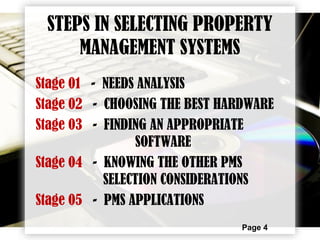
STEPS IN SELECTING PROPERTY
MANAGEMENT SYSTEMS
Stage 01 - NEEDS ANALYSIS
Stage 02 - CHOOSING THE BEST HARDWARE
Stage 03 - FINDING AN APPROPRIATE
SOFTWARE
Stage 04 - KNOWING THE OTHER PMS
SELECTION CONSIDERATIONS
Stage 05 - PMS APPLICATIONS
Page 5
Stage 01: NEEDS ANALYSIS
• Is a process where hotel owners and senior
managers determine the required scope of their
PMS needs.
– The needs analysis documents exactly what processes a
particular hotel will require from its PMS.
– Factors such as: Hotel size, product type, location, and
target market affect this analysis.
– The importance of needs analysis can be most clearly
seen when you consider what can go wrong if such an
analysis is not made. The first area of concern for
property owners and managers is cost, both initially
and over the long term.
Page 6
Procedure for Performing a Needs
Analysis:
• Select a Team to analyze needs
• Analyze the flow of guests through the lodging
property.
– Reservations
– Registration
– Guest Accounting
– Checkout
– Night Audit
– Guest History
Page 7
Continuation:
• Analyze the flow of information from other
departments to the front office.
• Analyze the administrative paperwork produced
in other departments.
• Review the information gathered in steps 2, 3,
and 4.
• Evaluate the needs that have been identified –
such as control reports, communication, and
administrative paperwork produced in other
departments – in terms of importance.
• Combine needs to determine desired applications.
Page 8
Stage 02: CHOOSING THE BEST
HARDWARE
– Choosing hardware for a PMS is not as difficult as
choosing software. Today most available hardware
is compatible with standard computer operating
systems (such as Microsoft Windows).
– This consideration is essential because most
software programs are written to run on these
standard operating systems.
– In short, you must choose your hardware based on
its ability to handle the software; check on this with
your hardware vendor.
Page 9
– Other technology factors to consider include the
following working concepts:
• PROCESSOR SPEED – How fast a central
processing unit (CPU) makes calculations per
second; expressed in MH (abbreviation for
“megahertz”)
• DISK DRIVE – A place in the computer where
data is stored or read; hard or floppy – 3-½
inch versus Zip Drive.
• MEMORY
– MEGABYTE – 1,024 Kilobytes of formatted capacity
– GIGABYTE – 1,024 Megabytes of formatted capacity
Continuation:
Page 10
• ACCESS TIME – the amount of time required for a
processor to retrieve information from the hard
drive; recorder in milliseconds.
• INTERNET – a network of computer systems that
share information over high – speed electronic
connections.
• I / O PORTS – (input / output devices) such as:
keyboards, monitors, modems, mouse, joysticks,
printers, and track balls
Continuation:
Page 11
• MONITOR – a television screen with color or
monochrome capacity to view input and output
data, control column width and line length of
display, adjust height of character display, and
allow visual control.
• MODEM – computer hardware that allows for
transfers of data through telephone lines;
expressed in baud – information transfer – rates.
Continuation:
Page 12
Stage 03: FINDING AN APPROPRIATE
SOFTWARE
– Selecting software, computer-designed
applications that process data such as guest
information and aid in financial transactions and
report generation, is more important than
selecting hardware, computer equipment such as:
Central Processing Units, keyboards, Monitors, and
Printers.
– The effectiveness of a PMS depends on selecting
software that allows management to increase
guest satisfaction and to access financial and
informational data for control purposes.
Page 13
– The information obtained from the needs
analysis will provide a framework for evaluating
the numerous software packages on the market
today
– Each software package offers numerous features;
it is important to choose one package that is
most appropriate for your needs. Software
packages on the market today include those
guest services, accounting, and information
options that are standard in the hotel industry.
Continuation:
Page 14
– Example of Software / Program uses by
different companies are the ff:
• COBOL Programming
• TURBO – C Programming
• ICBS / KAPITI SYSTEM
• FISERVE – Alliance (Branch Teller)
• MICROS FIDELIO / MICROS OPERA
Continuation:
Page 15
Stage 04: KNOWING THE OTHER PMS
SELECTION CONSIDERATIONS
Other factors to consider in choosing a PMS
are the ff:
 VENDOR CLAIMS – The prospective PMS purchaser
should contact current users of the system being
considered and ask relevant questions such as:
– How easy is it to operate this system?
– How useful are the reports you obtain?
– Is it worthy to purchase this system?
– Do we have a warranty and etc.?
Page 16
 HARDWARE INSTALLATION PLANS – A careful plan for
hardware installation will help the management
maintain guest service and employee morale.
– First, it is key to determine who will install writing or
cables.
– Next, to determined is which hardware will be installed
and at what times,
– Followed by which departments will receive hardware
first, and what methods will be required to get all
departments of the property on-line, (term used to
indicate that a computer should be used to develop a
flow chart, which will help departments adapt and
interact using on-line operations.
Continuation:
Page 17
 COMPUTER TRAINING PROGRAMS – The training
offered by a computer company ranges from
classes held at the corporate head quarters to on-
the-job training sessions and informal consultant
hot lines.
– The staff that will use the computers must be thoroughly
trained if the equipment is to be put to its best use.
– Training at the terminals should be preceded by an
explanation of how the system will help staff members in
their work.
– Some computer companies will lend dummy computer setup
to a lodging property so that staff can experiment with the
training modules. This allows them to make mistakes in
private and to become familiar with the keyboard
configuration.
Continuation:
Page 18
 BACKUP POWER SOURCES – What happens if the
power goes out? This concern, as well as the
possibility of brownouts and black outs has been
addressed by computer dealers. 
•  Brownouts – partial loss of electricity;
• Blackouts – total loss of electricity;
 BATTERY – powered temporary energy units are
used when power is lost or cut, to ensure that
operational data are not lost.
Continuation:
Page 19
 MAINTENANCE – adopting PMS is the maintenance
agreement, which should spell out the related
costs of repair and replacement of hardware and
software.  
– Allowance for emergency service and times
available for general service should also be listed.
 FINANCIAL CONSIDERATIONS – purchasing or leasing
a PMS for hotel use is a major financial decision.
Such an investment can tie up cash flow. If the
costs and benefits are not realistically projected,
profits may be in jeopardy.
Continuation:
Page 20
– After doing the first four steps, the application of
PMS is followed.
– After a very careful study for the needs of PMS,
finding an appropriate software or program to
be used, choosing the best hardware for your
business, and taking other considerations or
factors that might affect the PMS, you are now
finally equipped and ready to run the business of
your choice by applying your successful PMS
(Property Management System.)
Stage 05: PMS APPLICATIONS

PROPERTY MANAGEMENT SYSTEM

  • 1.
    Page 1 CHAPTER 4 (PropertyManagement Systems)
  • 2.
    Page 2 PROPERTY MANAGEMENTSYSTEMS • Are the computerized systems that facilitate the management of properties, personal property, equipment, including maintenance, legalities and personnel all through a single piece of software. • They replaced old-fashioned, paper-based methods that tended to be both cumbersome and inefficient.
  • 3.
    Page 3 PMS INTHE HOSPITALITY INDUSTRY • Hotels used a variety of computer systems to manage the operations of their front office. Called a property management system (PMS), these computer systems manage a variety of tasks. • A hotel PMS manages a guest’s check-in and checkout, cash transactions at the front desk, reservations, housekeeping, night audit and other tasks. The PMS impacts the rooms division before, during and after the arrival chronology. • PMS’s by nature differ greatly. Due to the wide variety of hotels currently in the market place, PMS’s have evolved to meet the differing array of needs. Each hotel must consider several factors that influence the type of PMS they use before finding one that best fits their needs.
  • 4.
    Page 4 STEPS INSELECTING PROPERTY MANAGEMENT SYSTEMS Stage 01 - NEEDS ANALYSIS Stage 02 - CHOOSING THE BEST HARDWARE Stage 03 - FINDING AN APPROPRIATE SOFTWARE Stage 04 - KNOWING THE OTHER PMS SELECTION CONSIDERATIONS Stage 05 - PMS APPLICATIONS
  • 5.
    Page 5 Stage 01:NEEDS ANALYSIS • Is a process where hotel owners and senior managers determine the required scope of their PMS needs. – The needs analysis documents exactly what processes a particular hotel will require from its PMS. – Factors such as: Hotel size, product type, location, and target market affect this analysis. – The importance of needs analysis can be most clearly seen when you consider what can go wrong if such an analysis is not made. The first area of concern for property owners and managers is cost, both initially and over the long term.
  • 6.
    Page 6 Procedure forPerforming a Needs Analysis: • Select a Team to analyze needs • Analyze the flow of guests through the lodging property. – Reservations – Registration – Guest Accounting – Checkout – Night Audit – Guest History
  • 7.
    Page 7 Continuation: • Analyzethe flow of information from other departments to the front office. • Analyze the administrative paperwork produced in other departments. • Review the information gathered in steps 2, 3, and 4. • Evaluate the needs that have been identified – such as control reports, communication, and administrative paperwork produced in other departments – in terms of importance. • Combine needs to determine desired applications.
  • 8.
    Page 8 Stage 02:CHOOSING THE BEST HARDWARE – Choosing hardware for a PMS is not as difficult as choosing software. Today most available hardware is compatible with standard computer operating systems (such as Microsoft Windows). – This consideration is essential because most software programs are written to run on these standard operating systems. – In short, you must choose your hardware based on its ability to handle the software; check on this with your hardware vendor.
  • 9.
    Page 9 – Othertechnology factors to consider include the following working concepts: • PROCESSOR SPEED – How fast a central processing unit (CPU) makes calculations per second; expressed in MH (abbreviation for “megahertz”) • DISK DRIVE – A place in the computer where data is stored or read; hard or floppy – 3-½ inch versus Zip Drive. • MEMORY – MEGABYTE – 1,024 Kilobytes of formatted capacity – GIGABYTE – 1,024 Megabytes of formatted capacity Continuation:
  • 10.
    Page 10 • ACCESSTIME – the amount of time required for a processor to retrieve information from the hard drive; recorder in milliseconds. • INTERNET – a network of computer systems that share information over high – speed electronic connections. • I / O PORTS – (input / output devices) such as: keyboards, monitors, modems, mouse, joysticks, printers, and track balls Continuation:
  • 11.
    Page 11 • MONITOR– a television screen with color or monochrome capacity to view input and output data, control column width and line length of display, adjust height of character display, and allow visual control. • MODEM – computer hardware that allows for transfers of data through telephone lines; expressed in baud – information transfer – rates. Continuation:
  • 12.
    Page 12 Stage 03:FINDING AN APPROPRIATE SOFTWARE – Selecting software, computer-designed applications that process data such as guest information and aid in financial transactions and report generation, is more important than selecting hardware, computer equipment such as: Central Processing Units, keyboards, Monitors, and Printers. – The effectiveness of a PMS depends on selecting software that allows management to increase guest satisfaction and to access financial and informational data for control purposes.
  • 13.
    Page 13 – Theinformation obtained from the needs analysis will provide a framework for evaluating the numerous software packages on the market today – Each software package offers numerous features; it is important to choose one package that is most appropriate for your needs. Software packages on the market today include those guest services, accounting, and information options that are standard in the hotel industry. Continuation:
  • 14.
    Page 14 – Exampleof Software / Program uses by different companies are the ff: • COBOL Programming • TURBO – C Programming • ICBS / KAPITI SYSTEM • FISERVE – Alliance (Branch Teller) • MICROS FIDELIO / MICROS OPERA Continuation:
  • 15.
    Page 15 Stage 04:KNOWING THE OTHER PMS SELECTION CONSIDERATIONS Other factors to consider in choosing a PMS are the ff:  VENDOR CLAIMS – The prospective PMS purchaser should contact current users of the system being considered and ask relevant questions such as: – How easy is it to operate this system? – How useful are the reports you obtain? – Is it worthy to purchase this system? – Do we have a warranty and etc.?
  • 16.
    Page 16  HARDWAREINSTALLATION PLANS – A careful plan for hardware installation will help the management maintain guest service and employee morale. – First, it is key to determine who will install writing or cables. – Next, to determined is which hardware will be installed and at what times, – Followed by which departments will receive hardware first, and what methods will be required to get all departments of the property on-line, (term used to indicate that a computer should be used to develop a flow chart, which will help departments adapt and interact using on-line operations. Continuation:
  • 17.
    Page 17  COMPUTERTRAINING PROGRAMS – The training offered by a computer company ranges from classes held at the corporate head quarters to on- the-job training sessions and informal consultant hot lines. – The staff that will use the computers must be thoroughly trained if the equipment is to be put to its best use. – Training at the terminals should be preceded by an explanation of how the system will help staff members in their work. – Some computer companies will lend dummy computer setup to a lodging property so that staff can experiment with the training modules. This allows them to make mistakes in private and to become familiar with the keyboard configuration. Continuation:
  • 18.
    Page 18  BACKUPPOWER SOURCES – What happens if the power goes out? This concern, as well as the possibility of brownouts and black outs has been addressed by computer dealers.  •  Brownouts – partial loss of electricity; • Blackouts – total loss of electricity;  BATTERY – powered temporary energy units are used when power is lost or cut, to ensure that operational data are not lost. Continuation:
  • 19.
    Page 19  MAINTENANCE– adopting PMS is the maintenance agreement, which should spell out the related costs of repair and replacement of hardware and software.   – Allowance for emergency service and times available for general service should also be listed.  FINANCIAL CONSIDERATIONS – purchasing or leasing a PMS for hotel use is a major financial decision. Such an investment can tie up cash flow. If the costs and benefits are not realistically projected, profits may be in jeopardy. Continuation:
  • 20.
    Page 20 – Afterdoing the first four steps, the application of PMS is followed. – After a very careful study for the needs of PMS, finding an appropriate software or program to be used, choosing the best hardware for your business, and taking other considerations or factors that might affect the PMS, you are now finally equipped and ready to run the business of your choice by applying your successful PMS (Property Management System.) Stage 05: PMS APPLICATIONS