Unit 5: Frontoffice computer system
Introduction
• The intention of this chapter is to understand the uses of
computers in front office operations.
• In today’s modern hotel, computerization is becoming more
important for the efficient and effective operation of the front
office.
• For example, the adoption of an overbooking policy requires
data on: previous guest stays and their status, trends, number of
no-shows, non-guaranteed bookings and possible late
cancelations.
• The use of computers can assist front office management with
their short and long-term planning of such strategies and
policies.
3.
Since thefront office contributes major portion in
coordinating the services requested by the guests, it
needs a information system that can help the front
office staff to sell services.
3
Con’t
4.
• Apart fromperforming basic operations, the system is capable of
automatically
• Generating information,
• Posting charges to guest’s account and,
• Balancing its own functions.
• This doesn’t mean that the receptionist or cashier is no longer
necessary.
5.
5
A PropertyManagement System (PMS) is a software system
employed to handle basic objectives of all the departments in the
hotel business and coordinate functions between them for optimum
business outcomes.
The most known PMS are: CNET, IDS, OPERA, AMADEUS,
FIDELIO, SHAWMAN etc.
CNET: Ethiopian software system. Used in small and medium sized
hotels. All front office activities are the featured in CNET.
It is also interface with other outlets/POS of the hotel
Property Management System?
6.
6
AMADEUS
Integrated with FrontOffice, sales and marketing,
and financial management functions. It allows the
user to move faster in all core aspects of guest
experience management.
FIDELIO
Fidelio hotel management software is a completely
integrated system package.
It is a highly flexible system.
Property Management System…
7.
7
SHAW MAN PMS
TheShaw Man PMS is an integrated Front Office
Management Software that can host multiple
properties and handle guest reservations
simultaneously across many units including an
integrated web-based reservation agent and auto
confirmation manager.
Shaw Man’s PMS plugs into an Integrated
Telephone Call Management System.
Property Management System…
8.
IDS PMS
IDSstands for internet distribution system which refers to the
portals that offers online reservation and bookings.
IDS is an online portal it offers numerous choices to the travel
agents and also provides hotels with better visibility on internet.
IDS for hotels is highly recommended for the small and midsize
hotel
The IDS for hotels connects your hotel with around many online
travel portals including some popular hotel booking websites like
Expedia, Orbitz, Hotwire, Travel Now, Travelocity, Booking.com,
hotels.de, hotels.com, Agoda, Priceline, Lastminute.com and many
more.
8
Property Management System…
9.
9
OPERA PMS
The Opera Hotel Program is a property
management system (PMS) solution fit for all sizes
and types of hotels.
It automatizes basic front office services such as
reservation, check-in and check-out therefore
saving time, as well as reduces human error.
Furthermore, it provides detailed reports regarding
personnel and workflows in the facility.
Property Management System…
10.
A PMSis required for the hotel staff for the following reasons:
It integrates all critical operations of the hotel on one
platform.
It provides real-time information on accommodations,
reservations, restaurants, spas, bars, and about every
working arm of the hotel.
It boosts the efficiency of the front office staff
It maximizes the performance of the hotel business.
It simplifies the time-taking or complex operations.
It reduces the chance of errors
It works for the convenience of the hotel staff, as well as
the guests. 10
Why is PMS Required?
11.
11
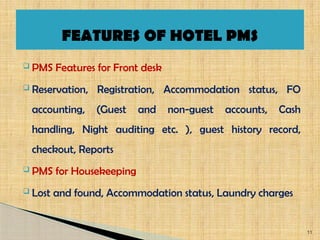
PMS Featuresfor Front desk
Reservation, Registration, Accommodation status, FO
accounting, (Guest and non-guest accounts, Cash
handling, Night auditing etc. ), guest history record,
checkout, Reports
PMS for Housekeeping
Lost and found, Accommodation status, Laundry charges
FEATURES OF HOTEL PMS
12.
12
PMS forFood and Beverage: POS sales and
posting, waiter’s order taking ticket, Material
inventory, Periodic sales reports, Standard recipes
PMS for HRM Department: Individual staff
member’s records, Shifts management, attendance,
and appraisals.
PMS for Accounts: All accounting activities, like loss
and profit statement, reports, weekly/monthly/annual
financial summery, balance sheet, payroll etc.
FEATURES OF HOTEL PMS
13.
13
PMS for Spa:spa cashiering, reservation,
posting, etc.
PMS for sales and marketing: to record all
marketing activities like Guest database for
market segmentation, Guest history, Travel
agents information as clients, Reports for goals
FEATURES OF HOTEL PMS
14.
14
Vendor Claims:The prospective PMS purchaser
should contact current users of the system being
considered and ask relevant questions: How easy is it
to operate this system?
Budget: A small hotel may want to opt for a
local, lesser known brand for the cost
constraints while bigger hotels may opt for
well-known brands as they can afford it.
Factors to be considered when Selecting a PMS
15.
15
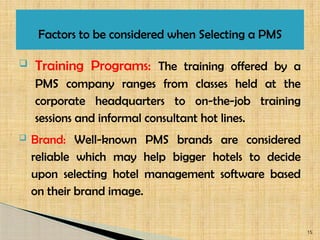
Training Programs:The training offered by a
PMS company ranges from classes held at the
corporate headquarters to on-the-job training
sessions and informal consultant hot lines.
Brand: Well-known PMS brands are considered
reliable which may help bigger hotels to decide
upon selecting hotel management software based
on their brand image.
Selecting a Property Management System…
Factors to be considered when Selecting a PMS
16.
16
Ease ofInstallation: Hotel’s operate 24hrs a day and 7 days
a week, so any disruption in the continuous operation of its
PMS can affect the hotel and its guests.
Before selecting a new PMS, the FOM should thoroughly
investigate the amount of time required in the installation.
Ease of Use: New FO employees must learn how to use the
PMS.
The ease with which they can learn the system is a factor in
reducing training costs and increasing the pace at which new
employees become comfortable operating the system.
Factors to be considered when Selecting a PMS
17.
17
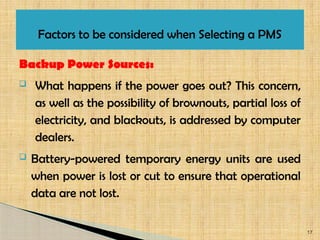
Backup Power Sources:
What happens if the power goes out? This concern,
as well as the possibility of brownouts, partial loss of
electricity, and blackouts, is addressed by computer
dealers.
Battery-powered temporary energy units are used
when power is lost or cut to ensure that operational
data are not lost.
Factors to be considered when Selecting a PMS
18.
18
Maintenance Agreement:Spell out the related costs of
repair and replacement of hardware and software.
For emergency service and times available for general
service, Backup equipment availability should also be
listed.
Size of the property:
Factors to be considered when Selecting a PMS
19.
19
Ease andFrequency of Upgrading: Hardware and
software upgrades are routinely issued by
manufacturers that significantly improve the
operational effectiveness of a PMS
FOMs should anticipate significant increases in
demand for up gradation, memory, and speed and
should provide for the same at the time of
procurement.
Factors to be considered when Selecting a PMS
20.
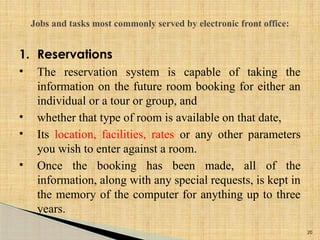
1. Reservations
• Thereservation system is capable of taking the
information on the future room booking for either an
individual or a tour or group, and
• whether that type of room is available on that date,
• Its location, facilities, rates or any other parameters
you wish to enter against a room.
• Once the booking has been made, all of the
information, along with any special requests, is kept in
the memory of the computer for anything up to three
years.
20
Jobs and tasks most commonly served by electronic front office:
21.
2. Yield management
•Yield management is a room management
technique which has been adapted from airlines to
suit the hotel industry.
• Its main purpose is to maximize room occupancy
while at the same time realizing the best average
room rate.
• A computerized yield management system enables
the reservations clerk to make the best choices as
to what rooms to take and at what price.
22.
• The systemgives the ability to instantly analyze the
profit potential of each booking.
• This is done by adjusting the room rate to suite the
need for rooms at any particular time. So that:
• an accurate assessment of room needs can be made,
• low and high demand periods,
• This information, along with knowledge of local
activities, can assist the sales and booking clerks to
see at a glance all of the ‘ what if …’ possibilities, not
just for day-to-day operation, but well into the future.
23.
3. Registration
• Thereceptionist - call up the information taken
during reservation.
• The guest’s registration card, confirms all of the
details with the guest.
• This procedure will obviously save time for each
guest upon check-in, and in turn reduce the queues
which tend to form at busy times.
24.
4. Energy management
•An energy management system/EMS/ is a system designed to
control automatically the operation of mechanical
equipment in a hotel,
• so as to achieve the optimum savings on utilities such as gas
and electricity.
• This system determines when equipment such as heating, air
conditioning and ventilation can be turned on or off, or
regulated up or down.
• When the guest enters the room they insert their key into a
special socket located next to the door.
25.
• This notifiesthe energy system to activate all
power to that room - the room lights can be
turned on and the room ventilation system works.
• When the guest leaves the room, the system will
automatically shut down after a short delay
period.
• The front office staff should notify the guest upon
arrival that the hotel has an energy management
system.
• They must also explain that the electricity and
room ventilation system have to be operated by
inserting the key into the slot by the door.
26.
5. Call AccountingSystem
• CAS can also be interfaced to the hotel’s main front
office computer or it may operate as a stand-alone
system. A CAS handles:
• all local and international telephone calls and
• automatically charges all of the appropriate costs to the
guest’s folio.
• the guest can call direct from their room without
having to go through the hotel operator;
27.
6. Electronic point-of-sale/EPOS/system
• Another interface to the front office system is that of
an electronic point-of-sale system.
• This is made up of a number of computerized cash
registers, better known as terminals, commonly found
in the food and beverage departments of a hotel.
• The interface of the food and beverage EPOS system
allows instantaneous and automatic transfer of
charges to the guest’s account.
28.
7. Check-out
• Thehotel computer system greatly helps to reduce the chore of the
guest check-out procedures.
• It prints, in a matter of seconds, an accurate, neat and complete
guest folio.
• A computerized system also helps to reduce the check-out
queues, which is a common complaint found in many hotels.
• The system does so by speeding up the settlement process by
offering such facilities as:
• a constant monitoring of house and credit limits,
• A fully automatic ‘in-room’ check-out system directly
29.
8. Audit
• Thework of audit clerk is often conducted through
the night and labor-intensive.
It requires:
• posted entries to be verified,
• accounts to be balanced,
• the cash flow to be checked,
• any room discrepancies to be resolved as well as
acting as a front desk clerk.
30.
9. Reporting
• Oneof the features of front office computer system is the
ability to retrieve and print relevant reports for
management, other departments and other sections of
the front office department, such as cashiers, mail and
information, reservations and so on.
• The amount and type of reporting can vary considerably;
• E.g. the housekeeping may require an up-to-date list of
all the day’s check-ins and check-outs, or
• the front office manager may require an hourly report of
the room status from the front desk or even current status
from the housekeeping department.
31.
• The reportprogram on a front office computer system enables
management to have an accurate idea of the current state of
affairs of the hotel’s operation. Other relevant reports can
include the following:
• No-show report
• Today’s arrival report
• Today’s departure report
• VIP report
• Housekeeping report
• Night audit report etc.
Many other reports, particular to an individual hotel, can be
programmed to be printed, based upon the needs of the
individual management requirements.
32.
32
1) Voice search:
isa growing technology trend within hospitality
because a growing number of guests or customers
are turning to voice search in order to find hotels,
restaurants and cafes, so it is worth taking the time
to properly capitalize on this.
To do so, you will need to make sure your website
and booking engine are structured so that the voice
search can be used properly.
The Latest Technology Trends in
the Hospitality Industry
33.
33
2. ContactlessPayments
Aside from speeding up payments and improving customer
satisfaction, contactless tech is also easily compatible with
loyalty programs.
Mobile contactless payments are possible even if customers
do not have their wallets with them, or even if their credit
card has been misplaced.
Additionally, with COVID firmly in the minds of hotel guests
and other hospitality customers, contactless payments can
also offer an excellent way to reduce human-to-human
contact.
The Latest Technology Trends in the
Hospitality Industry
34.
34
3. Robots inHotels
One of the most exciting technology trends the
hospitality industry is getting to grips with is the rise
of robotics and the use of robots to carry out tasks
traditionally performed by humans.
For instance, robots can occupy a concierge role
within hotels, welcoming guests and providing them
with important customer information.
Similarly, some hotels have started to use robots for
cleaning purposes, such as vacuum cleaning floors.
The Latest Technology Trends in the
Hospitality Industry
35.
35
4. Virtual Reality
In particular, this can make the difference at the stage when
customers are ready to make a booking, because it will give
potential customers a much clearer sense of what they can
expect when they visit for real.
During the COVID pandemic, those working in hospitality
marketing have a particularly good opportunity to capitalize
on virtual reality technology and gain an edge on rivals,
because it provides customers with the ability to experience
elements of a hotel or to see the layout of a restaurant prior to
booking.
The Latest Technology Trends in the Hospitality
Industry
36.
36
5. Recognition Technology
Forexample, imagine if a fingerprint or facial
recognition technology could be used in your hotel to
unlock rooms.
Now consider the uses of the same technology for
check-in and check-out purposes.
Example: Facial Recognition Check-in in Marriott
China
The Latest Technology Trends in the Hospitality Industry