Chapter 4:

Reservations
Reservations
• -The act of reserving; a keeping or withholding.
• -Booking in advance.
• -Something that is kept back or withheld.
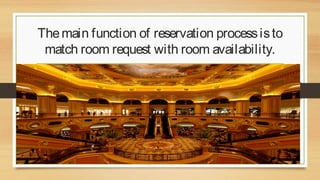
The main function of reservation process is to
match room request with room availability.
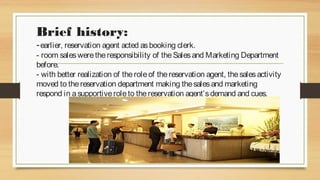
Brief history:

- earlier, reservation agent acted as booking clerk.

- room sales were the responsibility of the Sales and Marketing Department
before.
- with better realization of the role of the reservation agent, the sales activity
moved to the reservation department making the sales and marketing
respond in a supportive role to the reservation agent’s demand and cues.
Process of
reservations:
•
•
•
•
•
•
•

1.) receive reservation

2.) determining the room availability
3.) accepting or denying request
4.) documenting the reservation details
5.) confirming the reservation
6.) maintaining the reservation record
7.) compiling the reservation report
Reservation
terminology
Reservation terminologies:
• Allowances- Daily cash paid-outs to airline crews as negotiated crews as negotiated
with the airlines and recovered from them at later date.
• Amendments- Changes made of records concerning his/her stay.

•
•
•
•
•
•
•
•

Cancellation- A confirmed booking that has been confirmed in writing by a guest.
Confirmation- A room reservation that has been confirmed in writing by a guest.
Double occupancy- Two guest staying in a room.
Group- Any body of guest above 15 persons who travel together.
Guaranteed booking- A room booking that is confirmed in writing by a guest.
Guest- A client of the hotel.
F
orecast- A studied anticipation of room business.
F
ree sale- Rooms that is available for booking.
Reservation
terminologies:

• FIT- Stands for “ Free Individual Traveler” who is an independent guest who does not use
the services of middlemen for booking his/her room.

• GIT- Group Inclusive Tour
• L
ay-over- Airline passengers checked in by airlines who are catching a connecting flight
sometime later.

• On-request- a status when guest are kept waiting for a room booking confirmation.
• Overbooking- Booking rooms that are beyond the hotel room capacity.
• Pax- Person
• Revision- Change in booking instructions.
• Room availability- The room position when rooms are available for sale.
• Room blocking- Blocking a room in the reservation chart.
Reservation
terminologies:

• Room night- a charge for a one night occupation, spanning two days from noon to noon.
• Sale- a room space sold.

• Sold out- a status in which all rooms in the hotel are sold.
• Single occupancy- one guest staying in a room.
• Waitlist- a guest awaiting a confirmation of the room booking.
• Charge- is a financial obligation for a product or service during a guest stay.
• Fences- rate rules that may include restrictions such as advance booking cutoffs or nonrefundable payments.

• L
itigious society- an environment in which consumers sue providers and services for
not delivering them according to expected operating standards.

• L charges- guest charges that might not be included on the guest folio because of a
ate
delay in posting by other department.
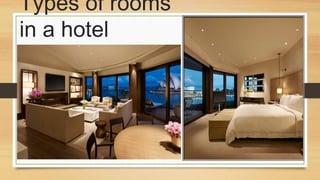
Types of rooms
in a hotel
k
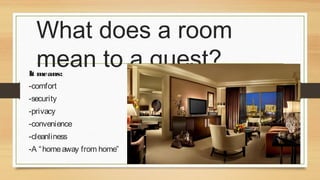
What does a room
mean to a guest?

It means:
-comfort
-security
-privacy

-convenience
-cleanliness
-A “ home away from home”
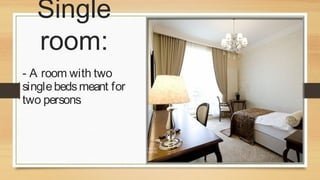
Single
room:
- A room with two
single beds meant for
two persons.
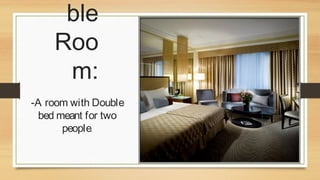
ble
Roo
m:
-A room with Double
bed meant for two
people.
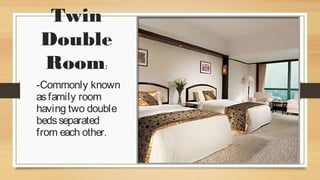
Twin
Double
Room:
-Commonly known
as family room
having two double
beds separated
from each other.
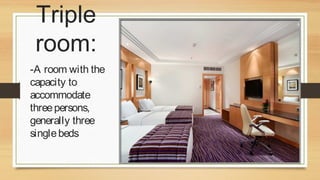
Triple
room:
-A room with the
capacity to
accommodate
three persons,
generally three
single beds
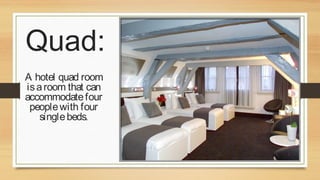
Quad:
A hotel quad room
is a room that can
accommodate four
people with four
single beds.
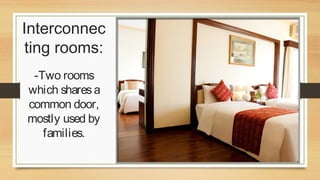
Interconnec
ting rooms:
-Two rooms
which shares a
common door,
mostly used by
families.
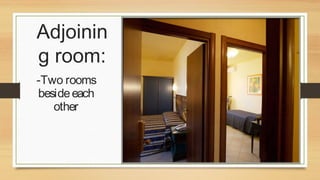
Adjoinin
g room:
-Two rooms
beside each
other
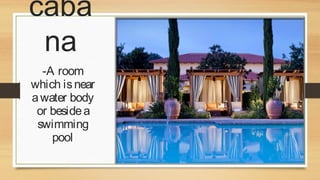
caba
na
-A room
which is near
a water body
or beside a
swimming
pool
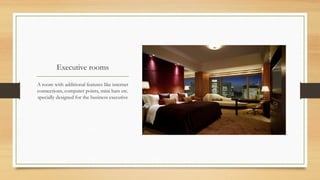
Executive rooms
A room with additional features like internet
connections, computer points, mini bars etc.
specially designed for the business executive
suites
• A suite in a hotel or other public accommodation denotes a class of luxury
accommodations, the key feature of which is multiple rooms.
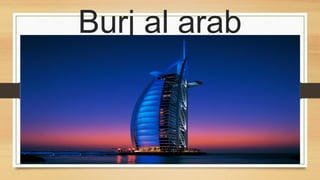
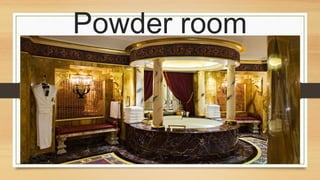
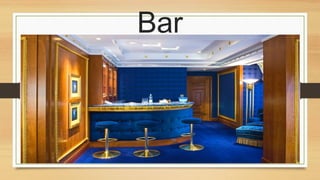
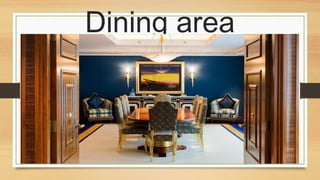
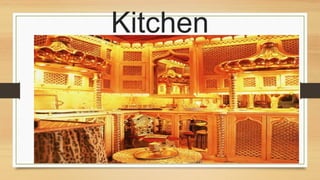
Burj al arab
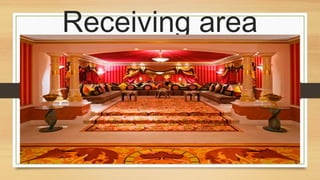
Receiving area
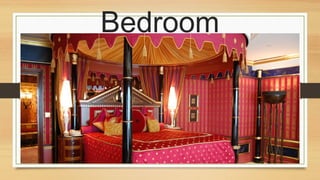
Bedroom
Powder room
Bar
Dining area
Kitchen
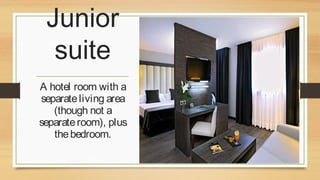
Junior
suite
A hotel room with a
separate living area
(though not a
separate room), plus
the bedroom.
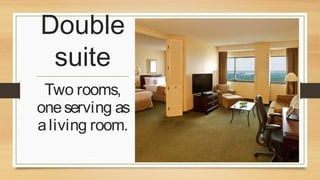
Double
suite
Two rooms,
one serving as
a living room.
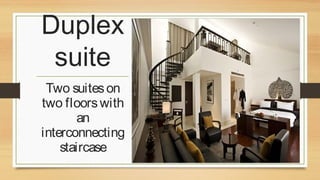
Duplex
suite
Two suites on
two floors with
an
interconnecting
staircase
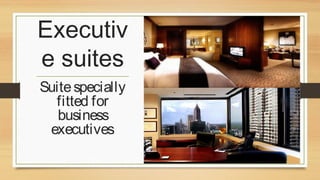
Executiv
e suites
Suite specially
fitted for
business
executives
.
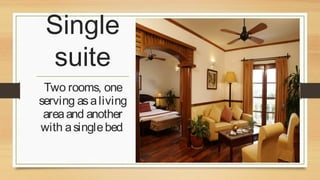
Single
suite
Two rooms, one
serving as a living
area and another
with a single bed.
Presidential suite
• Presidential suite and Royal suite are common

names for the most expensive suite in a luxury
hotel.

• a suite of rooms, as in a hotel, suitable for a
president or other head of state.
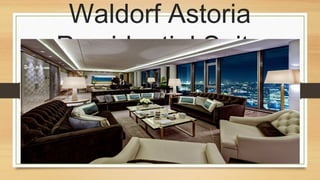
Waldorf Astoria
Presidential Suite
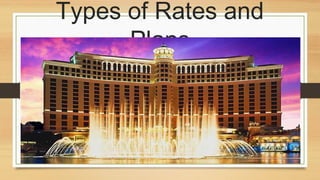
Types of Rates and
Plans
Rates

W
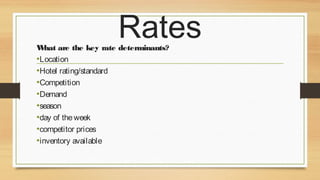
hat are the key rate determinants?
•Location
•Hotel rating/standard
•Competition
•Demand
•season
•day of the week
•competitor prices 
•inventory available
What Is a
Hotels Rack
Rate?

• A rack rate is a term that describes the frequently
inflated prices, which a person pays at a hotel
when he deals with the hotel directly when
booking a room. Basically, if you enquired for a
room for a night personally, you may pay more.
The payment can even be twice or thrice.
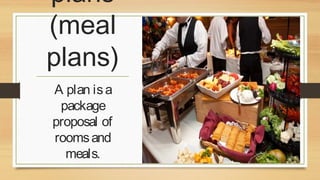
plans
(meal
plans)
A plan is a
package
proposal of
rooms and
meals.
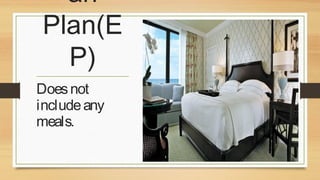
an
Plan(E
P)
Does not
include any
meals.
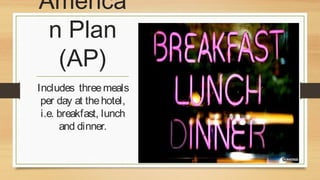
America
n Plan
(AP)
Includes three meals
per day at the hotel,
i.e. breakfast, lunch
and dinner.
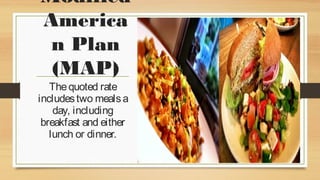
Modified
America
n Plan
(MAP)

The quoted rate
includes two meals a
day, including
breakfast and either
lunch or dinner.
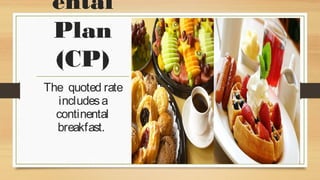
ental
Plan
(CP)
The quoted rate
includes a
continental
breakfast.
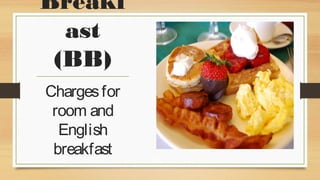
Breakf
ast
(BB)
Charges for
room and
English
breakfast
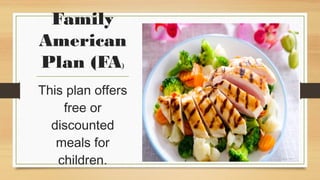
Family
American
Plan (FA)
This plan offers
free or
discounted
meals for
children.
Meal plans:
• -business executives prefer the European plan.

• - groups prefer the MAP.
• - an American plan is chosen by holiday makers. This plan is
often found at resorts.

• -The continental plan is found in Europe that is used to
breakfast of a continental style.

• - the bed and breakfast is a british.
Meal menus related to
plans

A list of the dishes to be served or available for
a meal.

• 1.

• 2. The dishes served or available at a meal.
• 3. A list of available options, especially as
displayed on a screen.
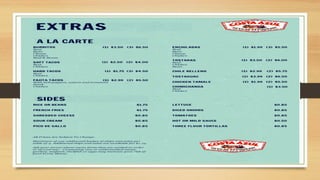
A la carte menu
• In reference to a menu of items priced and ordered separately.
• The courses generally follow the sequence of the classical
menu.

• Guest on a European plan without meal options will select,
meals from a la carte menu in any restaurant of the hotel .
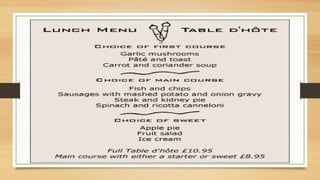
Table d’hote menu
• Table d'hôte menu is a menu where multi-

course meals with only a few choices are
charged at a fixed total price.
• It is offered in American plans and modified
American plans.
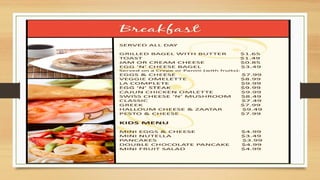
Breakfast menu
• Traditionally, American plans and modified American plans offer
this kind of breakfast but as travel has spread worldwide, the
breakfasts have been altered to local practices and tastes.
Types:

• 1.) English breakfast
• 2.) Continental breakfast
• 3.) American breakfast
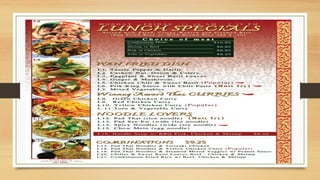
Lunch menus
• Lunch menus can vary from elaborate meals
or light meals depending on the purpose and
culture of the guest.
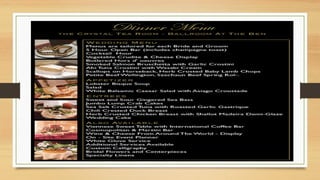
Dinner menus
•These menus are elaborate as
guests have more time and
leisure for eating.
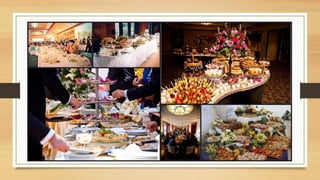
Buffet service
• It is a self-service where the food is
displayed on tables.
Sources of
reservations many
• Guest reservation in hotel is done through
sources.

• The term ‘ source’ means individual or group

company which takes service from hotel and in
reply pay for it.
•
•
•
•
•
•
•
•
•
•

Principal sources of
reservations are:

Global distribution system (GDS)
Tour operators
Travel agents
Airlines
Corporate houses
Embassies and consulates
Free individual traveler (FIT)
Central reservation office (CRS)
Hotel websites
Referral hotels
Global distribution
system (GDS)

• A network of providers that brings products and services
geographically spread to the doorstep of consumers
anywhere in the world.

• Some featured examples of GDS are Sabre computer

system, Amadeus computer system, Galileo central
reservation systems, World span and the Scandinavian
multi across reservation for Travel agents (SMART).
Tour
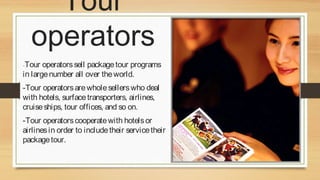
operators
-Tour

operators sell package tour programs
in large number all over the world.
-Tour operators are whole sellers who deal
with hotels, surface transporters, airlines,
cruise ships, tour offices, and so on.
-Tour operators cooperate with hotels or
airlines in order to include their service their
package tour.
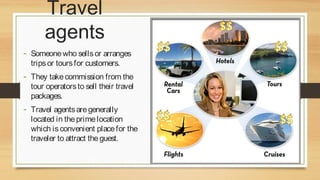
Travel
agents
- Someone who sells or arranges
trips or tours for customers.

- They take commission from the
tour operators to sell their travel
packages.

- Travel agents are generally

located in the prime location
which is convenient place for the
traveler to attract the guest.
Airlin
es

- Airlines is very popular
among hotels.

- Airlines crew generally

stay for short time and
hotel always has to give
discount on their stay.
Corporate
houses
- Corporate houses have to deal

with many clients and they also
have to arrange company
training programs and meetings.
They contact with a hotel for
these purposes.

- Rates are negotiated for

minimum room nights a year.
The more business the better is
the rate.
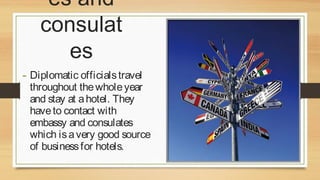
es and
consulat
es
- Diplomatic officials travel

throughout the whole year
and stay at a hotel. They
have to contact with
embassy and consulates
which is a very good source
of business for hotels.
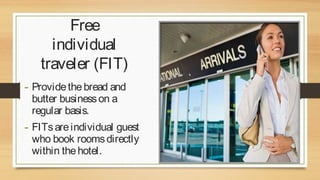
Free
individual
traveler (FIT)
- Provide the bread and
butter business on a
regular basis.

- FITs are individual guest

who book rooms directly
within the hotel.
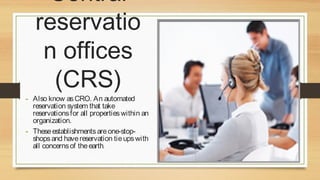
Central
reservatio
n offices
(CRS)

- Also know as CRO. An automated

reservation system that take
reservations for all properties within an
organization.
- These establishments are one-stopshops and have reservation tie ups with
all concerns of the earth.
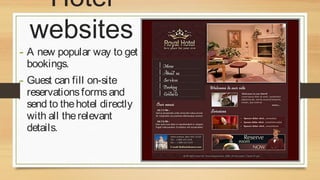
Hotel
websites

- A new popular way to get
bookings.

- Guest can fill on-site

reservations forms and
send to the hotel directly
with all the relevant
details.
Referral hotels
- Independent hotels that get-together to

recommend each other to guest staying in their
property, provided the establishment does not
have a hotel in that location.
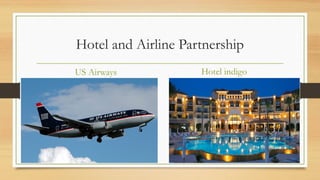
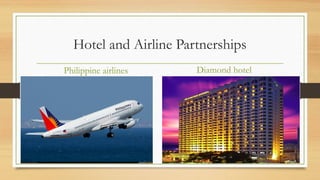
- An airline ties-up with referral hotels to attract
passengers.
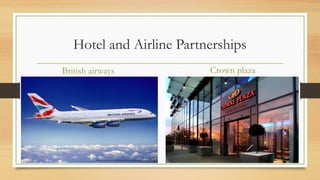
Hotel and Airline Partnerships
British airways

Crown plaza
Hotel and Airline Partnership
US Airways

Hotel indigo
Hotel and Airline Partnerships
Philippine airlines

Diamond hotel

Reservation

  • 1.
  • 2.
    Reservations • -The actof reserving; a keeping or withholding. • -Booking in advance. • -Something that is kept back or withheld.
  • 3.
    The main functionof reservation process is to match room request with room availability.
  • 4.
    Brief history: - earlier,reservation agent acted as booking clerk. - room sales were the responsibility of the Sales and Marketing Department before. - with better realization of the role of the reservation agent, the sales activity moved to the reservation department making the sales and marketing respond in a supportive role to the reservation agent’s demand and cues.
  • 5.
    Process of reservations: • • • • • • • 1.) receivereservation 2.) determining the room availability 3.) accepting or denying request 4.) documenting the reservation details 5.) confirming the reservation 6.) maintaining the reservation record 7.) compiling the reservation report
  • 6.
  • 7.
    Reservation terminologies: • Allowances-Daily cash paid-outs to airline crews as negotiated crews as negotiated with the airlines and recovered from them at later date. • Amendments- Changes made of records concerning his/her stay. • • • • • • • • Cancellation- A confirmed booking that has been confirmed in writing by a guest. Confirmation- A room reservation that has been confirmed in writing by a guest. Double occupancy- Two guest staying in a room. Group- Any body of guest above 15 persons who travel together. Guaranteed booking- A room booking that is confirmed in writing by a guest. Guest- A client of the hotel. F orecast- A studied anticipation of room business. F ree sale- Rooms that is available for booking.
  • 8.
    Reservation terminologies: • FIT- Standsfor “ Free Individual Traveler” who is an independent guest who does not use the services of middlemen for booking his/her room. • GIT- Group Inclusive Tour • L ay-over- Airline passengers checked in by airlines who are catching a connecting flight sometime later. • On-request- a status when guest are kept waiting for a room booking confirmation. • Overbooking- Booking rooms that are beyond the hotel room capacity. • Pax- Person • Revision- Change in booking instructions. • Room availability- The room position when rooms are available for sale. • Room blocking- Blocking a room in the reservation chart.
  • 9.
    Reservation terminologies: • Room night-a charge for a one night occupation, spanning two days from noon to noon. • Sale- a room space sold. • Sold out- a status in which all rooms in the hotel are sold. • Single occupancy- one guest staying in a room. • Waitlist- a guest awaiting a confirmation of the room booking. • Charge- is a financial obligation for a product or service during a guest stay. • Fences- rate rules that may include restrictions such as advance booking cutoffs or nonrefundable payments. • L itigious society- an environment in which consumers sue providers and services for not delivering them according to expected operating standards. • L charges- guest charges that might not be included on the guest folio because of a ate delay in posting by other department.
  • 10.
  • 11.
    What does aroom mean to a guest? It means: -comfort -security -privacy -convenience -cleanliness -A “ home away from home”
  • 12.
    Single room: - A roomwith two single beds meant for two persons.
  • 13.
    ble Roo m: -A room withDouble bed meant for two people.
  • 14.
    Twin Double Room: -Commonly known as familyroom having two double beds separated from each other.
  • 15.
    Triple room: -A room withthe capacity to accommodate three persons, generally three single beds
  • 16.
    Quad: A hotel quadroom is a room that can accommodate four people with four single beds.
  • 17.
    Interconnec ting rooms: -Two rooms whichshares a common door, mostly used by families.
  • 18.
  • 19.
    caba na -A room which isnear a water body or beside a swimming pool
  • 20.
    Executive rooms A roomwith additional features like internet connections, computer points, mini bars etc. specially designed for the business executive
  • 21.
    suites • A suitein a hotel or other public accommodation denotes a class of luxury accommodations, the key feature of which is multiple rooms.
  • 22.
  • 23.
  • 24.
  • 25.
  • 26.
  • 27.
  • 28.
  • 29.
    Junior suite A hotel roomwith a separate living area (though not a separate room), plus the bedroom.
  • 30.
  • 31.
    Duplex suite Two suites on twofloors with an interconnecting staircase
  • 32.
  • 33.
    Single suite Two rooms, one servingas a living area and another with a single bed.
  • 34.
    Presidential suite • Presidentialsuite and Royal suite are common names for the most expensive suite in a luxury hotel. • a suite of rooms, as in a hotel, suitable for a president or other head of state.
  • 35.
  • 36.
    Types of Ratesand Plans
  • 37.
    Rates W hat are thekey rate determinants? •Location •Hotel rating/standard •Competition •Demand •season •day of the week •competitor prices  •inventory available
  • 38.
    What Is a HotelsRack Rate? • A rack rate is a term that describes the frequently inflated prices, which a person pays at a hotel when he deals with the hotel directly when booking a room. Basically, if you enquired for a room for a night personally, you may pay more. The payment can even be twice or thrice.
  • 39.
    plans (meal plans) A plan isa package proposal of rooms and meals.
  • 40.
  • 41.
    America n Plan (AP) Includes threemeals per day at the hotel, i.e. breakfast, lunch and dinner.
  • 42.
    Modified America n Plan (MAP) The quotedrate includes two meals a day, including breakfast and either lunch or dinner.
  • 43.
  • 44.
  • 45.
    Family American Plan (FA) This planoffers free or discounted meals for children.
  • 46.
    Meal plans: • -businessexecutives prefer the European plan. • - groups prefer the MAP. • - an American plan is chosen by holiday makers. This plan is often found at resorts. • -The continental plan is found in Europe that is used to breakfast of a continental style. • - the bed and breakfast is a british.
  • 47.
    Meal menus relatedto plans A list of the dishes to be served or available for a meal. • 1. • 2. The dishes served or available at a meal. • 3. A list of available options, especially as displayed on a screen.
  • 48.
    A la cartemenu • In reference to a menu of items priced and ordered separately. • The courses generally follow the sequence of the classical menu. • Guest on a European plan without meal options will select, meals from a la carte menu in any restaurant of the hotel .
  • 50.
    Table d’hote menu •Table d'hôte menu is a menu where multi- course meals with only a few choices are charged at a fixed total price. • It is offered in American plans and modified American plans.
  • 52.
    Breakfast menu • Traditionally,American plans and modified American plans offer this kind of breakfast but as travel has spread worldwide, the breakfasts have been altered to local practices and tastes. Types: • 1.) English breakfast • 2.) Continental breakfast • 3.) American breakfast
  • 54.
    Lunch menus • Lunchmenus can vary from elaborate meals or light meals depending on the purpose and culture of the guest.
  • 56.
    Dinner menus •These menusare elaborate as guests have more time and leisure for eating.
  • 58.
    Buffet service • Itis a self-service where the food is displayed on tables.
  • 60.
    Sources of reservations many •Guest reservation in hotel is done through sources. • The term ‘ source’ means individual or group company which takes service from hotel and in reply pay for it.
  • 61.
    • • • • • • • • • • Principal sources of reservationsare: Global distribution system (GDS) Tour operators Travel agents Airlines Corporate houses Embassies and consulates Free individual traveler (FIT) Central reservation office (CRS) Hotel websites Referral hotels
  • 62.
    Global distribution system (GDS) •A network of providers that brings products and services geographically spread to the doorstep of consumers anywhere in the world. • Some featured examples of GDS are Sabre computer system, Amadeus computer system, Galileo central reservation systems, World span and the Scandinavian multi across reservation for Travel agents (SMART).
  • 63.
    Tour operators -Tour operators sell packagetour programs in large number all over the world. -Tour operators are whole sellers who deal with hotels, surface transporters, airlines, cruise ships, tour offices, and so on. -Tour operators cooperate with hotels or airlines in order to include their service their package tour.
  • 64.
    Travel agents - Someone whosells or arranges trips or tours for customers. - They take commission from the tour operators to sell their travel packages. - Travel agents are generally located in the prime location which is convenient place for the traveler to attract the guest.
  • 65.
    Airlin es - Airlines isvery popular among hotels. - Airlines crew generally stay for short time and hotel always has to give discount on their stay.
  • 66.
    Corporate houses - Corporate houseshave to deal with many clients and they also have to arrange company training programs and meetings. They contact with a hotel for these purposes. - Rates are negotiated for minimum room nights a year. The more business the better is the rate.
  • 67.
    es and consulat es - Diplomaticofficials travel throughout the whole year and stay at a hotel. They have to contact with embassy and consulates which is a very good source of business for hotels.
  • 68.
    Free individual traveler (FIT) - Providethe bread and butter business on a regular basis. - FITs are individual guest who book rooms directly within the hotel.
  • 69.
    Central reservatio n offices (CRS) - Alsoknow as CRO. An automated reservation system that take reservations for all properties within an organization. - These establishments are one-stopshops and have reservation tie ups with all concerns of the earth.
  • 70.
    Hotel websites - A newpopular way to get bookings. - Guest can fill on-site reservations forms and send to the hotel directly with all the relevant details.
  • 71.
    Referral hotels - Independenthotels that get-together to recommend each other to guest staying in their property, provided the establishment does not have a hotel in that location. - An airline ties-up with referral hotels to attract passengers.
  • 72.
    Hotel and AirlinePartnerships British airways Crown plaza
  • 73.
    Hotel and AirlinePartnership US Airways Hotel indigo
  • 74.
    Hotel and AirlinePartnerships Philippine airlines Diamond hotel