
Evolution III
Evolution notes III
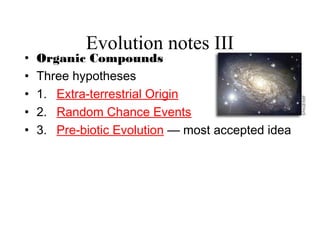
• Organic Compounds
• Three hypotheses
• 1. Extra-terrestrial Origin
• 2. Random Chance Events
• 3. Pre-biotic Evolution — most accepted idea
Evolution Notes III
• Earth’s age is estimated to be around
• 4.6 billion years old.
• Oldest sedimentary rocks, 3.8 billion
years contain no fossils.
• Oldest evidence is molecules of fossil
organic material, 3.4 billion
• Oldest candidate for possible organic
microfossils, 3.5 billion
• Oldest definitely living 2.5 billion—
Bluwago formation, remains of Blue-
green algae (prokaryotic cells).
• Pre-biotic evolution took approximately
one-half to a billion years
Evolution Notes III
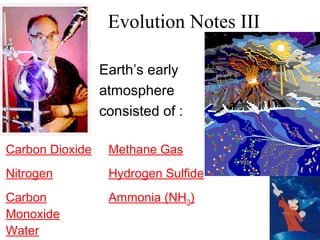
Earth’s early
atmosphere
consisted of :
Carbon Dioxide Methane Gas
Nitrogen Hydrogen Sulfide
Carbon
Monoxide
Ammonia (NH3)
Water
Evolution Notes III
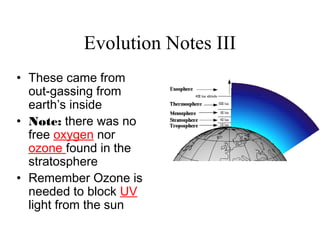
• These came from
out-gassing from
earth’s inside
• Note: there was no
free oxygen nor
ozone found in the
stratosphere
• Remember Ozone is
needed to block UV
light from the sun
Evolution III
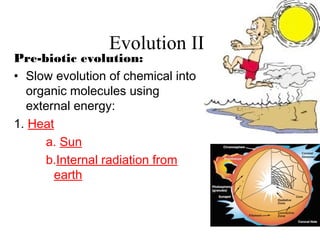
Pre-biotic evolution:
• Slow evolution of chemical into
organic molecules using
external energy:
1. Heat
a. Sun
b.Internal radiation from
earth
Evolution Notes III
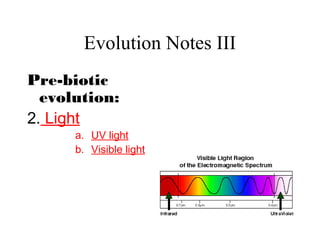
Pre-biotic
evolution:
2. Light
a. UV light
b. Visible light
Evolution Notes III
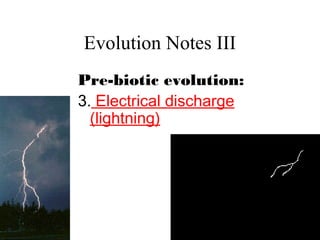
Pre-biotic evolution:
3. Electrical discharge
(lightning)
Evolution Notes III
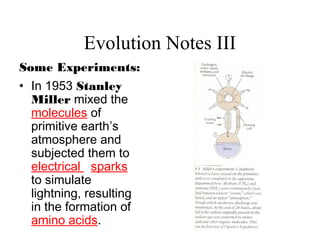
Some Experiments:
• In 1953 Stanley
Miller mixed the
molecules of
primitive earth’s
atmosphere and
subjected them to
electrical sparks
to simulate
lightning, resulting
in the formation of
amino acids.
Evolution Notes III
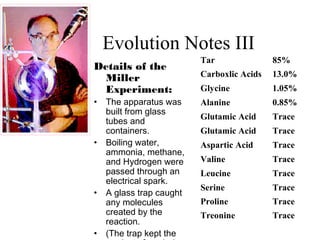
Details of the
Miller
Experiment:
• The apparatus was
built from glass
tubes and
containers.
• Boiling water,
ammonia, methane,
and Hydrogen were
passed through an
electrical spark.
• A glass trap caught
any molecules
created by the
reaction.
• (The trap kept the
Tar 85%
Carboxlic Acids 13.0%
Glycine 1.05%
Alanine 0.85%
Glutamic Acid Trace
Glutamic Acid Trace
Aspartic Acid Trace
Valine Trace
Leucine Trace
Serine Trace
Proline Trace
Treonine Trace
Evolution III
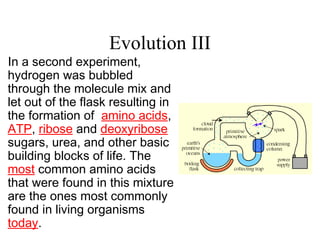
In a second experiment,
hydrogen was bubbled
through the molecule mix and
let out of the flask resulting in
the formation of amino acids,
ATP, ribose and deoxyribose
sugars, urea, and other basic
building blocks of life. The
most common amino acids
that were found in this mixture
are the ones most commonly
found in living organisms
today.
Evolution III
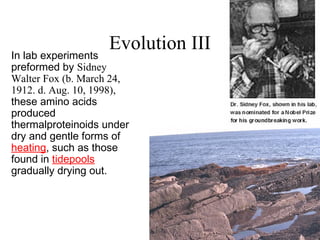
In lab experiments
preformed by Sidney
Walter Fox (b. March 24,
1912. d. Aug. 10, 1998),
these amino acids
produced
thermalproteinoids under
dry and gentle forms of
heating, such as those
found in tidepools
gradually drying out.
Evolution Notes III
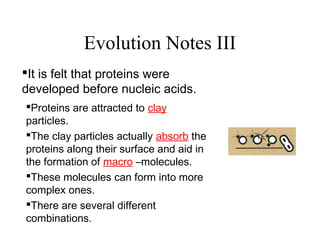
It is felt that proteins were
developed before nucleic acids.
Proteins are attracted to clay
particles.
The clay particles actually absorb the
proteins along their surface and aid in
the formation of macro –molecules.
These molecules can form into more
complex ones.
There are several different
combinations.
Evolution Notes III
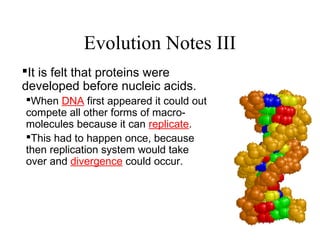
It is felt that proteins were
developed before nucleic acids.
When DNA first appeared it could out
compete all other forms of macro-
molecules because it can replicate.
This had to happen once, because
then replication system would take
over and divergence could occur.
Evolution Notes III
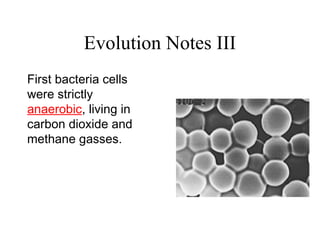
First bacteria cells
were strictly
anaerobic, living in
carbon dioxide and
methane gasses.
Evolution Notes III
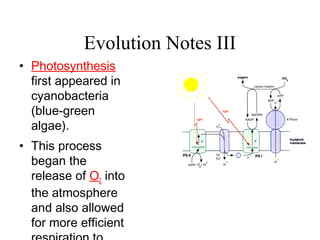
• Photosynthesis
first appeared in
cyanobacteria
(blue-green
algae).
• This process
began the
release of O2 into
the atmosphere
and also allowed
for more efficient
Evolution Notes III
• True early forms of
bacteria came about
around 2.5 million years
ago. First eukarotic
cells occurred
1,300,000,000 (1.3x10⁹
)
years ago. Oldest
multicellular animals are
approximately one
billion to 7,000,000
years old.
Evolution Notes III
Hardy / Weinberg Law of Equilibrium
Determines the expected statistical results
from a mathematical equation of genes
(alleles) in a population (a group of
interbreeding species).
Evolution Notes III
Works only under these conditions:
1.Random and equal mating
2.Very large population size (infinite
number ∞, several 1,000s)
3.No net mutations
4.No selection (natural or artificial)
5. No gene flow (in or out of population)
Evolution Notes III
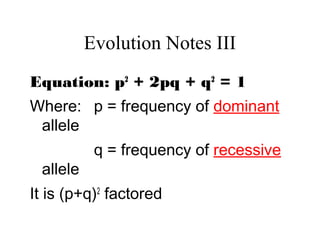
Equation: p2
+ 2pq + q2
= 1
Where: p = frequency of dominant
allele
q = frequency of recessive
allele
It is (p+q)2
factored
Evolution III
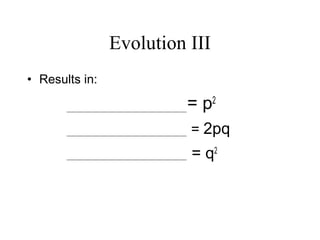
• Results in:
= p2
= 2pq
= q2
Evolution III
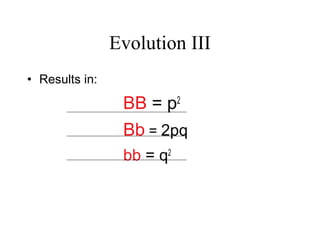
• Results in:
BB = p2
Bb = 2pq
bb = q2
Evolution III
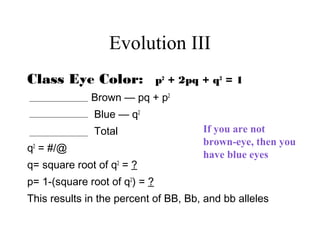
Class Eye Color: p2
+ 2pq + q2
= 1
Brown — pq + p2
Blue — q2
Total
q2
= #/@
q= square root of q2
= ?
p= 1-(square root of q2
) = ?
This results in the percent of BB, Bb, and bb alleles
If you are not
brown-eye, then you
have blue eyes
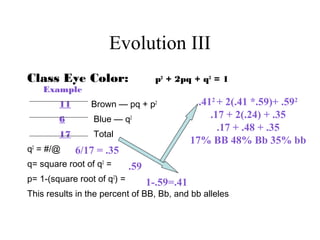
Evolution III
Class Eye Color: p2
+ 2pq + q2
= 1
Example
11 Brown — pq + p2
6 Blue — q2
17 Total
q2
= #/@
q= square root of q2
=
p= 1-(square root of q2
) =
This results in the percent of BB, Bb, and bb alleles
.412
+ 2(.41 *.59)+ .592
.17 + 2(.24) + .35
.17 + .48 + .35
17% BB 48% Bb 35% bb
6/17 = .35
.59
1-.59=.41
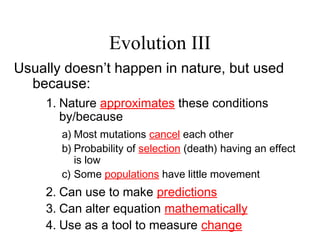
Evolution III
Usually doesn’t happen in nature, but used
because:
1. Nature approximates these conditions
by/because
a) Most mutations cancel each other
b) Probability of selection (death) having an effect
is low
c) Some populations have little movement
2. Can use to make predictions
3. Can alter equation mathematically
4. Use as a tool to measure change
Evolution Notes III
Selection:
• It is the differential survival
or reproduction of
individuals of different
genotypes.
• Natural selection works
only on heritable traits —
genes.
Evolution Notes III
Natural Selection:
• Controlled by large numbers of genes
• Natural selection acts on phenotypes, not genotypes.
• The phenotypic trait must be heritable, however, in
order for evolution to occur.
• Natural selection acts faster against dominant alleles
than recessive alleles.
• Evolution does not produce perfectly adapted
organisms.
• Evolution generally causes the modification of
existing structures, not the creation of brand new ones
and the results are often compromises between various
Evolution Notes III
Three types of selection:
1. Directional — pushes values
toward one extreme
2. Normalizing — selection
against extremes (stabilizing)
3. Disruptive — two or more
favored at same time
Evolution Notes III
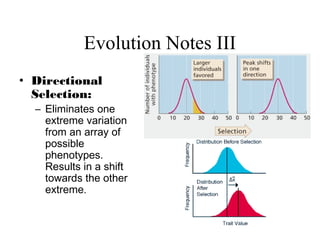
• Directional
Selection:
– Eliminates one
extreme variation
from an array of
possible
phenotypes.
Results in a shift
towards the other
extreme.
Evolution Notes III
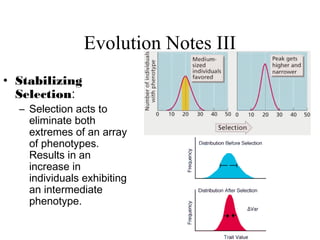
• Stabilizing
Selection:
– Selection acts to
eliminate both
extremes of an array
of phenotypes.
Results in an
increase in
individuals exhibiting
an intermediate
phenotype.
Evolution Notes III
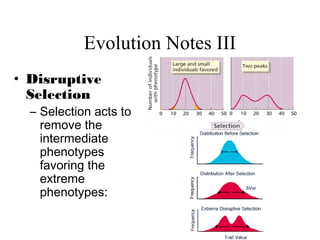
• Disruptive
Selection
– Selection acts to
remove the
intermediate
phenotypes
favoring the
extreme
phenotypes:
Evolution Notes III
Other types of selection:
1. Genetic Drift the random loss of fixing of
genes because of a small gene pool
2. Gene Flow the loss of alleles through
immigration or emigration
3. Neutral Alleles
Evolution Notes III
Speciation
Incomplete speciation
1. Sub-species —
interbreed
2. Semi-species —
mate less often
Evolution Notes III
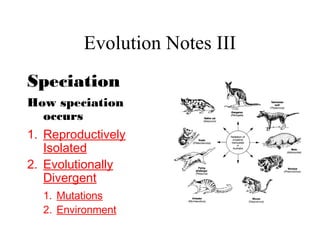
Speciation
How speciation
occurs
1. Reproductively
Isolated
2. Evolutionally
Divergent
1. Mutations
2. Environment
Evolution Notes III
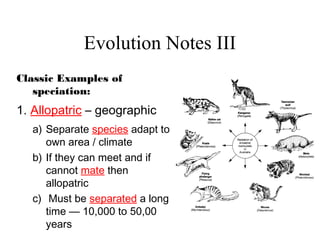
Classic Examples of
speciation:
1. Allopatric – geographic
a) Separate species adapt to
own area / climate
b) If they can meet and if
cannot mate then
allopatric
c) Must be separated a long
time — 10,000 to 50,00
years
Evolution Notes III
Examples:
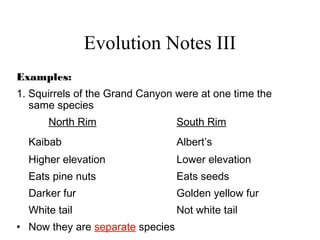
1. Squirrels of the Grand Canyon were at one time the
same species
North Rim South Rim
Kaibab Albert’s
Higher elevation Lower elevation
Eats pine nuts Eats seeds
Darker fur Golden yellow fur
White tail Not white tail
• Now they are separate species
Evolution Notes III
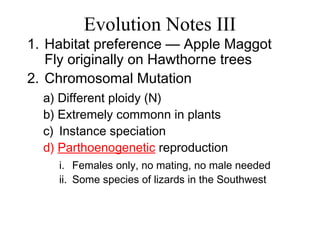
1. Habitat preference — Apple Maggot
Fly originally on Hawthorne trees
2. Chromosomal Mutation
a) Different ploidy (N)
b) Extremely commonn in plants
c) Instance speciation
d) Parthoenogenetic reproduction
i. Females only, no mating, no male needed
ii. Some species of lizards in the Southwest
Evolution Notes III
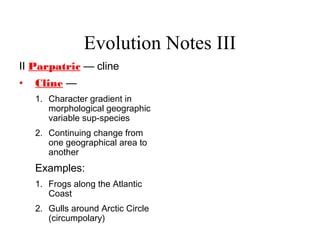
II Parpatric — cline
• Cline —
1. Character gradient in
morphological geographic
variable sup-species
2. Continuing change from
one geographical area to
another
Examples:
1. Frogs along the Atlantic
Coast
2. Gulls around Arctic Circle
(circumpolary)
Evolution Notes III
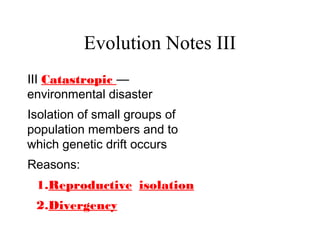
III Catastropic —
environmental disaster
Isolation of small groups of
population members and to
which genetic drift occurs
Reasons:
1.Reproductive isolation
2.Divergency
Evolution Notes III
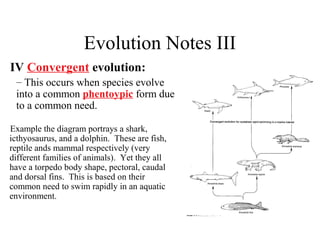
IV Convergent evolution:
– This occurs when species evolve
into a common phentoypic form due
to a common need.
Example the diagram portrays a shark,
icthyosaurus, and a dolphin. These are fish,
reptile ands mammal respectively (very
different families of animals). Yet they all
have a torpedo body shape, pectoral, caudal
and dorsal fins. This is based on their
common need to swim rapidly in an aquatic
environment.
Evolution Notes III
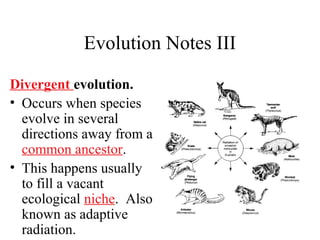
Divergent evolution.
• Occurs when species
evolve in several
directions away from a
common ancestor.
• This happens usually
to fill a vacant
ecological niche. Also
known as adaptive
radiation.
End
• http://www.becominghuman.org/

Evolution Presentation III

  • 1.
  • 2.
    Evolution notes III •Organic Compounds • Three hypotheses • 1. Extra-terrestrial Origin • 2. Random Chance Events • 3. Pre-biotic Evolution — most accepted idea
  • 3.
    Evolution Notes III •Earth’s age is estimated to be around • 4.6 billion years old. • Oldest sedimentary rocks, 3.8 billion years contain no fossils. • Oldest evidence is molecules of fossil organic material, 3.4 billion • Oldest candidate for possible organic microfossils, 3.5 billion • Oldest definitely living 2.5 billion— Bluwago formation, remains of Blue- green algae (prokaryotic cells). • Pre-biotic evolution took approximately one-half to a billion years
  • 4.
    Evolution Notes III Earth’searly atmosphere consisted of : Carbon Dioxide Methane Gas Nitrogen Hydrogen Sulfide Carbon Monoxide Ammonia (NH3) Water
  • 5.
    Evolution Notes III •These came from out-gassing from earth’s inside • Note: there was no free oxygen nor ozone found in the stratosphere • Remember Ozone is needed to block UV light from the sun
  • 6.
    Evolution III Pre-biotic evolution: •Slow evolution of chemical into organic molecules using external energy: 1. Heat a. Sun b.Internal radiation from earth
  • 7.
    Evolution Notes III Pre-biotic evolution: 2.Light a. UV light b. Visible light
  • 8.
    Evolution Notes III Pre-bioticevolution: 3. Electrical discharge (lightning)
  • 9.
    Evolution Notes III SomeExperiments: • In 1953 Stanley Miller mixed the molecules of primitive earth’s atmosphere and subjected them to electrical sparks to simulate lightning, resulting in the formation of amino acids.
  • 10.
    Evolution Notes III Detailsof the Miller Experiment: • The apparatus was built from glass tubes and containers. • Boiling water, ammonia, methane, and Hydrogen were passed through an electrical spark. • A glass trap caught any molecules created by the reaction. • (The trap kept the Tar 85% Carboxlic Acids 13.0% Glycine 1.05% Alanine 0.85% Glutamic Acid Trace Glutamic Acid Trace Aspartic Acid Trace Valine Trace Leucine Trace Serine Trace Proline Trace Treonine Trace
  • 11.
    Evolution III In asecond experiment, hydrogen was bubbled through the molecule mix and let out of the flask resulting in the formation of amino acids, ATP, ribose and deoxyribose sugars, urea, and other basic building blocks of life. The most common amino acids that were found in this mixture are the ones most commonly found in living organisms today.
  • 12.
    Evolution III In labexperiments preformed by Sidney Walter Fox (b. March 24, 1912. d. Aug. 10, 1998), these amino acids produced thermalproteinoids under dry and gentle forms of heating, such as those found in tidepools gradually drying out.
  • 13.
    Evolution Notes III Itis felt that proteins were developed before nucleic acids. Proteins are attracted to clay particles. The clay particles actually absorb the proteins along their surface and aid in the formation of macro –molecules. These molecules can form into more complex ones. There are several different combinations.
  • 14.
    Evolution Notes III Itis felt that proteins were developed before nucleic acids. When DNA first appeared it could out compete all other forms of macro- molecules because it can replicate. This had to happen once, because then replication system would take over and divergence could occur.
  • 15.
    Evolution Notes III Firstbacteria cells were strictly anaerobic, living in carbon dioxide and methane gasses.
  • 16.
    Evolution Notes III •Photosynthesis first appeared in cyanobacteria (blue-green algae). • This process began the release of O2 into the atmosphere and also allowed for more efficient
  • 17.
    Evolution Notes III •True early forms of bacteria came about around 2.5 million years ago. First eukarotic cells occurred 1,300,000,000 (1.3x10⁹ ) years ago. Oldest multicellular animals are approximately one billion to 7,000,000 years old.
  • 18.
    Evolution Notes III Hardy/ Weinberg Law of Equilibrium Determines the expected statistical results from a mathematical equation of genes (alleles) in a population (a group of interbreeding species).
  • 19.
    Evolution Notes III Worksonly under these conditions: 1.Random and equal mating 2.Very large population size (infinite number ∞, several 1,000s) 3.No net mutations 4.No selection (natural or artificial) 5. No gene flow (in or out of population)
  • 20.
    Evolution Notes III Equation:p2 + 2pq + q2 = 1 Where: p = frequency of dominant allele q = frequency of recessive allele It is (p+q)2 factored
  • 21.
    Evolution III • Resultsin: = p2 = 2pq = q2
  • 22.
    Evolution III • Resultsin: BB = p2 Bb = 2pq bb = q2
  • 23.
    Evolution III Class EyeColor: p2 + 2pq + q2 = 1 Brown — pq + p2 Blue — q2 Total q2 = #/@ q= square root of q2 = ? p= 1-(square root of q2 ) = ? This results in the percent of BB, Bb, and bb alleles If you are not brown-eye, then you have blue eyes
  • 24.
    Evolution III Class EyeColor: p2 + 2pq + q2 = 1 Example 11 Brown — pq + p2 6 Blue — q2 17 Total q2 = #/@ q= square root of q2 = p= 1-(square root of q2 ) = This results in the percent of BB, Bb, and bb alleles .412 + 2(.41 *.59)+ .592 .17 + 2(.24) + .35 .17 + .48 + .35 17% BB 48% Bb 35% bb 6/17 = .35 .59 1-.59=.41
  • 25.
    Evolution III Usually doesn’thappen in nature, but used because: 1. Nature approximates these conditions by/because a) Most mutations cancel each other b) Probability of selection (death) having an effect is low c) Some populations have little movement 2. Can use to make predictions 3. Can alter equation mathematically 4. Use as a tool to measure change
  • 26.
    Evolution Notes III Selection: •It is the differential survival or reproduction of individuals of different genotypes. • Natural selection works only on heritable traits — genes.
  • 27.
    Evolution Notes III NaturalSelection: • Controlled by large numbers of genes • Natural selection acts on phenotypes, not genotypes. • The phenotypic trait must be heritable, however, in order for evolution to occur. • Natural selection acts faster against dominant alleles than recessive alleles. • Evolution does not produce perfectly adapted organisms. • Evolution generally causes the modification of existing structures, not the creation of brand new ones and the results are often compromises between various
  • 28.
    Evolution Notes III Threetypes of selection: 1. Directional — pushes values toward one extreme 2. Normalizing — selection against extremes (stabilizing) 3. Disruptive — two or more favored at same time
  • 29.
    Evolution Notes III •Directional Selection: – Eliminates one extreme variation from an array of possible phenotypes. Results in a shift towards the other extreme.
  • 30.
    Evolution Notes III •Stabilizing Selection: – Selection acts to eliminate both extremes of an array of phenotypes. Results in an increase in individuals exhibiting an intermediate phenotype.
  • 31.
    Evolution Notes III •Disruptive Selection – Selection acts to remove the intermediate phenotypes favoring the extreme phenotypes:
  • 32.
    Evolution Notes III Othertypes of selection: 1. Genetic Drift the random loss of fixing of genes because of a small gene pool 2. Gene Flow the loss of alleles through immigration or emigration 3. Neutral Alleles
  • 33.
    Evolution Notes III Speciation Incompletespeciation 1. Sub-species — interbreed 2. Semi-species — mate less often
  • 34.
    Evolution Notes III Speciation Howspeciation occurs 1. Reproductively Isolated 2. Evolutionally Divergent 1. Mutations 2. Environment
  • 35.
    Evolution Notes III ClassicExamples of speciation: 1. Allopatric – geographic a) Separate species adapt to own area / climate b) If they can meet and if cannot mate then allopatric c) Must be separated a long time — 10,000 to 50,00 years
  • 36.
    Evolution Notes III Examples: 1.Squirrels of the Grand Canyon were at one time the same species North Rim South Rim Kaibab Albert’s Higher elevation Lower elevation Eats pine nuts Eats seeds Darker fur Golden yellow fur White tail Not white tail • Now they are separate species
  • 37.
    Evolution Notes III 1.Habitat preference — Apple Maggot Fly originally on Hawthorne trees 2. Chromosomal Mutation a) Different ploidy (N) b) Extremely commonn in plants c) Instance speciation d) Parthoenogenetic reproduction i. Females only, no mating, no male needed ii. Some species of lizards in the Southwest
  • 38.
    Evolution Notes III IIParpatric — cline • Cline — 1. Character gradient in morphological geographic variable sup-species 2. Continuing change from one geographical area to another Examples: 1. Frogs along the Atlantic Coast 2. Gulls around Arctic Circle (circumpolary)
  • 39.
    Evolution Notes III IIICatastropic — environmental disaster Isolation of small groups of population members and to which genetic drift occurs Reasons: 1.Reproductive isolation 2.Divergency
  • 40.
    Evolution Notes III IVConvergent evolution: – This occurs when species evolve into a common phentoypic form due to a common need. Example the diagram portrays a shark, icthyosaurus, and a dolphin. These are fish, reptile ands mammal respectively (very different families of animals). Yet they all have a torpedo body shape, pectoral, caudal and dorsal fins. This is based on their common need to swim rapidly in an aquatic environment.
  • 41.
    Evolution Notes III Divergentevolution. • Occurs when species evolve in several directions away from a common ancestor. • This happens usually to fill a vacant ecological niche. Also known as adaptive radiation.
  • 42.
  • 43.