Natural Selection and
            Evolution
          Vocabulary and
          Target Practice
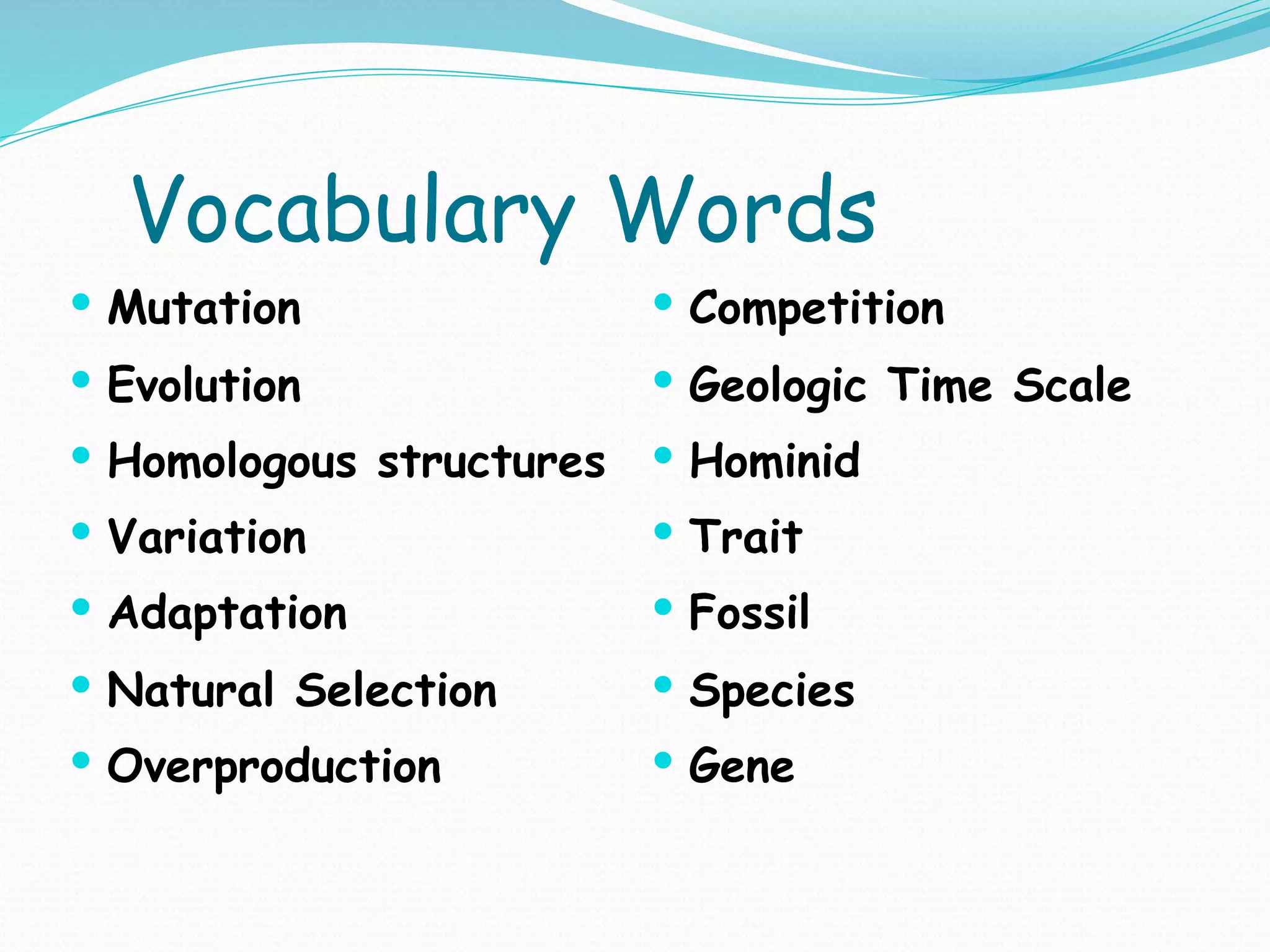
Vocabulary Words
 Mutation                 Competition
 Evolution                Geologic Time Scale
 Homologous structures    Hominid
 Variation                Trait
 Adaptation               Fossil
 Natural Selection        Species
 Overproduction           Gene
Definition of what?
A preserved remains or traces of an organism that lived in the past.

FOSSIL


What determines an individual’s physical traits?
 
Genes
Definition of what?
A preserved remains or traces of an organism that lived in the past.

FOSSIL


What determines an individual’s physical traits?
 
Genes
Definition of what?
A preserved remains or traces of an organism that lived in the past.

FOSSIL


What determines an individual’s physical traits?
 
Genes
What is the word?

A characteristic that an organism passes to offspring through its genes.

TRAITS


Similar structures that related species have inherited from a common
ancestor.
Homologous structures
What is the word?

A characteristic that an organism passes to offspring through its genes.

TRAITS


Similar structures that related species have inherited from a common
ancestor.
Homologous structures
What is the word?

A characteristic that an organism passes to offspring through its genes.

TRAITS


Similar structures that related species have inherited from a common
ancestor.
Homologous structures
Do you know what I am?
A group of similar organisms that can mate with each other and produce
fertile offspring.
 

SPECIES


Any change in the DNA of a gene or a chromosome.

MUTATION
Do you know what I am?
A group of similar organisms that can mate with each other and produce
fertile offspring.
 

SPECIES


Any change in the DNA of a gene or a chromosome.

MUTATION
Do you know what I am?
A group of similar organisms that can mate with each other and produce
fertile offspring.
 

SPECIES


Any change in the DNA of a gene or a chromosome.

MUTATION
What’s the word?
More individuals are produced than can survive.

OVERPRODUCTION


A type of primate characterized by bipedalism, relatively long lower limbs,
and lack of a tail.

HOMINID
What’s the word?
More individuals are produced than can survive.

OVERPRODUCTION


A type of primate characterized by bipedalism, relatively long lower limbs,
and lack of a tail.

HOMINID
What’s the word?
More individuals are produced than can survive.

OVERPRODUCTION


A type of primate characterized by bipedalism, relatively long lower limbs,
and lack of a tail.

HOMINID
Do you know the word?
 Any difference between members of the same species.
  
 VARIATION


 When a favorable trait helps a species survive so that they can
 reproduce and pass on the favorable trait to their offspring.

 NATURAL SELECTION
Do you know the word?
 Any difference between members of the same species.
  
 VARIATION


 When a favorable trait helps a species survive so that they can
 reproduce and pass on the favorable trait to their offspring.

 NATURAL SELECTION
Do you know the word?
 Any difference between members of the same species.
  
 VARIATION


 When a favorable trait helps a species survive so that they can
 reproduce and pass on the favorable trait to their offspring.

 NATURAL SELECTION
What am I?
 The members of a species must compete for food, space and other
  resources with one another to survive.
  
 COMPETITION


 The standard method used to divide the Earth’s long natural history
 in manageable parts or periods of time.

 GEOLOGIC TIME SCALE
What am I?
 The members of a species must compete for food, space and other
  resources with one another to survive.
  
 COMPETITION


 The standard method used to divide the Earth’s long natural history
 in manageable parts or periods of time.

 GEOLOGIC TIME SCALE
What am I?
 The members of a species must compete for food, space and other
  resources with one another to survive.
  
 COMPETITION


 The standard method used to divide the Earth’s long natural history
 in manageable parts or periods of time.

 GEOLOGIC TIME SCALE
What am I?
A characteristic (trait) that helps an organism survive and reproduce
in its environment.

ADAPTATION


The process of change over generations, sometimes creating a new
species. The gradual change in a species over time.

EVOLUTION
What am I?
A characteristic (trait) that helps an organism survive and reproduce
in its environment.

ADAPTATION


The process of change over generations, sometimes creating a new
species. The gradual change in a species over time.

EVOLUTION
What am I?
A characteristic (trait) that helps an organism survive and reproduce
in its environment.

ADAPTATION


The process of change over generations, sometimes creating a new
species. The gradual change in a species over time.

EVOLUTION
What are the factors
that affect Natural
Selection?
Can you give me some
examples of artificial
selection or selective
breeding?
What are some reasons
why species become
extinct?
What observations or
discoveries do biologists
use as support for the
theory of Evolution?
How can an adaptation
affect the survival of a
WHOLE species?
What is the scientific
explanation for how
species change over time?
Target Practice     o _____ developed ideas about
                    _________ and ________.
Word Bank
Adaptation           A trait that increases ability to
Evolution             survive and reproduce is known as an
Favorable Traits      ____________.
Offspring
Species              _____ help individuals ____.
Survive
Reproduce           o _____exist between individuals of
Variations
                      the same ____.
Darwin
                    • If an individual is able to survive, it
Natural Selection
                      will be able to ____, and so ______
STUDY Your
Vocabulary!

Answer the
questions on
your Evolution
Unit Test

       Video Clip

Evolution review ppt

  • 1.
    Natural Selection and Evolution Vocabulary and Target Practice
  • 2.
    Vocabulary Words  Mutation  Competition  Evolution  Geologic Time Scale  Homologous structures  Hominid  Variation  Trait  Adaptation  Fossil  Natural Selection  Species  Overproduction  Gene
  • 3.
    Definition of what? Apreserved remains or traces of an organism that lived in the past. FOSSIL   What determines an individual’s physical traits?   Genes
  • 4.
    Definition of what? Apreserved remains or traces of an organism that lived in the past. FOSSIL   What determines an individual’s physical traits?   Genes
  • 5.
    Definition of what? Apreserved remains or traces of an organism that lived in the past. FOSSIL   What determines an individual’s physical traits?   Genes
  • 6.
    What is theword? A characteristic that an organism passes to offspring through its genes. TRAITS Similar structures that related species have inherited from a common ancestor. Homologous structures
  • 7.
    What is theword? A characteristic that an organism passes to offspring through its genes. TRAITS Similar structures that related species have inherited from a common ancestor. Homologous structures
  • 8.
    What is theword? A characteristic that an organism passes to offspring through its genes. TRAITS Similar structures that related species have inherited from a common ancestor. Homologous structures
  • 9.
    Do you knowwhat I am? A group of similar organisms that can mate with each other and produce fertile offspring.   SPECIES Any change in the DNA of a gene or a chromosome. MUTATION
  • 10.
    Do you knowwhat I am? A group of similar organisms that can mate with each other and produce fertile offspring.   SPECIES Any change in the DNA of a gene or a chromosome. MUTATION
  • 11.
    Do you knowwhat I am? A group of similar organisms that can mate with each other and produce fertile offspring.   SPECIES Any change in the DNA of a gene or a chromosome. MUTATION
  • 12.
    What’s the word? Moreindividuals are produced than can survive. OVERPRODUCTION   A type of primate characterized by bipedalism, relatively long lower limbs, and lack of a tail. HOMINID
  • 13.
    What’s the word? Moreindividuals are produced than can survive. OVERPRODUCTION   A type of primate characterized by bipedalism, relatively long lower limbs, and lack of a tail. HOMINID
  • 14.
    What’s the word? Moreindividuals are produced than can survive. OVERPRODUCTION   A type of primate characterized by bipedalism, relatively long lower limbs, and lack of a tail. HOMINID
  • 15.
    Do you knowthe word? Any difference between members of the same species.   VARIATION When a favorable trait helps a species survive so that they can reproduce and pass on the favorable trait to their offspring. NATURAL SELECTION
  • 16.
    Do you knowthe word? Any difference between members of the same species.   VARIATION When a favorable trait helps a species survive so that they can reproduce and pass on the favorable trait to their offspring. NATURAL SELECTION
  • 17.
    Do you knowthe word? Any difference between members of the same species.   VARIATION When a favorable trait helps a species survive so that they can reproduce and pass on the favorable trait to their offspring. NATURAL SELECTION
  • 18.
    What am I? The members of a species must compete for food, space and other resources with one another to survive.   COMPETITION The standard method used to divide the Earth’s long natural history in manageable parts or periods of time. GEOLOGIC TIME SCALE
  • 19.
    What am I? The members of a species must compete for food, space and other resources with one another to survive.   COMPETITION The standard method used to divide the Earth’s long natural history in manageable parts or periods of time. GEOLOGIC TIME SCALE
  • 20.
    What am I? The members of a species must compete for food, space and other resources with one another to survive.   COMPETITION The standard method used to divide the Earth’s long natural history in manageable parts or periods of time. GEOLOGIC TIME SCALE
  • 21.
    What am I? Acharacteristic (trait) that helps an organism survive and reproduce in its environment. ADAPTATION   The process of change over generations, sometimes creating a new species. The gradual change in a species over time. EVOLUTION
  • 22.
    What am I? Acharacteristic (trait) that helps an organism survive and reproduce in its environment. ADAPTATION   The process of change over generations, sometimes creating a new species. The gradual change in a species over time. EVOLUTION
  • 23.
    What am I? Acharacteristic (trait) that helps an organism survive and reproduce in its environment. ADAPTATION   The process of change over generations, sometimes creating a new species. The gradual change in a species over time. EVOLUTION
  • 24.
    What are thefactors that affect Natural Selection?
  • 25.
    Can you giveme some examples of artificial selection or selective breeding?
  • 26.
    What are somereasons why species become extinct?
  • 27.
    What observations or discoveriesdo biologists use as support for the theory of Evolution?
  • 28.
    How can anadaptation affect the survival of a WHOLE species?
  • 29.
    What is thescientific explanation for how species change over time?
  • 30.
    Target Practice o _____ developed ideas about _________ and ________. Word Bank Adaptation  A trait that increases ability to Evolution survive and reproduce is known as an Favorable Traits ____________. Offspring Species  _____ help individuals ____. Survive Reproduce o _____exist between individuals of Variations the same ____. Darwin • If an individual is able to survive, it Natural Selection will be able to ____, and so ______
  • 31.
    STUDY Your Vocabulary! Answer the questionson your Evolution Unit Test Video Clip