Chapter 5
CPR
Heart Attack and Cardiac Arrest
• Heart attack occurs when heart
muscle tissue dies because its blood
supply is severely reduced or
stopped.
• Cardiac arrest results when the heart
stops beating.
Caring for Cardiac Arrest
The Chain of Survival
Five events that must occur rapidly and in
an integrated manner during cardiac arrest:
• Recognition and action
• Cardiopulmonary resuscitation (CPR)
• Defibrillation
• Advanced care
• Post-arrest care
Purpose of CPR
• CPR moves blood to the heart and brain
by giving chest compressions.
• CPR provides periodic breaths to place
oxygen into the victim’s lungs.
Performing CPR
Age Classifications
• Adults: Puberty and older
• Children: 1 year to puberty
• Infants: Younger than 1 year
Performing CPR
Check for Responsiveness and Breathing (1 of 2)
• Tap the victim’s shoulder and ask if he or she
is okay.
• At the same time, look to see if the victim is
breathing.
• Have a bystander call 9-1-1.
Performing CPR
Check for Responsiveness and Breathing (2 of 2)
• If alone, call 9-1-1 unless the victim is a
child or infant.
• For children and infants, give 30
compressions and 2 breaths before
calling 9-1-1.
Performing CPR
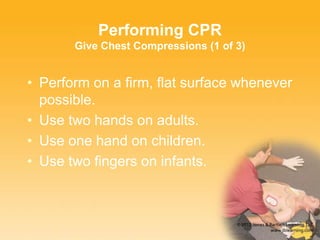
Give Chest Compressions (1 of 3)
• Perform on a firm, flat surface whenever
possible.
• Use two hands on adults.
• Use one hand on children.
• Use two fingers on infants.
Performing CPR
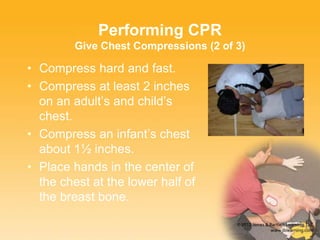
Give Chest Compressions (2 of 3)
• Compress hard and fast.
• Compress at least 2 inches
on an adult’s and child’s
chest.
• Compress an infant’s chest
about 1½ inches.
• Place hands in the center of
the chest at the lower half of
the breast bone.
Performing CPR
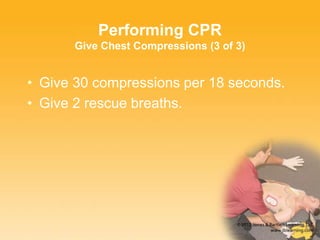
Give Chest Compressions (3 of 3)
• Give 30 compressions per 18 seconds.
• Give 2 rescue breaths.
Performing CPR
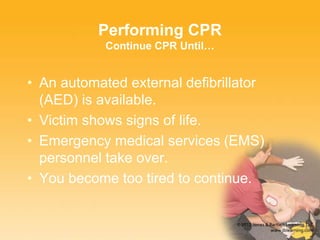
Continue CPR Until…
• An automated external defibrillator
(AED) is available.
• Victim shows signs of life.
• Emergency medical services (EMS)
personnel take over.
• You become too tired to continue.
Performing CPR
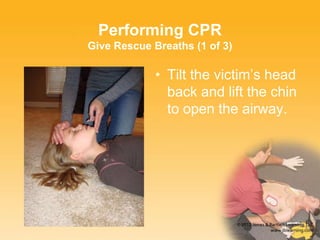
Give Rescue Breaths (1 of 3)
• Tilt the victim’s head
back and lift the chin
to open the airway.
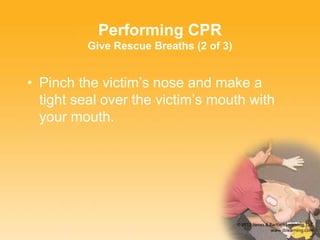
• Pinch the victim’s nose and make a
tight seal over the victim’s mouth with
your mouth.
Performing CPR
Give Rescue Breaths (2 of 3)
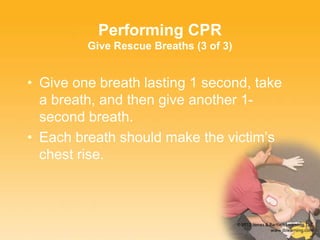
• Give one breath lasting 1 second, take
a breath, and then give another 1-
second breath.
• Each breath should make the victim’s
chest rise.
Performing CPR
Give Rescue Breaths (3 of 3)
Methods of Rescue Breathing
• Mouth-to-breathing device
• Mouth-to-nose method
• Mouth-to-stoma method
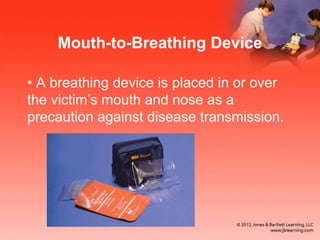
Mouth-to-Breathing Device
• A breathing device is placed in or over
the victim’s mouth and nose as a
precaution against disease transmission.
Mouth-to-Nose Method
• Used when:
• you cannot open the victim’s mouth.
• the victim’s mouth is severely injured.
• you cannot make a good seal with the
victim’s mouth.
• Tilt the head back, and push up on the
victim’s chin to close the mouth.
• Seal your mouth over the victim’s nose
and provide rescue breaths.
Mouth-to-Stoma Method
• A small, permanent opening in the neck
is a stoma.
• Close the victim’s mouth and nose and
breathe through the opening in the
neck.
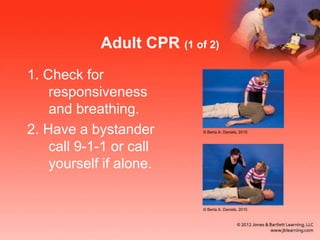
Adult CPR (1 of 2)
1. Check for
responsiveness
and breathing.
2. Have a bystander
call 9-1-1 or call
yourself if alone.
© Berta A. Daniels, 2010
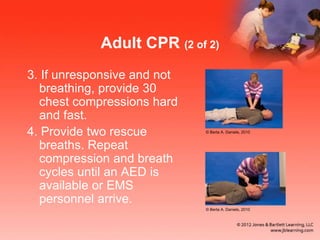
Adult CPR (2 of 2)
3. If unresponsive and not
breathing, provide 30
chest compressions hard
and fast.
4. Provide two rescue
breaths. Repeat
compression and breath
cycles until an AED is
available or EMS
personnel arrive.
© Berta A. Daniels, 2010
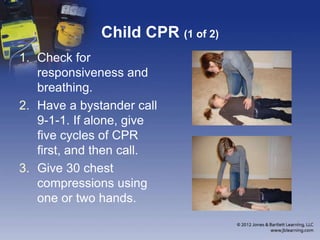
Child CPR (1 of 2)
1. Check for
responsiveness and
breathing.
2. Have a bystander call
9-1-1. If alone, give
five cycles of CPR
first, and then call.
3. Give 30 chest
compressions using
one or two hands.
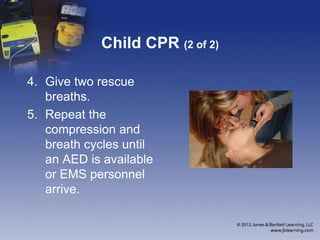
Child CPR (2 of 2)
4. Give two rescue
breaths.
5. Repeat the
compression and
breath cycles until
an AED is available
or EMS personnel
arrive.
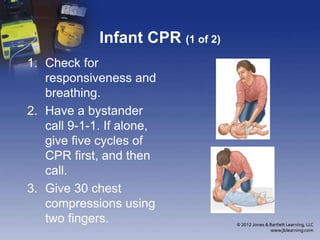
Infant CPR (1 of 2)
1. Check for
responsiveness and
breathing.
2. Have a bystander
call 9-1-1. If alone,
give five cycles of
CPR first, and then
call.
3. Give 30 chest
compressions using
two fingers.
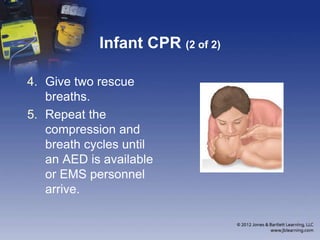
Infant CPR (2 of 2)
4. Give two rescue
breaths.
5. Repeat the
compression and
breath cycles until
an AED is available
or EMS personnel
arrive.
Airway Obstruction
An object lodged in the airway can cause
a mild or severe airway obstruction.
Mild Airway Obstruction
• Good air exchange present
• Victim can make forceful coughing
efforts.
• Victim should be encouraged to cough.
Severe Airway Obstruction
• Poor air exchange
• Breathing becomes more difficult.
• Weak and ineffective cough
• Inability to speak or breathe
• Skin, fingernail beds, and inside of
mouth appear bluish gray.
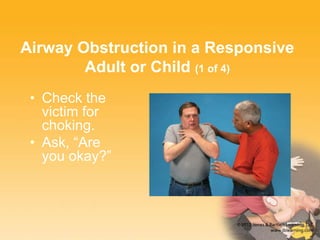
Airway Obstruction in a Responsive
Adult or Child (1 of 4)
• Check the
victim for
choking.
• Ask, “Are
you okay?”
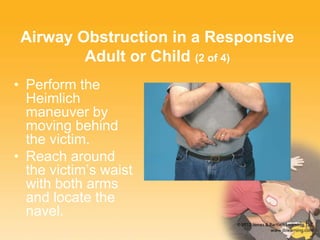
Airway Obstruction in a Responsive
Adult or Child (2 of 4)
• Perform the
Heimlich
maneuver by
moving behind
the victim.
• Reach around
the victim’s waist
with both arms
and locate the
navel.
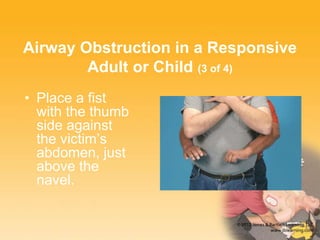
Airway Obstruction in a Responsive
Adult or Child (3 of 4)
• Place a fist
with the thumb
side against
the victim’s
abdomen, just
above the
navel.
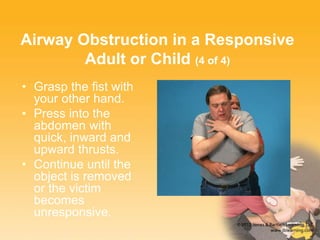
Airway Obstruction in a Responsive
Adult or Child (4 of 4)
• Grasp the fist with
your other hand.
• Press into the
abdomen with
quick, inward and
upward thrusts.
• Continue until the
object is removed
or the victim
becomes
unresponsive.
Airway Obstruction in Responsive
Infants (1 of 2)
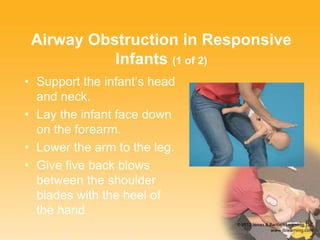
• Support the infant’s head
and neck.
• Lay the infant face down
on the forearm.
• Lower the arm to the leg.
• Give five back blows
between the shoulder
blades with the heel of
the hand.
Airway Obstruction in Responsive
Infants (2 of 2)
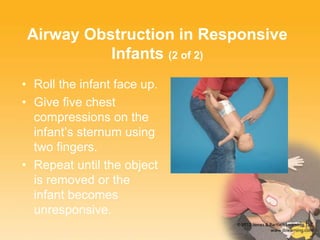
• Roll the infant face up.
• Give five chest
compressions on the
infant’s sternum using
two fingers.
• Repeat until the object
is removed or the
infant becomes
unresponsive.
If a Victim Becomes Unresponsive…
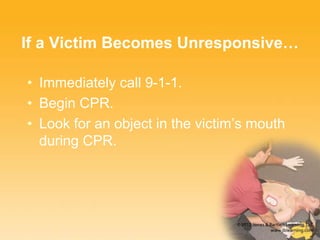
• Immediately call 9-1-1.
• Begin CPR.
• Look for an object in the victim’s mouth
during CPR.

Chapter 5 CPR

  • 1.
  • 2.
    Heart Attack andCardiac Arrest • Heart attack occurs when heart muscle tissue dies because its blood supply is severely reduced or stopped. • Cardiac arrest results when the heart stops beating.
  • 3.
    Caring for CardiacArrest The Chain of Survival Five events that must occur rapidly and in an integrated manner during cardiac arrest: • Recognition and action • Cardiopulmonary resuscitation (CPR) • Defibrillation • Advanced care • Post-arrest care
  • 4.
    Purpose of CPR •CPR moves blood to the heart and brain by giving chest compressions. • CPR provides periodic breaths to place oxygen into the victim’s lungs.
  • 5.
    Performing CPR Age Classifications •Adults: Puberty and older • Children: 1 year to puberty • Infants: Younger than 1 year
  • 6.
    Performing CPR Check forResponsiveness and Breathing (1 of 2) • Tap the victim’s shoulder and ask if he or she is okay. • At the same time, look to see if the victim is breathing. • Have a bystander call 9-1-1.
  • 7.
    Performing CPR Check forResponsiveness and Breathing (2 of 2) • If alone, call 9-1-1 unless the victim is a child or infant. • For children and infants, give 30 compressions and 2 breaths before calling 9-1-1.
  • 8.
    Performing CPR Give ChestCompressions (1 of 3) • Perform on a firm, flat surface whenever possible. • Use two hands on adults. • Use one hand on children. • Use two fingers on infants.
  • 9.
    Performing CPR Give ChestCompressions (2 of 3) • Compress hard and fast. • Compress at least 2 inches on an adult’s and child’s chest. • Compress an infant’s chest about 1½ inches. • Place hands in the center of the chest at the lower half of the breast bone.
  • 10.
    Performing CPR Give ChestCompressions (3 of 3) • Give 30 compressions per 18 seconds. • Give 2 rescue breaths.
  • 11.
    Performing CPR Continue CPRUntil… • An automated external defibrillator (AED) is available. • Victim shows signs of life. • Emergency medical services (EMS) personnel take over. • You become too tired to continue.
  • 12.
    Performing CPR Give RescueBreaths (1 of 3) • Tilt the victim’s head back and lift the chin to open the airway.
  • 13.
    • Pinch thevictim’s nose and make a tight seal over the victim’s mouth with your mouth. Performing CPR Give Rescue Breaths (2 of 3)
  • 14.
    • Give onebreath lasting 1 second, take a breath, and then give another 1- second breath. • Each breath should make the victim’s chest rise. Performing CPR Give Rescue Breaths (3 of 3)
  • 15.
    Methods of RescueBreathing • Mouth-to-breathing device • Mouth-to-nose method • Mouth-to-stoma method
  • 16.
    Mouth-to-Breathing Device • Abreathing device is placed in or over the victim’s mouth and nose as a precaution against disease transmission.
  • 17.
    Mouth-to-Nose Method • Usedwhen: • you cannot open the victim’s mouth. • the victim’s mouth is severely injured. • you cannot make a good seal with the victim’s mouth. • Tilt the head back, and push up on the victim’s chin to close the mouth. • Seal your mouth over the victim’s nose and provide rescue breaths.
  • 18.
    Mouth-to-Stoma Method • Asmall, permanent opening in the neck is a stoma. • Close the victim’s mouth and nose and breathe through the opening in the neck.
  • 19.
    Adult CPR (1of 2) 1. Check for responsiveness and breathing. 2. Have a bystander call 9-1-1 or call yourself if alone. © Berta A. Daniels, 2010 © Berta A. Daniels, 2010
  • 20.
    Adult CPR (2of 2) 3. If unresponsive and not breathing, provide 30 chest compressions hard and fast. 4. Provide two rescue breaths. Repeat compression and breath cycles until an AED is available or EMS personnel arrive. © Berta A. Daniels, 2010 © Berta A. Daniels, 2010
  • 21.
    Child CPR (1of 2) 1. Check for responsiveness and breathing. 2. Have a bystander call 9-1-1. If alone, give five cycles of CPR first, and then call. 3. Give 30 chest compressions using one or two hands.
  • 22.
    Child CPR (2of 2) 4. Give two rescue breaths. 5. Repeat the compression and breath cycles until an AED is available or EMS personnel arrive.
  • 23.
    Infant CPR (1of 2) 1. Check for responsiveness and breathing. 2. Have a bystander call 9-1-1. If alone, give five cycles of CPR first, and then call. 3. Give 30 chest compressions using two fingers.
  • 24.
    Infant CPR (2of 2) 4. Give two rescue breaths. 5. Repeat the compression and breath cycles until an AED is available or EMS personnel arrive.
  • 25.
    Airway Obstruction An objectlodged in the airway can cause a mild or severe airway obstruction.
  • 26.
    Mild Airway Obstruction •Good air exchange present • Victim can make forceful coughing efforts. • Victim should be encouraged to cough.
  • 27.
    Severe Airway Obstruction •Poor air exchange • Breathing becomes more difficult. • Weak and ineffective cough • Inability to speak or breathe • Skin, fingernail beds, and inside of mouth appear bluish gray.
  • 28.
    Airway Obstruction ina Responsive Adult or Child (1 of 4) • Check the victim for choking. • Ask, “Are you okay?”
  • 29.
    Airway Obstruction ina Responsive Adult or Child (2 of 4) • Perform the Heimlich maneuver by moving behind the victim. • Reach around the victim’s waist with both arms and locate the navel.
  • 30.
    Airway Obstruction ina Responsive Adult or Child (3 of 4) • Place a fist with the thumb side against the victim’s abdomen, just above the navel.
  • 31.
    Airway Obstruction ina Responsive Adult or Child (4 of 4) • Grasp the fist with your other hand. • Press into the abdomen with quick, inward and upward thrusts. • Continue until the object is removed or the victim becomes unresponsive.
  • 32.
    Airway Obstruction inResponsive Infants (1 of 2) • Support the infant’s head and neck. • Lay the infant face down on the forearm. • Lower the arm to the leg. • Give five back blows between the shoulder blades with the heel of the hand.
  • 33.
    Airway Obstruction inResponsive Infants (2 of 2) • Roll the infant face up. • Give five chest compressions on the infant’s sternum using two fingers. • Repeat until the object is removed or the infant becomes unresponsive.
  • 34.
    If a VictimBecomes Unresponsive… • Immediately call 9-1-1. • Begin CPR. • Look for an object in the victim’s mouth during CPR.

Editor's Notes