Chapter 19
Bites and Stings
Animal Bites (1 of 2)
It is estimated that one of
every two Americans will
be bitten at some time by
an animal or person.
• Dogs bites equal
about 80% of these
injuries.
•Immediate tissue damage
and later infection are two
concerns of animal bites.
© Chuck Stewart, MD.
Animal Bites (2 of 2)
• Children and elderly people are especially
prone to animal bites.
• Damage mostly occurs on the hands, arms,
legs, and face.
• Wild animal attacks occur most often in
rural or wilderness locations.
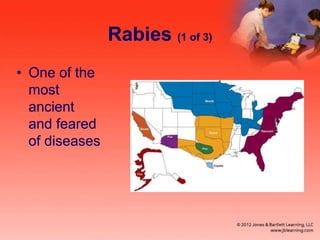
Rabies (1 of 3)
• One of the
most
ancient
and feared
of diseases
Rabies (2 of 3)
• Caused by a virus found in warm-blooded
animals
• Spreads from one animal to another in
the saliva
• A bite or scratch is considered exposure if it
penetrates the skin.
• Nonbite exposure consists of contamination
of wounds.
Rabies (3 of 3)
• Consider an animal rabid if the animal:
• Made an unprovoked attack
• Acted strangely
• Was a high-risk species
• Report animal bites to police or animal control.
Recognizing an Animal Bite
• Puncture wound
• Tissue and skin
crushed
• Open wound on
fingers, knuckles,
and/or hand
Care for Animal Bites
• If the wound is not bleeding heavily, wash it
with soap and water.
• Control the bleeding with direct pressure.
• Cover the wound with sterile or clean
dressing.
• Seek medical care.
Human Bites
Human bites can
cause severe injury.
•Most are acts of
violence.
•Most common injury
location is the hand.
Recognizing Human Bites
• True bites:
• Part of the body’s flesh is caught
between teeth
• Clenched-fist injury:
• Results from cutting a fist on teeth.
• High likelihood of infection
Care for Human Bites
• If the wound is not bleeding heavily, wash it
with soap and water for 5 to 10 minutes.
• Flush with running water under pressure.
• Control bleeding with direct pressure.
• Cover with sterile dressing.
• Do not close the wound.
• Seek medical care.
Snake Bites (1 of 7)
About 50,000 people throughout the world die
of snake bites each year. In the United States
40,000 to 50,000 people are bitten by snakes,
7,000 to 8,000 of them by venomous snakes.
Snake Bites (2 of 7)
Four species of
venomous snakes in the
United States:
• Rattlesnakes
• Copperheads
• Water moccasins
• Coral snakes
Snake Bites (3 of 7)
• Snake bites can be painful, costly, and
potentially deadly.
• Partial or complete loss of an extremity or
finger or loss of movement in a joint can
occur.
• Most victims recover.
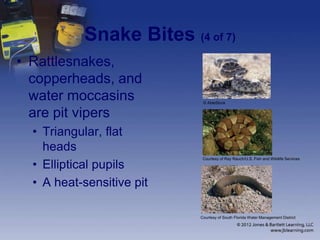
Snake Bites (4 of 7)
• Rattlesnakes,
copperheads, and
water moccasins
are pit vipers
• Triangular, flat
heads
• Elliptical pupils
• A heat-sensitive pit
© AbleStock
Courtesy of Ray Rauch/U.S. Fish and Wildlife Services
Courtesy of South Florida Water Management District
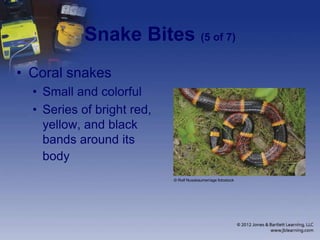
Snake Bites (5 of 7)
• Coral snakes
• Small and colorful
• Series of bright red,
yellow, and black
bands around its
body
© Rolf Nussbaumer/age fotostock
Snake Bites (6 of 7)
• At least one species of
venomous snake is
found in every state
except Alaska, Hawaii,
and Maine.
Snake Bites (7 of 7)
Legitimate snake bite:
• Bitten before the
encounter with a snake
was recognized
• Bitten while trying to
move away
• Most often involve the
lower extremities
• Are accidental
Illegitimate snake bites:
• Victim recognized the
encounter with a snake.
• Did not attempt to move
away
• Most often occur on the
upper extremities.
• Most often occur when
the victim tries to kill,
capture, play with, or
move a snake.
Pit Vipers
• Pit vipers are found in every state but
Alaska, Maine, and Hawaii.
• Rattlesnakes are the most widespread.
• Keep the rodent population under control
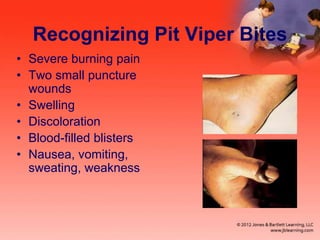
Recognizing Pit Viper Bites
• Severe burning pain
• Two small puncture
wounds
• Swelling
• Discoloration
• Blood-filled blisters
• Nausea, vomiting,
sweating, weakness
Care for Pit Viper Bites
• Get victim away from snake.
• Do not attempt to capture or kill the snake.
• Keep victim quiet.
• Gently wash area with soap and water.
• Remove rings or other jewelry.
• Stabilize the extremity.
• Keep the extremity below heart level.
• Seek medical care.
Coral Snake Bites
• America’s most venomous snake
• Rarely bite people
• Venom is a neurotoxin
• Symptoms begin 1 to 5 hours
after the bite.
Recognizing Coral Snake Bites
• Minimal pain
• Sagging or drooping upper eyelids
• Weakness
• Pricking, tingling of skin
• Double vision
• Difficulty swallowing
• Sweating
• Abnormal flow of saliva
Care for Coral Snake Bites
• Keep victim calm.
• Gently clean with soap and water.
• Apply mild pressure.
• Seek medical care.
Nonpoisonous Snake Bites
• Nonvenomous snakes inflict the
most bites.
• Assume a snake is venomous if
you don’t know what type it is.
Recognizing Nonpoisonous
Snake Bites
• Mild to moderate pinch
• Curved lines of tiny
pinpricks on the skin that
correspond with the rows
of sharp, pointy teeth
• Bleeding
• Mild itching
Care for Nonpoisonous Snake
Bites
• Gently clean with soap and
water.
• Care for the bite as you would
a minor wound.
• Seek medical care.
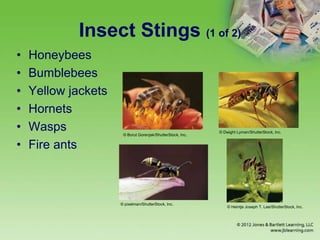
Insect Stings (1 of 2)
• Honeybees
• Bumblebees
• Yellow jackets
• Hornets
• Wasps
• Fire ants
© Borut Gorenjak/ShutterStock, Inc.
© Dwight Lyman/ShutterStock, Inc.
© pixelman/ShutterStock, Inc.
© Heintje Joseph T. Lee/ShutterStock, Inc.
Insect Stings (2 of 2)
• These insects account for more deaths and
illnesses each year than all other venomous
animals combined.
• About 1 in every 200 people is dangerously
allergic to stinging insect venom.
Insect Stings
Honeybees and Some Yellow Jackets
• Have barbed stingers.
• Barbed stingers become embedded in
the victim’s skin during the sting.
• Die after the sting
Insect Stings
Honeybees and Bumblebees
• Do not release all their venom during initial
injection
• Some venom remains in the stinger
embedded in the victim’s skin.
• This venom worsens the victim’s reaction.
Insect Stings
Wasps, Yellow Jackets, Hornets, and Fire
Ants
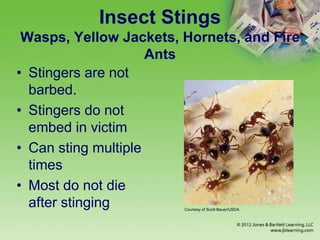
• Stingers are not
barbed.
• Stingers do not
embed in victim
• Can sting multiple
times
• Most do not die
after stinging Courtesy of Scott Bauer/USDA
Insect Stings
Yellow Jackets
• Wasp
• Can sting multiple times
• Ground-nesting bee
• Stings once then dies
• Smaller than yellow jacket wasps
Reactions to Insect Stings (1 of 2)
Most stings cause
only self-limited,
local inflammatory
reactions.
•Pain
•Itching
•Redness
•Swelling
Courtesy of Daniel Wojcik/USDA
Reactions to Insect Stings (2 of 2)
•Swelling and
redness
•Nausea
•Vomiting
•Wheezing
•Fever
•Drippy nose
•Anaphylaxis
• Generally occurs
within few minutes
to 1 hour
• Throat swelling
• Bronchospasm
Multiple Insect Stings
• Five hundred stings will usually kill even
people who are not allergic to stinging
insects.
• Massive numbers of stings are rare.
• Africanized bees are also known as killer
bees.
Recognizing Insect Stings (1 of 2)
• Usual reactions:
• Instant pain
• Redness at site
• Itching
• Worrisome reactions:
• Hives
• Swelling of lips or
tongue
• Tickle in throat
• Wheezing
• Life-threatening
reactions:
• Bluish or grayish
skin color
• Seizures
• Unresponsiveness
• Inability to breathe
Recognizing Insect Stings (2 of 2)
• Lack of uniformity in victims’ responses
• Stings to the mouth or eye tend to be more
dangerous.
• Victims tend to react more severely to
multiple stings, especially 10 or more.
• The most dangerous single stings in
nonallergic individuals are those inside the
throat.
Care for Insect Stings
• Remove stinger and venom sac.
• Wash with soap and water.
• Apply an ice pack.
• Give pain medication, topical steroid
cream, or antihistamine.
• Observe the victim for 30 minutes.
• Only use epinephrine for severe allergic
reaction
• Watch for delayed allergic reaction
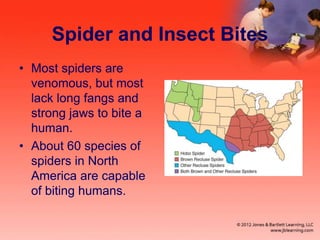
Spider and Insect Bites
• Most spiders are
venomous, but most
lack long fangs and
strong jaws to bite a
human.
• About 60 species of
spiders in North
America are capable
of biting humans.
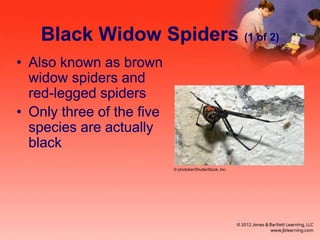
Black Widow Spiders (1 of 2)
• Also known as brown
widow spiders and
red-legged spiders
• Only three of the five
species are actually
black
© photobar/ShutterStock, Inc.
Black Widow Spiders (2 of 2)
• Females are one of the largest spiders
• Fangs can penetrate human skin
• Shiny black abdomens with red or yellow spot
or white spots or bands
• Produce one of the most potent venoms
• Found throughout world
• Extensive, irregular, shaggy web
Recognizing Black Widow
Spider Bites
• Victim might feel a sharp pinprick
• Two tiny red spots might be seen
• Within 15 minutes to 4 hours, muscle
stiffness and cramps occur.
• Headache, chills, fever, sweating,
dizziness, nausea, and vomiting
• Severe pain around bite peaks in 2 to 3
hours
Care for Black Widow Spider
Bites
• Catch spider if possible.
• Clean with soap and water or rubbing
alcohol.
• Place an ice pack over the bite.
• Give pain medication.
• Monitor breathing.
• Seek medical care immediately.
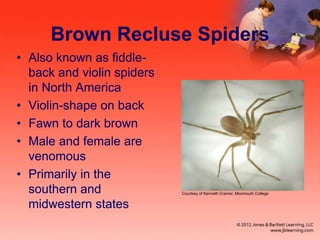
Brown Recluse Spiders
• Also known as fiddle-
back and violin spiders
in North America
• Violin-shape on back
• Fawn to dark brown
• Male and female are
venomous
• Primarily in the
southern and
midwestern states
Courtesy of Kenneth Cramer, Monmouth College
Recognizing Brown Recluse
Spider Bites
• Local reaction usually within 2 to 8 hours
• Mild to severe pain at the bite site
• Redness, swelling, and local itching
• Blister forms at site in 48 to 72 hours
• Bull’s-eye pattern
• Volcano lesions
• Fever, weakness, vomiting, joint pain, rash
• Stomach cramps, nausea, vomiting
Care for Brown Recluse Spider
Bites
• Catch spider if possible.
• Clean with soap and water or
rubbing alcohol.
• Apply an ice pack.
• Give pain medication.
• Seek medical care immediately.
Tarantulas
• Bite only when
provoked or roughly
handled
• When upset,
scratches abdomen
and flicks hairs onto
a person © Nick Simon/ShutterStock, Inc.
Recognizing Tarantula Bites
and Embedded Hairs
• The bite causes pain,
aching, or stinging.
• The hairs cause itching
and inflammation that
can last several weeks.
Care for Tarantula Bites
• Catch spider if possible.
• Clean with soap and water or rubbing alcohol.
• Apply an ice pack.
• Give pain medication.
• Seek medical care immediately.
Care for Embedded Tarantula
Hairs
• Remove hairs with sticky tape.
• Wash with soap and water.
• Apply hydrocortisone cream.
• Give the victim pain medication.
• Give the victim an antihistamine.
Recognizing Common
Aggressive House Spider
Bites
• Similar to those of the brown recluse
spider
• Redness, blisters, and later, dead
tissue
• Headache, visual problems, weakness
Care for Common
Aggressive House Spider
Bites
• Catch spider if possible.
• Clean with soap and water or
rubbing alcohol.
• Apply an ice pack.
• Give pain medication.
• Seek medical care immediately.
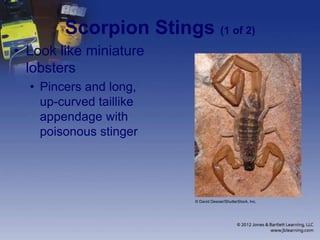
Scorpion Stings (1 of 2)
• Look like miniature
lobsters
• Pincers and long,
up-curved taillike
appendage with
poisonous stinger
© David Desoer/ShutterStock, Inc.
Scorpion Stings (2 of 2)
• Bark scorpion is the only threat to humans.
• Found primarily in Arizona
• Pale tan color
• Three fourths of an inch to 1.25 inches long
• Stings to adults are usually not life-
threatening.
• Stings to small children may be dangerous.
Recognizing Scorpion Stings
• Local immediate pain and burning
• Later, numbness or tingling
• No swelling or blanching
• Tapping finger over site causes pain.
• Pain or even paralysis in severe cases
• Uncontrolled jerking movements and facial
twitching
Care for Scorpion Stings
• Monitor breathing.
• Gently clean with soap and water or
rubbing alcohol.
• Apply an ice pack.
• Give pain medication.
• Seek medical care.
Centipede Bites
• Giant desert centipede is only US
centipede dangerous to humans.
• Up to 8 inches long
• Can inject toxic substances
• Venom is relatively weak
Recognizing Centipede Bites
• Burning pain
• Local inflammation
• Mild swelling of lymph nodes
• Inflammation, swelling, redness lasting 4-12
hours
• Swelling and tenderness can last 3 weeks,
or disappear and recur.
Care for Centipede Bites
• Clean the wound with soap and water.
• Apply an ice pack.
• Give pain medication.
• Seek medical care for severe reactions.
Mosquito Bites
• In developing countries,
mosquitoes transmit malaria, yellow
fever, dengue fever.
• In the United States, they carry
encephalitis.
• Need blood to lay eggs
• Breed in water
• Most bite at twilight
Care for Mosquito Bites
• Wash with soap and water.
• Apply an ice pack.
• Apply calamine lotion or hydrocortisone
ointment.
• Antihistamine every 6 hours or cortisone
might be useful
Embedded Ticks (1 of 2)
• Close relatives of mites and spiders
• Classified as hard ticks or soft ticks
• Carry diseases, are nuisance, cause
paralysis
• Need blood meal to grow
• Limited in ability to find meals
• Bites are nearly painless
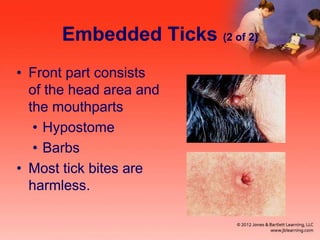
Embedded Ticks (2 of 2)
• Front part consists
of the head area and
the mouthparts
• Hypostome
• Barbs
• Most tick bites are
harmless.
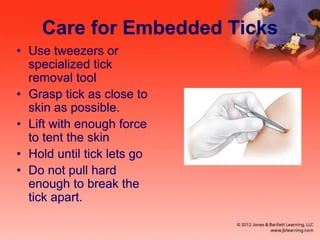
Care for Embedded Ticks
• Use tweezers or
specialized tick
removal tool
• Grasp tick as close to
skin as possible.
• Lift with enough force
to tent the skin
• Hold until tick lets go
• Do not pull hard
enough to break the
tick apart.
Care for Embedded Ticks
After Removal (1 of 2)
• Wash with soap and water.
• Apply rubbing alcohol.
• Apply an ice pack.
• Apply calamine lotion.
• Keep the area clean.
• Watch bite site for rash for 1 month.
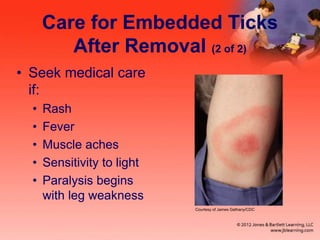
Care for Embedded Ticks
After Removal (2 of 2)
• Seek medical care
if:
• Rash
• Fever
• Muscle aches
• Sensitivity to light
• Paralysis begins
with leg weakness
Courtesy of James Gathany/CDC
Marine Animal Injuries
• Most marine animals bite or
sting in defense, rather than
attack.
Sharks
• The chance of being attacked by a shark along
the North American coastline is less than 1 in
5 million.
• Most attacks occur within 100 feet of shore.
• Most victims are attacked without warning.
• The leg is the most frequently bitten part.
• Sharks are attracted to chemicals found in fish
blood.
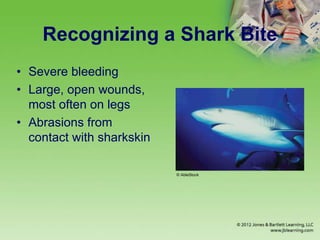
Recognizing a Shark Bite
• Severe bleeding
• Large, open wounds,
most often on legs
• Abrasions from
contact with sharkskin
© AbleStock
Care for a Shark Bite or
Puncture
• Control bleeding.
• Treat for shock.
• Seek medical care.
Barracudas and Moray Eels
• Barracuda bites are rare.
• Moray eels are frequent
biters of divers who handle
or tease them.
Recognizing Barracuda and
Moray Eel Bites
• Barracuda lacerations are similar to those
of a shark.
• Eel bites involve severe puncture wounds
with narrow jaws.
Care for Barracuda and Moray
Eel Bites
• Care for a barracuda bite as you would a
shark bite.
• Care for an eel bite:
• Flush the wound with water under
pressure.
• Control the bleeding.
Marine Animals That Sting
• Each year, jellyfish, Portuguese man-of-wars,
corals, and anemones that lie along the
shallow ocean waters of the United States
sting more than 1 million people.
• Jellyfish and Portuguese man-of-wars have
long tentacles equipped with stinging devices
called nematocysts.
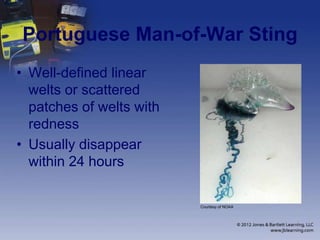
Portuguese Man-of-War Sting
• Well-defined linear
welts or scattered
patches of welts with
redness
• Usually disappear
within 24 hours
Courtesy of NOAA
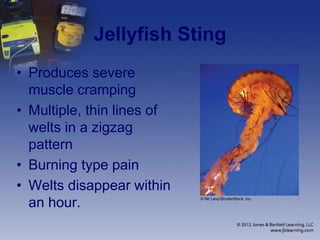
Jellyfish Sting
• Produces severe
muscle cramping
• Multiple, thin lines of
welts in a zigzag
pattern
• Burning type pain
• Welts disappear within
an hour. © Nir Levy/ShutterStock, Inc.
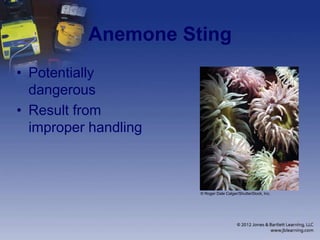
Anemone Sting
• Potentially
dangerous
• Result from
improper handling
© Roger Dale Calger/ShutterStock, Inc.
Recognizing Marine Animal
Stings
• Stinging
• Severe itching and burning
• Prickling, tingling
• Blisters
• Severe allergic reaction
• Difficulty breathing
• Muscle cramping
• Nausea, vomiting
Care for Marine Stings
• Apply vinegar for at least 30 seconds.
• Baking soda paste will work too.
• Use hot water immersion for at least 20
minutes.
• Hot dry pack will work too.
• Apply a coating of hydrocortisone
several times a day.
Stingrays
• Most wounds inflicted by stingrays are
produced on the ankle or foot when the
victim steps on the ray.
• At least 1,500 stingray injuries occur each
year in coastal US waters.
• The tail barb of a stingray easily penetrates
human skin.
Recognizing a Stingray
Puncture
• Sudden, intense pain
• Open wound
• Swelling
© AbleStock
Care for a Stingray Puncture
• Immerse the injured part in hot
water for 30 to 90 minutes.
• Wash the wound with soap and
water.
• Irrigate with water under pressure.
• Treat like any puncture wound.

Chapter 19 Bites and Stings

  • 1.
  • 2.
    Animal Bites (1of 2) It is estimated that one of every two Americans will be bitten at some time by an animal or person. • Dogs bites equal about 80% of these injuries. •Immediate tissue damage and later infection are two concerns of animal bites. © Chuck Stewart, MD.
  • 3.
    Animal Bites (2of 2) • Children and elderly people are especially prone to animal bites. • Damage mostly occurs on the hands, arms, legs, and face. • Wild animal attacks occur most often in rural or wilderness locations.
  • 4.
    Rabies (1 of3) • One of the most ancient and feared of diseases
  • 5.
    Rabies (2 of3) • Caused by a virus found in warm-blooded animals • Spreads from one animal to another in the saliva • A bite or scratch is considered exposure if it penetrates the skin. • Nonbite exposure consists of contamination of wounds.
  • 6.
    Rabies (3 of3) • Consider an animal rabid if the animal: • Made an unprovoked attack • Acted strangely • Was a high-risk species • Report animal bites to police or animal control.
  • 7.
    Recognizing an AnimalBite • Puncture wound • Tissue and skin crushed • Open wound on fingers, knuckles, and/or hand
  • 8.
    Care for AnimalBites • If the wound is not bleeding heavily, wash it with soap and water. • Control the bleeding with direct pressure. • Cover the wound with sterile or clean dressing. • Seek medical care.
  • 9.
    Human Bites Human bitescan cause severe injury. •Most are acts of violence. •Most common injury location is the hand.
  • 10.
    Recognizing Human Bites •True bites: • Part of the body’s flesh is caught between teeth • Clenched-fist injury: • Results from cutting a fist on teeth. • High likelihood of infection
  • 11.
    Care for HumanBites • If the wound is not bleeding heavily, wash it with soap and water for 5 to 10 minutes. • Flush with running water under pressure. • Control bleeding with direct pressure. • Cover with sterile dressing. • Do not close the wound. • Seek medical care.
  • 12.
    Snake Bites (1of 7) About 50,000 people throughout the world die of snake bites each year. In the United States 40,000 to 50,000 people are bitten by snakes, 7,000 to 8,000 of them by venomous snakes.
  • 13.
    Snake Bites (2of 7) Four species of venomous snakes in the United States: • Rattlesnakes • Copperheads • Water moccasins • Coral snakes
  • 14.
    Snake Bites (3of 7) • Snake bites can be painful, costly, and potentially deadly. • Partial or complete loss of an extremity or finger or loss of movement in a joint can occur. • Most victims recover.
  • 15.
    Snake Bites (4of 7) • Rattlesnakes, copperheads, and water moccasins are pit vipers • Triangular, flat heads • Elliptical pupils • A heat-sensitive pit © AbleStock Courtesy of Ray Rauch/U.S. Fish and Wildlife Services Courtesy of South Florida Water Management District
  • 16.
    Snake Bites (5of 7) • Coral snakes • Small and colorful • Series of bright red, yellow, and black bands around its body © Rolf Nussbaumer/age fotostock
  • 17.
    Snake Bites (6of 7) • At least one species of venomous snake is found in every state except Alaska, Hawaii, and Maine.
  • 18.
    Snake Bites (7of 7) Legitimate snake bite: • Bitten before the encounter with a snake was recognized • Bitten while trying to move away • Most often involve the lower extremities • Are accidental Illegitimate snake bites: • Victim recognized the encounter with a snake. • Did not attempt to move away • Most often occur on the upper extremities. • Most often occur when the victim tries to kill, capture, play with, or move a snake.
  • 19.
    Pit Vipers • Pitvipers are found in every state but Alaska, Maine, and Hawaii. • Rattlesnakes are the most widespread. • Keep the rodent population under control
  • 20.
    Recognizing Pit ViperBites • Severe burning pain • Two small puncture wounds • Swelling • Discoloration • Blood-filled blisters • Nausea, vomiting, sweating, weakness
  • 21.
    Care for PitViper Bites • Get victim away from snake. • Do not attempt to capture or kill the snake. • Keep victim quiet. • Gently wash area with soap and water. • Remove rings or other jewelry. • Stabilize the extremity. • Keep the extremity below heart level. • Seek medical care.
  • 22.
    Coral Snake Bites •America’s most venomous snake • Rarely bite people • Venom is a neurotoxin • Symptoms begin 1 to 5 hours after the bite.
  • 23.
    Recognizing Coral SnakeBites • Minimal pain • Sagging or drooping upper eyelids • Weakness • Pricking, tingling of skin • Double vision • Difficulty swallowing • Sweating • Abnormal flow of saliva
  • 24.
    Care for CoralSnake Bites • Keep victim calm. • Gently clean with soap and water. • Apply mild pressure. • Seek medical care.
  • 25.
    Nonpoisonous Snake Bites •Nonvenomous snakes inflict the most bites. • Assume a snake is venomous if you don’t know what type it is.
  • 26.
    Recognizing Nonpoisonous Snake Bites •Mild to moderate pinch • Curved lines of tiny pinpricks on the skin that correspond with the rows of sharp, pointy teeth • Bleeding • Mild itching
  • 27.
    Care for NonpoisonousSnake Bites • Gently clean with soap and water. • Care for the bite as you would a minor wound. • Seek medical care.
  • 28.
    Insect Stings (1of 2) • Honeybees • Bumblebees • Yellow jackets • Hornets • Wasps • Fire ants © Borut Gorenjak/ShutterStock, Inc. © Dwight Lyman/ShutterStock, Inc. © pixelman/ShutterStock, Inc. © Heintje Joseph T. Lee/ShutterStock, Inc.
  • 29.
    Insect Stings (2of 2) • These insects account for more deaths and illnesses each year than all other venomous animals combined. • About 1 in every 200 people is dangerously allergic to stinging insect venom.
  • 30.
    Insect Stings Honeybees andSome Yellow Jackets • Have barbed stingers. • Barbed stingers become embedded in the victim’s skin during the sting. • Die after the sting
  • 31.
    Insect Stings Honeybees andBumblebees • Do not release all their venom during initial injection • Some venom remains in the stinger embedded in the victim’s skin. • This venom worsens the victim’s reaction.
  • 32.
    Insect Stings Wasps, YellowJackets, Hornets, and Fire Ants • Stingers are not barbed. • Stingers do not embed in victim • Can sting multiple times • Most do not die after stinging Courtesy of Scott Bauer/USDA
  • 33.
    Insect Stings Yellow Jackets •Wasp • Can sting multiple times • Ground-nesting bee • Stings once then dies • Smaller than yellow jacket wasps
  • 34.
    Reactions to InsectStings (1 of 2) Most stings cause only self-limited, local inflammatory reactions. •Pain •Itching •Redness •Swelling Courtesy of Daniel Wojcik/USDA
  • 35.
    Reactions to InsectStings (2 of 2) •Swelling and redness •Nausea •Vomiting •Wheezing •Fever •Drippy nose •Anaphylaxis • Generally occurs within few minutes to 1 hour • Throat swelling • Bronchospasm
  • 36.
    Multiple Insect Stings •Five hundred stings will usually kill even people who are not allergic to stinging insects. • Massive numbers of stings are rare. • Africanized bees are also known as killer bees.
  • 37.
    Recognizing Insect Stings(1 of 2) • Usual reactions: • Instant pain • Redness at site • Itching • Worrisome reactions: • Hives • Swelling of lips or tongue • Tickle in throat • Wheezing • Life-threatening reactions: • Bluish or grayish skin color • Seizures • Unresponsiveness • Inability to breathe
  • 38.
    Recognizing Insect Stings(2 of 2) • Lack of uniformity in victims’ responses • Stings to the mouth or eye tend to be more dangerous. • Victims tend to react more severely to multiple stings, especially 10 or more. • The most dangerous single stings in nonallergic individuals are those inside the throat.
  • 39.
    Care for InsectStings • Remove stinger and venom sac. • Wash with soap and water. • Apply an ice pack. • Give pain medication, topical steroid cream, or antihistamine. • Observe the victim for 30 minutes. • Only use epinephrine for severe allergic reaction • Watch for delayed allergic reaction
  • 40.
    Spider and InsectBites • Most spiders are venomous, but most lack long fangs and strong jaws to bite a human. • About 60 species of spiders in North America are capable of biting humans.
  • 41.
    Black Widow Spiders(1 of 2) • Also known as brown widow spiders and red-legged spiders • Only three of the five species are actually black © photobar/ShutterStock, Inc.
  • 42.
    Black Widow Spiders(2 of 2) • Females are one of the largest spiders • Fangs can penetrate human skin • Shiny black abdomens with red or yellow spot or white spots or bands • Produce one of the most potent venoms • Found throughout world • Extensive, irregular, shaggy web
  • 43.
    Recognizing Black Widow SpiderBites • Victim might feel a sharp pinprick • Two tiny red spots might be seen • Within 15 minutes to 4 hours, muscle stiffness and cramps occur. • Headache, chills, fever, sweating, dizziness, nausea, and vomiting • Severe pain around bite peaks in 2 to 3 hours
  • 44.
    Care for BlackWidow Spider Bites • Catch spider if possible. • Clean with soap and water or rubbing alcohol. • Place an ice pack over the bite. • Give pain medication. • Monitor breathing. • Seek medical care immediately.
  • 45.
    Brown Recluse Spiders •Also known as fiddle- back and violin spiders in North America • Violin-shape on back • Fawn to dark brown • Male and female are venomous • Primarily in the southern and midwestern states Courtesy of Kenneth Cramer, Monmouth College
  • 46.
    Recognizing Brown Recluse SpiderBites • Local reaction usually within 2 to 8 hours • Mild to severe pain at the bite site • Redness, swelling, and local itching • Blister forms at site in 48 to 72 hours • Bull’s-eye pattern • Volcano lesions • Fever, weakness, vomiting, joint pain, rash • Stomach cramps, nausea, vomiting
  • 47.
    Care for BrownRecluse Spider Bites • Catch spider if possible. • Clean with soap and water or rubbing alcohol. • Apply an ice pack. • Give pain medication. • Seek medical care immediately.
  • 48.
    Tarantulas • Bite onlywhen provoked or roughly handled • When upset, scratches abdomen and flicks hairs onto a person © Nick Simon/ShutterStock, Inc.
  • 49.
    Recognizing Tarantula Bites andEmbedded Hairs • The bite causes pain, aching, or stinging. • The hairs cause itching and inflammation that can last several weeks.
  • 50.
    Care for TarantulaBites • Catch spider if possible. • Clean with soap and water or rubbing alcohol. • Apply an ice pack. • Give pain medication. • Seek medical care immediately.
  • 51.
    Care for EmbeddedTarantula Hairs • Remove hairs with sticky tape. • Wash with soap and water. • Apply hydrocortisone cream. • Give the victim pain medication. • Give the victim an antihistamine.
  • 52.
    Recognizing Common Aggressive HouseSpider Bites • Similar to those of the brown recluse spider • Redness, blisters, and later, dead tissue • Headache, visual problems, weakness
  • 53.
    Care for Common AggressiveHouse Spider Bites • Catch spider if possible. • Clean with soap and water or rubbing alcohol. • Apply an ice pack. • Give pain medication. • Seek medical care immediately.
  • 54.
    Scorpion Stings (1of 2) • Look like miniature lobsters • Pincers and long, up-curved taillike appendage with poisonous stinger © David Desoer/ShutterStock, Inc.
  • 55.
    Scorpion Stings (2of 2) • Bark scorpion is the only threat to humans. • Found primarily in Arizona • Pale tan color • Three fourths of an inch to 1.25 inches long • Stings to adults are usually not life- threatening. • Stings to small children may be dangerous.
  • 56.
    Recognizing Scorpion Stings •Local immediate pain and burning • Later, numbness or tingling • No swelling or blanching • Tapping finger over site causes pain. • Pain or even paralysis in severe cases • Uncontrolled jerking movements and facial twitching
  • 57.
    Care for ScorpionStings • Monitor breathing. • Gently clean with soap and water or rubbing alcohol. • Apply an ice pack. • Give pain medication. • Seek medical care.
  • 58.
    Centipede Bites • Giantdesert centipede is only US centipede dangerous to humans. • Up to 8 inches long • Can inject toxic substances • Venom is relatively weak
  • 59.
    Recognizing Centipede Bites •Burning pain • Local inflammation • Mild swelling of lymph nodes • Inflammation, swelling, redness lasting 4-12 hours • Swelling and tenderness can last 3 weeks, or disappear and recur.
  • 60.
    Care for CentipedeBites • Clean the wound with soap and water. • Apply an ice pack. • Give pain medication. • Seek medical care for severe reactions.
  • 61.
    Mosquito Bites • Indeveloping countries, mosquitoes transmit malaria, yellow fever, dengue fever. • In the United States, they carry encephalitis. • Need blood to lay eggs • Breed in water • Most bite at twilight
  • 62.
    Care for MosquitoBites • Wash with soap and water. • Apply an ice pack. • Apply calamine lotion or hydrocortisone ointment. • Antihistamine every 6 hours or cortisone might be useful
  • 63.
    Embedded Ticks (1of 2) • Close relatives of mites and spiders • Classified as hard ticks or soft ticks • Carry diseases, are nuisance, cause paralysis • Need blood meal to grow • Limited in ability to find meals • Bites are nearly painless
  • 64.
    Embedded Ticks (2of 2) • Front part consists of the head area and the mouthparts • Hypostome • Barbs • Most tick bites are harmless.
  • 65.
    Care for EmbeddedTicks • Use tweezers or specialized tick removal tool • Grasp tick as close to skin as possible. • Lift with enough force to tent the skin • Hold until tick lets go • Do not pull hard enough to break the tick apart.
  • 66.
    Care for EmbeddedTicks After Removal (1 of 2) • Wash with soap and water. • Apply rubbing alcohol. • Apply an ice pack. • Apply calamine lotion. • Keep the area clean. • Watch bite site for rash for 1 month.
  • 67.
    Care for EmbeddedTicks After Removal (2 of 2) • Seek medical care if: • Rash • Fever • Muscle aches • Sensitivity to light • Paralysis begins with leg weakness Courtesy of James Gathany/CDC
  • 68.
    Marine Animal Injuries •Most marine animals bite or sting in defense, rather than attack.
  • 69.
    Sharks • The chanceof being attacked by a shark along the North American coastline is less than 1 in 5 million. • Most attacks occur within 100 feet of shore. • Most victims are attacked without warning. • The leg is the most frequently bitten part. • Sharks are attracted to chemicals found in fish blood.
  • 70.
    Recognizing a SharkBite • Severe bleeding • Large, open wounds, most often on legs • Abrasions from contact with sharkskin © AbleStock
  • 71.
    Care for aShark Bite or Puncture • Control bleeding. • Treat for shock. • Seek medical care.
  • 72.
    Barracudas and MorayEels • Barracuda bites are rare. • Moray eels are frequent biters of divers who handle or tease them.
  • 73.
    Recognizing Barracuda and MorayEel Bites • Barracuda lacerations are similar to those of a shark. • Eel bites involve severe puncture wounds with narrow jaws.
  • 74.
    Care for Barracudaand Moray Eel Bites • Care for a barracuda bite as you would a shark bite. • Care for an eel bite: • Flush the wound with water under pressure. • Control the bleeding.
  • 75.
    Marine Animals ThatSting • Each year, jellyfish, Portuguese man-of-wars, corals, and anemones that lie along the shallow ocean waters of the United States sting more than 1 million people. • Jellyfish and Portuguese man-of-wars have long tentacles equipped with stinging devices called nematocysts.
  • 76.
    Portuguese Man-of-War Sting •Well-defined linear welts or scattered patches of welts with redness • Usually disappear within 24 hours Courtesy of NOAA
  • 77.
    Jellyfish Sting • Producessevere muscle cramping • Multiple, thin lines of welts in a zigzag pattern • Burning type pain • Welts disappear within an hour. © Nir Levy/ShutterStock, Inc.
  • 78.
    Anemone Sting • Potentially dangerous •Result from improper handling © Roger Dale Calger/ShutterStock, Inc.
  • 79.
    Recognizing Marine Animal Stings •Stinging • Severe itching and burning • Prickling, tingling • Blisters • Severe allergic reaction • Difficulty breathing • Muscle cramping • Nausea, vomiting
  • 80.
    Care for MarineStings • Apply vinegar for at least 30 seconds. • Baking soda paste will work too. • Use hot water immersion for at least 20 minutes. • Hot dry pack will work too. • Apply a coating of hydrocortisone several times a day.
  • 81.
    Stingrays • Most woundsinflicted by stingrays are produced on the ankle or foot when the victim steps on the ray. • At least 1,500 stingray injuries occur each year in coastal US waters. • The tail barb of a stingray easily penetrates human skin.
  • 82.
    Recognizing a Stingray Puncture •Sudden, intense pain • Open wound • Swelling © AbleStock
  • 83.
    Care for aStingray Puncture • Immerse the injured part in hot water for 30 to 90 minutes. • Wash the wound with soap and water. • Irrigate with water under pressure. • Treat like any puncture wound.