UNIT- 2
PRECIPITATION
DEFINITION
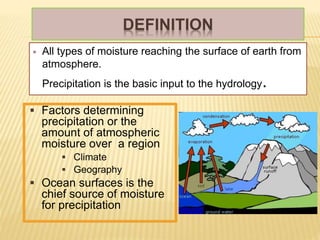
 All types of moisture reaching the surface of earth from
atmosphere.
Precipitation is the basic input to the hydrology.
 Factors determining
precipitation or the
amount of atmospheric
moisture over a region
 Climate
 Geography
 Ocean surfaces is the
chief source of moisture
for precipitation
MECHANISM OF PRECIPITATION
 There are different kinds of
precipitation :
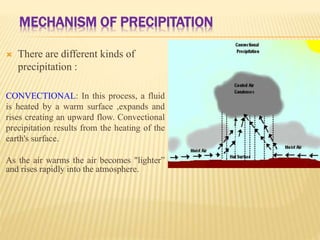
CONVECTIONAL: In this process, a fluid
is heated by a warm surface ,expands and
rises creating an upward flow. Convectional
precipitation results from the heating of the
earth's surface.
As the air warms the air becomes "lighter”
and rises rapidly into the atmosphere.
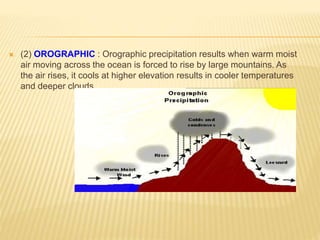
 (2) OROGRAPHIC : Orographic precipitation results when warm moist
air moving across the ocean is forced to rise by large mountains. As
the air rises, it cools at higher elevation results in cooler temperatures
and deeper clouds.
CYCLONIC OR FRONTAL PRECIPITATION
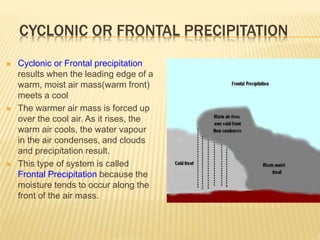
 Cyclonic or Frontal precipitation
results when the leading edge of a
warm, moist air mass(warm front)
meets a cool
 The warmer air mass is forced up
over the cool air. As it rises, the
warm air cools, the water vapour
in the air condenses, and clouds
and precipitation result.
 This type of system is called
Frontal Precipitation because the
moisture tends to occur along the
front of the air mass.
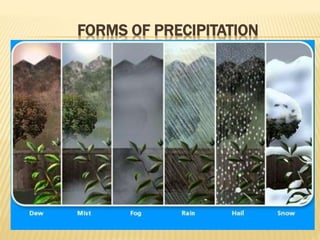
FORMS OF PRECIPITATION
RAIN
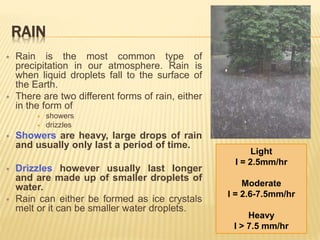
 Rain is the most common type of
precipitation in our atmosphere. Rain is
when liquid droplets fall to the surface of
the Earth.
 There are two different forms of rain, either
in the form of
 showers
 drizzles
 Showers are heavy, large drops of rain
and usually only last a period of time.
 Drizzles however usually last longer
and are made up of smaller droplets of
water.
 Rain can either be formed as ice crystals
melt or it can be smaller water droplets.
Light
I = 2.5mm/hr
Moderate
I = 2.6-7.5mm/hr
Heavy
I > 7.5 mm/hr
SNOW
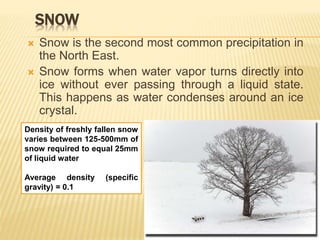
 Snow is the second most common precipitation in
the North East.
 Snow forms when water vapor turns directly into
ice without ever passing through a liquid state.
This happens as water condenses around an ice
crystal.
Density of freshly fallen snow
varies between 125-500mm of
snow required to equal 25mm
of liquid water
Average density (specific
gravity) = 0.1
HAIL
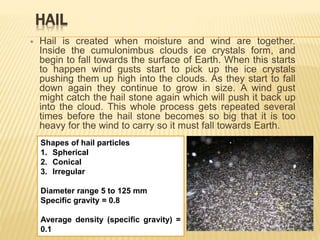
 Hail is created when moisture and wind are together.
Inside the cumulonimbus clouds ice crystals form, and
begin to fall towards the surface of Earth. When this starts
to happen wind gusts start to pick up the ice crystals
pushing them up high into the clouds. As they start to fall
down again they continue to grow in size. A wind gust
might catch the hail stone again which will push it back up
into the cloud. This whole process gets repeated several
times before the hail stone becomes so big that it is too
heavy for the wind to carry so it must fall towards Earth.
Shapes of hail particles
1. Spherical
2. Conical
3. Irregular
Diameter range 5 to 125 mm
Specific gravity = 0.8
Average density (specific gravity) =
0.1
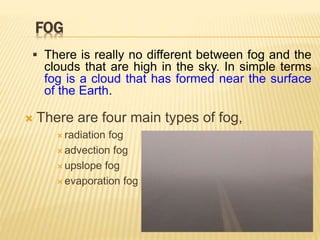
FOG
 There are four main types of fog,
 radiation fog
 advection fog
 upslope fog
 evaporation fog
 There is really no different between fog and the
clouds that are high in the sky. In simple terms
fog is a cloud that has formed near the surface
of the Earth.
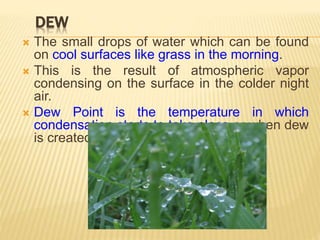
DEW
 The small drops of water which can be found
on cool surfaces like grass in the morning.
 This is the result of atmospheric vapor
condensing on the surface in the colder night
air.
 Dew Point is the temperature in which
condensation starts to take place or when dew
is created.
MIST / DRIZZLE
 Mist is a bunch of small droplets of water which are
in the air. This occurs with cold air when it is above
a warm surface, for example water.
 Fog and mist are very similar, the only difference is
their visibility.
 If you cannot see 1 kilometer or less you know you're
dealing with fog.
 You can see visuals through mist and it is
more haze looking than a thicker substance.
Diameter range between 0.1
and 0.5 mm/hr
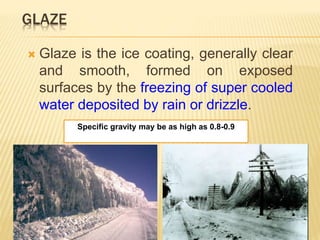
GLAZE
 Glaze is the ice coating, generally clear
and smooth, formed on exposed
surfaces by the freezing of super cooled
water deposited by rain or drizzle.
Specific gravity may be as high as 0.8-0.9
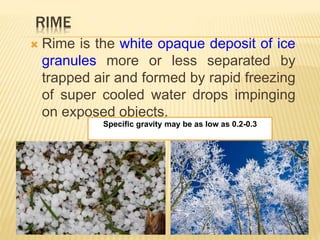
RIME
 Rime is the white opaque deposit of ice
granules more or less separated by
trapped air and formed by rapid freezing
of super cooled water drops impinging
on exposed objects.
Specific gravity may be as low as 0.2-0.3
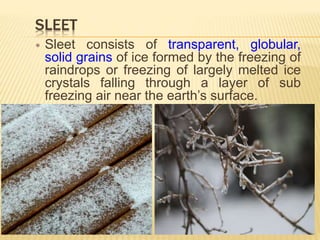
SLEET
 Sleet consists of transparent, globular,
solid grains of ice formed by the freezing of
raindrops or freezing of largely melted ice
crystals falling through a layer of sub
freezing air near the earth’s surface.
MEASUREMENT OF PRECIPITATION
 Rainfall and other forms of precipitation are
measured in terms of depth, the values being
expressed in millimeters and 10th of millimeters.
 One millimeter of precipitation represents the
quantity of water needed to cover the land with a
1mm layer of water, taking into account that nothing
is lost through drainage, evaporation or absorption.
 Instrument used to collect and measure the
precipitation is called rain gauge.
MEASUREMENT OF PRECIPITATION
 1. Amount of precipitation
 2. Intensity of precipitation
 3. Duration of precipitation
 4. Arial extent of precipitation
MEASUREMENT METHODS
 Measurement of precipitation (Rain and Snow)
can be done by various devices. These
measuring devices and techniques are :
 Rain Gauges
 Snow Gauges
 Radars
 Satellites
 Scratching of snow packs
 Water equivalent in snow packs
RAIN GAUGES
 Rain gages are most commonly used for the
measurement of precipitation, both in terms of
rain fall and snow. The rain gauge is also
known as hyeto meter .
 Rain gauges have been used historically to
provide rainfall quantities and rates at a single
point in space
 The volume of water collected in a cylinder is
divided by the area of the cylinder opening and
converted into a depth or rain.
TYPES OF RAIN GAUGES
 There are two main types of rain gages
which are used to measure the
precipitation. These are:
 1. Non recording rain gages
 2. Recording rain gages
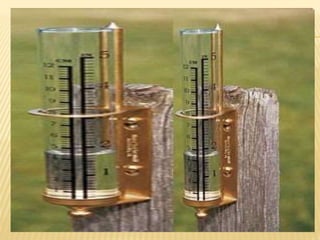
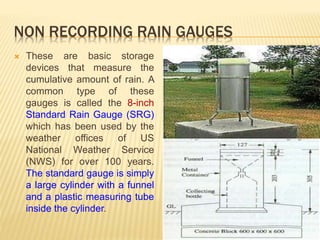
NON RECORDING RAIN GAUGES
 These are basic storage
devices that measure the
cumulative amount of rain. A
common type of these
gauges is called the 8-inch
Standard Rain Gauge (SRG)
which has been used by the
weather offices of US
National Weather Service
(NWS) for over 100 years.
The standard gauge is simply
a large cylinder with a funnel
and a plastic measuring tube
inside the cylinder.
 The non-recording rain gauge used in India is the Symons's
rain gauge .
 It consists of a funnel with a circular rim of 12.7 cm diameter
and a glass bottle as a receiver.
 The cylindrical metal casing is fixed vertically to the masonry
foundation with the level rim 30.5 cm above the ground
surface.
 The rain falling into the funnel is collected in the receiver and
is measured in a special measuring glass graduated in mm
of rainfall; when full it can measure 1.25 cm of rain.
 The rainfall is measured every day at 08.30 hours IST. The
collector is of size 100 to 200 cm.
During heavy rains, it must be measured three or four times
in the day, lest the receiver fill and overflow, but the last
measurement should be at 08.30 hours IST and the sum total
of all the measurements during the previous 24 hours entered
as the rainfall of the day in the register.
Usually, rainfall measurements are made at 08.30 hr IST and
sometimes at 17.30 hr IST also.
Thus the non-recording or the Symons rain gauge gives only
the total depth of rainfall for the previous 24 hours (i.e., daily
rainfall) and does not give the intensity and duration of rainfall
during different time intervals of the day.
It is often desirable to protect the gauge from being damaged
by cattle and for this purpose a barbed wire fence may be
erected around it.
RECORDING RAIN GAUGE
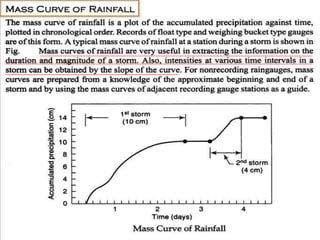
This is also called self-recording, automatic or
integrating rain gauge.
This type of rain gauge has an automatic mechanical
arrangement consisting of a clockwork, a drum with a graph
paper fixed around it and a pencil point, which draws the
mass curve of rainfall. From this mass curve, the depth of
rainfall in a given time, the rate or intensity of rainfall at any
instant during a storm, time of onset and cessation of
rainfall, can be determined.
The gauge is installed on a concrete or masonry
platform 45 cm square in the observatory enclosure by the
side of the ordinary rain gauge at a distance of 2-3 m from it.
The gauge is so installed that the rim of the funnel is
horizontal and at a height of exactly 75 cm above ground
surface. The self-recording rain gauge is generally used in
conjunction with an ordinary rain gauge exposed close by,
for use as standard, by means of which the readings of the
recording rain gauge can be checked and if necessary
adjusted.
TYPES OF RECORDING RAIN GAUGES
 There are three main types of recording rain
gauges
 1. Float type rain gauges
 2. Tipping bucket type rain gauges
 3. Weighing type rain gauges
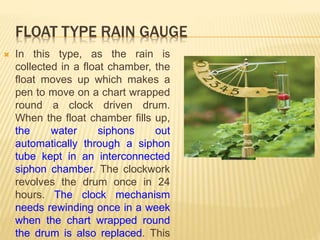
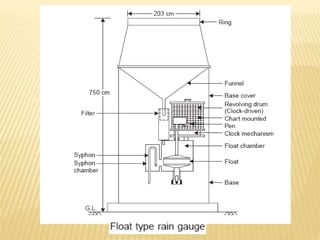
FLOAT TYPE RAIN GAUGE
 In this type, as the rain is
collected in a float chamber, the
float moves up which makes a
pen to move on a chart wrapped
round a clock driven drum.
When the float chamber fills up,
the water siphons out
automatically through a siphon
tube kept in an interconnected
siphon chamber. The clockwork
revolves the drum once in 24
hours. The clock mechanism
needs rewinding once in a week
when the chart wrapped round
the drum is also replaced. This
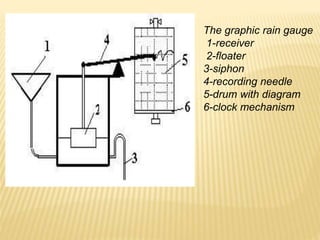
The graphic rain gauge
1-receiver
2-floater
3-siphon
4-recording needle
5-drum with diagram
6-clock mechanism
 The rise of float with increasing catch of rainfall
is recorded. Some gauges must be emptied
manually while others are emptied
automatically using self starting siphons.
 In most gauges oil or mercury is the float and is
placed in the receiver, but in some cases the
receiver rests on a both of oil or mercury and
the float measures the rise of oil or mercury
displaced by the increasing weight of the
receiver as the rainfall catch freezes. Float may
get damaged by rainfall catch freezer
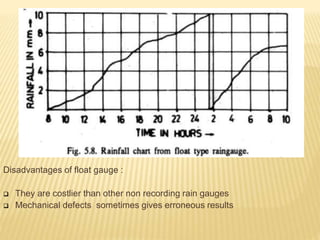
Disadvantages of float gauge :
 They are costlier than other non recording rain gauges
 Mechanical defects sometimes gives erroneous results
TIPPING BUCKET RAIN GAUGE
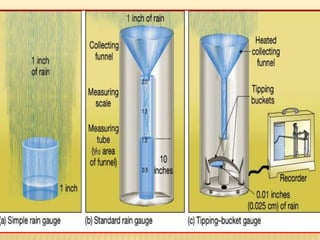
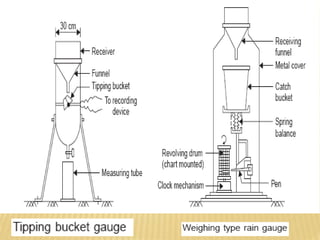
 This consists of a cylindrical receiver 30 cm diameter
with a funnel inside .
 Just below the funnel a pair of tipping buckets is
pivoted such that when one of the bucket receives a
rainfall of 0.25 mm it tips and empties into a tank
below, while the other bucket takes its position and
the process is repeated.
 The tipping of the bucket actuates on electric circuit
which causes a pen to move on a chart wrapped
round a drum which revolves by a clock mechanism.
This type cannot record snow.
 A tipping bucket rain gauge is used for
measurement of rainfall. It measures the rainfall
with a least count of 1 mm and gives out one
electrical pulse for every millimeter of rainfall
 Advantage of tipping bucket :
 it is the only recording gauge which can be used in
remote places by installing the recorder at a
convenient and easily accessible location
 Disadvantages of tipping bucket :
 If the bucket is designed to tip at a convenient
frequency for a particular intensity of rainfall , they
will tip either too soon or too late for other
intensities
WEIGHING TYPE RAIN GAUGE
 In this type of rain-gauge, when a certain
weight of rainfall is collected in a tank, which
rests on a spring-lever balance, it makes a
pen to move on a chart wrapped round a
clock driven drum. The rotation of the drum
sets the time scale while the vertical motion
of the pen records the cumulative
precipitation.
 Disadvantages of weighing type rain gauge :
 in heavy precipitation there is good chance
that bucket will overflow
 these instruments are costlier too
 Advantages of weighing type rain gauge :
it can measure all forms of precipitation
including snow and rain
ERRORS IN PRECIPITATION MEASUREMENT BY
RAIN GAUGES
 Instrumental errors
 Errors in scale reading
 Dent in receivers
 Dent in measuring cylinders
 About 0.25mm of water is initially required to wet the
surface of gauge
 Rain gauges splash from collector
 Frictional effects
 Non verticality of measuring cylinders (10° inclination gives
1.5% less precipitation)
 Loss of water by evaporation
 Leakage in measuring cylinder
 Wind speed reduces measured amount of rain in the rain
gauges.
LOCATION OF RAIN GAUGES
The amount of rainfall collected by a rain gauge depends on its
exposure conditions and there fore great care must be taken for
selecting suitable site for a rain gauge.
According to Indian standards the following precautions must be
taken while selecting a site for a rain gauge station :
1) The site should be on level ground,i.e, sloping ground, hill tops or
hill slopes are not suitable
2) The site should be an open space.
3) Horizontal distance between the rain gauge and the nearest object
should be twice the height of the object
4) Site should be away from continuous wind forces.
5) Other meteorological object and the fencing of the site
should maintain the horizontal distance between the
rain gauge and the nearest object twice the height of
object.
6) The site should be easily accessible.
7) The gauge should be truly vertical.
8) 10% of total number of rain gauge stations of any basin
should be self recording.
9) The observer must visit the site regularly to ensure its
proper readiness for measurement.
PLACEMENT OF RAIN GAUGES
Gauges are affected by wind pattern, eddies, trees and
the gauge itself, therefore it is important to have the
gauge located and positioned properly.
• 1m above ground level is standard -
all gauges in a catchment should be the same height
• 2 to 4 times the distance away from an isolated object
(such as a tree or building) or in a forest a clearing
with the radius at least the tree height or place the
gauge at canopy level
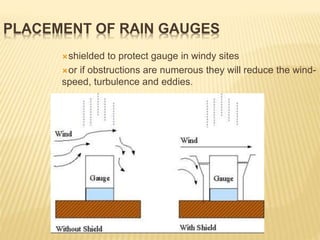
PLACEMENT OF RAIN GAUGES
shielded to protect gauge in windy sites
or if obstructions are numerous they will reduce the wind-
speed, turbulence and eddies.
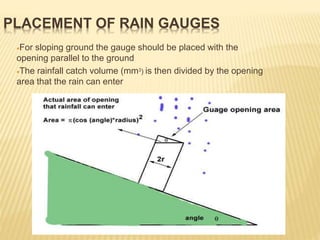
For sloping ground the gauge should be placed with the
opening parallel to the ground
The rainfall catch volume (mm3) is then divided by the opening
area that the rain can enter
PLACEMENT OF RAIN GAUGES
ANALYSIS AND INTERPRETATION OF RAINFALL
DATA
 The precipitation process is essentially random in nature. We can’t predict
with certainty what will be the rainfall for any given period in future.
 The rainfall magnitudes can be estimated only with some probability
attached to them. Therefore the analysis of rainfall data obtained over a
long period in the past would help the hydrologist to make reasonable
probabilistic estimates of rainfall to be used in various designs
 The rainfall obtained from single rain gauge station is known as the point
rainfall or station rainfall.
 If the data at the station covers a period of more than 30 years, the
normal annual rainfall, or the normal monthly rainfall for any month can be
computed
 The normal monthly rainfall of a station is computed as the arithmetic
average of the monthly rainfall or yearly rainfall in last 30 years.
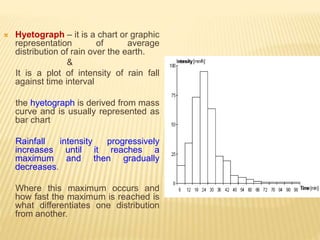
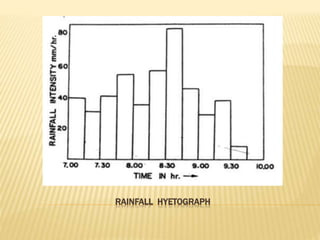
 Hyetograph – it is a chart or graphic
representation of average
distribution of rain over the earth.
&
It is a plot of intensity of rain fall
against time interval
the hyetograph is derived from mass
curve and is usually represented as
bar chart
Rainfall intensity progressively
increases until it reaches a
maximum and then gradually
decreases.
Where this maximum occurs and
how fast the maximum is reached is
what differentiates one distribution
from another.
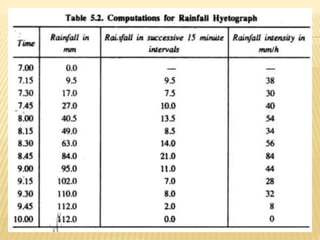
Q. A storm commenced at 7:00 hours. The
ordinates of the rainfall mass-curve of the storm
in mm as recommended by a recording rain
gauge at 15 min intervals are –
0,9.5,17,27,40.5,49,63,84,95,102,110,112,112
construct a hyetograph of this storm for a
uniform interval of 15 min ?
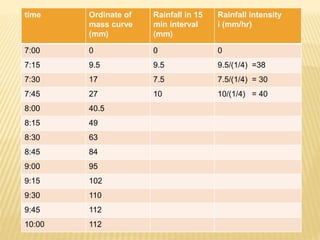
time Ordinate of
mass curve
(mm)
Rainfall in 15
min interval
(mm)
Rainfall intensity
i (mm/hr)
7:00 0 0 0
7:15 9.5 9.5 9.5/(1/4) =38
7:30 17 7.5 7.5/(1/4) = 30
7:45 27 10 10/(1/4) = 40
8:00 40.5
8:15 49
8:30 63
8:45 84
9:00 95
9:15 102
9:30 110
9:45 112
10:00 112
RAINFALL HYETOGRAPH
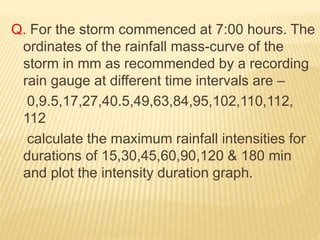
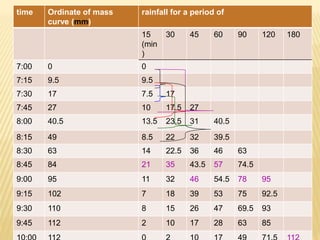
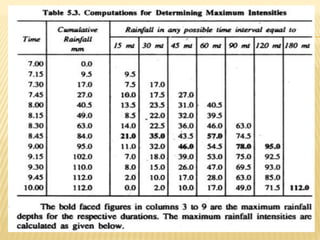
Q. For the storm commenced at 7:00 hours. The
ordinates of the rainfall mass-curve of the
storm in mm as recommended by a recording
rain gauge at different time intervals are –
0,9.5,17,27,40.5,49,63,84,95,102,110,112,
112
calculate the maximum rainfall intensities for
durations of 15,30,45,60,90,120 & 180 min
and plot the intensity duration graph.
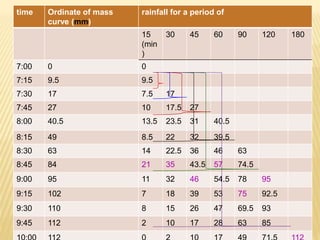
time Ordinate of mass
curve (mm)
rainfall for a period of
15
(min
)
30 45 60 90 120 180
7:00 0 0
7:15 9.5 9.5
7:30 17 7.5 17
7:45 27 10 17.5 27
8:00 40.5 13.5 23.5 31 40.5
8:15 49 8.5 22 32 39.5
8:30 63 14 22.5 36 46 63
8:45 84 21 35 43.5 57 74.5
9:00 95 11 32 46 54.5 78 95
9:15 102 7 18 39 53 75 92.5
9:30 110 8 15 26 47 69.5 93
9:45 112 2 10 17 28 63 85
time Ordinate of mass
curve (mm)
rainfall for a period of
15
(min
)
30 45 60 90 120 180
7:00 0 0
7:15 9.5 9.5
7:30 17 7.5 17
7:45 27 10 17.5 27
8:00 40.5 13.5 23.5 31 40.5
8:15 49 8.5 22 32 39.5
8:30 63 14 22.5 36 46 63
8:45 84 21 35 43.5 57 74.5
9:00 95 11 32 46 54.5 78 95
9:15 102 7 18 39 53 75 92.5
9:30 110 8 15 26 47 69.5 93
9:45 112 2 10 17 28 63 85
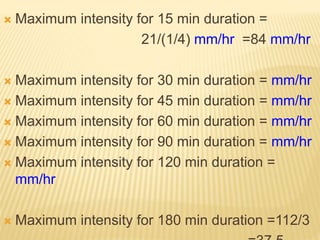
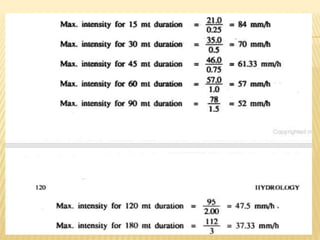
 Maximum intensity for 15 min duration =
21/(1/4) mm/hr =84 mm/hr
 Maximum intensity for 30 min duration = mm/hr
 Maximum intensity for 45 min duration = mm/hr
 Maximum intensity for 60 min duration = mm/hr
 Maximum intensity for 90 min duration = mm/hr
 Maximum intensity for 120 min duration =
mm/hr
 Maximum intensity for 180 min duration =112/3
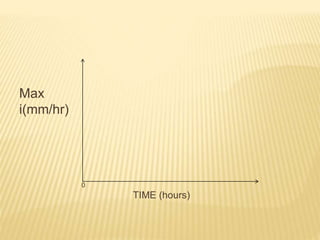
Max
i(mm/hr)
0
TIME (hours)
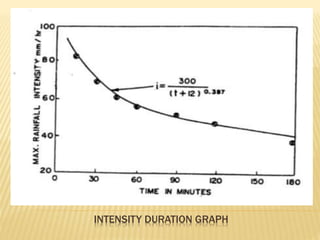
INTENSITY DURATION GRAPH
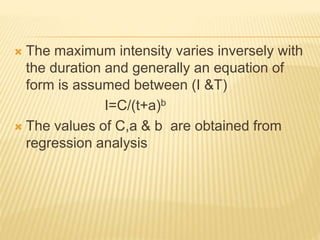
 The maximum intensity varies inversely with
the duration and generally an equation of
form is assumed between (I &T)
I=C/(t+a)b
 The values of C,a & b are obtained from
regression analysis
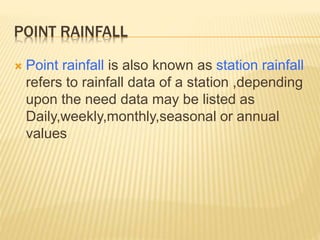
POINT RAINFALL
 Point rainfall is also known as station rainfall
refers to rainfall data of a station ,depending
upon the need data may be listed as
Daily,weekly,monthly,seasonal or annual
values
MOVING AVERAGE
 Moving average is a technique for smoothening
out the high frequency fluctuations of time
series and to enable the trend.
 The range of m years is selected starting from
first set of m years of data.
 The average of data of m years is calculated
and placed in middle year of range m.
 The process is repeated for next year.
 Normally 3 or more years are taken, usually an
odd value.
 More the years more smooth curve will be
obtained.
RAINGAUGE NETWORK
 Since the catching area of rain gauge is very
small compared to areal extent of storm.
 To cover large catchment area a number of
rain gauges would be required as large as
possible
 More the rain gauge more the accuracy.
 Economic considerations and other
considerations such as topography,
accessibility etc restrict number of rain
gauges to some extent.
RAINGAUGE DENSITY
 The World Meteorological Organisation (W.M.O)
recommends the following densities-
 In flat regions of tempreture,mediterranean and tropical
zones
IDEAL: 1 station for 600 to 900 km2
ACCEPTABLE: 1 station for 900 to 3000 km2
IN mountaneous region of temperature
IDEAL: 1 station for 100 to 250 km2
ACCEPTABLE: 1 station for 25 to 1000 km2
In Arid & Polar zones --1 station for 1500 to 10,000 km2
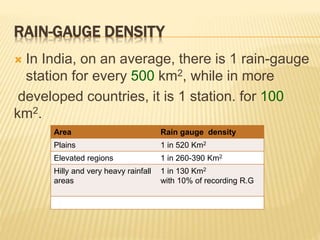
RAIN-GAUGE DENSITY
 In India, on an average, there is 1 rain-gauge
station for every 500 km2, while in more
developed countries, it is 1 station. for 100
km2.
Area Rain gauge density
Plains 1 in 520 Km2
Elevated regions 1 in 260-390 Km2
Hilly and very heavy rainfall
areas
1 in 130 Km2
with 10% of recording R.G
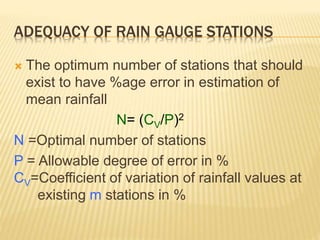
ADEQUACY OF RAIN GAUGE STATIONS
 The optimum number of stations that should
exist to have %age error in estimation of
mean rainfall
N= (CV/P)2
N =Optimal number of stations
P = Allowable degree of error in %
CV=Coefficient of variation of rainfall values at
existing m stations in %
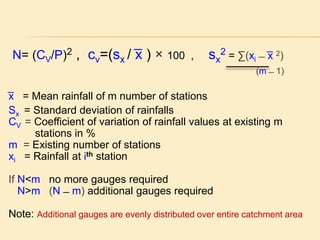
N= (CV/P)2 , cv=(sx / ͞x ) × 100 , sx
2 = ∑(xi ̶ ͞x 2)
(m ̶ 1)
͞x = Mean rainfall of m number of stations
Sx = Standard deviation of rainfalls
CV = Coefficient of variation of rainfall values at existing m
stations in %
m = Existing number of stations
xi = Rainfall at ith station
If N<m no more gauges required
N>m (N ̶ m) additional gauges required
Note: Additional gauges are evenly distributed over entire catchment area
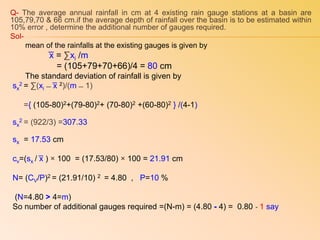
Q- The average annual rainfall in cm at 4 existing rain gauge stations at a basin are
105,79,70 & 66 cm.if the average depth of rainfall over the basin is to be estimated within
10% error , determine the additional number of gauges required.
Sol-
mean of the rainfalls at the existing gauges is given by
͞x = ∑xi /m
= (105+79+70+66)/4 = 80 cm
The standard deviation of rainfall is given by
sx
2 = ∑(xi ̶ ͞x 2)/(m ̶ 1)
={ (105-80)2+(79-80)2+ (70-80)2 +(60-80)2 } /(4-1)
sx
2 = (922/3) =307.33
sx = 17.53 cm
cv=(sx / ͞x ) × 100 = (17.53/80) × 100 = 21.91 cm
N= (CV/P)2 = (21.91/10) 2 = 4.80 , P=10 %
(N=4.80 > 4=m)
So number of additional gauges required =(N-m) = (4.80 - 4) = 0.80 ͌ 1 say
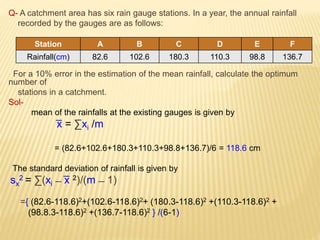
Q- A catchment area has six rain gauge stations. In a year, the annual rainfall
recorded by the gauges are as follows:
For a 10% error in the estimation of the mean rainfall, calculate the optimum
number of
stations in a catchment.
Sol-
mean of the rainfalls at the existing gauges is given by
͞x = ∑xi /m
= (82.6+102.6+180.3+110.3+98.8+136.7)/6 = 118.6 cm
The standard deviation of rainfall is given by
sx
2 = ∑(xi ̶ ͞x 2)/(m ̶ 1)
={ (82.6-118.6)2+(102.6-118.6)2+ (180.3-118.6)2 +(110.3-118.6)2 +
(98.8.3-118.6)2 +(136.7-118.6)2 } /(6-1)
Station A B C D E F
Rainfall(cm) 82.6 102.6 180.3 110.3 98.8 136.7
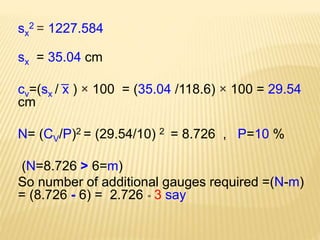
sx
2 = 1227.584
sx = 35.04 cm
cv=(sx / ͞x ) × 100 = (35.04 /118.6) × 100 = 29.54
cm
N= (CV/P)2 = (29.54/10) 2 = 8.726 , P=10 %
(N=8.726 > 6=m)
So number of additional gauges required =(N-m)
= (8.726 - 6) = 2.726 ͌ 3 say
AVERAGE ANNUAL RAINFALL
 The mean of yearly rainfall observed for a period of
35 consecutive years is called the
 average annual rainfall (a.a.r.) as used in India
 The A.A.R of a place depends upon:
1) Distance from the ocean.
2) Direction of prevailing winds.
3) The mean annual temperature.
4) Altitude of place
5) Topography
INTERPRETATION OF PRECIPITATION DATA
Interpretation of precipitation data includes:
1) Estimating missing precipitation data at a
station
2) Checking inconsistency in particular data at
a station
3) Averaging precipitation over an area
1. ESTIMATING MISSING PRECIPITATION
DATA AT A STATION
Missing precipitation data is estimated by
two commonly used methods.
 Arithmetic Mean Method
 Normal Ratio Method (NRM)
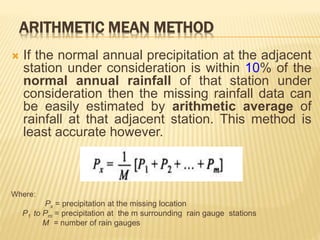
ARITHMETIC MEAN METHOD
 If the normal annual precipitation at the adjacent
station under consideration is within 10% of the
normal annual rainfall of that station under
consideration then the missing rainfall data can
be easily estimated by arithmetic average of
rainfall at that adjacent station. This method is
least accurate however.
Where:
Px = precipitation at the missing location
P1 to Pm = precipitation at the m surrounding rain gauge stations
M = number of rain gauges
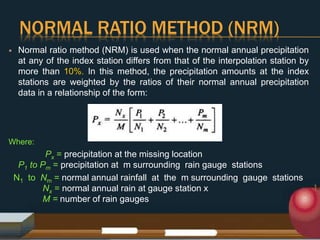
NORMAL RATIO METHOD (NRM)
 Normal ratio method (NRM) is used when the normal annual precipitation
at any of the index station differs from that of the interpolation station by
more than 10%. In this method, the precipitation amounts at the index
stations are weighted by the ratios of their normal annual precipitation
data in a relationship of the form:
Where:
Px = precipitation at the missing location
P1 to Pm = precipitation at m surrounding rain gauge stations
N1 to Nm = normal annual rainfall at the m surrounding gauge stations
Nx = normal annual rain at gauge station x
M = number of rain gauges
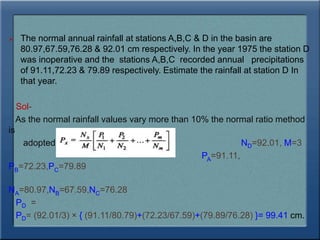
 The normal annual rainfall at stations A,B,C & D in the basin are
80.97,67.59,76.28 & 92.01 cm respectively. In the year 1975 the station D
was inoperative and the stations A,B,C recorded annual precipitations
of 91.11,72.23 & 79.89 respectively. Estimate the rainfall at station D In
that year.
Sol-
As the normal rainfall values vary more than 10% the normal ratio method
is
adopted. ND=92.01, M=3
PA=91.11,
PB=72.23,PC=79.89
NA=80.97,NB=67.59,NC=76.28
PD =
PD= (92.01/3) × { (91.11/80.79)+(72.23/67.59)+(79.89/76.28) }= 99.41 cm.
CHECKING INCONSISTENCY IN A
PARTICULAR DATA RECORD AT A STATION
Double Mass Curve Analysis.
 It is used to check the consistency of many
kinds of hydrologic data
 By comparing date for a single station with
that of a pattern composed of the data from
several other stations in the area
 The double-mass curve can be used to adjust
inconsistent precipitation data
COMMON CAUSES OF INCONSISTENCY OF RECORD
1) Shifting of rain gauge station at a new location.
2) The neighborhood of a station is undergoing a
marked change.
3) Change in the ecosystem due to calamities such as
Forest fires, Land slides etc.
4) Occurrence of observational error from a certain
date.
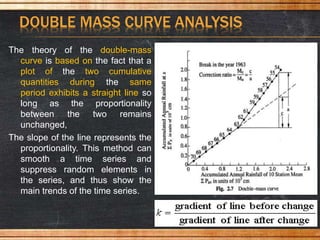
DOUBLE MASS CURVE ANALYSIS
The theory of the double-mass
curve is based on the fact that a
plot of the two cumulative
quantities during the same
period exhibits a straight line so
long as the proportionality
between the two remains
unchanged,
The slope of the line represents the
proportionality. This method can
smooth a time series and
suppress random elements in
the series, and thus show the
main trends of the time series.
AVERAGING PRECIPITATION OVER AREA
It is the amount of precipitation which can
be assumed uniform over an area. If the
average precipitation over an area is
known than total rain volume of water can
be computed for that area.
Rain volume = Pavg × A
METHODS FOR COMPUTING AVERAGE
PRECIPITATION OVER AN AREA
There are some widely used methods to
compute average precipitation over an area,
but the most common of these used are:
 Arithmetic mean method
 Theissen polygon method
 Isohyetal method
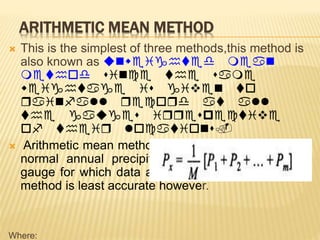
ARITHMETIC MEAN METHOD
 This is the simplest of three methods,this method is
also known as unweighted mean
method since the same
weightage is given to
rainfall record at all
the gauges irrespective
of their locations.
 Arithmetic mean method is used when area is flat &
normal annual precipitation is within 10% of the
gauge for which data are being reconstructed. This
method is least accurate however.
Where:
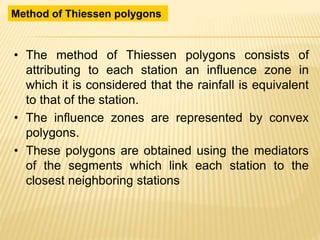
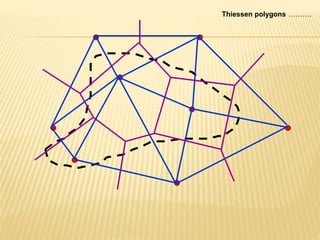
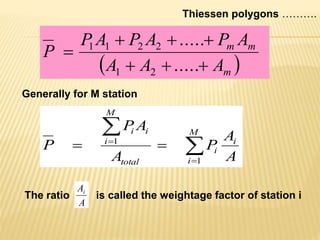
• The method of Thiessen polygons consists of
attributing to each station an influence zone in
which it is considered that the rainfall is equivalent
to that of the station.
• The influence zones are represented by convex
polygons.
• These polygons are obtained using the mediators
of the segments which link each station to the
closest neighboring stations
Method of Thiessen polygons
Thiessen polygons ……….
A1
A2
A3
A4
A5
A6
A7
A8
P1
P2
P3
P4
P5
P6
P7
P8
 m
mm
AAA
APAPAP
P



.....
.....
21
2211





M
i
i
i
total
i
M
i
i
A
A
P
A
AP
P
1
1
Thiessen polygons ……….
Generally for M station
The ratio is called the weightage factor of station i
A
Ai
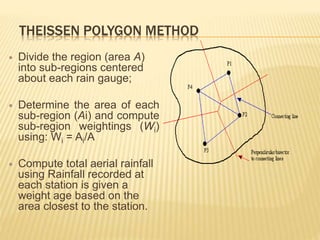
THEISSEN POLYGON METHOD
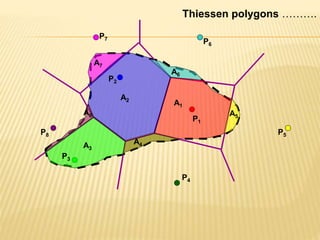
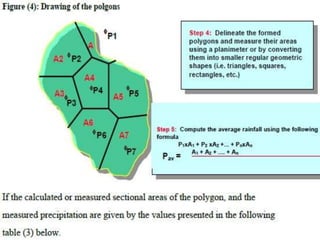
 Divide the region (area A)
into sub-regions centered
about each rain gauge;
 Determine the area of each
sub-region (Ai) and compute
sub-region weightings (Wi)
using: Wi = Ai/A
 Compute total aerial rainfall
using Rainfall recorded at
each station is given a
weight age based on the
area closest to the station.
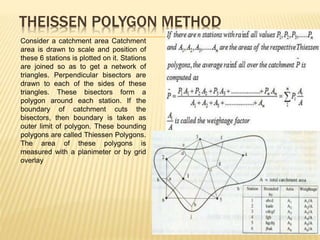
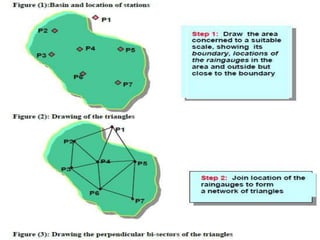
THEISSEN POLYGON METHOD
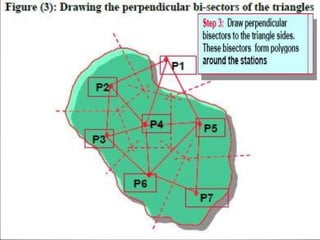
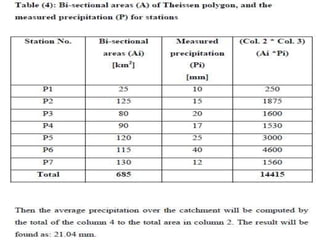
Consider a catchment area Catchment
area is drawn to scale and position of
these 6 stations is plotted on it. Stations
are joined so as to get a network of
triangles. Perpendicular bisectors are
drawn to each of the sides of these
triangles. These bisectors form a
polygon around each station. If the
boundary of catchment cuts the
bisectors, then boundary is taken as
outer limit of polygon. These bounding
polygons are called Thiessen Polygons.
The area of these polygons is
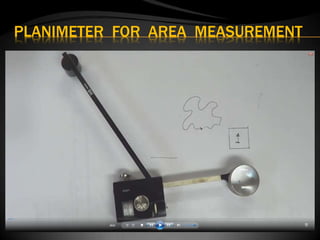
measured with a planimeter or by grid
overlay
PLANIMETER FOR AREA MEASUREMENT
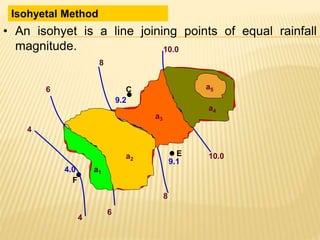
• An isohyet is a line joining points of equal rainfall
magnitude.
Isohyetal Method
F
B
E
A
C
D
12
9.2
4.0
7.0
7.2
9.1
10.0
10.0
12
8
8
6
6
4
4
a1a1
a2
a3
a4
a5
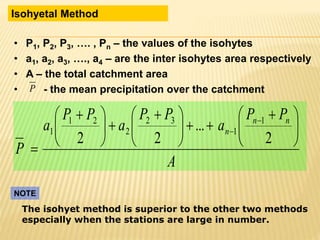
• P1, P2, P3, …. , Pn – the values of the isohytes
• a1, a2, a3, …., a4 – are the inter isohytes area respectively
• A – the total catchment area
• - the mean precipitation over the catchment
Isohyetal Method
P
A
PP
a
PP
a
PP
a
P
nn
n 




 





 





 



2
...
22
1
1
32
2
21
1
The isohyet method is superior to the other two methods
especially when the stations are large in number.
NOTE
ISOHYETAL METHOD
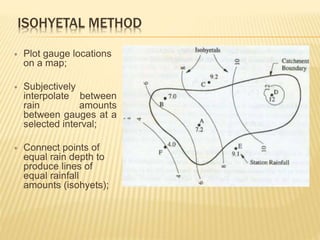
 Plot gauge locations
on a map;
 Subjectively
interpolate between
rain amounts
between gauges at a
selected interval;
 Connect points of
equal rain depth to
produce lines of
equal rainfall
amounts (isohyets);
ISOHYETAL METHOD
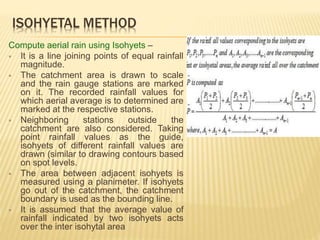
Compute aerial rain using Isohyets –
 It is a line joining points of equal rainfall
magnitude.
 The catchment area is drawn to scale
and the rain gauge stations are marked
on it. The recorded rainfall values for
which aerial average is to determined are
marked at the respective stations.
 Neighboring stations outside the
catchment are also considered. Taking
point rainfall values as the guide,
isohyets of different rainfall values are
drawn (similar to drawing contours based
on spot levels.
 The area between adjacent isohyets is
measured using a planimeter. If isohyets
go out of the catchment, the catchment
boundary is used as the bounding line.
 It is assumed that the average value of
rainfall indicated by two isohyets acts
over the inter isohytal area
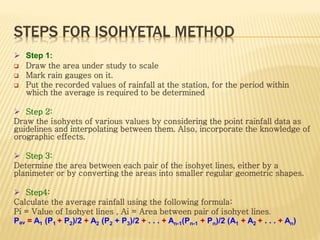
STEPS FOR ISOHYETAL METHOD
 Step 1:
 Draw the area under study to scale
 Mark rain gauges on it.
 Put the recorded values of rainfall at the station, for the period within
which the average is required to be determined
 Step 2:
Draw the isohyets of various values by considering the point rainfall data as
guidelines and interpolating between them. Also, incorporate the knowledge of
orographic effects.
 Step 3:
Determine the area between each pair of the isohyet lines, either by a
planimeter or by converting the areas into smaller regular geometric shapes.
 Step4:
Calculate the average rainfall using the following formula:
Pi = Value of Isohyet lines , Ai = Area between pair of isohyet lines.
Pav = A1 (P1 + P2)/2 + A2 (P2 + P3)/2 + . . . + An-1(Pn-1 + Pn)/2 (A1 + A2 + . . . + An)
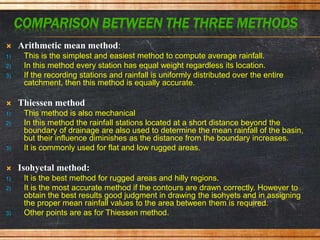
COMPARISON BETWEEN THE THREE METHODS:
 Arithmetic mean method:
1) This is the simplest and easiest method to compute average rainfall.
2) In this method every station has equal weight regardless its location.
3) If the recording stations and rainfall is uniformly distributed over the entire
catchment, then this method is equally accurate.
 Thiessen method
1) This method is also mechanical
2) In this method the rainfall stations located at a short distance beyond the
boundary of drainage are also used to determine the mean rainfall of the basin,
but their influence diminishes as the distance from the boundary increases.
3) It is commonly used for flat and low rugged areas.
 Isohyetal method:
1) It is the best method for rugged areas and hilly regions.
2) It is the most accurate method if the contours are drawn correctly. However to
obtain the best results good judgment in drawing the isohyets and in assigning
the proper mean rainfall values to the area between them is required.
3) Other points are as for Thiessen method.

Precipitation unit 2

  • 1.
  • 2.
    DEFINITION  All typesof moisture reaching the surface of earth from atmosphere. Precipitation is the basic input to the hydrology.  Factors determining precipitation or the amount of atmospheric moisture over a region  Climate  Geography  Ocean surfaces is the chief source of moisture for precipitation
  • 3.
    MECHANISM OF PRECIPITATION There are different kinds of precipitation : CONVECTIONAL: In this process, a fluid is heated by a warm surface ,expands and rises creating an upward flow. Convectional precipitation results from the heating of the earth's surface. As the air warms the air becomes "lighter” and rises rapidly into the atmosphere.
  • 4.
     (2) OROGRAPHIC: Orographic precipitation results when warm moist air moving across the ocean is forced to rise by large mountains. As the air rises, it cools at higher elevation results in cooler temperatures and deeper clouds.
  • 5.
    CYCLONIC OR FRONTALPRECIPITATION  Cyclonic or Frontal precipitation results when the leading edge of a warm, moist air mass(warm front) meets a cool  The warmer air mass is forced up over the cool air. As it rises, the warm air cools, the water vapour in the air condenses, and clouds and precipitation result.  This type of system is called Frontal Precipitation because the moisture tends to occur along the front of the air mass.
  • 6.
  • 7.
    RAIN  Rain isthe most common type of precipitation in our atmosphere. Rain is when liquid droplets fall to the surface of the Earth.  There are two different forms of rain, either in the form of  showers  drizzles  Showers are heavy, large drops of rain and usually only last a period of time.  Drizzles however usually last longer and are made up of smaller droplets of water.  Rain can either be formed as ice crystals melt or it can be smaller water droplets. Light I = 2.5mm/hr Moderate I = 2.6-7.5mm/hr Heavy I > 7.5 mm/hr
  • 8.
    SNOW  Snow isthe second most common precipitation in the North East.  Snow forms when water vapor turns directly into ice without ever passing through a liquid state. This happens as water condenses around an ice crystal. Density of freshly fallen snow varies between 125-500mm of snow required to equal 25mm of liquid water Average density (specific gravity) = 0.1
  • 9.
    HAIL  Hail iscreated when moisture and wind are together. Inside the cumulonimbus clouds ice crystals form, and begin to fall towards the surface of Earth. When this starts to happen wind gusts start to pick up the ice crystals pushing them up high into the clouds. As they start to fall down again they continue to grow in size. A wind gust might catch the hail stone again which will push it back up into the cloud. This whole process gets repeated several times before the hail stone becomes so big that it is too heavy for the wind to carry so it must fall towards Earth. Shapes of hail particles 1. Spherical 2. Conical 3. Irregular Diameter range 5 to 125 mm Specific gravity = 0.8 Average density (specific gravity) = 0.1
  • 10.
    FOG  There arefour main types of fog,  radiation fog  advection fog  upslope fog  evaporation fog  There is really no different between fog and the clouds that are high in the sky. In simple terms fog is a cloud that has formed near the surface of the Earth.
  • 11.
    DEW  The smalldrops of water which can be found on cool surfaces like grass in the morning.  This is the result of atmospheric vapor condensing on the surface in the colder night air.  Dew Point is the temperature in which condensation starts to take place or when dew is created.
  • 12.
    MIST / DRIZZLE Mist is a bunch of small droplets of water which are in the air. This occurs with cold air when it is above a warm surface, for example water.  Fog and mist are very similar, the only difference is their visibility.  If you cannot see 1 kilometer or less you know you're dealing with fog.  You can see visuals through mist and it is more haze looking than a thicker substance. Diameter range between 0.1 and 0.5 mm/hr
  • 13.
    GLAZE  Glaze isthe ice coating, generally clear and smooth, formed on exposed surfaces by the freezing of super cooled water deposited by rain or drizzle. Specific gravity may be as high as 0.8-0.9
  • 14.
    RIME  Rime isthe white opaque deposit of ice granules more or less separated by trapped air and formed by rapid freezing of super cooled water drops impinging on exposed objects. Specific gravity may be as low as 0.2-0.3
  • 15.
    SLEET  Sleet consistsof transparent, globular, solid grains of ice formed by the freezing of raindrops or freezing of largely melted ice crystals falling through a layer of sub freezing air near the earth’s surface.
  • 17.
    MEASUREMENT OF PRECIPITATION Rainfall and other forms of precipitation are measured in terms of depth, the values being expressed in millimeters and 10th of millimeters.  One millimeter of precipitation represents the quantity of water needed to cover the land with a 1mm layer of water, taking into account that nothing is lost through drainage, evaporation or absorption.  Instrument used to collect and measure the precipitation is called rain gauge.
  • 18.
    MEASUREMENT OF PRECIPITATION 1. Amount of precipitation  2. Intensity of precipitation  3. Duration of precipitation  4. Arial extent of precipitation
  • 19.
    MEASUREMENT METHODS  Measurementof precipitation (Rain and Snow) can be done by various devices. These measuring devices and techniques are :  Rain Gauges  Snow Gauges  Radars  Satellites  Scratching of snow packs  Water equivalent in snow packs
  • 20.
    RAIN GAUGES  Raingages are most commonly used for the measurement of precipitation, both in terms of rain fall and snow. The rain gauge is also known as hyeto meter .  Rain gauges have been used historically to provide rainfall quantities and rates at a single point in space  The volume of water collected in a cylinder is divided by the area of the cylinder opening and converted into a depth or rain.
  • 22.
    TYPES OF RAINGAUGES  There are two main types of rain gages which are used to measure the precipitation. These are:  1. Non recording rain gages  2. Recording rain gages
  • 23.
    NON RECORDING RAINGAUGES  These are basic storage devices that measure the cumulative amount of rain. A common type of these gauges is called the 8-inch Standard Rain Gauge (SRG) which has been used by the weather offices of US National Weather Service (NWS) for over 100 years. The standard gauge is simply a large cylinder with a funnel and a plastic measuring tube inside the cylinder.
  • 24.
     The non-recordingrain gauge used in India is the Symons's rain gauge .  It consists of a funnel with a circular rim of 12.7 cm diameter and a glass bottle as a receiver.  The cylindrical metal casing is fixed vertically to the masonry foundation with the level rim 30.5 cm above the ground surface.  The rain falling into the funnel is collected in the receiver and is measured in a special measuring glass graduated in mm of rainfall; when full it can measure 1.25 cm of rain.  The rainfall is measured every day at 08.30 hours IST. The collector is of size 100 to 200 cm.
  • 25.
    During heavy rains,it must be measured three or four times in the day, lest the receiver fill and overflow, but the last measurement should be at 08.30 hours IST and the sum total of all the measurements during the previous 24 hours entered as the rainfall of the day in the register. Usually, rainfall measurements are made at 08.30 hr IST and sometimes at 17.30 hr IST also. Thus the non-recording or the Symons rain gauge gives only the total depth of rainfall for the previous 24 hours (i.e., daily rainfall) and does not give the intensity and duration of rainfall during different time intervals of the day. It is often desirable to protect the gauge from being damaged by cattle and for this purpose a barbed wire fence may be erected around it.
  • 26.
    RECORDING RAIN GAUGE Thisis also called self-recording, automatic or integrating rain gauge. This type of rain gauge has an automatic mechanical arrangement consisting of a clockwork, a drum with a graph paper fixed around it and a pencil point, which draws the mass curve of rainfall. From this mass curve, the depth of rainfall in a given time, the rate or intensity of rainfall at any instant during a storm, time of onset and cessation of rainfall, can be determined. The gauge is installed on a concrete or masonry platform 45 cm square in the observatory enclosure by the side of the ordinary rain gauge at a distance of 2-3 m from it. The gauge is so installed that the rim of the funnel is horizontal and at a height of exactly 75 cm above ground surface. The self-recording rain gauge is generally used in conjunction with an ordinary rain gauge exposed close by, for use as standard, by means of which the readings of the recording rain gauge can be checked and if necessary adjusted.
  • 27.
    TYPES OF RECORDINGRAIN GAUGES  There are three main types of recording rain gauges  1. Float type rain gauges  2. Tipping bucket type rain gauges  3. Weighing type rain gauges
  • 28.
    FLOAT TYPE RAINGAUGE  In this type, as the rain is collected in a float chamber, the float moves up which makes a pen to move on a chart wrapped round a clock driven drum. When the float chamber fills up, the water siphons out automatically through a siphon tube kept in an interconnected siphon chamber. The clockwork revolves the drum once in 24 hours. The clock mechanism needs rewinding once in a week when the chart wrapped round the drum is also replaced. This
  • 30.
    The graphic raingauge 1-receiver 2-floater 3-siphon 4-recording needle 5-drum with diagram 6-clock mechanism
  • 31.
     The riseof float with increasing catch of rainfall is recorded. Some gauges must be emptied manually while others are emptied automatically using self starting siphons.  In most gauges oil or mercury is the float and is placed in the receiver, but in some cases the receiver rests on a both of oil or mercury and the float measures the rise of oil or mercury displaced by the increasing weight of the receiver as the rainfall catch freezes. Float may get damaged by rainfall catch freezer
  • 32.
    Disadvantages of floatgauge :  They are costlier than other non recording rain gauges  Mechanical defects sometimes gives erroneous results
  • 33.
    TIPPING BUCKET RAINGAUGE  This consists of a cylindrical receiver 30 cm diameter with a funnel inside .  Just below the funnel a pair of tipping buckets is pivoted such that when one of the bucket receives a rainfall of 0.25 mm it tips and empties into a tank below, while the other bucket takes its position and the process is repeated.  The tipping of the bucket actuates on electric circuit which causes a pen to move on a chart wrapped round a drum which revolves by a clock mechanism. This type cannot record snow.
  • 34.
     A tippingbucket rain gauge is used for measurement of rainfall. It measures the rainfall with a least count of 1 mm and gives out one electrical pulse for every millimeter of rainfall
  • 35.
     Advantage oftipping bucket :  it is the only recording gauge which can be used in remote places by installing the recorder at a convenient and easily accessible location  Disadvantages of tipping bucket :  If the bucket is designed to tip at a convenient frequency for a particular intensity of rainfall , they will tip either too soon or too late for other intensities
  • 37.
    WEIGHING TYPE RAINGAUGE  In this type of rain-gauge, when a certain weight of rainfall is collected in a tank, which rests on a spring-lever balance, it makes a pen to move on a chart wrapped round a clock driven drum. The rotation of the drum sets the time scale while the vertical motion of the pen records the cumulative precipitation.
  • 39.
     Disadvantages ofweighing type rain gauge :  in heavy precipitation there is good chance that bucket will overflow  these instruments are costlier too  Advantages of weighing type rain gauge : it can measure all forms of precipitation including snow and rain
  • 40.
    ERRORS IN PRECIPITATIONMEASUREMENT BY RAIN GAUGES  Instrumental errors  Errors in scale reading  Dent in receivers  Dent in measuring cylinders  About 0.25mm of water is initially required to wet the surface of gauge  Rain gauges splash from collector  Frictional effects  Non verticality of measuring cylinders (10° inclination gives 1.5% less precipitation)  Loss of water by evaporation  Leakage in measuring cylinder  Wind speed reduces measured amount of rain in the rain gauges.
  • 41.
    LOCATION OF RAINGAUGES The amount of rainfall collected by a rain gauge depends on its exposure conditions and there fore great care must be taken for selecting suitable site for a rain gauge. According to Indian standards the following precautions must be taken while selecting a site for a rain gauge station : 1) The site should be on level ground,i.e, sloping ground, hill tops or hill slopes are not suitable 2) The site should be an open space. 3) Horizontal distance between the rain gauge and the nearest object should be twice the height of the object 4) Site should be away from continuous wind forces.
  • 42.
    5) Other meteorologicalobject and the fencing of the site should maintain the horizontal distance between the rain gauge and the nearest object twice the height of object. 6) The site should be easily accessible. 7) The gauge should be truly vertical. 8) 10% of total number of rain gauge stations of any basin should be self recording. 9) The observer must visit the site regularly to ensure its proper readiness for measurement.
  • 43.
    PLACEMENT OF RAINGAUGES Gauges are affected by wind pattern, eddies, trees and the gauge itself, therefore it is important to have the gauge located and positioned properly. • 1m above ground level is standard - all gauges in a catchment should be the same height • 2 to 4 times the distance away from an isolated object (such as a tree or building) or in a forest a clearing with the radius at least the tree height or place the gauge at canopy level
  • 44.
    PLACEMENT OF RAINGAUGES shielded to protect gauge in windy sites or if obstructions are numerous they will reduce the wind- speed, turbulence and eddies.
  • 45.
    For sloping groundthe gauge should be placed with the opening parallel to the ground The rainfall catch volume (mm3) is then divided by the opening area that the rain can enter PLACEMENT OF RAIN GAUGES
  • 46.
    ANALYSIS AND INTERPRETATIONOF RAINFALL DATA  The precipitation process is essentially random in nature. We can’t predict with certainty what will be the rainfall for any given period in future.  The rainfall magnitudes can be estimated only with some probability attached to them. Therefore the analysis of rainfall data obtained over a long period in the past would help the hydrologist to make reasonable probabilistic estimates of rainfall to be used in various designs  The rainfall obtained from single rain gauge station is known as the point rainfall or station rainfall.  If the data at the station covers a period of more than 30 years, the normal annual rainfall, or the normal monthly rainfall for any month can be computed  The normal monthly rainfall of a station is computed as the arithmetic average of the monthly rainfall or yearly rainfall in last 30 years.
  • 47.
     Hyetograph –it is a chart or graphic representation of average distribution of rain over the earth. & It is a plot of intensity of rain fall against time interval the hyetograph is derived from mass curve and is usually represented as bar chart Rainfall intensity progressively increases until it reaches a maximum and then gradually decreases. Where this maximum occurs and how fast the maximum is reached is what differentiates one distribution from another.
  • 49.
    Q. A stormcommenced at 7:00 hours. The ordinates of the rainfall mass-curve of the storm in mm as recommended by a recording rain gauge at 15 min intervals are – 0,9.5,17,27,40.5,49,63,84,95,102,110,112,112 construct a hyetograph of this storm for a uniform interval of 15 min ?
  • 50.
    time Ordinate of masscurve (mm) Rainfall in 15 min interval (mm) Rainfall intensity i (mm/hr) 7:00 0 0 0 7:15 9.5 9.5 9.5/(1/4) =38 7:30 17 7.5 7.5/(1/4) = 30 7:45 27 10 10/(1/4) = 40 8:00 40.5 8:15 49 8:30 63 8:45 84 9:00 95 9:15 102 9:30 110 9:45 112 10:00 112
  • 52.
  • 53.
    Q. For thestorm commenced at 7:00 hours. The ordinates of the rainfall mass-curve of the storm in mm as recommended by a recording rain gauge at different time intervals are – 0,9.5,17,27,40.5,49,63,84,95,102,110,112, 112 calculate the maximum rainfall intensities for durations of 15,30,45,60,90,120 & 180 min and plot the intensity duration graph.
  • 54.
    time Ordinate ofmass curve (mm) rainfall for a period of 15 (min ) 30 45 60 90 120 180 7:00 0 0 7:15 9.5 9.5 7:30 17 7.5 17 7:45 27 10 17.5 27 8:00 40.5 13.5 23.5 31 40.5 8:15 49 8.5 22 32 39.5 8:30 63 14 22.5 36 46 63 8:45 84 21 35 43.5 57 74.5 9:00 95 11 32 46 54.5 78 95 9:15 102 7 18 39 53 75 92.5 9:30 110 8 15 26 47 69.5 93 9:45 112 2 10 17 28 63 85
  • 55.
    time Ordinate ofmass curve (mm) rainfall for a period of 15 (min ) 30 45 60 90 120 180 7:00 0 0 7:15 9.5 9.5 7:30 17 7.5 17 7:45 27 10 17.5 27 8:00 40.5 13.5 23.5 31 40.5 8:15 49 8.5 22 32 39.5 8:30 63 14 22.5 36 46 63 8:45 84 21 35 43.5 57 74.5 9:00 95 11 32 46 54.5 78 95 9:15 102 7 18 39 53 75 92.5 9:30 110 8 15 26 47 69.5 93 9:45 112 2 10 17 28 63 85
  • 57.
     Maximum intensityfor 15 min duration = 21/(1/4) mm/hr =84 mm/hr  Maximum intensity for 30 min duration = mm/hr  Maximum intensity for 45 min duration = mm/hr  Maximum intensity for 60 min duration = mm/hr  Maximum intensity for 90 min duration = mm/hr  Maximum intensity for 120 min duration = mm/hr  Maximum intensity for 180 min duration =112/3
  • 59.
  • 60.
  • 61.
     The maximumintensity varies inversely with the duration and generally an equation of form is assumed between (I &T) I=C/(t+a)b  The values of C,a & b are obtained from regression analysis
  • 62.
    POINT RAINFALL  Pointrainfall is also known as station rainfall refers to rainfall data of a station ,depending upon the need data may be listed as Daily,weekly,monthly,seasonal or annual values
  • 63.
    MOVING AVERAGE  Movingaverage is a technique for smoothening out the high frequency fluctuations of time series and to enable the trend.  The range of m years is selected starting from first set of m years of data.  The average of data of m years is calculated and placed in middle year of range m.  The process is repeated for next year.  Normally 3 or more years are taken, usually an odd value.  More the years more smooth curve will be obtained.
  • 64.
    RAINGAUGE NETWORK  Sincethe catching area of rain gauge is very small compared to areal extent of storm.  To cover large catchment area a number of rain gauges would be required as large as possible  More the rain gauge more the accuracy.  Economic considerations and other considerations such as topography, accessibility etc restrict number of rain gauges to some extent.
  • 65.
    RAINGAUGE DENSITY  TheWorld Meteorological Organisation (W.M.O) recommends the following densities-  In flat regions of tempreture,mediterranean and tropical zones IDEAL: 1 station for 600 to 900 km2 ACCEPTABLE: 1 station for 900 to 3000 km2 IN mountaneous region of temperature IDEAL: 1 station for 100 to 250 km2 ACCEPTABLE: 1 station for 25 to 1000 km2 In Arid & Polar zones --1 station for 1500 to 10,000 km2
  • 66.
    RAIN-GAUGE DENSITY  InIndia, on an average, there is 1 rain-gauge station for every 500 km2, while in more developed countries, it is 1 station. for 100 km2. Area Rain gauge density Plains 1 in 520 Km2 Elevated regions 1 in 260-390 Km2 Hilly and very heavy rainfall areas 1 in 130 Km2 with 10% of recording R.G
  • 67.
    ADEQUACY OF RAINGAUGE STATIONS  The optimum number of stations that should exist to have %age error in estimation of mean rainfall N= (CV/P)2 N =Optimal number of stations P = Allowable degree of error in % CV=Coefficient of variation of rainfall values at existing m stations in %
  • 68.
    N= (CV/P)2 ,cv=(sx / ͞x ) × 100 , sx 2 = ∑(xi ̶ ͞x 2) (m ̶ 1) ͞x = Mean rainfall of m number of stations Sx = Standard deviation of rainfalls CV = Coefficient of variation of rainfall values at existing m stations in % m = Existing number of stations xi = Rainfall at ith station If N<m no more gauges required N>m (N ̶ m) additional gauges required Note: Additional gauges are evenly distributed over entire catchment area
  • 69.
    Q- The averageannual rainfall in cm at 4 existing rain gauge stations at a basin are 105,79,70 & 66 cm.if the average depth of rainfall over the basin is to be estimated within 10% error , determine the additional number of gauges required. Sol- mean of the rainfalls at the existing gauges is given by ͞x = ∑xi /m = (105+79+70+66)/4 = 80 cm The standard deviation of rainfall is given by sx 2 = ∑(xi ̶ ͞x 2)/(m ̶ 1) ={ (105-80)2+(79-80)2+ (70-80)2 +(60-80)2 } /(4-1) sx 2 = (922/3) =307.33 sx = 17.53 cm cv=(sx / ͞x ) × 100 = (17.53/80) × 100 = 21.91 cm N= (CV/P)2 = (21.91/10) 2 = 4.80 , P=10 % (N=4.80 > 4=m) So number of additional gauges required =(N-m) = (4.80 - 4) = 0.80 ͌ 1 say
  • 70.
    Q- A catchmentarea has six rain gauge stations. In a year, the annual rainfall recorded by the gauges are as follows: For a 10% error in the estimation of the mean rainfall, calculate the optimum number of stations in a catchment. Sol- mean of the rainfalls at the existing gauges is given by ͞x = ∑xi /m = (82.6+102.6+180.3+110.3+98.8+136.7)/6 = 118.6 cm The standard deviation of rainfall is given by sx 2 = ∑(xi ̶ ͞x 2)/(m ̶ 1) ={ (82.6-118.6)2+(102.6-118.6)2+ (180.3-118.6)2 +(110.3-118.6)2 + (98.8.3-118.6)2 +(136.7-118.6)2 } /(6-1) Station A B C D E F Rainfall(cm) 82.6 102.6 180.3 110.3 98.8 136.7
  • 71.
    sx 2 = 1227.584 sx= 35.04 cm cv=(sx / ͞x ) × 100 = (35.04 /118.6) × 100 = 29.54 cm N= (CV/P)2 = (29.54/10) 2 = 8.726 , P=10 % (N=8.726 > 6=m) So number of additional gauges required =(N-m) = (8.726 - 6) = 2.726 ͌ 3 say
  • 72.
    AVERAGE ANNUAL RAINFALL The mean of yearly rainfall observed for a period of 35 consecutive years is called the  average annual rainfall (a.a.r.) as used in India  The A.A.R of a place depends upon: 1) Distance from the ocean. 2) Direction of prevailing winds. 3) The mean annual temperature. 4) Altitude of place 5) Topography
  • 73.
    INTERPRETATION OF PRECIPITATIONDATA Interpretation of precipitation data includes: 1) Estimating missing precipitation data at a station 2) Checking inconsistency in particular data at a station 3) Averaging precipitation over an area
  • 74.
    1. ESTIMATING MISSINGPRECIPITATION DATA AT A STATION Missing precipitation data is estimated by two commonly used methods.  Arithmetic Mean Method  Normal Ratio Method (NRM)
  • 75.
    ARITHMETIC MEAN METHOD If the normal annual precipitation at the adjacent station under consideration is within 10% of the normal annual rainfall of that station under consideration then the missing rainfall data can be easily estimated by arithmetic average of rainfall at that adjacent station. This method is least accurate however. Where: Px = precipitation at the missing location P1 to Pm = precipitation at the m surrounding rain gauge stations M = number of rain gauges
  • 76.
    NORMAL RATIO METHOD(NRM)  Normal ratio method (NRM) is used when the normal annual precipitation at any of the index station differs from that of the interpolation station by more than 10%. In this method, the precipitation amounts at the index stations are weighted by the ratios of their normal annual precipitation data in a relationship of the form: Where: Px = precipitation at the missing location P1 to Pm = precipitation at m surrounding rain gauge stations N1 to Nm = normal annual rainfall at the m surrounding gauge stations Nx = normal annual rain at gauge station x M = number of rain gauges
  • 77.
     The normalannual rainfall at stations A,B,C & D in the basin are 80.97,67.59,76.28 & 92.01 cm respectively. In the year 1975 the station D was inoperative and the stations A,B,C recorded annual precipitations of 91.11,72.23 & 79.89 respectively. Estimate the rainfall at station D In that year. Sol- As the normal rainfall values vary more than 10% the normal ratio method is adopted. ND=92.01, M=3 PA=91.11, PB=72.23,PC=79.89 NA=80.97,NB=67.59,NC=76.28 PD = PD= (92.01/3) × { (91.11/80.79)+(72.23/67.59)+(79.89/76.28) }= 99.41 cm.
  • 78.
    CHECKING INCONSISTENCY INA PARTICULAR DATA RECORD AT A STATION Double Mass Curve Analysis.  It is used to check the consistency of many kinds of hydrologic data  By comparing date for a single station with that of a pattern composed of the data from several other stations in the area  The double-mass curve can be used to adjust inconsistent precipitation data
  • 79.
    COMMON CAUSES OFINCONSISTENCY OF RECORD 1) Shifting of rain gauge station at a new location. 2) The neighborhood of a station is undergoing a marked change. 3) Change in the ecosystem due to calamities such as Forest fires, Land slides etc. 4) Occurrence of observational error from a certain date.
  • 80.
    DOUBLE MASS CURVEANALYSIS The theory of the double-mass curve is based on the fact that a plot of the two cumulative quantities during the same period exhibits a straight line so long as the proportionality between the two remains unchanged, The slope of the line represents the proportionality. This method can smooth a time series and suppress random elements in the series, and thus show the main trends of the time series.
  • 81.
    AVERAGING PRECIPITATION OVERAREA It is the amount of precipitation which can be assumed uniform over an area. If the average precipitation over an area is known than total rain volume of water can be computed for that area. Rain volume = Pavg × A
  • 82.
    METHODS FOR COMPUTINGAVERAGE PRECIPITATION OVER AN AREA There are some widely used methods to compute average precipitation over an area, but the most common of these used are:  Arithmetic mean method  Theissen polygon method  Isohyetal method
  • 83.
    ARITHMETIC MEAN METHOD This is the simplest of three methods,this method is also known as unweighted mean method since the same weightage is given to rainfall record at all the gauges irrespective of their locations.  Arithmetic mean method is used when area is flat & normal annual precipitation is within 10% of the gauge for which data are being reconstructed. This method is least accurate however. Where:
  • 84.
    • The methodof Thiessen polygons consists of attributing to each station an influence zone in which it is considered that the rainfall is equivalent to that of the station. • The influence zones are represented by convex polygons. • These polygons are obtained using the mediators of the segments which link each station to the closest neighboring stations Method of Thiessen polygons
  • 85.
  • 86.
  • 87.
  • 88.
    THEISSEN POLYGON METHOD Divide the region (area A) into sub-regions centered about each rain gauge;  Determine the area of each sub-region (Ai) and compute sub-region weightings (Wi) using: Wi = Ai/A  Compute total aerial rainfall using Rainfall recorded at each station is given a weight age based on the area closest to the station.
  • 89.
    THEISSEN POLYGON METHOD Considera catchment area Catchment area is drawn to scale and position of these 6 stations is plotted on it. Stations are joined so as to get a network of triangles. Perpendicular bisectors are drawn to each of the sides of these triangles. These bisectors form a polygon around each station. If the boundary of catchment cuts the bisectors, then boundary is taken as outer limit of polygon. These bounding polygons are called Thiessen Polygons. The area of these polygons is measured with a planimeter or by grid overlay
  • 93.
  • 95.
    • An isohyetis a line joining points of equal rainfall magnitude. Isohyetal Method F B E A C D 12 9.2 4.0 7.0 7.2 9.1 10.0 10.0 12 8 8 6 6 4 4 a1a1 a2 a3 a4 a5
  • 96.
    • P1, P2,P3, …. , Pn – the values of the isohytes • a1, a2, a3, …., a4 – are the inter isohytes area respectively • A – the total catchment area • - the mean precipitation over the catchment Isohyetal Method P A PP a PP a PP a P nn n                         2 ... 22 1 1 32 2 21 1 The isohyet method is superior to the other two methods especially when the stations are large in number. NOTE
  • 97.
    ISOHYETAL METHOD  Plotgauge locations on a map;  Subjectively interpolate between rain amounts between gauges at a selected interval;  Connect points of equal rain depth to produce lines of equal rainfall amounts (isohyets);
  • 98.
    ISOHYETAL METHOD Compute aerialrain using Isohyets –  It is a line joining points of equal rainfall magnitude.  The catchment area is drawn to scale and the rain gauge stations are marked on it. The recorded rainfall values for which aerial average is to determined are marked at the respective stations.  Neighboring stations outside the catchment are also considered. Taking point rainfall values as the guide, isohyets of different rainfall values are drawn (similar to drawing contours based on spot levels.  The area between adjacent isohyets is measured using a planimeter. If isohyets go out of the catchment, the catchment boundary is used as the bounding line.  It is assumed that the average value of rainfall indicated by two isohyets acts over the inter isohytal area
  • 99.
    STEPS FOR ISOHYETALMETHOD  Step 1:  Draw the area under study to scale  Mark rain gauges on it.  Put the recorded values of rainfall at the station, for the period within which the average is required to be determined  Step 2: Draw the isohyets of various values by considering the point rainfall data as guidelines and interpolating between them. Also, incorporate the knowledge of orographic effects.  Step 3: Determine the area between each pair of the isohyet lines, either by a planimeter or by converting the areas into smaller regular geometric shapes.  Step4: Calculate the average rainfall using the following formula: Pi = Value of Isohyet lines , Ai = Area between pair of isohyet lines. Pav = A1 (P1 + P2)/2 + A2 (P2 + P3)/2 + . . . + An-1(Pn-1 + Pn)/2 (A1 + A2 + . . . + An)
  • 100.
    COMPARISON BETWEEN THETHREE METHODS:  Arithmetic mean method: 1) This is the simplest and easiest method to compute average rainfall. 2) In this method every station has equal weight regardless its location. 3) If the recording stations and rainfall is uniformly distributed over the entire catchment, then this method is equally accurate.  Thiessen method 1) This method is also mechanical 2) In this method the rainfall stations located at a short distance beyond the boundary of drainage are also used to determine the mean rainfall of the basin, but their influence diminishes as the distance from the boundary increases. 3) It is commonly used for flat and low rugged areas.  Isohyetal method: 1) It is the best method for rugged areas and hilly regions. 2) It is the most accurate method if the contours are drawn correctly. However to obtain the best results good judgment in drawing the isohyets and in assigning the proper mean rainfall values to the area between them is required. 3) Other points are as for Thiessen method.