Ch. 19  Air Pressure and Wind Earth-Space Science Bremen High School Teacher : Aaron McNeely http://www.etplanet.com/download/wallpaper/Windows%20XP%20Wallpaper/wind.jpg
Air Pressure Sec 19.1 Air pressure: The pressure exerted by the weight of air overhead, exerted in all directions At sea level    14.7 pounds per square inch, (1kg/cm2)  Responsible for earth’s winds Exerted in all directions, reason that objects aren’t crushed
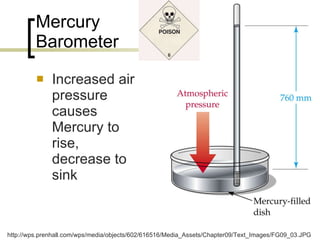
Mercury Barometer Increased air pressure causes Mercury to rise, decrease to sink http://wps.prenhall.com/wps/media/objects/602/616516/Media_Assets/Chapter09/Text_Images/FG09_03.JPG
Air Pressure and Wind Wind is the horizontal movement of air Wind results from horizontal differences in air pressure Air flows from areas of high pressure to areas of low pressure (H to L) The unequal heating of earth’s surface results in pressure differences Ultimately the sun is the source of wind
Mapping Pressure Differences Areas of equal pressure are connected using isobars Isobars resemble contour lines on a topographic map
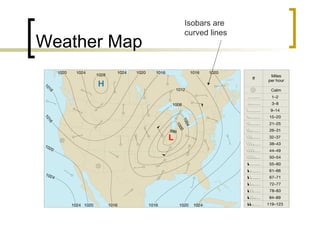
Weather Map Isobars are curved lines
Pressure Gradients Refers to spacing between isobars Closer the lines, the greater the pressure difference Closely-spaced isobars = strong winds Widely spaced isobars = light winds
Other Factors Ground friction Coriolis effect
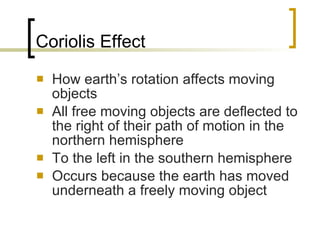
Coriolis Effect How earth’s rotation affects moving objects All free moving objects are deflected to the right of their path of motion in the northern hemisphere To the left in the southern hemisphere Occurs because the earth has moved underneath a freely moving object
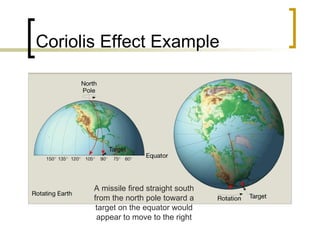
Coriolis Effect Example A missile fired straight south from the north pole toward a target on the equator would appear to move to the right
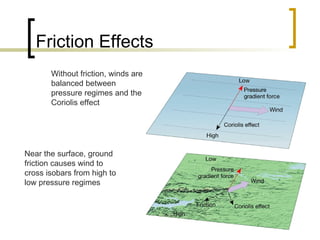
Friction Effects Without friction, winds are balanced between pressure regimes and the Coriolis effect Near the surface, ground friction causes wind to cross isobars from high to low pressure regimes
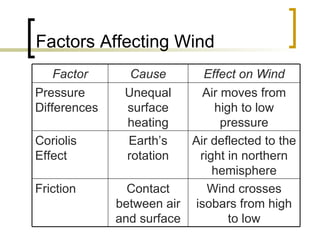
Factors Affecting Wind Wind crosses isobars from high to low Contact between air and surface Friction Air deflected to the right in northern hemisphere Earth’s rotation Coriolis Effect Air moves from high to low pressure Unequal surface heating Pressure Differences Effect on Wind Cause Factor
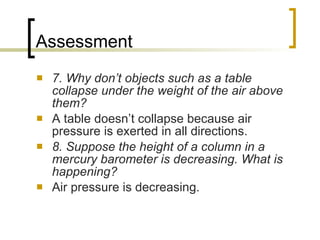
Assessment 7. Why don’t objects such as a table collapse under the weight of the air above them? A table doesn’t collapse because air pressure is exerted in all directions. 8. Suppose the height of a column in a mercury barometer is decreasing. What is happening? Air pressure is decreasing.
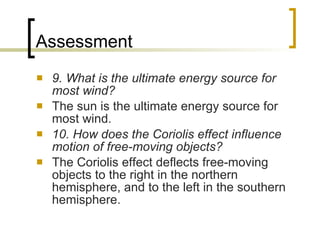
Assessment 9. What is the ultimate energy source for most wind? The sun is the ultimate energy source for most wind. 10. How does the Coriolis effect influence motion of free-moving objects? The Coriolis effect deflects free-moving objects to the right in the northern hemisphere, and to the left in the southern hemisphere.
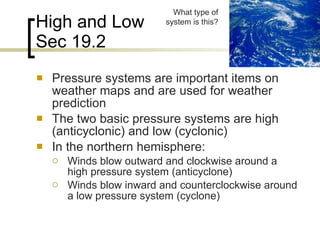
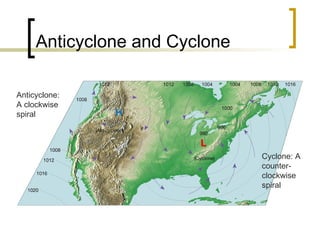
High and Low Sec 19.2 Pressure systems are important items on weather maps and are used for weather prediction The two basic pressure systems are high (anticyclonic) and low (cyclonic) In the northern hemisphere: Winds blow outward and clockwise around a high pressure system (anticyclone) Winds blow inward and counterclockwise around a low pressure system (cyclone) What type of system is this?
Anticyclone and Cyclone Anticyclone: A clockwise spiral Cyclone: A counter-clockwise spiral
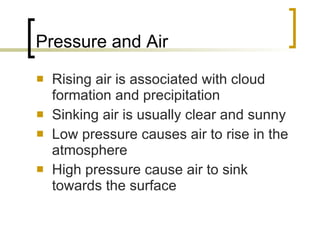
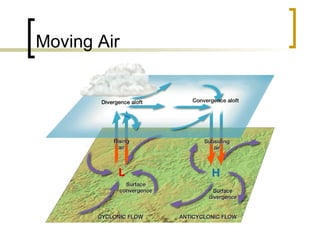
Pressure and Air Rising air is associated with cloud formation and precipitation Sinking air is usually clear and sunny Low pressure causes air to rise in the atmosphere High pressure cause air to sink towards the surface
Moving Air
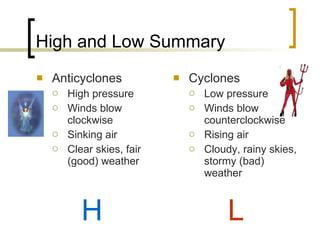
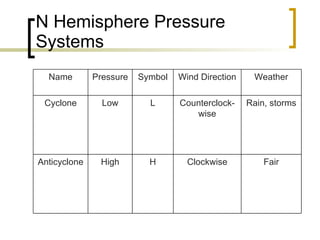
High and Low Summary Anticyclones High pressure Winds blow clockwise Sinking air Clear skies, fair (good) weather Cyclones Low pressure Winds blow counterclockwise Rising air Cloudy, rainy skies, stormy (bad) weather H L
N Hemisphere Pressure Systems Fair Clockwise H High Anticyclone Rain, storms Counterclock-wise L Low Cyclone Weather Wind Direction Symbol Pressure Name
Global Winds Unequal heating of the earth is the ultimate cause of winds The equator receives more solar energy than the poles The atmosphere moves warm air toward high latitudes, and cold toward low latitudes
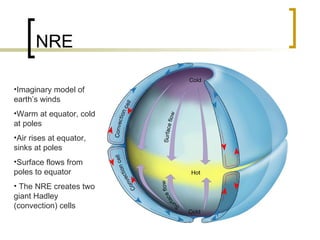
The Nonrotating Earth (NRE) Hypothetical : The earth does not rotate and is completely covered with water Winds would flow from high to low pressure (no Coriolis effect) Low pressure at the, high pressure at the poles Wind would rise at the equator move toward the poles and sink Also termed Hadley cells
NRE Imaginary model of earth’s winds Warm at equator, cold at poles Air rises at equator, sinks at poles Surface flows from poles to equator The NRE creates two giant Hadley (convection) cells
Rotating Earth When rotation is added to the NRE model, the two cell convection system breaks down into many individual cells
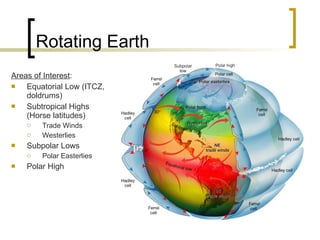
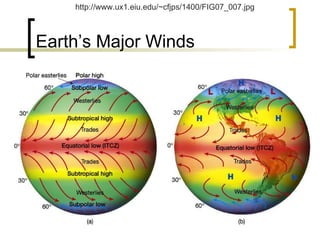
Rotating Earth Areas of Interest : Equatorial Low (ITCZ, doldrums) Subtropical Highs (Horse latitudes) Trade Winds Westerlies Subpolar Lows Polar Easterlies Polar High
Earth’s Major Winds http://www.ux1.eiu.edu/~cfjps/1400/FIG07_007.jpg
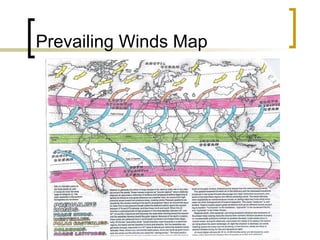
Prevailing Winds Map
Assessment 14 Describe how winds blow around pressure centers in the northern hemisphere. In the northern hemisphere, wind in a high pressure rotates clockwise, and wind in a low pressure system rotates counterclockwise.
Assessment 15. Compare the air pressure for a cyclone with an anticyclone. Air experiences high pressure in a cyclone and low pressure in an anticylone.
A s s e s s m e n t 16. Describe how the atmosphere balances the unequal heating of earth’s surface. Sinking and rising air near the earth’s surface helps to regulate surface temperatures.
A s s e s s m e n t 17. What is the only truly continuous pressure belt? Why is it continuous? The subpolar low in the southern hemisphere is the only continuous pressure belt. The subpolar low is uninterrupted by continental land masses.
Assessment 18. In general, what type of weather can you expect if a low-pressure system is moving into your area? Low pressure systems usually deliver clouds and precipitation.
Local Winds Sec 19.3 Two factors Surface features (topographic effects)  Differences in surface composition (land vs. water) Ex : Land & Sea breezes, Valley & Mountain breezes
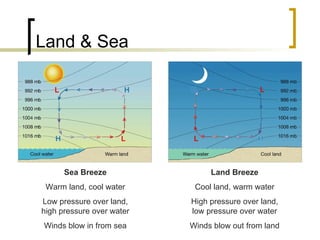
Land & Sea Sea Breeze Warm land, cool water Low pressure over land, high pressure over water Winds blow in from sea Land Breeze Cool land, warm water High pressure over land, low pressure over water Winds blow out from land
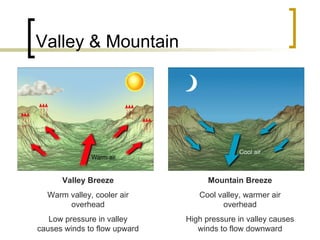
Valley & Mountain Valley Breeze Warm valley, cooler air overhead Low pressure in valley causes winds to flow upward Mountain Breeze Cool valley, warmer air overhead High pressure in valley causes winds to flow downward
Wind Direction Prevailing Wind : When the wind consistently blows more often from one direction In the United States, the prevailing westerlies consistently blow from west to east
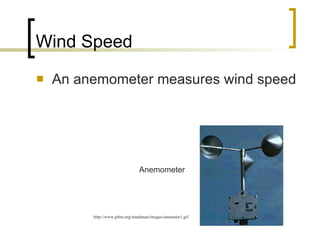
Wind Speed An anemometer measures wind speed Anemometer http://www.pfmt.org/standman/images/anameter1.gif
Assessment 29. What are local winds, and how are they caused? Local winds are small in scale and are caused by differences in air pressure. These pressure differences result from the shape and unequal heating of the land.
Assessment 30. Describe the general movement of weather within the United States. Weather in the United States generally moves from west to east.
Assessment 31. What two factors mainly influence global precipitation? The two factors that influence precipitation are the amount of moisture in air and the location of land and water.
Assessment 32. The mercury barometer was invented by a) Galileo b) Newton c) Torricelli d) Watt
Assessment 33. The force exerted by air above is called? a) air pressure b) convergence c) divergence d) the Coriolis effect
Assessment 34. What are centers of low pressure called? a) air masses b) anticyclones c) cyclones d) jet streams
Assessment 35. Variations in air pressure from place to place are the principal cause of a) clouds  b) lows c) hail d) wind
Assessment 36. What is the pressure zone that is associated with rising air near the equator? a) equatorial low b) equatorial high c) subtropical low d) subtropical high
Assessment 37. Where is the deflection of wind due to the Coriolis effect the strongest? a) near the equator b) in the midlatitudes c) near the poles d) near the westerlies
Assessment 38. In what stormy region do the westerlies and polar easterlies converge?  a) equatorial low b) subpolar high c) polar front d) subtropical front
Assessment 39. In what stormy region do the westerlies and polar easterlies converge? a) equatorial low b) subpolar high c) polar front d) subtropical front

Ch.19 Notes Mc Neely 2009

  • 1.
    Ch. 19 Air Pressure and Wind Earth-Space Science Bremen High School Teacher : Aaron McNeely http://www.etplanet.com/download/wallpaper/Windows%20XP%20Wallpaper/wind.jpg
  • 2.
    Air Pressure Sec19.1 Air pressure: The pressure exerted by the weight of air overhead, exerted in all directions At sea level  14.7 pounds per square inch, (1kg/cm2) Responsible for earth’s winds Exerted in all directions, reason that objects aren’t crushed
  • 3.
    Mercury Barometer Increasedair pressure causes Mercury to rise, decrease to sink http://wps.prenhall.com/wps/media/objects/602/616516/Media_Assets/Chapter09/Text_Images/FG09_03.JPG
  • 4.
    Air Pressure andWind Wind is the horizontal movement of air Wind results from horizontal differences in air pressure Air flows from areas of high pressure to areas of low pressure (H to L) The unequal heating of earth’s surface results in pressure differences Ultimately the sun is the source of wind
  • 5.
    Mapping Pressure DifferencesAreas of equal pressure are connected using isobars Isobars resemble contour lines on a topographic map
  • 6.
    Weather Map Isobarsare curved lines
  • 7.
    Pressure Gradients Refersto spacing between isobars Closer the lines, the greater the pressure difference Closely-spaced isobars = strong winds Widely spaced isobars = light winds
  • 8.
    Other Factors Groundfriction Coriolis effect
  • 9.
    Coriolis Effect Howearth’s rotation affects moving objects All free moving objects are deflected to the right of their path of motion in the northern hemisphere To the left in the southern hemisphere Occurs because the earth has moved underneath a freely moving object
  • 10.
    Coriolis Effect ExampleA missile fired straight south from the north pole toward a target on the equator would appear to move to the right
  • 11.
    Friction Effects Withoutfriction, winds are balanced between pressure regimes and the Coriolis effect Near the surface, ground friction causes wind to cross isobars from high to low pressure regimes
  • 12.
    Factors Affecting WindWind crosses isobars from high to low Contact between air and surface Friction Air deflected to the right in northern hemisphere Earth’s rotation Coriolis Effect Air moves from high to low pressure Unequal surface heating Pressure Differences Effect on Wind Cause Factor
  • 13.
    Assessment 7. Whydon’t objects such as a table collapse under the weight of the air above them? A table doesn’t collapse because air pressure is exerted in all directions. 8. Suppose the height of a column in a mercury barometer is decreasing. What is happening? Air pressure is decreasing.
  • 14.
    Assessment 9. Whatis the ultimate energy source for most wind? The sun is the ultimate energy source for most wind. 10. How does the Coriolis effect influence motion of free-moving objects? The Coriolis effect deflects free-moving objects to the right in the northern hemisphere, and to the left in the southern hemisphere.
  • 15.
    High and LowSec 19.2 Pressure systems are important items on weather maps and are used for weather prediction The two basic pressure systems are high (anticyclonic) and low (cyclonic) In the northern hemisphere: Winds blow outward and clockwise around a high pressure system (anticyclone) Winds blow inward and counterclockwise around a low pressure system (cyclone) What type of system is this?
  • 16.
    Anticyclone and CycloneAnticyclone: A clockwise spiral Cyclone: A counter-clockwise spiral
  • 17.
    Pressure and AirRising air is associated with cloud formation and precipitation Sinking air is usually clear and sunny Low pressure causes air to rise in the atmosphere High pressure cause air to sink towards the surface
  • 18.
  • 19.
    High and LowSummary Anticyclones High pressure Winds blow clockwise Sinking air Clear skies, fair (good) weather Cyclones Low pressure Winds blow counterclockwise Rising air Cloudy, rainy skies, stormy (bad) weather H L
  • 20.
    N Hemisphere PressureSystems Fair Clockwise H High Anticyclone Rain, storms Counterclock-wise L Low Cyclone Weather Wind Direction Symbol Pressure Name
  • 21.
    Global Winds Unequalheating of the earth is the ultimate cause of winds The equator receives more solar energy than the poles The atmosphere moves warm air toward high latitudes, and cold toward low latitudes
  • 22.
    The Nonrotating Earth(NRE) Hypothetical : The earth does not rotate and is completely covered with water Winds would flow from high to low pressure (no Coriolis effect) Low pressure at the, high pressure at the poles Wind would rise at the equator move toward the poles and sink Also termed Hadley cells
  • 23.
    NRE Imaginary modelof earth’s winds Warm at equator, cold at poles Air rises at equator, sinks at poles Surface flows from poles to equator The NRE creates two giant Hadley (convection) cells
  • 24.
    Rotating Earth Whenrotation is added to the NRE model, the two cell convection system breaks down into many individual cells
  • 25.
    Rotating Earth Areasof Interest : Equatorial Low (ITCZ, doldrums) Subtropical Highs (Horse latitudes) Trade Winds Westerlies Subpolar Lows Polar Easterlies Polar High
  • 26.
    Earth’s Major Windshttp://www.ux1.eiu.edu/~cfjps/1400/FIG07_007.jpg
  • 27.
  • 28.
    Assessment 14 Describehow winds blow around pressure centers in the northern hemisphere. In the northern hemisphere, wind in a high pressure rotates clockwise, and wind in a low pressure system rotates counterclockwise.
  • 29.
    Assessment 15. Comparethe air pressure for a cyclone with an anticyclone. Air experiences high pressure in a cyclone and low pressure in an anticylone.
  • 30.
    A s se s s m e n t 16. Describe how the atmosphere balances the unequal heating of earth’s surface. Sinking and rising air near the earth’s surface helps to regulate surface temperatures.
  • 31.
    A s se s s m e n t 17. What is the only truly continuous pressure belt? Why is it continuous? The subpolar low in the southern hemisphere is the only continuous pressure belt. The subpolar low is uninterrupted by continental land masses.
  • 32.
    Assessment 18. Ingeneral, what type of weather can you expect if a low-pressure system is moving into your area? Low pressure systems usually deliver clouds and precipitation.
  • 33.
    Local Winds Sec19.3 Two factors Surface features (topographic effects) Differences in surface composition (land vs. water) Ex : Land & Sea breezes, Valley & Mountain breezes
  • 34.
    Land & SeaSea Breeze Warm land, cool water Low pressure over land, high pressure over water Winds blow in from sea Land Breeze Cool land, warm water High pressure over land, low pressure over water Winds blow out from land
  • 35.
    Valley & MountainValley Breeze Warm valley, cooler air overhead Low pressure in valley causes winds to flow upward Mountain Breeze Cool valley, warmer air overhead High pressure in valley causes winds to flow downward
  • 36.
    Wind Direction PrevailingWind : When the wind consistently blows more often from one direction In the United States, the prevailing westerlies consistently blow from west to east
  • 37.
    Wind Speed Ananemometer measures wind speed Anemometer http://www.pfmt.org/standman/images/anameter1.gif
  • 38.
    Assessment 29. Whatare local winds, and how are they caused? Local winds are small in scale and are caused by differences in air pressure. These pressure differences result from the shape and unequal heating of the land.
  • 39.
    Assessment 30. Describethe general movement of weather within the United States. Weather in the United States generally moves from west to east.
  • 40.
    Assessment 31. Whattwo factors mainly influence global precipitation? The two factors that influence precipitation are the amount of moisture in air and the location of land and water.
  • 41.
    Assessment 32. Themercury barometer was invented by a) Galileo b) Newton c) Torricelli d) Watt
  • 42.
    Assessment 33. Theforce exerted by air above is called? a) air pressure b) convergence c) divergence d) the Coriolis effect
  • 43.
    Assessment 34. Whatare centers of low pressure called? a) air masses b) anticyclones c) cyclones d) jet streams
  • 44.
    Assessment 35. Variationsin air pressure from place to place are the principal cause of a) clouds b) lows c) hail d) wind
  • 45.
    Assessment 36. Whatis the pressure zone that is associated with rising air near the equator? a) equatorial low b) equatorial high c) subtropical low d) subtropical high
  • 46.
    Assessment 37. Whereis the deflection of wind due to the Coriolis effect the strongest? a) near the equator b) in the midlatitudes c) near the poles d) near the westerlies
  • 47.
    Assessment 38. Inwhat stormy region do the westerlies and polar easterlies converge? a) equatorial low b) subpolar high c) polar front d) subtropical front
  • 48.
    Assessment 39. Inwhat stormy region do the westerlies and polar easterlies converge? a) equatorial low b) subpolar high c) polar front d) subtropical front