MENDELLIAN PRINCIPLES
         OF HEREDITY


     Christine Joyce Javier ☺
                   II – LOVE
              January 18, 2012
Millions of different kinds of organisms
abound our Earth and they reproduces only its
own kind. It didn’t ever happen that a cat can
produce puppies as well as dogs can’t produce
kittens. Cabbage seeds will not ever produce
pepper. For a long time no one understood how
traits were inherited, until an Austrian monk
tinkered in his garden and observe his peas.
MENDEL’S GARDEN PEAS EXPERIMENT
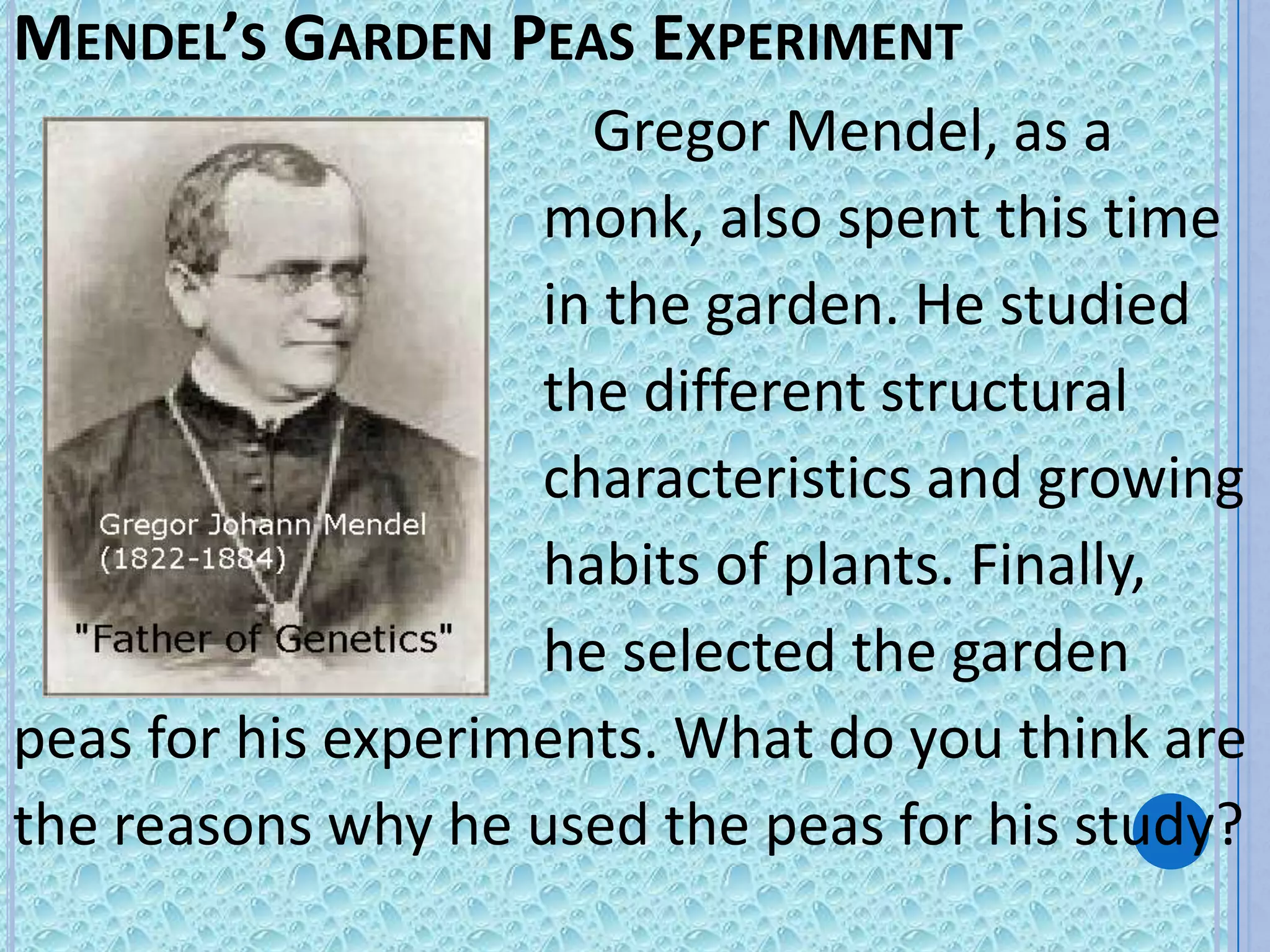
                      Gregor Mendel, as a
                    monk, also spent this time
                    in the garden. He studied
                    the different structural
                    characteristics and growing
                    habits of plants. Finally,
                    he selected the garden
peas for his experiments. What do you think are
the reasons why he used the peas for his study?
REASONS FOR CHOOSING GARDEN PEAS
1.) Garden peas have presence of observable
 traits with contrasting forms.
2.) Garden peas reproduce at a fast rate and
 reproduce several generations in a short time.
3.) They are hardy plants. They do not need
 much caring.
4.) Garden peas have its own structural
 adaptation of self-pollination.
PROCEDURE OF THE EXPERIMENT

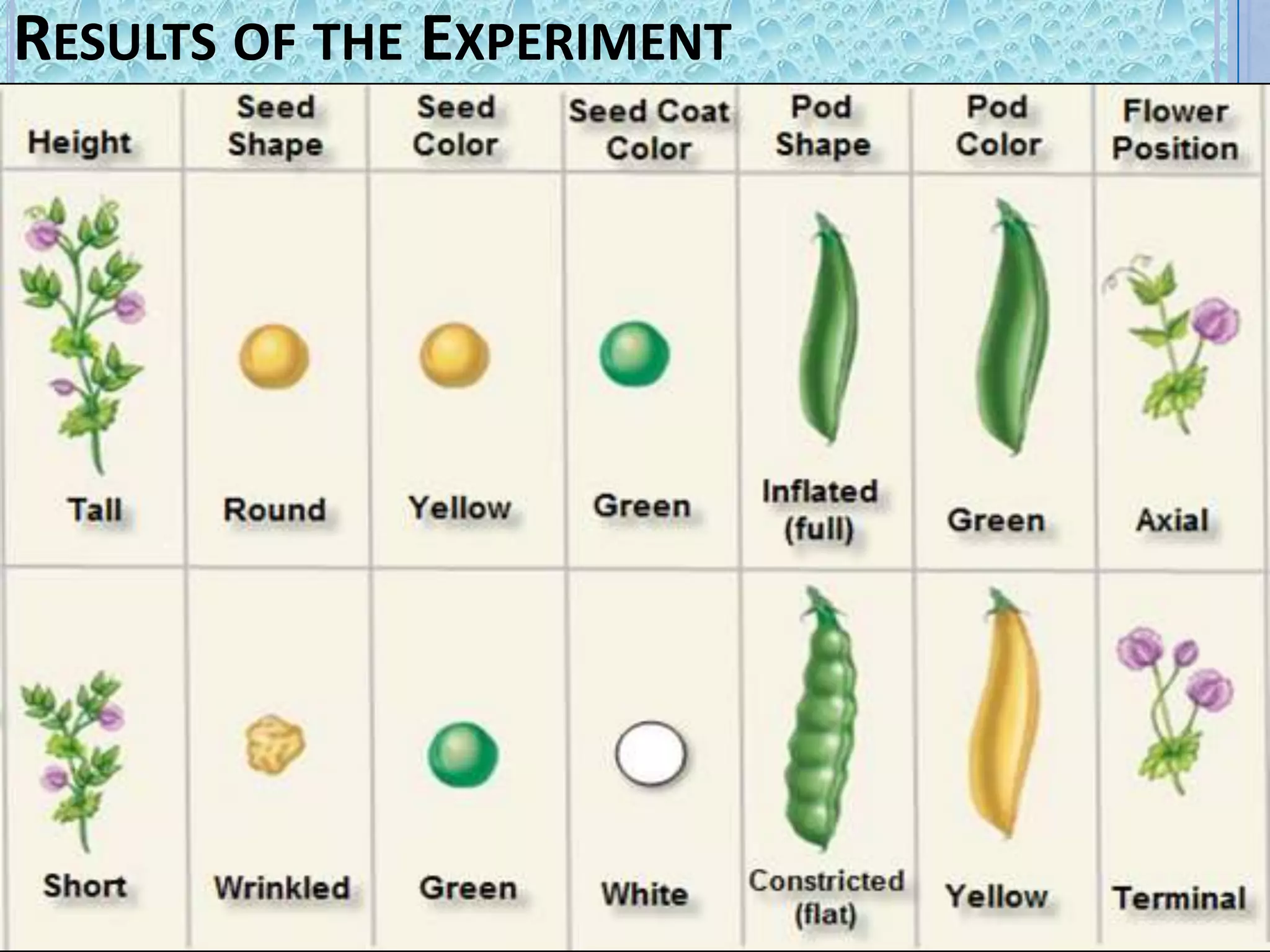
     Mendel used 29, 000 pea plants and
obtained 14 varieties of seeds. He chose to
study the 7 traits. Each trait had two or more
forms, like height in the pea plant is a trait
with two-forms: short and tall. Pea plants do
not grow to be middle-sized.
RESULTS OF THE EXPERIMENT
Traits – is the general characteristics of the peas
(or any other organism). For example, the color
of the seed.

Characters – is the specific characteristics of the
peas (or any other organism). For example,
yellow or green seed.
RESULTS OF THE EXPERIMENT
     After the research with plants, the basic
underlying principles of heredity that he
discovered also apply to people and other
animals because the mechanisms of heredity
are essentially the same for all complex life
forms.
     In our book, we have there “3 Principles of
Heredity” but in other references, they just only
have 2.
DEFINITION OF TERMS
 Genes – section of a chromosome; control
  what traits any living thing will have and
  controls what traits a living thing can pass to
  its young.
 Dominant Trait – trait that hides another trait.
 Recessive Trait – trait that is hidden.
 Purebreeding or Truebreeding – when the
  traits of the offsprings are the same as the
  parent plant for several generations.
 P Generation – parent generation.
DEFINITION OF TERMS
 Allele - is one of two or more forms of a gene;
  groups of genes.
 F1 Generation – first filial generation, or the
  offsprings of P generation.
 F2 Generation – second filial generation, or the
  offsprings of F1 generation.
 Genotype – genetic makeup of the cell.
 Phenotype – organism's observable
  characteristics or traits; external appearance
  of an individual.
DEFINITION OF TERMS
 Homozygous – has 2 of the identical (same)
  alleles of a gene.
 Heterozygous – has 2 different alleles of a
  gene.
 Punnett Square – is a diagram that is used to
  predict an outcome of a particular cross or
  breeding experiment.
 Heredity – passing of traits to offspring.
BASIC PRINCIPLES OF HEREDITY
     Some biologists refer to Mendel‘s
“principles“ as "laws".

1.) The Law of Dominance
2.) The Law of Segregation
3.) The Law of Independent Assortment
1ST LAW: THE LAW OF DOMINANCE
     It states that: “when purbreeding plants
having contrasting characters are crossed, all
the offsprings will show only one of the
characters. The character that appears is
dominant and the one that does not is
recessive.”

Meaning: When certain genes, come in 2 forms,
 one trait will be expressed over the other
 (dominant form over the recessive one).
1ST LAW: THE LAW OF DOMINANCE
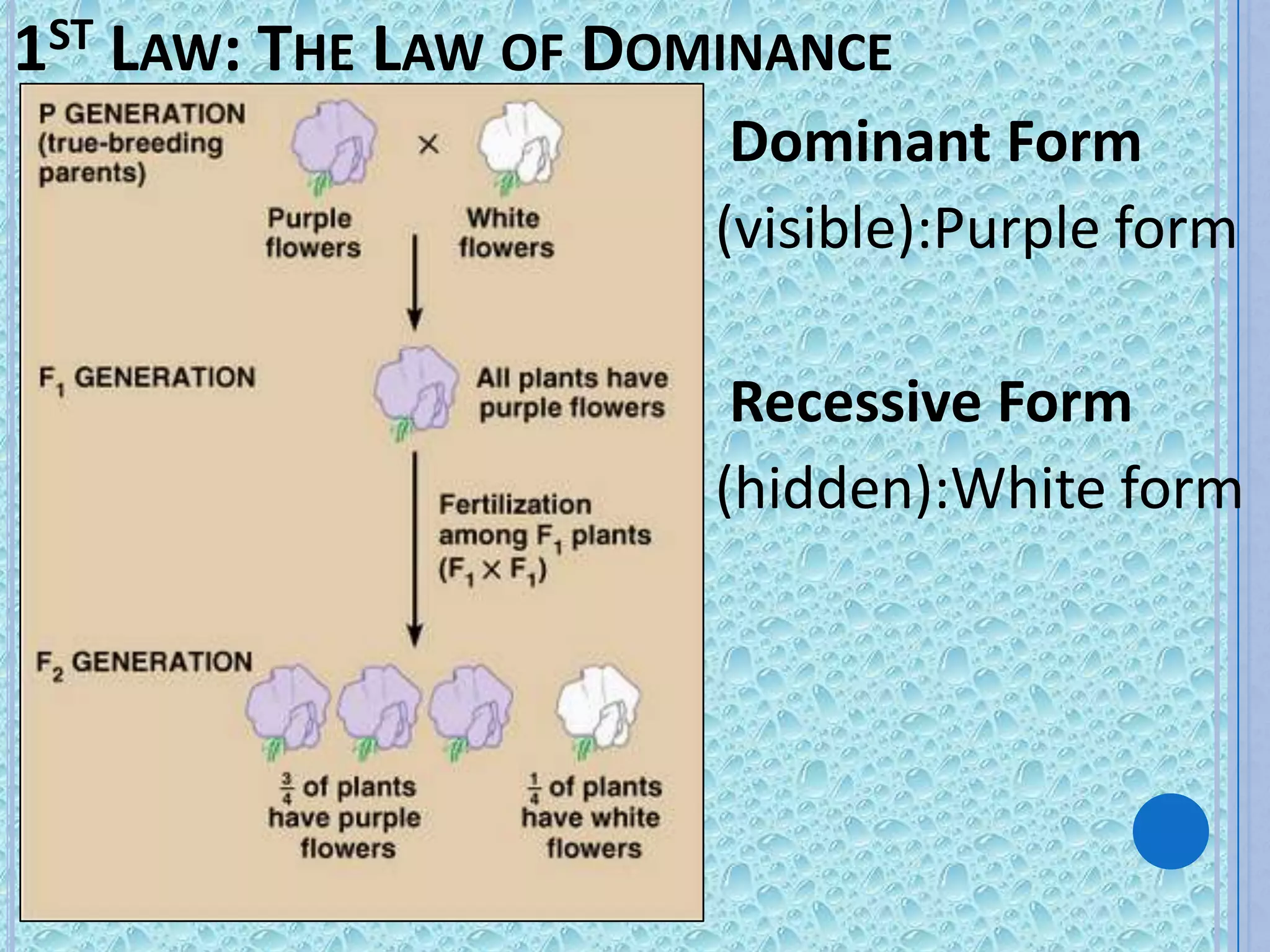
Ex: In the P Generation, there was a purple
flower and a white flower. They were
combined. Don’t expect that the result of the
flower color was light violet. For the F1
Generation, all plants have purple flowers. The
purple form of the trait was visible but the
white form was hidden. For the F2 Generation,
the ¾ of plants have purple flowers, and ¼ only
of them have white flowers.
1ST LAW: THE LAW OF DOMINANCE
                        Dominant Form
                       (visible):Purple form

                        Recessive Form
                       (hidden):White form
2ND LAW: THE LAW OF SEGREGATION

     It states that: “two genes of a pair separate
or segregate during gamete formation.
Therefore, the traits are distributed.”

Meaning: Members of a pair of genes for
 hereditary characters separate cleanly from
 each other so that only one members of the
 pair of genes goes into a particular gamete.
2ND LAW: THE LAW OF SEGREGATION
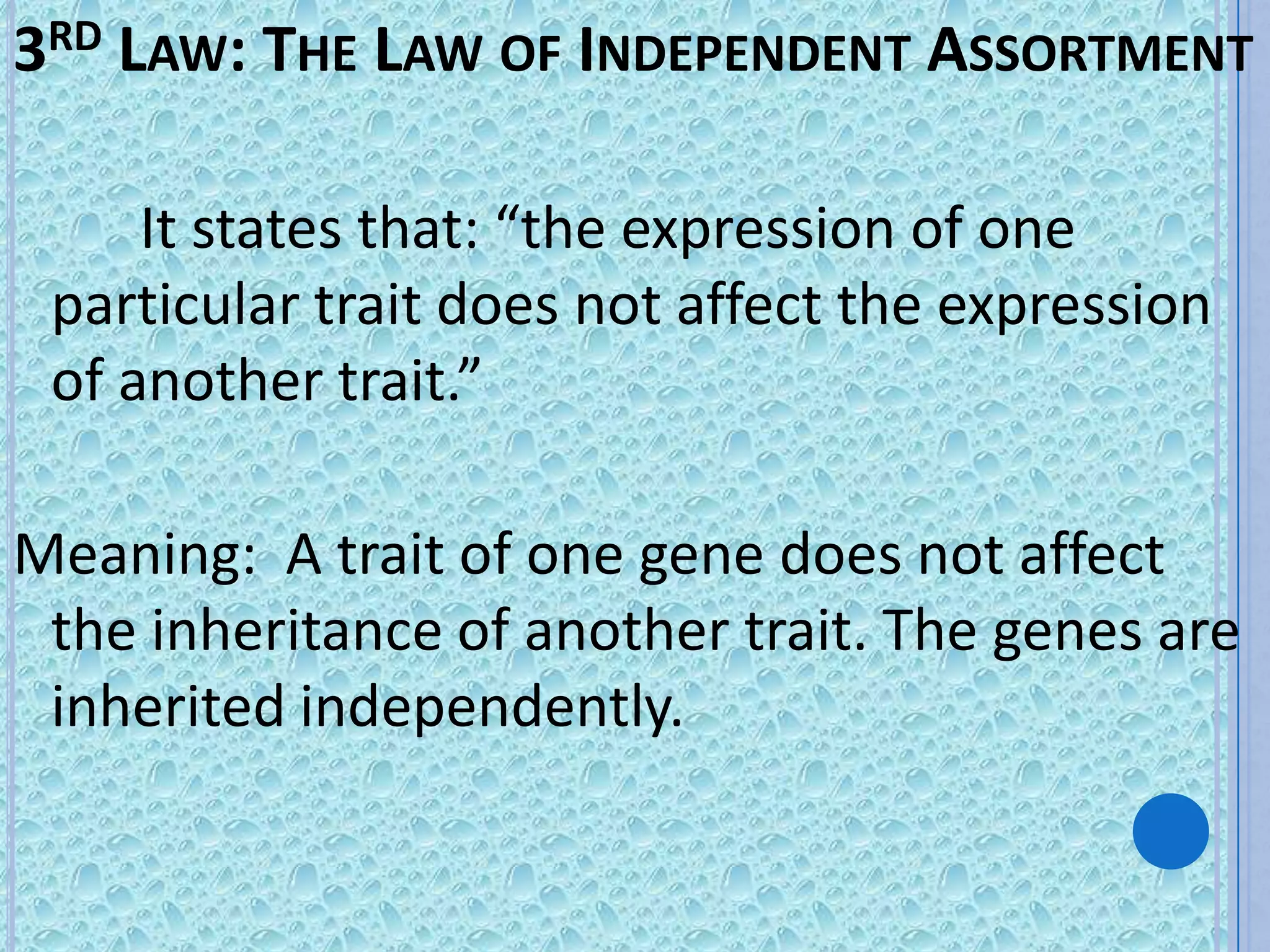
Ex: During the formation of gametes, mother or
 father’s alleles segregate (separate) so that
 each zygote (fertilized egg) only carries
 a single complete copy of a gene. In the
 picture on the next slide, T=Tall and t=short. In
 the F2 generation, each zygote either has one
 "T" or one "t" from mother or one "T" or one
 "t" from father.
2ND LAW: THE LAW OF SEGREGATION

                     They segregated from
                  the dominate factor and
                  expressed in its original
                  state.
3RD LAW: THE LAW OF INDEPENDENT ASSORTMENT

     It states that: “the expression of one
 particular trait does not affect the expression
 of another trait.”

Meaning: A trait of one gene does not affect
 the inheritance of another trait. The genes are
 inherited independently.
3RD LAW: THE LAW OF INDEPENDENT ASSORTMENT
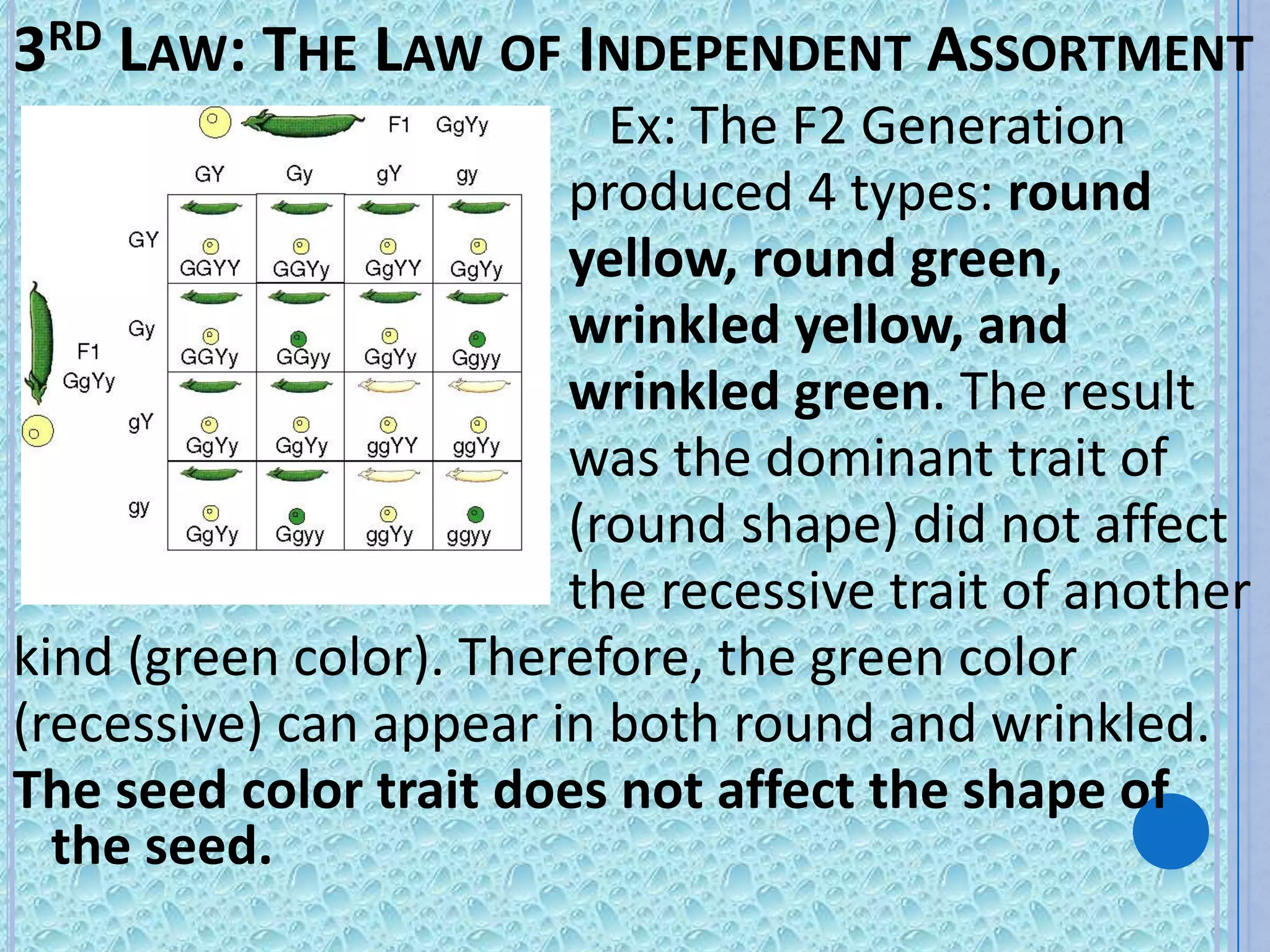
                          Ex: The F2 Generation
                        produced 4 types: round
                        yellow, round green,
                        wrinkled yellow, and
                        wrinkled green. The result
                        was the dominant trait of
                        (round shape) did not affect
                        the recessive trait of another
kind (green color). Therefore, the green color
(recessive) can appear in both round and wrinkled.
The seed color trait does not affect the shape of
  the seed.
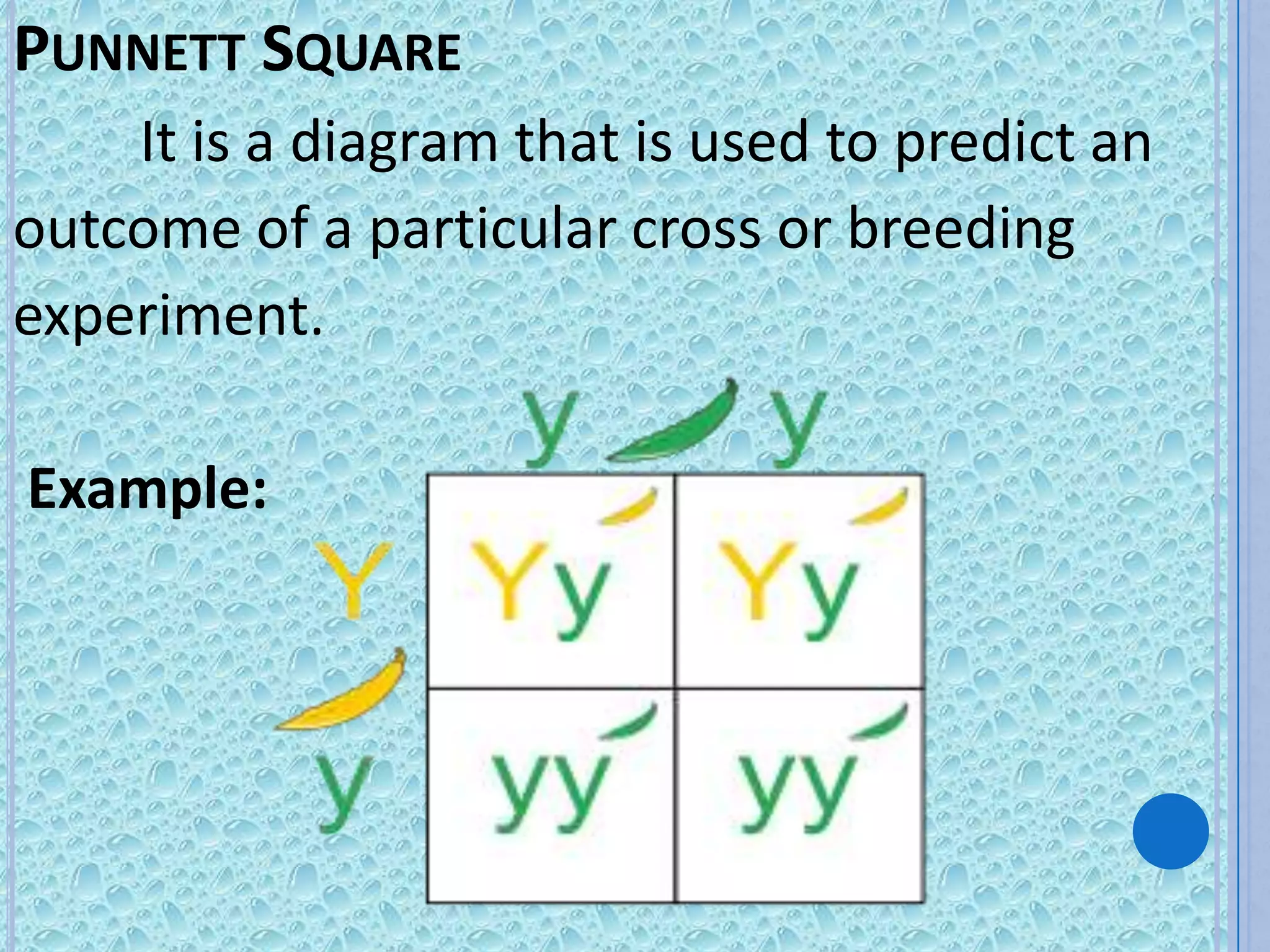
PUNNETT SQUARE
    It is a diagram that is used to predict an
outcome of a particular cross or breeding
experiment.

Example:

Genetics - Mendellian Principles of Heredity

  • 1.
    MENDELLIAN PRINCIPLES OF HEREDITY Christine Joyce Javier ☺ II – LOVE January 18, 2012
  • 2.
    Millions of differentkinds of organisms abound our Earth and they reproduces only its own kind. It didn’t ever happen that a cat can produce puppies as well as dogs can’t produce kittens. Cabbage seeds will not ever produce pepper. For a long time no one understood how traits were inherited, until an Austrian monk tinkered in his garden and observe his peas.
  • 3.
    MENDEL’S GARDEN PEASEXPERIMENT Gregor Mendel, as a monk, also spent this time in the garden. He studied the different structural characteristics and growing habits of plants. Finally, he selected the garden peas for his experiments. What do you think are the reasons why he used the peas for his study?
  • 4.
    REASONS FOR CHOOSINGGARDEN PEAS 1.) Garden peas have presence of observable traits with contrasting forms. 2.) Garden peas reproduce at a fast rate and reproduce several generations in a short time. 3.) They are hardy plants. They do not need much caring. 4.) Garden peas have its own structural adaptation of self-pollination.
  • 5.
    PROCEDURE OF THEEXPERIMENT Mendel used 29, 000 pea plants and obtained 14 varieties of seeds. He chose to study the 7 traits. Each trait had two or more forms, like height in the pea plant is a trait with two-forms: short and tall. Pea plants do not grow to be middle-sized.
  • 6.
    RESULTS OF THEEXPERIMENT Traits – is the general characteristics of the peas (or any other organism). For example, the color of the seed. Characters – is the specific characteristics of the peas (or any other organism). For example, yellow or green seed.
  • 7.
    RESULTS OF THEEXPERIMENT
  • 8.
    RESULTS OF THEEXPERIMENT After the research with plants, the basic underlying principles of heredity that he discovered also apply to people and other animals because the mechanisms of heredity are essentially the same for all complex life forms. In our book, we have there “3 Principles of Heredity” but in other references, they just only have 2.
  • 9.
    DEFINITION OF TERMS Genes – section of a chromosome; control what traits any living thing will have and controls what traits a living thing can pass to its young.  Dominant Trait – trait that hides another trait.  Recessive Trait – trait that is hidden.  Purebreeding or Truebreeding – when the traits of the offsprings are the same as the parent plant for several generations.  P Generation – parent generation.
  • 10.
    DEFINITION OF TERMS Allele - is one of two or more forms of a gene; groups of genes.  F1 Generation – first filial generation, or the offsprings of P generation.  F2 Generation – second filial generation, or the offsprings of F1 generation.  Genotype – genetic makeup of the cell.  Phenotype – organism's observable characteristics or traits; external appearance of an individual.
  • 11.
    DEFINITION OF TERMS Homozygous – has 2 of the identical (same) alleles of a gene.  Heterozygous – has 2 different alleles of a gene.  Punnett Square – is a diagram that is used to predict an outcome of a particular cross or breeding experiment.  Heredity – passing of traits to offspring.
  • 12.
    BASIC PRINCIPLES OFHEREDITY Some biologists refer to Mendel‘s “principles“ as "laws". 1.) The Law of Dominance 2.) The Law of Segregation 3.) The Law of Independent Assortment
  • 13.
    1ST LAW: THELAW OF DOMINANCE It states that: “when purbreeding plants having contrasting characters are crossed, all the offsprings will show only one of the characters. The character that appears is dominant and the one that does not is recessive.” Meaning: When certain genes, come in 2 forms, one trait will be expressed over the other (dominant form over the recessive one).
  • 14.
    1ST LAW: THELAW OF DOMINANCE Ex: In the P Generation, there was a purple flower and a white flower. They were combined. Don’t expect that the result of the flower color was light violet. For the F1 Generation, all plants have purple flowers. The purple form of the trait was visible but the white form was hidden. For the F2 Generation, the ¾ of plants have purple flowers, and ¼ only of them have white flowers.
  • 15.
    1ST LAW: THELAW OF DOMINANCE Dominant Form (visible):Purple form Recessive Form (hidden):White form
  • 16.
    2ND LAW: THELAW OF SEGREGATION It states that: “two genes of a pair separate or segregate during gamete formation. Therefore, the traits are distributed.” Meaning: Members of a pair of genes for hereditary characters separate cleanly from each other so that only one members of the pair of genes goes into a particular gamete.
  • 17.
    2ND LAW: THELAW OF SEGREGATION Ex: During the formation of gametes, mother or father’s alleles segregate (separate) so that each zygote (fertilized egg) only carries a single complete copy of a gene. In the picture on the next slide, T=Tall and t=short. In the F2 generation, each zygote either has one "T" or one "t" from mother or one "T" or one "t" from father.
  • 18.
    2ND LAW: THELAW OF SEGREGATION They segregated from the dominate factor and expressed in its original state.
  • 19.
    3RD LAW: THELAW OF INDEPENDENT ASSORTMENT It states that: “the expression of one particular trait does not affect the expression of another trait.” Meaning: A trait of one gene does not affect the inheritance of another trait. The genes are inherited independently.
  • 20.
    3RD LAW: THELAW OF INDEPENDENT ASSORTMENT Ex: The F2 Generation produced 4 types: round yellow, round green, wrinkled yellow, and wrinkled green. The result was the dominant trait of (round shape) did not affect the recessive trait of another kind (green color). Therefore, the green color (recessive) can appear in both round and wrinkled. The seed color trait does not affect the shape of the seed.
  • 21.
    PUNNETT SQUARE It is a diagram that is used to predict an outcome of a particular cross or breeding experiment. Example: