HOMEWORK FROM LAST CLASS: Complete the Genetics Practice Problems worksheet  Read over class notes and check out the class blog:  http://msoonscience.blogspot.com/
INTRODUCTION TO  GENETICS - REVIEW
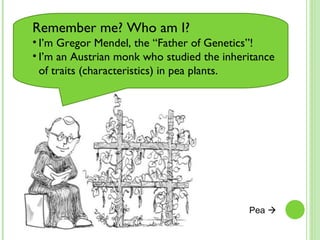
Remember me? Who am I?  I’m Gregor Mendel, the “Father of Genetics”! I’m an Austrian monk who studied the inheritance of traits (characteristics) in pea plants. Pea  
VOCABULARY REVIEW
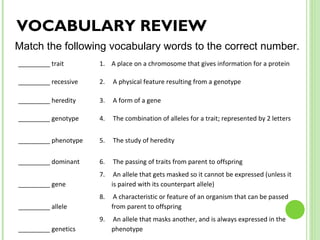
VOCABULARY REVIEW Match the following vocabulary words to the correct number. _________ trait A place on a chromosome that gives information for a protein _________ recessive 2.  A physical feature resulting from a genotype _________ heredity 3.  A form of a gene _________ genotype 4.  The combination of alleles for a trait; represented by 2 letters  _________ phenotype 5.  The study of heredity _________ dominant 6.  The passing of traits from parent to offspring _________ gene 7.  An allele that gets masked so it cannot be expressed (unless it is paired with its counterpart allele) _________ allele 8.  A characteristic or feature of an organism that can be passed from parent to offspring _________ genetics 9.  An allele that masks another, and is always expressed in the phenotype
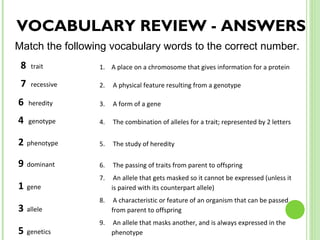
VOCABULARY REVIEW - ANSWERS Match the following vocabulary words to the correct number. 8  trait A place on a chromosome that gives information for a protein 7  recessive 2.  A physical feature resulting from a genotype 6   heredity 3.  A form of a gene 4   genotype 4.  The combination of alleles for a trait; represented by 2 letters  2   phenotype 5.  The study of heredity 9   dominant 6.  The passing of traits from parent to offspring 1   gene 7.  An allele that gets masked so it cannot be expressed (unless it is paired with its counterpart allele) 3   allele 8.  A characteristic or feature of an organism that can be passed from parent to offspring 5   genetics 9.  An allele that masks another, and is always expressed in the phenotype
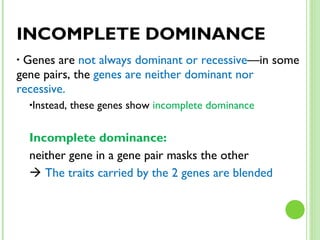
INCOMPLETE DOMINANCE Genes are  not always dominant or recessive —in some gene pairs, the  genes are neither dominant nor recessive. Instead, these genes show  incomplete dominance Incomplete dominance:  neither gene in a gene pair masks the other    The traits carried by the 2 genes are blended
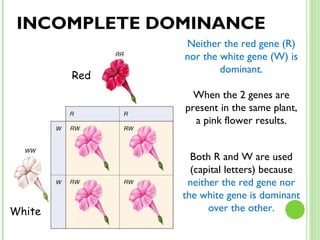
INCOMPLETE DOMINANCE Neither the red gene (R) nor the white gene (W) is dominant. When the 2 genes are present in the same plant, a pink flower results. Both R and W are used (capital letters) because  neither the red gene nor the white gene is dominant over the other. White Red
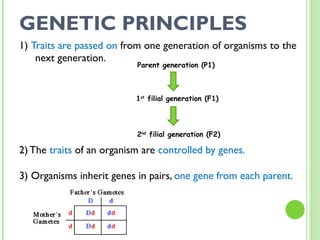
GENETIC PRINCIPLES 1)  Traits are passed on  from one generation of organisms to the next generation. 2) The  traits  of an organism are  controlled by genes. 3) Organisms inherit genes in pairs,  one gene from each parent. Parent generation (P1) 1 st  filial generation (F1) 2 nd  filial generation (F2)
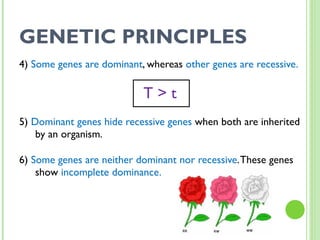
GENETIC PRINCIPLES 4)  Some genes are dominant , whereas  other genes are recessive. T > t 5)  Dominant genes hide recessive genes  when both are inherited by an organism. 6)  Some genes are neither dominant nor recessive . These genes show  incomplete dominance.
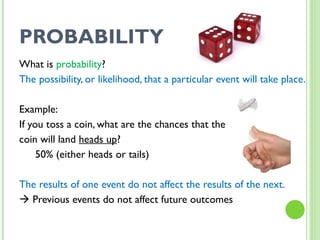
PROBABILITY What is  probability ? The possibility, or likelihood, that a particular event will take place. Example:  If you toss a coin, what are the chances that the  coin will land  heads up ?  50% (either heads or tails) The results of one event do not affect the results of the next.    Previous events do not affect future outcomes
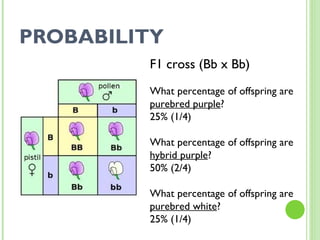
PROBABILITY F1 cross (Bb x Bb) What percentage of offspring are  purebred purple ? 25% (1/4) What percentage of offspring are  hybrid purple ? 50% (2/4) What percentage of offspring are  purebred white ? 25% (1/4)
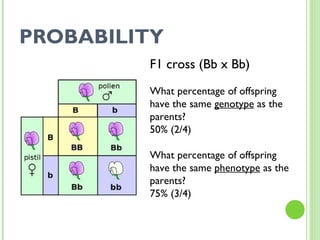
PROBABILITY F1 cross (Bb x Bb) What percentage of offspring have the same  genotype  as the parents? 50% (2/4) What percentage of offspring have the same  phenotype  as the parents? 75% (3/4)
ACTIVITY! Paint your paper maché eggs and sperm!
INSTRUCTIONS 1)  Find your pair’s egg or sperm. 2) Put newspaper down on your lab bench. 3) Paint your egg or sperm— get creative! 4) Place your painted egg or sperm on top of newspaper on the back table dry. I will hang the eggs and sperm in the classroom when they are dry!
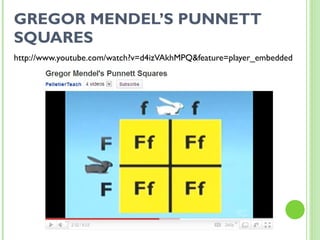
GREGOR MENDEL’S PUNNETT SQUARES http://www.youtube.com/watch?v=d4izVAkhMPQ&feature=player_embedded
HOMEWORK FOR NEXT CLASS: Take a break!  No homework over Spring Break!  
WORKS CITED Images taken from the following sources: http://elleseconomy.com/ http://mcclungsworld.com/2009/09/24/plants-squares-and-stuff/ http://www.life123.com/parenting/education/probability-statistics/probability-problems.shtml http://smabiology.blogspot.com/2008_11_01_archive.html http://www.graphicshunt.com/health/images/chromosome-885.htm

SCI 9 Lesson 2 Mar 17 - Introduction to Genetics (2)

  • 1.
    HOMEWORK FROM LASTCLASS: Complete the Genetics Practice Problems worksheet Read over class notes and check out the class blog: http://msoonscience.blogspot.com/
  • 2.
    INTRODUCTION TO GENETICS - REVIEW
  • 3.
    Remember me? Whoam I? I’m Gregor Mendel, the “Father of Genetics”! I’m an Austrian monk who studied the inheritance of traits (characteristics) in pea plants. Pea 
  • 4.
  • 5.
    VOCABULARY REVIEW Matchthe following vocabulary words to the correct number. _________ trait A place on a chromosome that gives information for a protein _________ recessive 2. A physical feature resulting from a genotype _________ heredity 3. A form of a gene _________ genotype 4. The combination of alleles for a trait; represented by 2 letters _________ phenotype 5. The study of heredity _________ dominant 6. The passing of traits from parent to offspring _________ gene 7. An allele that gets masked so it cannot be expressed (unless it is paired with its counterpart allele) _________ allele 8. A characteristic or feature of an organism that can be passed from parent to offspring _________ genetics 9. An allele that masks another, and is always expressed in the phenotype
  • 6.
    VOCABULARY REVIEW -ANSWERS Match the following vocabulary words to the correct number. 8 trait A place on a chromosome that gives information for a protein 7 recessive 2. A physical feature resulting from a genotype 6 heredity 3. A form of a gene 4 genotype 4. The combination of alleles for a trait; represented by 2 letters 2 phenotype 5. The study of heredity 9 dominant 6. The passing of traits from parent to offspring 1 gene 7. An allele that gets masked so it cannot be expressed (unless it is paired with its counterpart allele) 3 allele 8. A characteristic or feature of an organism that can be passed from parent to offspring 5 genetics 9. An allele that masks another, and is always expressed in the phenotype
  • 7.
    INCOMPLETE DOMINANCE Genesare not always dominant or recessive —in some gene pairs, the genes are neither dominant nor recessive. Instead, these genes show incomplete dominance Incomplete dominance: neither gene in a gene pair masks the other  The traits carried by the 2 genes are blended
  • 8.
    INCOMPLETE DOMINANCE Neitherthe red gene (R) nor the white gene (W) is dominant. When the 2 genes are present in the same plant, a pink flower results. Both R and W are used (capital letters) because neither the red gene nor the white gene is dominant over the other. White Red
  • 9.
    GENETIC PRINCIPLES 1) Traits are passed on from one generation of organisms to the next generation. 2) The traits of an organism are controlled by genes. 3) Organisms inherit genes in pairs, one gene from each parent. Parent generation (P1) 1 st filial generation (F1) 2 nd filial generation (F2)
  • 10.
    GENETIC PRINCIPLES 4) Some genes are dominant , whereas other genes are recessive. T > t 5) Dominant genes hide recessive genes when both are inherited by an organism. 6) Some genes are neither dominant nor recessive . These genes show incomplete dominance.
  • 11.
    PROBABILITY What is probability ? The possibility, or likelihood, that a particular event will take place. Example: If you toss a coin, what are the chances that the coin will land heads up ? 50% (either heads or tails) The results of one event do not affect the results of the next.  Previous events do not affect future outcomes
  • 12.
    PROBABILITY F1 cross(Bb x Bb) What percentage of offspring are purebred purple ? 25% (1/4) What percentage of offspring are hybrid purple ? 50% (2/4) What percentage of offspring are purebred white ? 25% (1/4)
  • 13.
    PROBABILITY F1 cross(Bb x Bb) What percentage of offspring have the same genotype as the parents? 50% (2/4) What percentage of offspring have the same phenotype as the parents? 75% (3/4)
  • 14.
    ACTIVITY! Paint yourpaper maché eggs and sperm!
  • 15.
    INSTRUCTIONS 1) Find your pair’s egg or sperm. 2) Put newspaper down on your lab bench. 3) Paint your egg or sperm— get creative! 4) Place your painted egg or sperm on top of newspaper on the back table dry. I will hang the eggs and sperm in the classroom when they are dry!
  • 16.
    GREGOR MENDEL’S PUNNETTSQUARES http://www.youtube.com/watch?v=d4izVAkhMPQ&feature=player_embedded
  • 17.
    HOMEWORK FOR NEXTCLASS: Take a break! No homework over Spring Break! 
  • 18.
    WORKS CITED Imagestaken from the following sources: http://elleseconomy.com/ http://mcclungsworld.com/2009/09/24/plants-squares-and-stuff/ http://www.life123.com/parenting/education/probability-statistics/probability-problems.shtml http://smabiology.blogspot.com/2008_11_01_archive.html http://www.graphicshunt.com/health/images/chromosome-885.htm

Editor's Notes

  • #3 Mendelian Genetics 03/19/11
  • #4 Mendelian Genetics 03/19/11
  • #8 Mendelian Genetics 03/19/11
  • #9 Mendelian Genetics 03/19/11