Genetics A study of inheritance
Objectives Understand Phenotype Genotype Dominance Gene Segregation Use a Punnett square to Solve monohybrid crosses Predict genotype ratio Predict phenotype ratio
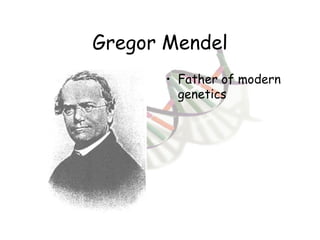
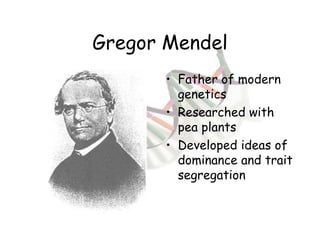
Gregor Mendel Father of modern genetics
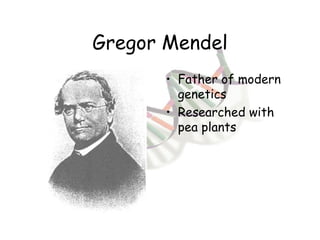
Gregor Mendel Father of modern genetics Researched with pea plants
Gregor Mendel Father of modern genetics Researched with pea plants Developed ideas of dominance and trait segregation
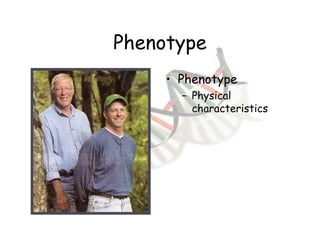
Phenotype Phenotype  Physical characteristics
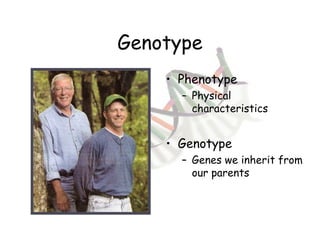
Genotype Phenotype  Physical characteristics  Genotype  Genes we inherit from our parents
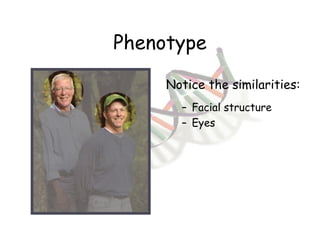
Phenotype Facial structure Notice the similarities:
Phenotype Facial structure Eyes Notice the similarities:
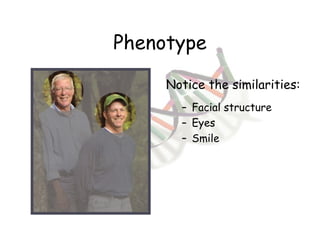
Phenotype Facial structure Eyes Smile Notice the similarities:
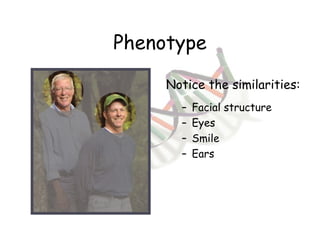
Phenotype Facial structure Eyes Smile Ears Notice the similarities:
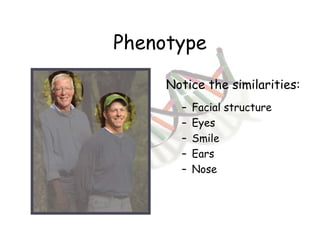
Phenotype Facial structure Eyes Smile Ears Nose Notice the similarities:
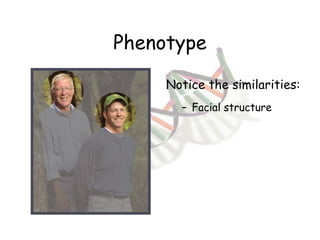
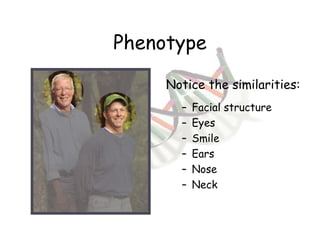
Phenotype Facial structure Eyes Smile Ears Nose Neck Notice the similarities:
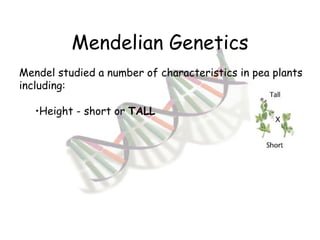
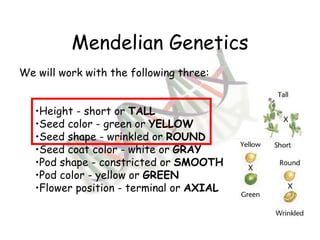
Mendelian Genetics Mendel studied a number of characteristics in pea plants including: Height - short or  TALL
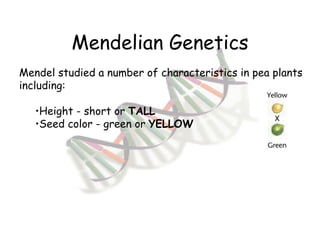
Mendelian Genetics Mendel studied a number of characteristics in pea plants including: Height - short or  TALL Seed color - green or  YELLOW
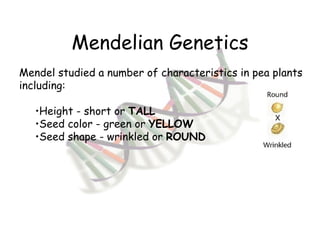
Mendelian Genetics Mendel studied a number of characteristics in pea plants including: Height - short or  TALL Seed color - green or  YELLOW Seed shape - wrinkled or  ROUND
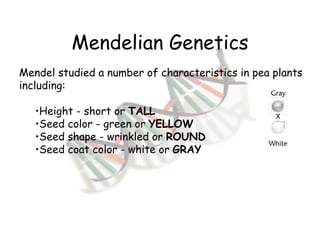
Mendelian Genetics Mendel studied a number of characteristics in pea plants including: Height - short or  TALL Seed color - green or  YELLOW Seed shape - wrinkled or  ROUND Seed coat color - white or  GRAY
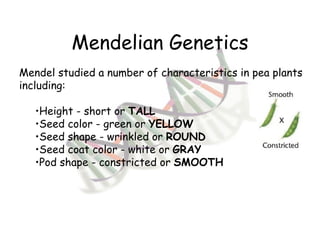
Mendelian Genetics Mendel studied a number of characteristics in pea plants including: Height - short or  TALL Seed color - green or  YELLOW Seed shape - wrinkled or  ROUND Seed coat color - white or  GRAY   Pod shape - constricted or  SMOOTH
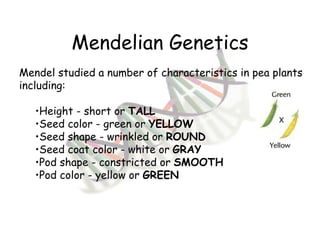
Mendelian Genetics Mendel studied a number of characteristics in pea plants including: Height - short or  TALL Seed color - green or  YELLOW Seed shape - wrinkled or  ROUND Seed coat color - white or  GRAY   Pod shape - constricted or  SMOOTH Pod color - yellow or  GREEN
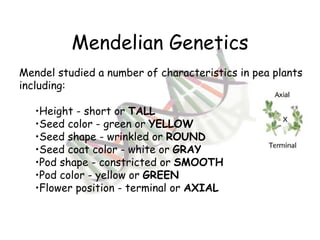
Mendelian Genetics Mendel studied a number of characteristics in pea plants including: Height - short or  TALL Seed color - green or  YELLOW Seed shape - wrinkled or  ROUND Seed coat color - white or  GRAY   Pod shape - constricted or  SMOOTH Pod color - yellow or  GREEN Flower position - terminal or  AXIAL
Mendelian Genetics We will work with the following three: Height - short or  TALL Seed color - green or  YELLOW Seed shape - wrinkled or  ROUND Seed coat color - white or  GRAY   Pod shape - constricted or  SMOOTH Pod color - yellow or  GREEN Flower position - terminal or  AXIAL
Predicting Inheritance To determine the chances of inheriting a given trait, scientists use Punnett squares and symbols to represent the genes. UPPERCASE  letters are used to represent dominant genes. lowercase  letters are used to represent recessive genes.
Predicting Inheritance For example: T = represents the gene for  TALL  in pea plants t = represents the gene for short in pea plants So: TT & Tt both result in a  TALL  plant, because T is dominant over t.  t is recessive.  tt will result in a short plant. Remember there are two genes for every trait! One from each parent.
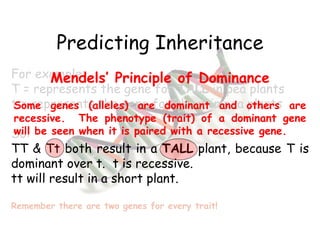
Predicting Inheritance For example: T = represents the gene for  TALL  in pea plants t = represents the gene for short in pea plants So: TT &  Tt  both result in a  TALL  plant, because T is dominant over t.  t is recessive.  tt will result in a short plant. Remember there are two genes for every trait! Mendels’ Principle of Dominance Some genes (alleles) are dominant and others are recessive.  The phenotype (trait) of a dominant gene will be seen when it is paired with a recessive gene.
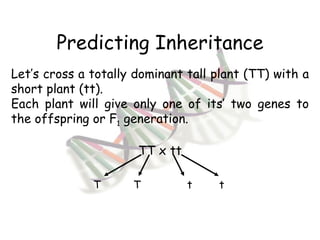
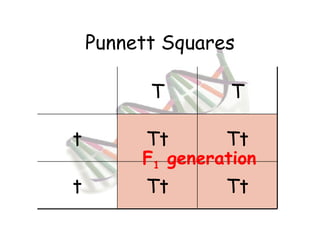
Predicting Inheritance Let’s cross a totally dominant tall plant (TT) with a short plant (tt). Each plant will give only one of its’ two genes to the offspring or F 1  generation. TT x tt T T t t
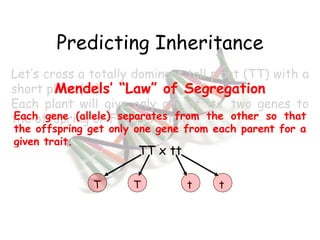
Predicting Inheritance Let’s cross a totally dominant tall plant (TT) with a short plant (tt). Each plant will give only one of its’ two genes to the offspring or F 1  generation. TT x tt T T t t Mendels’ “Law” of Segregation Each gene (allele) separates from the other so that the offspring get only one gene from each parent for a given trait.
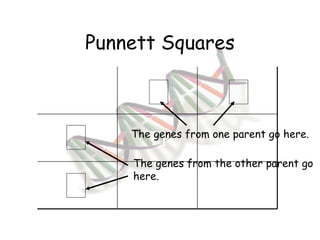
Punnett Squares The genes from one parent go here. The genes from the other parent go here. Tt Tt Tt Tt
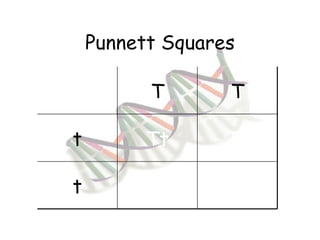
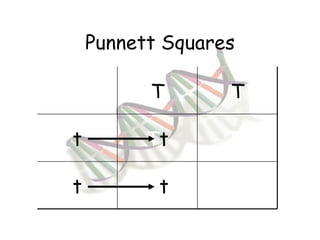
Punnett Squares T T t Tt Tt t Tt Tt
Punnett Squares T T t T t Tt t T t Tt
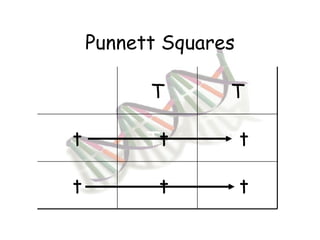
Punnett Squares T T t T t T t t T t T t
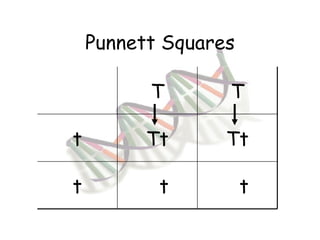
Punnett Squares T T t Tt Tt t T t T t
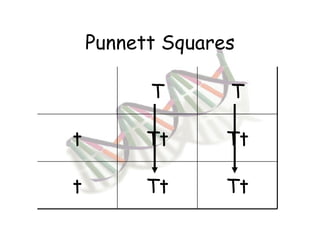
Punnett Squares T T t Tt Tt t Tt Tt
Punnett Squares F 1  generation T T t Tt Tt t Tt Tt
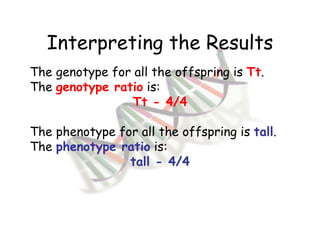
Interpreting the Results The genotype for all the offspring is  Tt . The  genotype ratio  is:  Tt - 4/4 The phenotype for all the offspring is  tall . The  phenotype ratio  is:  tall - 4/4
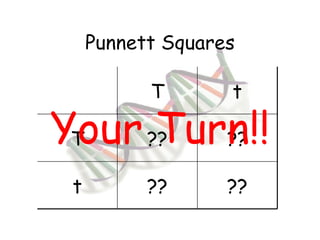
Punnett Squares Your Turn!! T t T ?? ?? t ?? ??
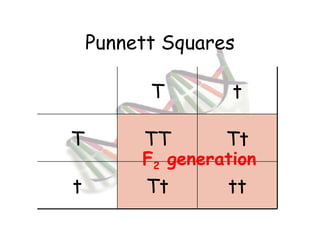
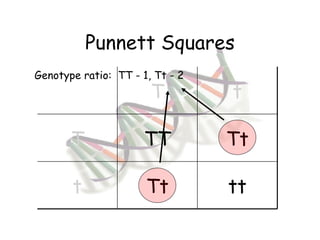
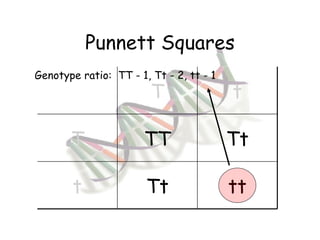
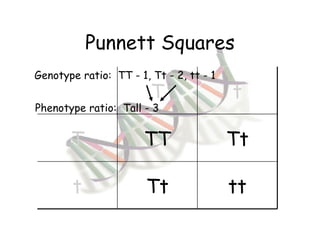
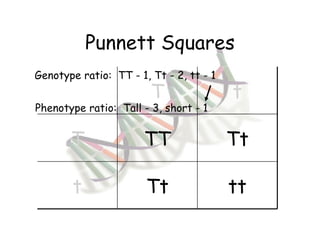
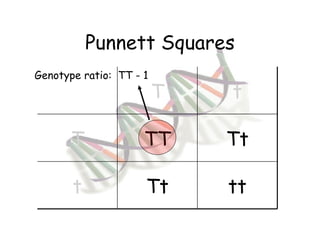
Punnett Squares F 2  generation T t T TT Tt t Tt tt
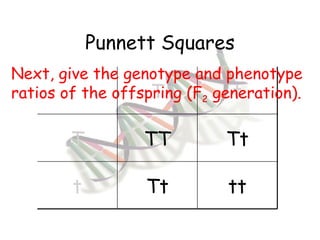
Punnett Squares Next, give the genotype and phenotype ratios of the offspring (F 2  generation). T t T TT Tt t Tt tt
Punnett Squares Genotype ratio:  TT - 1 T t T TT Tt t Tt tt
Punnett Squares Genotype ratio:  TT - 1, Tt - 2 T t T TT Tt t Tt tt
Punnett Squares Genotype ratio:  TT - 1, Tt - 2, tt - 1 T t T TT Tt t Tt tt
Punnett Squares Genotype ratio:  TT - 1, Tt - 2, tt - 1 Phenotype ratio:  Tall - 3 T t T TT Tt t Tt tt
Punnett Squares Genotype ratio:  TT - 1, Tt - 2, tt - 1 Phenotype ratio:  Tall - 3, short - 1 T t T TT Tt t Tt tt
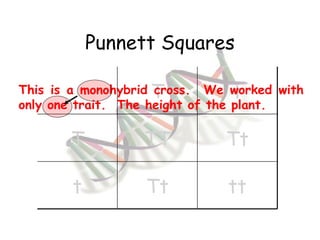
Punnett Squares This is a monohybrid cross.  We worked with only one trait.  The height of the plant. T t T TT Tt t Tt tt
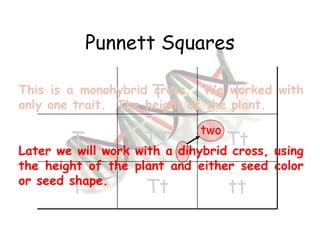
Punnett Squares This is a monohybrid cross.  We worked with only one trait.  The height of the plant. Later we will work with a dihybrid cross, using the height of the plant and either seed color or seed shape. two T t T TT Tt t Tt tt
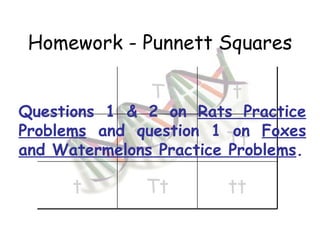
Homework - Punnett Squares Questions 1 & 2 on  Rats Practice Problems  and question 1 on  Foxes and Watermelons Practice Problems . T t T TT Tt t Tt tt

Genetics Intro

  • 1.
    Genetics A studyof inheritance
  • 2.
    Objectives Understand PhenotypeGenotype Dominance Gene Segregation Use a Punnett square to Solve monohybrid crosses Predict genotype ratio Predict phenotype ratio
  • 3.
    Gregor Mendel Fatherof modern genetics
  • 4.
    Gregor Mendel Fatherof modern genetics Researched with pea plants
  • 5.
    Gregor Mendel Fatherof modern genetics Researched with pea plants Developed ideas of dominance and trait segregation
  • 6.
    Phenotype Phenotype Physical characteristics
  • 7.
    Genotype Phenotype Physical characteristics Genotype Genes we inherit from our parents
  • 8.
    Phenotype Facial structureNotice the similarities:
  • 9.
    Phenotype Facial structureEyes Notice the similarities:
  • 10.
    Phenotype Facial structureEyes Smile Notice the similarities:
  • 11.
    Phenotype Facial structureEyes Smile Ears Notice the similarities:
  • 12.
    Phenotype Facial structureEyes Smile Ears Nose Notice the similarities:
  • 13.
    Phenotype Facial structureEyes Smile Ears Nose Neck Notice the similarities:
  • 14.
    Mendelian Genetics Mendelstudied a number of characteristics in pea plants including: Height - short or TALL
  • 15.
    Mendelian Genetics Mendelstudied a number of characteristics in pea plants including: Height - short or TALL Seed color - green or YELLOW
  • 16.
    Mendelian Genetics Mendelstudied a number of characteristics in pea plants including: Height - short or TALL Seed color - green or YELLOW Seed shape - wrinkled or ROUND
  • 17.
    Mendelian Genetics Mendelstudied a number of characteristics in pea plants including: Height - short or TALL Seed color - green or YELLOW Seed shape - wrinkled or ROUND Seed coat color - white or GRAY
  • 18.
    Mendelian Genetics Mendelstudied a number of characteristics in pea plants including: Height - short or TALL Seed color - green or YELLOW Seed shape - wrinkled or ROUND Seed coat color - white or GRAY Pod shape - constricted or SMOOTH
  • 19.
    Mendelian Genetics Mendelstudied a number of characteristics in pea plants including: Height - short or TALL Seed color - green or YELLOW Seed shape - wrinkled or ROUND Seed coat color - white or GRAY Pod shape - constricted or SMOOTH Pod color - yellow or GREEN
  • 20.
    Mendelian Genetics Mendelstudied a number of characteristics in pea plants including: Height - short or TALL Seed color - green or YELLOW Seed shape - wrinkled or ROUND Seed coat color - white or GRAY Pod shape - constricted or SMOOTH Pod color - yellow or GREEN Flower position - terminal or AXIAL
  • 21.
    Mendelian Genetics Wewill work with the following three: Height - short or TALL Seed color - green or YELLOW Seed shape - wrinkled or ROUND Seed coat color - white or GRAY Pod shape - constricted or SMOOTH Pod color - yellow or GREEN Flower position - terminal or AXIAL
  • 22.
    Predicting Inheritance Todetermine the chances of inheriting a given trait, scientists use Punnett squares and symbols to represent the genes. UPPERCASE letters are used to represent dominant genes. lowercase letters are used to represent recessive genes.
  • 23.
    Predicting Inheritance Forexample: T = represents the gene for TALL in pea plants t = represents the gene for short in pea plants So: TT & Tt both result in a TALL plant, because T is dominant over t. t is recessive. tt will result in a short plant. Remember there are two genes for every trait! One from each parent.
  • 24.
    Predicting Inheritance Forexample: T = represents the gene for TALL in pea plants t = represents the gene for short in pea plants So: TT & Tt both result in a TALL plant, because T is dominant over t. t is recessive. tt will result in a short plant. Remember there are two genes for every trait! Mendels’ Principle of Dominance Some genes (alleles) are dominant and others are recessive. The phenotype (trait) of a dominant gene will be seen when it is paired with a recessive gene.
  • 25.
    Predicting Inheritance Let’scross a totally dominant tall plant (TT) with a short plant (tt). Each plant will give only one of its’ two genes to the offspring or F 1 generation. TT x tt T T t t
  • 26.
    Predicting Inheritance Let’scross a totally dominant tall plant (TT) with a short plant (tt). Each plant will give only one of its’ two genes to the offspring or F 1 generation. TT x tt T T t t Mendels’ “Law” of Segregation Each gene (allele) separates from the other so that the offspring get only one gene from each parent for a given trait.
  • 27.
    Punnett Squares Thegenes from one parent go here. The genes from the other parent go here. Tt Tt Tt Tt
  • 28.
    Punnett Squares TT t Tt Tt t Tt Tt
  • 29.
    Punnett Squares TT t T t Tt t T t Tt
  • 30.
    Punnett Squares TT t T t T t t T t T t
  • 31.
    Punnett Squares TT t Tt Tt t T t T t
  • 32.
    Punnett Squares TT t Tt Tt t Tt Tt
  • 33.
    Punnett Squares F1 generation T T t Tt Tt t Tt Tt
  • 34.
    Interpreting the ResultsThe genotype for all the offspring is Tt . The genotype ratio is: Tt - 4/4 The phenotype for all the offspring is tall . The phenotype ratio is: tall - 4/4
  • 35.
    Punnett Squares YourTurn!! T t T ?? ?? t ?? ??
  • 36.
    Punnett Squares F2 generation T t T TT Tt t Tt tt
  • 37.
    Punnett Squares Next,give the genotype and phenotype ratios of the offspring (F 2 generation). T t T TT Tt t Tt tt
  • 38.
    Punnett Squares Genotyperatio: TT - 1 T t T TT Tt t Tt tt
  • 39.
    Punnett Squares Genotyperatio: TT - 1, Tt - 2 T t T TT Tt t Tt tt
  • 40.
    Punnett Squares Genotyperatio: TT - 1, Tt - 2, tt - 1 T t T TT Tt t Tt tt
  • 41.
    Punnett Squares Genotyperatio: TT - 1, Tt - 2, tt - 1 Phenotype ratio: Tall - 3 T t T TT Tt t Tt tt
  • 42.
    Punnett Squares Genotyperatio: TT - 1, Tt - 2, tt - 1 Phenotype ratio: Tall - 3, short - 1 T t T TT Tt t Tt tt
  • 43.
    Punnett Squares Thisis a monohybrid cross. We worked with only one trait. The height of the plant. T t T TT Tt t Tt tt
  • 44.
    Punnett Squares Thisis a monohybrid cross. We worked with only one trait. The height of the plant. Later we will work with a dihybrid cross, using the height of the plant and either seed color or seed shape. two T t T TT Tt t Tt tt
  • 45.
    Homework - PunnettSquares Questions 1 & 2 on Rats Practice Problems and question 1 on Foxes and Watermelons Practice Problems . T t T TT Tt t Tt tt