
INTRODUCTION TO CLINICAL
PHARMACY PRACTICE
Aimen Salman
Assistant Professor
Department of Pharmacology
United Institute of Pharmacy
1
CONTENTS
 Definition
 Pharmaceutical Care
 History of Clinical Pharmacy
 Clinical Pharmacy Requirements
 Scope of Clinical Pharmacy
 Goal
 Activities of Clinical Pharmacists
 New Definitions
2
DEFINITION
 Clinical pharmacy practice is relatively a new
discipline in pharmacy practice in which the
emphasis is transferred from products oriented to
patient oriented practice.
 However, the definition of clinical pharmacy or
clinical pharmacy practice has not been universally
standardized; hence different academic institutions
and pharmaceutical societies have attempted to
define it in their own perspectives.
3
 In doing so, the discipline “clinical pharmacy” now has
numerous meanings through out world.
 Few of the recognized definitions are as follows:
 Clinical Pharmacy is a health science discipline in which
pharmacists provide patient care that optimizes
medication therapy and promotes health, wellness, and
disease prevention.
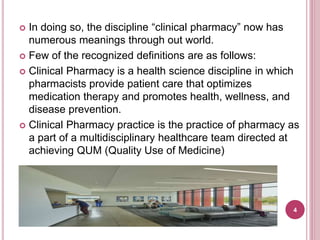
 Clinical Pharmacy practice is the practice of pharmacy as
a part of a multidisciplinary healthcare team directed at
achieving QUM (Quality Use of Medicine)
4
 In a nutshell, you can define clinical pharmacy as follows:
 'Clinical Pharmacy' can be defined as the branch of
pharmaceutical sciences dealing with utilization of
pharmacist's knowledge, skills and judgements related to
biomedical and pharmaceutical sciences, to prove the
safety, the cost and the precision of drug usage in the
patient care.
5
 A definition of clinical pharmacy based on the activities
might be more comprehendible.
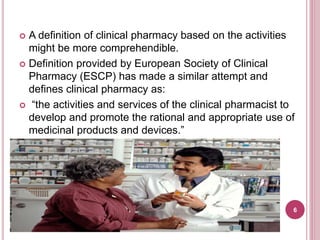
 Definition provided by European Society of Clinical
Pharmacy (ESCP) has made a similar attempt and
defines clinical pharmacy as:
 “the activities and services of the clinical pharmacist to
develop and promote the rational and appropriate use of
medicinal products and devices.”
6
 However, in elaborating activities of clinical pharmacist, it
has included nonclinical activities such as dispensing and
compounding along with clinical activities.
 Overlapping of clinical activities with non-clinical activities
may jumble up the responsibilities of hospital pharmacist
and clinical pharmacist.
7
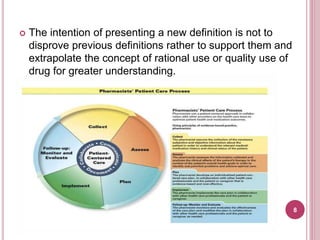
 The intention of presenting a new definition is not to
disprove previous definitions rather to support them and
extrapolate the concept of rational use or quality use of
drug for greater understanding.
8
PHARMACEUTICAL CARE
 Irrespective of words used in the definitions
mentioned above, the core of clinical pharmacy lies
in the concept of pharmaceutical care, which is
defined as,
 “specific activities and services through which an
individual pharmacist cooperates with a patient and
other professionals in designing, implementing and
monitoring a therapeutic plan that will produce
specific therapeutic outcomes for the patient.”
9
 Thus such activities that promote rational drug therapy
are clinical pharmacy.
 Including such activities into the definition of clinical
pharmacy may increase its understanding.
10
HISTORY OF CLINICAL PHARMACY
 The term clinical pharmacy was first used in 1953.
 The concept of clinical pharmacology started in
1960s with two incidences:
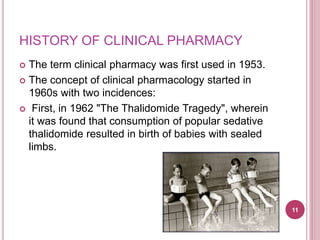
 First, in 1962 "The Thalidomide Tragedy", wherein
it was found that consumption of popular sedative
thalidomide resulted in birth of babies with sealed
limbs.
11
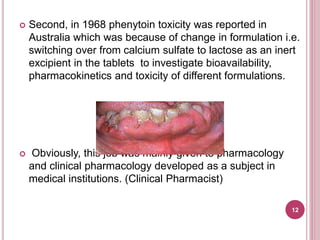
 Second, in 1968 phenytoin toxicity was reported in
Australia which was because of change in formulation i.e.
switching over from calcium sulfate to lactose as an inert
excipient in the tablets to investigate bioavailability,
pharmacokinetics and toxicity of different formulations.
 Obviously, this job was mainly given to pharmacology
and clinical pharmacology developed as a subject in
medical institutions. (Clinical Pharmacist)
12
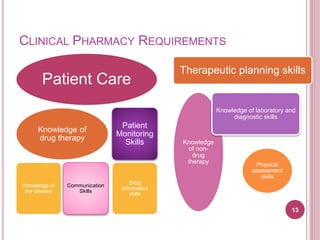
CLINICAL PHARMACY REQUIREMENTS
Patient Care
Knowledge of
drug therapy
Knowledge of
the disease
Communication
Skills
Patient
Monitoring
Skills
Drug
information
skills
Therapeutic planning skills
Knowledge
of non-
drug
therapy
Knowledge of laboratory and
diagnostic skills
Physical
assessment
skills
13
SCOPE OF CLINICAL PHARMACY
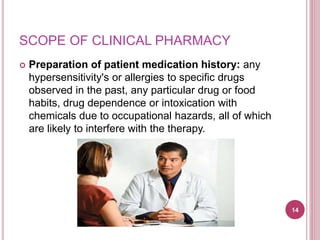
 Preparation of patient medication history: any
hypersensitivity's or allergies to specific drugs
observed in the past, any particular drug or food
habits, drug dependence or intoxication with
chemicals due to occupational hazards, all of which
are likely to interfere with the therapy.
14
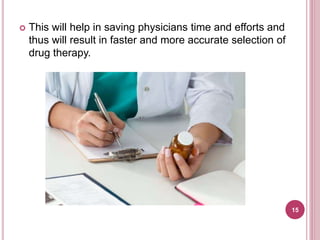
 This will help in saving physicians time and efforts and
thus will result in faster and more accurate selection of
drug therapy.
15
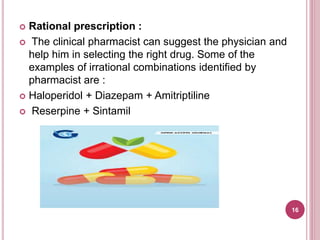
 Rational prescription :
 The clinical pharmacist can suggest the physician and
help him in selecting the right drug. Some of the
examples of irrational combinations identified by
pharmacist are :
 Haloperidol + Diazepam + Amitriptiline
 Reserpine + Sintamil
16
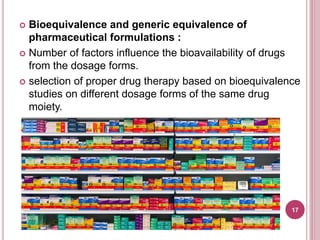
 Bioequivalence and generic equivalence of
pharmaceutical formulations :
 Number of factors influence the bioavailability of drugs
from the dosage forms.
 selection of proper drug therapy based on bioequivalence
studies on different dosage forms of the same drug
moiety.
17
 Patient monitoring :
 observes the signs and symptoms that indicate the need
for or reaction to drugs.
 Clinical pharmacist who knows correct route of
administration, the signs and symptoms of overdosages,
contraindications, desired effects, undesired effects and
side effects can help in monitoring the drug therapy for
safety and efficiency, a necessity with the increasing
applications of potent and toxic chemicals and drugs.
 drugs with narrow therapeutic index, or when drugs
administered in patients who are critically ill or are
suffering from chronic diseases.
18
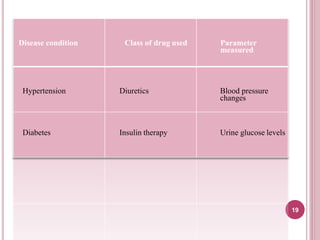
Disease condition Class of drug used Parameter
measured
Hypertension Diuretics Blood pressure
changes
Diabetes Insulin therapy Urine glucose levels
19
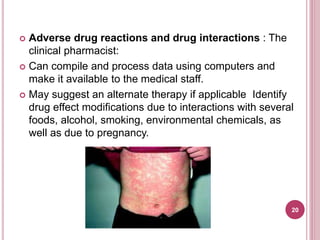
 Adverse drug reactions and drug interactions : The
clinical pharmacist:
 Can compile and process data using computers and
make it available to the medical staff.
 May suggest an alternate therapy if applicable Identify
drug effect modifications due to interactions with several
foods, alcohol, smoking, environmental chemicals, as
well as due to pregnancy.
20
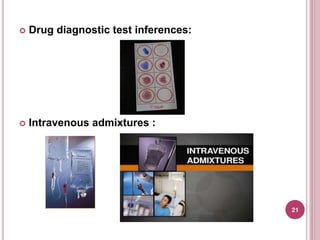
 Drug diagnostic test inferences:
 Intravenous admixtures :
21
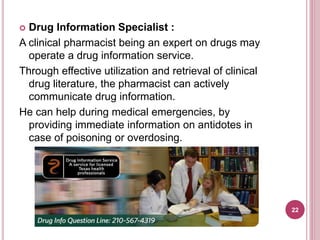
 Drug Information Specialist :
A clinical pharmacist being an expert on drugs may
operate a drug information service.
Through effective utilization and retrieval of clinical
drug literature, the pharmacist can actively
communicate drug information.
He can help during medical emergencies, by
providing immediate information on antidotes in
case of poisoning or overdosing.
22
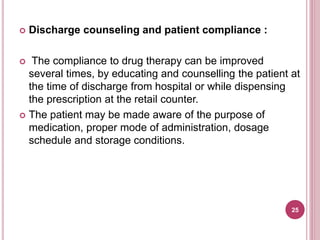
 Retail pharmacy stores :
 Many OTC drugs have the potential to interact with
prescription drugs.
 A clinical pharmacist at retail drug stores can maintain
patient drug profiles, family drug profiles and family
records based upon which the pharmacist can counsel
the patient each time while filling the prescription.
23
 He can determine the patients responses to drug
therapy and help him in the selection and use of
OTC drugs.
24
 Discharge counseling and patient compliance :
 The compliance to drug therapy can be improved
several times, by educating and counselling the patient at
the time of discharge from hospital or while dispensing
the prescription at the retail counter.
 The patient may be made aware of the purpose of
medication, proper mode of administration, dosage
schedule and storage conditions.
25
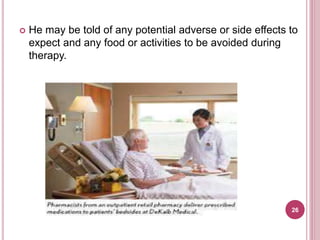
 He may be told of any potential adverse or side effects to
expect and any food or activities to be avoided during
therapy.
26
 Clinical research and continuous education program
:
 The clinical pharmacist can participate in an evaluation
program on investigational drugs.
 He can help in conducting clinical trials based on sound
principles of biostatistical methods of evaluation.
 He can also develop training programs for pharmacists,
nurses and interns.
27
 Medical Audit :
 Medical audit is a logical and necessary procedure
within organized teamwork.
 The clinical pharmacist is either the initiator or a very
active member of a functioning committee
28
 Following are the activities, concerning medical audit:
i. Legislation.
ii. Contractual obligation.
iii. Regulation and registration of pharmacotherapy orders
and administration.
iv. Regulation of clinical experiments with drugs
v. Information per subject and per patient
vi. Pharmacotherapy-committee policy
vii. Regulation of information from the pharmaceutical
industry
viii. Local or regional microsymposia per patient
ix. Formulary policy
x. Retrospective study of drug use patterns
xi. Medical audit committee work
29
GOAL
 to promote the correct and appropriate use of medicinal
products and devices.
 These activities aim at:
 maximising the clinical effect of medicines
 minimising the risk of treatment-induced adverse events
 minimising the expenditures for pharmacological
treatments.
30
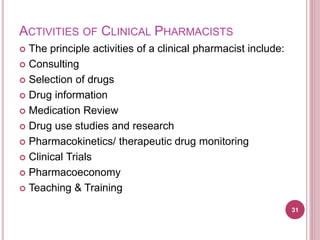
ACTIVITIES OF CLINICAL PHARMACISTS
 The principle activities of a clinical pharmacist include:
 Consulting
 Selection of drugs
 Drug information
 Medication Review
 Drug use studies and research
 Pharmacokinetics/ therapeutic drug monitoring
 Clinical Trials
 Pharmacoeconomy
 Teaching & Training
31
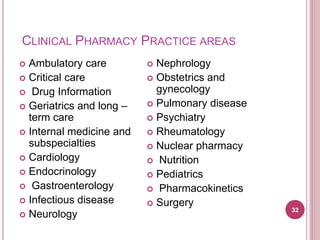
CLINICAL PHARMACY PRACTICE AREAS
 Ambulatory care
 Critical care
 Drug Information
 Geriatrics and long –
term care
 Internal medicine and
subspecialties
 Cardiology
 Endocrinology
 Gastroenterology
 Infectious disease
 Neurology
 Nephrology
 Obstetrics and
gynecology
 Pulmonary disease
 Psychiatry
 Rheumatology
 Nuclear pharmacy
 Nutrition
 Pediatrics
 Pharmacokinetics
 Surgery
32
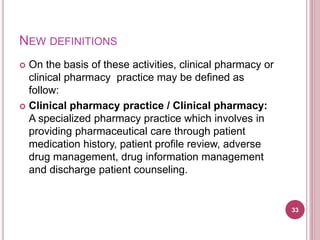
NEW DEFINITIONS
 On the basis of these activities, clinical pharmacy or
clinical pharmacy practice may be defined as
follow:
 Clinical pharmacy practice / Clinical pharmacy:
A specialized pharmacy practice which involves in
providing pharmaceutical care through patient
medication history, patient profile review, adverse
drug management, drug information management
and discharge patient counseling.
33
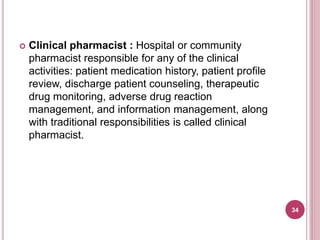
 Clinical pharmacist : Hospital or community
pharmacist responsible for any of the clinical
activities: patient medication history, patient profile
review, discharge patient counseling, therapeutic
drug monitoring, adverse drug reaction
management, and information management, along
with traditional responsibilities is called clinical
pharmacist.
34
 Clinical Pharmacist Specialist : Hospital or
community pharmacist specializes in providing
pharmaceutical care through clinical activities are
called clinical pharmacy specialist
 Advance clinical pharmacy practice: Clinical
pharmacy practice which includes collaborative
agreement between the clinical pharmacist and
physician allowing clinical pharmacist to prescribe
medication is called advance clinical pharmacy
practice.
35

Introduction to clinical pharmacy practice

  • 1.
    INTRODUCTION TO CLINICAL PHARMACYPRACTICE Aimen Salman Assistant Professor Department of Pharmacology United Institute of Pharmacy 1
  • 2.
    CONTENTS  Definition  PharmaceuticalCare  History of Clinical Pharmacy  Clinical Pharmacy Requirements  Scope of Clinical Pharmacy  Goal  Activities of Clinical Pharmacists  New Definitions 2
  • 3.
    DEFINITION  Clinical pharmacypractice is relatively a new discipline in pharmacy practice in which the emphasis is transferred from products oriented to patient oriented practice.  However, the definition of clinical pharmacy or clinical pharmacy practice has not been universally standardized; hence different academic institutions and pharmaceutical societies have attempted to define it in their own perspectives. 3
  • 4.
     In doingso, the discipline “clinical pharmacy” now has numerous meanings through out world.  Few of the recognized definitions are as follows:  Clinical Pharmacy is a health science discipline in which pharmacists provide patient care that optimizes medication therapy and promotes health, wellness, and disease prevention.  Clinical Pharmacy practice is the practice of pharmacy as a part of a multidisciplinary healthcare team directed at achieving QUM (Quality Use of Medicine) 4
  • 5.
     In anutshell, you can define clinical pharmacy as follows:  'Clinical Pharmacy' can be defined as the branch of pharmaceutical sciences dealing with utilization of pharmacist's knowledge, skills and judgements related to biomedical and pharmaceutical sciences, to prove the safety, the cost and the precision of drug usage in the patient care. 5
  • 6.
     A definitionof clinical pharmacy based on the activities might be more comprehendible.  Definition provided by European Society of Clinical Pharmacy (ESCP) has made a similar attempt and defines clinical pharmacy as:  “the activities and services of the clinical pharmacist to develop and promote the rational and appropriate use of medicinal products and devices.” 6
  • 7.
     However, inelaborating activities of clinical pharmacist, it has included nonclinical activities such as dispensing and compounding along with clinical activities.  Overlapping of clinical activities with non-clinical activities may jumble up the responsibilities of hospital pharmacist and clinical pharmacist. 7
  • 8.
     The intentionof presenting a new definition is not to disprove previous definitions rather to support them and extrapolate the concept of rational use or quality use of drug for greater understanding. 8
  • 9.
    PHARMACEUTICAL CARE  Irrespectiveof words used in the definitions mentioned above, the core of clinical pharmacy lies in the concept of pharmaceutical care, which is defined as,  “specific activities and services through which an individual pharmacist cooperates with a patient and other professionals in designing, implementing and monitoring a therapeutic plan that will produce specific therapeutic outcomes for the patient.” 9
  • 10.
     Thus suchactivities that promote rational drug therapy are clinical pharmacy.  Including such activities into the definition of clinical pharmacy may increase its understanding. 10
  • 11.
    HISTORY OF CLINICALPHARMACY  The term clinical pharmacy was first used in 1953.  The concept of clinical pharmacology started in 1960s with two incidences:  First, in 1962 "The Thalidomide Tragedy", wherein it was found that consumption of popular sedative thalidomide resulted in birth of babies with sealed limbs. 11
  • 12.
     Second, in1968 phenytoin toxicity was reported in Australia which was because of change in formulation i.e. switching over from calcium sulfate to lactose as an inert excipient in the tablets to investigate bioavailability, pharmacokinetics and toxicity of different formulations.  Obviously, this job was mainly given to pharmacology and clinical pharmacology developed as a subject in medical institutions. (Clinical Pharmacist) 12
  • 13.
    CLINICAL PHARMACY REQUIREMENTS PatientCare Knowledge of drug therapy Knowledge of the disease Communication Skills Patient Monitoring Skills Drug information skills Therapeutic planning skills Knowledge of non- drug therapy Knowledge of laboratory and diagnostic skills Physical assessment skills 13
  • 14.
    SCOPE OF CLINICALPHARMACY  Preparation of patient medication history: any hypersensitivity's or allergies to specific drugs observed in the past, any particular drug or food habits, drug dependence or intoxication with chemicals due to occupational hazards, all of which are likely to interfere with the therapy. 14
  • 15.
     This willhelp in saving physicians time and efforts and thus will result in faster and more accurate selection of drug therapy. 15
  • 16.
     Rational prescription:  The clinical pharmacist can suggest the physician and help him in selecting the right drug. Some of the examples of irrational combinations identified by pharmacist are :  Haloperidol + Diazepam + Amitriptiline  Reserpine + Sintamil 16
  • 17.
     Bioequivalence andgeneric equivalence of pharmaceutical formulations :  Number of factors influence the bioavailability of drugs from the dosage forms.  selection of proper drug therapy based on bioequivalence studies on different dosage forms of the same drug moiety. 17
  • 18.
     Patient monitoring:  observes the signs and symptoms that indicate the need for or reaction to drugs.  Clinical pharmacist who knows correct route of administration, the signs and symptoms of overdosages, contraindications, desired effects, undesired effects and side effects can help in monitoring the drug therapy for safety and efficiency, a necessity with the increasing applications of potent and toxic chemicals and drugs.  drugs with narrow therapeutic index, or when drugs administered in patients who are critically ill or are suffering from chronic diseases. 18
  • 19.
    Disease condition Classof drug used Parameter measured Hypertension Diuretics Blood pressure changes Diabetes Insulin therapy Urine glucose levels 19
  • 20.
     Adverse drugreactions and drug interactions : The clinical pharmacist:  Can compile and process data using computers and make it available to the medical staff.  May suggest an alternate therapy if applicable Identify drug effect modifications due to interactions with several foods, alcohol, smoking, environmental chemicals, as well as due to pregnancy. 20
  • 21.
     Drug diagnostictest inferences:  Intravenous admixtures : 21
  • 22.
     Drug InformationSpecialist : A clinical pharmacist being an expert on drugs may operate a drug information service. Through effective utilization and retrieval of clinical drug literature, the pharmacist can actively communicate drug information. He can help during medical emergencies, by providing immediate information on antidotes in case of poisoning or overdosing. 22
  • 23.
     Retail pharmacystores :  Many OTC drugs have the potential to interact with prescription drugs.  A clinical pharmacist at retail drug stores can maintain patient drug profiles, family drug profiles and family records based upon which the pharmacist can counsel the patient each time while filling the prescription. 23
  • 24.
     He candetermine the patients responses to drug therapy and help him in the selection and use of OTC drugs. 24
  • 25.
     Discharge counselingand patient compliance :  The compliance to drug therapy can be improved several times, by educating and counselling the patient at the time of discharge from hospital or while dispensing the prescription at the retail counter.  The patient may be made aware of the purpose of medication, proper mode of administration, dosage schedule and storage conditions. 25
  • 26.
     He maybe told of any potential adverse or side effects to expect and any food or activities to be avoided during therapy. 26
  • 27.
     Clinical researchand continuous education program :  The clinical pharmacist can participate in an evaluation program on investigational drugs.  He can help in conducting clinical trials based on sound principles of biostatistical methods of evaluation.  He can also develop training programs for pharmacists, nurses and interns. 27
  • 28.
     Medical Audit:  Medical audit is a logical and necessary procedure within organized teamwork.  The clinical pharmacist is either the initiator or a very active member of a functioning committee 28
  • 29.
     Following arethe activities, concerning medical audit: i. Legislation. ii. Contractual obligation. iii. Regulation and registration of pharmacotherapy orders and administration. iv. Regulation of clinical experiments with drugs v. Information per subject and per patient vi. Pharmacotherapy-committee policy vii. Regulation of information from the pharmaceutical industry viii. Local or regional microsymposia per patient ix. Formulary policy x. Retrospective study of drug use patterns xi. Medical audit committee work 29
  • 30.
    GOAL  to promotethe correct and appropriate use of medicinal products and devices.  These activities aim at:  maximising the clinical effect of medicines  minimising the risk of treatment-induced adverse events  minimising the expenditures for pharmacological treatments. 30
  • 31.
    ACTIVITIES OF CLINICALPHARMACISTS  The principle activities of a clinical pharmacist include:  Consulting  Selection of drugs  Drug information  Medication Review  Drug use studies and research  Pharmacokinetics/ therapeutic drug monitoring  Clinical Trials  Pharmacoeconomy  Teaching & Training 31
  • 32.
    CLINICAL PHARMACY PRACTICEAREAS  Ambulatory care  Critical care  Drug Information  Geriatrics and long – term care  Internal medicine and subspecialties  Cardiology  Endocrinology  Gastroenterology  Infectious disease  Neurology  Nephrology  Obstetrics and gynecology  Pulmonary disease  Psychiatry  Rheumatology  Nuclear pharmacy  Nutrition  Pediatrics  Pharmacokinetics  Surgery 32
  • 33.
    NEW DEFINITIONS  Onthe basis of these activities, clinical pharmacy or clinical pharmacy practice may be defined as follow:  Clinical pharmacy practice / Clinical pharmacy: A specialized pharmacy practice which involves in providing pharmaceutical care through patient medication history, patient profile review, adverse drug management, drug information management and discharge patient counseling. 33
  • 34.
     Clinical pharmacist: Hospital or community pharmacist responsible for any of the clinical activities: patient medication history, patient profile review, discharge patient counseling, therapeutic drug monitoring, adverse drug reaction management, and information management, along with traditional responsibilities is called clinical pharmacist. 34
  • 35.
     Clinical PharmacistSpecialist : Hospital or community pharmacist specializes in providing pharmaceutical care through clinical activities are called clinical pharmacy specialist  Advance clinical pharmacy practice: Clinical pharmacy practice which includes collaborative agreement between the clinical pharmacist and physician allowing clinical pharmacist to prescribe medication is called advance clinical pharmacy practice. 35