Math and Dosage Calculations for Health Care   Third Edition Booth & Whaley McGraw-Hill 5- Chapter 5: Drug Orders Edited by B. Holmes MSN/Ed, RN
Learning Outcomes Summarize the Rights of Medication Administration. Interpret a written drug order.  Identify on physicians’ orders and prescriptions the information needed to dispense medication.
Learning Outcomes  (cont.) Locate on medication administration records or electronic medication records the information needed to administer medication. Recognize drug orders that do not contain all of the necessary information to carry out the orders safely. Select appropriate action for confusing, incomplete, or illegible drug orders.
Introduction It is important to be able to read and understand a drug order to correctly calculate medication dosages. You can be held responsible for medication errors regardless of the source.
Rights of Medication Administration Basic Rights Right patient Right drug Right dose Right route Right time Right documentation Additional Rights Right reason Right to refuse Right to know Right technique
Right Patient Before giving a medication to a patient Check for  two  identifiers. Patient’s full name Another identifier – date of birth, SSN, or medical record number Ask the patient state his/her full name and second identifier.
Right Patient  (cont.) Check that the name on medication order is exactly the same as the name of the patient. Outpatient – photographic identification Inpatient – identification number, identification bracelet, bar code scanning Check the bed number.
Right Drug To be sure a patient receives the right drug. Only give drugs that you prepared yourself Check the expiration date. Check original order before administration If the patient questions a medication, make sure you are able explain the drug, purpose, and side effect
Right Drug  (cont.) A patient always has the right to refuse a medication. Dispose of refused medications according to facility guidelines.
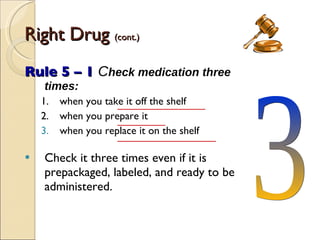
Right Drug  (cont.) Rule 5 – 1   C heck medication three times: 1. when you take it off the shelf 2. when you prepare it when you replace it on the shelf Check it three times even if it is prepackaged, labeled, and ready to be administered. 3
Right Dose Preparing and administering the right dose may require calculations. Conversion from dosage ordered to desired dose Amount to administer  Use extreme caution when calculating dosages. Pay special attention to decimal points
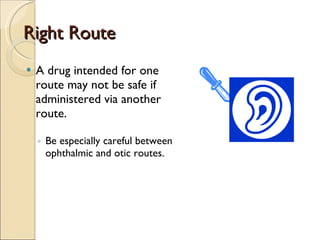
Right Route A drug intended for one route may not be safe if administered via another route. Be especially careful between ophthalmic and otic routes.
Right Route  (cont.) Some medications are produced in different versions for different routes. Example aspirin is available as tablets or as suppositories Check that route listed on drug label matches route ordered.
Right Time Most often within 30 minutes of schedule Absolute time – 9:00 a.m. Relative time – before breakfast Drug order should identify special timing considerations if needed. PRN medications  Given when needed with a specified time interval. Check when previous dose was given.
Right Documentation Sign the  medication administration record  (MAR) immediately after the patient takes the medication. Do not document prior to giving the medication. If documentation not done, medication administration is not complete Also document if the patient Refuses a medication Consumes only part of the dose  Vomits after taking the drug
Right Reason Know why a medication is being given. Check medication record Check order Check with prescribing physician
Right to Know Patients must be educated about their medications, including the  Reason for taking the medication  Expected effect of the medication Side effects of medications
Right Technique Medications must be given correctly according to the order.  For example: Buccal -- between cheek and gum Sublingual -- under the tongue If unsure of technique Physicians’ Desk Reference (PDR) Facility policy or procedure manual Valid Internet source
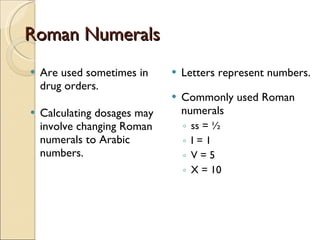
Roman Numerals Are used sometimes in drug orders. Calculating dosages may involve changing Roman numerals to Arabic numbers. Letters represent numbers. Commonly used Roman numerals ss = ½ I = 1 V = 5 X = 10
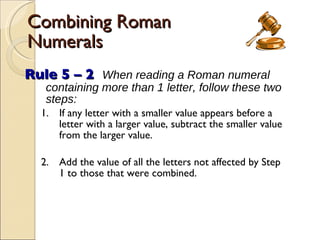
Combining Roman Numerals Rule 5 – 2   When reading a Roman numeral containing more than 1 letter, follow these two steps: 1. If any letter with a smaller value appears before a letter with a larger value, subtract the smaller value from the larger value. 2. Add the value of all the letters not affected by Step 1 to those that were combined.
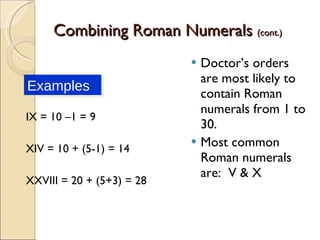
Combining Roman Numerals  (cont.) IX = 10 –1 = 9 XIV = 10 + (5-1) = 14 XXVIII = 20 + (5+3) = 28 Doctor’s orders are most likely to contain Roman numerals from 1 to 30.  Most common Roman numerals are:  V & X Examples
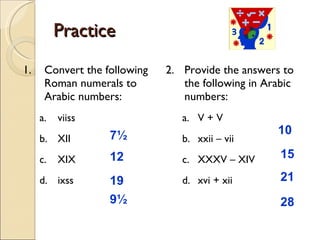
Practice  1. Convert the following Roman numerals to Arabic numbers: viiss XII XIX ixss 2. Provide the answers to the following in Arabic numbers: V + V xxii – vii XXXV – XIV xvi + xii 7½  12   19 9½   10  15  21  28
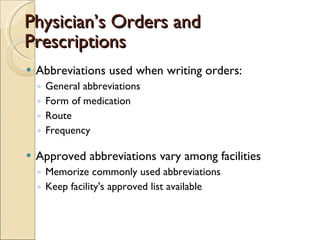
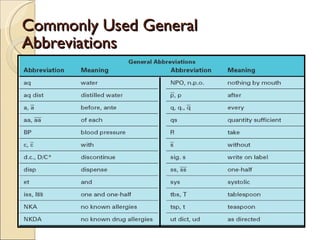
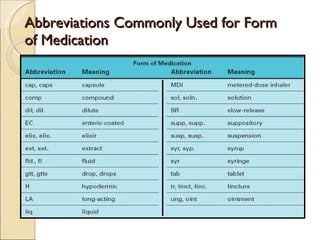
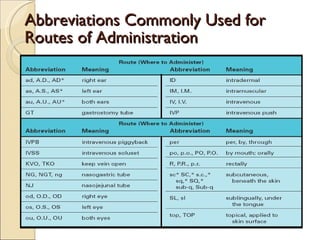
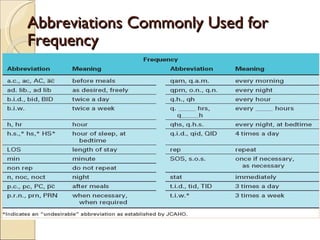
Physician’s Orders and Prescriptions Abbreviations used when writing orders:  General abbreviations Form of medication Route Frequency Approved abbreviations vary among facilities Memorize commonly used abbreviations Keep facility's approved list available
Commonly Used General Abbreviations
Abbreviations Commonly Used for Form of Medication
Abbreviations Commonly Used for Routes of Administration
Abbreviations Commonly Used for Frequency
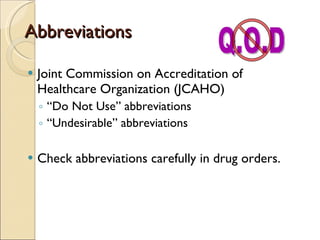
Abbreviations Joint Commission on Accreditation of Healthcare Organization (JCAHO)  “ Do Not Use” abbreviations “ Undesirable” abbreviations Check abbreviations carefully in drug orders. Q.O.D
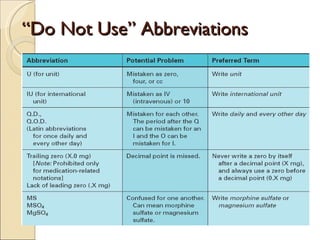
“ Do Not Use” Abbreviations
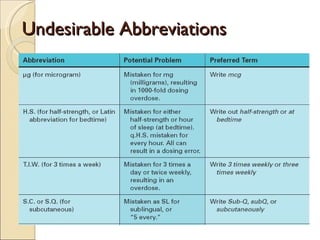
Undesirable Abbreviations
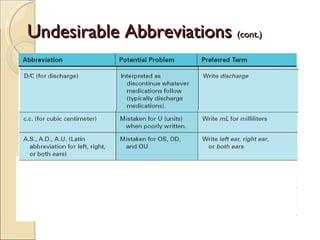
Undesirable Abbreviations  (cont.)
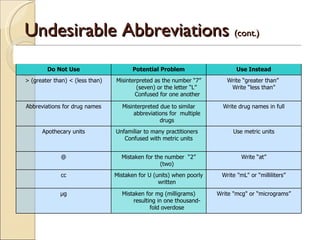
Undesirable Abbreviations  (cont.) Do Not Use Potential Problem Use Instead > (greater than) < (less than) Misinterpreted as the number “7” (seven) or the letter “L”  Confused for one another Write “greater than”  Write “less than” Abbreviations for drug names Misinterpreted due to similar abbreviations for  multiple drugs Write drug names in full Apothecary units Unfamiliar to many practitioners  Confused with metric units Use metric units @ Mistaken for the number  “2” (two) Write “at” cc Mistaken for U (units) when poorly written Write &quot;mL&quot; or “milliliters” µg Mistaken for mg (milligrams) resulting in one thousand-fold overdose Write &quot;mcg&quot; or “micrograms”
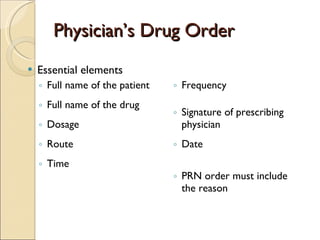
Physician’s Drug Order Essential elements Full name of the patient Full name of the drug Dosage  Route Time  Frequency Signature of prescribing physician Date  PRN order must include the reason
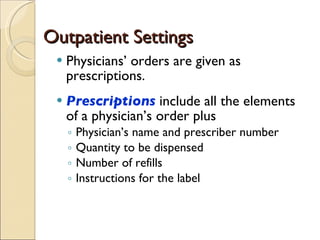
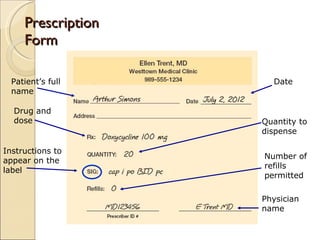
Outpatient Settings Physicians’ orders are given as prescriptions.  Prescriptions   include all the elements of a physician’s order plus  Physician’s name and prescriber number Quantity to be dispensed Number of refills Instructions for the label
Prescription  Form Drug and  dose Quantity to  dispense Instructions to  appear on the  label Number of  refills  permitted Patient’s full  name Date Physician  name
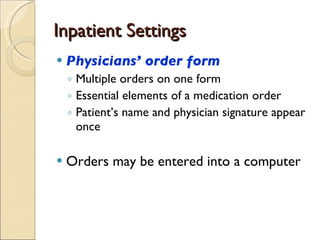
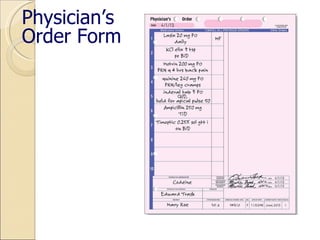
Inpatient Settings Physicians’ order form Multiple orders on one form Essential elements of a medication order Patient’s name and physician signature appear once Orders may be entered into a computer
Physician’s Order Form
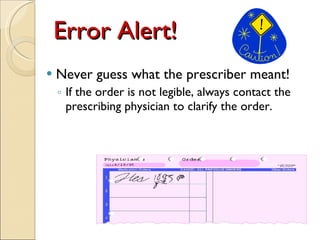
Error Alert! Never guess what the prescriber meant! If the order is not legible, always contact the prescribing physician to clarify the order.
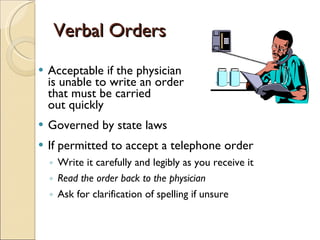
Verbal Orders Acceptable if the physician  is unable to write an order that must be carried  out quickly Governed by state laws  If permitted to accept a telephone order Write it carefully and legibly as you receive it Read the order back to the physician Ask for clarification of spelling if unsure
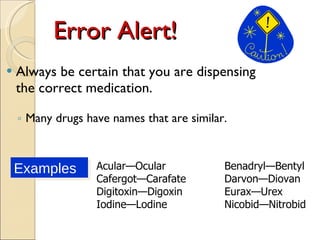
Error Alert! Always be certain that you are dispensing the correct medication. Many drugs have names that are similar. Acular—Ocular Benadryl—Bentyl Cafergot—Carafate Darvon—Diovan Digitoxin—Digoxin Eurax—Urex Iodine—Lodine Nicobid—Nitrobid Examples
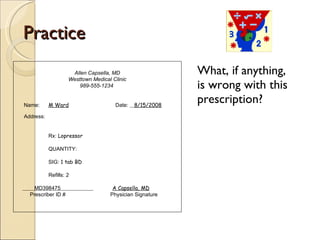
Practice What, if anything, is wrong with this prescription? Allen Capsella, MD Westtown Medical Clinic 989-555-1234  Name:  M Ward   Date:  8/15/2008 Address:  Rx:  Lopressor QUANTITY:  SIG:  1 tab BD Refills: 2 MD398475  A Capsella, MD Prescriber ID #   Physician Signature
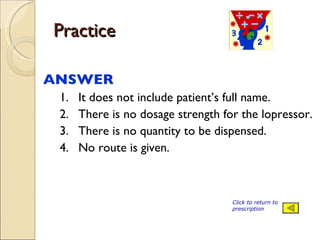
Practice ANSWER  1. It does not include patient’s full name. 2. There is no dosage strength for the lopressor. 3. There is no quantity to be dispensed. 4. No route is given. Click to return to prescription
Medication Administration Systems Standard schedule for administering medication  Varies by facility Verifier  Ensures that the times listed for administration are appropriate  Adjust times as necessary  Mealtimes  Conflicting medication schedule
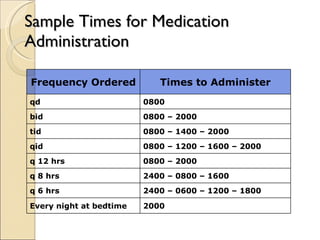
Sample Times for Medication Administration Frequency Ordered Times to Administer qd 0800 bid 0800 – 2000 tid 0800 – 1400 – 2000 qid 0800 – 1200 – 1600 – 2000 q 12 hrs 0800 – 2000 q 8 hrs 2400 – 0800 – 1600 q 6 hrs 2400 – 0600 – 1200 – 1800 Every night at bedtime 2000
Medication Administration Records (MAR) Legal documents that may be handwritten or computerized Contain same information as the order form Specify the times to administer the medication Provide a place to document each medication administration
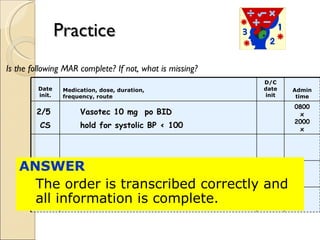
Medication Administration Records (MAR) (cont.) Rule 5-3  MARs   must include the following information: 1. Name of medication, dose, route, frequency 2. Times that accurately reflect the frequency specified 3. Name and identification number of patient 4. Date order was written (including start and end dates as necessary) 5. Special instructions or information required by the facility
Practice Is the following MAR complete? If not, what is missing? ANSWER  The order is transcribed correctly and all information is complete. Date init. Medication, dose, duration, frequency, route D/C date init Admin time 2/5  CS Vasotec 10 mg  po BID   hold for systolic BP < 100 0800 x 2000 x
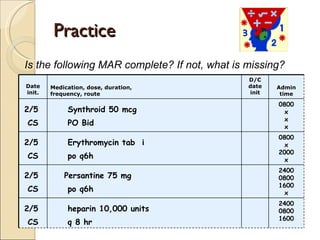
Practice Is the following MAR complete? If not, what is missing? Date init. Medication, dose, duration, frequency, route D/C date init Admin time 2/5  CS Synthroid 50 mcg   PO Bid 0800 x x x 2/5  CS Erythromycin tab  i   po q6h 0800 x 2000 x 2/5  CS Persantine 75 mg    po q6h 2400 0800 1600 x 2/5  CS heparin 10,000 units   q 8 hr 2400 0800 1600
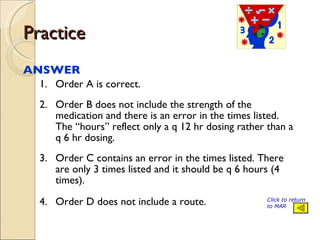
Practice  ANSWER  1. Order A is correct. 2. Order B does not include the strength of the medication and there is an error in the times listed. The “hours” reflect only a q 12 hr dosing rather than a q 6 hr dosing. 3. Order C contains an error in the times listed. There are only 3 times listed and it should be q 6 hours (4 times). 4. Order D does not include a route. Click to return to MAR
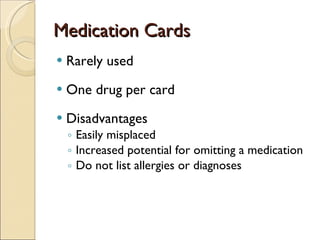
Medication Cards Rarely used One drug per card Disadvantages Easily misplaced Increased potential for omitting a medication Do not list allergies or diagnoses
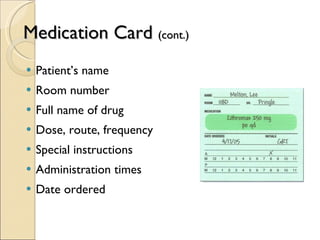
Medication Card  (cont.) Patient’s name Room number Full name of drug Dose, route, frequency Special instructions Administration times Date ordered
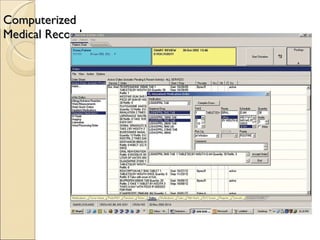
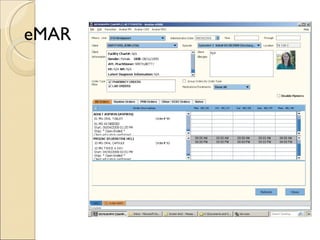
Computerized Medical Records Patient information is entered directly into a computer. Information is easily updated and accessible. Includes  Orders  Lab results Allergies  Appointments  Discharge plans
Computerized Medical Record
Computerized Medical Records  (cont.) Electronic Medication Administration Records   (eMARs) Ongoing working document Records medications as they are administered Users must log into system using secure passwords
eMAR
Medication Reference Materials To dispense or administer medications Know effects of the drugs Be familiar with drug information sources
Medication Reference Materials  (cont.) Resources Package inserts Physicians’ Desk Reference  (PDR) United States Pharmacopeia National Formulary Drug handbooks Reputable Internet sites Software programs used with personal digital assistant (PDA)
Apply Your Knowledge Which of the  basic rights  of medication administration is not listed? Right patient Right drug Right dose Right time Right technique Right documentation Answer  right route
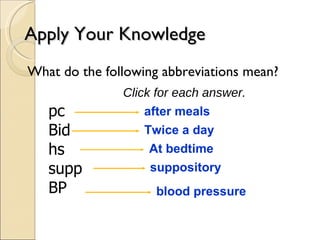
Apply Your Knowledge What do the following abbreviations mean? pc Bid hs supp BP Click for each answer. after meals Twice a day At bedtime suppository blood pressure
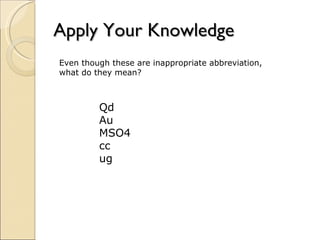
Apply Your Knowledge Even though these are inappropriate abbreviation, what do they mean? Qd Au MSO4 cc ug
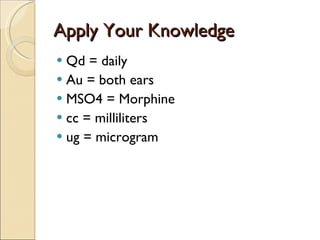
Apply Your Knowledge Qd = daily Au = both ears MSO4 = Morphine cc = milliliters ug = microgram
End of Chapter 5 You must motivate yourself EVERYDAY! ~Matthew  Stasior

Chapter05

  • 1.
    Math and DosageCalculations for Health Care Third Edition Booth & Whaley McGraw-Hill 5- Chapter 5: Drug Orders Edited by B. Holmes MSN/Ed, RN
  • 2.
    Learning Outcomes Summarizethe Rights of Medication Administration. Interpret a written drug order. Identify on physicians’ orders and prescriptions the information needed to dispense medication.
  • 3.
    Learning Outcomes (cont.) Locate on medication administration records or electronic medication records the information needed to administer medication. Recognize drug orders that do not contain all of the necessary information to carry out the orders safely. Select appropriate action for confusing, incomplete, or illegible drug orders.
  • 4.
    Introduction It isimportant to be able to read and understand a drug order to correctly calculate medication dosages. You can be held responsible for medication errors regardless of the source.
  • 5.
    Rights of MedicationAdministration Basic Rights Right patient Right drug Right dose Right route Right time Right documentation Additional Rights Right reason Right to refuse Right to know Right technique
  • 6.
    Right Patient Beforegiving a medication to a patient Check for two identifiers. Patient’s full name Another identifier – date of birth, SSN, or medical record number Ask the patient state his/her full name and second identifier.
  • 7.
    Right Patient (cont.) Check that the name on medication order is exactly the same as the name of the patient. Outpatient – photographic identification Inpatient – identification number, identification bracelet, bar code scanning Check the bed number.
  • 8.
    Right Drug Tobe sure a patient receives the right drug. Only give drugs that you prepared yourself Check the expiration date. Check original order before administration If the patient questions a medication, make sure you are able explain the drug, purpose, and side effect
  • 9.
    Right Drug (cont.) A patient always has the right to refuse a medication. Dispose of refused medications according to facility guidelines.
  • 10.
    Right Drug (cont.) Rule 5 – 1 C heck medication three times: 1. when you take it off the shelf 2. when you prepare it when you replace it on the shelf Check it three times even if it is prepackaged, labeled, and ready to be administered. 3
  • 11.
    Right Dose Preparingand administering the right dose may require calculations. Conversion from dosage ordered to desired dose Amount to administer Use extreme caution when calculating dosages. Pay special attention to decimal points
  • 12.
    Right Route Adrug intended for one route may not be safe if administered via another route. Be especially careful between ophthalmic and otic routes.
  • 13.
    Right Route (cont.) Some medications are produced in different versions for different routes. Example aspirin is available as tablets or as suppositories Check that route listed on drug label matches route ordered.
  • 14.
    Right Time Mostoften within 30 minutes of schedule Absolute time – 9:00 a.m. Relative time – before breakfast Drug order should identify special timing considerations if needed. PRN medications Given when needed with a specified time interval. Check when previous dose was given.
  • 15.
    Right Documentation Signthe medication administration record (MAR) immediately after the patient takes the medication. Do not document prior to giving the medication. If documentation not done, medication administration is not complete Also document if the patient Refuses a medication Consumes only part of the dose Vomits after taking the drug
  • 16.
    Right Reason Knowwhy a medication is being given. Check medication record Check order Check with prescribing physician
  • 17.
    Right to KnowPatients must be educated about their medications, including the Reason for taking the medication Expected effect of the medication Side effects of medications
  • 18.
    Right Technique Medicationsmust be given correctly according to the order. For example: Buccal -- between cheek and gum Sublingual -- under the tongue If unsure of technique Physicians’ Desk Reference (PDR) Facility policy or procedure manual Valid Internet source
  • 19.
    Roman Numerals Areused sometimes in drug orders. Calculating dosages may involve changing Roman numerals to Arabic numbers. Letters represent numbers. Commonly used Roman numerals ss = ½ I = 1 V = 5 X = 10
  • 20.
    Combining Roman NumeralsRule 5 – 2 When reading a Roman numeral containing more than 1 letter, follow these two steps: 1. If any letter with a smaller value appears before a letter with a larger value, subtract the smaller value from the larger value. 2. Add the value of all the letters not affected by Step 1 to those that were combined.
  • 21.
    Combining Roman Numerals (cont.) IX = 10 –1 = 9 XIV = 10 + (5-1) = 14 XXVIII = 20 + (5+3) = 28 Doctor’s orders are most likely to contain Roman numerals from 1 to 30. Most common Roman numerals are: V & X Examples
  • 22.
    Practice 1.Convert the following Roman numerals to Arabic numbers: viiss XII XIX ixss 2. Provide the answers to the following in Arabic numbers: V + V xxii – vii XXXV – XIV xvi + xii 7½ 12 19 9½ 10 15 21 28
  • 23.
    Physician’s Orders andPrescriptions Abbreviations used when writing orders: General abbreviations Form of medication Route Frequency Approved abbreviations vary among facilities Memorize commonly used abbreviations Keep facility's approved list available
  • 24.
    Commonly Used GeneralAbbreviations
  • 25.
    Abbreviations Commonly Usedfor Form of Medication
  • 26.
    Abbreviations Commonly Usedfor Routes of Administration
  • 27.
  • 28.
    Abbreviations Joint Commissionon Accreditation of Healthcare Organization (JCAHO) “ Do Not Use” abbreviations “ Undesirable” abbreviations Check abbreviations carefully in drug orders. Q.O.D
  • 29.
    “ Do NotUse” Abbreviations
  • 30.
  • 31.
  • 32.
    Undesirable Abbreviations (cont.) Do Not Use Potential Problem Use Instead > (greater than) < (less than) Misinterpreted as the number “7” (seven) or the letter “L” Confused for one another Write “greater than” Write “less than” Abbreviations for drug names Misinterpreted due to similar abbreviations for multiple drugs Write drug names in full Apothecary units Unfamiliar to many practitioners Confused with metric units Use metric units @ Mistaken for the number “2” (two) Write “at” cc Mistaken for U (units) when poorly written Write &quot;mL&quot; or “milliliters” µg Mistaken for mg (milligrams) resulting in one thousand-fold overdose Write &quot;mcg&quot; or “micrograms”
  • 33.
    Physician’s Drug OrderEssential elements Full name of the patient Full name of the drug Dosage Route Time Frequency Signature of prescribing physician Date PRN order must include the reason
  • 34.
    Outpatient Settings Physicians’orders are given as prescriptions. Prescriptions include all the elements of a physician’s order plus Physician’s name and prescriber number Quantity to be dispensed Number of refills Instructions for the label
  • 35.
    Prescription FormDrug and dose Quantity to dispense Instructions to appear on the label Number of refills permitted Patient’s full name Date Physician name
  • 36.
    Inpatient Settings Physicians’order form Multiple orders on one form Essential elements of a medication order Patient’s name and physician signature appear once Orders may be entered into a computer
  • 37.
  • 38.
    Error Alert! Neverguess what the prescriber meant! If the order is not legible, always contact the prescribing physician to clarify the order.
  • 39.
    Verbal Orders Acceptableif the physician is unable to write an order that must be carried out quickly Governed by state laws If permitted to accept a telephone order Write it carefully and legibly as you receive it Read the order back to the physician Ask for clarification of spelling if unsure
  • 40.
    Error Alert! Alwaysbe certain that you are dispensing the correct medication. Many drugs have names that are similar. Acular—Ocular Benadryl—Bentyl Cafergot—Carafate Darvon—Diovan Digitoxin—Digoxin Eurax—Urex Iodine—Lodine Nicobid—Nitrobid Examples
  • 41.
    Practice What, ifanything, is wrong with this prescription? Allen Capsella, MD Westtown Medical Clinic 989-555-1234 Name: M Ward Date: 8/15/2008 Address: Rx: Lopressor QUANTITY: SIG: 1 tab BD Refills: 2 MD398475 A Capsella, MD Prescriber ID # Physician Signature
  • 42.
    Practice ANSWER 1. It does not include patient’s full name. 2. There is no dosage strength for the lopressor. 3. There is no quantity to be dispensed. 4. No route is given. Click to return to prescription
  • 43.
    Medication Administration SystemsStandard schedule for administering medication Varies by facility Verifier Ensures that the times listed for administration are appropriate Adjust times as necessary Mealtimes Conflicting medication schedule
  • 44.
    Sample Times forMedication Administration Frequency Ordered Times to Administer qd 0800 bid 0800 – 2000 tid 0800 – 1400 – 2000 qid 0800 – 1200 – 1600 – 2000 q 12 hrs 0800 – 2000 q 8 hrs 2400 – 0800 – 1600 q 6 hrs 2400 – 0600 – 1200 – 1800 Every night at bedtime 2000
  • 45.
    Medication Administration Records(MAR) Legal documents that may be handwritten or computerized Contain same information as the order form Specify the times to administer the medication Provide a place to document each medication administration
  • 46.
    Medication Administration Records(MAR) (cont.) Rule 5-3 MARs must include the following information: 1. Name of medication, dose, route, frequency 2. Times that accurately reflect the frequency specified 3. Name and identification number of patient 4. Date order was written (including start and end dates as necessary) 5. Special instructions or information required by the facility
  • 47.
    Practice Is thefollowing MAR complete? If not, what is missing? ANSWER The order is transcribed correctly and all information is complete. Date init. Medication, dose, duration, frequency, route D/C date init Admin time 2/5 CS Vasotec 10 mg po BID hold for systolic BP < 100 0800 x 2000 x
  • 48.
    Practice Is thefollowing MAR complete? If not, what is missing? Date init. Medication, dose, duration, frequency, route D/C date init Admin time 2/5 CS Synthroid 50 mcg PO Bid 0800 x x x 2/5 CS Erythromycin tab i po q6h 0800 x 2000 x 2/5 CS Persantine 75 mg po q6h 2400 0800 1600 x 2/5 CS heparin 10,000 units q 8 hr 2400 0800 1600
  • 49.
    Practice ANSWER 1. Order A is correct. 2. Order B does not include the strength of the medication and there is an error in the times listed. The “hours” reflect only a q 12 hr dosing rather than a q 6 hr dosing. 3. Order C contains an error in the times listed. There are only 3 times listed and it should be q 6 hours (4 times). 4. Order D does not include a route. Click to return to MAR
  • 50.
    Medication Cards Rarelyused One drug per card Disadvantages Easily misplaced Increased potential for omitting a medication Do not list allergies or diagnoses
  • 51.
    Medication Card (cont.) Patient’s name Room number Full name of drug Dose, route, frequency Special instructions Administration times Date ordered
  • 52.
    Computerized Medical RecordsPatient information is entered directly into a computer. Information is easily updated and accessible. Includes Orders Lab results Allergies Appointments Discharge plans
  • 53.
  • 54.
    Computerized Medical Records (cont.) Electronic Medication Administration Records (eMARs) Ongoing working document Records medications as they are administered Users must log into system using secure passwords
  • 55.
  • 56.
    Medication Reference MaterialsTo dispense or administer medications Know effects of the drugs Be familiar with drug information sources
  • 57.
    Medication Reference Materials (cont.) Resources Package inserts Physicians’ Desk Reference (PDR) United States Pharmacopeia National Formulary Drug handbooks Reputable Internet sites Software programs used with personal digital assistant (PDA)
  • 58.
    Apply Your KnowledgeWhich of the basic rights of medication administration is not listed? Right patient Right drug Right dose Right time Right technique Right documentation Answer right route
  • 59.
    Apply Your KnowledgeWhat do the following abbreviations mean? pc Bid hs supp BP Click for each answer. after meals Twice a day At bedtime suppository blood pressure
  • 60.
    Apply Your KnowledgeEven though these are inappropriate abbreviation, what do they mean? Qd Au MSO4 cc ug
  • 61.
    Apply Your KnowledgeQd = daily Au = both ears MSO4 = Morphine cc = milliliters ug = microgram
  • 62.
    End of Chapter5 You must motivate yourself EVERYDAY! ~Matthew Stasior