Clinical pharmacy
Submitted To :
Dr. KANCHAN VOHRA
Assistant Professor
Submitted By :
Mohd. Rafi Bhat
Clinical pharmacy may be defined as the science and
practice of rationale use of medications, where the
pharmacists are more oriented towards the patient
care rationalizing medication therapy promoting
health , wellness of people
It is the modern and extended field of pharmacy.
“ The discipline that embodies the application and
development (by pharmacist) of scientific principles
of pharmacology, toxicology, therapeutics, and
clinical pharmacokinetics, pharmacoeconomics ,
pharmacogenomics and other allied sciences for the
care of patients”.
History
 Until the mid 1960’s ; Traditional role.
 The development of clinical pharmacy started in USA.
 More clinically oriented curriculum were designed with
the award of Pharm D degree.
 These developments influenced the practice of
pharmacy in U.K., Initially prescription and drug
administration records were introduced followed by an
increasing pharmacy practice in hospital wards. Master
degree programs in clinical pharmacy were introduced
for first time in 1976.
 The progress of clinical pharmacy development
remained at low profile in the first decade after its
birth in U.K. However, Nuffield(british industrialist)
report in1986 geared up the momentum for
progression of clinical pharmacy.
 Until today, the clinical pharmacy practice in Nepal is
in embryonic stage
How does clinical pharmacy differ
from pharmacy?
The discipline of pharmacy embraces the knowledge on
synthesis, chemistry and preparation of drugs
Clinical pharmacy is more oriented to the analysis of
population needs with regards to medicines, ways of
administration, patterns of use ,drugs effects on the
Patients, ‘the overall drug therapy management’.
The focus of attention moves from the drug to the single
patient or population receiving drugs.
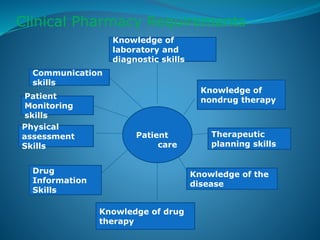
Clinical Pharmacy Requirements
Patient
care
Knowledge of
nondrug therapy
Therapeutic
planning skills
Knowledge of the
disease
Knowledge of drug
therapy
Drug
Information
Skills
Physical
assessment
Skills
Patient
Monitoring
skills
Communication
skills
Knowledge of
laboratory and
diagnostic skills
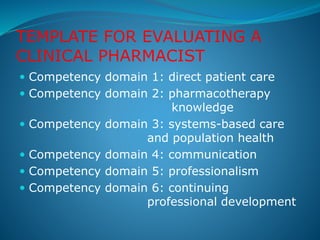
TEMPLATE FOR EVALUATING A
CLINICAL PHARMACIST
 Competency domain 1: direct patient care
 Competency domain 2: pharmacotherapy
knowledge
 Competency domain 3: systems-based care
and population health
 Competency domain 4: communication
 Competency domain 5: professionalism
 Competency domain 6: continuing
professional development
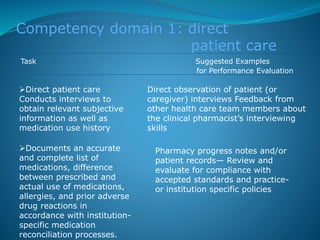
Competency domain 1: direct
patient care
Task Suggested Examples
for Performance Evaluation
Direct patient care
Conducts interviews to
obtain relevant subjective
information as well as
medication use history
Direct observation of patient (or
caregiver) interviews Feedback from
other health care team members about
the clinical pharmacist’s interviewing
skills
Documents an accurate
and complete list of
medications, difference
between prescribed and
actual use of medications,
allergies, and prior adverse
drug reactions in
accordance with institution-
specific medication
reconciliation processes.
Pharmacy progress notes and/or
patient records— Review and
evaluate for compliance with
accepted standards and practice-
or institution specific policies
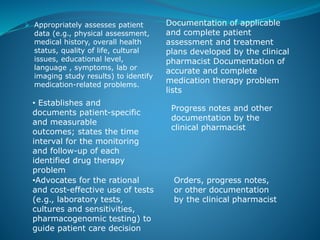
 Appropriately assesses patient
data (e.g., physical assessment,
medical history, overall health
status, quality of life, cultural
issues, educational level,
language , symptoms, lab or
imaging study results) to identify
medication-related problems.
Documentation of applicable
and complete patient
assessment and treatment
plans developed by the clinical
pharmacist Documentation of
accurate and complete
medication therapy problem
lists
• Establishes and
documents patient-specific
and measurable
outcomes; states the time
interval for the monitoring
and follow-up of each
identified drug therapy
problem
Progress notes and other
documentation by the
clinical pharmacist
•Advocates for the rational
and cost-effective use of tests
(e.g., laboratory tests,
cultures and sensitivities,
pharmacogenomic testing) to
guide patient care decision
Orders, progress notes,
or other documentation
by the clinical pharmacist
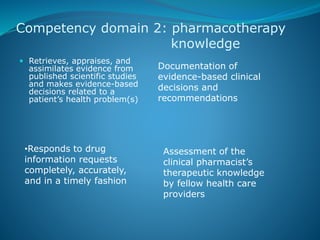
Competency domain 2: pharmacotherapy
knowledge
 Retrieves, appraises, and
assimilates evidence from
published scientific studies
and makes evidence-based
decisions related to a
patient’s health problem(s)
Documentation of
evidence-based clinical
decisions and
recommendations
•Responds to drug
information requests
completely, accurately,
and in a timely fashion
Assessment of the
clinical pharmacist’s
therapeutic knowledge
by fellow health care
providers
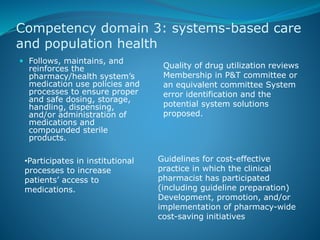
Competency domain 3: systems-based care
and population health
 Follows, maintains, and
reinforces the
pharmacy/health system’s
medication use policies and
processes to ensure proper
and safe dosing, storage,
handling, dispensing,
and/or administration of
medications and
compounded sterile
products.
Quality of drug utilization reviews
Membership in P&T committee or
an equivalent committee System
error identification and the
potential system solutions
proposed.
•Participates in institutional
processes to increase
patients’ access to
medications.
Guidelines for cost-effective
practice in which the clinical
pharmacist has participated
(including guideline preparation)
Development, promotion, and/or
implementation of pharmacy-wide
cost-saving initiatives
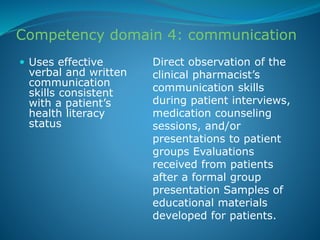
Competency domain 4: communication
 Uses effective
verbal and written
communication
skills consistent
with a patient’s
health literacy
status
Direct observation of the
clinical pharmacist’s
communication skills
during patient interviews,
medication counseling
sessions, and/or
presentations to patient
groups Evaluations
received from patients
after a formal group
presentation Samples of
educational materials
developed for patients.
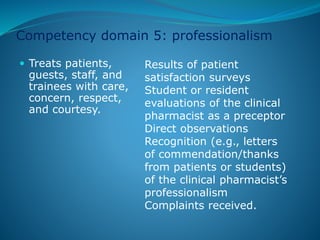
Competency domain 5: professionalism
 Treats patients,
guests, staff, and
trainees with care,
concern, respect,
and courtesy.
Results of patient
satisfaction surveys
Student or resident
evaluations of the clinical
pharmacist as a preceptor
Direct observations
Recognition (e.g., letters
of commendation/thanks
from patients or students)
of the clinical pharmacist’s
professionalism
Complaints received.
Competency domain 6: continuing
professional development
 Participates consistently
in continuing
professional
development activities
and pursues professional
and career development
activities that enhance
research and
scholarship.
Documentation of
participation in continuing
education/continuing
professional development
activities and programs
Documentation of
certifications earned or
renewed.
•Maintains competency
through certification
and maintenance of
certification
Roles and Responsibilities of a
Clinical Pharmacist
Assuring safe, accurate, rational and cost-
effective use of medications
Engage in collaborative practice with other
healthcare practitioners for the purpose of
improving care and conserving resources
Make patient-focused transitions into and out
of acute care practice settings, ambulatory
care or alternative site settings with the
patient’s best interest in mind
Possess in-depth knowledge of medications
that is integrated with a foundational
understanding of the biomedical,
pharmaceutical, socio behavioral, and clinical
sciences
To achieve desired therapeutic goals, the
clinical pharmacist applies evidence-based
therapeutic guidelines, evolving sciences,
emerging technologies, and relevant legal,
ethical, social, cultural, economic and
professional principles
 Assume responsibility and accountability for
managing medication therapy in direct patient
care settings, whether practicing
independently or in consultation/collaboration
with other health care professionals
Within the system of health care, clinical
pharmacists are experts in the therapeutic use
of medications
Routinely provide medication therapy
evaluations and recommendations to patients
and health care professionals
Other roles
Clinical pharmacist researchers generate,
disseminate, and apply new knowledge that
contributes to improved health and quality of
life
Scope of Practice for Clinical
Pharmacists
Professional Practice
Education
Accountability
Responsibility
Professional Practice
 Clinical pharmacists are licensed professionals with advanced
education and training who practice in all types of patient care
settings. They participate as members of the health care team to
provide high-quality, coordinated, patient-centered care to ensure
that individuals and populations achieve the best possible outcomes
from their medications. Clinical pharmacists assess medication-
related needs, evaluate medication therapy, develop and implement
plans of care, and provide follow-up evaluation and medication
monitoring in collaboration with other members of the health care
team. In the course of this practice, clinical pharmacists interpret
diagnostic and laboratory tests, identify the most appropriate drug
and nondrug therapies, and teach patients and caregivers about
medications and how to use them. They also serve as health care
researchers, university and college faculty, medication information
specialists, organizational leaders, consultants, and authors of books
and articles on pharmacology and medication therapy.
Education
 Today’s clinical pharmacists complete 6–8 years of undergraduate
and professional education leading to the doctor of pharmacy
(Pharm.D.) degree, including 2–3 years of coursework that
emphasizes pharmacology and the clinical assessment, monitoring,
and treatment of disease; and 1–2 years in supervised, direct patient
care settings, where, as members of the health care team, they engage
in the assessment, treatment, monitoring, and teaching of patients.
They also complete 1–2 years of accredited postgraduate residency
training as licensed clinical practitioners, where they work in team-
based settings under the guidance of expert practitioners in clinical
pharmacy and other health disciplines. Clinical pharmacists achieve
board certification in their area(s) of specialization and maintain
competence through recertification, mandatory continuing education,
and self-directed continuous professional development.
Accountability
 As accountable members of the health care team,
clinical pharmacists establish and maintain written
collaborative practice agreements with individual
physicians, medical groups, or health systems and/ or
practice under formally granted clinical privileges from
the medical staff or credentialing system of the
organization in which they practice. These
agreements, together with state pharmacy practice
acts, confer specific authorities, responsibilities, and
accountabilities to the clinical pharmacist. Clinical
pharmacists are committed to promoting quality care
that improves patients’ health outcomes. This is
accomplished by leading and participating in health
care organizations, conducting research, disseminating
research findings, and applying these findings to
clinical practice.
Responsibility
 Clinical pharmacists have a covenantal, “ fiducial ” relationship
with their patients. This relationship relies on the trust placed in
the clinical pharmacist by the patient and the commitment of
the clinical pharmacist to act in the best interests of individual
patients and patient populations. Clinical pharmacists exhibit
the traits of professionalism: responsibility, commitment to
excellence, respect for others, honesty and integrity, and care
and compassion. They subscribe to the pharmacy profession’s
code of ethics and adhere to all pharmacist-related legal and
ethical standards. Clinical pharmacists also assume
responsibility for advancing their discipline through
involvement in professional societies and participation in
health policy at local, state, national, and international levels.
Define clinical pharmacy

Define clinical pharmacy

  • 1.
    Clinical pharmacy Submitted To: Dr. KANCHAN VOHRA Assistant Professor Submitted By : Mohd. Rafi Bhat
  • 2.
    Clinical pharmacy maybe defined as the science and practice of rationale use of medications, where the pharmacists are more oriented towards the patient care rationalizing medication therapy promoting health , wellness of people It is the modern and extended field of pharmacy. “ The discipline that embodies the application and development (by pharmacist) of scientific principles of pharmacology, toxicology, therapeutics, and clinical pharmacokinetics, pharmacoeconomics , pharmacogenomics and other allied sciences for the care of patients”.
  • 3.
    History  Until themid 1960’s ; Traditional role.  The development of clinical pharmacy started in USA.  More clinically oriented curriculum were designed with the award of Pharm D degree.  These developments influenced the practice of pharmacy in U.K., Initially prescription and drug administration records were introduced followed by an increasing pharmacy practice in hospital wards. Master degree programs in clinical pharmacy were introduced for first time in 1976.  The progress of clinical pharmacy development remained at low profile in the first decade after its birth in U.K. However, Nuffield(british industrialist) report in1986 geared up the momentum for progression of clinical pharmacy.  Until today, the clinical pharmacy practice in Nepal is in embryonic stage
  • 4.
    How does clinicalpharmacy differ from pharmacy? The discipline of pharmacy embraces the knowledge on synthesis, chemistry and preparation of drugs Clinical pharmacy is more oriented to the analysis of population needs with regards to medicines, ways of administration, patterns of use ,drugs effects on the Patients, ‘the overall drug therapy management’. The focus of attention moves from the drug to the single patient or population receiving drugs.
  • 5.
    Clinical Pharmacy Requirements Patient care Knowledgeof nondrug therapy Therapeutic planning skills Knowledge of the disease Knowledge of drug therapy Drug Information Skills Physical assessment Skills Patient Monitoring skills Communication skills Knowledge of laboratory and diagnostic skills
  • 6.
    TEMPLATE FOR EVALUATINGA CLINICAL PHARMACIST  Competency domain 1: direct patient care  Competency domain 2: pharmacotherapy knowledge  Competency domain 3: systems-based care and population health  Competency domain 4: communication  Competency domain 5: professionalism  Competency domain 6: continuing professional development
  • 7.
    Competency domain 1:direct patient care Task Suggested Examples for Performance Evaluation Direct patient care Conducts interviews to obtain relevant subjective information as well as medication use history Direct observation of patient (or caregiver) interviews Feedback from other health care team members about the clinical pharmacist’s interviewing skills Documents an accurate and complete list of medications, difference between prescribed and actual use of medications, allergies, and prior adverse drug reactions in accordance with institution- specific medication reconciliation processes. Pharmacy progress notes and/or patient records— Review and evaluate for compliance with accepted standards and practice- or institution specific policies
  • 8.
     Appropriately assessespatient data (e.g., physical assessment, medical history, overall health status, quality of life, cultural issues, educational level, language , symptoms, lab or imaging study results) to identify medication-related problems. Documentation of applicable and complete patient assessment and treatment plans developed by the clinical pharmacist Documentation of accurate and complete medication therapy problem lists • Establishes and documents patient-specific and measurable outcomes; states the time interval for the monitoring and follow-up of each identified drug therapy problem Progress notes and other documentation by the clinical pharmacist •Advocates for the rational and cost-effective use of tests (e.g., laboratory tests, cultures and sensitivities, pharmacogenomic testing) to guide patient care decision Orders, progress notes, or other documentation by the clinical pharmacist
  • 9.
    Competency domain 2:pharmacotherapy knowledge  Retrieves, appraises, and assimilates evidence from published scientific studies and makes evidence-based decisions related to a patient’s health problem(s) Documentation of evidence-based clinical decisions and recommendations •Responds to drug information requests completely, accurately, and in a timely fashion Assessment of the clinical pharmacist’s therapeutic knowledge by fellow health care providers
  • 10.
    Competency domain 3:systems-based care and population health  Follows, maintains, and reinforces the pharmacy/health system’s medication use policies and processes to ensure proper and safe dosing, storage, handling, dispensing, and/or administration of medications and compounded sterile products. Quality of drug utilization reviews Membership in P&T committee or an equivalent committee System error identification and the potential system solutions proposed. •Participates in institutional processes to increase patients’ access to medications. Guidelines for cost-effective practice in which the clinical pharmacist has participated (including guideline preparation) Development, promotion, and/or implementation of pharmacy-wide cost-saving initiatives
  • 11.
    Competency domain 4:communication  Uses effective verbal and written communication skills consistent with a patient’s health literacy status Direct observation of the clinical pharmacist’s communication skills during patient interviews, medication counseling sessions, and/or presentations to patient groups Evaluations received from patients after a formal group presentation Samples of educational materials developed for patients.
  • 12.
    Competency domain 5:professionalism  Treats patients, guests, staff, and trainees with care, concern, respect, and courtesy. Results of patient satisfaction surveys Student or resident evaluations of the clinical pharmacist as a preceptor Direct observations Recognition (e.g., letters of commendation/thanks from patients or students) of the clinical pharmacist’s professionalism Complaints received.
  • 13.
    Competency domain 6:continuing professional development  Participates consistently in continuing professional development activities and pursues professional and career development activities that enhance research and scholarship. Documentation of participation in continuing education/continuing professional development activities and programs Documentation of certifications earned or renewed. •Maintains competency through certification and maintenance of certification
  • 14.
    Roles and Responsibilitiesof a Clinical Pharmacist Assuring safe, accurate, rational and cost- effective use of medications Engage in collaborative practice with other healthcare practitioners for the purpose of improving care and conserving resources Make patient-focused transitions into and out of acute care practice settings, ambulatory care or alternative site settings with the patient’s best interest in mind
  • 15.
    Possess in-depth knowledgeof medications that is integrated with a foundational understanding of the biomedical, pharmaceutical, socio behavioral, and clinical sciences To achieve desired therapeutic goals, the clinical pharmacist applies evidence-based therapeutic guidelines, evolving sciences, emerging technologies, and relevant legal, ethical, social, cultural, economic and professional principles
  • 16.
     Assume responsibilityand accountability for managing medication therapy in direct patient care settings, whether practicing independently or in consultation/collaboration with other health care professionals Within the system of health care, clinical pharmacists are experts in the therapeutic use of medications Routinely provide medication therapy evaluations and recommendations to patients and health care professionals
  • 17.
    Other roles Clinical pharmacistresearchers generate, disseminate, and apply new knowledge that contributes to improved health and quality of life
  • 18.
    Scope of Practicefor Clinical Pharmacists Professional Practice Education Accountability Responsibility
  • 19.
    Professional Practice  Clinicalpharmacists are licensed professionals with advanced education and training who practice in all types of patient care settings. They participate as members of the health care team to provide high-quality, coordinated, patient-centered care to ensure that individuals and populations achieve the best possible outcomes from their medications. Clinical pharmacists assess medication- related needs, evaluate medication therapy, develop and implement plans of care, and provide follow-up evaluation and medication monitoring in collaboration with other members of the health care team. In the course of this practice, clinical pharmacists interpret diagnostic and laboratory tests, identify the most appropriate drug and nondrug therapies, and teach patients and caregivers about medications and how to use them. They also serve as health care researchers, university and college faculty, medication information specialists, organizational leaders, consultants, and authors of books and articles on pharmacology and medication therapy.
  • 20.
    Education  Today’s clinicalpharmacists complete 6–8 years of undergraduate and professional education leading to the doctor of pharmacy (Pharm.D.) degree, including 2–3 years of coursework that emphasizes pharmacology and the clinical assessment, monitoring, and treatment of disease; and 1–2 years in supervised, direct patient care settings, where, as members of the health care team, they engage in the assessment, treatment, monitoring, and teaching of patients. They also complete 1–2 years of accredited postgraduate residency training as licensed clinical practitioners, where they work in team- based settings under the guidance of expert practitioners in clinical pharmacy and other health disciplines. Clinical pharmacists achieve board certification in their area(s) of specialization and maintain competence through recertification, mandatory continuing education, and self-directed continuous professional development.
  • 21.
    Accountability  As accountablemembers of the health care team, clinical pharmacists establish and maintain written collaborative practice agreements with individual physicians, medical groups, or health systems and/ or practice under formally granted clinical privileges from the medical staff or credentialing system of the organization in which they practice. These agreements, together with state pharmacy practice acts, confer specific authorities, responsibilities, and accountabilities to the clinical pharmacist. Clinical pharmacists are committed to promoting quality care that improves patients’ health outcomes. This is accomplished by leading and participating in health care organizations, conducting research, disseminating research findings, and applying these findings to clinical practice.
  • 22.
    Responsibility  Clinical pharmacistshave a covenantal, “ fiducial ” relationship with their patients. This relationship relies on the trust placed in the clinical pharmacist by the patient and the commitment of the clinical pharmacist to act in the best interests of individual patients and patient populations. Clinical pharmacists exhibit the traits of professionalism: responsibility, commitment to excellence, respect for others, honesty and integrity, and care and compassion. They subscribe to the pharmacy profession’s code of ethics and adhere to all pharmacist-related legal and ethical standards. Clinical pharmacists also assume responsibility for advancing their discipline through involvement in professional societies and participation in health policy at local, state, national, and international levels.