The Prescription
3rd Year Pharmacy Practice
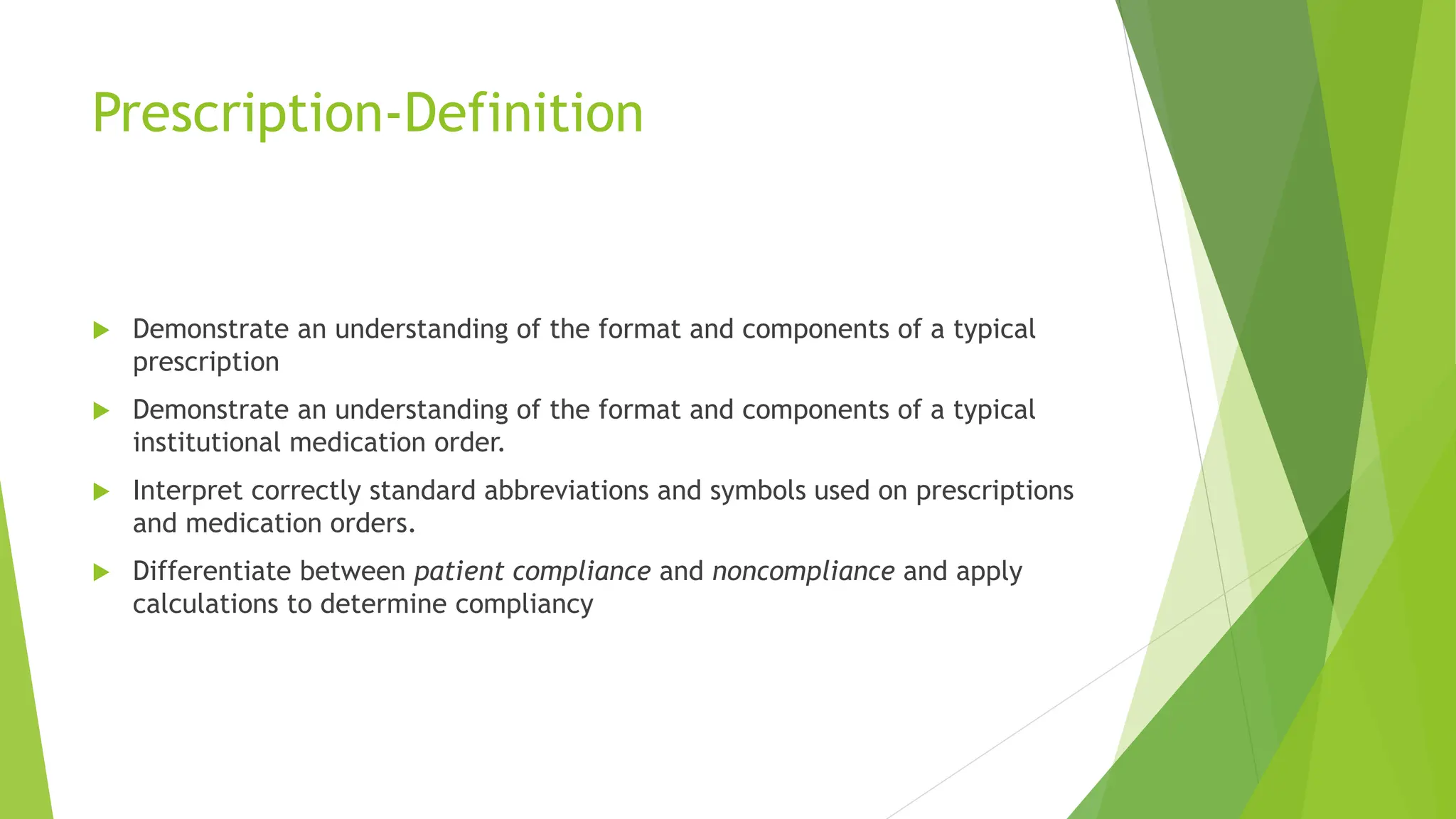
Prescription-Definition
 Demonstrate an understanding of the format and components of a typical
prescription
 Demonstrate an understanding of the format and components of a typical
institutional medication order.
 Interpret correctly standard abbreviations and symbols used on prescriptions
and medication orders.
 Differentiate between patient compliance and noncompliance and apply
calculations to determine compliancy
Prescription-Definition
 a Prescription is an order for medication issued by a physician, dentist, or
other properly licensed medical practitioner.
 A prescription designates a specific medication and dosage to be prepared by
a pharmacist and administered to a particular patient.
 A prescription is usually written on preprinted forms containing the traditional
symbol (meaning ‘‘recipe,’’ ‘‘take thou,’’ or ‘‘you take’’), name, address,
telephone number, and other pertinent information regarding the physician or
other prescriber
Example of A Prescription
Components of a Prescription
 Parts labeled are as follows:
 (1) Prescriber information and signature
 (2) Patient information
 (3) Date prescription was written
 (4) symbol (the Superscription), meaning ‘‘take thou,’’
 ‘‘you take,’’ or ‘‘recipe’’
 (5) Medication prescribed (the Inscription)
 (6) Dispensing instructions to the pharmacist (the Subscription)
 (7) Directions to the patient (the Signa)
 (8) Special instructions. It is important to note that for any Medicaid or Medicare prescription
and according to individual state laws, a handwritten language by the prescriber, such as
‘‘Brand necessary,’’ may be required to disallow generic substitution.
Prescription and Medication order
Accuracy
 It is the responsibility of the pharmacist to ensure that each prescription and
medication order received is correct in its form and content;
 is appropriate for the patient being treated;
 and is subsequently filled, labeled, dispensed, and administered accurately.
 In essence, each medication should be: therapeutically appropriate for the
patient; prescribed at the correct dose; •
 dispensed in the correct strength and dosage form; •
 correctly labeled with complete instructions for the patient or caregiver; and
for the patient in a hospital or other health care facility, each medication
must be administered
 to the correct patient, at the correct time, and by the correct rate and route
of administration.
Errors and Omissions
 To ensure such accuracy, the pharmacist is obliged to review each
prescription and medication order in a step-by-step manner to detect errors
of omission and commission.
 This is termed a search for errors and omissions.
 A review of the completeness and correctness of a prescription or medication
order is an important initial step in the process of ensuring accuracy.
 It is important to note that other subsequent and related parameters to
ensure the accuracy of medication use—such as the application of
pharmacotherapeutics, medication therapy management (MTM), and the legal
and regulatory aspects of drugs and prescribing authority are essential to
pharmacy practice and patient care.
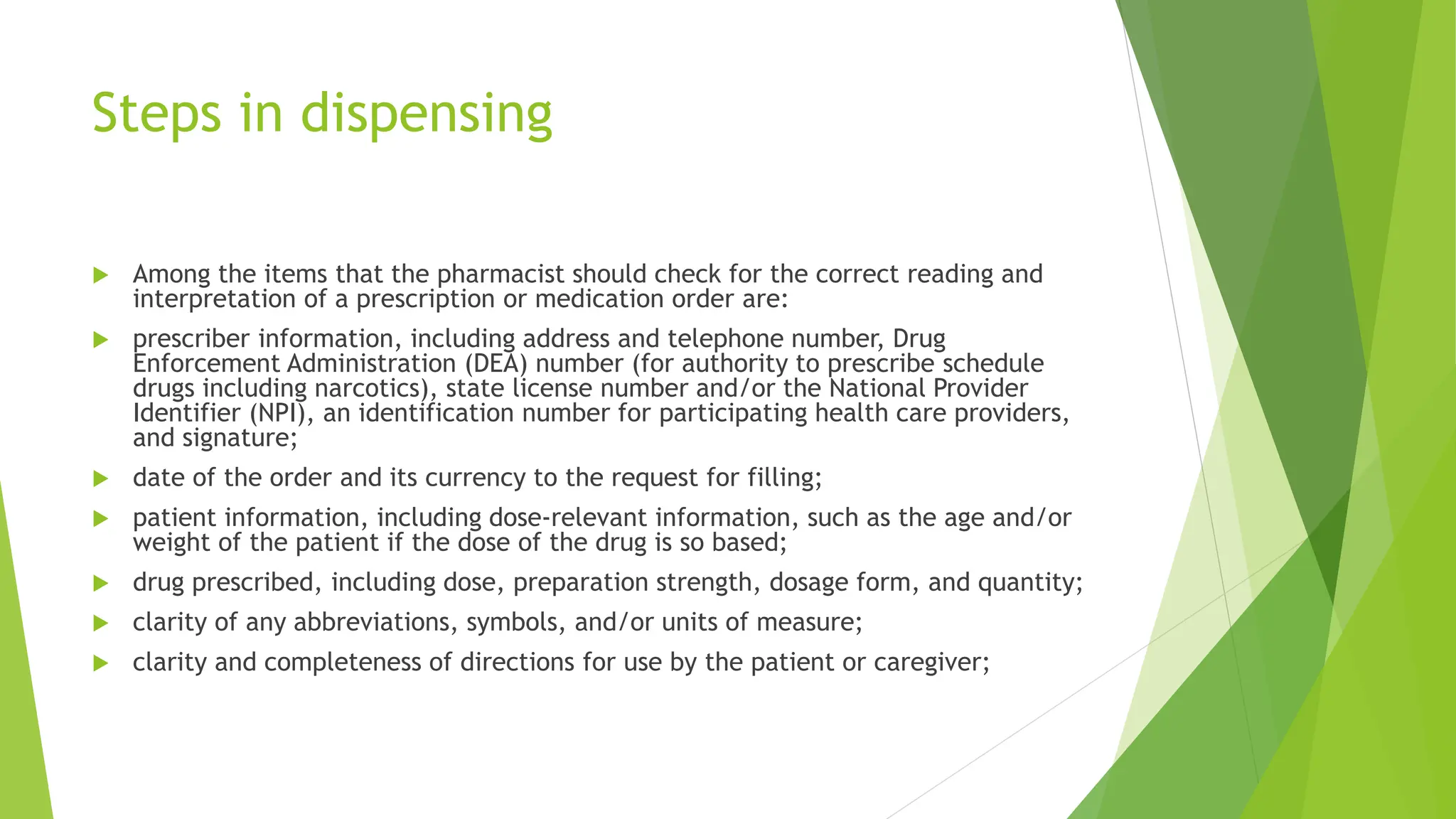
Steps in dispensing
 Among the items that the pharmacist should check for the correct reading and
interpretation of a prescription or medication order are:
 prescriber information, including address and telephone number, Drug
Enforcement Administration (DEA) number (for authority to prescribe schedule
drugs including narcotics), state license number and/or the National Provider
Identifier (NPI), an identification number for participating health care providers,
and signature;
 date of the order and its currency to the request for filling;
 patient information, including dose-relevant information, such as the age and/or
weight of the patient if the dose of the drug is so based;
 drug prescribed, including dose, preparation strength, dosage form, and quantity;
 clarity of any abbreviations, symbols, and/or units of measure;
 clarity and completeness of directions for use by the patient or caregiver;
Steps in dispensing process
 refill and/or generic substitution authorization;•
 need for special labeling, such as expiration date, conditions for storage, and
foods and/or other medications not to take concomitantly; and
 a listing of the ingredients and quantities for orders to be compounded;
calculations performed
 should be checked and double-checked, as should the positive identification
of all ingredients
 used along with their measurements.
Authentication of the Prescription
 Once the prescription or medication order is filled and the label prepared, before dispensing, the
pharmacist should make certain of the following:
 The filled prescription or medication order contains the correct drug, strength, dosage form, and quantity.
Placing a medication’s indication (use) on the prescription label has been shown to be of benefit in
understanding of the use of their medication for some patients, particularly older patients and those taking
multiple medications.
 The bar-coding of pharmaceutical products used in hospital settings is required by the federal Food and
Drug Administration (FDA) as an added protection to ensure accurate product dispensing and administration
 The pharmacy-imprinted serial number on the label matches that on the order.
 The label has the name of the correct patient and physician; the correct drug name, quantity, and strength;
the name or initials of the pharmacist who filled the order; and the number of refills remaining.
 Additional label information and/or auxiliary labels may be required according to good pharmacy practice
and by federal and state law depending on the drug dispensed.
 A repeat comparison should be made of the drug and drug strength called for on the prescription against
the labeling of the product used to fill the prescription to assure that the proper drug was used.
Prescription Abbreviations
 The use of abbreviations is common on prescriptions and medication orders.
Some are derived from the Latin through its historical use in medicine and
pharmacy, whereas others have evolved through prescribers’ use of writing
shortcuts.
Most Common abbreviations
Abbreviations
(latin Origin)
Meaning Abbreviation Meaning
applic. apply
a.c. before food aq. or aqua water
a.m. before noon aur. ear
aa. of each aurist. ear drops
ad lib. as much as desired b. twice
alt. alternate b.d. twice daily
alt. die. alternate days b.i.d. twice daily
amp ampoule b. twice
ante before b.d. twice daily
Prescription Abbreviations
Abbreviation Meaning Abbreviation Meaning
c. with d. a day
calid. warm dest. distilled
cap. capsule dil. diluted
cib. food div. divide
co. compound dol.urg
when the pain is
severe
collut. mouthwash dolent.part.
to the afflicted
part
collyr. eye lotion dos. dose
conc. concentrated ex aq. in water
crem. cream ext. extract
Prescription Abbreviations
ex aq. in water garg. gargle
ext. extract gtt. or guttae drops
extemp.
extemporaneously
dispensed
i.c. between meals
h. at the hour of IM intramuscular
h.s. at bedtime inf infusion
m. or mane in the morning inj injection
m.d. as directed IV intravenous
m.d.u.
to be used as
directed
n. or nocte at night
MDI
metered dose
inhaler
n.et m. night and morning
Prescription Abbreviation
q.d. four times daily t.d.d. three times daily
q.d.s.
to be taken four
times daily
t.d.s.
to be taken three
times daily
q.i.d. four times daily t.i.d. three times daily
q.q.h. every fourth hour tinct. tincture
q.s. sufficient trit. or triturate
serial dilution or
mixing ingredients
q12h every 12 hours WSP white soft paraffin
q4h every 4 hours YSP
yellow soft
paraffin
q6h every 6 hours
qq. every

3rd Year Prescription lecture.pptx for pharmacy student

  • 1.
    The Prescription 3rd YearPharmacy Practice
  • 2.
    Prescription-Definition  Demonstrate anunderstanding of the format and components of a typical prescription  Demonstrate an understanding of the format and components of a typical institutional medication order.  Interpret correctly standard abbreviations and symbols used on prescriptions and medication orders.  Differentiate between patient compliance and noncompliance and apply calculations to determine compliancy
  • 3.
    Prescription-Definition  a Prescriptionis an order for medication issued by a physician, dentist, or other properly licensed medical practitioner.  A prescription designates a specific medication and dosage to be prepared by a pharmacist and administered to a particular patient.  A prescription is usually written on preprinted forms containing the traditional symbol (meaning ‘‘recipe,’’ ‘‘take thou,’’ or ‘‘you take’’), name, address, telephone number, and other pertinent information regarding the physician or other prescriber
  • 4.
    Example of APrescription
  • 5.
    Components of aPrescription  Parts labeled are as follows:  (1) Prescriber information and signature  (2) Patient information  (3) Date prescription was written  (4) symbol (the Superscription), meaning ‘‘take thou,’’  ‘‘you take,’’ or ‘‘recipe’’  (5) Medication prescribed (the Inscription)  (6) Dispensing instructions to the pharmacist (the Subscription)  (7) Directions to the patient (the Signa)  (8) Special instructions. It is important to note that for any Medicaid or Medicare prescription and according to individual state laws, a handwritten language by the prescriber, such as ‘‘Brand necessary,’’ may be required to disallow generic substitution.
  • 6.
    Prescription and Medicationorder Accuracy  It is the responsibility of the pharmacist to ensure that each prescription and medication order received is correct in its form and content;  is appropriate for the patient being treated;  and is subsequently filled, labeled, dispensed, and administered accurately.  In essence, each medication should be: therapeutically appropriate for the patient; prescribed at the correct dose; •  dispensed in the correct strength and dosage form; •  correctly labeled with complete instructions for the patient or caregiver; and for the patient in a hospital or other health care facility, each medication must be administered  to the correct patient, at the correct time, and by the correct rate and route of administration.
  • 7.
    Errors and Omissions To ensure such accuracy, the pharmacist is obliged to review each prescription and medication order in a step-by-step manner to detect errors of omission and commission.  This is termed a search for errors and omissions.  A review of the completeness and correctness of a prescription or medication order is an important initial step in the process of ensuring accuracy.  It is important to note that other subsequent and related parameters to ensure the accuracy of medication use—such as the application of pharmacotherapeutics, medication therapy management (MTM), and the legal and regulatory aspects of drugs and prescribing authority are essential to pharmacy practice and patient care.
  • 8.
    Steps in dispensing Among the items that the pharmacist should check for the correct reading and interpretation of a prescription or medication order are:  prescriber information, including address and telephone number, Drug Enforcement Administration (DEA) number (for authority to prescribe schedule drugs including narcotics), state license number and/or the National Provider Identifier (NPI), an identification number for participating health care providers, and signature;  date of the order and its currency to the request for filling;  patient information, including dose-relevant information, such as the age and/or weight of the patient if the dose of the drug is so based;  drug prescribed, including dose, preparation strength, dosage form, and quantity;  clarity of any abbreviations, symbols, and/or units of measure;  clarity and completeness of directions for use by the patient or caregiver;
  • 9.
    Steps in dispensingprocess  refill and/or generic substitution authorization;•  need for special labeling, such as expiration date, conditions for storage, and foods and/or other medications not to take concomitantly; and  a listing of the ingredients and quantities for orders to be compounded; calculations performed  should be checked and double-checked, as should the positive identification of all ingredients  used along with their measurements.
  • 10.
    Authentication of thePrescription  Once the prescription or medication order is filled and the label prepared, before dispensing, the pharmacist should make certain of the following:  The filled prescription or medication order contains the correct drug, strength, dosage form, and quantity. Placing a medication’s indication (use) on the prescription label has been shown to be of benefit in understanding of the use of their medication for some patients, particularly older patients and those taking multiple medications.  The bar-coding of pharmaceutical products used in hospital settings is required by the federal Food and Drug Administration (FDA) as an added protection to ensure accurate product dispensing and administration  The pharmacy-imprinted serial number on the label matches that on the order.  The label has the name of the correct patient and physician; the correct drug name, quantity, and strength; the name or initials of the pharmacist who filled the order; and the number of refills remaining.  Additional label information and/or auxiliary labels may be required according to good pharmacy practice and by federal and state law depending on the drug dispensed.  A repeat comparison should be made of the drug and drug strength called for on the prescription against the labeling of the product used to fill the prescription to assure that the proper drug was used.
  • 11.
    Prescription Abbreviations  Theuse of abbreviations is common on prescriptions and medication orders. Some are derived from the Latin through its historical use in medicine and pharmacy, whereas others have evolved through prescribers’ use of writing shortcuts.
  • 12.
    Most Common abbreviations Abbreviations (latinOrigin) Meaning Abbreviation Meaning applic. apply a.c. before food aq. or aqua water a.m. before noon aur. ear aa. of each aurist. ear drops ad lib. as much as desired b. twice alt. alternate b.d. twice daily alt. die. alternate days b.i.d. twice daily amp ampoule b. twice ante before b.d. twice daily
  • 13.
    Prescription Abbreviations Abbreviation MeaningAbbreviation Meaning c. with d. a day calid. warm dest. distilled cap. capsule dil. diluted cib. food div. divide co. compound dol.urg when the pain is severe collut. mouthwash dolent.part. to the afflicted part collyr. eye lotion dos. dose conc. concentrated ex aq. in water crem. cream ext. extract
  • 14.
    Prescription Abbreviations ex aq.in water garg. gargle ext. extract gtt. or guttae drops extemp. extemporaneously dispensed i.c. between meals h. at the hour of IM intramuscular h.s. at bedtime inf infusion m. or mane in the morning inj injection m.d. as directed IV intravenous m.d.u. to be used as directed n. or nocte at night MDI metered dose inhaler n.et m. night and morning
  • 15.
    Prescription Abbreviation q.d. fourtimes daily t.d.d. three times daily q.d.s. to be taken four times daily t.d.s. to be taken three times daily q.i.d. four times daily t.i.d. three times daily q.q.h. every fourth hour tinct. tincture q.s. sufficient trit. or triturate serial dilution or mixing ingredients q12h every 12 hours WSP white soft paraffin q4h every 4 hours YSP yellow soft paraffin q6h every 6 hours qq. every