ElectronConfiguration
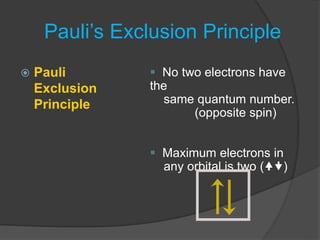
Pauli’s Exclusion Principle
 Pauli
Exclusion
Principle
 No two electrons have
the
same quantum number.
(opposite spin)
 Maximum electrons in
any orbital is two ()
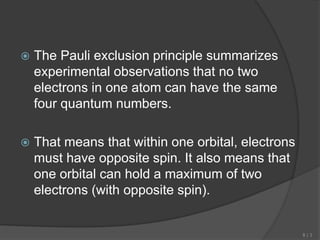
 The Pauli exclusion principle summarizes
experimental observations that no two
electrons in one atom can have the same
four quantum numbers.
 That means that within one orbital, electrons
must have opposite spin. It also means that
one orbital can hold a maximum of two
electrons (with opposite spin).
8 | 3
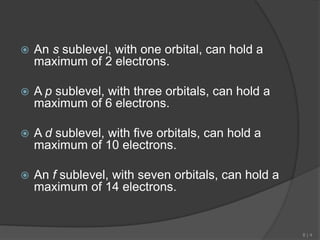
 An s sublevel, with one orbital, can hold a
maximum of 2 electrons.
 A p sublevel, with three orbitals, can hold a
maximum of 6 electrons.
 A d sublevel, with five orbitals, can hold a
maximum of 10 electrons.
 An f sublevel, with seven orbitals, can hold a
maximum of 14 electrons.
8 | 4
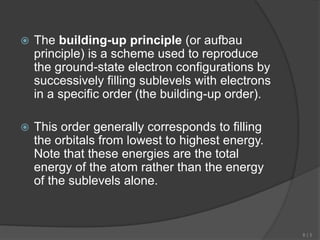
 The building-up principle (or aufbau
principle) is a scheme used to reproduce
the ground-state electron configurations by
successively filling sublevels with electrons
in a specific order (the building-up order).
 This order generally corresponds to filling
the orbitals from lowest to highest energy.
Note that these energies are the total
energy of the atom rather than the energy
of the sublevels alone.
8 | 5
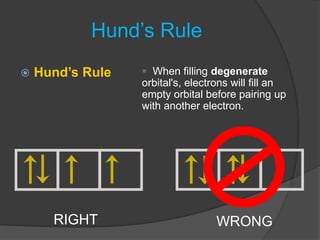
Hund’s Rule
 Hund’s Rule  When filling degenerate
orbital's, electrons will fill an
empty orbital before pairing up
with another electron.
RIGHT WRONG
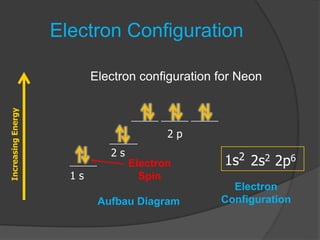
Electron Configuration
______ ______ ______
______
______
Aufbau Diagram
IncreasingEnergy
Electron
Spin
2p61s2 2s2
Electron
Configuration
Electron configuration for Neon
2 p
2 s
1 s
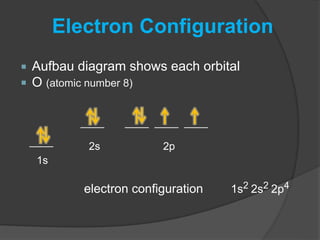
Electron Configuration
 Aufbau diagram shows each orbital
 O (atomic number 8)
____ ____ ____ ____
____ 2s 2p
1s
electron configuration 1s2 2s2 2p4
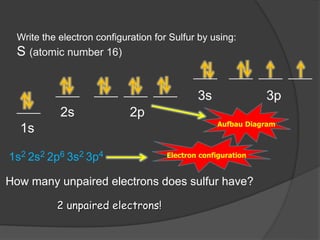
Write the electron configuration for Sulfur by using:
S (atomic number 16)
____ ____ ____ ____
____ ____ ____ ____ 3s 3p
____ 2s 2p
1s
1s2 2s2 2p6 3s2 3p4
How many unpaired electrons does sulfur have?
2 unpaired electrons!
Aufbau Diagram
Electron configuration
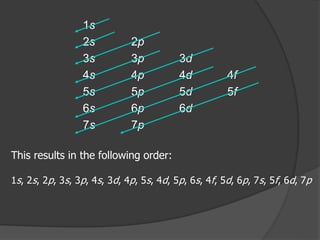
1s
2s 2p
3s 3p 3d
4s 4p 4d 4f
5s 5p 5d 5f
6s 6p 6d
7s 7p
This results in the following order:
1s, 2s, 2p, 3s, 3p, 4s, 3d, 4p, 5s, 4d, 5p, 6s, 4f, 5d, 6p, 7s, 5f, 6d, 7p
Electron Configuration
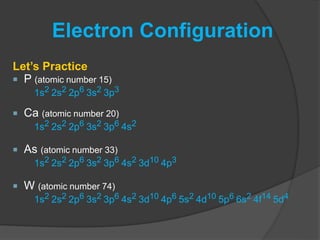
Let’s Practice
 P (atomic number 15)
1s2 2s2 2p6 3s2 3p3
 Ca (atomic number 20)
1s2 2s2 2p6 3s2 3p6 4s2
 As (atomic number 33)
1s2 2s2 2p6 3s2 3p6 4s2 3d10 4p3
 W (atomic number 74)
1s2 2s2 2p6 3s2 3p6 4s2 3d10 4p6 5s2 4d10 5p6 6s2 4f14 5d4
Electron Configuration
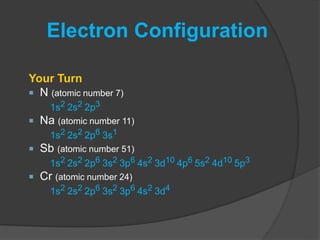
Your Turn
 N (atomic number 7)
1s2 2s2 2p3
 Na (atomic number 11)
1s2 2s2 2p6 3s1
 Sb (atomic number 51)
1s2 2s2 2p6 3s2 3p6 4s2 3d10 4p6 5s2 4d10 5p3
 Cr (atomic number 24)
1s2 2s2 2p6 3s2 3p6 4s2 3d4
 The lowest-energy configuration of an
atom is called its ground state.
 Any other configuration represents an
excited state.
8 | 13
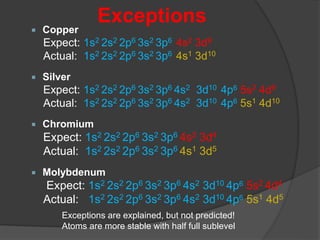
Exceptions
 Copper
Expect: 1s2 2s2 2p6 3s2 3p6 4s2 3d9
Actual: 1s2 2s2 2p6 3s2 3p6 4s1 3d10
 Silver
Expect: 1s2 2s2 2p6 3s2 3p6 4s2 3d10 4p6 5s2 4d9
Actual: 1s2 2s2 2p6 3s2 3p6 4s2 3d10 4p6 5s1 4d10
 Chromium
Expect: 1s2 2s2 2p6 3s2 3p6 4s2 3d4
Actual: 1s2 2s2 2p6 3s2 3p6 4s1 3d5
 Molybdenum
Expect: 1s2 2s2 2p6 3s2 3p6 4s2 3d10 4p6 5s2 4d4
Actual: 1s2 2s2 2p6 3s2 3p6 4s2 3d10 4p6 5s1 4d5
Exceptions are explained, but not predicted!
Atoms are more stable with half full sublevel
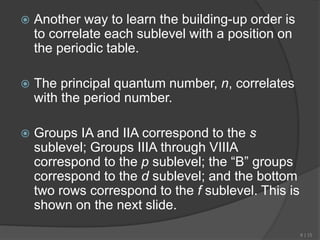
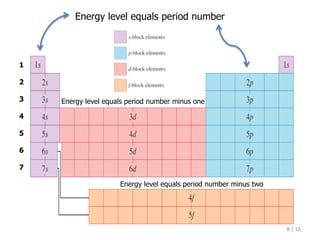
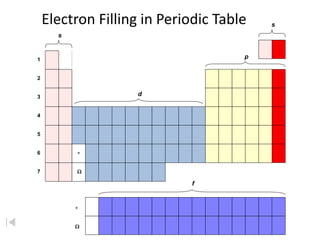
 Another way to learn the building-up order is
to correlate each sublevel with a position on
the periodic table.
 The principal quantum number, n, correlates
with the period number.
 Groups IA and IIA correspond to the s
sublevel; Groups IIIA through VIIIA
correspond to the p sublevel; the “B” groups
correspond to the d sublevel; and the bottom
two rows correspond to the f sublevel. This is
shown on the next slide.
8 | 15
8 | 16
Energy level equals period number
Energy level equals period number minus one
Energy level equals period number minus two
1
2
3
4
5
6
7
Electron Filling in Periodic Table
1
2
3
4
5
6
7
s
d
p
s
f
*
W
W
*
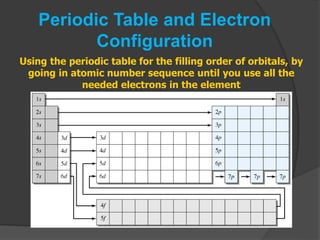
Periodic Table and Electron
Configuration
Using the periodic table for the filling order of orbitals, by
going in atomic number sequence until you use all the
needed electrons in the element

Chapter 5, extra notes

  • 1.
  • 2.
    Pauli’s Exclusion Principle Pauli Exclusion Principle  No two electrons have the same quantum number. (opposite spin)  Maximum electrons in any orbital is two ()
  • 3.
     The Pauliexclusion principle summarizes experimental observations that no two electrons in one atom can have the same four quantum numbers.  That means that within one orbital, electrons must have opposite spin. It also means that one orbital can hold a maximum of two electrons (with opposite spin). 8 | 3
  • 4.
     An ssublevel, with one orbital, can hold a maximum of 2 electrons.  A p sublevel, with three orbitals, can hold a maximum of 6 electrons.  A d sublevel, with five orbitals, can hold a maximum of 10 electrons.  An f sublevel, with seven orbitals, can hold a maximum of 14 electrons. 8 | 4
  • 5.
     The building-upprinciple (or aufbau principle) is a scheme used to reproduce the ground-state electron configurations by successively filling sublevels with electrons in a specific order (the building-up order).  This order generally corresponds to filling the orbitals from lowest to highest energy. Note that these energies are the total energy of the atom rather than the energy of the sublevels alone. 8 | 5
  • 6.
    Hund’s Rule  Hund’sRule  When filling degenerate orbital's, electrons will fill an empty orbital before pairing up with another electron. RIGHT WRONG
  • 7.
    Electron Configuration ______ ____________ ______ ______ Aufbau Diagram IncreasingEnergy Electron Spin 2p61s2 2s2 Electron Configuration Electron configuration for Neon 2 p 2 s 1 s
  • 8.
    Electron Configuration  Aufbaudiagram shows each orbital  O (atomic number 8) ____ ____ ____ ____ ____ 2s 2p 1s electron configuration 1s2 2s2 2p4
  • 9.
    Write the electronconfiguration for Sulfur by using: S (atomic number 16) ____ ____ ____ ____ ____ ____ ____ ____ 3s 3p ____ 2s 2p 1s 1s2 2s2 2p6 3s2 3p4 How many unpaired electrons does sulfur have? 2 unpaired electrons! Aufbau Diagram Electron configuration
  • 10.
    1s 2s 2p 3s 3p3d 4s 4p 4d 4f 5s 5p 5d 5f 6s 6p 6d 7s 7p This results in the following order: 1s, 2s, 2p, 3s, 3p, 4s, 3d, 4p, 5s, 4d, 5p, 6s, 4f, 5d, 6p, 7s, 5f, 6d, 7p
  • 11.
    Electron Configuration Let’s Practice P (atomic number 15) 1s2 2s2 2p6 3s2 3p3  Ca (atomic number 20) 1s2 2s2 2p6 3s2 3p6 4s2  As (atomic number 33) 1s2 2s2 2p6 3s2 3p6 4s2 3d10 4p3  W (atomic number 74) 1s2 2s2 2p6 3s2 3p6 4s2 3d10 4p6 5s2 4d10 5p6 6s2 4f14 5d4
  • 12.
    Electron Configuration Your Turn N (atomic number 7) 1s2 2s2 2p3  Na (atomic number 11) 1s2 2s2 2p6 3s1  Sb (atomic number 51) 1s2 2s2 2p6 3s2 3p6 4s2 3d10 4p6 5s2 4d10 5p3  Cr (atomic number 24) 1s2 2s2 2p6 3s2 3p6 4s2 3d4
  • 13.
     The lowest-energyconfiguration of an atom is called its ground state.  Any other configuration represents an excited state. 8 | 13
  • 14.
    Exceptions  Copper Expect: 1s22s2 2p6 3s2 3p6 4s2 3d9 Actual: 1s2 2s2 2p6 3s2 3p6 4s1 3d10  Silver Expect: 1s2 2s2 2p6 3s2 3p6 4s2 3d10 4p6 5s2 4d9 Actual: 1s2 2s2 2p6 3s2 3p6 4s2 3d10 4p6 5s1 4d10  Chromium Expect: 1s2 2s2 2p6 3s2 3p6 4s2 3d4 Actual: 1s2 2s2 2p6 3s2 3p6 4s1 3d5  Molybdenum Expect: 1s2 2s2 2p6 3s2 3p6 4s2 3d10 4p6 5s2 4d4 Actual: 1s2 2s2 2p6 3s2 3p6 4s2 3d10 4p6 5s1 4d5 Exceptions are explained, but not predicted! Atoms are more stable with half full sublevel
  • 15.
     Another wayto learn the building-up order is to correlate each sublevel with a position on the periodic table.  The principal quantum number, n, correlates with the period number.  Groups IA and IIA correspond to the s sublevel; Groups IIIA through VIIIA correspond to the p sublevel; the “B” groups correspond to the d sublevel; and the bottom two rows correspond to the f sublevel. This is shown on the next slide. 8 | 15
  • 16.
    8 | 16 Energylevel equals period number Energy level equals period number minus one Energy level equals period number minus two 1 2 3 4 5 6 7
  • 17.
    Electron Filling inPeriodic Table 1 2 3 4 5 6 7 s d p s f * W W *
  • 18.
    Periodic Table andElectron Configuration Using the periodic table for the filling order of orbitals, by going in atomic number sequence until you use all the needed electrons in the element