Electronic Structure of Atom
Part 2
The Pauli Exclusion Principle and Electron
Configurations
 The spin quantum number, ms, determines
the number of electrons that can occupy an
orbital.
 ms = ±1/2
 Electrons described as “spin up” or “spin down”.
 An electron is specified by a set of four quantum
numbers.
The Pauli Exclusion Principle and Electron
Configurations
 Pauli Exclusion Principle - no two electrons in
an atom may have the same set of four
quantum numbers.
 Two electrons can have the same values of n, l, and
ml, but different values of ms.
 Two electrons maximum per orbital.
 Two electrons occupying the same orbital are spin
paired.
Orbital Energies and Electron Configurations
 Electrons in smaller orbitals are held more
tightly and have lower energies.
 Orbital size increases as the value of n increases.
 True for hydrogen atoms, but not entirely true for
multielectron atoms.
 As nuclear charge increases, orbital size decreases.
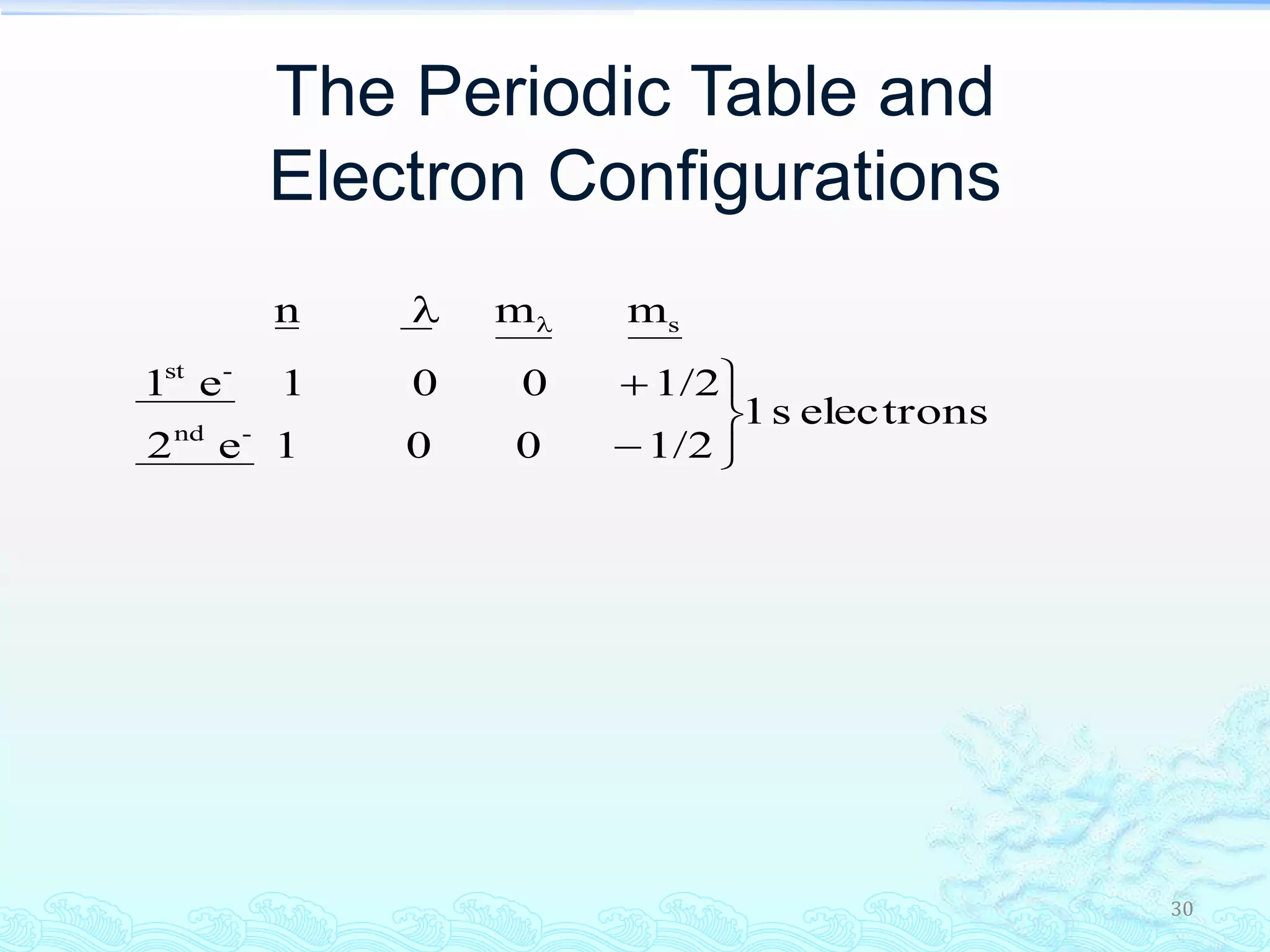
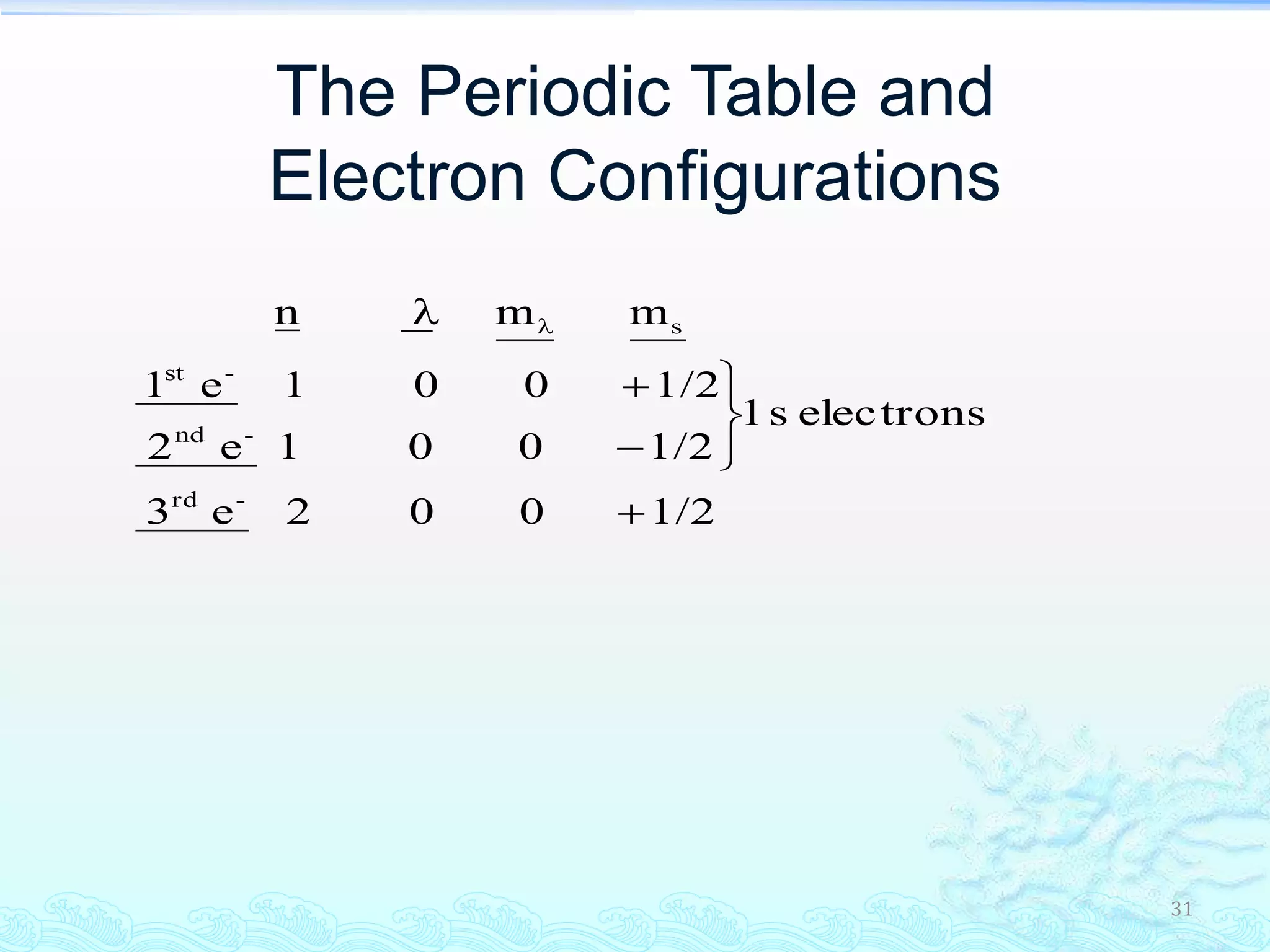
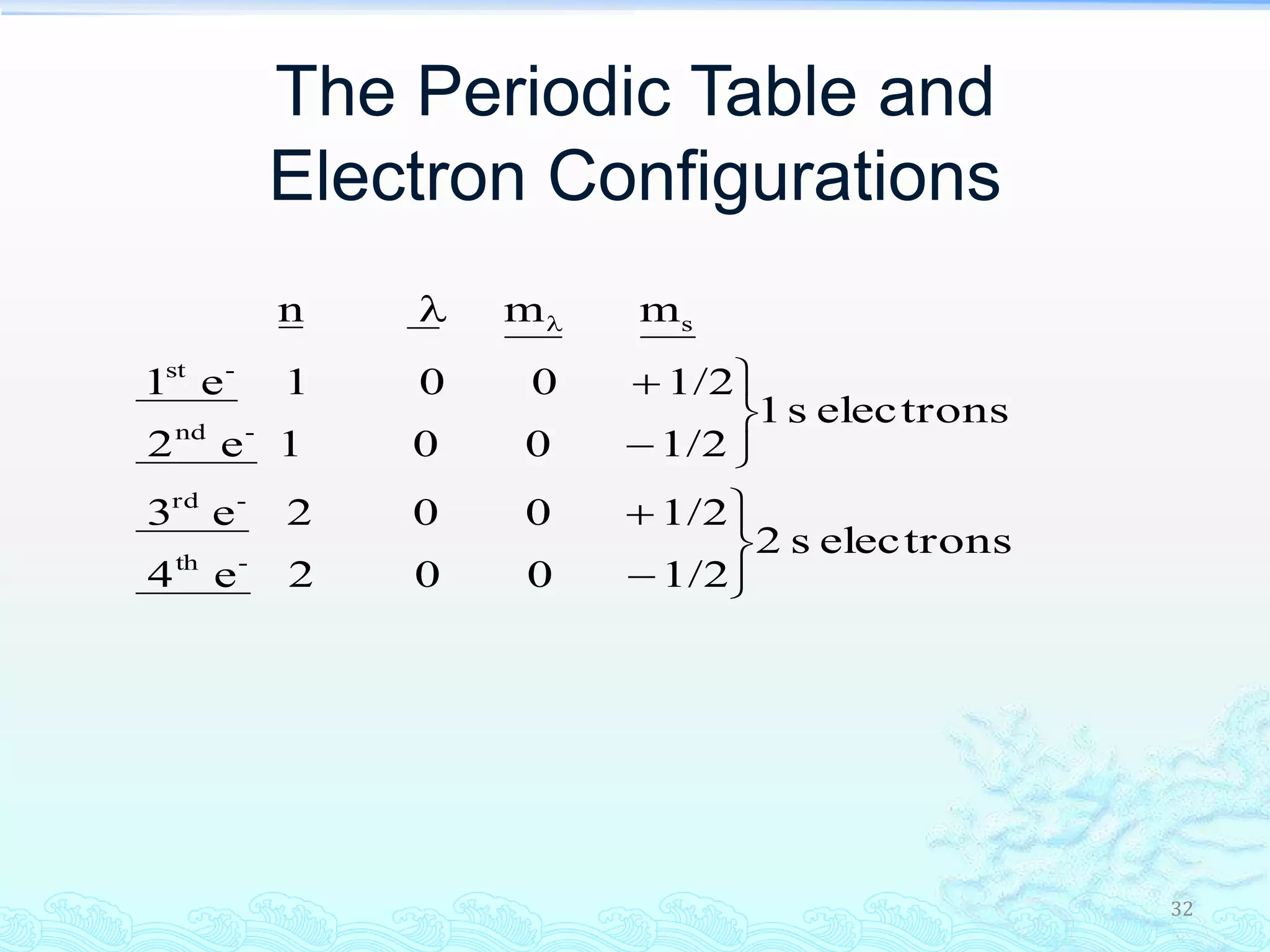
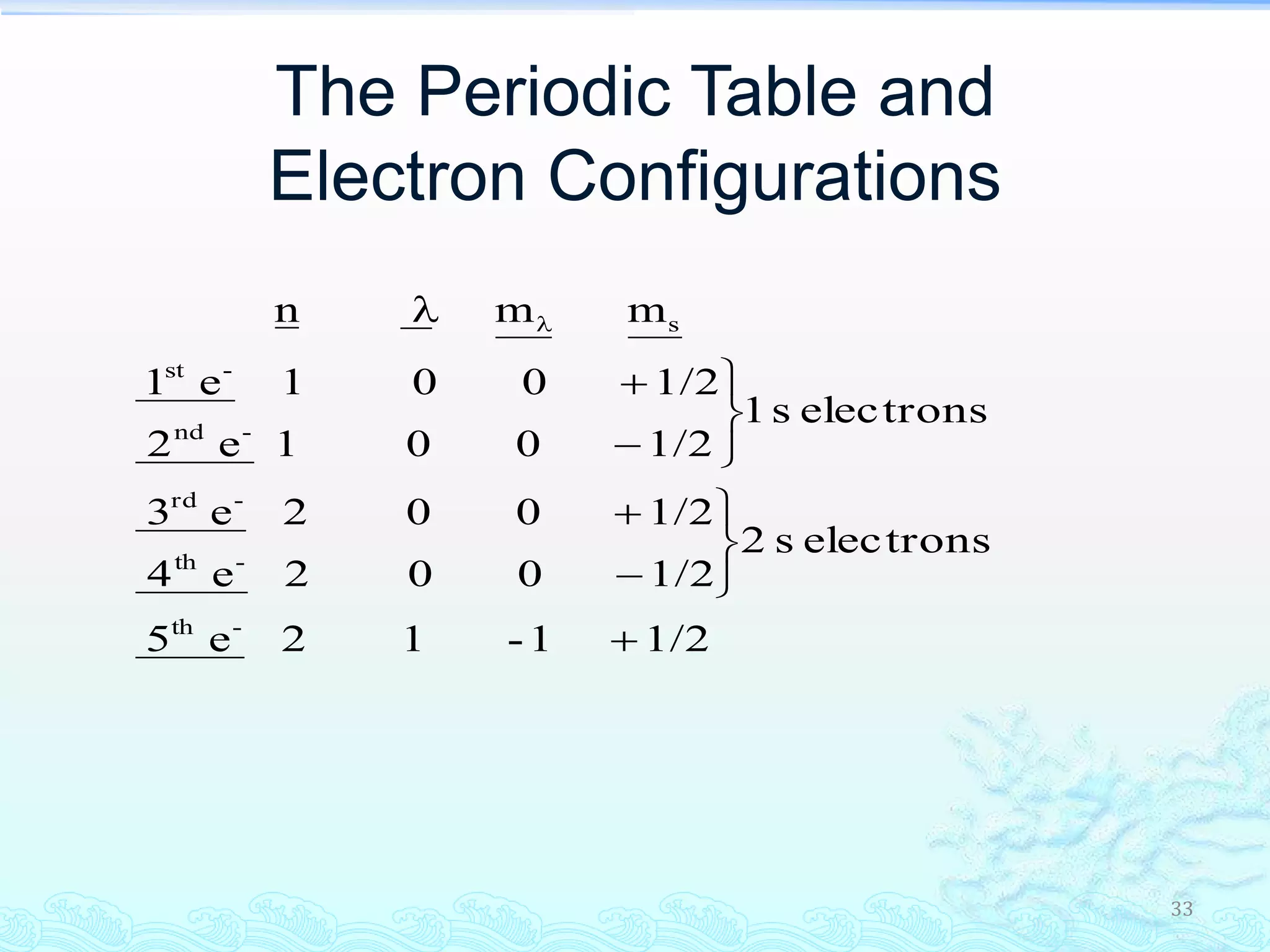
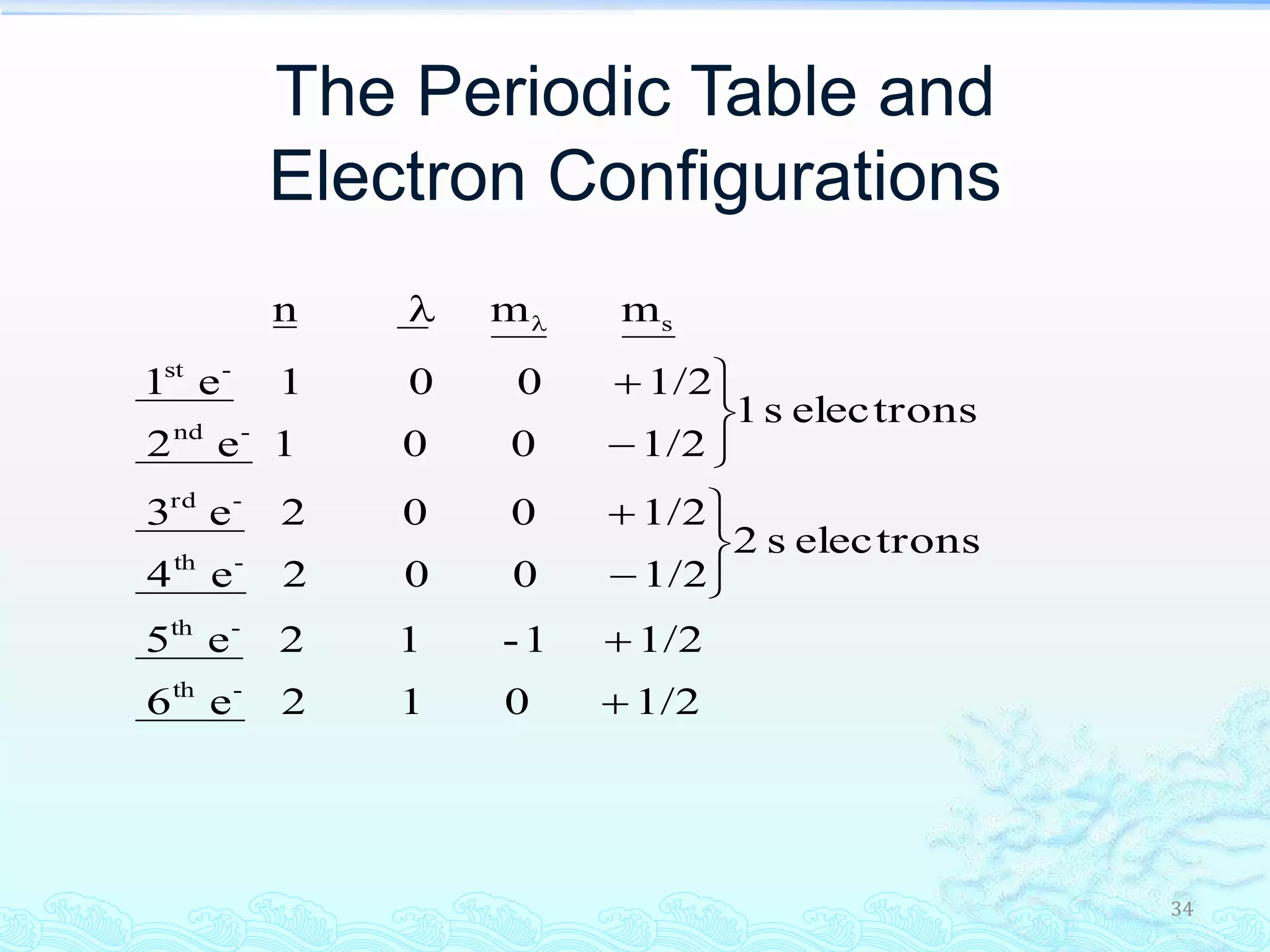
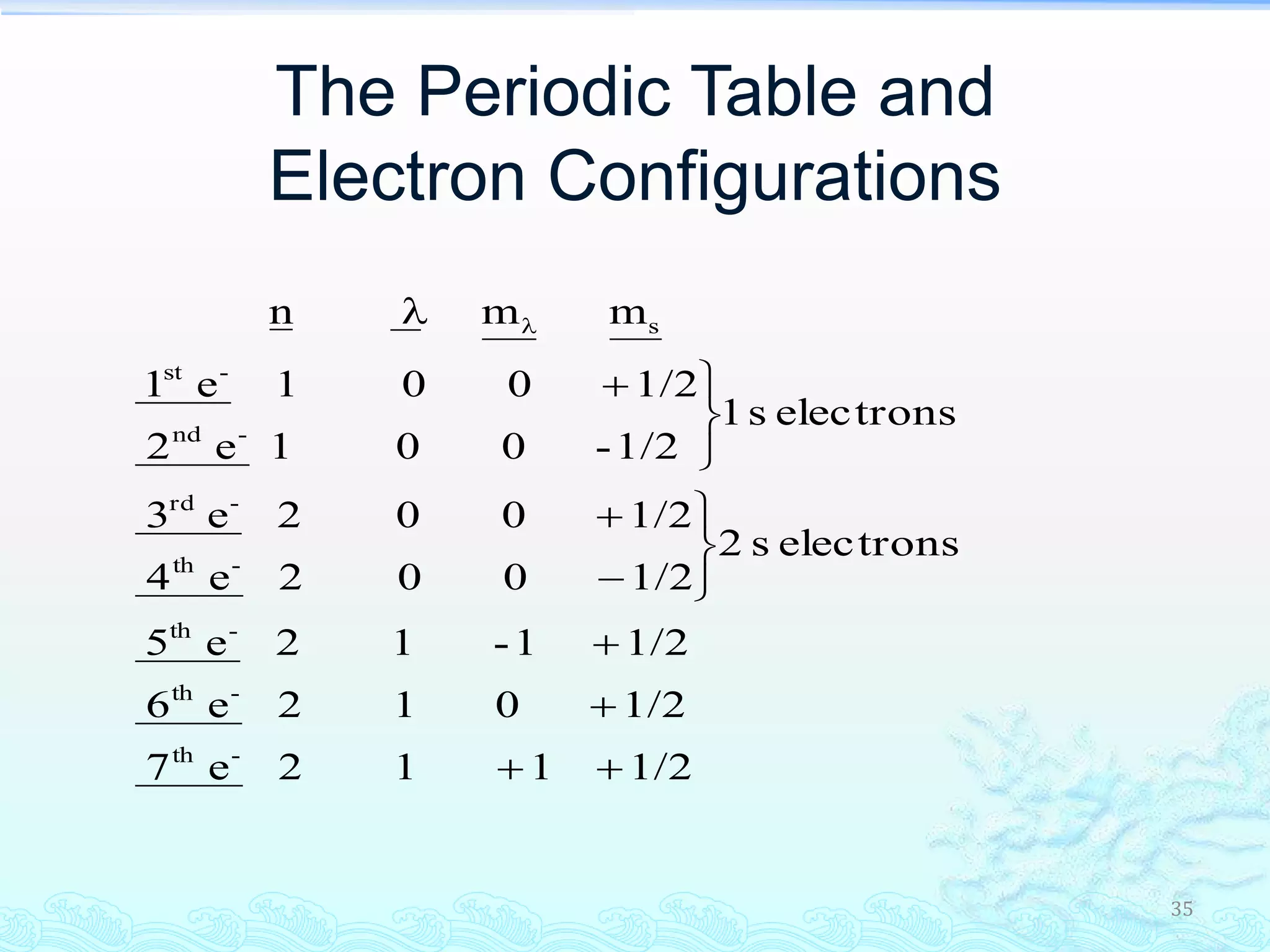
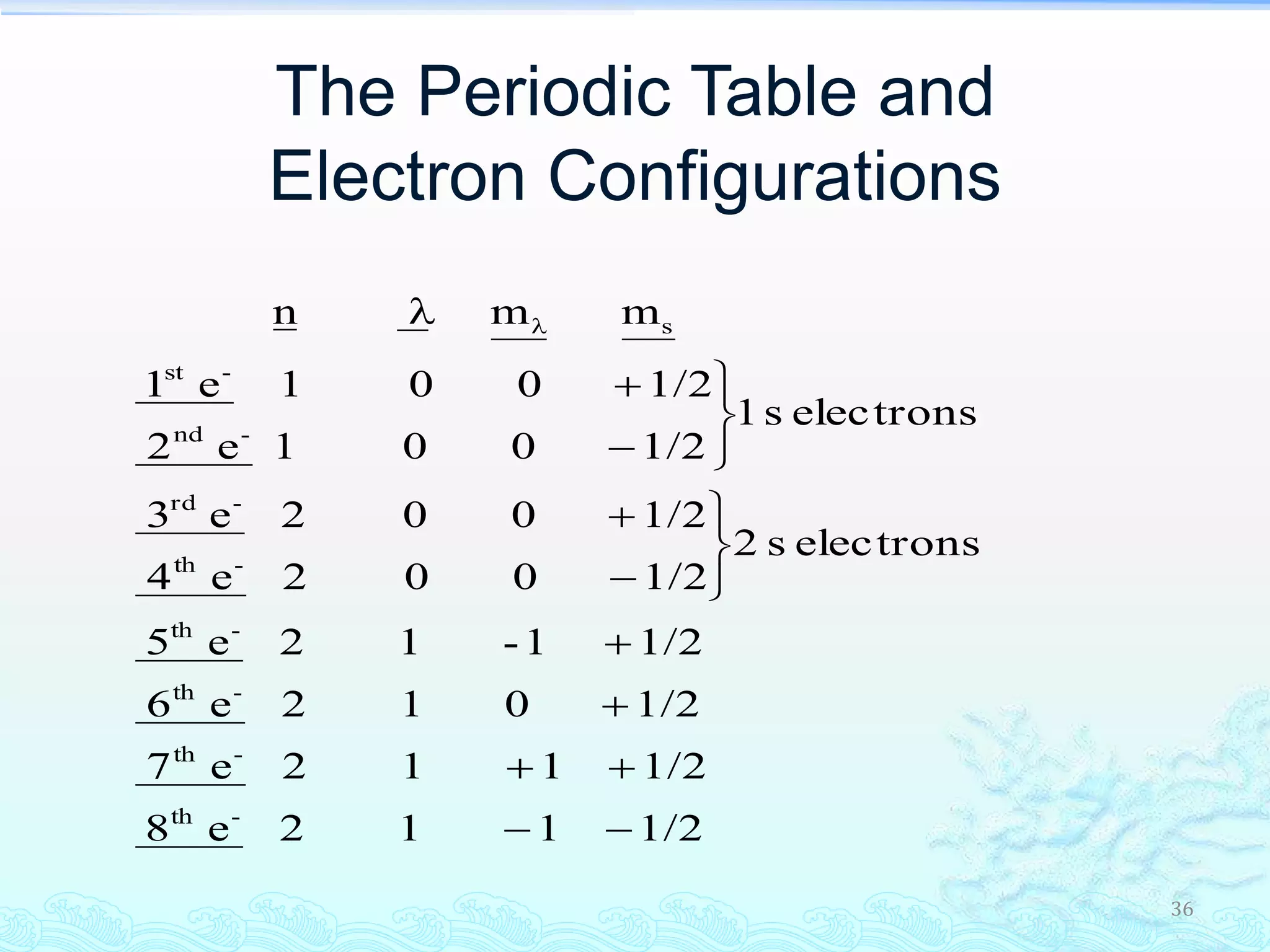
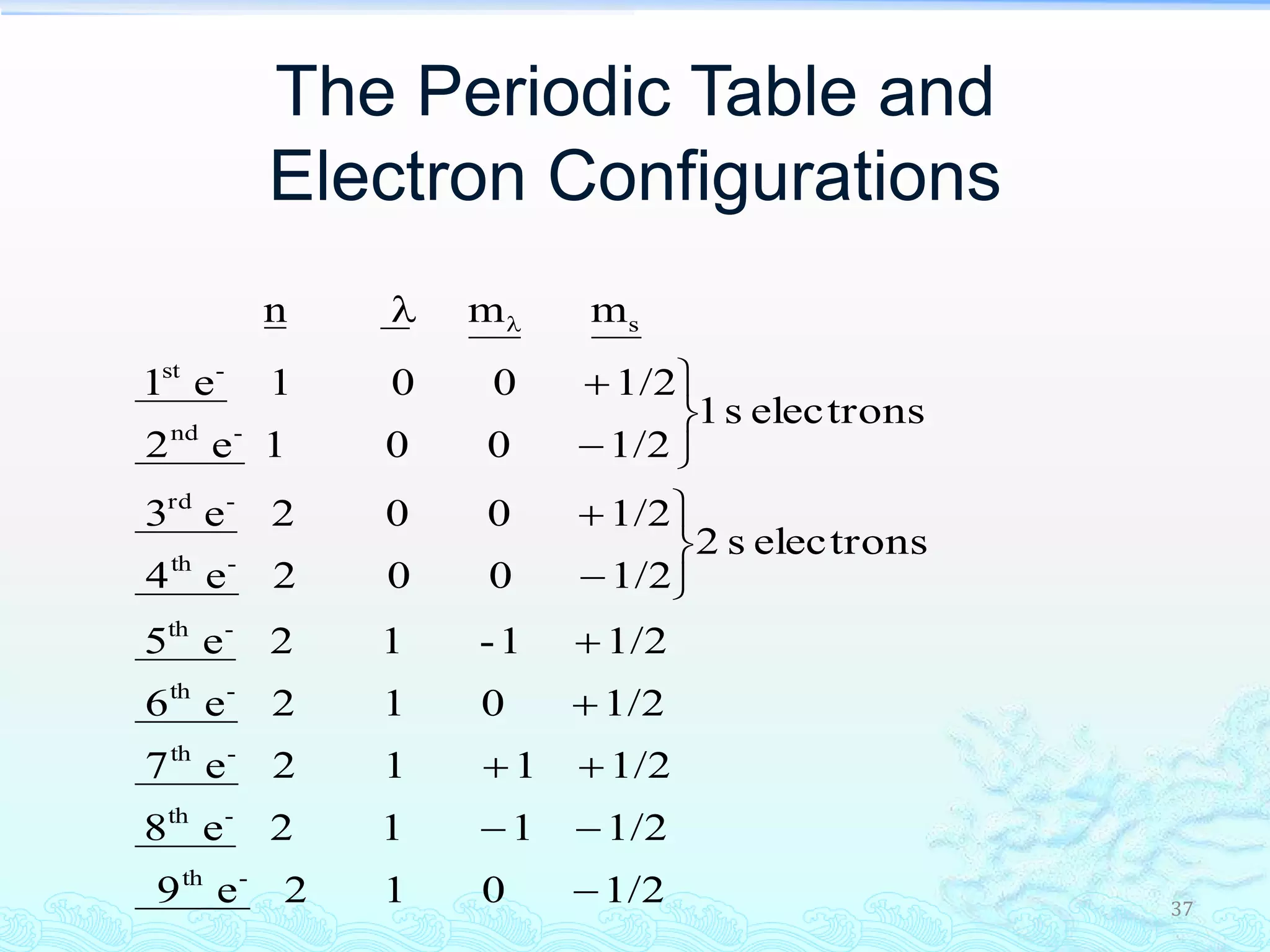
 Electrons interact with other electrons as well as the
positively charged nucleus.
Orbital Energies and Electron Configurations
 For electrons in larger orbitals, the charge
“felt” is a combination of the actual nuclear
charge and the offsetting charge of electrons
in lower orbitals.
 The masking of the nuclear charge is called
shielding.
 Shielding results in a reduced, effective nuclear
charge.
Orbital Energies and Electron Configurations
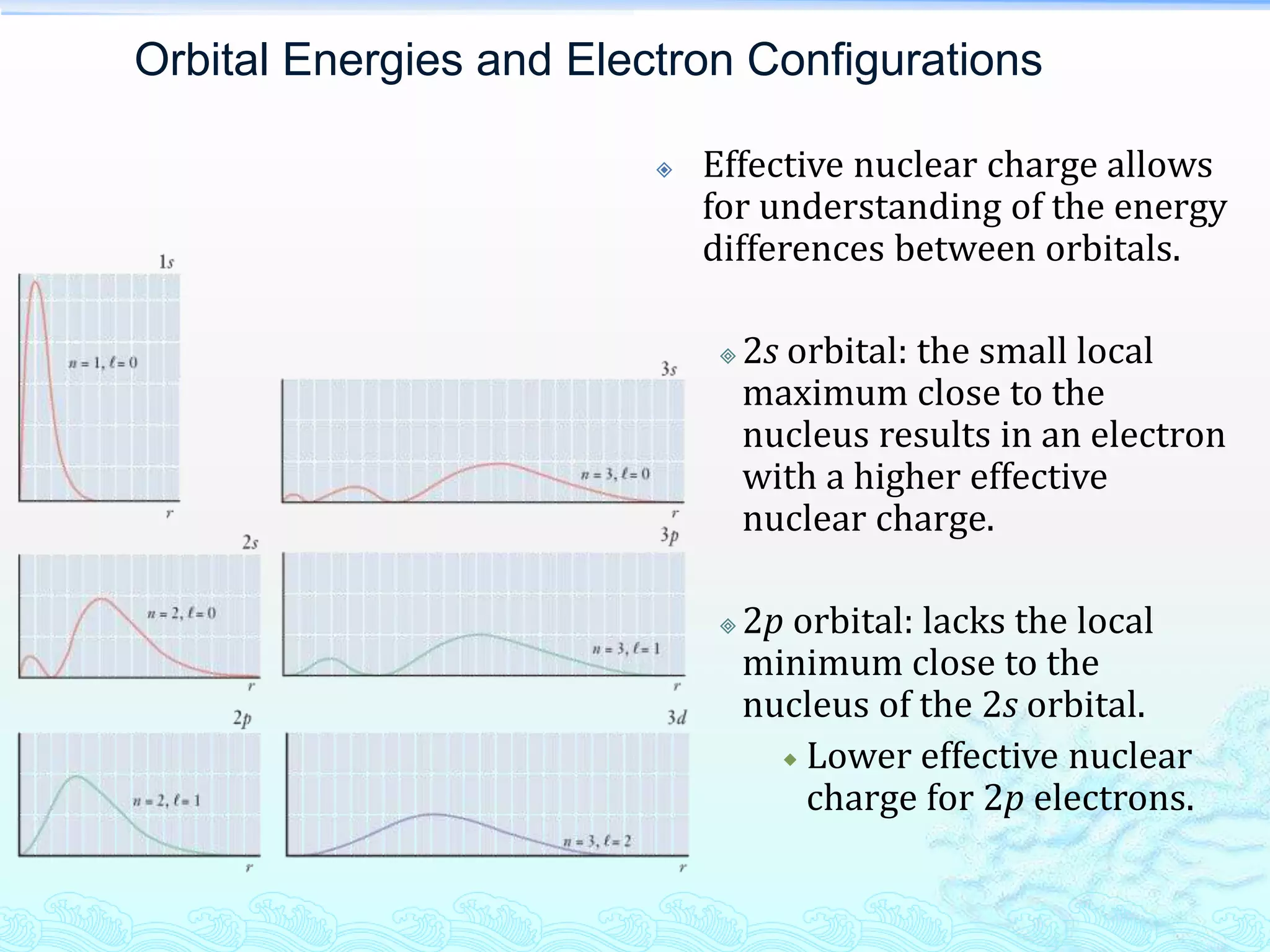
 Effective nuclear charge allows
for understanding of the energy
differences between orbitals.
 2s orbital: the small local
maximum close to the
nucleus results in an electron
with a higher effective
nuclear charge.
 2p orbital: lacks the local
minimum close to the
nucleus of the 2s orbital.
 Lower effective nuclear
charge for 2p electrons.
Orbital Energies and Electron Configurations
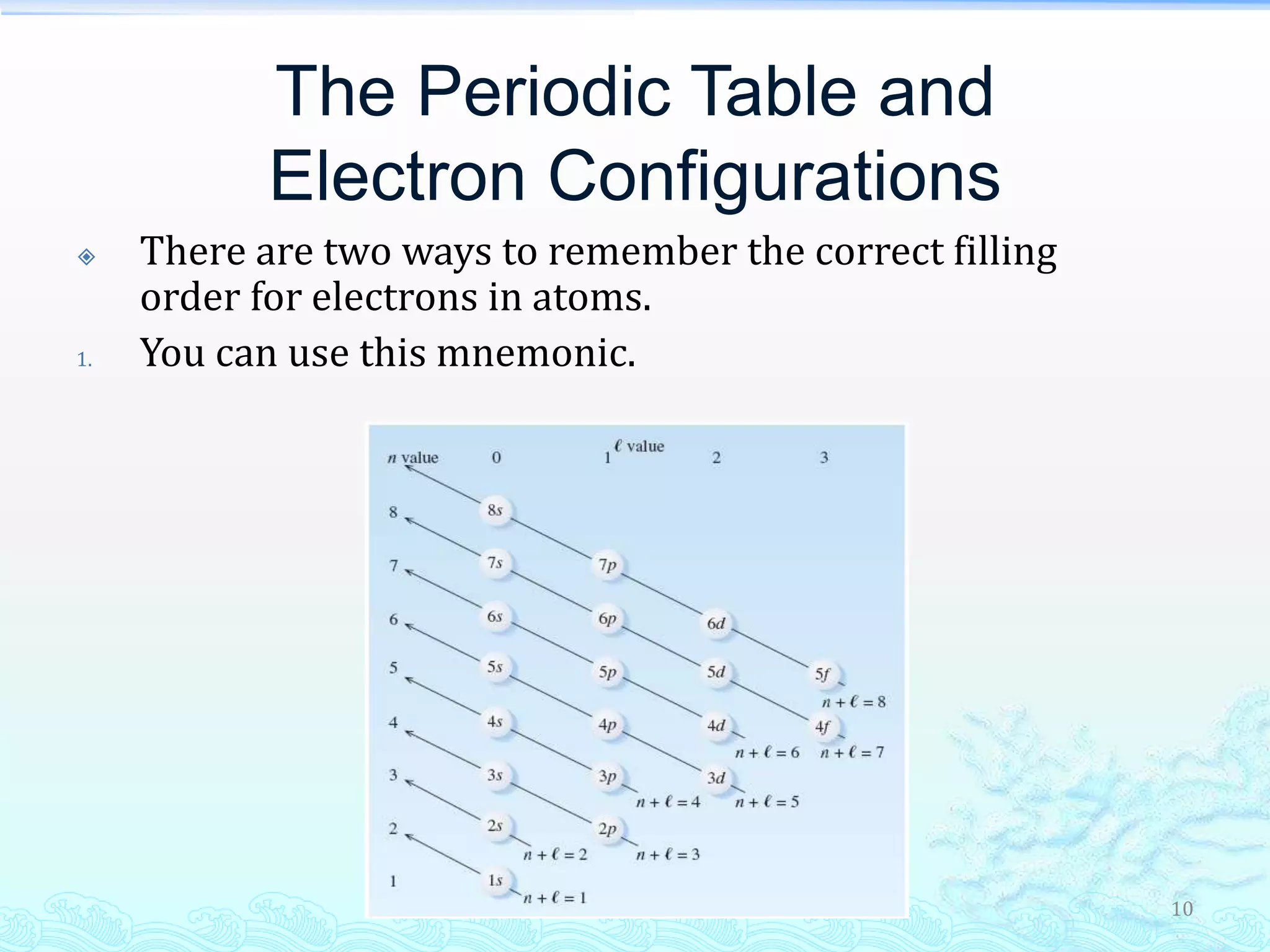
 The energy ordering for atomic orbitals is
1s, 2s, 2p, 3s, 3p, 4s, 3d, 4p, 5s, 4d, 5p, 6s, 4f,
5d, 6p, 7s, 5f, 6d, and 7p.
 An orbital’s size and penetration when treated
quantitatively produces the order of filling
represented.
 Electronic configurations are written in
order of energy for atomic orbitals.
Hund’s Rule and the Aufbau Principle
 Aufbau principle - when filling orbitals, start with the
lowest energy and proceed to the next highest energy level.
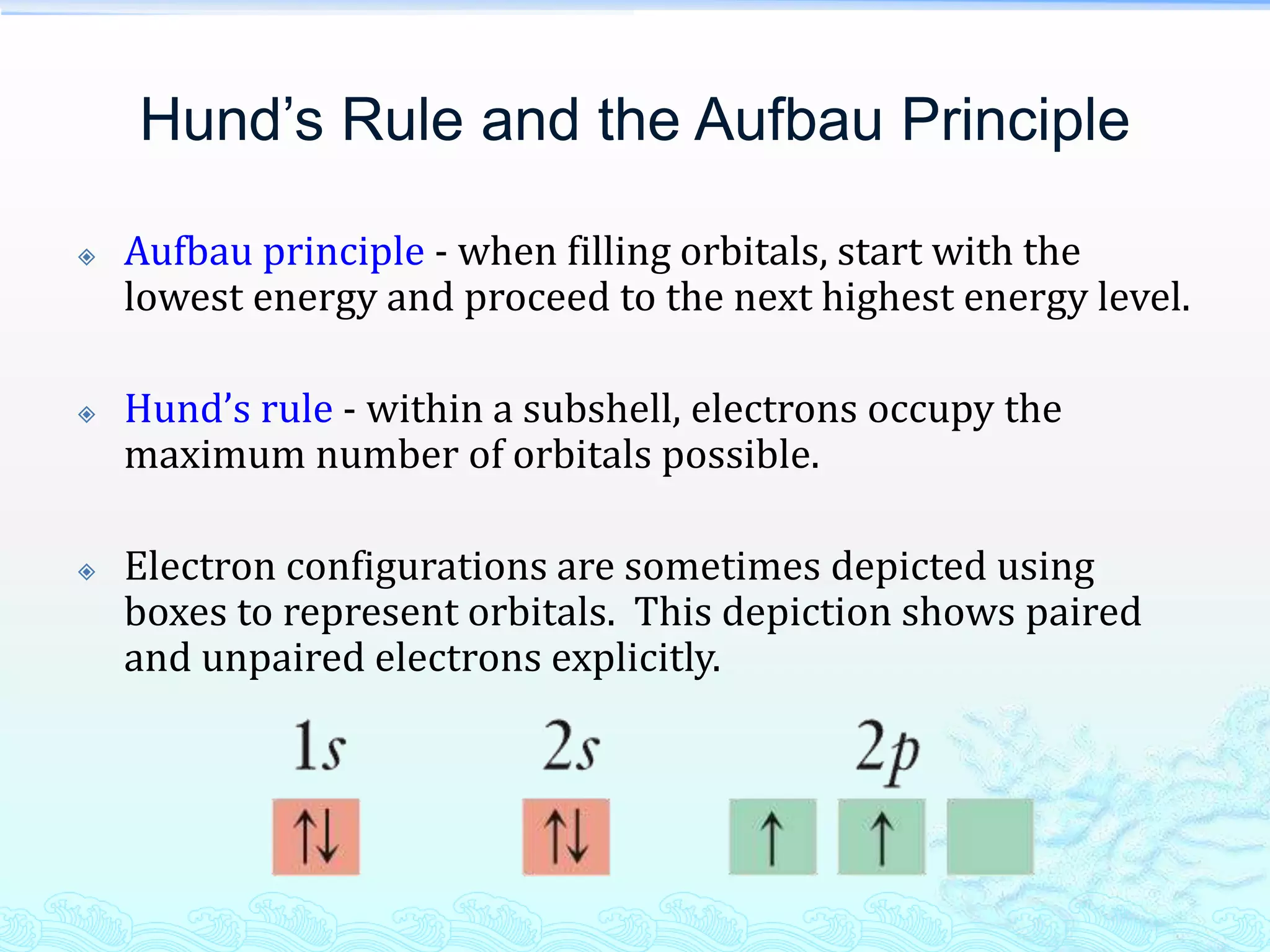
 Hund’s rule - within a subshell, electrons occupy the
maximum number of orbitals possible.
 Electron configurations are sometimes depicted using
boxes to represent orbitals. This depiction shows paired
and unpaired electrons explicitly.
9
The Periodic Table and
Electron Configurations
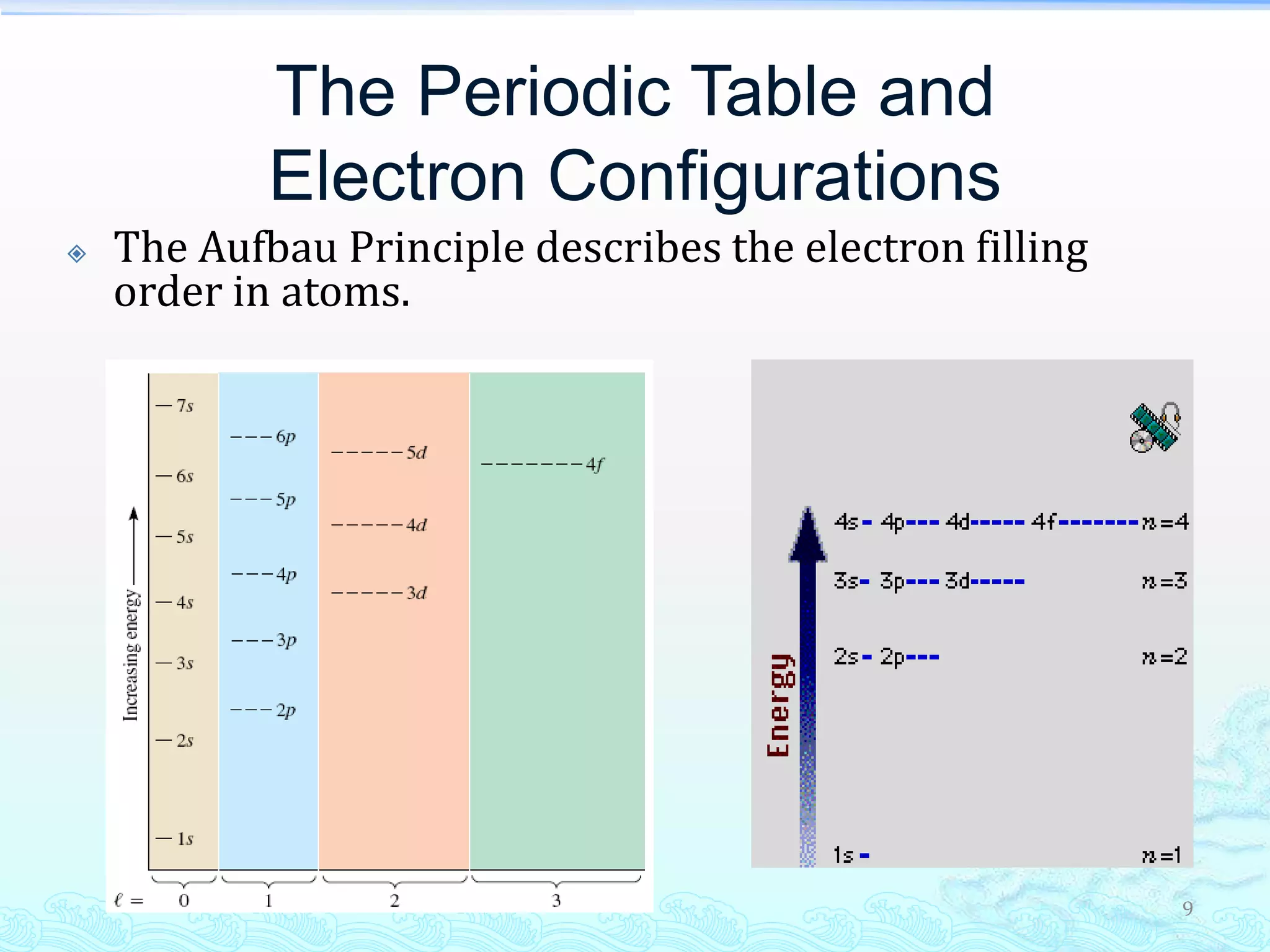
 The Aufbau Principle describes the electron filling
order in atoms.
10
The Periodic Table and
Electron Configurations
 There are two ways to remember the correct filling
order for electrons in atoms.
1. You can use this mnemonic.
11
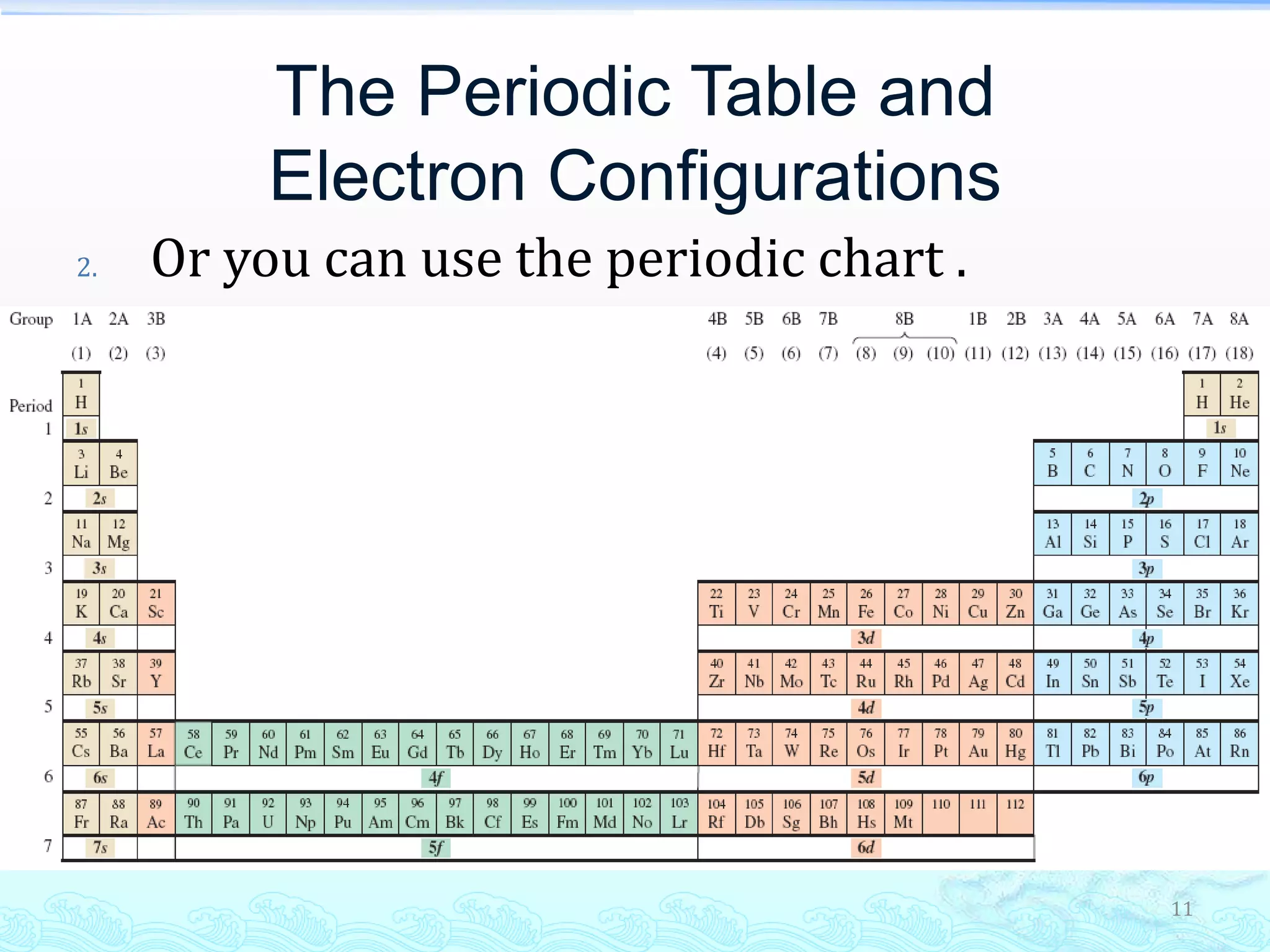
The Periodic Table and
Electron Configurations
2. Or you can use the periodic chart .
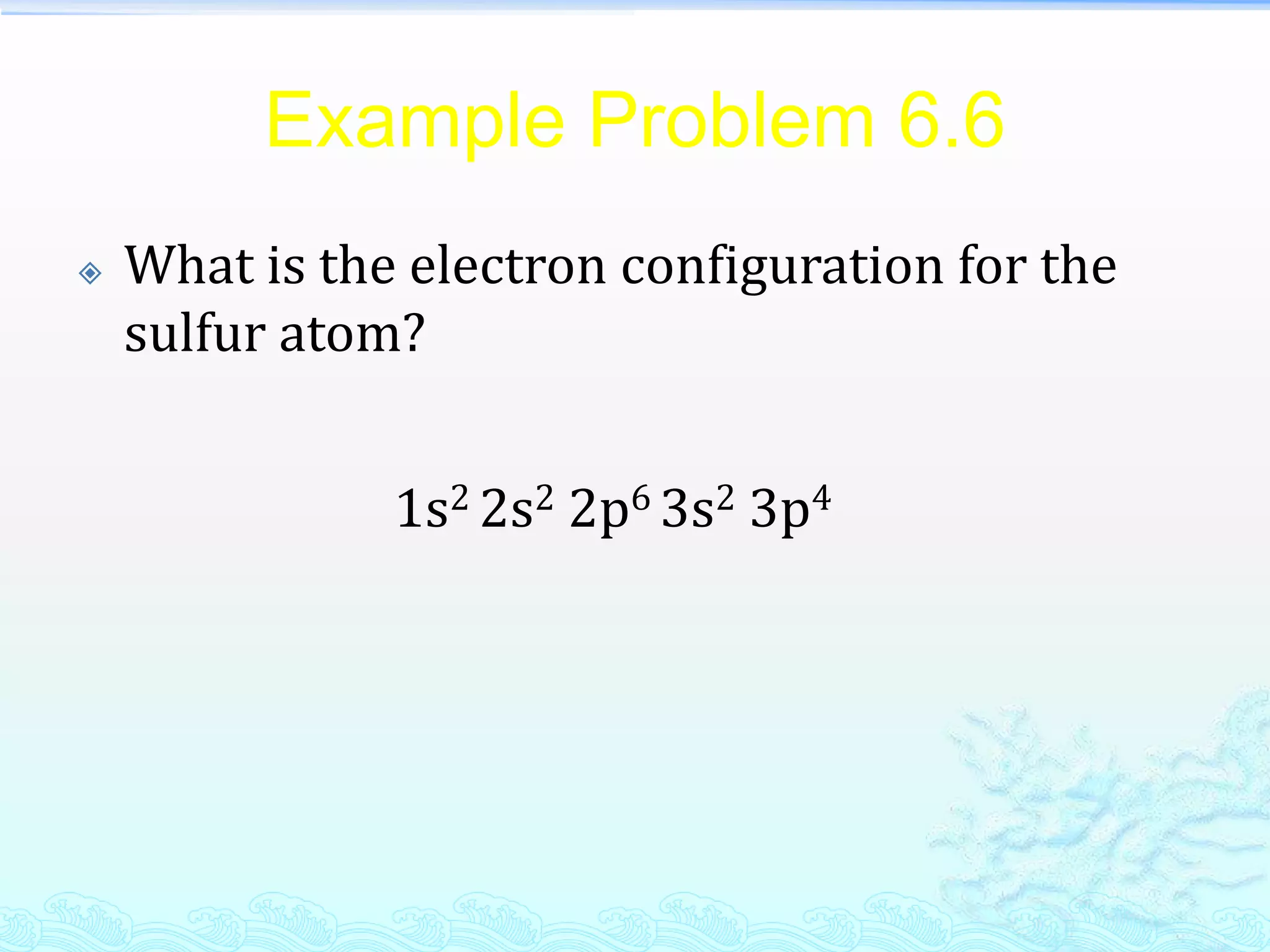
Example Problem 6.6
 What is the electron configuration for the
sulfur atom?
1s2 2s2 2p6 3s2 3p4
Hund’s Rule and the Aufbau Principle
 A simplified depiction uses superscripts to indicate
the number of electrons in an orbital set.
 1s2 2s2 2p2 is the electronic configuration for carbon.
 Noble gas electronic configurations are used as a
shorthand for writing electronic configurations.
 Relates electronic structure to chemical bonding.
 Electrons in outermost occupied orbitals give rise to
chemical reactivity of an element.
 [He] 2s2 2p2 is the shorthand for carbon
Hund’s Rule and the Aufbau Principle
 The inner electrons, which lie closer to the nucleus,
are referred to as core electrons.
 Core electrons can be represented by the noble gas with
the same electronic configuration.
 The outer electrons are usually referred to as
valence electrons.
 Valence electrons are shown explicitly when a noble gas
shorthand is used to write electronic configurations.
 Valence electrons determine reactivity.
Example Problem 6.7
 Rewrite the electron configuration for sulfur
using the shorthand notation.
[Ne] 1s2 2s2 2p6
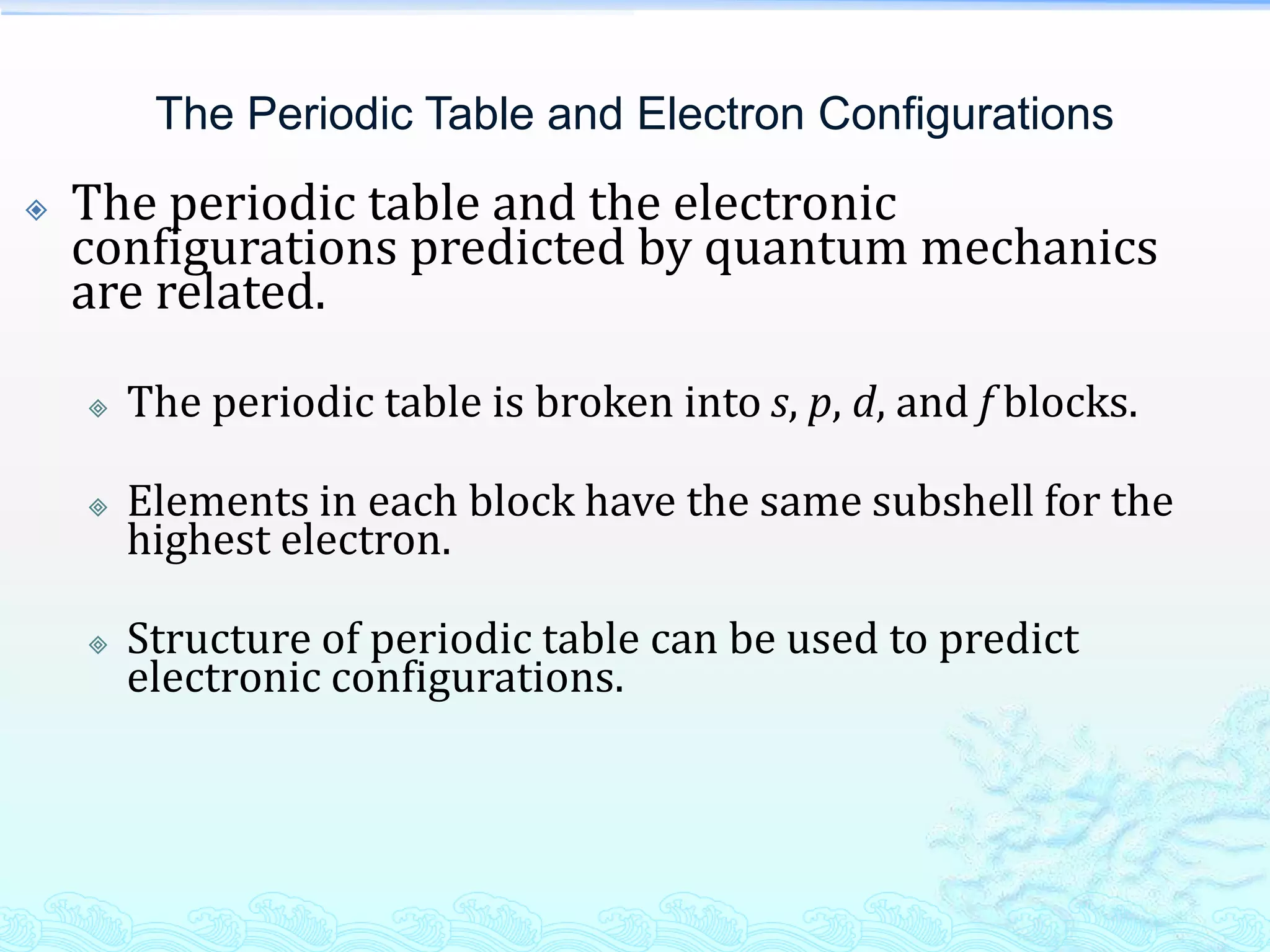
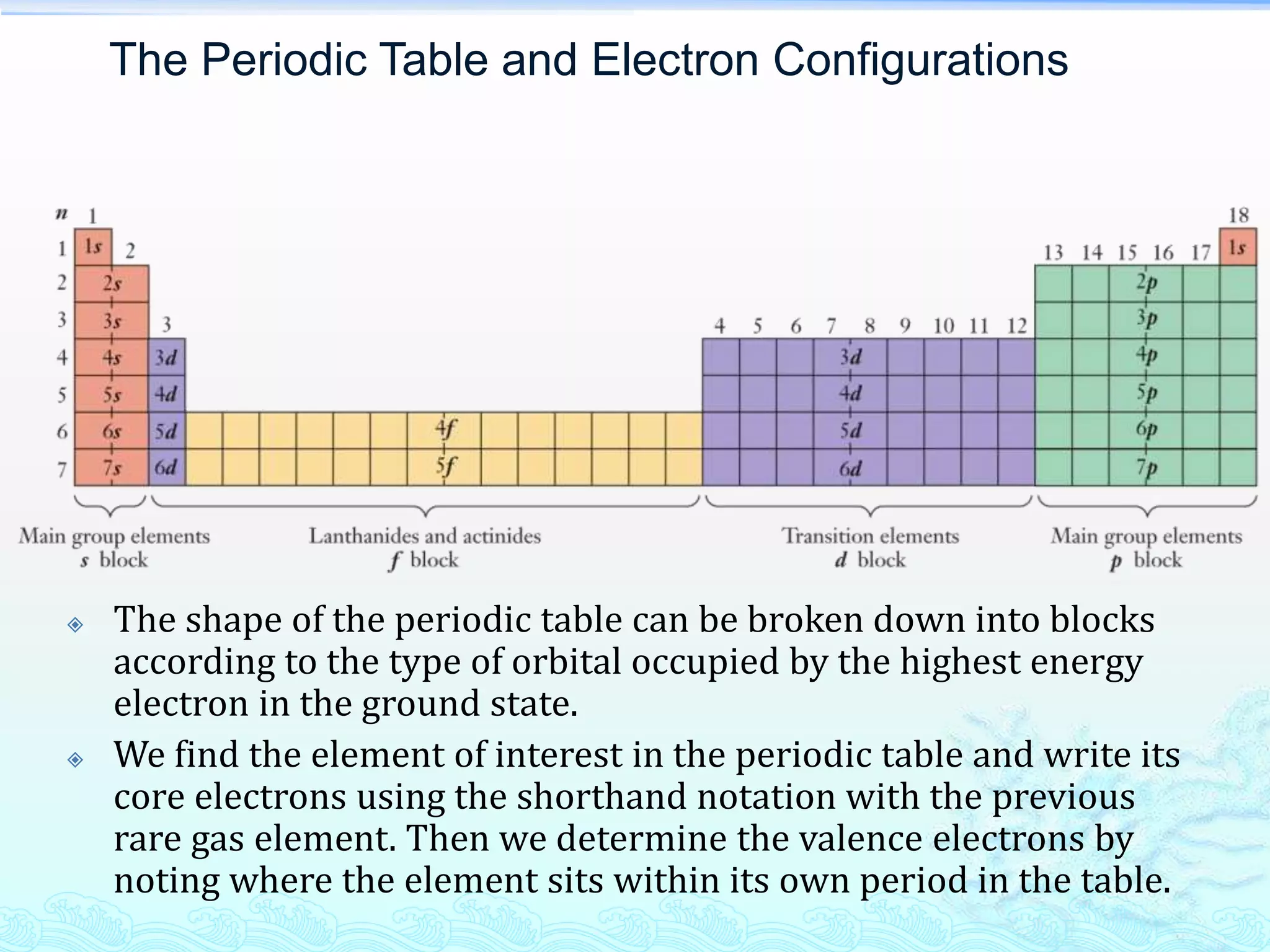
The Periodic Table and Electron Configurations
 The periodic table and the electronic
configurations predicted by quantum mechanics
are related.
 The periodic table is broken into s, p, d, and f blocks.
 Elements in each block have the same subshell for the
highest electron.
 Structure of periodic table can be used to predict
electronic configurations.
The Periodic Table and Electron Configurations
 The shape of the periodic table can be broken down into blocks
according to the type of orbital occupied by the highest energy
electron in the ground state.
 We find the element of interest in the periodic table and write its
core electrons using the shorthand notation with the previous
rare gas element. Then we determine the valence electrons by
noting where the element sits within its own period in the table.
Example Problem 6.8
 Use the periodic table to determine the
electron configuration of tungsten (W),
which is used in the filaments of most
incandescent lights.
[Xe] 6s2 4f14 5d4
19
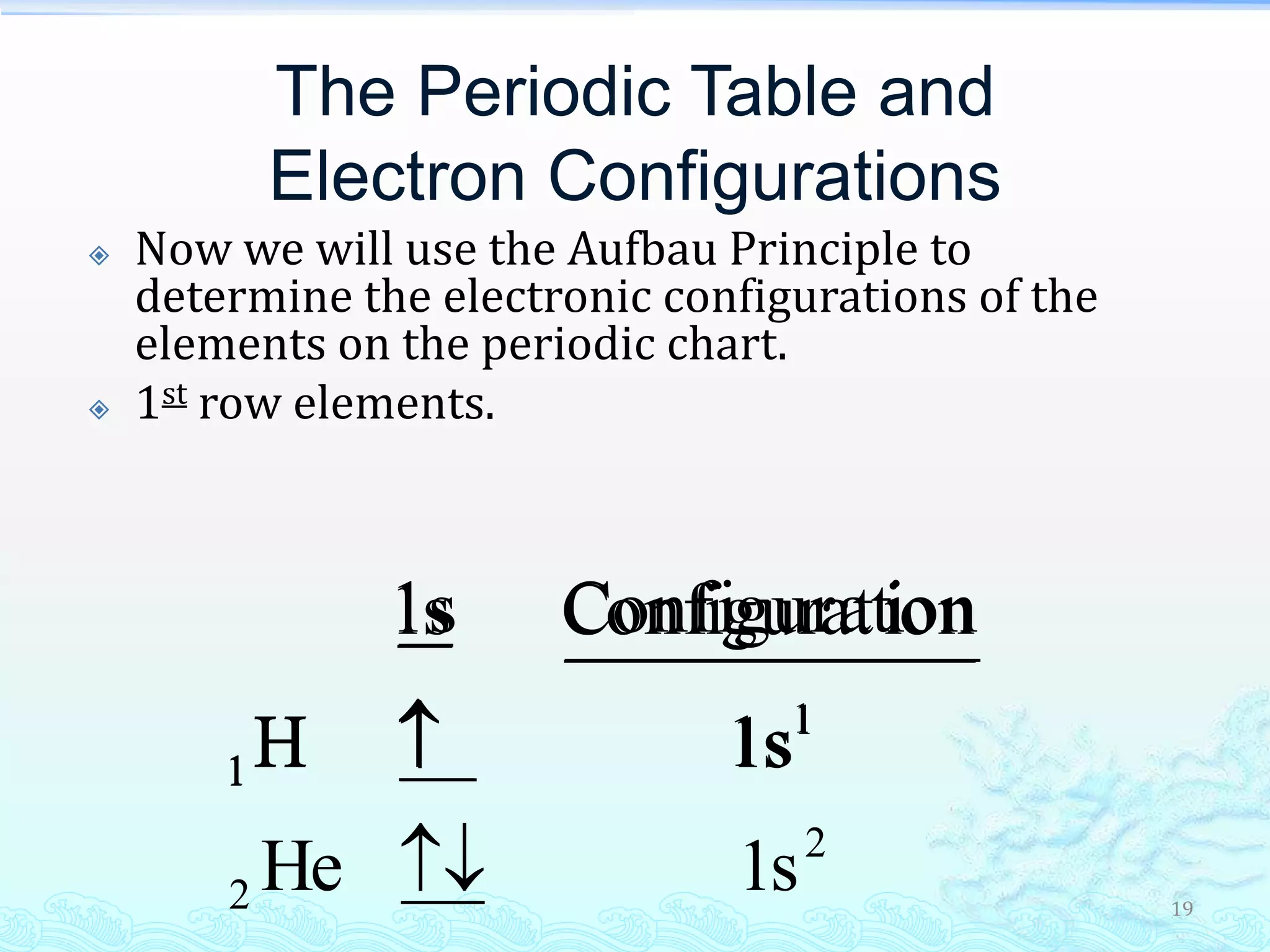
The Periodic Table and
Electron Configurations
 Now we will use the Aufbau Principle to
determine the electronic configurations of the
elements on the periodic chart.
 1st row elements.
2
2
1
1
1sHe
1sH
ionConfigurat1s

 1
1 1sH
ionConfigurat1s

20
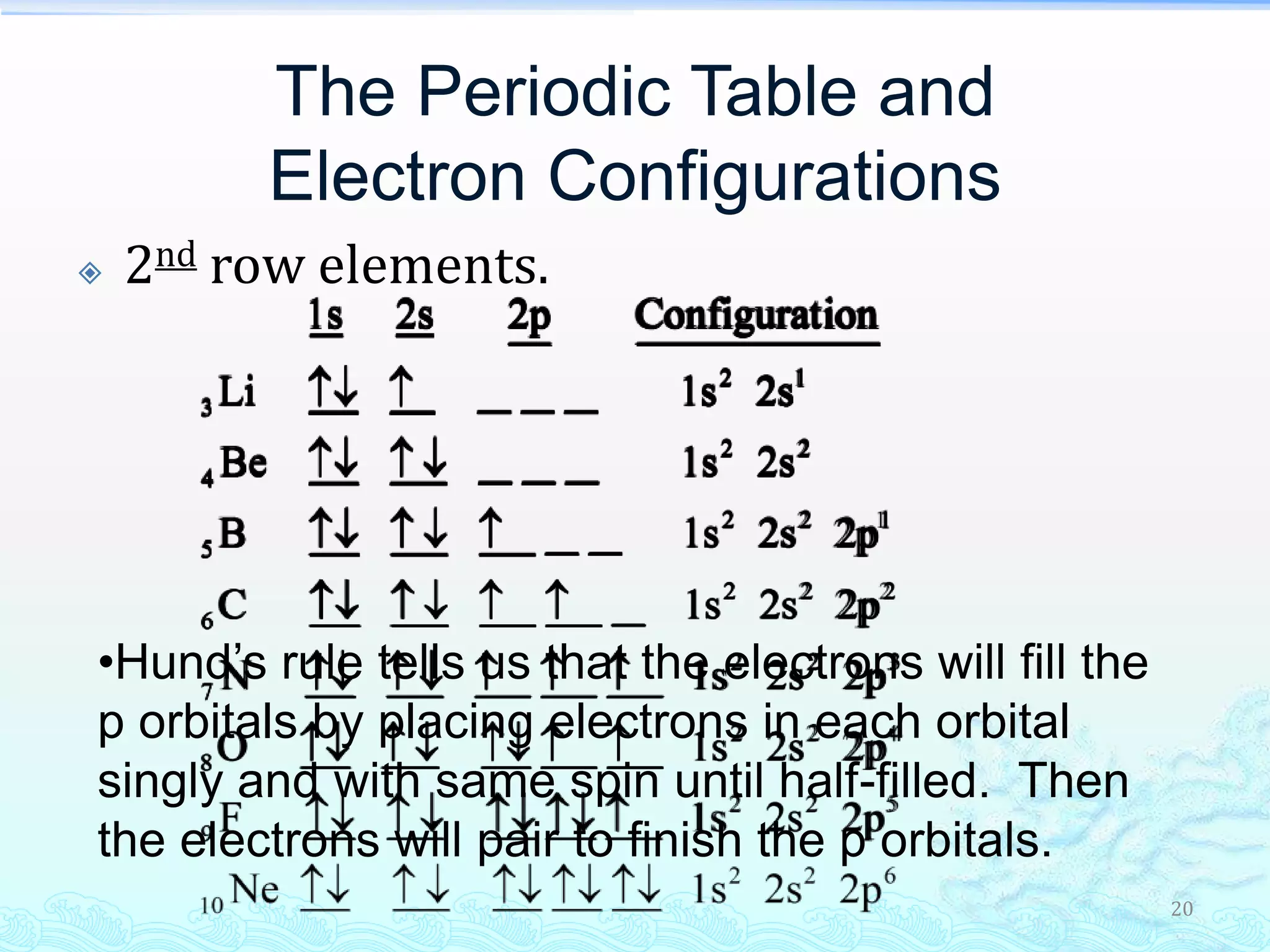
The Periodic Table and
Electron Configurations
 2nd row elements.
•Hund’s rule tells us that the electrons will fill the
p orbitals by placing electrons in each orbital
singly and with same spin until half-filled. Then
the electrons will pair to finish the p orbitals.
21
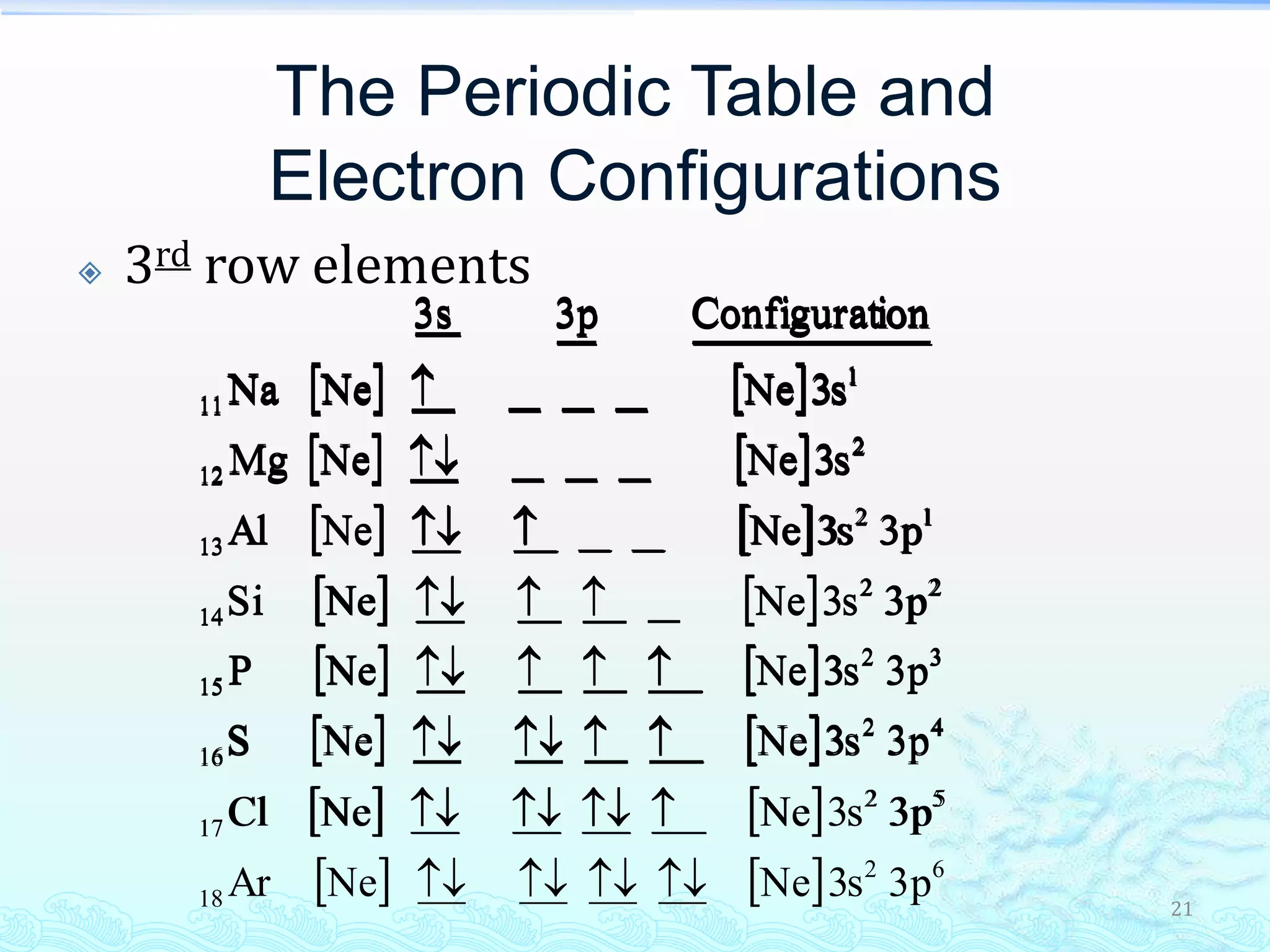
The Periodic Table and
Electron Configurations
 3rd row elements
   
   
   
   
   
   
   
    62
18
52
17
42
16
32
15
22
14
12
13
2
12
1
11
3ps3NeNeAr
3ps3NeNeCl
3ps3NeNeS
3ps3NeNeP
3ps3NeNeSi
3ps3NeNeAl
s3NeNeMg
s3NeNeNa
ionConfigurat3p3s







   
   
   
   
   
   
    52
17
42
16
32
15
22
14
12
13
2
12
1
11
3ps3NeNeCl
3ps3NeNeS
3ps3NeNeP
3ps3NeNeSi
3ps3NeNeAl
s3NeNeMg
s3NeNeNa
ionConfigurat3p3s






   
   
   
   
   
    42
16
32
15
22
14
12
13
2
12
1
11
3ps3NeNeS
3ps3NeNeP
3ps3NeNeSi
3ps3NeNeAl
s3NeNeMg
s3NeNeNa
ionConfigurat3p3s





   
   
   
   
    32
15
22
14
12
13
2
12
1
11
3ps3NeNeP
3ps3NeNeSi
3ps3NeNeAl
s3NeNeMg
s3NeNeNa
ionConfigurat3p3s




   
    2
12
1
11
s3NeNeMg
s3NeNeNa
ionConfigurat3p3s

    1
11 s3NeNeNa
ionConfigurat3p3s
   
   
   
    22
14
12
13
2
12
1
11
3ps3NeNeSi
3ps3NeNeAl
s3NeNeMg
s3NeNeNa
ionConfigurat3p3s



   
   
    12
13
2
12
1
11
3ps3NeNeAl
s3NeNeMg
s3NeNeNa
ionConfigurat3p3s



22
The Periodic Table and
Electron Configurations
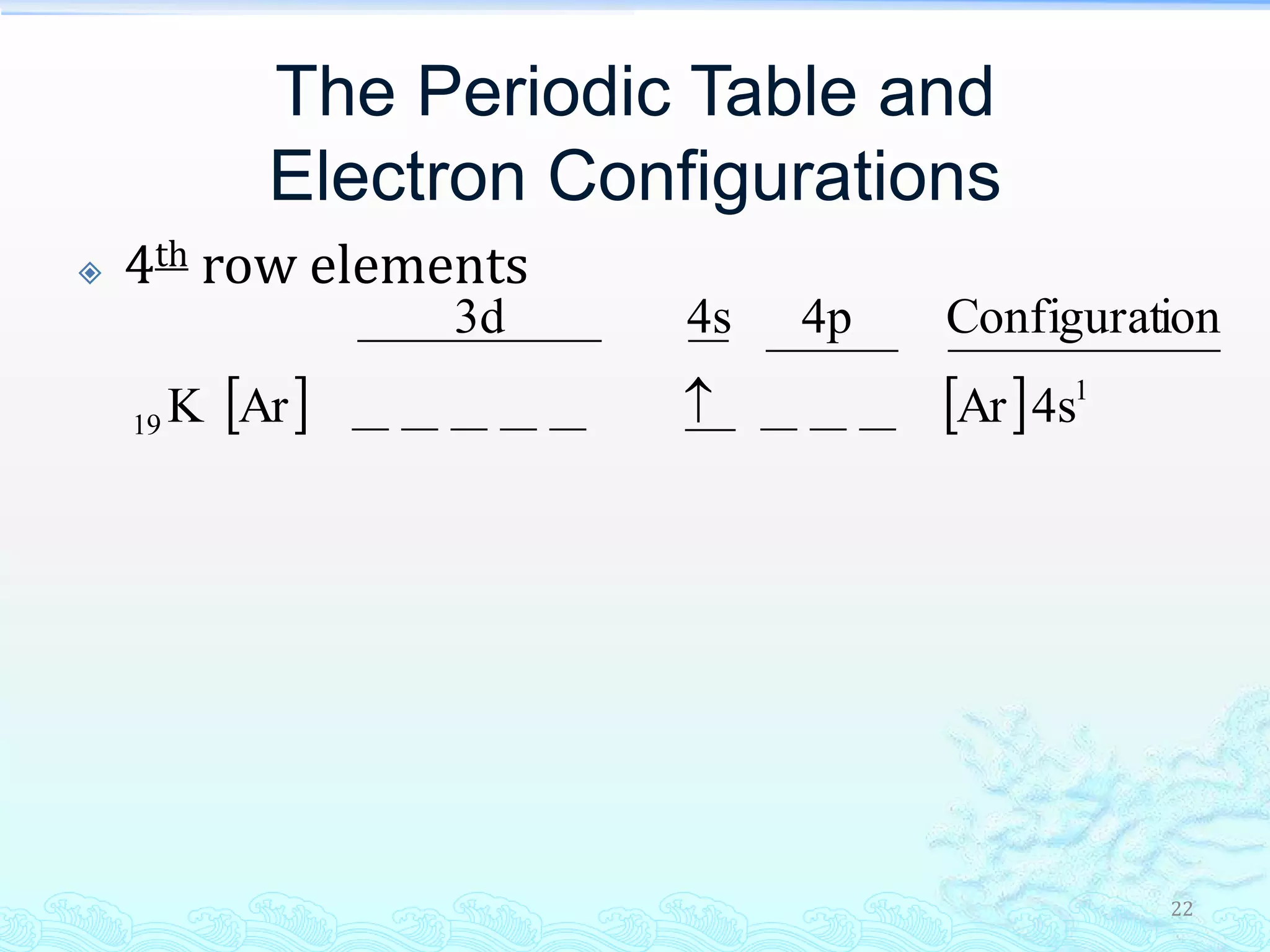
 4th row elements
    1
19 4sArArK
ionConfigurat4p4s3d

23
The Periodic Table and
Electron Configurations
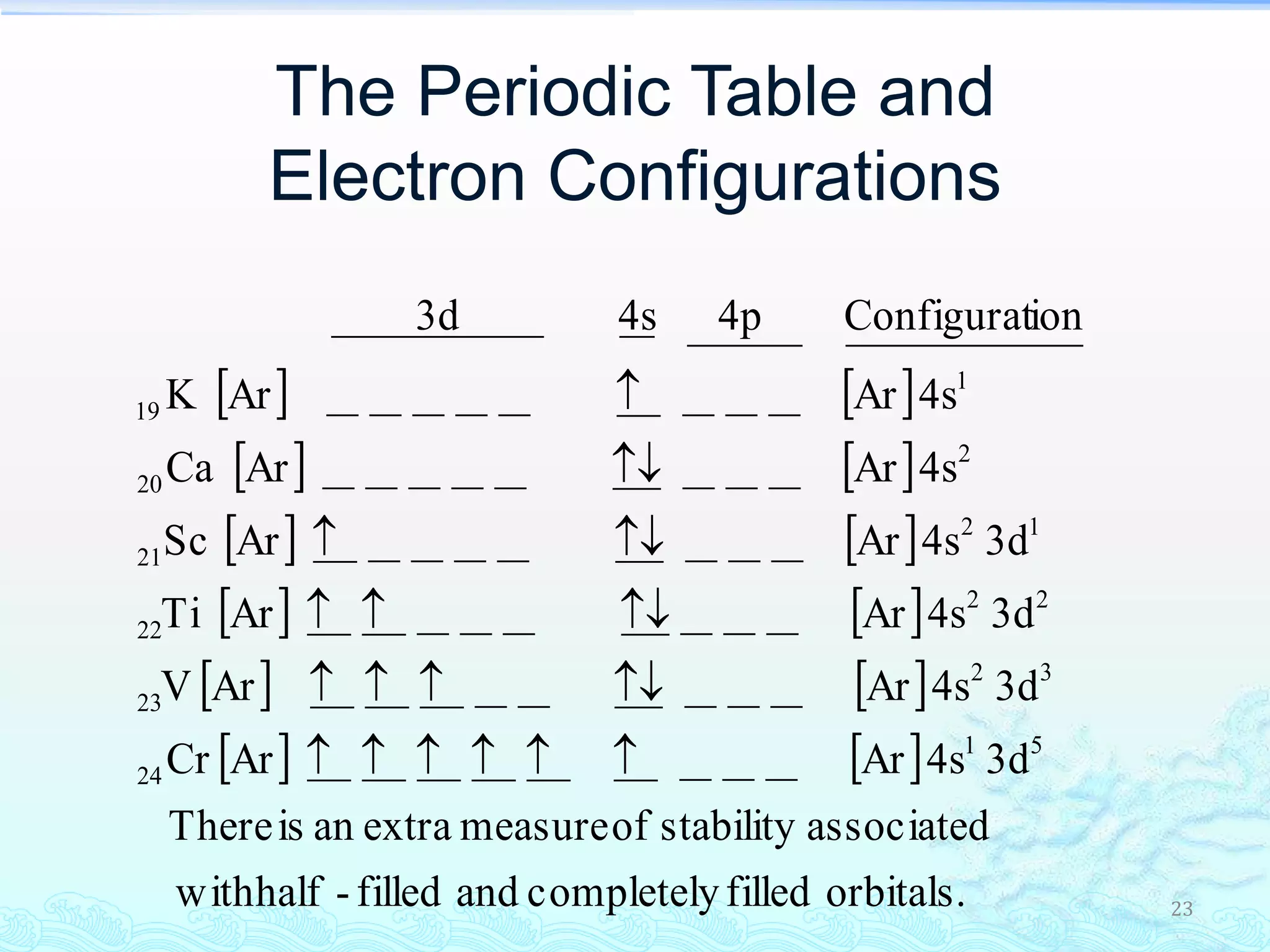
   
   
   
   
   
   
orbitals.filledcompletelyandfilled-halfwith
associatedstabilityofmeasureextraanisThere
3d4sArArCr
3d4sArArV
3d4sArArTi
3d4sArArSc
4sArArCa
4sArArK
ionConfigurat4p4s3d
51
24
32
23
22
22
12
21
2
20
1
19






24
The Periodic Table and
Electron Configurations
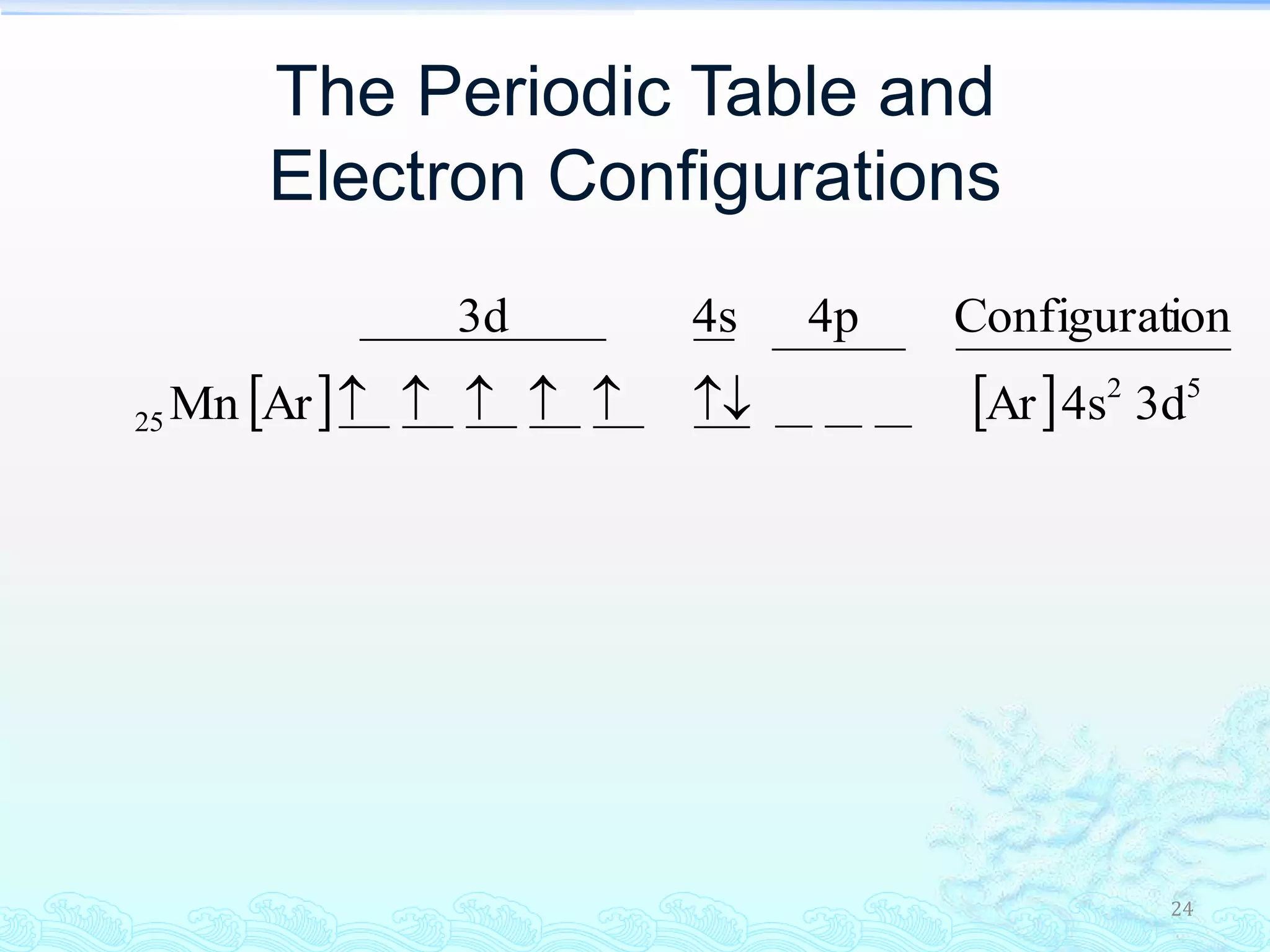
    52
25 3d4sArArMn
ionConfigurat4p4s3d

25
The Periodic Table and
Electron Configurations
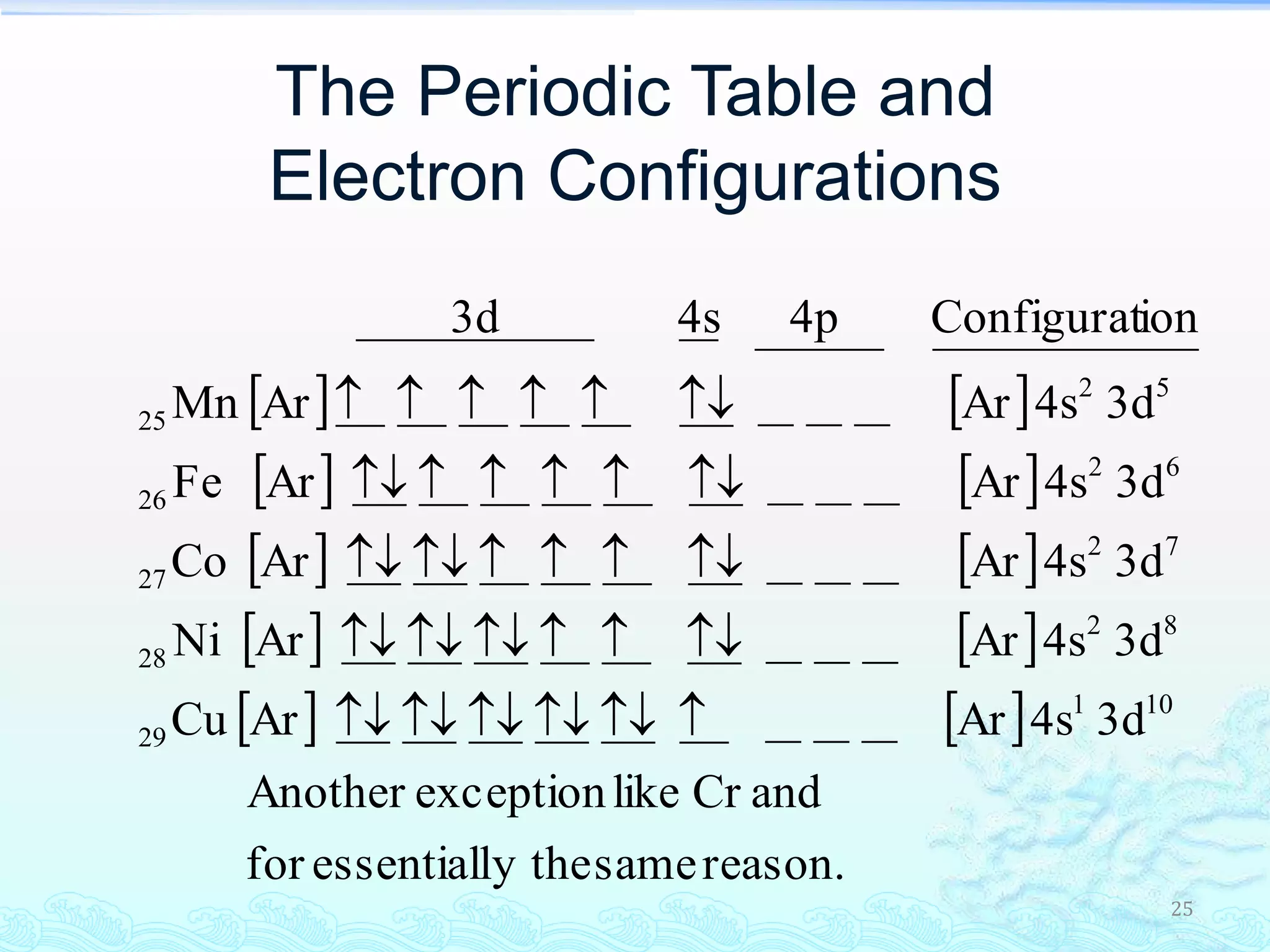
   
   
   
   
   
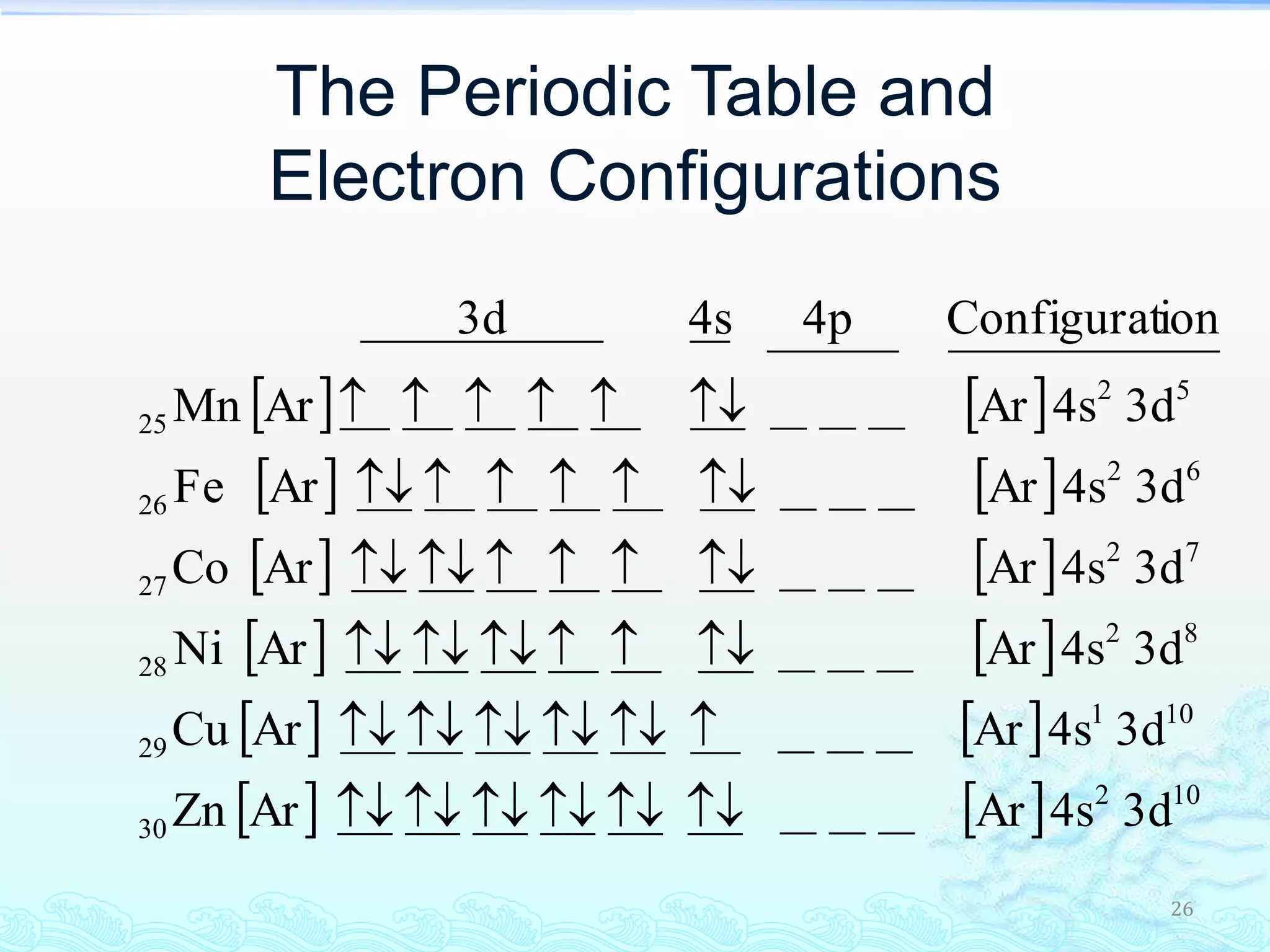
reason.samey theessentiallfor
andCrlikeexceptionAnother
3d4sArArCu
3d4sArArNi
3d4sArArCo
3d4sArArFe
3d4sArArMn
ionConfigurat4p4s3d
101
29
82
28
72
27
62
26
52
25





26
The Periodic Table and
Electron Configurations
   
   
   
   
   
    102
30
101
29
82
28
72
27
62
26
52
25
3d4sArArZn
3d4sArArCu
3d4sArArNi
3d4sArArCo
3d4sArArFe
3d4sArArMn
ionConfigurat4p4s3d






27
The Periodic Table and
Electron Configurations
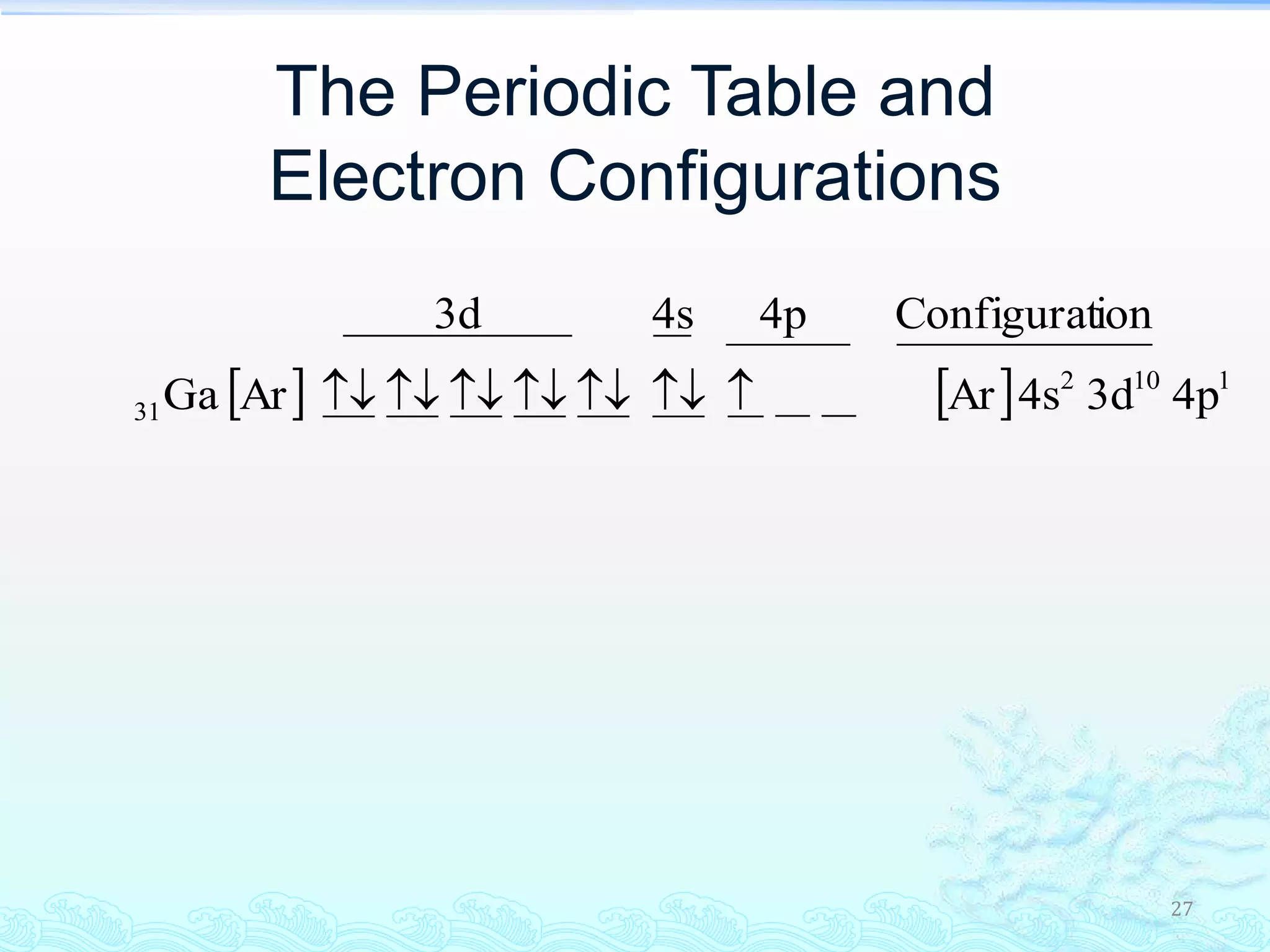
    1102
31 4p3d4sArArGa
ionConfigurat4p4s3d

28
The Periodic Table and
Electron Configurations
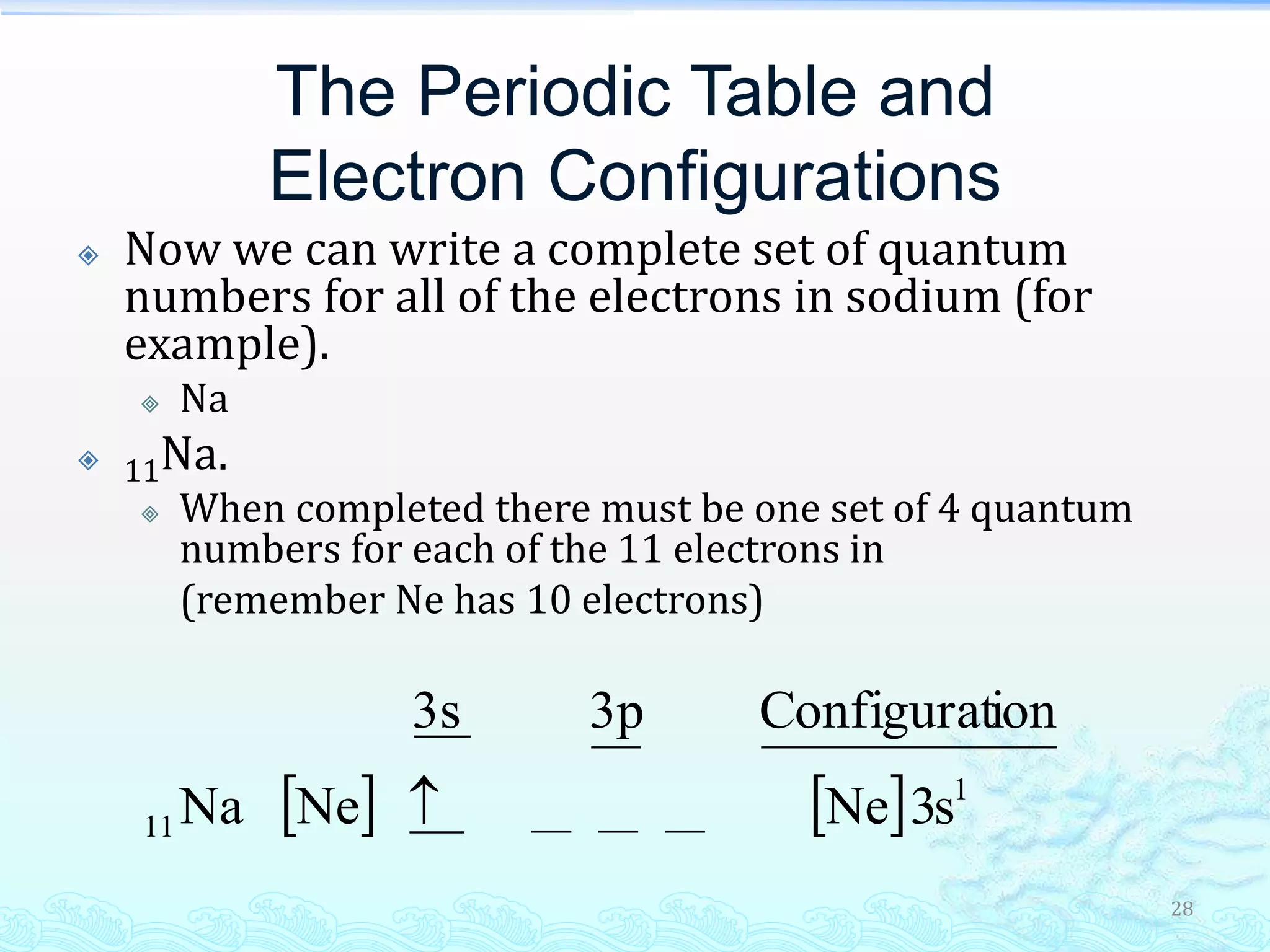
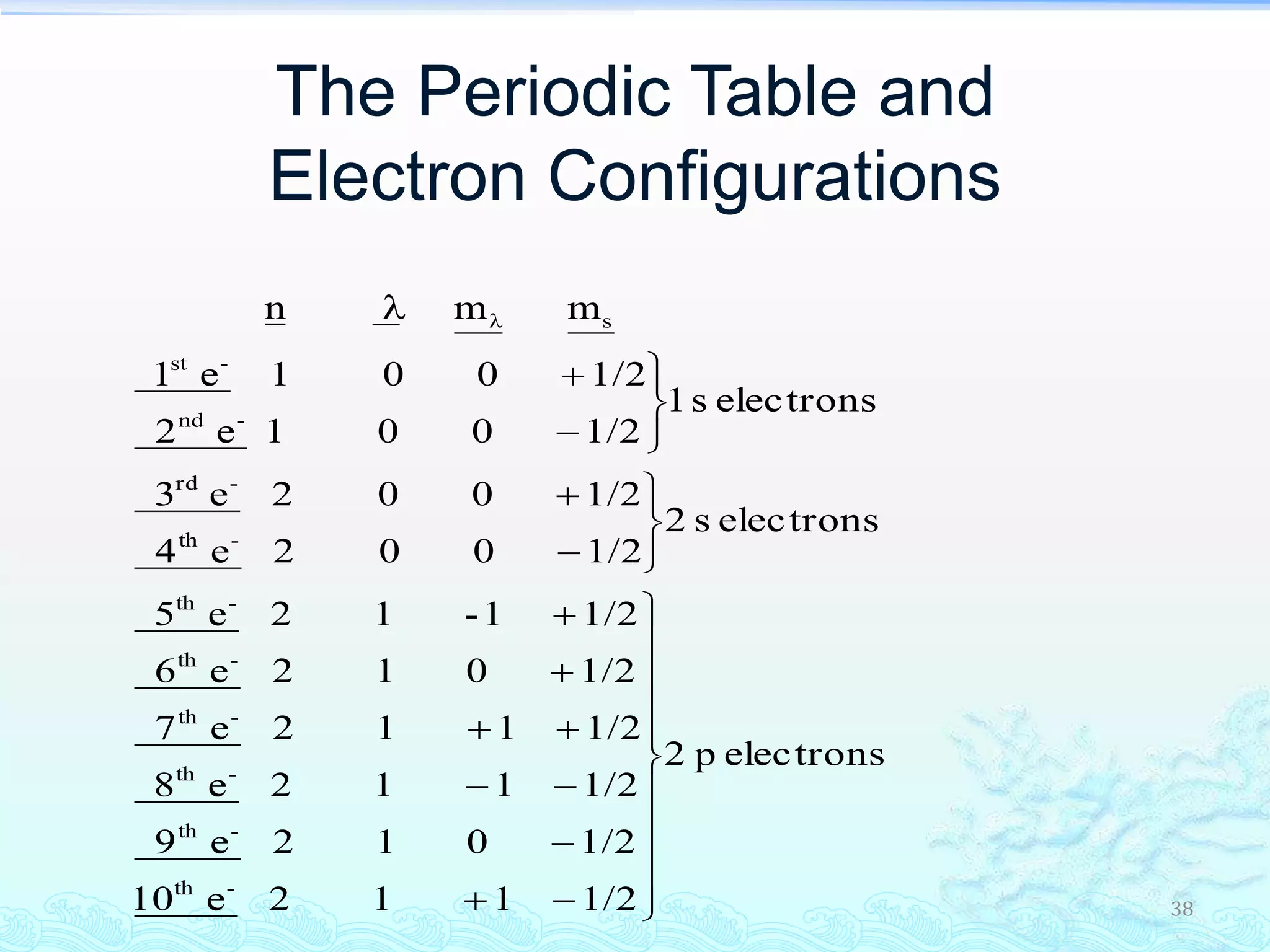
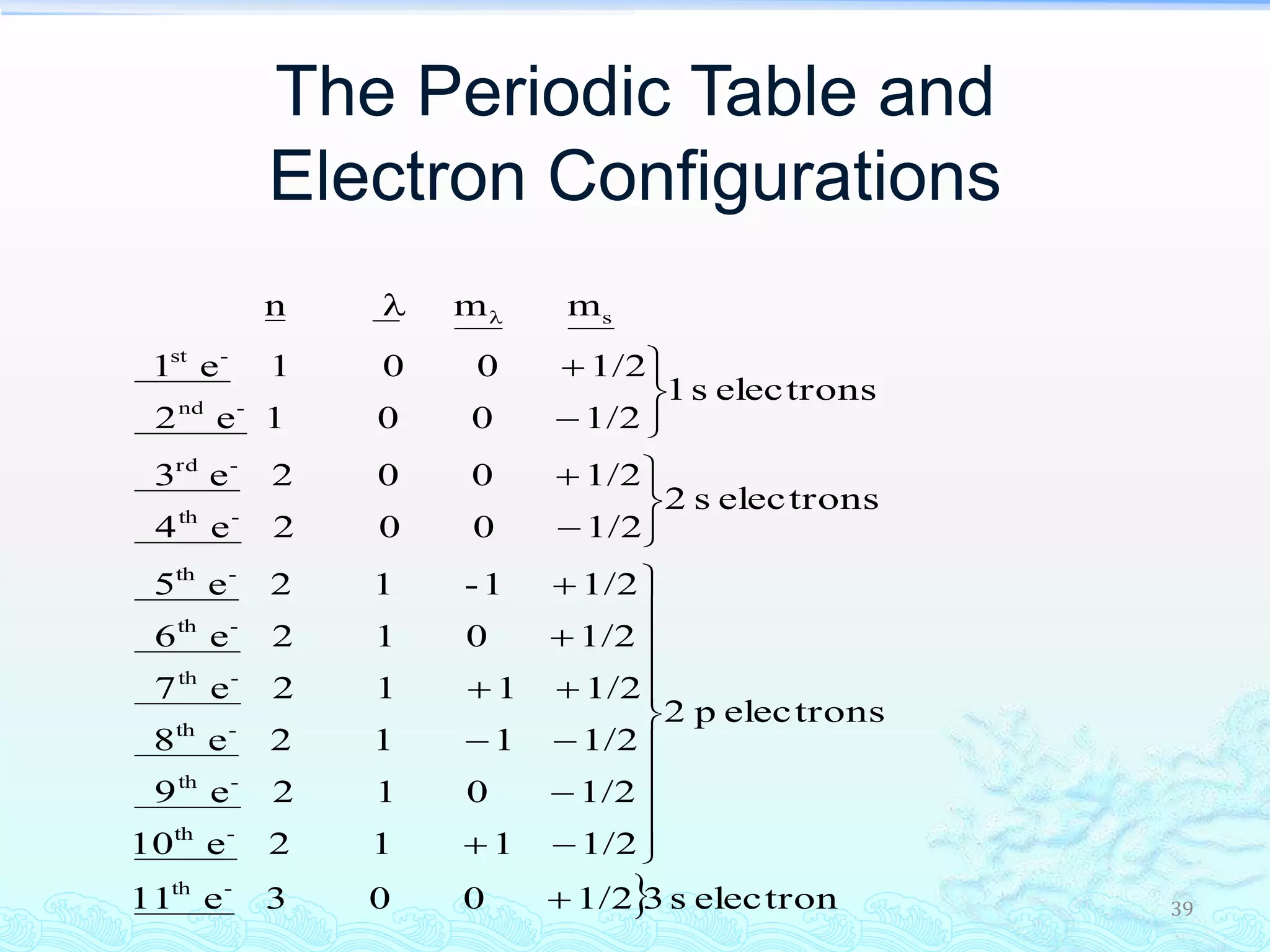
 Now we can write a complete set of quantum
numbers for all of the electrons in sodium (for
example).
 Na
 11Na.
 When completed there must be one set of 4 quantum
numbers for each of the 11 electrons in
(remember Ne has 10 electrons)
    1
11 s3NeNeNa
ionConfigurat3p3s

29
The Periodic Table and
Electron Configurations
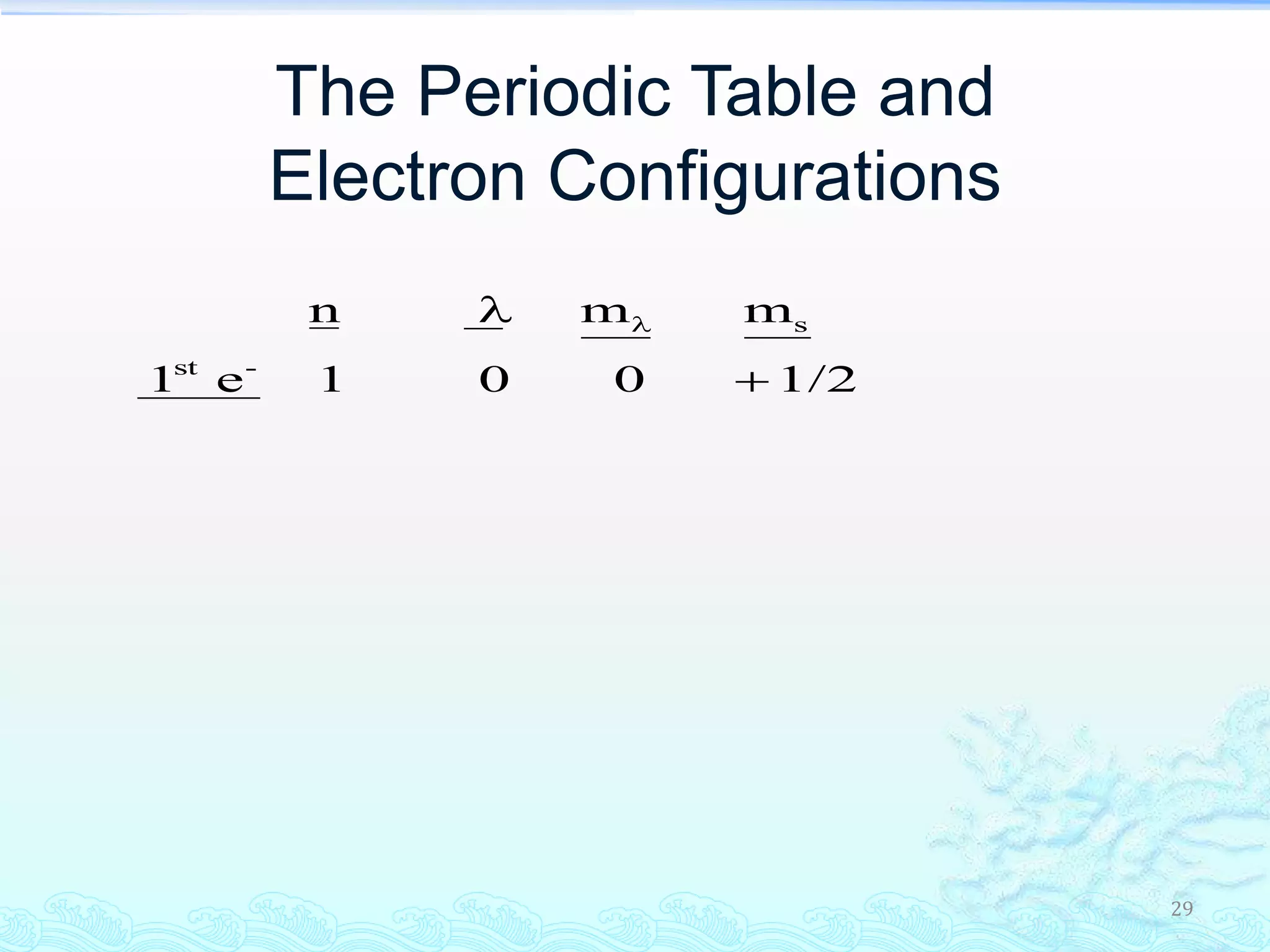
1/2001e1
mmn
-st
s


30
The Periodic Table and
Electron Configurations
electronss1
1/2001e2
1/2001e1
mmn
-nd
-st
s






31
The Periodic Table and
Electron Configurations
1/2002e3
electronss1
1/2001e2
1/2001e1
mmn
-rd
-nd
-st
s








32
The Periodic Table and
Electron Configurations
electronss2
1/2002e4
1/2002e3
electronss1
1/2001e2
1/2001e1
mmn
-th
-rd
-nd
-st
s











33
The Periodic Table and
Electron Configurations
1/21-12e5
electronss2
1/2002e4
1/2002e3
electronss1
1/2001e2
1/2001e1
mmn
-th
-th
-rd
-nd
-st
s












34
The Periodic Table and
Electron Configurations
1/2012e6
1/21-12e5
electronss2
1/2002e4
1/2002e3
electronss1
1/2001e2
1/2001e1
mmn
-th
-th
-th
-rd
-nd
-st
s













35
The Periodic Table and
Electron Configurations
1/2112e7
1/2012e6
1/21-12e5
electronss2
1/2002e4
1/2002e3
electronss1
1/2-001e2
1/2001e1
mmn
-th
-th
-th
-th
-rd
-nd
-st
s












36
The Periodic Table and
Electron Configurations
1/2112e8
1/2112e7
1/2012e6
1/21-12e5
electronss2
1/2002e4
1/2002e3
electronss1
1/2001e2
1/2001e1
mmn
-th
-th
-th
-th
-th
-rd
-nd
-st
s















37
The Periodic Table and
Electron Configurations
1/2012e9
1/2112e8
1/2112e7
1/2012e6
1/21-12e5
electronss2
1/2002e4
1/2002e3
electronss1
1/2001e2
1/2001e1
mmn
-th
-th
-th
-th
-th
-th
-rd
-nd
-st
s
















38
The Periodic Table and
Electron Configurations
electronsp2
1/2112e10
1/2012e9
1/2112e8
1/2112e7
1/2012e6
1/21-12e5
electronss2
1/2002e4
1/2002e3
electronss1
1/2001e2
1/2001e1
mmn
-th
-th
-th
-th
-th
-th
-th
-rd
-nd
-st
s




























39
The Periodic Table and
Electron Configurations
 electrons31/2003e11
electronsp2
1/2112e10
1/2012e9
1/2112e8
1/2112e7
1/2012e6
1/21-12e5
electronss2
1/2002e4
1/2002e3
electronss1
1/2001e2
1/2001e1
mmn
-th
-th
-th
-th
-th
-th
-th
-th
-rd
-nd
-st
s






























L4electronicstructureofatompart2 130906000855-

  • 1.
  • 2.
    The Pauli ExclusionPrinciple and Electron Configurations  The spin quantum number, ms, determines the number of electrons that can occupy an orbital.  ms = ±1/2  Electrons described as “spin up” or “spin down”.  An electron is specified by a set of four quantum numbers.
  • 3.
    The Pauli ExclusionPrinciple and Electron Configurations  Pauli Exclusion Principle - no two electrons in an atom may have the same set of four quantum numbers.  Two electrons can have the same values of n, l, and ml, but different values of ms.  Two electrons maximum per orbital.  Two electrons occupying the same orbital are spin paired.
  • 4.
    Orbital Energies andElectron Configurations  Electrons in smaller orbitals are held more tightly and have lower energies.  Orbital size increases as the value of n increases.  True for hydrogen atoms, but not entirely true for multielectron atoms.  As nuclear charge increases, orbital size decreases.  Electrons interact with other electrons as well as the positively charged nucleus.
  • 5.
    Orbital Energies andElectron Configurations  For electrons in larger orbitals, the charge “felt” is a combination of the actual nuclear charge and the offsetting charge of electrons in lower orbitals.  The masking of the nuclear charge is called shielding.  Shielding results in a reduced, effective nuclear charge.
  • 6.
    Orbital Energies andElectron Configurations  Effective nuclear charge allows for understanding of the energy differences between orbitals.  2s orbital: the small local maximum close to the nucleus results in an electron with a higher effective nuclear charge.  2p orbital: lacks the local minimum close to the nucleus of the 2s orbital.  Lower effective nuclear charge for 2p electrons.
  • 7.
    Orbital Energies andElectron Configurations  The energy ordering for atomic orbitals is 1s, 2s, 2p, 3s, 3p, 4s, 3d, 4p, 5s, 4d, 5p, 6s, 4f, 5d, 6p, 7s, 5f, 6d, and 7p.  An orbital’s size and penetration when treated quantitatively produces the order of filling represented.  Electronic configurations are written in order of energy for atomic orbitals.
  • 8.
    Hund’s Rule andthe Aufbau Principle  Aufbau principle - when filling orbitals, start with the lowest energy and proceed to the next highest energy level.  Hund’s rule - within a subshell, electrons occupy the maximum number of orbitals possible.  Electron configurations are sometimes depicted using boxes to represent orbitals. This depiction shows paired and unpaired electrons explicitly.
  • 9.
    9 The Periodic Tableand Electron Configurations  The Aufbau Principle describes the electron filling order in atoms.
  • 10.
    10 The Periodic Tableand Electron Configurations  There are two ways to remember the correct filling order for electrons in atoms. 1. You can use this mnemonic.
  • 11.
    11 The Periodic Tableand Electron Configurations 2. Or you can use the periodic chart .
  • 12.
    Example Problem 6.6 What is the electron configuration for the sulfur atom? 1s2 2s2 2p6 3s2 3p4
  • 13.
    Hund’s Rule andthe Aufbau Principle  A simplified depiction uses superscripts to indicate the number of electrons in an orbital set.  1s2 2s2 2p2 is the electronic configuration for carbon.  Noble gas electronic configurations are used as a shorthand for writing electronic configurations.  Relates electronic structure to chemical bonding.  Electrons in outermost occupied orbitals give rise to chemical reactivity of an element.  [He] 2s2 2p2 is the shorthand for carbon
  • 14.
    Hund’s Rule andthe Aufbau Principle  The inner electrons, which lie closer to the nucleus, are referred to as core electrons.  Core electrons can be represented by the noble gas with the same electronic configuration.  The outer electrons are usually referred to as valence electrons.  Valence electrons are shown explicitly when a noble gas shorthand is used to write electronic configurations.  Valence electrons determine reactivity.
  • 15.
    Example Problem 6.7 Rewrite the electron configuration for sulfur using the shorthand notation. [Ne] 1s2 2s2 2p6
  • 16.
    The Periodic Tableand Electron Configurations  The periodic table and the electronic configurations predicted by quantum mechanics are related.  The periodic table is broken into s, p, d, and f blocks.  Elements in each block have the same subshell for the highest electron.  Structure of periodic table can be used to predict electronic configurations.
  • 17.
    The Periodic Tableand Electron Configurations  The shape of the periodic table can be broken down into blocks according to the type of orbital occupied by the highest energy electron in the ground state.  We find the element of interest in the periodic table and write its core electrons using the shorthand notation with the previous rare gas element. Then we determine the valence electrons by noting where the element sits within its own period in the table.
  • 18.
    Example Problem 6.8 Use the periodic table to determine the electron configuration of tungsten (W), which is used in the filaments of most incandescent lights. [Xe] 6s2 4f14 5d4
  • 19.
    19 The Periodic Tableand Electron Configurations  Now we will use the Aufbau Principle to determine the electronic configurations of the elements on the periodic chart.  1st row elements. 2 2 1 1 1sHe 1sH ionConfigurat1s   1 1 1sH ionConfigurat1s 
  • 20.
    20 The Periodic Tableand Electron Configurations  2nd row elements. •Hund’s rule tells us that the electrons will fill the p orbitals by placing electrons in each orbital singly and with same spin until half-filled. Then the electrons will pair to finish the p orbitals.
  • 21.
    21 The Periodic Tableand Electron Configurations  3rd row elements                                 62 18 52 17 42 16 32 15 22 14 12 13 2 12 1 11 3ps3NeNeAr 3ps3NeNeCl 3ps3NeNeS 3ps3NeNeP 3ps3NeNeSi 3ps3NeNeAl s3NeNeMg s3NeNeNa ionConfigurat3p3s                                    52 17 42 16 32 15 22 14 12 13 2 12 1 11 3ps3NeNeCl 3ps3NeNeS 3ps3NeNeP 3ps3NeNeSi 3ps3NeNeAl s3NeNeMg s3NeNeNa ionConfigurat3p3s                               42 16 32 15 22 14 12 13 2 12 1 11 3ps3NeNeS 3ps3NeNeP 3ps3NeNeSi 3ps3NeNeAl s3NeNeMg s3NeNeNa ionConfigurat3p3s                          32 15 22 14 12 13 2 12 1 11 3ps3NeNeP 3ps3NeNeSi 3ps3NeNeAl s3NeNeMg s3NeNeNa ionConfigurat3p3s             2 12 1 11 s3NeNeMg s3NeNeNa ionConfigurat3p3s      1 11 s3NeNeNa ionConfigurat3p3s                 22 14 12 13 2 12 1 11 3ps3NeNeSi 3ps3NeNeAl s3NeNeMg s3NeNeNa ionConfigurat3p3s                12 13 2 12 1 11 3ps3NeNeAl s3NeNeMg s3NeNeNa ionConfigurat3p3s   
  • 22.
    22 The Periodic Tableand Electron Configurations  4th row elements     1 19 4sArArK ionConfigurat4p4s3d 
  • 23.
    23 The Periodic Tableand Electron Configurations                         orbitals.filledcompletelyandfilled-halfwith associatedstabilityofmeasureextraanisThere 3d4sArArCr 3d4sArArV 3d4sArArTi 3d4sArArSc 4sArArCa 4sArArK ionConfigurat4p4s3d 51 24 32 23 22 22 12 21 2 20 1 19      
  • 24.
    24 The Periodic Tableand Electron Configurations     52 25 3d4sArArMn ionConfigurat4p4s3d 
  • 25.
    25 The Periodic Tableand Electron Configurations                     reason.samey theessentiallfor andCrlikeexceptionAnother 3d4sArArCu 3d4sArArNi 3d4sArArCo 3d4sArArFe 3d4sArArMn ionConfigurat4p4s3d 101 29 82 28 72 27 62 26 52 25     
  • 26.
    26 The Periodic Tableand Electron Configurations                         102 30 101 29 82 28 72 27 62 26 52 25 3d4sArArZn 3d4sArArCu 3d4sArArNi 3d4sArArCo 3d4sArArFe 3d4sArArMn ionConfigurat4p4s3d      
  • 27.
    27 The Periodic Tableand Electron Configurations     1102 31 4p3d4sArArGa ionConfigurat4p4s3d 
  • 28.
    28 The Periodic Tableand Electron Configurations  Now we can write a complete set of quantum numbers for all of the electrons in sodium (for example).  Na  11Na.  When completed there must be one set of 4 quantum numbers for each of the 11 electrons in (remember Ne has 10 electrons)     1 11 s3NeNeNa ionConfigurat3p3s 
  • 29.
    29 The Periodic Tableand Electron Configurations 1/2001e1 mmn -st s  
  • 30.
    30 The Periodic Tableand Electron Configurations electronss1 1/2001e2 1/2001e1 mmn -nd -st s      
  • 31.
    31 The Periodic Tableand Electron Configurations 1/2002e3 electronss1 1/2001e2 1/2001e1 mmn -rd -nd -st s        
  • 32.
    32 The Periodic Tableand Electron Configurations electronss2 1/2002e4 1/2002e3 electronss1 1/2001e2 1/2001e1 mmn -th -rd -nd -st s           
  • 33.
    33 The Periodic Tableand Electron Configurations 1/21-12e5 electronss2 1/2002e4 1/2002e3 electronss1 1/2001e2 1/2001e1 mmn -th -th -rd -nd -st s            
  • 34.
    34 The Periodic Tableand Electron Configurations 1/2012e6 1/21-12e5 electronss2 1/2002e4 1/2002e3 electronss1 1/2001e2 1/2001e1 mmn -th -th -th -rd -nd -st s             
  • 35.
    35 The Periodic Tableand Electron Configurations 1/2112e7 1/2012e6 1/21-12e5 electronss2 1/2002e4 1/2002e3 electronss1 1/2-001e2 1/2001e1 mmn -th -th -th -th -rd -nd -st s            
  • 36.
    36 The Periodic Tableand Electron Configurations 1/2112e8 1/2112e7 1/2012e6 1/21-12e5 electronss2 1/2002e4 1/2002e3 electronss1 1/2001e2 1/2001e1 mmn -th -th -th -th -th -rd -nd -st s               
  • 37.
    37 The Periodic Tableand Electron Configurations 1/2012e9 1/2112e8 1/2112e7 1/2012e6 1/21-12e5 electronss2 1/2002e4 1/2002e3 electronss1 1/2001e2 1/2001e1 mmn -th -th -th -th -th -th -rd -nd -st s                
  • 38.
    38 The Periodic Tableand Electron Configurations electronsp2 1/2112e10 1/2012e9 1/2112e8 1/2112e7 1/2012e6 1/21-12e5 electronss2 1/2002e4 1/2002e3 electronss1 1/2001e2 1/2001e1 mmn -th -th -th -th -th -th -th -rd -nd -st s                            
  • 39.
    39 The Periodic Tableand Electron Configurations  electrons31/2003e11 electronsp2 1/2112e10 1/2012e9 1/2112e8 1/2112e7 1/2012e6 1/21-12e5 electronss2 1/2002e4 1/2002e3 electronss1 1/2001e2 1/2001e1 mmn -th -th -th -th -th -th -th -th -rd -nd -st s                             