Chapter 4:  Cell ReproductionSection 1:  Cell Division and MitosisMr. MotukMinersville Area Jr./Sr. High School
I.  Cell CycleCell Cycle:  Organisms to through stages, or a life cycle, while they are alive. A simple life cycle would be birth, growth and development, and death. Cells go through a life cycle.The cell cycle is a series of events that take place in a cell from one division to the next. Different types of cells divide differentlyNerve cells cannot be replaced while skin cells are constantly being replaced. Section 1:  The Cell Cycle (1)2
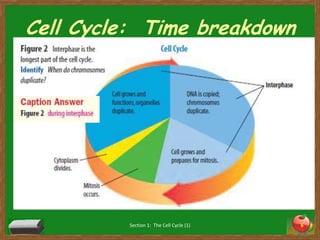
I.  Cell CycleSteps of the Cell Cycle-  The cell cycle is a series of events that cells go through as they grow and divide. Interphase, Prophase, Metaphase, Anaphase, Telophase, and Cytokenesis. INTERPHASE-  First step in the Cell Cycle has  three parts. G1 PhaseDuring the G1 phase cells do most of their growing. During this phase, cells increase in size and synthesize (make) new proteins and organelles. Section 1:  The Cell Cycle (1)3
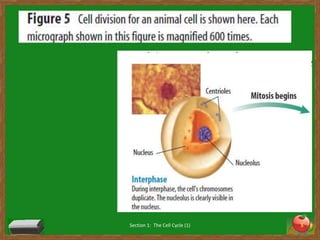
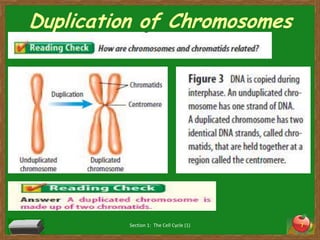
I.  Cell CycleInterphase(Continued)S-PhaseThe G1 Phase is followed by the S PhaseChromosomes are replicated and the synthesis of DNA occurs.G2 PhaseG2 is usually the shortest phase of interphase. During G2 phase, many of the organelles and molecules required for cell division are produced. When the events of the G2 Phase are complete, the cell is ready to enter the Mitosis and cytokinesis phases, and begin the process of cell division.  Section 1:  The Cell Cycle (1)4
Section 1:  The Cell Cycle (1)5
Cell Cycle:  Time breakdownSection 1:  The Cell Cycle (1)6
Duplication of ChromosomesSection 1:  The Cell Cycle (1)7
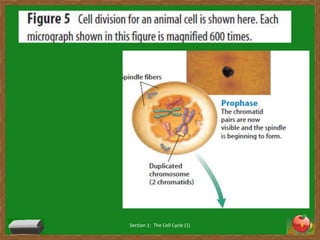
I.  Cell CycleMitosis-  Biologists divide the events of Mitosis into four phases:  prophase, metaphase, anaphase, and telophase;   Mitosis is the process in which the nucleus divides to form two identical nuclei. Prophase- First and longest phase of mitosis. Chromosomes become visible. Centrioles separate and locate on opposite sides of the nucleus. Between the centrioles threadlike spindle fibers begin to stretch across the cell. Nuclear membrane and nucleolus fade and disappear. Section 1:  The Cell Cycle (1)8
Section 1:  The Cell Cycle (1)9
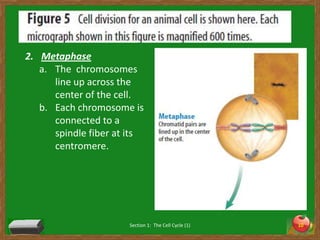
Section 1:  The Cell Cycle (1)10Metaphase The  chromosomes line up across the center of the cell. Each chromosome is connected to a spindle fiber at its centromere.
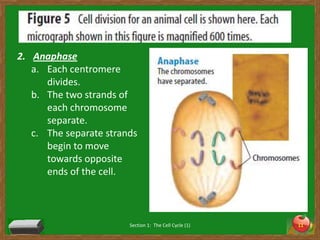
Section 1:  The Cell Cycle (1)11AnaphaseEach centromere divides. The two strands of each chromosome separate. The separate strands begin to move towards opposite ends of the cell.
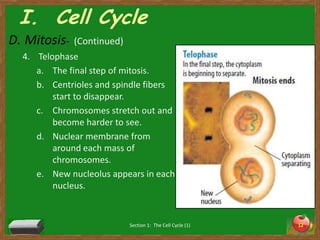
I.  Cell CycleMitosis-  (Continued)TelophaseThe final step of mitosis. Centrioles and spindle fibers start to disappear. Chromosomes stretch out and become harder to see. Nuclear membrane from around each mass of chromosomes. New nucleolus appears in each nucleus. Section 1:  The Cell Cycle (1)12
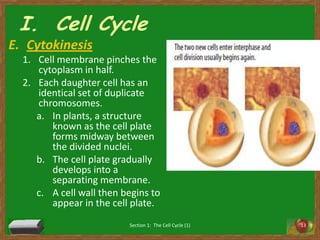
I.  Cell CycleCytokinesisCell membrane pinches the cytoplasm in half. Each daughter cell has an identical set of duplicate chromosomes. In plants, a structure known as the cell plate forms midway between the divided nuclei. The cell plate gradually develops into a separating membrane. A cell wall then begins to appear in the cell plate. Section 1:  The Cell Cycle (1)13
I.  Cell CycleResults of MitosisMitosis is the division of the nucleus, it produces two nuclei that are identical to each other and the original nucleus. Each cell in your body, except sex cells, has a nucleus with 46 chromosomes, 23 pairs. All of your cells use different parts of the same hereditary material to become different types of cells.  (see pg 100 in your book)Section 1:  The Cell Cycle (1)14
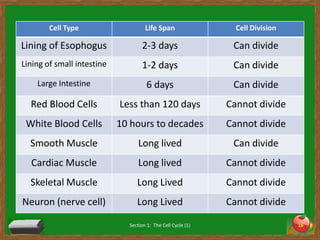
I.  Cell CycleResults of MitosisMitosis allows growth and replaces worn out or damaged cells. If you cut yourself, the wound heals because cell division replaces damaged cells. You are much larger and have more cells than a baby mainly because of cell division. Section 1:  The Cell Cycle (1)15
Section 1:  The Cell Cycle (1)16
II. Asexual ReproductionAsexual ReproductionThere are two types of reproduction. Asexual reproductionSexual reproductionIn asexual reproduction, a new organism (sometimes more than one) is produced from one organism. The new organism will have hereditary material identical to the hereditary material of the parent organism. How many organisms are needed for asexual reproduction?OneSection 1:  The Cell Cycle (1)17
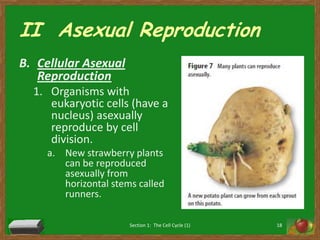
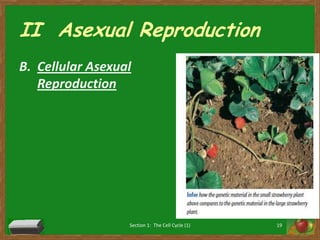
II  Asexual ReproductionCellular Asexual ReproductionOrganisms with eukaryotic cells (have a nucleus) asexually reproduce by cell division. New strawberry plants can be reproduced asexually from horizontal stems called runners. Section 1:  The Cell Cycle (1)18
II  Asexual ReproductionCellular Asexual ReproductionSection 1:  The Cell Cycle (1)19
II. Asexual ReproductionCellular Asexual ReproductionBacteria do not have a nucleus, so they cannot use mitosis.  Instead bacteria reproduce asexually by fission. During fission, an organism whose cells do not contain a nucleus copies its genetic material and then divides into two identical organisms. Section 1:  The Cell Cycle (1)20
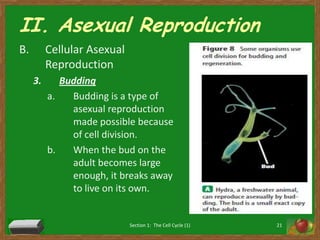
II. Asexual ReproductionCellular Asexual ReproductionBudding Budding is a type of asexual reproduction made possible because of cell division. When the bud on the adult becomes large enough, it breaks away to live on its own.Section 1:  The Cell Cycle (1)21
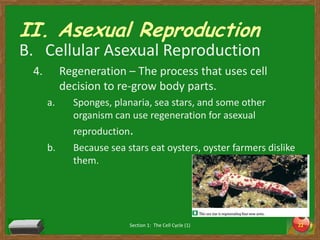
II. Asexual ReproductionCellular Asexual ReproductionRegeneration– The process that uses cell decision to re-grow body parts. Sponges, planaria, sea stars, and some other organism can use regeneration for asexual reproduction. Because sea stars eat oysters, oyster farmers dislike them.  Section 1:  The Cell Cycle (1)22
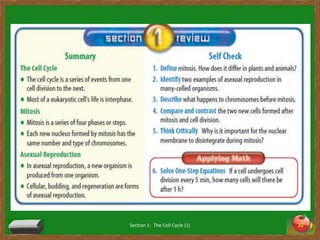
Section 1:  The Cell Cycle (1)23

Chapter 4 section 1 (cell divsion and mitosis)

  • 1.
    Chapter 4: Cell ReproductionSection 1: Cell Division and MitosisMr. MotukMinersville Area Jr./Sr. High School
  • 2.
    I. CellCycleCell Cycle: Organisms to through stages, or a life cycle, while they are alive. A simple life cycle would be birth, growth and development, and death. Cells go through a life cycle.The cell cycle is a series of events that take place in a cell from one division to the next. Different types of cells divide differentlyNerve cells cannot be replaced while skin cells are constantly being replaced. Section 1: The Cell Cycle (1)2
  • 3.
    I. CellCycleSteps of the Cell Cycle- The cell cycle is a series of events that cells go through as they grow and divide. Interphase, Prophase, Metaphase, Anaphase, Telophase, and Cytokenesis. INTERPHASE- First step in the Cell Cycle has three parts. G1 PhaseDuring the G1 phase cells do most of their growing. During this phase, cells increase in size and synthesize (make) new proteins and organelles. Section 1: The Cell Cycle (1)3
  • 4.
    I. CellCycleInterphase(Continued)S-PhaseThe G1 Phase is followed by the S PhaseChromosomes are replicated and the synthesis of DNA occurs.G2 PhaseG2 is usually the shortest phase of interphase. During G2 phase, many of the organelles and molecules required for cell division are produced. When the events of the G2 Phase are complete, the cell is ready to enter the Mitosis and cytokinesis phases, and begin the process of cell division. Section 1: The Cell Cycle (1)4
  • 5.
    Section 1: The Cell Cycle (1)5
  • 6.
    Cell Cycle: Time breakdownSection 1: The Cell Cycle (1)6
  • 7.
    Duplication of ChromosomesSection1: The Cell Cycle (1)7
  • 8.
    I. CellCycleMitosis- Biologists divide the events of Mitosis into four phases: prophase, metaphase, anaphase, and telophase; Mitosis is the process in which the nucleus divides to form two identical nuclei. Prophase- First and longest phase of mitosis. Chromosomes become visible. Centrioles separate and locate on opposite sides of the nucleus. Between the centrioles threadlike spindle fibers begin to stretch across the cell. Nuclear membrane and nucleolus fade and disappear. Section 1: The Cell Cycle (1)8
  • 9.
    Section 1: The Cell Cycle (1)9
  • 10.
    Section 1: The Cell Cycle (1)10Metaphase The chromosomes line up across the center of the cell. Each chromosome is connected to a spindle fiber at its centromere.
  • 11.
    Section 1: The Cell Cycle (1)11AnaphaseEach centromere divides. The two strands of each chromosome separate. The separate strands begin to move towards opposite ends of the cell.
  • 12.
    I. CellCycleMitosis- (Continued)TelophaseThe final step of mitosis. Centrioles and spindle fibers start to disappear. Chromosomes stretch out and become harder to see. Nuclear membrane from around each mass of chromosomes. New nucleolus appears in each nucleus. Section 1: The Cell Cycle (1)12
  • 13.
    I. CellCycleCytokinesisCell membrane pinches the cytoplasm in half. Each daughter cell has an identical set of duplicate chromosomes. In plants, a structure known as the cell plate forms midway between the divided nuclei. The cell plate gradually develops into a separating membrane. A cell wall then begins to appear in the cell plate. Section 1: The Cell Cycle (1)13
  • 14.
    I. CellCycleResults of MitosisMitosis is the division of the nucleus, it produces two nuclei that are identical to each other and the original nucleus. Each cell in your body, except sex cells, has a nucleus with 46 chromosomes, 23 pairs. All of your cells use different parts of the same hereditary material to become different types of cells. (see pg 100 in your book)Section 1: The Cell Cycle (1)14
  • 15.
    I. CellCycleResults of MitosisMitosis allows growth and replaces worn out or damaged cells. If you cut yourself, the wound heals because cell division replaces damaged cells. You are much larger and have more cells than a baby mainly because of cell division. Section 1: The Cell Cycle (1)15
  • 16.
    Section 1: The Cell Cycle (1)16
  • 17.
    II. Asexual ReproductionAsexualReproductionThere are two types of reproduction. Asexual reproductionSexual reproductionIn asexual reproduction, a new organism (sometimes more than one) is produced from one organism. The new organism will have hereditary material identical to the hereditary material of the parent organism. How many organisms are needed for asexual reproduction?OneSection 1: The Cell Cycle (1)17
  • 18.
    II AsexualReproductionCellular Asexual ReproductionOrganisms with eukaryotic cells (have a nucleus) asexually reproduce by cell division. New strawberry plants can be reproduced asexually from horizontal stems called runners. Section 1: The Cell Cycle (1)18
  • 19.
    II AsexualReproductionCellular Asexual ReproductionSection 1: The Cell Cycle (1)19
  • 20.
    II. Asexual ReproductionCellularAsexual ReproductionBacteria do not have a nucleus, so they cannot use mitosis. Instead bacteria reproduce asexually by fission. During fission, an organism whose cells do not contain a nucleus copies its genetic material and then divides into two identical organisms. Section 1: The Cell Cycle (1)20
  • 21.
    II. Asexual ReproductionCellularAsexual ReproductionBudding Budding is a type of asexual reproduction made possible because of cell division. When the bud on the adult becomes large enough, it breaks away to live on its own.Section 1: The Cell Cycle (1)21
  • 22.
    II. Asexual ReproductionCellularAsexual ReproductionRegeneration– The process that uses cell decision to re-grow body parts. Sponges, planaria, sea stars, and some other organism can use regeneration for asexual reproduction. Because sea stars eat oysters, oyster farmers dislike them. Section 1: The Cell Cycle (1)22
  • 23.
    Section 1: The Cell Cycle (1)23