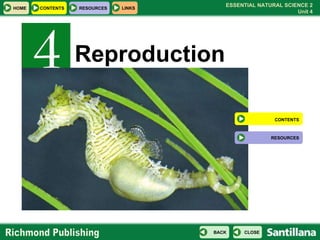
Reproduction CONTENTS RESOURCES
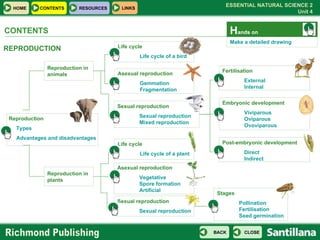
CONTENTS Reproduction Types Advantages and disadvantages Asexual reproduction Vegetative  Spore formation Artificial Fertilisation External Internal Sexual reproduction Sexual reproduction Mixed reproduction Reproduction in animals Reproduction in plants Embryonic development Viviparous Oviparous Ovoviparous Post-embryonic development Direct Indirect Sexual reproduction Sexual reproduction Stages Pollination Fertilisation Seed germination Life cycle  Life cycle of a plant Life cycle Life cycle of a bird Asexual reproduction Gemmation Fragmentation REPRODUCTION H ands on Make a detailed drawing
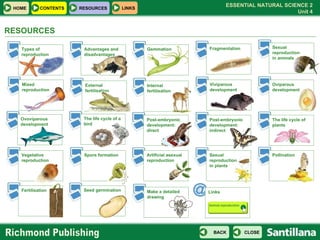
RESOURCES Types of reproduction Advantages and disadvantages Fragmentation Gemmation Sexual reproduction in animals Mixed reproduction External fertilisation Internal fertilisation Oviparous development Viviparous development Post-embryonic development: direct The life cycle of a bird Ovoviparous development Post-embryonic development: indirect Spore formation The life cycle of plants Artificial asexual reproduction Vegetative reproduction Sexual reproduction in plants Pollination Seed germination Fertilisation Make a detailed drawing Links Animal reproduction
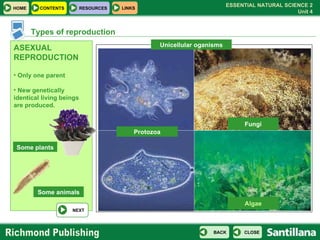
ASEXUAL REPRODUCTION Only one parent New genetically identical living beings are produced. Some animals Some plants Types of reproduction  Protozoa Fungi Algae Unicellular oganisms NEXT
Types of reproduction SEXUAL REPRODUCTION Two parents: a  male and a female Descendants have  genetic material from  both parents. Multicellular oganisms
Advantages and disadvantages Advantages requires only one parent faster and easier rapid population growth no travel is necessary Disadvantages no genetic diversity difficulty in adapting to environmental changes clone Asexual reproduction NEXT
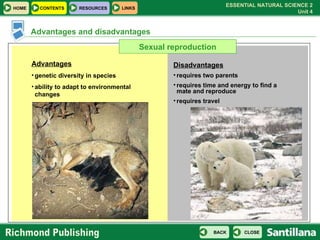
Advantages and disadvantages Advantages genetic diversity in species ability to adapt to environmental changes Disadvantages requires two parents requires time and energy to find a mate and reproduce requires travel Sexual reproduction
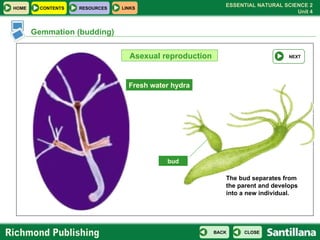
Gemmation (budding) Asexual reproduction Fresh water hydra bud The bud separates from the parent and develops into a new individual. NEXT
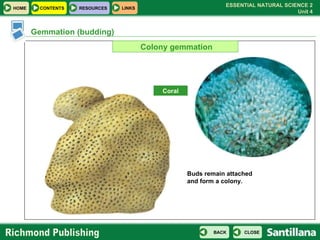
Gemmation (budding) Colony gemmation Coral Buds remain attached and form a colony.
Fragmentation Regeneration Starfish regenerated arms NEXT
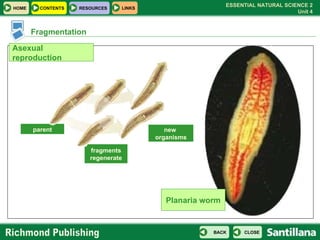
Fragmentation new  organisms fragments regenerate parent Planaria worm Asexual reproduction
Snails Sexual reproduction in animals Hhermaphrodites have both male and female gonads. NEXT
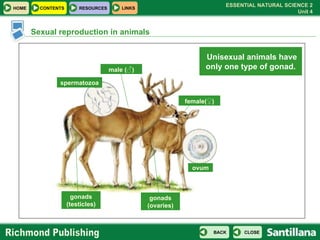
ovum spermatozoa Sexual reproduction in animals Unisexual animals have only one type of gonad. male ( ♂ ) female( ♀ ) gonads (testicles) gonads (ovaries)
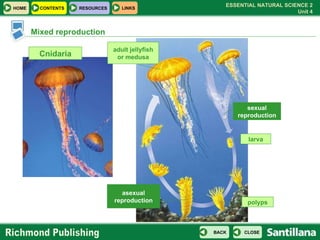
Mixed reproduction Cnidaria sexual reproduction asexual reproduction larva polyps adult jellyfish or medusa
External fertilisation Life cycle with external fertilisation male( ♂ ) female( ♀ ) Fusion of the gametes occurs outside the female body. developing embryos ova spermatozoa
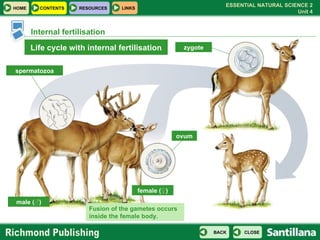
Internal fertilisation Life cycle with internal fertilisation male ( ♂ ) female ( ♀ ) ovum spermatozoa zygote Fusion of the gametes occurs inside the female body.
Viviparous development Mammals Embryonic development The embryo develops inside the female body. placenta umbilical cord uterus embryo
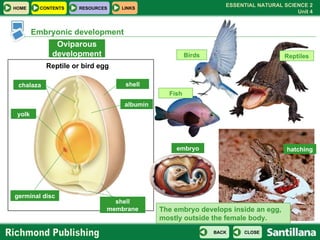
embryo Fish Birds Embryonic development Reptiles Reptile or bird egg Oviparous development The embryo develops inside an egg, mostly outside the female body. hatching shell chalaza albumin yolk germinal disc shell membrane
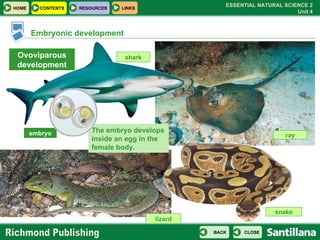
shark Embryonic development ray snake lizard The embryo develops inside an egg in the female body. embryo Ovoviparous development
Life cycle of a bird embryonic development After fertilisation, the embryo begins to develop inside the egg. The egg is laid in a nest. The embryo continues to develop during incubation. Hatching The male and female bird mate. The new being leaves the egg.
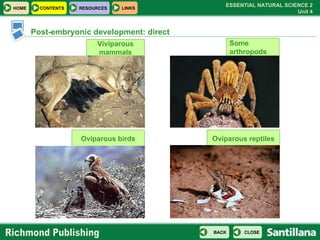
Some arthropods Oviparous birds Viviparous mammals Post-embryonic development: direct Oviparous reptiles
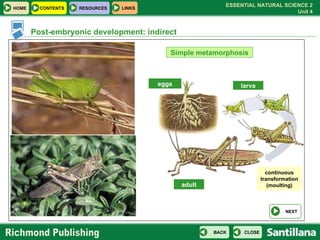
Post-embryonic development: indirect Simple metamorphosis larva eggs adult continuous transformation (moulting) NEXT
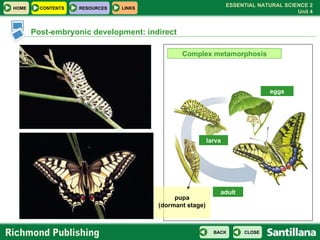
Post-embryonic development: indirect Complex metamorphosis pupa (dormant stage) larva eggs adult
The life cycle of plants FLOWERING PLANTS NON-FLOWERING PLANTS Angiosperms Gymnosperms Mosses Ferns VISIBLE PART gametophyte VISIBLE PART sporophyte NEXT VISIBLE PART sporophyte gametophyte
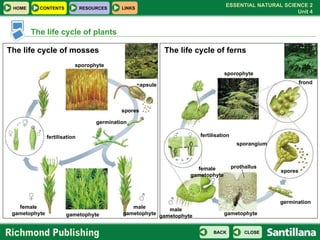
The life cycle of plants The life cycle of mosses The life cycle of ferns capsule sporophyte gametophyte germination sporangium spores frond fertilisation ♀ ♂ male gametophyte ♂ female gametophyte ♀ prothallus sporophyte spores germination gametophyte male gametophyte female gametophyte fertilisation ♂ ♀ ♀ ♂
fern Spore formation spores moss spores FUNGI  ARE NOT PLANTS. spores mushroom
Vegetative reproduction Stolons Bulbs Stem tubers white clover stolon bud potato onion garlic
Artificial asexual reproduction in plants Layering Artificial methods Cuttings Grafting
Sexual reproduction in plants FLOWER gametophyte  reproductive organs gametes anther pollen grains anther filament stamen sepals (calyx) stigma style ovary ovules pistil petals (corolla)
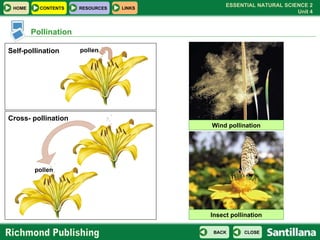
Pollination Self-pollination Cross- pollination pollen pollen Wind pollination Insect pollination
Fertilisation in plants ovule Pollen grains land and a pollen tube develops. 1 pollen grains The ovule (female gamete) is fertilised and a zygote is formed. 2 pollen tube male  gamete embryo albumin seed cotyledons The ovary becomes the  fruit and the ovule becomes a seed. 3 The seed germinates and an embryo develops. 4
Seed germination OXYGEN TEMPERATURE MOISTURE seed cotyledons radicle plumule bud water
Make a detailed drawing: The flower Prepare the slide Remove some petals. Place the flower on a glass. Tape the flower to the transparency. Cut the transparency into a square. Place it on a slide frame. Project the image. Insert the slide into the projector.  Project the image onto the paper. Move the projector in close so the entire image fits on the paper.  Draw over the projected image. Complete the drawing Add the names of each part of the flower.  sepal ovary style petal stigma anther
Links Animal reproduction http://www.saburchill.com/chapters/chap0031.html Plant Reproduction Tutorial http://www.skoool.ie/content/skoool_learning/junior/lessons/science/plant_reproduction/flash/h-frame-ie.htm Growing plants  http://www.bbc.co.uk/scotland/education/bitesize/standard/biology/world_of_plants/growing_plants_rev1.shtml How plants reproduce http://www.emc.maricopa.edu/faculty/farabee/BIOBK/BioBookflowers.html Flowers and reproduction http://www.saburchill.com/chapters/chap0041.html

U04 Reproduction

  • 1.
  • 2.
    CONTENTS Reproduction TypesAdvantages and disadvantages Asexual reproduction Vegetative Spore formation Artificial Fertilisation External Internal Sexual reproduction Sexual reproduction Mixed reproduction Reproduction in animals Reproduction in plants Embryonic development Viviparous Oviparous Ovoviparous Post-embryonic development Direct Indirect Sexual reproduction Sexual reproduction Stages Pollination Fertilisation Seed germination Life cycle Life cycle of a plant Life cycle Life cycle of a bird Asexual reproduction Gemmation Fragmentation REPRODUCTION H ands on Make a detailed drawing
  • 3.
    RESOURCES Types ofreproduction Advantages and disadvantages Fragmentation Gemmation Sexual reproduction in animals Mixed reproduction External fertilisation Internal fertilisation Oviparous development Viviparous development Post-embryonic development: direct The life cycle of a bird Ovoviparous development Post-embryonic development: indirect Spore formation The life cycle of plants Artificial asexual reproduction Vegetative reproduction Sexual reproduction in plants Pollination Seed germination Fertilisation Make a detailed drawing Links Animal reproduction
  • 4.
    ASEXUAL REPRODUCTION Onlyone parent New genetically identical living beings are produced. Some animals Some plants Types of reproduction Protozoa Fungi Algae Unicellular oganisms NEXT
  • 5.
    Types of reproductionSEXUAL REPRODUCTION Two parents: a male and a female Descendants have genetic material from both parents. Multicellular oganisms
  • 6.
    Advantages and disadvantagesAdvantages requires only one parent faster and easier rapid population growth no travel is necessary Disadvantages no genetic diversity difficulty in adapting to environmental changes clone Asexual reproduction NEXT
  • 7.
    Advantages and disadvantagesAdvantages genetic diversity in species ability to adapt to environmental changes Disadvantages requires two parents requires time and energy to find a mate and reproduce requires travel Sexual reproduction
  • 8.
    Gemmation (budding) Asexualreproduction Fresh water hydra bud The bud separates from the parent and develops into a new individual. NEXT
  • 9.
    Gemmation (budding) Colonygemmation Coral Buds remain attached and form a colony.
  • 10.
  • 11.
    Fragmentation new organisms fragments regenerate parent Planaria worm Asexual reproduction
  • 12.
    Snails Sexual reproductionin animals Hhermaphrodites have both male and female gonads. NEXT
  • 13.
    ovum spermatozoa Sexualreproduction in animals Unisexual animals have only one type of gonad. male ( ♂ ) female( ♀ ) gonads (testicles) gonads (ovaries)
  • 14.
    Mixed reproduction Cnidariasexual reproduction asexual reproduction larva polyps adult jellyfish or medusa
  • 15.
    External fertilisation Lifecycle with external fertilisation male( ♂ ) female( ♀ ) Fusion of the gametes occurs outside the female body. developing embryos ova spermatozoa
  • 16.
    Internal fertilisation Lifecycle with internal fertilisation male ( ♂ ) female ( ♀ ) ovum spermatozoa zygote Fusion of the gametes occurs inside the female body.
  • 17.
    Viviparous development MammalsEmbryonic development The embryo develops inside the female body. placenta umbilical cord uterus embryo
  • 18.
    embryo Fish BirdsEmbryonic development Reptiles Reptile or bird egg Oviparous development The embryo develops inside an egg, mostly outside the female body. hatching shell chalaza albumin yolk germinal disc shell membrane
  • 19.
    shark Embryonic developmentray snake lizard The embryo develops inside an egg in the female body. embryo Ovoviparous development
  • 20.
    Life cycle ofa bird embryonic development After fertilisation, the embryo begins to develop inside the egg. The egg is laid in a nest. The embryo continues to develop during incubation. Hatching The male and female bird mate. The new being leaves the egg.
  • 21.
    Some arthropods Oviparousbirds Viviparous mammals Post-embryonic development: direct Oviparous reptiles
  • 22.
    Post-embryonic development: indirectSimple metamorphosis larva eggs adult continuous transformation (moulting) NEXT
  • 23.
    Post-embryonic development: indirectComplex metamorphosis pupa (dormant stage) larva eggs adult
  • 24.
    The life cycleof plants FLOWERING PLANTS NON-FLOWERING PLANTS Angiosperms Gymnosperms Mosses Ferns VISIBLE PART gametophyte VISIBLE PART sporophyte NEXT VISIBLE PART sporophyte gametophyte
  • 25.
    The life cycleof plants The life cycle of mosses The life cycle of ferns capsule sporophyte gametophyte germination sporangium spores frond fertilisation ♀ ♂ male gametophyte ♂ female gametophyte ♀ prothallus sporophyte spores germination gametophyte male gametophyte female gametophyte fertilisation ♂ ♀ ♀ ♂
  • 26.
    fern Spore formationspores moss spores FUNGI ARE NOT PLANTS. spores mushroom
  • 27.
    Vegetative reproduction StolonsBulbs Stem tubers white clover stolon bud potato onion garlic
  • 28.
    Artificial asexual reproductionin plants Layering Artificial methods Cuttings Grafting
  • 29.
    Sexual reproduction inplants FLOWER gametophyte reproductive organs gametes anther pollen grains anther filament stamen sepals (calyx) stigma style ovary ovules pistil petals (corolla)
  • 30.
    Pollination Self-pollination Cross-pollination pollen pollen Wind pollination Insect pollination
  • 31.
    Fertilisation in plantsovule Pollen grains land and a pollen tube develops. 1 pollen grains The ovule (female gamete) is fertilised and a zygote is formed. 2 pollen tube male gamete embryo albumin seed cotyledons The ovary becomes the fruit and the ovule becomes a seed. 3 The seed germinates and an embryo develops. 4
  • 32.
    Seed germination OXYGENTEMPERATURE MOISTURE seed cotyledons radicle plumule bud water
  • 33.
    Make a detaileddrawing: The flower Prepare the slide Remove some petals. Place the flower on a glass. Tape the flower to the transparency. Cut the transparency into a square. Place it on a slide frame. Project the image. Insert the slide into the projector. Project the image onto the paper. Move the projector in close so the entire image fits on the paper. Draw over the projected image. Complete the drawing Add the names of each part of the flower. sepal ovary style petal stigma anther
  • 34.
    Links Animal reproductionhttp://www.saburchill.com/chapters/chap0031.html Plant Reproduction Tutorial http://www.skoool.ie/content/skoool_learning/junior/lessons/science/plant_reproduction/flash/h-frame-ie.htm Growing plants http://www.bbc.co.uk/scotland/education/bitesize/standard/biology/world_of_plants/growing_plants_rev1.shtml How plants reproduce http://www.emc.maricopa.edu/faculty/farabee/BIOBK/BioBookflowers.html Flowers and reproduction http://www.saburchill.com/chapters/chap0041.html