Chapter 3
REPORTER: BEVERLY A. SERADA
Frequency indicates how often something
occurs.
YOUR
LOGO
Frequency distribution:
A frequency distribution shows the frequency of
repeated items in a graphical form or tabular form. It
gives a visual display of the frequency of items or
shows the number of times they occurred.
A frequency distribution table has two or
three columns.
The first column has all the outcomes as individual
values or in the form of class intervals.
The second column of the table includes tally marks of
each outcome, which also tells us about the frequency
using vertical lines.
The third column tells us about the frequency of each
outcome.
PART OE
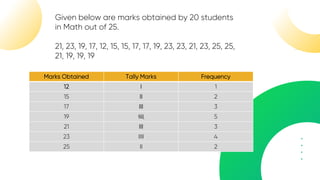
Given below are marks obtained by 20 students
in Math out of 25.
21, 23, 19, 17, 12, 15, 15, 17, 17, 19, 23, 23, 21, 23, 25, 25,
21, 19, 19, 19
Marks Obtained Tally Marks Frequency
12 I 1
15 II 2
17 III 3
19 IIII 5
21 III 3
23 IIII 4
25 II 2
PART OE
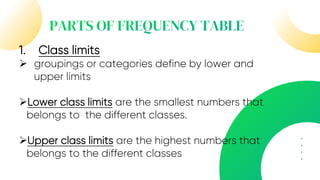
1. Class limits
 groupings or categories define by lower and
upper limits
Lower class limits are the smallest numbers that
belongs to the different classes.
Upper class limits are the highest numbers that
belongs to the different classes
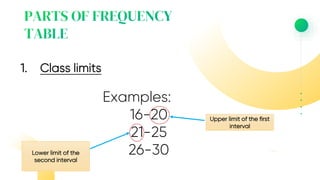
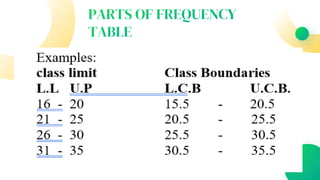
1. Class limits
Examples:
16-20
21-25
26-30
Upper limit of the first
interval
Lower limit of the
second interval
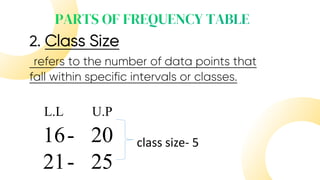
2. Class Size
refers to the number of data points that
fall within specific intervals or classes.
class size- 5
L.L U.P
16- 20
21- 25
3. Class Boundaries
used to separate class but without gaps
created by class limits
the number to be added or subtracted is half
the difference between the upper limit of one
class and the lower limit of the
next class
Topic 1
Presentations are
communication tools.
Topic 1
Presentations are
communication tools.
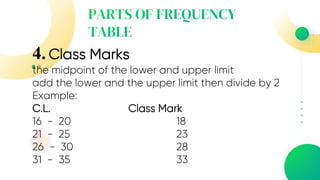
4. Class Marks
the midpoint of the lower and upper limit
add the lower and the upper limit then divide by 2
Example:
C.L. Class Mark
16 - 20 18
21 - 25 23
26 - 30 28
31 - 35 33
Topic 1
Presentations are
communication tools.
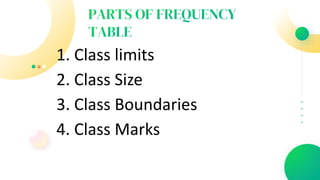
1. Class limits
2. Class Size
3. Class Boundaries
4. Class Marks
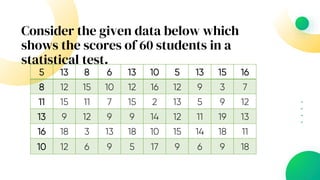
Consider the given data below which
shows the scores of 60 students in a
statistical test.
5 13 8 6 13 10 5 13 15 16
8 12 15 10 12 16 12 9 3 7
11 15 11 7 15 2 13 5 9 12
13 9 12 9 9 14 12 11 19 13
16 18 3 13 18 10 15 14 18 11
10 12 6 9 5 17 9 6 9 18
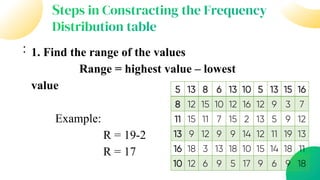
: 1. Find the range of the values
Range = highest value – lowest
value
Example:
R = 19-2
R = 17
5 13 8 6 13 10 5 13 15 16
8 12 15 10 12 16 12 9 3 7
11 15 11 7 15 2 13 5 9 12
13 9 12 9 9 14 12 11 19 13
16 18 3 13 18 10 15 14 18 11
10 12 6 9 5 17 9 6 9 18
Presentations are
communication
tools.
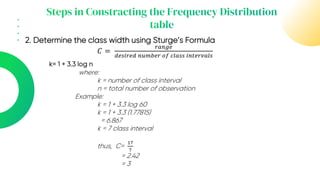
2. Determine the class width using Sturge’s Formula
𝐶 =
𝑟𝑎𝑛𝑔𝑒
𝑑𝑒𝑠𝑖𝑟𝑒𝑑 𝑛𝑢𝑚𝑏𝑒𝑟 𝑜𝑓 𝑐𝑙𝑎𝑠𝑠 𝑖𝑛𝑡𝑒𝑟𝑣𝑎𝑙𝑠
k= 1 + 3.3 log n
where:
k = number of class interval
n = total number of observation
Example:
k = 1 + 3.3 log 60
k = 1 + 3.3 (1.77815)
= 6.867
k = 7 class interval
thus, C=
17
7
= 2.42
= 3
Topic
Presentations are
communication
tools.
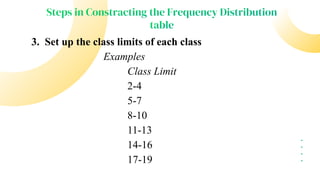
3. Set up the class limits of each class
Examples
Class Limit
2-4
5-7
8-10
11-13
14-16
17-19
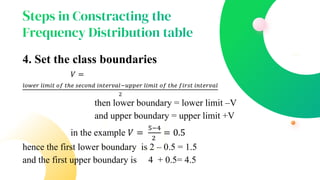
4. Set the class boundaries
𝑉 =
𝑙𝑜𝑤𝑒𝑟 𝑙𝑖𝑚𝑖𝑡 𝑜𝑓 𝑡ℎ𝑒 𝑠𝑒𝑐𝑜𝑛𝑑 𝑖𝑛𝑡𝑒𝑟𝑣𝑎𝑙−𝑢𝑝𝑝𝑒𝑟 𝑙𝑖𝑚𝑖𝑡 𝑜𝑓 𝑡ℎ𝑒 𝑓𝑖𝑟𝑠𝑡 𝑖𝑛𝑡𝑒𝑟𝑣𝑎𝑙
2
then lower boundary = lower limit –V
and upper boundary = upper limit +V
in the example 𝑉 =
5−4
2
= 0.5
hence the first lower boundary is 2 – 0.5 = 1.5
and the first upper boundary is 4 + 0.5= 4.5
Examples
Class Limit
2-4
5-7
8-10
11-13
14-16
17-19
Upper limit of the first
interval
Lower limit of the
second interval
Examples:
Class boundaries
1.5 - 4.5
4.5 - 7.5
7.5 -10.5
10.5 - 13.5
13.5 - 16.5
16.5 - 19.5
Class Limit
2-4
5-7
8-10
11-13
14-16
17-19
240+
Short description
Presentations are communication
tools that can be used as speeches,
reports, and more.
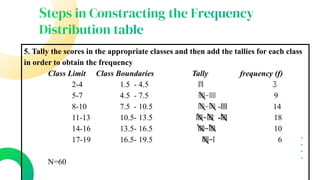
5. Tally the scores in the appropriate classes and then add the tallies for each class
in order to obtain the frequency
Class Limit Class Boundaries Tally frequency (f)
2-4 1.5 - 4.5 lll 3
5-7 4.5 - 7.5 llll-llll 9
8-10 7.5 - 10.5 llll-llll -llll 14
11-13 10.5- 13.5 llll-llll -llll 18
14-16 13.5- 16.5 llll-llll 10
17-19 16.5- 19.5 llll-l 6
N=60
Consider the given data below which
shows the scores of 60 students in a
statistical test.
5 13 8 6 13 10 5 13 15 16
8 12 15 10 12 16 12 9 3 7
11 15 11 7 15 2 13 5 9 12
13 9 12 9 9 14 12 11 19 13
16 18 3 13 18 10 15 14 18 11
10 12 6 9 5 17 9 6 9 18
Education.
Presentations are communication tools that can be used as demonstrations,
lectures, speeches, reports, and more. Most of the time, they're presented
before an audience.
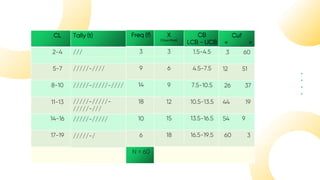
What is cumulative frequency distribution ?
• Cumulative means totalling or gradually building up. In statistics, cumulative frequency is
found by adding up all successive frequencies in a frequency distribution table.
• In statistics, the frequency of the first-class interval is added to the frequency of the second class,
and this sum is added to the third class and so on then, frequencies that are obtained this way are
known as cumulative frequency (c.f.).
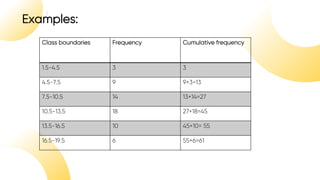
• A cumulative frequency table is a simple visual representation of the cumulative
frequencies for each distinct value or category.
Class boundaries Frequency Cumulative frequency
1.5-4.5 3 3
4.5-7.5 9 9+3=13
7.5-10.5 14 13+14=27
10.5-13.5 18 27+18=45
13.5-16.5 10 45+10= 55
16.5-19.5 6 55+6=61
Examples:
Education.
Presentations are communication tools that can be used as demonstrations,
lectures, speeches, reports, and more. Most of the time, they're presented
before an audience.
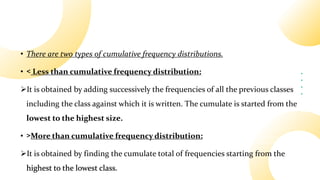
• There are two types of cumulative frequency distributions.
• < Less than cumulative frequency distribution:
It is obtained by adding successively the frequencies of all the previous classes
including the class against which it is written. The cumulate is started from the
lowest to the highest size.
• >More than cumulative frequency distribution:
It is obtained by finding the cumulate total of frequencies starting from the
highest to the lowest class.
Education.
Presentations are communication tools that can be used as demonstrations,
lectures, speeches, reports, and more. Most of the time, they're presented
before an audience.
CL
2-4
5-7
8-10
11-13
14-16
17-19
Tally (t)
///
/////-////
/////-/////-////
/////-/////-
/////-///
/////-/////
/////-/
Freq (f)
3
9
14
18
10
6
N = 60
X
(Class Mark)
3
6
9
12
15
18
CB
LCB - UCB
1.5-4.5
4.5-7.5
7.5-10.5
10.5-13.5
13.5-16.5
16.5-19.5
Cuf
< >
3 60
12 51
26 37
44 19
54 9
60 3
Education.
Presentations are communication tools that can be used as demonstrations,
lectures, speeches, reports, and more. Most of the time, they're presented
before an audience.
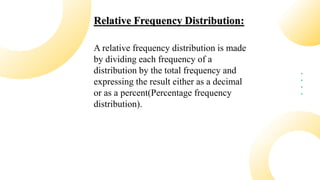
Relative Frequency Distribution:
A relative frequency distribution is made
by dividing each frequency of a
distribution by the total frequency and
expressing the result either as a decimal
or as a percent(Percentage frequency
distribution).
Education.
Presentations are communication tools that can be used as demonstrations,
lectures, speeches, reports, and more. Most of the time, they're presented
before an audience.
CL
2-4
5-7
8-10
11-13
14-16
17-19
Tally (t)
///
/////-////
/////-/////-////
/////-/////-
/////-///
/////-/////
/////-/
Freq (f)
3
9
14
18
10
6
N = 60
X
3
6
9
12
15
18
CB
LCB - UCB
1.5-4.5
4.5-7.5
7.5-10.5
10.5-13.5
13.5-16.5
16.5-19.5
Cuf
< >
3 60
12 51
26 37
44 19
54 9
60 3
rel f
3/60(100)= 5
9/60(100)= 15
14/60(100)= 23.33
18/60(100)= 30
/60(100)= 16
/60(100)= 10
Education.
Presentations are communication tools that can be used as demonstrations,
lectures, speeches, reports, and more. Most of the time, they're presented
before an audience.
Example-2
The following data show the weights (in pounds) of 30
students of a school.
(a) Find relative frequency distribution.
(b) Find percentage frequency distribution.
(c) What percentage of the student‘s weight is less 117 pounds.
(d) What percentage of the student‘s weight is over 117 pounds.
(e) What percentage of the student‘s weight is in between 100 and
126 pounds.
Class Interval Frequency
91 - 99 3
100 – 108 7
109 – 117 11
118 – 126 7
127 – 135 2
30
Solution:
(a) And (b)
Class Interval Frequency Relative Frequency=
𝒇
𝒇
Percentage Frequency=
𝒇
𝒇
× 𝟏𝟎𝟎
91 - 99 3
100 – 108 7
109 – 117 11
118 – 126 7
127 – 135 2
30 1 100
1
.
0
30
3

10
100
30
3


23
.
0
30
7

33
.
23
100
30
7


37
.
0
30
11
 67
.
36
100
30
11


23
.
0
30
7

33
.
23
100
30
7


07
.
0
30
2
 67
.
6
100
30
2


(c) From column four
Percentage of the student's weight is less 117 pounds = 10% + 23.33%
+ 36.67%
Percentage of the student's weight is less 117 pounds = 70%
(d) From column four
Percentage of the student's weight is over 117 pounds = 23.33% +
6.67%
Percentage of the student's weight is over 117 pounds = 30%
Topic 1
Presentations are
communication tools.
(e) From column four
Percentage of the student's weight is in between 100 and
126 pounds =
23.33% + 36.67% +
23.33%
Percentage of the student's weight is in between 100 and
126 pounds = 83.33%
CHAPTER 3: FREQUENCY DISTRIBUTION ..pptx

CHAPTER 3: FREQUENCY DISTRIBUTION ..pptx

  • 1.
  • 2.
    Frequency indicates howoften something occurs.
  • 3.
    YOUR LOGO Frequency distribution: A frequencydistribution shows the frequency of repeated items in a graphical form or tabular form. It gives a visual display of the frequency of items or shows the number of times they occurred.
  • 4.
    A frequency distributiontable has two or three columns. The first column has all the outcomes as individual values or in the form of class intervals. The second column of the table includes tally marks of each outcome, which also tells us about the frequency using vertical lines. The third column tells us about the frequency of each outcome.
  • 5.
    PART OE Given beloware marks obtained by 20 students in Math out of 25. 21, 23, 19, 17, 12, 15, 15, 17, 17, 19, 23, 23, 21, 23, 25, 25, 21, 19, 19, 19 Marks Obtained Tally Marks Frequency 12 I 1 15 II 2 17 III 3 19 IIII 5 21 III 3 23 IIII 4 25 II 2
  • 6.
    PART OE 1. Classlimits  groupings or categories define by lower and upper limits Lower class limits are the smallest numbers that belongs to the different classes. Upper class limits are the highest numbers that belongs to the different classes
  • 7.
    1. Class limits Examples: 16-20 21-25 26-30 Upperlimit of the first interval Lower limit of the second interval
  • 8.
    2. Class Size refersto the number of data points that fall within specific intervals or classes. class size- 5 L.L U.P 16- 20 21- 25
  • 9.
    3. Class Boundaries usedto separate class but without gaps created by class limits the number to be added or subtracted is half the difference between the upper limit of one class and the lower limit of the next class
  • 10.
  • 11.
    Topic 1 Presentations are communicationtools. 4. Class Marks the midpoint of the lower and upper limit add the lower and the upper limit then divide by 2 Example: C.L. Class Mark 16 - 20 18 21 - 25 23 26 - 30 28 31 - 35 33
  • 13.
    Topic 1 Presentations are communicationtools. 1. Class limits 2. Class Size 3. Class Boundaries 4. Class Marks
  • 15.
    Consider the givendata below which shows the scores of 60 students in a statistical test. 5 13 8 6 13 10 5 13 15 16 8 12 15 10 12 16 12 9 3 7 11 15 11 7 15 2 13 5 9 12 13 9 12 9 9 14 12 11 19 13 16 18 3 13 18 10 15 14 18 11 10 12 6 9 5 17 9 6 9 18
  • 16.
    : 1. Findthe range of the values Range = highest value – lowest value Example: R = 19-2 R = 17 5 13 8 6 13 10 5 13 15 16 8 12 15 10 12 16 12 9 3 7 11 15 11 7 15 2 13 5 9 12 13 9 12 9 9 14 12 11 19 13 16 18 3 13 18 10 15 14 18 11 10 12 6 9 5 17 9 6 9 18
  • 17.
    Presentations are communication tools. 2. Determinethe class width using Sturge’s Formula 𝐶 = 𝑟𝑎𝑛𝑔𝑒 𝑑𝑒𝑠𝑖𝑟𝑒𝑑 𝑛𝑢𝑚𝑏𝑒𝑟 𝑜𝑓 𝑐𝑙𝑎𝑠𝑠 𝑖𝑛𝑡𝑒𝑟𝑣𝑎𝑙𝑠 k= 1 + 3.3 log n where: k = number of class interval n = total number of observation Example: k = 1 + 3.3 log 60 k = 1 + 3.3 (1.77815) = 6.867 k = 7 class interval thus, C= 17 7 = 2.42 = 3
  • 18.
    Topic Presentations are communication tools. 3. Setup the class limits of each class Examples Class Limit 2-4 5-7 8-10 11-13 14-16 17-19
  • 19.
    4. Set theclass boundaries 𝑉 = 𝑙𝑜𝑤𝑒𝑟 𝑙𝑖𝑚𝑖𝑡 𝑜𝑓 𝑡ℎ𝑒 𝑠𝑒𝑐𝑜𝑛𝑑 𝑖𝑛𝑡𝑒𝑟𝑣𝑎𝑙−𝑢𝑝𝑝𝑒𝑟 𝑙𝑖𝑚𝑖𝑡 𝑜𝑓 𝑡ℎ𝑒 𝑓𝑖𝑟𝑠𝑡 𝑖𝑛𝑡𝑒𝑟𝑣𝑎𝑙 2 then lower boundary = lower limit –V and upper boundary = upper limit +V in the example 𝑉 = 5−4 2 = 0.5 hence the first lower boundary is 2 – 0.5 = 1.5 and the first upper boundary is 4 + 0.5= 4.5
  • 20.
    Examples Class Limit 2-4 5-7 8-10 11-13 14-16 17-19 Upper limitof the first interval Lower limit of the second interval
  • 21.
    Examples: Class boundaries 1.5 -4.5 4.5 - 7.5 7.5 -10.5 10.5 - 13.5 13.5 - 16.5 16.5 - 19.5 Class Limit 2-4 5-7 8-10 11-13 14-16 17-19
  • 22.
    240+ Short description Presentations arecommunication tools that can be used as speeches, reports, and more. 5. Tally the scores in the appropriate classes and then add the tallies for each class in order to obtain the frequency Class Limit Class Boundaries Tally frequency (f) 2-4 1.5 - 4.5 lll 3 5-7 4.5 - 7.5 llll-llll 9 8-10 7.5 - 10.5 llll-llll -llll 14 11-13 10.5- 13.5 llll-llll -llll 18 14-16 13.5- 16.5 llll-llll 10 17-19 16.5- 19.5 llll-l 6 N=60
  • 23.
    Consider the givendata below which shows the scores of 60 students in a statistical test. 5 13 8 6 13 10 5 13 15 16 8 12 15 10 12 16 12 9 3 7 11 15 11 7 15 2 13 5 9 12 13 9 12 9 9 14 12 11 19 13 16 18 3 13 18 10 15 14 18 11 10 12 6 9 5 17 9 6 9 18
  • 24.
    Education. Presentations are communicationtools that can be used as demonstrations, lectures, speeches, reports, and more. Most of the time, they're presented before an audience. What is cumulative frequency distribution ? • Cumulative means totalling or gradually building up. In statistics, cumulative frequency is found by adding up all successive frequencies in a frequency distribution table. • In statistics, the frequency of the first-class interval is added to the frequency of the second class, and this sum is added to the third class and so on then, frequencies that are obtained this way are known as cumulative frequency (c.f.). • A cumulative frequency table is a simple visual representation of the cumulative frequencies for each distinct value or category.
  • 25.
    Class boundaries FrequencyCumulative frequency 1.5-4.5 3 3 4.5-7.5 9 9+3=13 7.5-10.5 14 13+14=27 10.5-13.5 18 27+18=45 13.5-16.5 10 45+10= 55 16.5-19.5 6 55+6=61 Examples:
  • 26.
    Education. Presentations are communicationtools that can be used as demonstrations, lectures, speeches, reports, and more. Most of the time, they're presented before an audience. • There are two types of cumulative frequency distributions. • < Less than cumulative frequency distribution: It is obtained by adding successively the frequencies of all the previous classes including the class against which it is written. The cumulate is started from the lowest to the highest size. • >More than cumulative frequency distribution: It is obtained by finding the cumulate total of frequencies starting from the highest to the lowest class.
  • 27.
    Education. Presentations are communicationtools that can be used as demonstrations, lectures, speeches, reports, and more. Most of the time, they're presented before an audience. CL 2-4 5-7 8-10 11-13 14-16 17-19 Tally (t) /// /////-//// /////-/////-//// /////-/////- /////-/// /////-///// /////-/ Freq (f) 3 9 14 18 10 6 N = 60 X (Class Mark) 3 6 9 12 15 18 CB LCB - UCB 1.5-4.5 4.5-7.5 7.5-10.5 10.5-13.5 13.5-16.5 16.5-19.5 Cuf < > 3 60 12 51 26 37 44 19 54 9 60 3
  • 28.
    Education. Presentations are communicationtools that can be used as demonstrations, lectures, speeches, reports, and more. Most of the time, they're presented before an audience. Relative Frequency Distribution: A relative frequency distribution is made by dividing each frequency of a distribution by the total frequency and expressing the result either as a decimal or as a percent(Percentage frequency distribution).
  • 29.
    Education. Presentations are communicationtools that can be used as demonstrations, lectures, speeches, reports, and more. Most of the time, they're presented before an audience. CL 2-4 5-7 8-10 11-13 14-16 17-19 Tally (t) /// /////-//// /////-/////-//// /////-/////- /////-/// /////-///// /////-/ Freq (f) 3 9 14 18 10 6 N = 60 X 3 6 9 12 15 18 CB LCB - UCB 1.5-4.5 4.5-7.5 7.5-10.5 10.5-13.5 13.5-16.5 16.5-19.5 Cuf < > 3 60 12 51 26 37 44 19 54 9 60 3 rel f 3/60(100)= 5 9/60(100)= 15 14/60(100)= 23.33 18/60(100)= 30 /60(100)= 16 /60(100)= 10
  • 30.
    Education. Presentations are communicationtools that can be used as demonstrations, lectures, speeches, reports, and more. Most of the time, they're presented before an audience. Example-2 The following data show the weights (in pounds) of 30 students of a school. (a) Find relative frequency distribution. (b) Find percentage frequency distribution. (c) What percentage of the student‘s weight is less 117 pounds. (d) What percentage of the student‘s weight is over 117 pounds. (e) What percentage of the student‘s weight is in between 100 and 126 pounds. Class Interval Frequency 91 - 99 3 100 – 108 7 109 – 117 11 118 – 126 7 127 – 135 2 30
  • 31.
    Solution: (a) And (b) ClassInterval Frequency Relative Frequency= 𝒇 𝒇 Percentage Frequency= 𝒇 𝒇 × 𝟏𝟎𝟎 91 - 99 3 100 – 108 7 109 – 117 11 118 – 126 7 127 – 135 2 30 1 100 1 . 0 30 3  10 100 30 3   23 . 0 30 7  33 . 23 100 30 7   37 . 0 30 11  67 . 36 100 30 11   23 . 0 30 7  33 . 23 100 30 7   07 . 0 30 2  67 . 6 100 30 2  
  • 32.
    (c) From columnfour Percentage of the student's weight is less 117 pounds = 10% + 23.33% + 36.67% Percentage of the student's weight is less 117 pounds = 70% (d) From column four Percentage of the student's weight is over 117 pounds = 23.33% + 6.67% Percentage of the student's weight is over 117 pounds = 30%
  • 33.
    Topic 1 Presentations are communicationtools. (e) From column four Percentage of the student's weight is in between 100 and 126 pounds = 23.33% + 36.67% + 23.33% Percentage of the student's weight is in between 100 and 126 pounds = 83.33%