FREQUENCY POLYGON
PRESENTED BY
MEENU M
2nd SEMESTER
B.Ed MATHEMATICS
GRAPHICAL REPRESENTATION OF DATA
 Data : Collection of facts or information
 It can be represented by a variety of graphs
 This gives a visual picture of the distribution
 Different types of Graphs
 Bar graph
 Pie graph
 Histogram
 Frequency polygon
 Frequency curve
 Ogives
FREQUENCY POLYGON
 It is a type of graphical representation of data
It is a line graph in which points are joined by straight lines to make a
polygon
 It can be constructed by joining the midpoints of the tops of all the
rectangles in a histogram
The height of the point represent the frequencies
It can also be drawn without constructing a Histogram
Terms associated with frequency polygon
 Class interval : Specific range in which data is going to
fall eg : 20-30
 Frequency : The number of times the observation
occurred
 Mid point : The center point of bar
 Upper limit (U.L) : Ending value of class interval
 Lower limit (L.L) : Starting value of class interval
 Class mark : Mid value of class
Class mark =
U.L+L.L
2
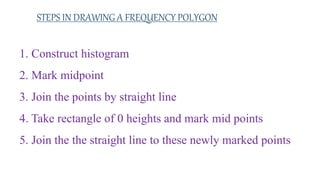
STEPS IN DRAWING A FREQUENCY POLYGON
1. Construct histogram
2. Mark midpoint
3. Join the points by straight line
4. Take rectangle of 0 heights and mark mid points
5. Join the the straight line to these newly marked points
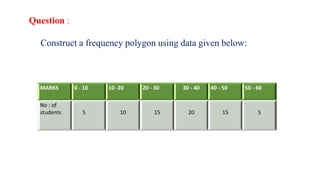
Question :
Construct a frequency polygon using data given below:
MARKS 0 - 10 10 -20 20 - 30 30 - 40 40 - 50 50 - 60
No : of
students 5 10 15 20 15 5
0 10 20 30 40 50 60
5
10
15
20
Marks
No
:
of
students
70
-10
Marks obtained by students
FREQUENCY POLYGON WITHOUT HISTOGRAM
Construct frequency polygon of following data:
MARKS 30 - 40 40 - 50 50 - 60 60 - 70 70 - 80 80 - 90
No : of
students 5 10 15 20 15 5
Answer:
MARKS No : of Students Class mark
30 – 40 5 35 (
40+30
2
=
70
2
=35)
40 – 50 10 45
50 – 60 15 55
60 – 70 20 65
70 - 80 5 75
30 40 50 60 70 80
5
10
15
20
MARK
No
of
students
Marks obtained by students
0
Advantages
It help to sort out and represent data
Give a clear picture distribution of data
Simple and easier to understand
We can draw two or more frequency polygons on the same axes/graph
 Thus we can make comparisons between the sets of data easily
Disadvantages
 Can be used only with continuous data
Less accurate representation of data because it represent
frequency of each class by single point
In short : It can mainly used to show the change and for comparison
Frequency Polygon.pptx

Frequency Polygon.pptx

  • 1.
    FREQUENCY POLYGON PRESENTED BY MEENUM 2nd SEMESTER B.Ed MATHEMATICS
  • 2.
    GRAPHICAL REPRESENTATION OFDATA  Data : Collection of facts or information  It can be represented by a variety of graphs  This gives a visual picture of the distribution  Different types of Graphs  Bar graph  Pie graph  Histogram  Frequency polygon  Frequency curve  Ogives
  • 3.
    FREQUENCY POLYGON  Itis a type of graphical representation of data It is a line graph in which points are joined by straight lines to make a polygon  It can be constructed by joining the midpoints of the tops of all the rectangles in a histogram The height of the point represent the frequencies It can also be drawn without constructing a Histogram
  • 4.
    Terms associated withfrequency polygon  Class interval : Specific range in which data is going to fall eg : 20-30  Frequency : The number of times the observation occurred  Mid point : The center point of bar  Upper limit (U.L) : Ending value of class interval  Lower limit (L.L) : Starting value of class interval  Class mark : Mid value of class Class mark = U.L+L.L 2
  • 5.
    STEPS IN DRAWINGA FREQUENCY POLYGON 1. Construct histogram 2. Mark midpoint 3. Join the points by straight line 4. Take rectangle of 0 heights and mark mid points 5. Join the the straight line to these newly marked points
  • 6.
    Question : Construct afrequency polygon using data given below: MARKS 0 - 10 10 -20 20 - 30 30 - 40 40 - 50 50 - 60 No : of students 5 10 15 20 15 5
  • 7.
    0 10 2030 40 50 60 5 10 15 20 Marks No : of students 70 -10 Marks obtained by students
  • 8.
    FREQUENCY POLYGON WITHOUTHISTOGRAM Construct frequency polygon of following data: MARKS 30 - 40 40 - 50 50 - 60 60 - 70 70 - 80 80 - 90 No : of students 5 10 15 20 15 5 Answer: MARKS No : of Students Class mark 30 – 40 5 35 ( 40+30 2 = 70 2 =35) 40 – 50 10 45 50 – 60 15 55 60 – 70 20 65 70 - 80 5 75
  • 9.
    30 40 5060 70 80 5 10 15 20 MARK No of students Marks obtained by students 0
  • 10.
    Advantages It help tosort out and represent data Give a clear picture distribution of data Simple and easier to understand We can draw two or more frequency polygons on the same axes/graph  Thus we can make comparisons between the sets of data easily
  • 11.
    Disadvantages  Can beused only with continuous data Less accurate representation of data because it represent frequency of each class by single point In short : It can mainly used to show the change and for comparison