Communication System
Ass. Prof. Ibrar Ullah
BSc (Electrical Engineering)
UET Peshawar
MSc (Communication & Electronics Engineering)
UET Peshawar

PhD (In Progress) Electronics Engineering
(Specialization in Wireless Communication)
MAJU Islamabad

E-Mail: ibrar@cecos.edu.pk
Ph: 03339051548 (0830 to 1300 hrs)

1
Chapter-3
•
•
•
•
•
•
•
•
•

Aperiodic signal representation by Fourier integral
(Fourier Transform)
Transforms of some useful functions
Some properties of the Fourier transform
Signal transmission through a linear system
Ideal and practical filters
Signal; distortion over a communication channel
Signal energy and energy spectral density
Signal power and power spectral density
Numerical computation of Fourier transform
2
Fourier Transform
Motivation
•

The motivation for the Fourier transform comes from the study of
Fourier series.

•

In Fourier series complicated periodic functions are written as
the sum of simple waves mathematically represented by sines
and cosines.

•

Due to the properties of sine and cosine it is possible to recover
the amount of each wave in the sum by an integral

•

In many cases it is desirable to use Euler's formula, which states
that e2πiθ = cos 2πθ + i sin 2πθ, to write Fourier series in terms of
the basic waves e2πiθ.

•

From sines and cosines to complex exponentials makes it
necessary for the Fourier coefficients to be complex valued.
complex number gives both the amplitude (or size) of the wave
present in the function and the phase (or the initial angle) of the
wave.

3
Fourier Transform
• The Fourier series can only be used for periodic
signals.
• We may use Fourier series to motivate the Fourier
transform.
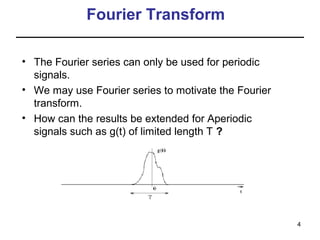
• How can the results be extended for Aperiodic
signals such as g(t) of limited length T ?

4
Fourier Transform

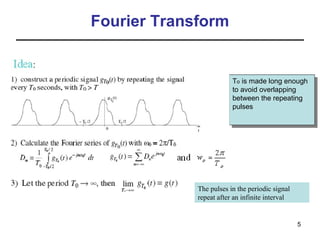
Toois made long enough
T is made long enough
to avoid overlapping
between the repeating
pulses
pulses

The pulses in the periodic signal
repeat after an infinite interval

5
Fourier Transform

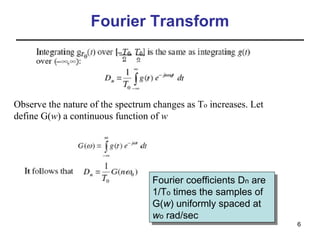
Observe the nature of the spectrum changes as To increases. Let
define G(w) a continuous function of w

Fourier coefficients Dnnare
Fourier coefficients D are
1/Tootimes the samples of
1/T times the samples of
G(w) uniformly spaced at
woorad/sec
w rad/sec

6
Fourier Transform
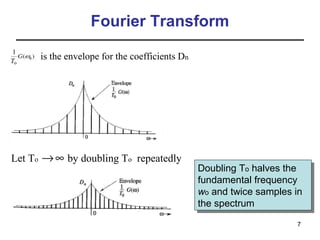
is the envelope for the coefficients Dn

Let To → ∞ by doubling To repeatedly

Doubling Toohalves the
Doubling T halves the
fundamental frequency
wooand twice samples in
w and twice samples in
the spectrum
the spectrum
7
Fourier Transform
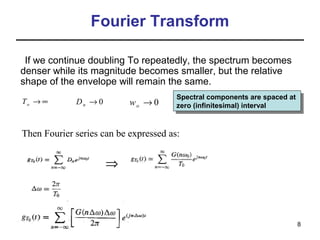
If we continue doubling To repeatedly, the spectrum becomes
denser while its magnitude becomes smaller, but the relative
shape of the envelope will remain the same.
To → ∞

wo → 0

Dn → 0

Spectral components are spaced at
zero (infinitesimal) interval

Then Fourier series can be expressed as:

⇒

8
Fourier Transform
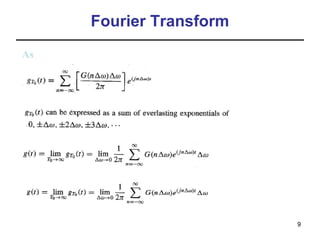
As

9
Fourier Transform

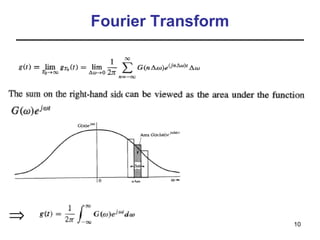
⇒

10
Fourier Transform

11
Fourier Transform

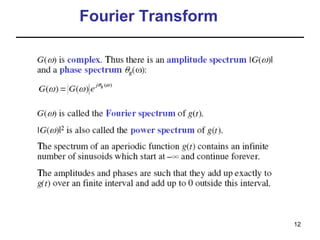
12
Fourier Transform

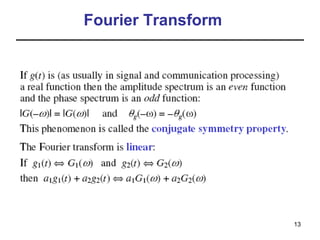
13
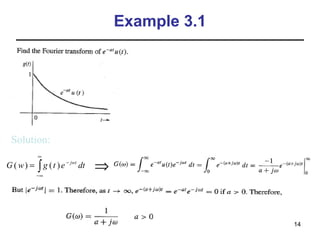
Example 3.1

Solution:
G ( w) =

∞

g ( t ) e − jwt dt
∫

−∞

⇒

14
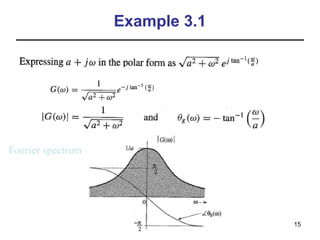
Example 3.1

Fourier spectrum

15
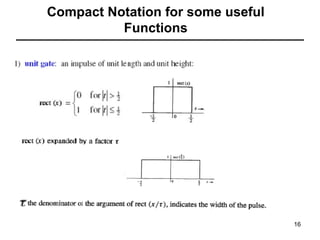
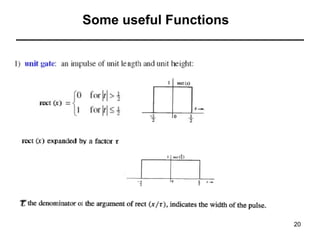
Compact Notation for some useful
Functions

16
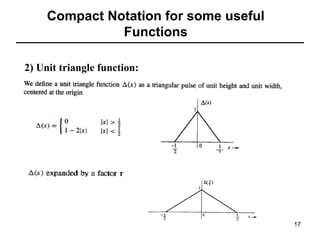
Compact Notation for some useful
Functions
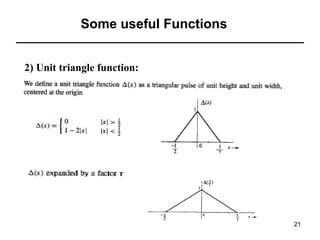
2) Unit triangle function:

17
Compact Notation for some useful
Functions
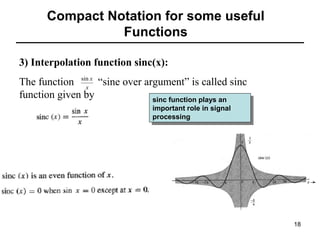
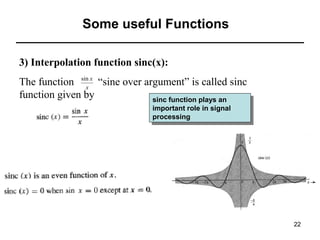
3) Interpolation function sinc(x):
The function sin x “sine over argument” is called sinc
x
function given by
sinc function plays an
important role in signal
processing
processing

18
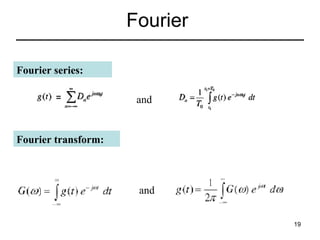
Fourier
Fourier series:
and

Fourier transform:

and
19
Some useful Functions

20
Some useful Functions
2) Unit triangle function:

21
Some useful Functions
3) Interpolation function sinc(x):
The function sin x “sine over argument” is called sinc
x
function given by
sinc function plays an
important role in signal
processing
processing

22
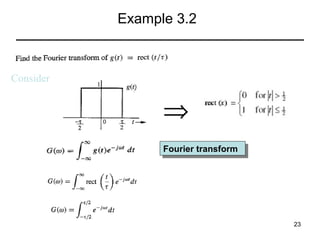
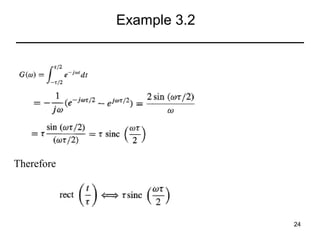
Example 3.2

Consider

⇒
Fourier transform
Fourier transform

23
Example 3.2

Therefore

24
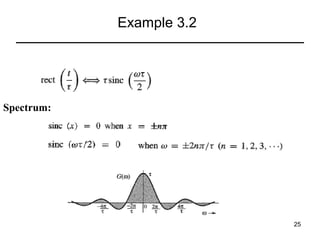
Example 3.2

Spectrum:

25
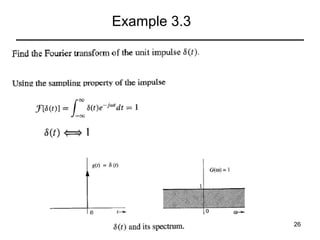
Example 3.3

26
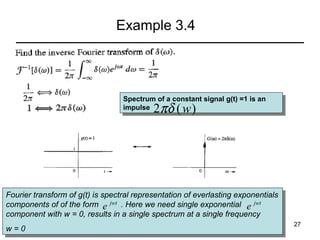
Example 3.4

Spectrum of aaconstant signal g(t) =1 is an
Spectrum of constant signal g(t) =1 is an
impulse
impulse

2πδ ( w )

Fourier transform of g(t) is spectral representation of everlasting exponentials
components of of the form e jwt . .Here we need single exponential e jwt
components of of the form
Here we need single exponential
component with w = 0, results in a single spectrum at a single frequency
w=0
w=0

27
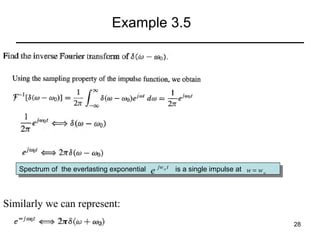
Example 3.5

Spectrum of the everlasting exponential

e jw o t

is aasingle impulse at w = w o
is single impulse at

Similarly we can represent:
28
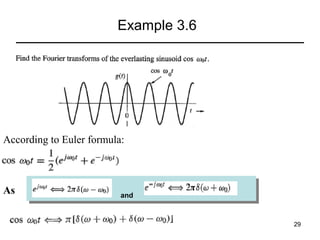
Example 3.6

According to Euler formula:

As

and
and

29
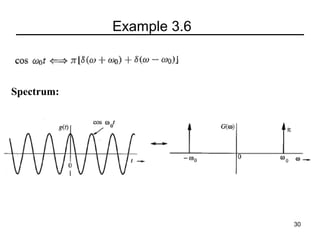
Example 3.6

Spectrum:

30
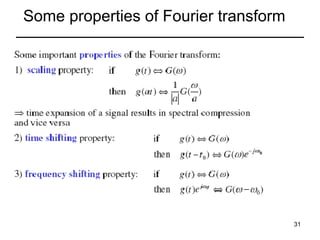
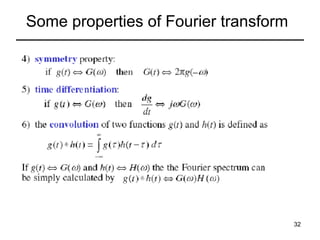
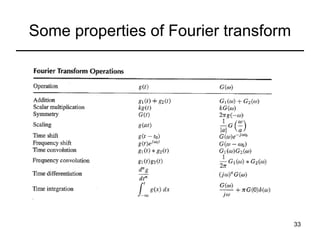
Some properties of Fourier transform

31
Some properties of Fourier transform

32
Some properties of Fourier transform

33
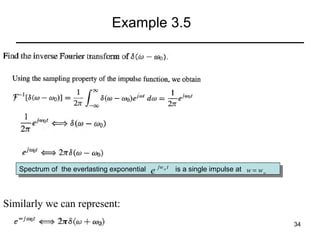
Example 3.5

Spectrum of the everlasting exponential

e jw o t

is aasingle impulse at w = w o
is single impulse at

Similarly we can represent:
34
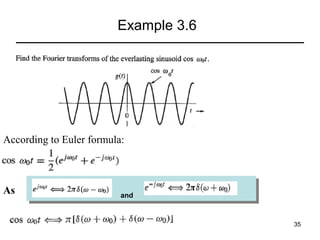
Example 3.6

According to Euler formula:

As

and
and

35
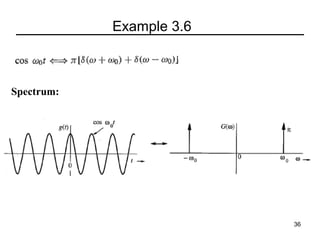
Example 3.6

Spectrum:

36
Some properties of Fourier transform

37
Some properties of Fourier transform

38
Some properties of Fourier transform
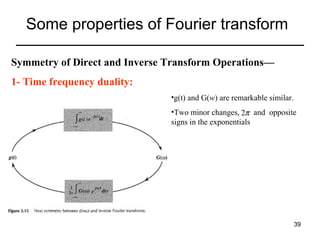
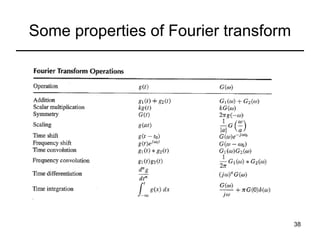
Symmetry of Direct and Inverse Transform Operations—
1- Time frequency duality:
•g(t) and G(w) are remarkable similar.
•Two minor changes, 2π and opposite
signs in the exponentials

39
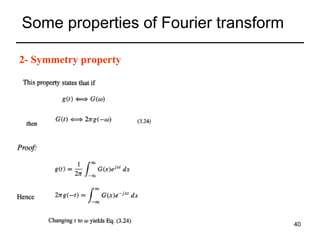
Some properties of Fourier transform
2- Symmetry property

40
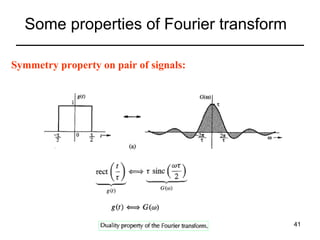
Some properties of Fourier transform
Symmetry property on pair of signals:

41
Some properties of Fourier
transform

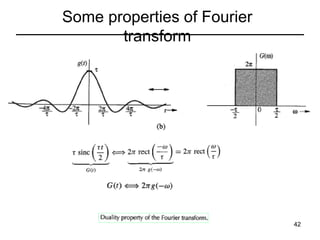
42
Some properties of Fourier transform
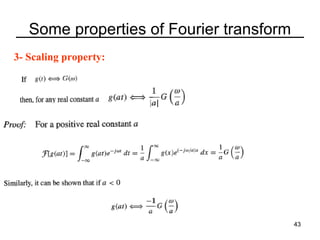
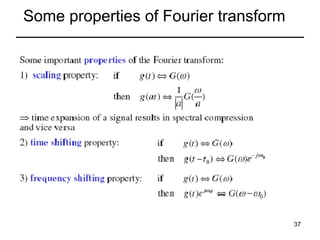
3- Scaling property:

43
Some properties of Fourier
transform

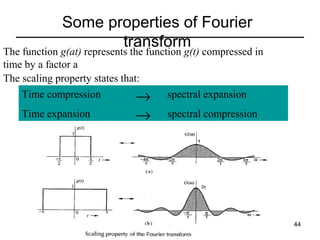
The function g(at) represents the function g(t) compressed in
time by a factor a
The scaling property states that:
Time compression
→ spectral expansion
Time expansion

→

spectral compression

44
Some properties of Fourier transform
Reciprocity of the Signal Duration and its Bandwidth
As g(t) is wider, its spectrum is narrower and vice versa.
Doubling the signal duration halves its bandwidth.
Bandwidth of a signal is inversely proportional to the signal duration
or width.

45
Some properties of Fourier transform
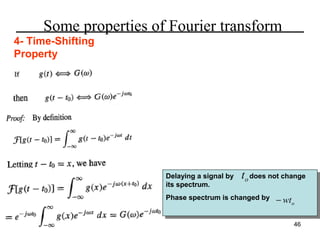
4- Time-Shifting
Property

Delaying aasignal by
Delaying signal by
its spectrum.
its spectrum.

to does not change
does not change

Phase spectrum is changed by

− wt o
46
Some properties of Fourier transform
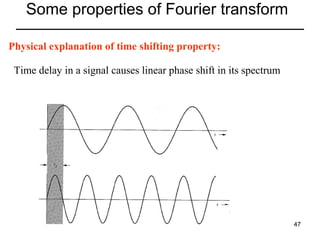
Physical explanation of time shifting property:
Time delay in a signal causes linear phase shift in its spectrum

47
Some properties of Fourier transform
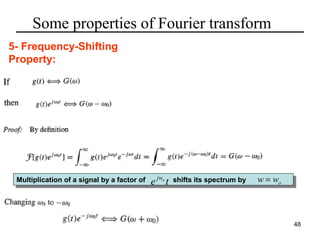
5- Frequency-Shifting
Property:

Multiplication of aasignal by aafactor of
Multiplication of signal by factor of

e jwo t

shifts its spectrum by

w = wo

48
Some properties of Fourier transform
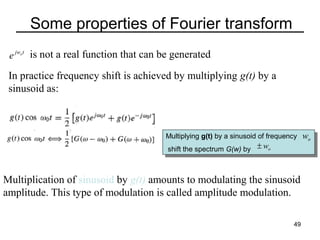
e jwot is not a real function that can be generated

In practice frequency shift is achieved by multiplying g(t) by a
sinusoid as:

Multiplying g(t) by aasinusoid of frequency
Multiplying g(t) by sinusoid of frequency
shift the spectrum G(w) by ± wo
shift the spectrum G(w) by

Multiplication of sinusoid by g(t) amounts to modulating the sinusoid
amplitude. This type of modulation is called amplitude modulation.
49

wo

communication system Chapter 3

  • 1.
    Communication System Ass. Prof.Ibrar Ullah BSc (Electrical Engineering) UET Peshawar MSc (Communication & Electronics Engineering) UET Peshawar PhD (In Progress) Electronics Engineering (Specialization in Wireless Communication) MAJU Islamabad E-Mail: ibrar@cecos.edu.pk Ph: 03339051548 (0830 to 1300 hrs) 1
  • 2.
    Chapter-3 • • • • • • • • • Aperiodic signal representationby Fourier integral (Fourier Transform) Transforms of some useful functions Some properties of the Fourier transform Signal transmission through a linear system Ideal and practical filters Signal; distortion over a communication channel Signal energy and energy spectral density Signal power and power spectral density Numerical computation of Fourier transform 2
  • 3.
    Fourier Transform Motivation • The motivationfor the Fourier transform comes from the study of Fourier series. • In Fourier series complicated periodic functions are written as the sum of simple waves mathematically represented by sines and cosines. • Due to the properties of sine and cosine it is possible to recover the amount of each wave in the sum by an integral • In many cases it is desirable to use Euler's formula, which states that e2πiθ = cos 2πθ + i sin 2πθ, to write Fourier series in terms of the basic waves e2πiθ. • From sines and cosines to complex exponentials makes it necessary for the Fourier coefficients to be complex valued. complex number gives both the amplitude (or size) of the wave present in the function and the phase (or the initial angle) of the wave. 3
  • 4.
    Fourier Transform • TheFourier series can only be used for periodic signals. • We may use Fourier series to motivate the Fourier transform. • How can the results be extended for Aperiodic signals such as g(t) of limited length T ? 4
  • 5.
    Fourier Transform Toois madelong enough T is made long enough to avoid overlapping to avoid overlapping between the repeating between the repeating pulses pulses The pulses in the periodic signal repeat after an infinite interval 5
  • 6.
    Fourier Transform Observe thenature of the spectrum changes as To increases. Let define G(w) a continuous function of w Fourier coefficients Dnnare Fourier coefficients D are 1/Tootimes the samples of 1/T times the samples of G(w) uniformly spaced at G(w) uniformly spaced at woorad/sec w rad/sec 6
  • 7.
    Fourier Transform is theenvelope for the coefficients Dn Let To → ∞ by doubling To repeatedly Doubling Toohalves the Doubling T halves the fundamental frequency fundamental frequency wooand twice samples in w and twice samples in the spectrum the spectrum 7
  • 8.
    Fourier Transform If wecontinue doubling To repeatedly, the spectrum becomes denser while its magnitude becomes smaller, but the relative shape of the envelope will remain the same. To → ∞ wo → 0 Dn → 0 Spectral components are spaced at Spectral components are spaced at zero (infinitesimal) interval zero (infinitesimal) interval Then Fourier series can be expressed as: ⇒ 8
  • 9.
  • 10.
  • 11.
  • 12.
  • 13.
  • 14.
    Example 3.1 Solution: G (w) = ∞ g ( t ) e − jwt dt ∫ −∞ ⇒ 14
  • 15.
  • 16.
    Compact Notation forsome useful Functions 16
  • 17.
    Compact Notation forsome useful Functions 2) Unit triangle function: 17
  • 18.
    Compact Notation forsome useful Functions 3) Interpolation function sinc(x): The function sin x “sine over argument” is called sinc x function given by sinc function plays an sinc function plays an important role in signal important role in signal processing processing 18
  • 19.
  • 20.
  • 21.
    Some useful Functions 2)Unit triangle function: 21
  • 22.
    Some useful Functions 3)Interpolation function sinc(x): The function sin x “sine over argument” is called sinc x function given by sinc function plays an sinc function plays an important role in signal important role in signal processing processing 22
  • 23.
  • 24.
  • 25.
  • 26.
  • 27.
    Example 3.4 Spectrum ofaaconstant signal g(t) =1 is an Spectrum of constant signal g(t) =1 is an impulse impulse 2πδ ( w ) Fourier transform of g(t) is spectral representation of everlasting exponentials Fourier transform of g(t) is spectral representation of everlasting exponentials components of of the form e jwt . .Here we need single exponential e jwt components of of the form Here we need single exponential component with w = 0, results in a single spectrum at a single frequency component with w = 0, results in a single spectrum at a single frequency w=0 w=0 27
  • 28.
    Example 3.5 Spectrum ofthe everlasting exponential Spectrum of the everlasting exponential e jw o t is aasingle impulse at w = w o is single impulse at Similarly we can represent: 28
  • 29.
    Example 3.6 According toEuler formula: As and and 29
  • 30.
  • 31.
    Some properties ofFourier transform 31
  • 32.
    Some properties ofFourier transform 32
  • 33.
    Some properties ofFourier transform 33
  • 34.
    Example 3.5 Spectrum ofthe everlasting exponential Spectrum of the everlasting exponential e jw o t is aasingle impulse at w = w o is single impulse at Similarly we can represent: 34
  • 35.
    Example 3.6 According toEuler formula: As and and 35
  • 36.
  • 37.
    Some properties ofFourier transform 37
  • 38.
    Some properties ofFourier transform 38
  • 39.
    Some properties ofFourier transform Symmetry of Direct and Inverse Transform Operations— 1- Time frequency duality: •g(t) and G(w) are remarkable similar. •Two minor changes, 2π and opposite signs in the exponentials 39
  • 40.
    Some properties ofFourier transform 2- Symmetry property 40
  • 41.
    Some properties ofFourier transform Symmetry property on pair of signals: 41
  • 42.
    Some properties ofFourier transform 42
  • 43.
    Some properties ofFourier transform 3- Scaling property: 43
  • 44.
    Some properties ofFourier transform The function g(at) represents the function g(t) compressed in time by a factor a The scaling property states that: Time compression → spectral expansion Time expansion → spectral compression 44
  • 45.
    Some properties ofFourier transform Reciprocity of the Signal Duration and its Bandwidth As g(t) is wider, its spectrum is narrower and vice versa. Doubling the signal duration halves its bandwidth. Bandwidth of a signal is inversely proportional to the signal duration or width. 45
  • 46.
    Some properties ofFourier transform 4- Time-Shifting Property Delaying aasignal by Delaying signal by its spectrum. its spectrum. to does not change does not change Phase spectrum is changed by Phase spectrum is changed by − wt o 46
  • 47.
    Some properties ofFourier transform Physical explanation of time shifting property: Time delay in a signal causes linear phase shift in its spectrum 47
  • 48.
    Some properties ofFourier transform 5- Frequency-Shifting Property: Multiplication of aasignal by aafactor of Multiplication of signal by factor of e jwo t shifts its spectrum by shifts its spectrum by w = wo 48
  • 49.
    Some properties ofFourier transform e jwot is not a real function that can be generated In practice frequency shift is achieved by multiplying g(t) by a sinusoid as: Multiplying g(t) by aasinusoid of frequency Multiplying g(t) by sinusoid of frequency shift the spectrum G(w) by ± wo shift the spectrum G(w) by Multiplication of sinusoid by g(t) amounts to modulating the sinusoid amplitude. This type of modulation is called amplitude modulation. 49 wo