Fourier Analysis Techniques
Part I
Contents
• Why Fourier Series and Fourier Transform?
• Fourier Series
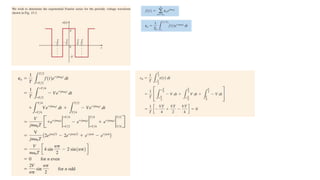
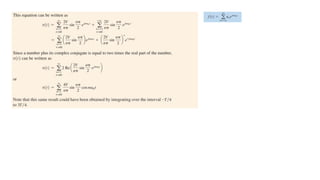
• Exponential Fourier Series
• Derivation of Trigonometric Fourier Series
• Even, Odd and Half wave symmetry
• Time shifting
• Composite Waveform Generation
• Frequency Spectrum Construction
Usage of Fourier Series and Transform
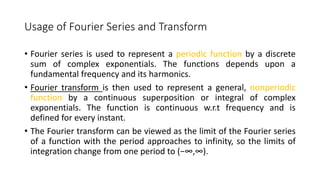
• Fourier series is used to represent a periodic function by a discrete
sum of complex exponentials. The functions depends upon a
fundamental frequency and its harmonics.
• Fourier transform is then used to represent a general, nonperiodic
function by a continuous superposition or integral of complex
exponentials. The function is continuous w.r.t frequency and is
defined for every instant.
• The Fourier transform can be viewed as the limit of the Fourier series
of a function with the period approaches to infinity, so the limits of
integration change from one period to (−∞,∞).
Fourier vs Laplace
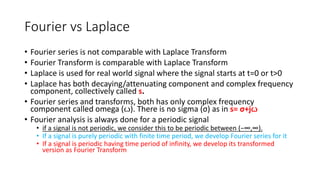
• Fourier series is not comparable with Laplace Transform
• Fourier Transform is comparable with Laplace Transform
• Laplace is used for real world signal where the signal starts at t=0 or t>0
• Laplace has both decaying/attenuating component and complex frequency
component, collectively called s.
• Fourier series and transforms, both has only complex frequency
component called omega (ꙍ). There is no sigma (σ) as in s= σ+jꙍ
• Fourier analysis is always done for a periodic signal
• if a signal is not periodic, we consider this to be periodic between (−∞,∞).
• If a signal is purely periodic with finite time period, we develop Fourier series for it
• If a signal is periodic having time period of infinity, we develop its transformed
version as Fourier Transform
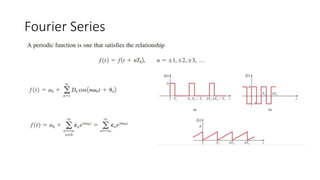
Fourier Series
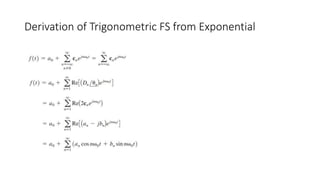
Derivation of Trigonometric FS from Exponential
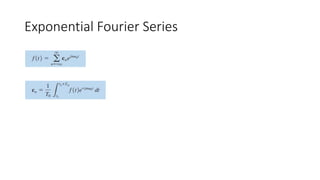
Exponential Fourier Series
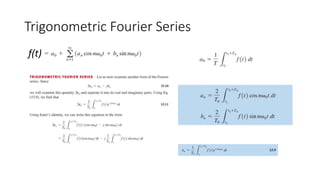
Trigonometric Fourier Series
f(t)
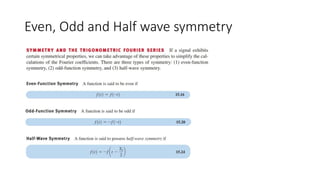
Even, Odd and Half wave symmetry
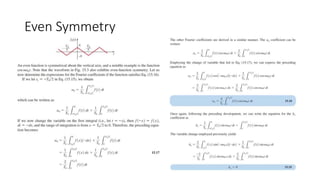
Even Symmetry
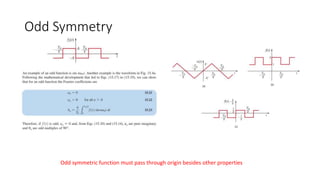
Odd Symmetry
Odd symmetric function must pass through origin besides other properties
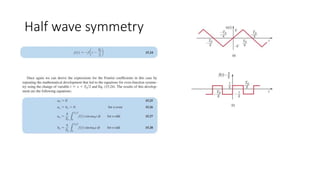
Half wave symmetry
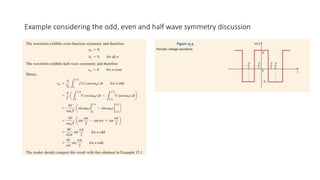
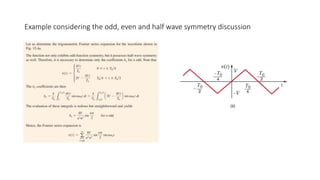
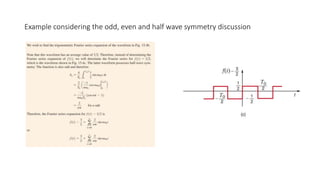
Example considering the odd, even and half wave symmetry discussion
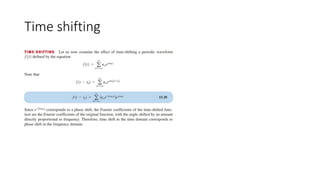
Time shifting
Composite Waveform Generation
Fourier series and transforms both give us
mathematical formulation of a wave form and it
is piece wise additive as well.
This concludes that, while computing, we can use
the same equations to extrapolate our analysis as
well as build new waves by using some basic
waveforms.
Thus, composite wave form can be the addition
of DC levels of wave, ao
x(t) + ao
y(t) and an
x(t) with
an
y(t) and bn
x(t) with bn
y(t) for two waves x(t) and
y(t)
Basic wave forms are given in Table 15.1 (pp. 765)
Ed. 10 Irwin BECA
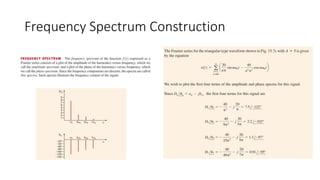
Frequency Spectrum Construction
Thanks
• http://eedmd.weebly.com/ca2/
• MS Teams: EE-201 Circuit Analysis II (Code: kv0slqu)
• http://slideshare.com/jazzofizia/

Fourier analysis techniques fourier series

  • 1.
  • 2.
    Contents • Why FourierSeries and Fourier Transform? • Fourier Series • Exponential Fourier Series • Derivation of Trigonometric Fourier Series • Even, Odd and Half wave symmetry • Time shifting • Composite Waveform Generation • Frequency Spectrum Construction
  • 3.
    Usage of FourierSeries and Transform • Fourier series is used to represent a periodic function by a discrete sum of complex exponentials. The functions depends upon a fundamental frequency and its harmonics. • Fourier transform is then used to represent a general, nonperiodic function by a continuous superposition or integral of complex exponentials. The function is continuous w.r.t frequency and is defined for every instant. • The Fourier transform can be viewed as the limit of the Fourier series of a function with the period approaches to infinity, so the limits of integration change from one period to (−∞,∞).
  • 4.
    Fourier vs Laplace •Fourier series is not comparable with Laplace Transform • Fourier Transform is comparable with Laplace Transform • Laplace is used for real world signal where the signal starts at t=0 or t>0 • Laplace has both decaying/attenuating component and complex frequency component, collectively called s. • Fourier series and transforms, both has only complex frequency component called omega (ꙍ). There is no sigma (σ) as in s= σ+jꙍ • Fourier analysis is always done for a periodic signal • if a signal is not periodic, we consider this to be periodic between (−∞,∞). • If a signal is purely periodic with finite time period, we develop Fourier series for it • If a signal is periodic having time period of infinity, we develop its transformed version as Fourier Transform
  • 5.
  • 6.
    Derivation of TrigonometricFS from Exponential
  • 7.
  • 8.
  • 11.
    Even, Odd andHalf wave symmetry
  • 12.
  • 13.
    Odd Symmetry Odd symmetricfunction must pass through origin besides other properties
  • 14.
  • 15.
    Example considering theodd, even and half wave symmetry discussion
  • 16.
    Example considering theodd, even and half wave symmetry discussion
  • 17.
    Example considering theodd, even and half wave symmetry discussion
  • 18.
  • 19.
    Composite Waveform Generation Fourierseries and transforms both give us mathematical formulation of a wave form and it is piece wise additive as well. This concludes that, while computing, we can use the same equations to extrapolate our analysis as well as build new waves by using some basic waveforms. Thus, composite wave form can be the addition of DC levels of wave, ao x(t) + ao y(t) and an x(t) with an y(t) and bn x(t) with bn y(t) for two waves x(t) and y(t) Basic wave forms are given in Table 15.1 (pp. 765) Ed. 10 Irwin BECA
  • 20.
  • 21.
    Thanks • http://eedmd.weebly.com/ca2/ • MSTeams: EE-201 Circuit Analysis II (Code: kv0slqu) • http://slideshare.com/jazzofizia/