Lab No.02

M-files and Matrix operations

Designed by : Dawar Awan
dawar@cecos.edu.pk
CECOS College of Engineering and IT

March – July 2012
Matrices
 MATLAB treats every thing as a matrix (check the Workspace)
 1-by-1 matrices are interpreted as scalars
 Matrices with only one row or one column are known as vectors

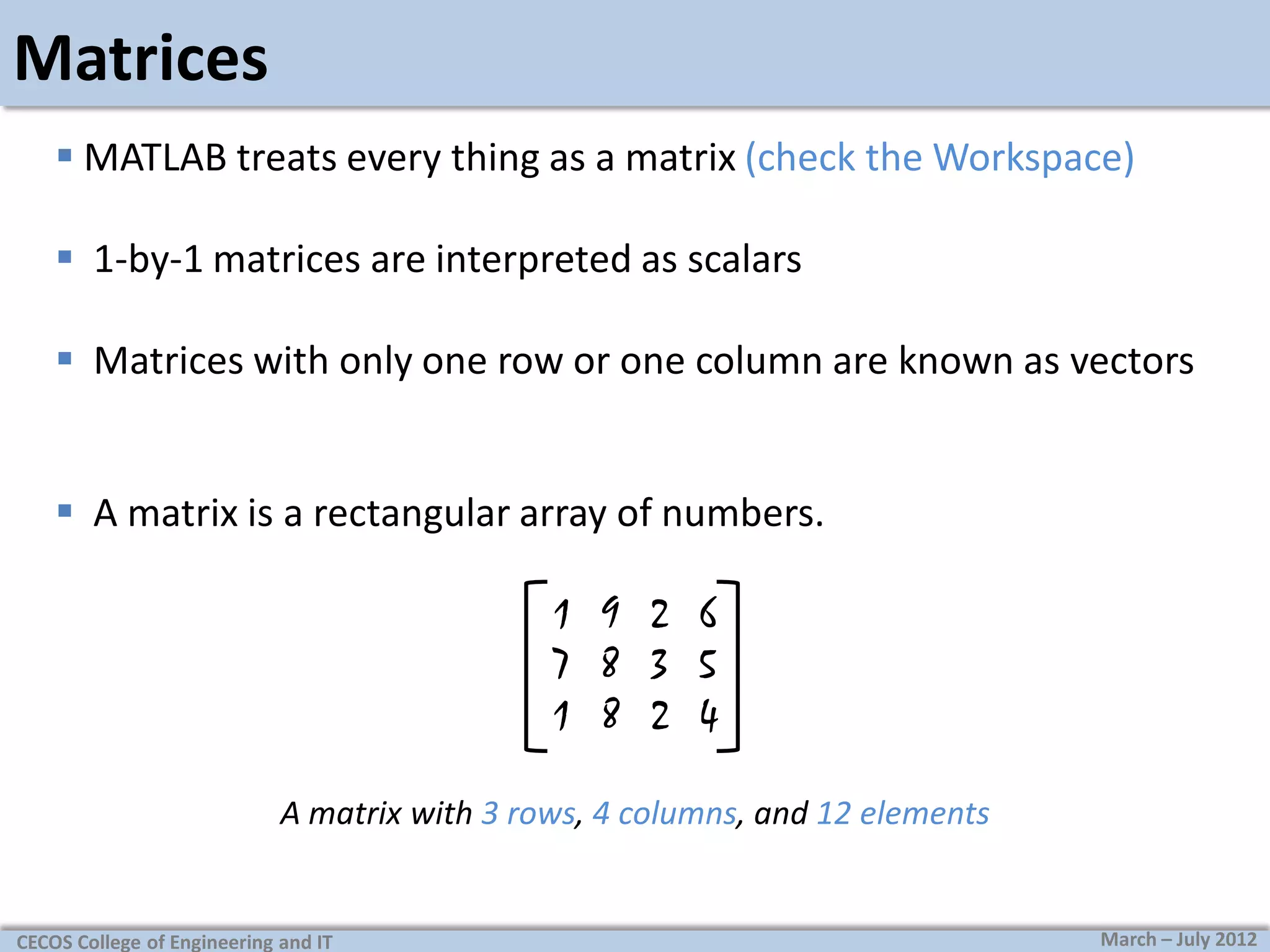
 A matrix is a rectangular array of numbers.
1 9 2 6
7 8 3 5
1 8 2 4
A matrix with 3 rows, 4 columns, and 12 elements

CECOS College of Engineering and IT

March – July 2012
Defining matrices
>> A = [1 2 3; 4 5 6; 7 8 9];
>> A = [1, 2, 3; 4, 5, 6; 7, 8, 9];

and
>> A = [ 1 2 3
456
7 8 9 ];
Defines

A=
1

3

4

5

6

7
CECOS College of Engineering and IT

2

8

9
March – July 2012
Accessing matrix elements
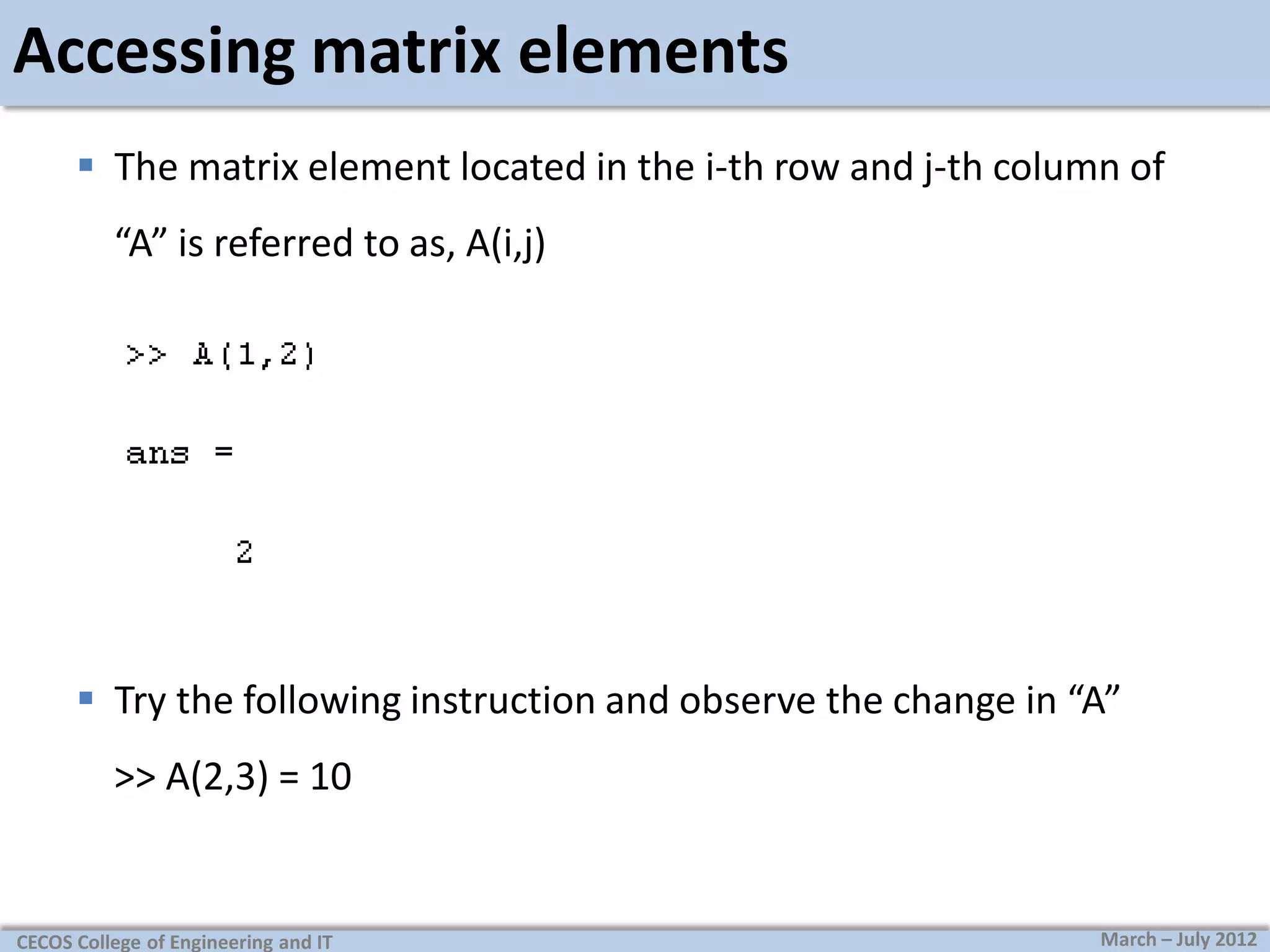
 The matrix element located in the i-th row and j-th column of
“A” is referred to as, A(i,j)

 Try the following instruction and observe the change in “A”
>> A(2,3) = 10

CECOS College of Engineering and IT

March – July 2012
Some Built-in matrix functions
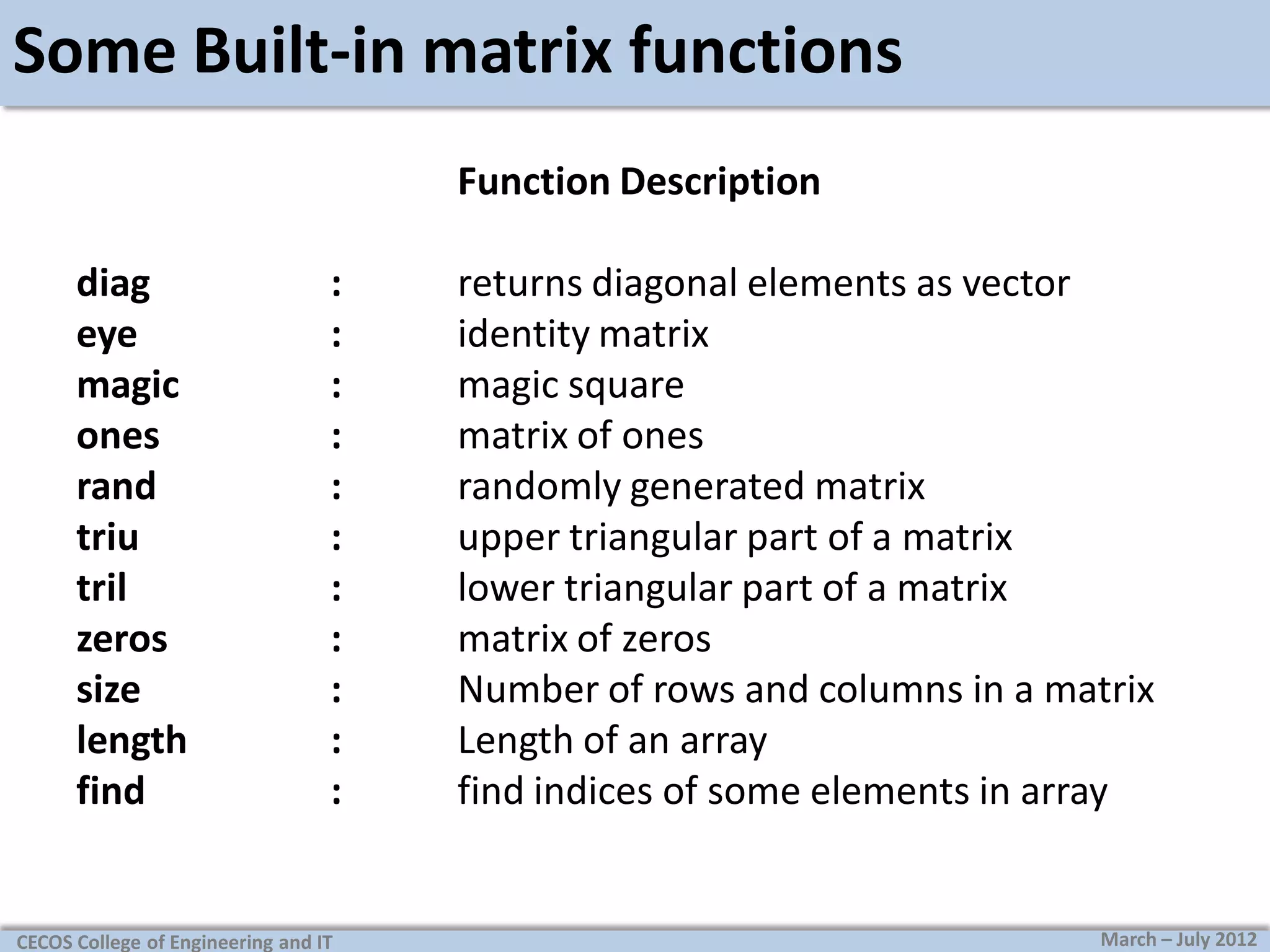
Function Description
diag
eye
magic
ones
rand
triu
tril
zeros
size
length
find

:
:
:
:
:
:
:
:
:
:
:

CECOS College of Engineering and IT

returns diagonal elements as vector
identity matrix
magic square
matrix of ones
randomly generated matrix
upper triangular part of a matrix
lower triangular part of a matrix
matrix of zeros
Number of rows and columns in a matrix
Length of an array
find indices of some elements in array

March – July 2012
Matrix functions : Examples
>> a=[1 2 3;4 5 6;7 8 9]
a=
1
4
7

2
5
8

3
6
9

>> diag(a)

>> triu(a)

>> tril(a)

>> size(a)

>> length(a)

ans =

ans =

ans =

ans =

ans =

1
5
9
CECOS College of Engineering and IT

1
0
0

2
5
0

3
6
9

1
4
7

0
5
8

0
0
9

3

3

3

March – July 2012
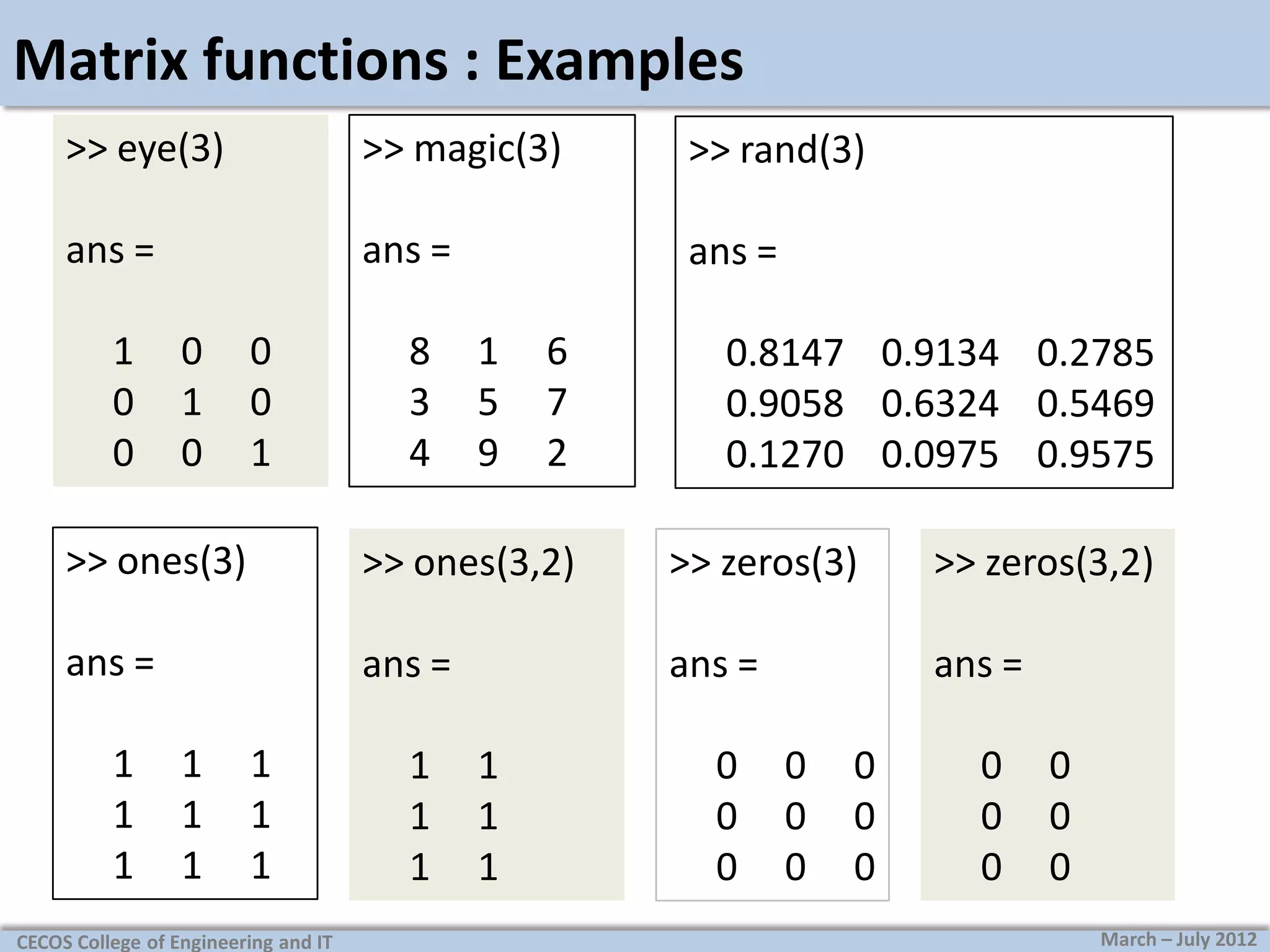
Matrix functions : Examples
>> eye(3)

>> magic(3)

>> rand(3)

ans =

ans =

ans =

1
0
0

0
1
0

0
0
1

8
3
4

1
5
9

6
7
2

0.8147 0.9134 0.2785
0.9058 0.6324 0.5469
0.1270 0.0975 0.9575

>> ones(3)

>> ones(3,2)

>> zeros(3)

>> zeros(3,2)

ans =

ans =

ans =

ans =

1
1
1

1
1
1

1
1
1

CECOS College of Engineering and IT

1
1
1

1
1
1

0
0
0

0
0
0

0
0
0

0
0
0

0
0
0
March – July 2012
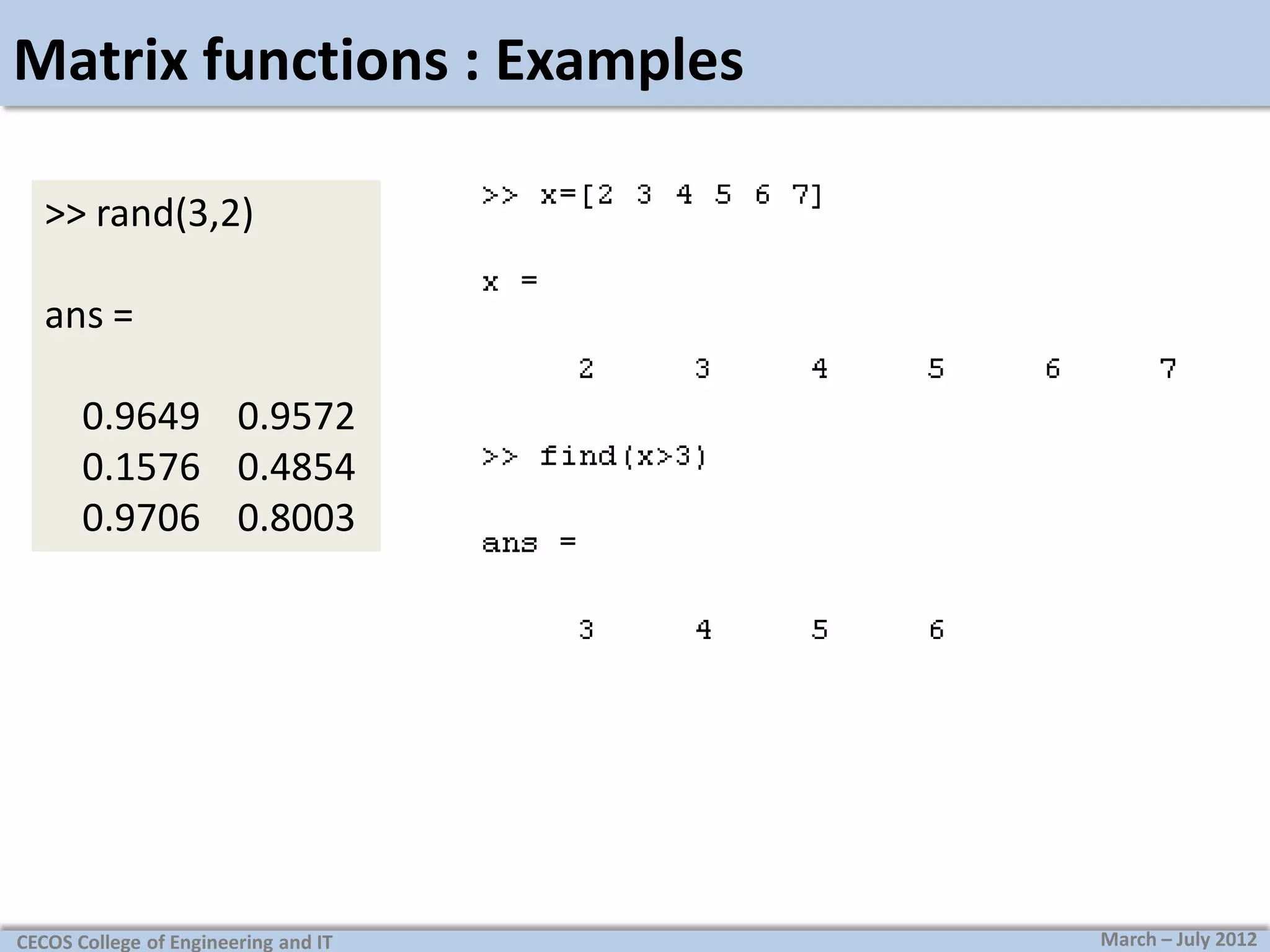
Matrix functions : Examples
>> rand(3,2)

ans =
0.9649 0.9572
0.1576 0.4854
0.9706 0.8003

CECOS College of Engineering and IT

March – July 2012
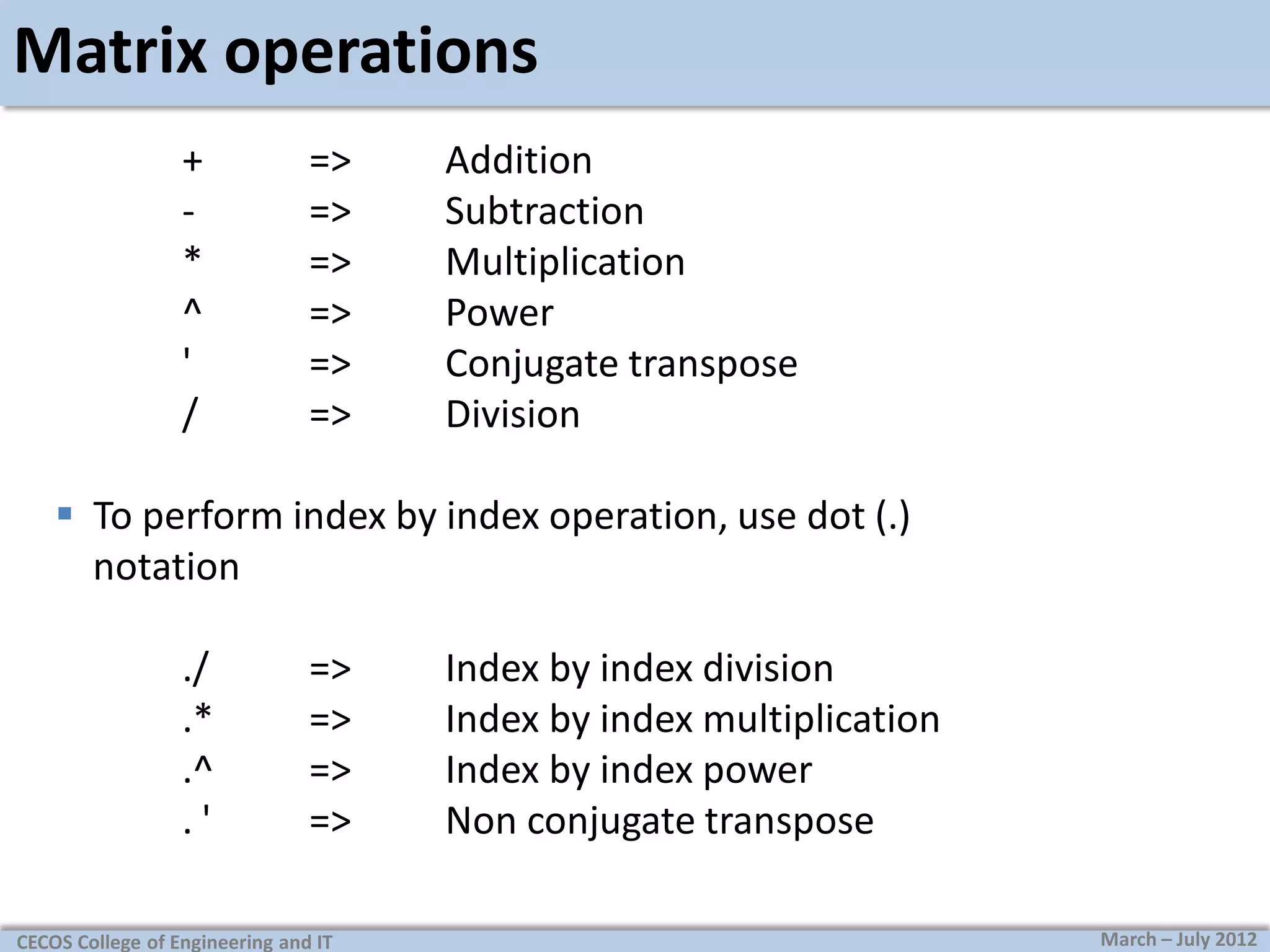
Matrix operations
+
*
^
'
/

=>
=>
=>
=>
=>
=>

Addition
Subtraction
Multiplication
Power
Conjugate transpose
Division

 To perform index by index operation, use dot (.)
notation
./
.*
.^
.'

=>
=>
=>
=>

CECOS College of Engineering and IT

Index by index division
Index by index multiplication
Index by index power
Non conjugate transpose
March – July 2012
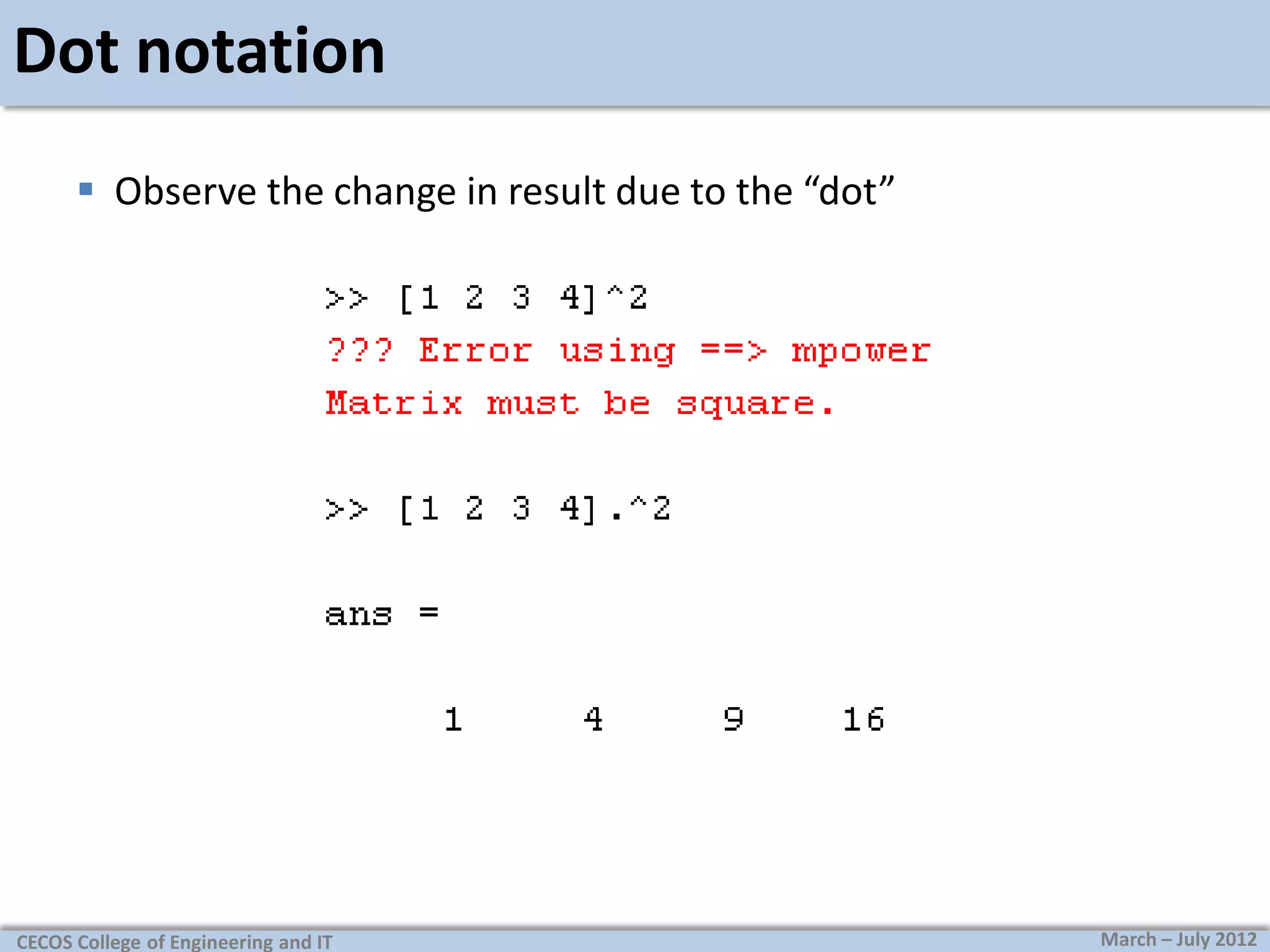
Dot notation
 Observe the change in result due to the “dot”

CECOS College of Engineering and IT

March – July 2012
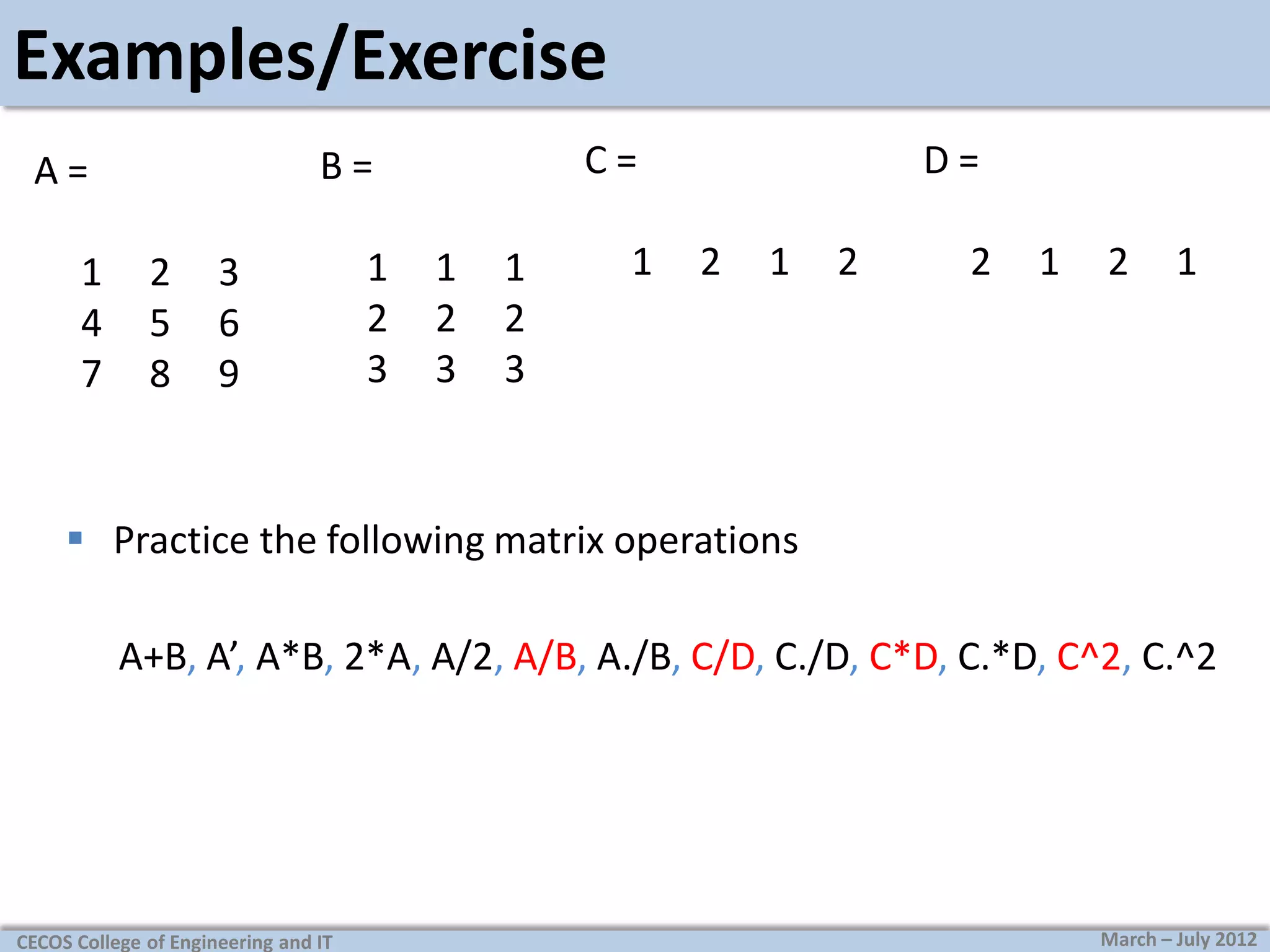
Examples/Exercise
1
4
7

C=

B=

A=
2
5
8

3
6
9

1
2
3

1
2
3

1
2
3

1

D=
2

1

2

2

1

2

1

 Practice the following matrix operations
A+B, A’, A*B, 2*A, A/2, A/B, A./B, C/D, C./D, C*D, C.*D, C^2, C.^2

CECOS College of Engineering and IT

March – July 2012
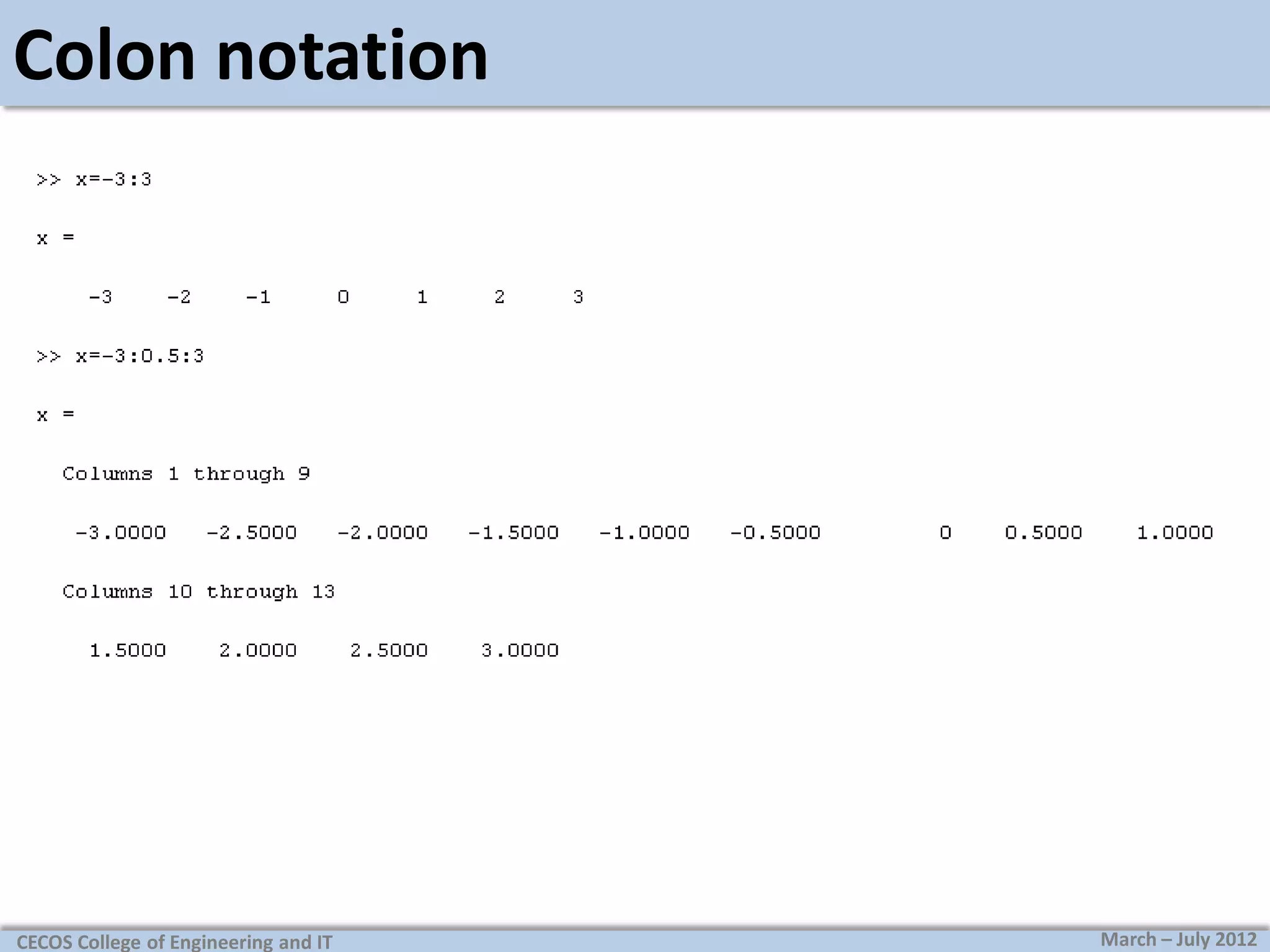
Colon notation

CECOS College of Engineering and IT

March – July 2012
M - files
 M-files are script/text files containing MATLAB commands
Script M-file
Function M-file

 To make a script M-file, you need to open a file using the built-in
MATLAB editor.
 There are two ways to accomplish it:
1. From file menu, click NEW
2. Type edit on command line
CECOS College of Engineering and IT

March – July 2012
M - files

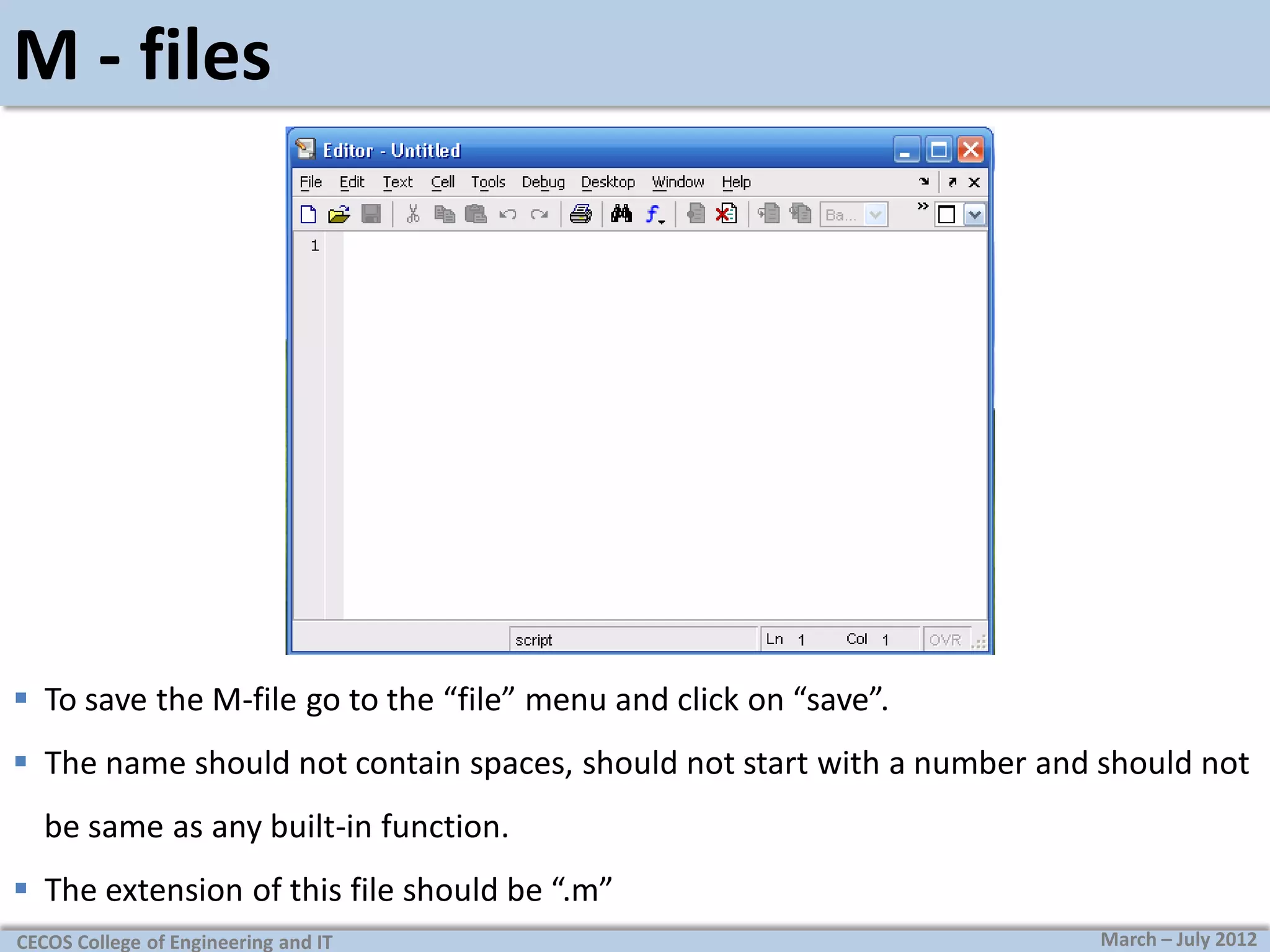
 To save the M-file go to the “file” menu and click on “save”.
 The name should not contain spaces, should not start with a number and should not
be same as any built-in function.

 The extension of this file should be “.m”
CECOS College of Engineering and IT

March – July 2012
M - files
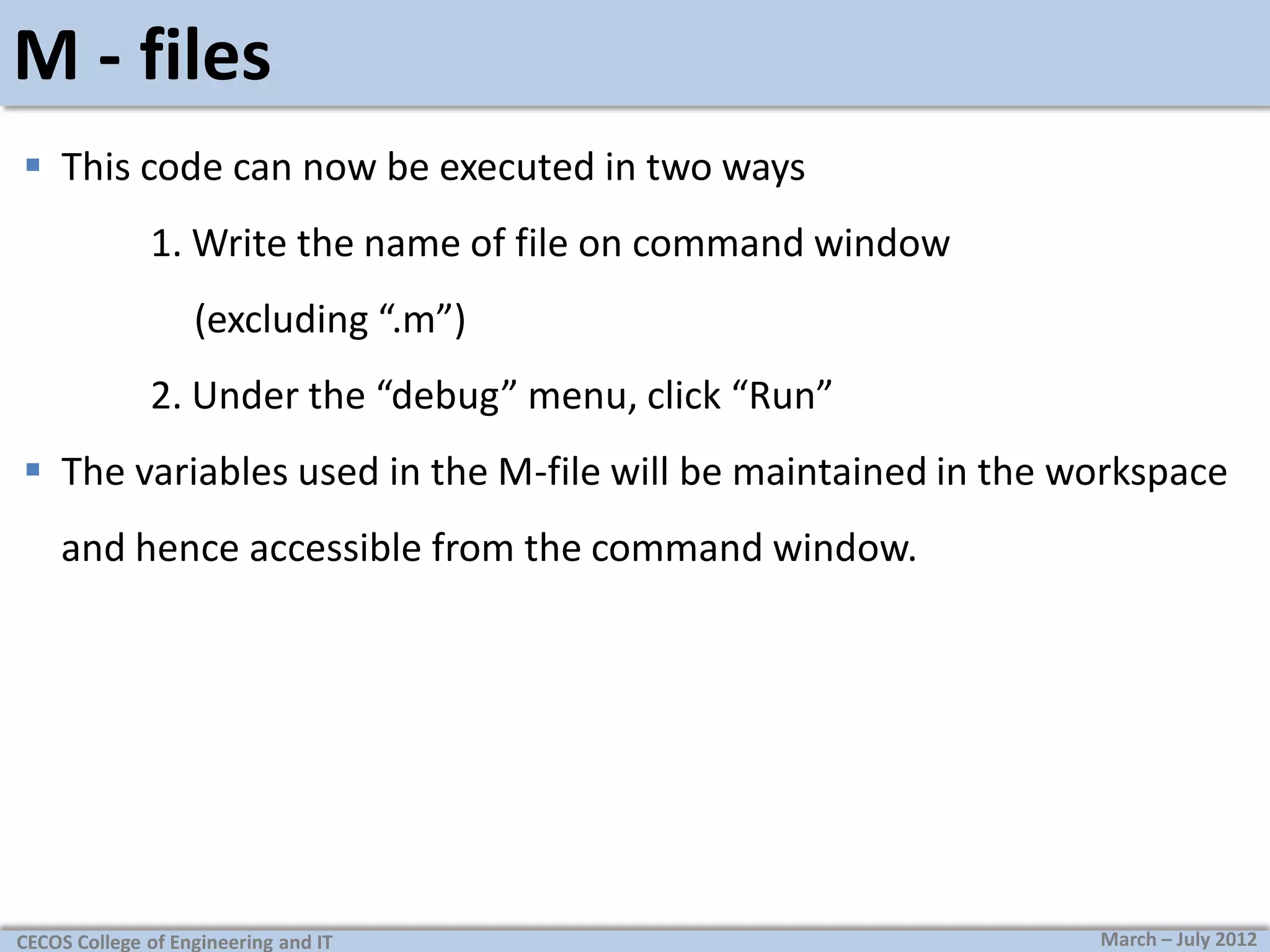
 This code can now be executed in two ways
1. Write the name of file on command window
(excluding “.m”)
2. Under the “debug” menu, click “Run”
 The variables used in the M-file will be maintained in the workspace

and hence accessible from the command window.

CECOS College of Engineering and IT

March – July 2012
M - files
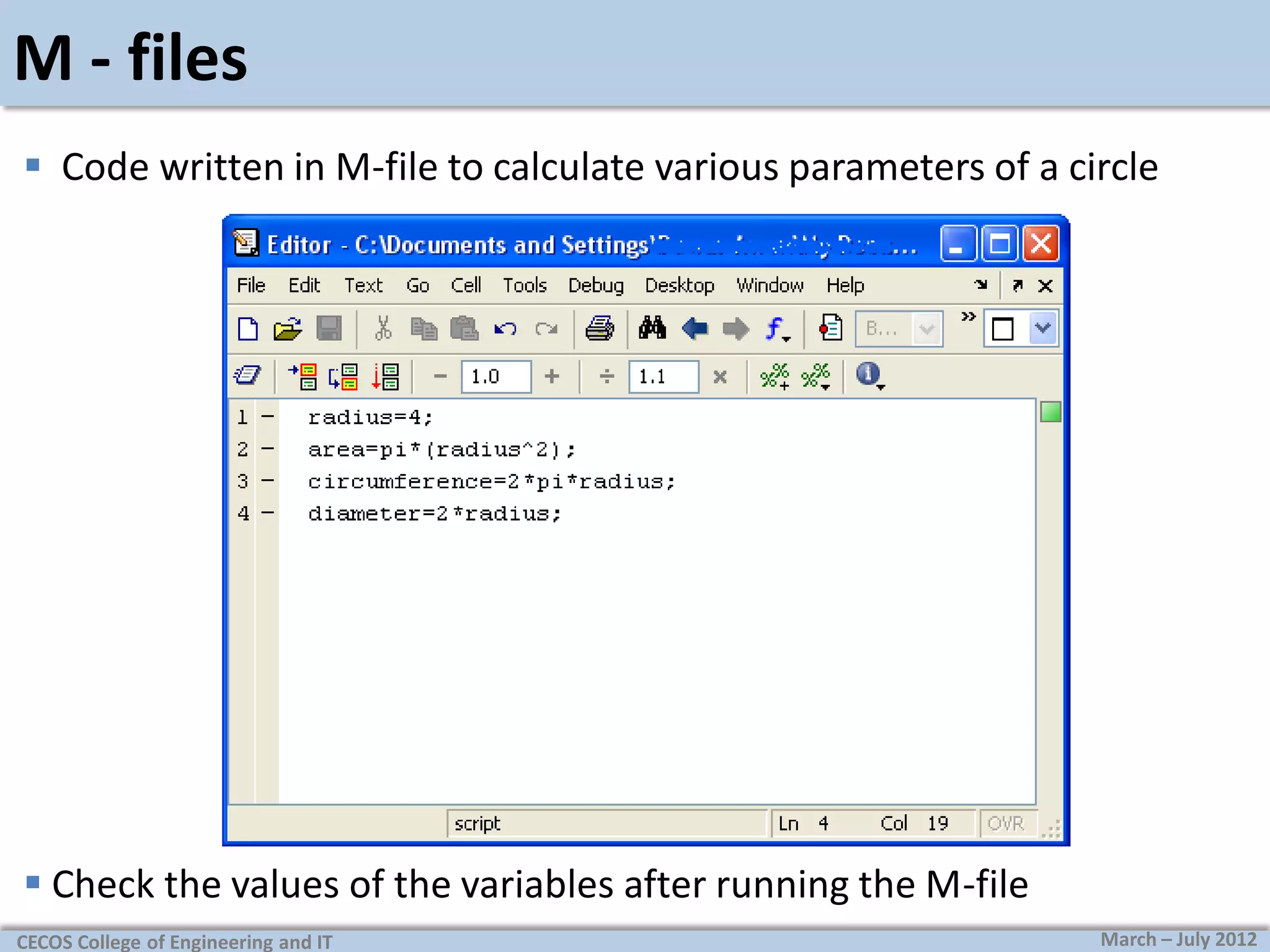
 Code written in M-file to calculate various parameters of a circle

 Check the values of the variables after running the M-file
CECOS College of Engineering and IT

March – July 2012
Comments
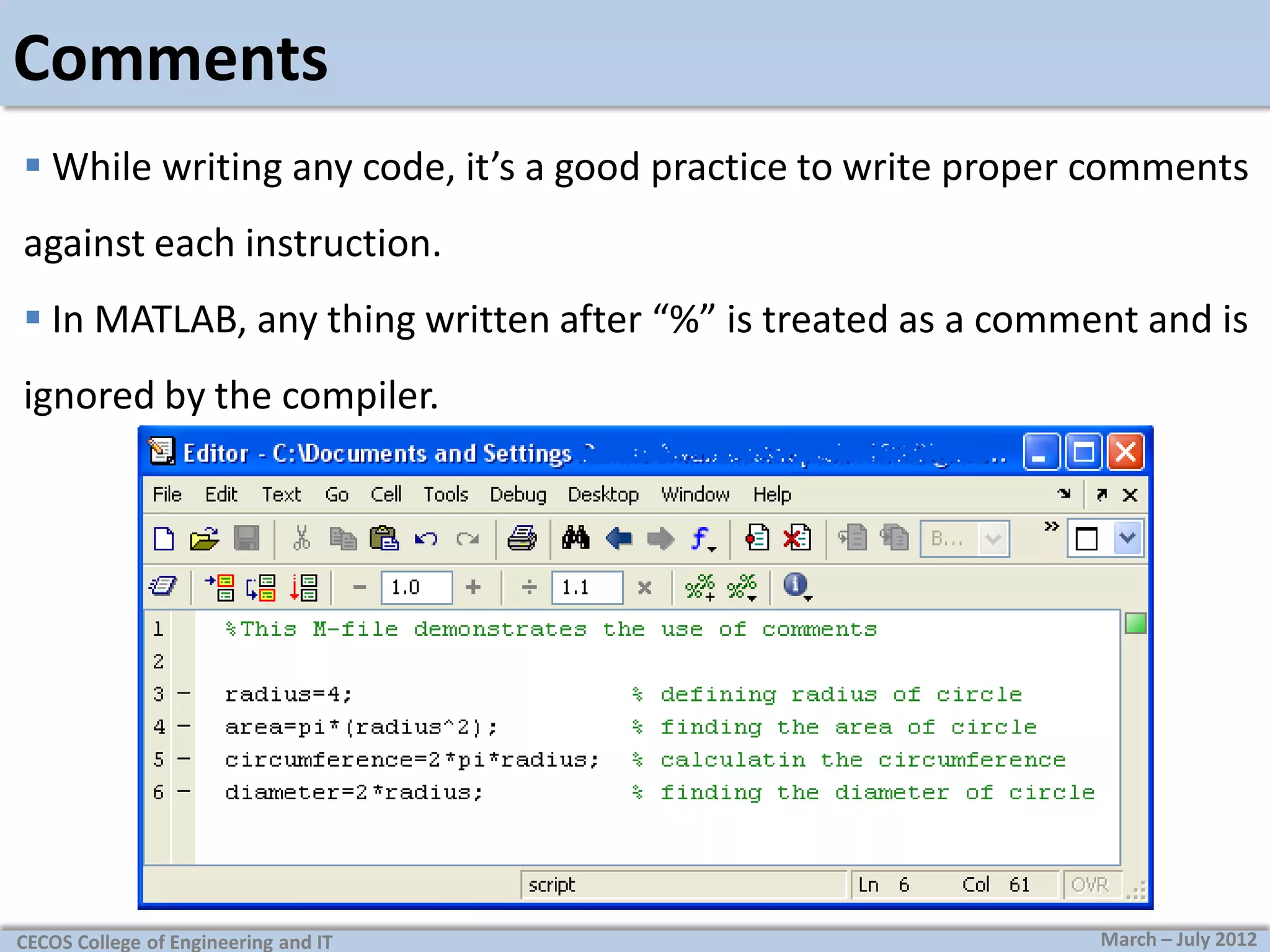
 While writing any code, it’s a good practice to write proper comments
against each instruction.
 In MATLAB, any thing written after “%” is treated as a comment and is
ignored by the compiler.

CECOS College of Engineering and IT

March – July 2012
Function M-files
 User defined functions
 These M-files start with a keyword, “function”
 The first line of these files should look like
function[output variables]=functionName(input variables)
 These files are saved with the funtionName.m as file name.

 An example:

CECOS College of Engineering and IT

March – July 2012
Function M-files
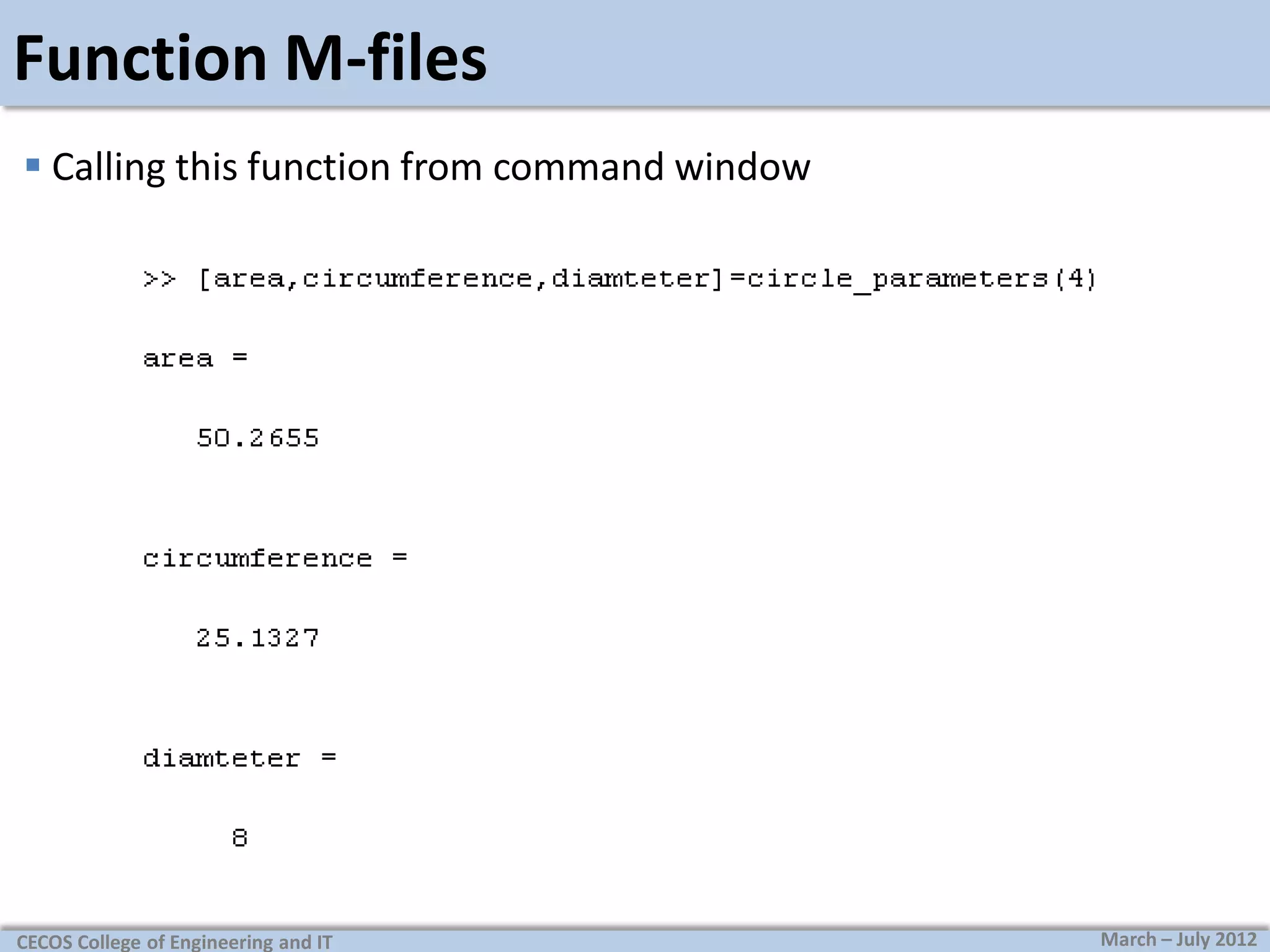
 Calling this function from command window

CECOS College of Engineering and IT

March – July 2012
Function M-files
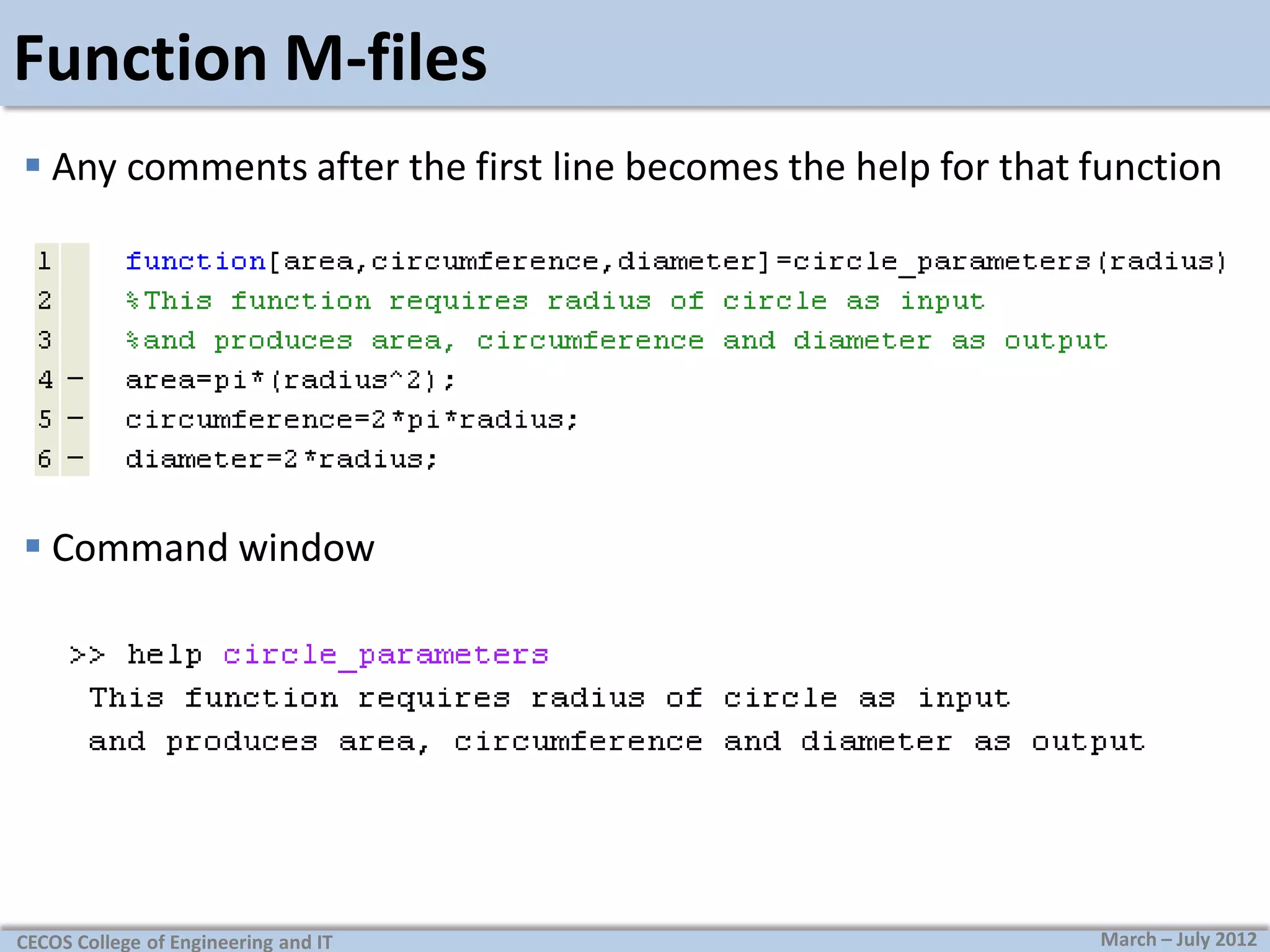
 Any comments after the first line becomes the help for that function

 Command window

CECOS College of Engineering and IT

March – July 2012
Tasks
1- Generate a vector of 50 elements having random values between 0
and 50.
2- Generate a vector, containing all the odd numbers between 0 and
100.
3- Create a function M-file that accepts two numbers and generates

there sum, product and difference as output.
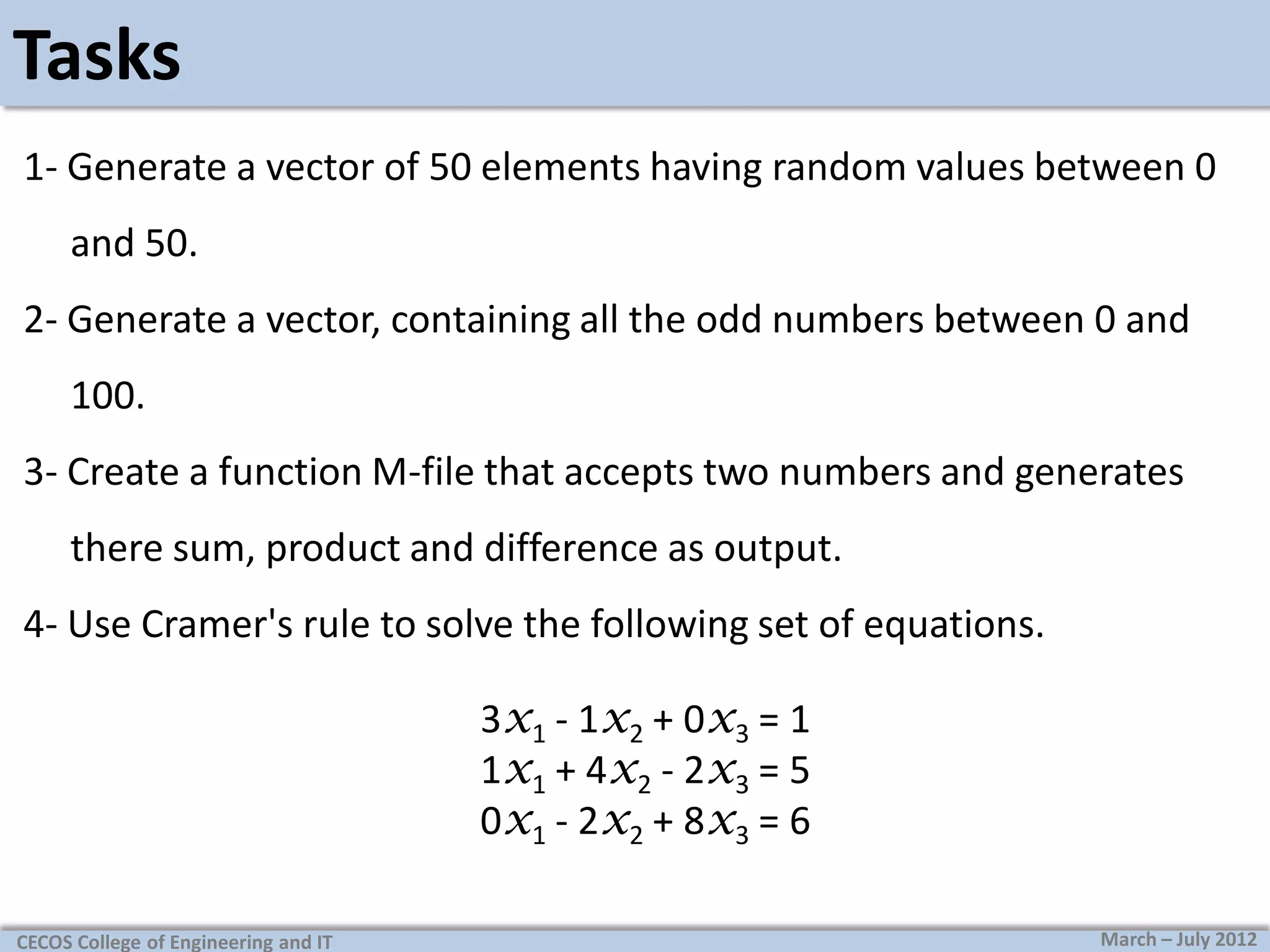
4- Use Cramer's rule to solve the following set of equations.
3x1 - 1x2 + 0x3 = 1
1x1 + 4x2 - 2x3 = 5
0x1 - 2x2 + 8x3 = 6
CECOS College of Engineering and IT

March – July 2012

matab no2

  • 1.
    Lab No.02 M-files andMatrix operations Designed by : Dawar Awan dawar@cecos.edu.pk CECOS College of Engineering and IT March – July 2012
  • 2.
    Matrices  MATLAB treatsevery thing as a matrix (check the Workspace)  1-by-1 matrices are interpreted as scalars  Matrices with only one row or one column are known as vectors  A matrix is a rectangular array of numbers. 1 9 2 6 7 8 3 5 1 8 2 4 A matrix with 3 rows, 4 columns, and 12 elements CECOS College of Engineering and IT March – July 2012
  • 3.
    Defining matrices >> A= [1 2 3; 4 5 6; 7 8 9]; >> A = [1, 2, 3; 4, 5, 6; 7, 8, 9]; and >> A = [ 1 2 3 456 7 8 9 ]; Defines A= 1 3 4 5 6 7 CECOS College of Engineering and IT 2 8 9 March – July 2012
  • 4.
    Accessing matrix elements The matrix element located in the i-th row and j-th column of “A” is referred to as, A(i,j)  Try the following instruction and observe the change in “A” >> A(2,3) = 10 CECOS College of Engineering and IT March – July 2012
  • 5.
    Some Built-in matrixfunctions Function Description diag eye magic ones rand triu tril zeros size length find : : : : : : : : : : : CECOS College of Engineering and IT returns diagonal elements as vector identity matrix magic square matrix of ones randomly generated matrix upper triangular part of a matrix lower triangular part of a matrix matrix of zeros Number of rows and columns in a matrix Length of an array find indices of some elements in array March – July 2012
  • 6.
    Matrix functions :Examples >> a=[1 2 3;4 5 6;7 8 9] a= 1 4 7 2 5 8 3 6 9 >> diag(a) >> triu(a) >> tril(a) >> size(a) >> length(a) ans = ans = ans = ans = ans = 1 5 9 CECOS College of Engineering and IT 1 0 0 2 5 0 3 6 9 1 4 7 0 5 8 0 0 9 3 3 3 March – July 2012
  • 7.
    Matrix functions :Examples >> eye(3) >> magic(3) >> rand(3) ans = ans = ans = 1 0 0 0 1 0 0 0 1 8 3 4 1 5 9 6 7 2 0.8147 0.9134 0.2785 0.9058 0.6324 0.5469 0.1270 0.0975 0.9575 >> ones(3) >> ones(3,2) >> zeros(3) >> zeros(3,2) ans = ans = ans = ans = 1 1 1 1 1 1 1 1 1 CECOS College of Engineering and IT 1 1 1 1 1 1 0 0 0 0 0 0 0 0 0 0 0 0 0 0 0 March – July 2012
  • 8.
    Matrix functions :Examples >> rand(3,2) ans = 0.9649 0.9572 0.1576 0.4854 0.9706 0.8003 CECOS College of Engineering and IT March – July 2012
  • 9.
    Matrix operations + * ^ ' / => => => => => => Addition Subtraction Multiplication Power Conjugate transpose Division To perform index by index operation, use dot (.) notation ./ .* .^ .' => => => => CECOS College of Engineering and IT Index by index division Index by index multiplication Index by index power Non conjugate transpose March – July 2012
  • 10.
    Dot notation  Observethe change in result due to the “dot” CECOS College of Engineering and IT March – July 2012
  • 11.
    Examples/Exercise 1 4 7 C= B= A= 2 5 8 3 6 9 1 2 3 1 2 3 1 2 3 1 D= 2 1 2 2 1 2 1  Practice thefollowing matrix operations A+B, A’, A*B, 2*A, A/2, A/B, A./B, C/D, C./D, C*D, C.*D, C^2, C.^2 CECOS College of Engineering and IT March – July 2012
  • 12.
    Colon notation CECOS Collegeof Engineering and IT March – July 2012
  • 13.
    M - files M-files are script/text files containing MATLAB commands Script M-file Function M-file  To make a script M-file, you need to open a file using the built-in MATLAB editor.  There are two ways to accomplish it: 1. From file menu, click NEW 2. Type edit on command line CECOS College of Engineering and IT March – July 2012
  • 14.
    M - files To save the M-file go to the “file” menu and click on “save”.  The name should not contain spaces, should not start with a number and should not be same as any built-in function.  The extension of this file should be “.m” CECOS College of Engineering and IT March – July 2012
  • 15.
    M - files This code can now be executed in two ways 1. Write the name of file on command window (excluding “.m”) 2. Under the “debug” menu, click “Run”  The variables used in the M-file will be maintained in the workspace and hence accessible from the command window. CECOS College of Engineering and IT March – July 2012
  • 16.
    M - files Code written in M-file to calculate various parameters of a circle  Check the values of the variables after running the M-file CECOS College of Engineering and IT March – July 2012
  • 17.
    Comments  While writingany code, it’s a good practice to write proper comments against each instruction.  In MATLAB, any thing written after “%” is treated as a comment and is ignored by the compiler. CECOS College of Engineering and IT March – July 2012
  • 18.
    Function M-files  Userdefined functions  These M-files start with a keyword, “function”  The first line of these files should look like function[output variables]=functionName(input variables)  These files are saved with the funtionName.m as file name.  An example: CECOS College of Engineering and IT March – July 2012
  • 19.
    Function M-files  Callingthis function from command window CECOS College of Engineering and IT March – July 2012
  • 20.
    Function M-files  Anycomments after the first line becomes the help for that function  Command window CECOS College of Engineering and IT March – July 2012
  • 21.
    Tasks 1- Generate avector of 50 elements having random values between 0 and 50. 2- Generate a vector, containing all the odd numbers between 0 and 100. 3- Create a function M-file that accepts two numbers and generates there sum, product and difference as output. 4- Use Cramer's rule to solve the following set of equations. 3x1 - 1x2 + 0x3 = 1 1x1 + 4x2 - 2x3 = 5 0x1 - 2x2 + 8x3 = 6 CECOS College of Engineering and IT March – July 2012